BLAZING THE TRAILS BEFORE
BEATING THE PATH:
SAMPLE-EFFICIENT MONTE-
CARLO PLANNING
KATSUKI OHTO
@NIPS2016-YOMI
2017/1/19
INTRODUCED PAPER
• Blazing the trails before beating the path:
Sample - efficient Monte-Carlo planning
(JB. Grill, M. Valko and R. Munos)
• NIPS 2016 accepted paper (poster session)
• Abstract starts with “You are a robot…”
• http://papers.nips.cc/paper/6253-blazing-the-trails-before-
beating-the-path-sample-efficient-monte-carlo-planning
TRAILBLAZER
• Nested-fashion Monte-Carlo Planning Algorithm
• Problem settings:
MDP (contains MAX nodes and AVG nodes)
Actions per each state : Finite
State transition candidates : Finite or Infinite
• Strong theoretical guarantee
MAX
AVG
AIM
• Input : an MDP (Markov Decision Process)
(discount factor 𝛾, maximum number of valid actions 𝐾),
𝜀 (> 0), 𝛿 (0 < 𝛿 < 1)
• Output : estimated value 𝜇 𝜀,𝛿 of current state 𝑠0
• Aim : Get good estimation of real value 𝒱[𝑠0] of current state
such as
ℙ 𝜇 𝜀,𝛿 − 𝒱 𝑠0 > 𝜀 ≤ 𝛿
( ℙ ∙ means probability of ∙ )
with the minimum number of calls to the generative model (state transition function)
1 PLAYER TREE MODEL
IN STOCHASTIC ENVIRONMENT
• Each MAX node means an
opportunity to decide action
• Each AVG node means
stochastic state transition
MAX
AVG
ALGORITHM OVERVIEW
• Global Initialization
set 𝜂, 𝜆 as global value
set 𝑚 as an argument of
root node
• Recursive algorithm
log(𝜂/𝛾)
ALGORITHM OVERVIEW 2
• In both MAX nodes and AVG nodes,
arguments are
𝑚 (desired branching factor)
and
𝜀 (admissible estimation error)
• If 𝑚 is large, we can search many children, but we need much time
(dilemma)
• If 𝜀 is small, we can search deeply, but we need much time (dilemma)
ALGORITHM
FOR AVG NODES
• Input : 𝑚 and 𝜀
• Output : estimated value
• If admissible error 𝜀 is large, ignore
successive reward
• Fill 𝑚 transition samples
(and store immediate reward)
• search all of 𝑚 sampled next states
• return averaged immediate reward +
estimated successive reward
ALGORITHM
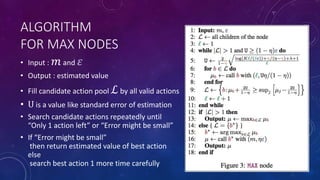
FOR MAX NODES
• Input : 𝑚 and 𝜀
• Output : estimated value
• Fill candidate action pool ℒ by all valid actions
• U is a value like standard error of estimation
• Search candidate actions repeatedly until
“Only 1 action left” or “Error might be small”
• If “Error might be small”
then return estimated value of best action
else
search best action 1 more time carefully
SAMPLE COMPLEXITY OF TRAILBLAER
• Sample Complexity is a measure of performance of algorithm
• If N (the number of next states) is finite,
(
1
𝜀
)
max(2,
log 𝑁𝜅
log
1
𝛾
+𝑜 1 )
on condition that 𝜅 ∈ 1, 𝐾 (in detail in
the paper)
else
(
1
𝜀
)2+𝑑
on condition that 𝑑 is a measure of difficulty to identify near-
optimal nodes

Introduction of "TrailBlazer" algorithm

  • 1.
    BLAZING THE TRAILSBEFORE BEATING THE PATH: SAMPLE-EFFICIENT MONTE- CARLO PLANNING KATSUKI OHTO @NIPS2016-YOMI 2017/1/19
  • 2.
    INTRODUCED PAPER • Blazingthe trails before beating the path: Sample - efficient Monte-Carlo planning (JB. Grill, M. Valko and R. Munos) • NIPS 2016 accepted paper (poster session) • Abstract starts with “You are a robot…” • http://papers.nips.cc/paper/6253-blazing-the-trails-before- beating-the-path-sample-efficient-monte-carlo-planning
  • 3.
    TRAILBLAZER • Nested-fashion Monte-CarloPlanning Algorithm • Problem settings: MDP (contains MAX nodes and AVG nodes) Actions per each state : Finite State transition candidates : Finite or Infinite • Strong theoretical guarantee MAX AVG
  • 4.
    AIM • Input :an MDP (Markov Decision Process) (discount factor 𝛾, maximum number of valid actions 𝐾), 𝜀 (> 0), 𝛿 (0 < 𝛿 < 1) • Output : estimated value 𝜇 𝜀,𝛿 of current state 𝑠0 • Aim : Get good estimation of real value 𝒱[𝑠0] of current state such as ℙ 𝜇 𝜀,𝛿 − 𝒱 𝑠0 > 𝜀 ≤ 𝛿 ( ℙ ∙ means probability of ∙ ) with the minimum number of calls to the generative model (state transition function)
  • 5.
    1 PLAYER TREEMODEL IN STOCHASTIC ENVIRONMENT • Each MAX node means an opportunity to decide action • Each AVG node means stochastic state transition MAX AVG
  • 6.
    ALGORITHM OVERVIEW • GlobalInitialization set 𝜂, 𝜆 as global value set 𝑚 as an argument of root node • Recursive algorithm log(𝜂/𝛾)
  • 7.
    ALGORITHM OVERVIEW 2 •In both MAX nodes and AVG nodes, arguments are 𝑚 (desired branching factor) and 𝜀 (admissible estimation error) • If 𝑚 is large, we can search many children, but we need much time (dilemma) • If 𝜀 is small, we can search deeply, but we need much time (dilemma)
  • 8.
    ALGORITHM FOR AVG NODES •Input : 𝑚 and 𝜀 • Output : estimated value • If admissible error 𝜀 is large, ignore successive reward • Fill 𝑚 transition samples (and store immediate reward) • search all of 𝑚 sampled next states • return averaged immediate reward + estimated successive reward
  • 9.
    ALGORITHM FOR MAX NODES •Input : 𝑚 and 𝜀 • Output : estimated value • Fill candidate action pool ℒ by all valid actions • U is a value like standard error of estimation • Search candidate actions repeatedly until “Only 1 action left” or “Error might be small” • If “Error might be small” then return estimated value of best action else search best action 1 more time carefully
  • 10.
    SAMPLE COMPLEXITY OFTRAILBLAER • Sample Complexity is a measure of performance of algorithm • If N (the number of next states) is finite, ( 1 𝜀 ) max(2, log 𝑁𝜅 log 1 𝛾 +𝑜 1 ) on condition that 𝜅 ∈ 1, 𝐾 (in detail in the paper) else ( 1 𝜀 )2+𝑑 on condition that 𝑑 is a measure of difficulty to identify near- optimal nodes