The new Information and
Communication Technologies
(ICTs) have been a driving force
of the globalized world in which
we find ourselves today.
Do ICTs have a role in helping to
turn the global situation
around?
Internationally, the spread and
appropriation of ICTs is a key
globalization driver and knowledge
carrier. In these circumstances,
societies need to build
communications systems and manage
them well, develop infrastructure and
the capacity to use it, and implement
good policy and regulation. In the
right environments, both business and
non-profit enterprise are effective in
rapidly expanding
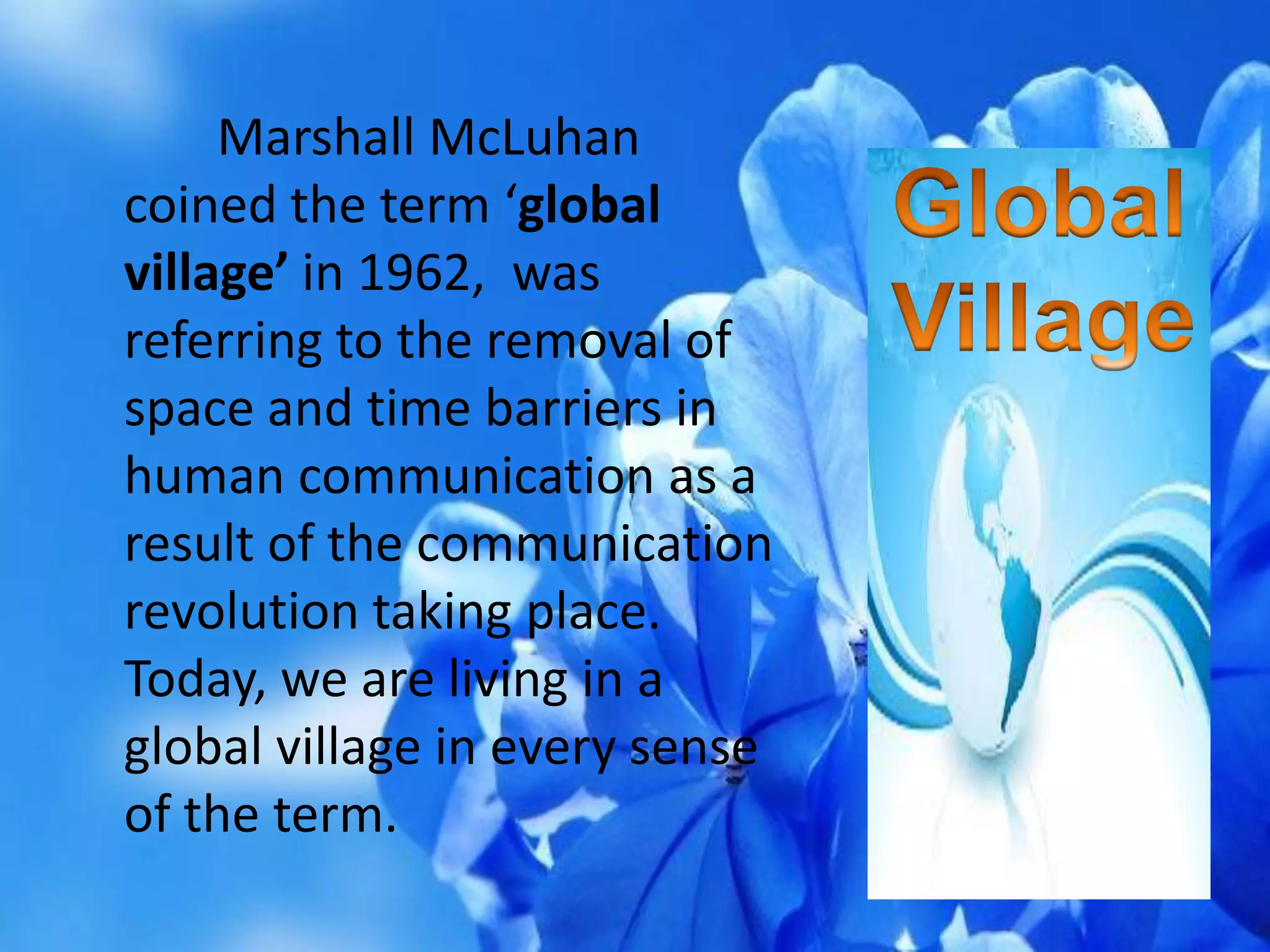
Marshall McLuhan
coined the term ‘global
village’ in 1962, was
referring to the removal of
space and time barriers in
human communication as a
result of the communication
revolution taking place.
Today, we are living in a
global village in every sense
of the term.
The use of ICTs assist in sharing
information more effectively and
delivering better services to the
public. Wisely deployed, ‘ICTs, can
potentially impact almost every
sector, making development
budgets, private sector and
commitments from development
partners go further in terms of cost
effectiveness, impact and reach’
(UNDP 2005,p. 1).
ICTs help to increase
transparency and
accountability and
decrease corruption. They
promote economic growth
by improving the interface
with business and
empowering citizens to
participate in advancing
good governance.
ICTs also help to accelerate
the pace of sustainable
human development and to
increase the effectiveness of
new and more responsive
solutions in the fields of
health, education and related
MDG focus areas’ (UNDP
2005, p. 1).
There’s a belief that ICT
potentially has the
capacity towards the
improvement of
many different
aspects of life, from
alleviating poverty to
strengthening the
democratic polity.
A belief that ICT will
deliver its potential benefit
on specific developmental
aims, such as enhancement
of livelihoods in rural areas
(Duncombe and Heeks 2002),
or improved government
services (Krishna and
Walsham 2005)
The Role of ICT and Development
Perspective
• The progressive perspective considers ICT as
enabling transformations in multiple domains of
human activities, but they can be accommodated
within the existing international and local social
order.
• The disruptive perspective is premised on the highly
political and controversial nature of development,
both as a concept and as an area of policy for
international and local action, and reveal conflicts of
interest and struggles of power as a necessary part of
IS innovation in developing countries
Communication and networking
enabled by information and
communication technologies (ICTs)
are proving to be economically,
socially, and politically
transformative over time. For
example, in both poor and wealthy
countries, mobile phone use has
been skyrocketing and facilitating the
expansion of markets, social
business, and public services.
In fact, an entire range of
economic services, enabled by
mobile phones, has begun to
emerge: micro finance and
insurance, marketing and
distribution (for example,
farmers and fishermen
connecting with markets,
reduced distribution margins,
and buyer control
Personal services, and public
services (such as telehealth and
distance education) and beyond
the economic impacts,
improvements are being made in
other freedoms or dimensions of
well-being — personal security,
political participation and
accountability, social peace,
dignity, and opportunity
In the right environments, both
business and non-profit
enterprise are effective in rapidly
expanding connectivity, using
low-margin, high-volume
business models. Affordable
mobile Internet — smart phones
and data services — exists today
in wealthier societies and could
be near universal in the next
generation.
These developments are
important, where they are
thriving. But we should not forget
the negative aspects and
possibilities of communications-
based transformation, such as
mobile phones being used to fan
violence, cybercrime and
terrorism, and our vulnerability to
disruption of communication.
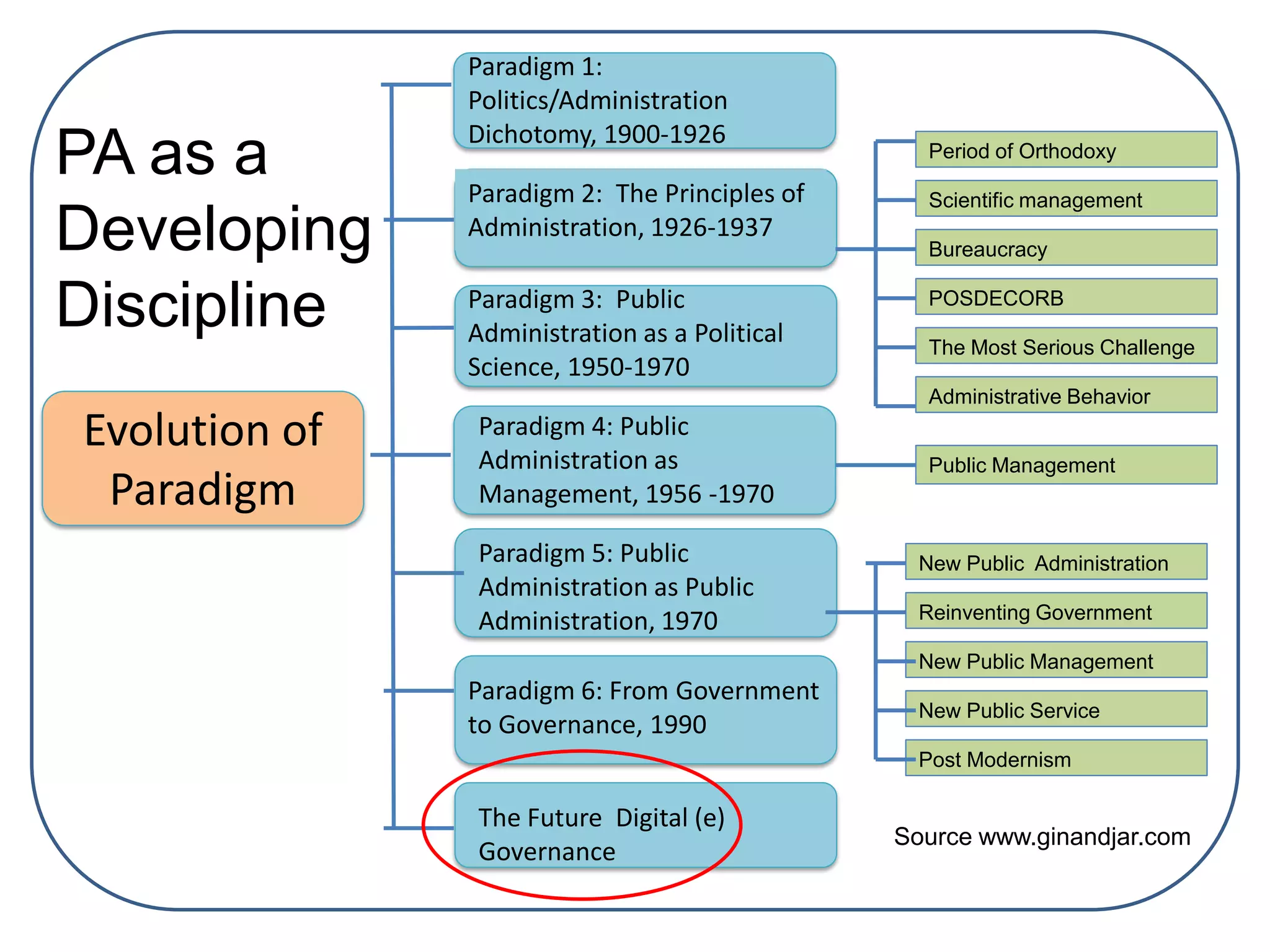
Digital E-Governance
Paradigm 1:
Politics/Administration
Dichotomy, 1900-1926
Paradigm 2: The Principles of
Administration, 1926-1937
Paradigm 3: Public
Administration as a Political
Science, 1950-1970
Paradigm 4: Public
Administration as
Management, 1956 -1970
Paradigm 5: Public
Administration as Public
Administration, 1970
Paradigm 6: From Government
to Governance, 1990
Period of Orthodoxy
Scientific management
Bureaucracy
POSDECORB
The Most Serious Challenge
Administrative Behavior
Public Management
New Public Administration
Reinventing Government
New Public Management
New Public Service
Post Modernism
The Future Digital (e)
Governance
Evolution of
Paradigm
Source www.ginandjar.com
PA as a
Developing
Discipline
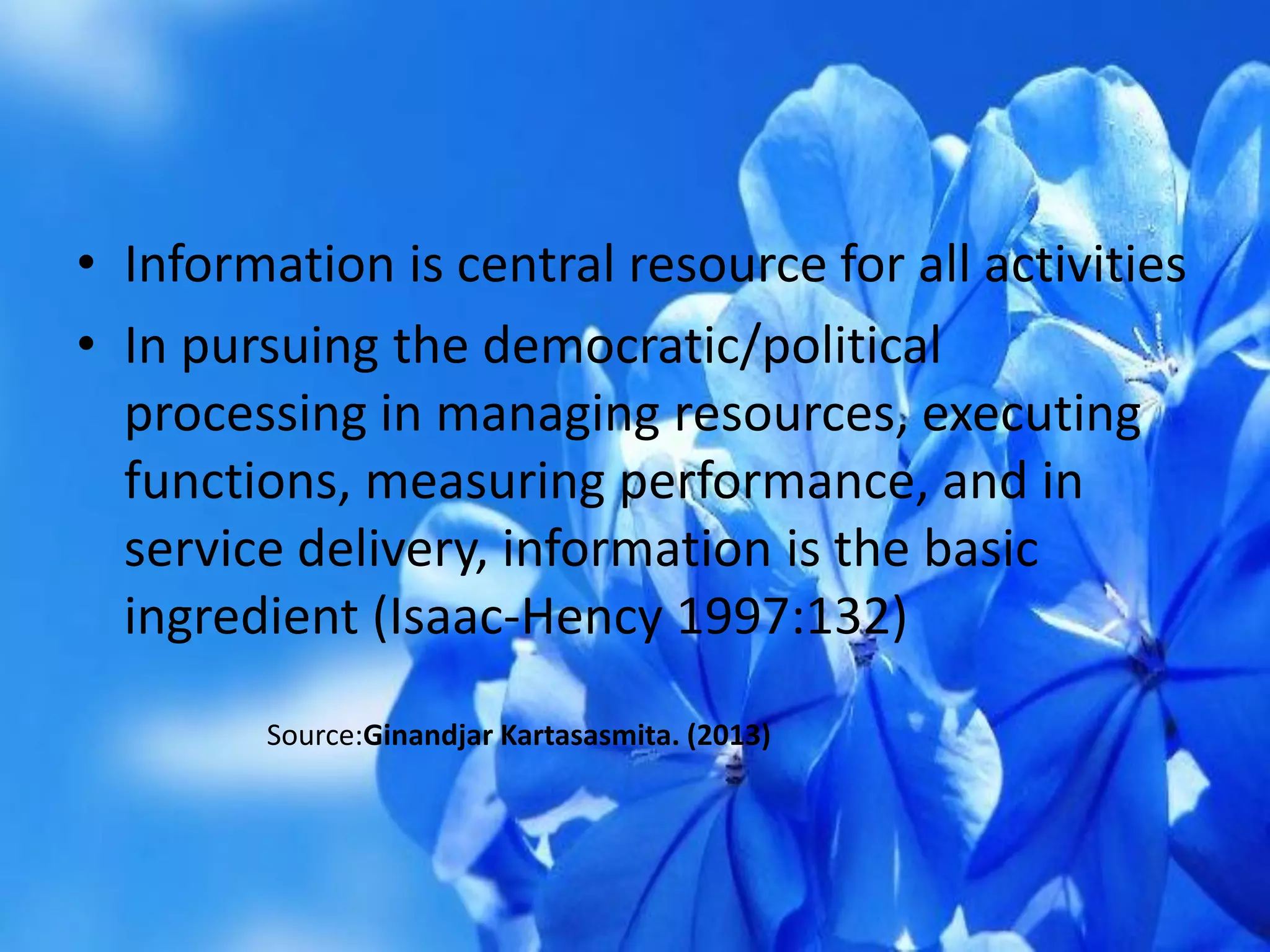
• Information is central resource for all activities
• In pursuing the democratic/political
processing in managing resources, executing
functions, measuring performance, and in
service delivery, information is the basic
ingredient (Isaac-Hency 1997:132)
Source:Ginandjar Kartasasmita. (2013)
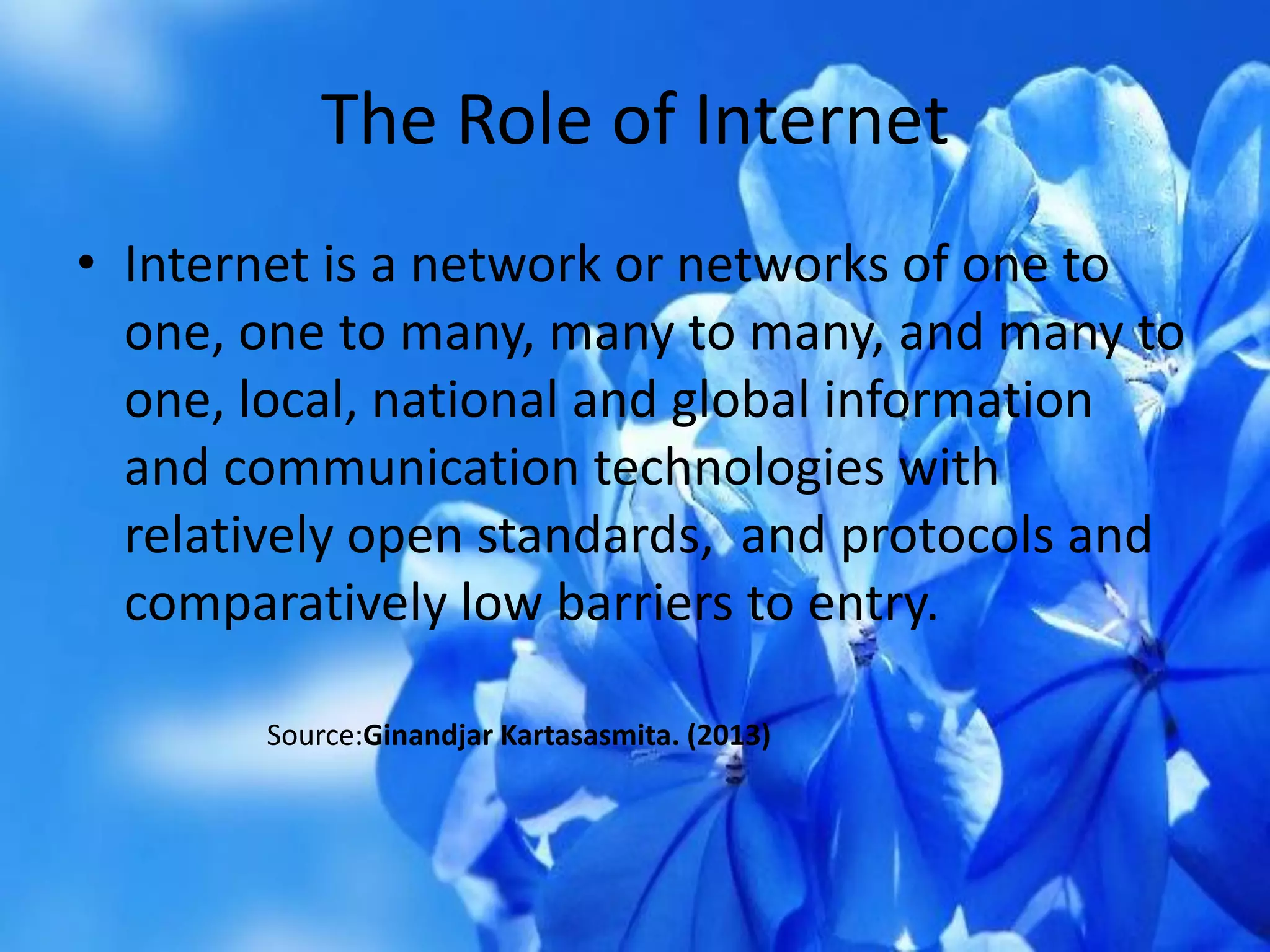
The Role of Internet
• Internet is a network or networks of one to
one, one to many, many to many, and many to
one, local, national and global information
and communication technologies with
relatively open standards, and protocols and
comparatively low barriers to entry.
Source:Ginandjar Kartasasmita. (2013)
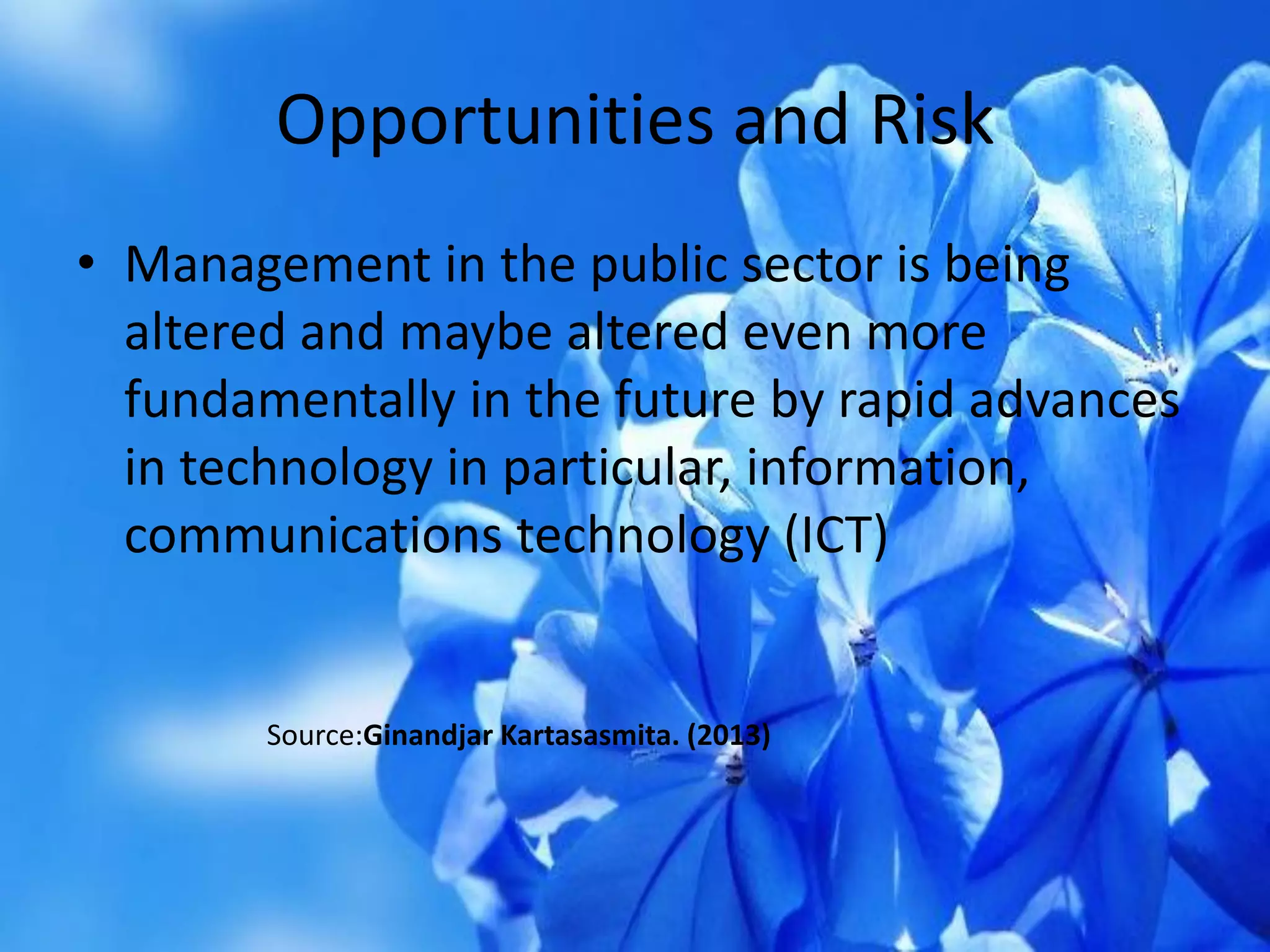
Opportunities and Risk
• Management in the public sector is being
altered and maybe altered even more
fundamentally in the future by rapid advances
in technology in particular, information,
communications technology (ICT)
Source:Ginandjar Kartasasmita. (2013)
The information age has been driven and
dominated by technopreneurs — a small army
of ‘geeks’ who have reshaped our world faster
than any political leader has ever done…. We
now have to apply these technologies for
saving lives, improving livelihoods and lifting
millions of people out of squalor, misery and
suffering. In short, the time has come to move
our focus from the geeks to the meek.
(Sir Arthur C.
Clarke)
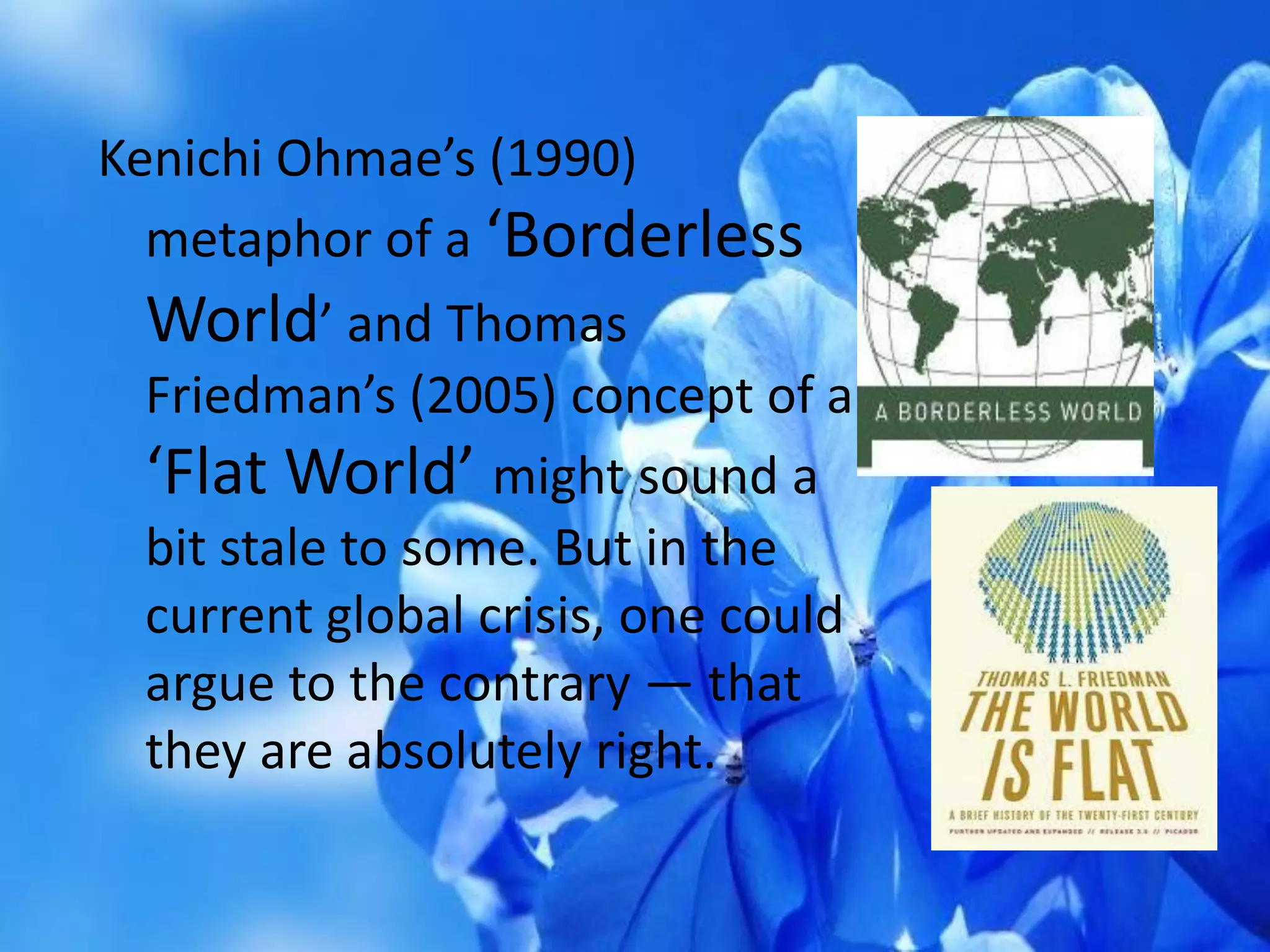
Kenichi Ohmae’s (1990)
metaphor of a ‘Borderless
World’ and Thomas
Friedman’s (2005) concept of a
‘Flat World’ might sound a
bit stale to some. But in the
current global crisis, one could
argue to the contrary — that
they are absolutely right.
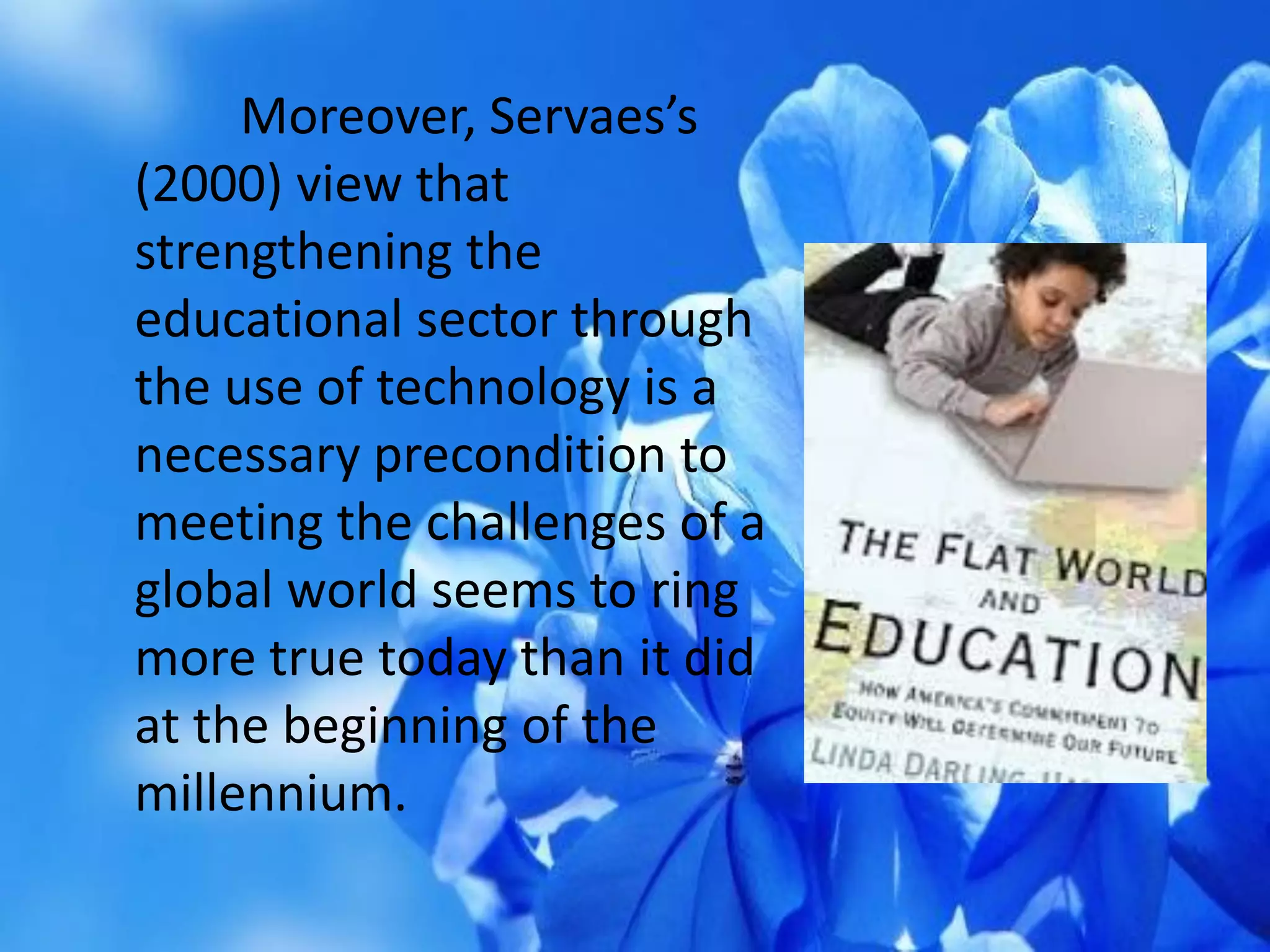
Moreover, Servaes’s
(2000) view that
strengthening the
educational sector through
the use of technology is a
necessary precondition to
meeting the challenges of a
global world seems to ring
more true today than it did
at the beginning of the
millennium.
In its 2001 Global Technology Index,
the Philippines slipped from its 1999 ranking
of 32 and 38 out of 49 attributed “mainly to
the decline of the number of computers per
capita, weak deployment of cellular access
and small population of internet users.”
ICTs in the Philippines
• In 2002, the Philippines ranked 76th out of the 165
countries indexed by ICT diffusion 22 in a 2004
study conducted by UNCTAD. This is an outstanding
improvement from its rank of 126th in 1995, but it is
worthy to note that the Philippines has held its 2002
ranking since 1999.
• In 2003-2004 a new type of public sphere
more participatory and intentional’, we have
seen ICTs completely transform our lives,
including the way politics and governance are
played out. This started in Asia with the now
famous ‘coup de text’ in the Philippines
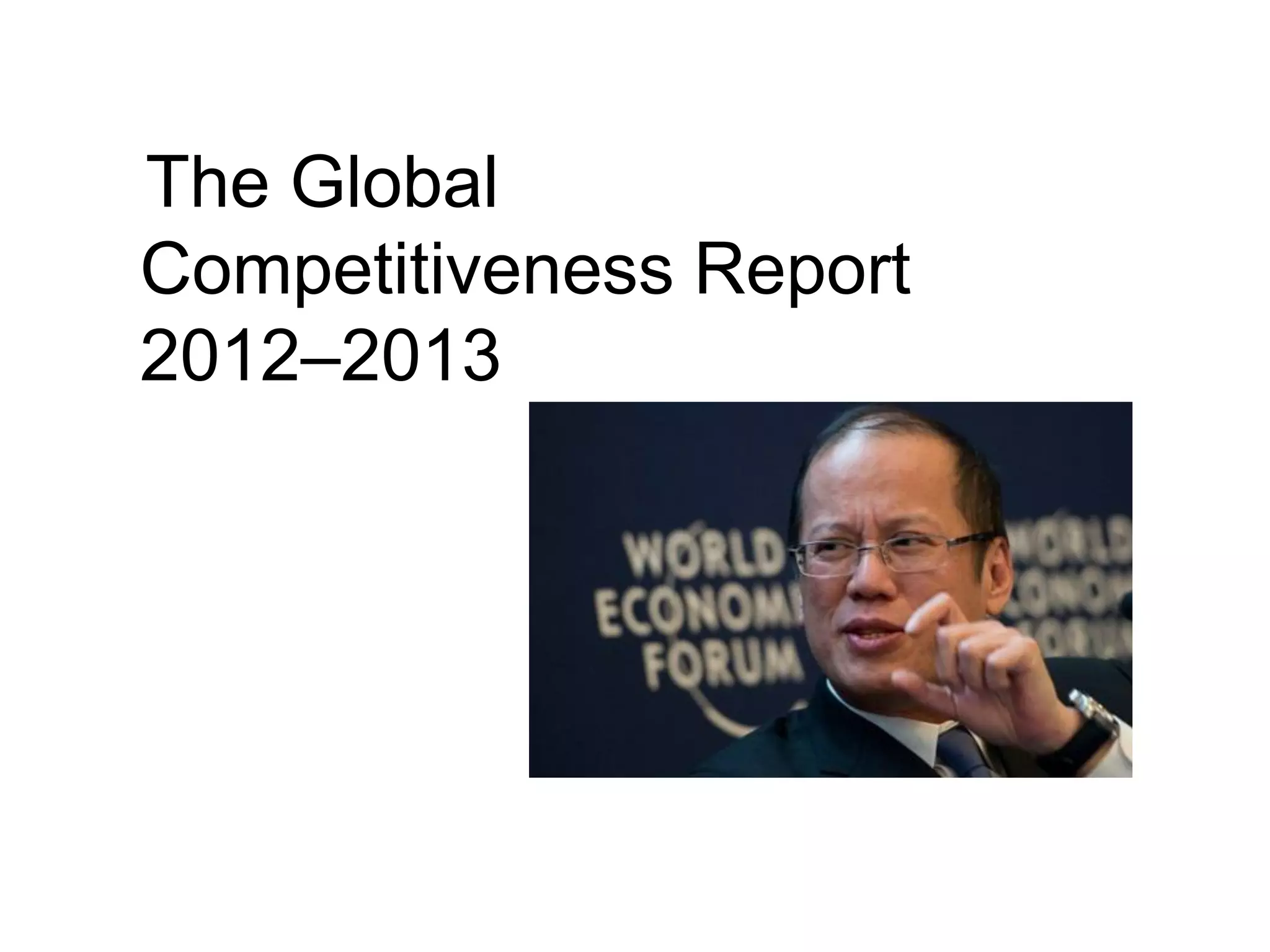
The Global
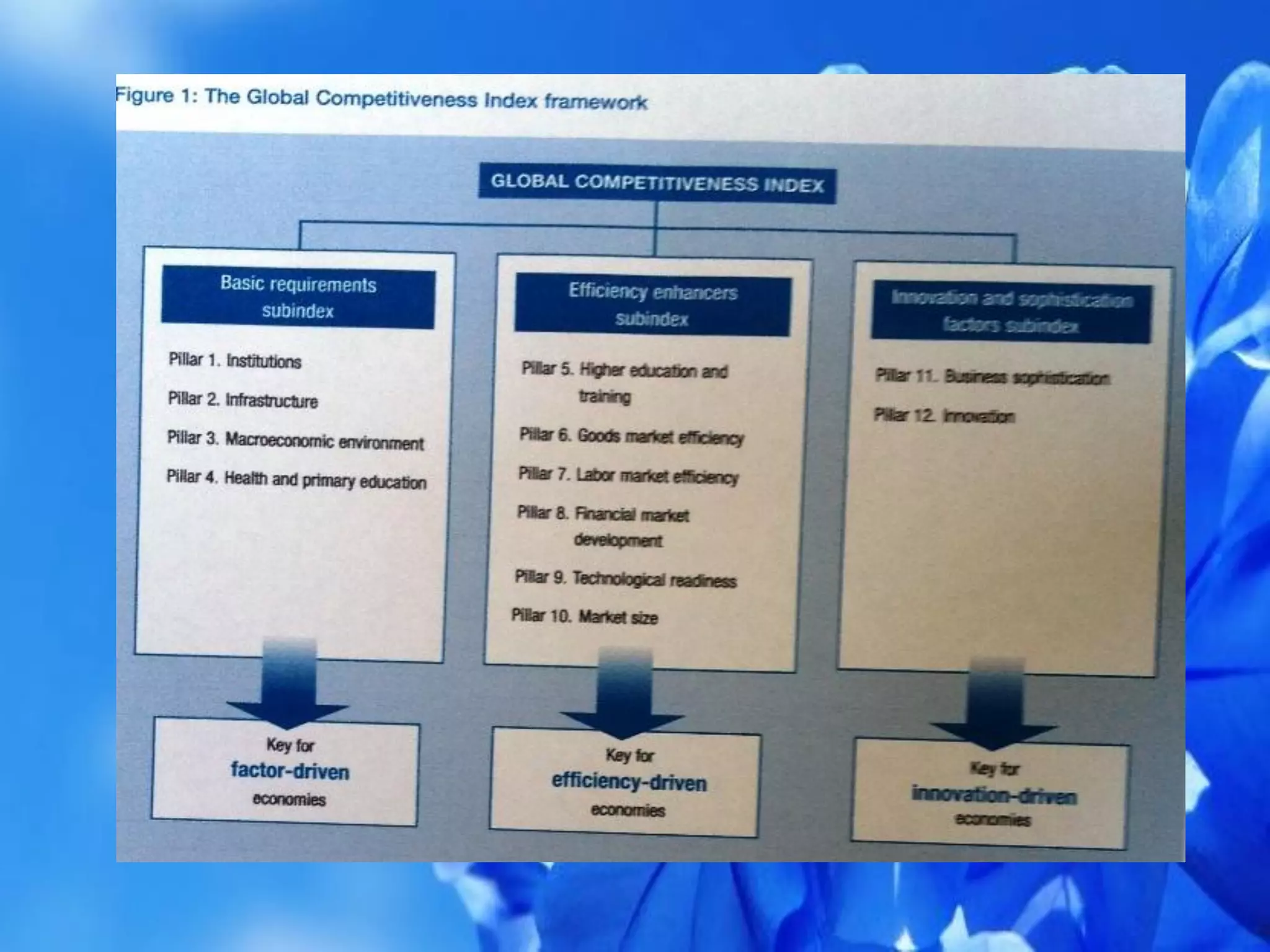
Competitiveness Report
2012–2013
Measuring Competitiveness
For more than three decades, the World
Economic Forum’s annual Global
Competitiveness Reports have studied and
benchmarked the many factors underpinning
national competitiveness.
Many determinants drive productivity and
competitiveness. Understanding the factors
behind this process has occupied the minds of
economists for hundreds of years,
engendering theories ranging from Adam
Smith’s focus on specialization and the
division of labor to neoclassical economists’
emphasis on investment in physical capital
and infrastructure..
More recently, to interest in other
mechanisms such as education and training,
technological progress, macroeconomic
stability, good governance, firm sophistication,
and market efficiency, among others. While all
of these factors are likely to be important for
competitiveness and growth, they are not
mutually exclusive—two or more of them can
be significant at the same time, and in fact
that is what has been shown in the economic
literature.
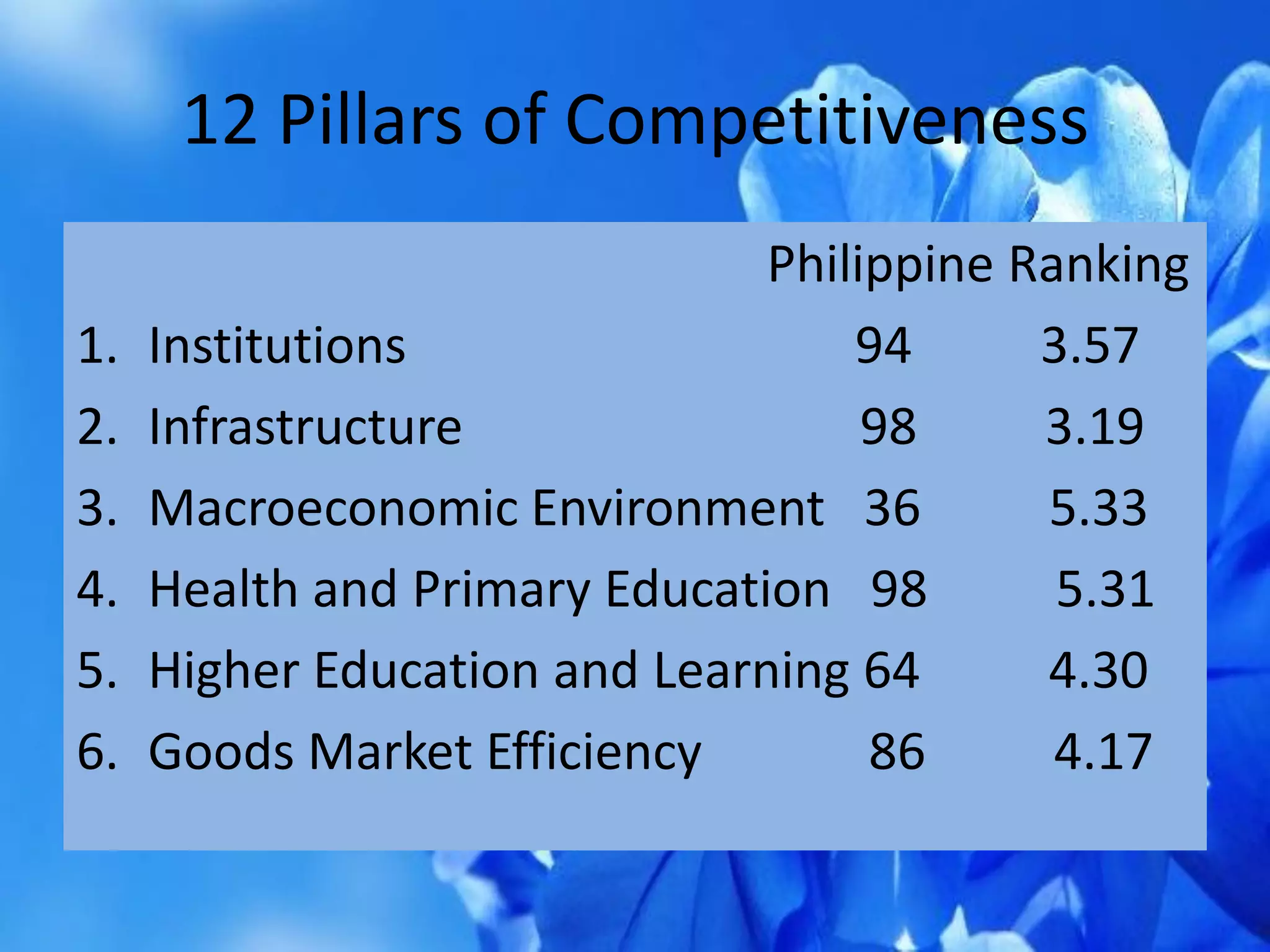
12 Pillars of Competitiveness
Philippine Ranking
1. Institutions 94 3.57
2. Infrastructure 98 3.19
3. Macroeconomic Environment 36 5.33
4. Health and Primary Education 98 5.31
5. Higher Education and Learning 64 4.30
6. Goods Market Efficiency 86 4.17
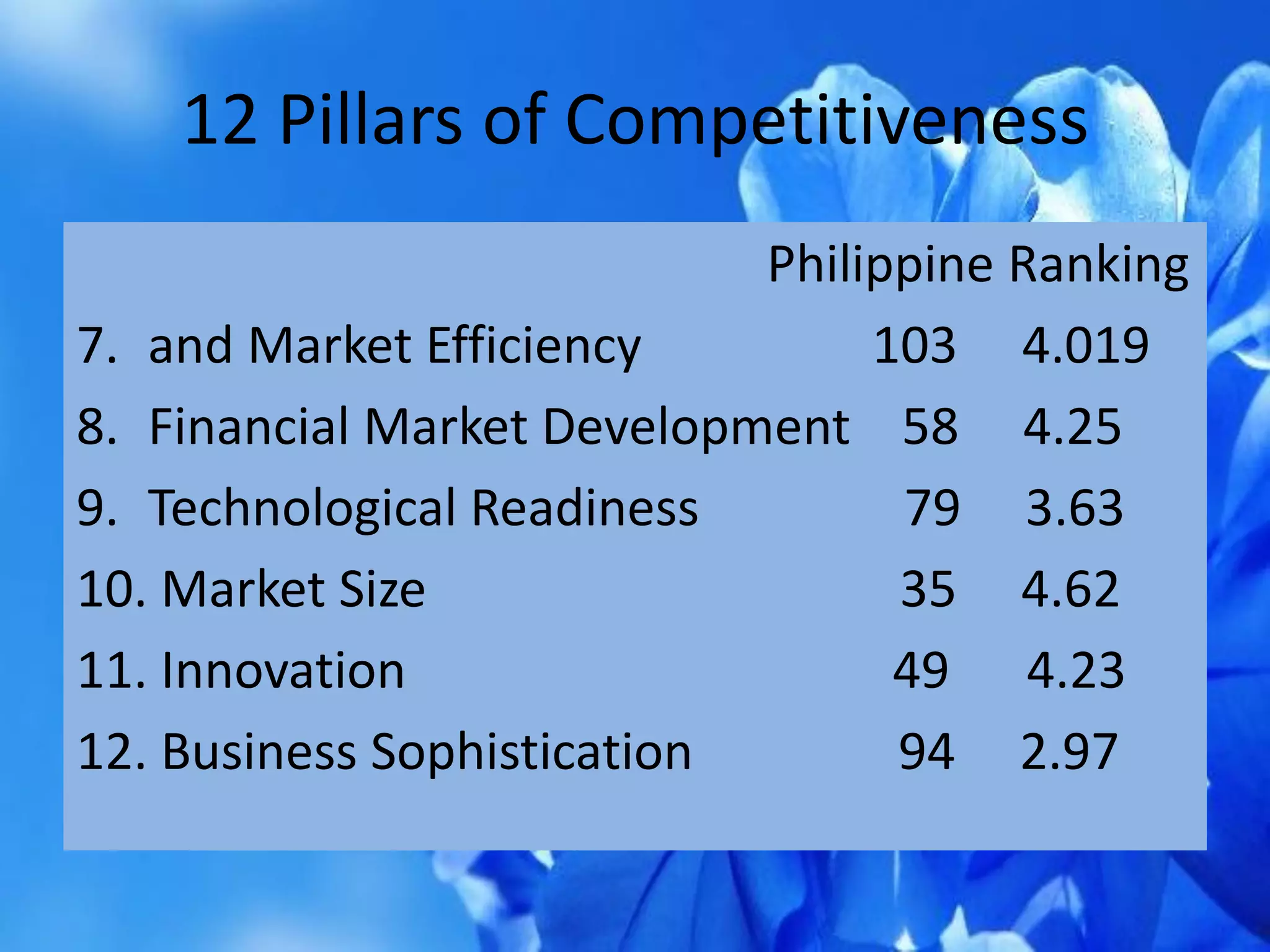
Philippine Ranking
7. and Market Efficiency 103 4.019
8. Financial Market Development 58 4.25
9. Technological Readiness 79 3.63
10. Market Size 35 4.62
11. Innovation 49 4.23
12. Business Sophistication 94 2.97
12 Pillars of Competitiveness
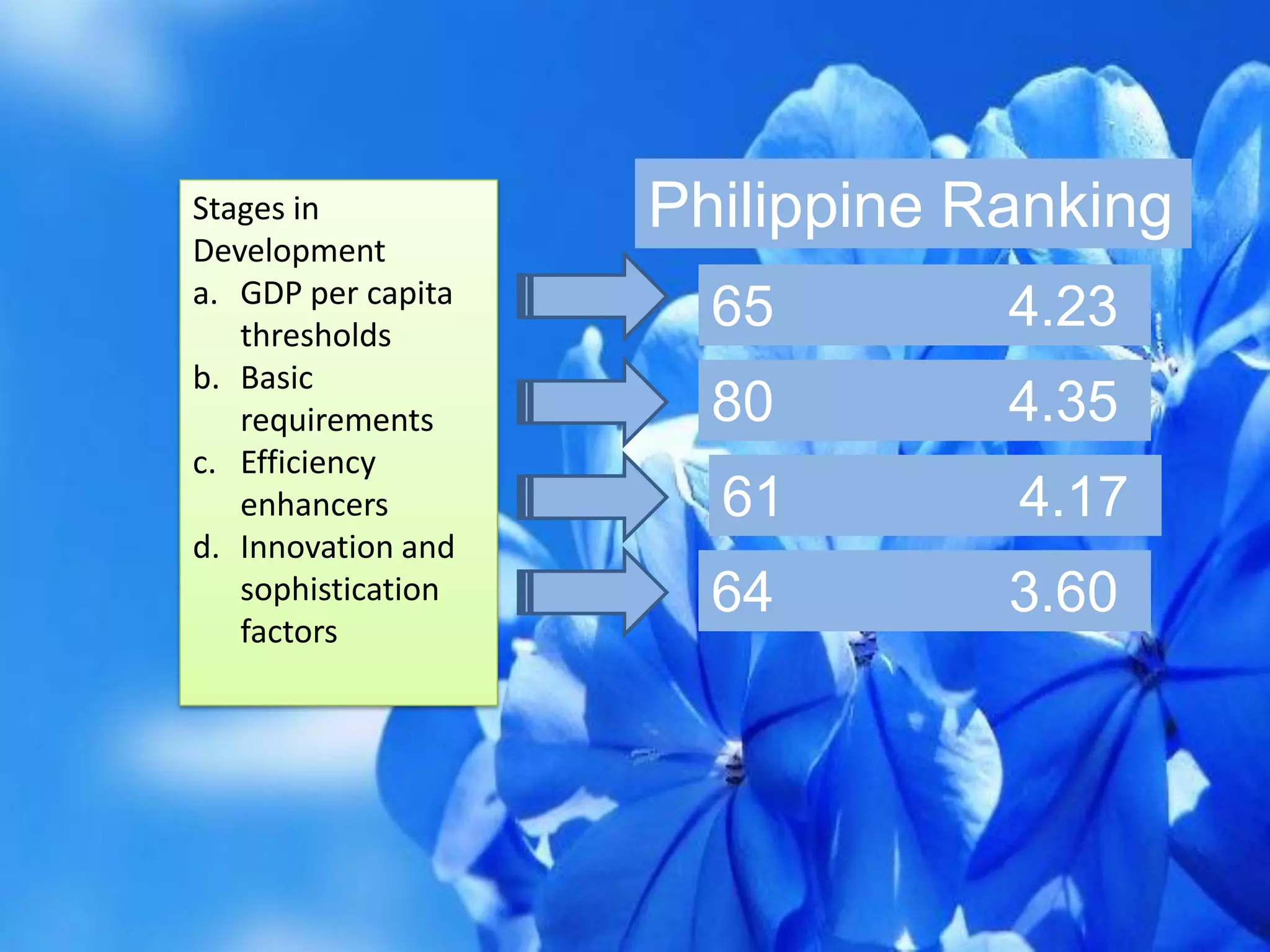
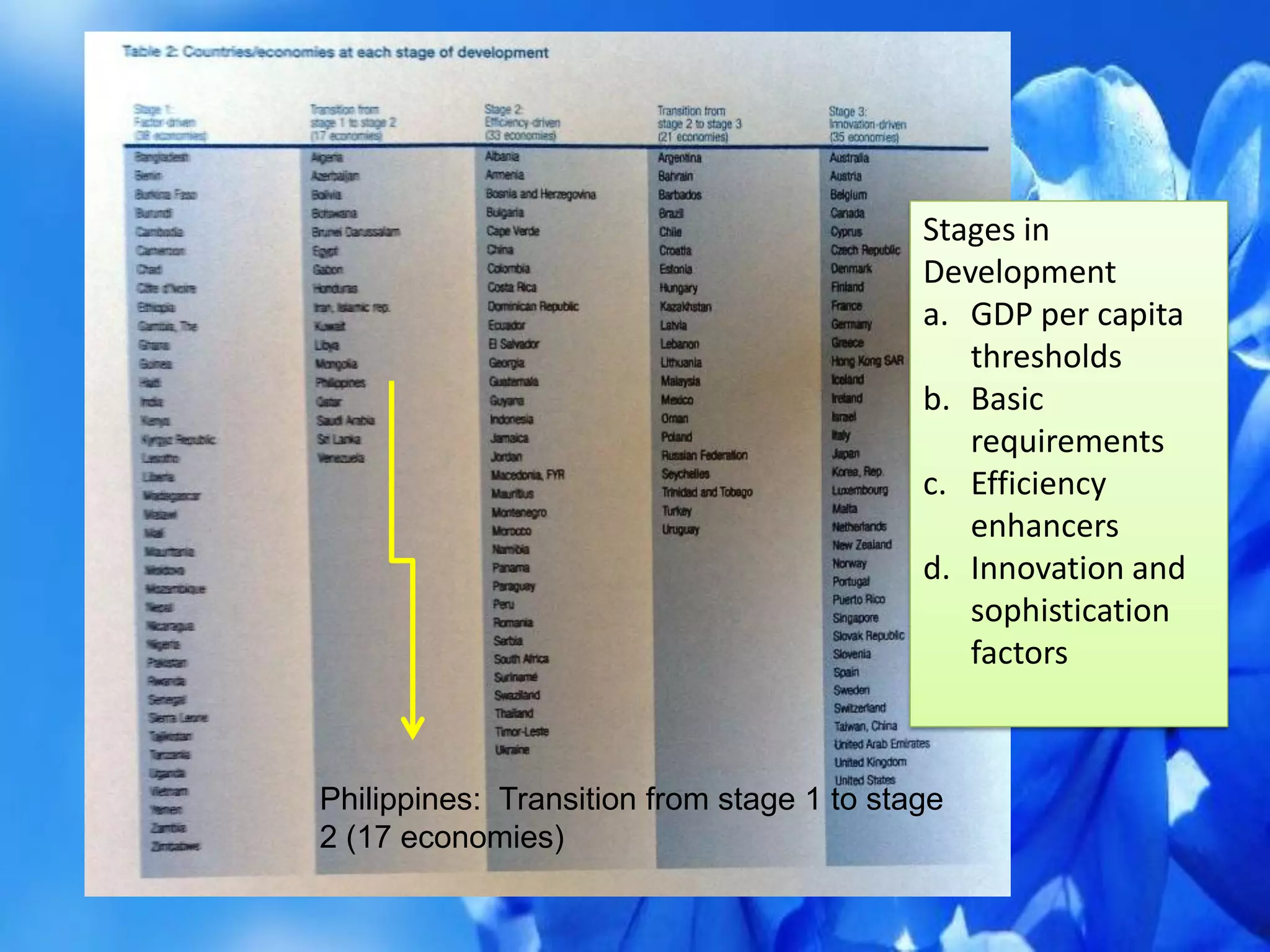
Stages in
Development
a. GDP per capita
thresholds
b. Basic
requirements
c. Efficiency
enhancers
d. Innovation and
sophistication
factors
64 3.60
61 4.17
80 4.35
65 4.23
Philippine Ranking
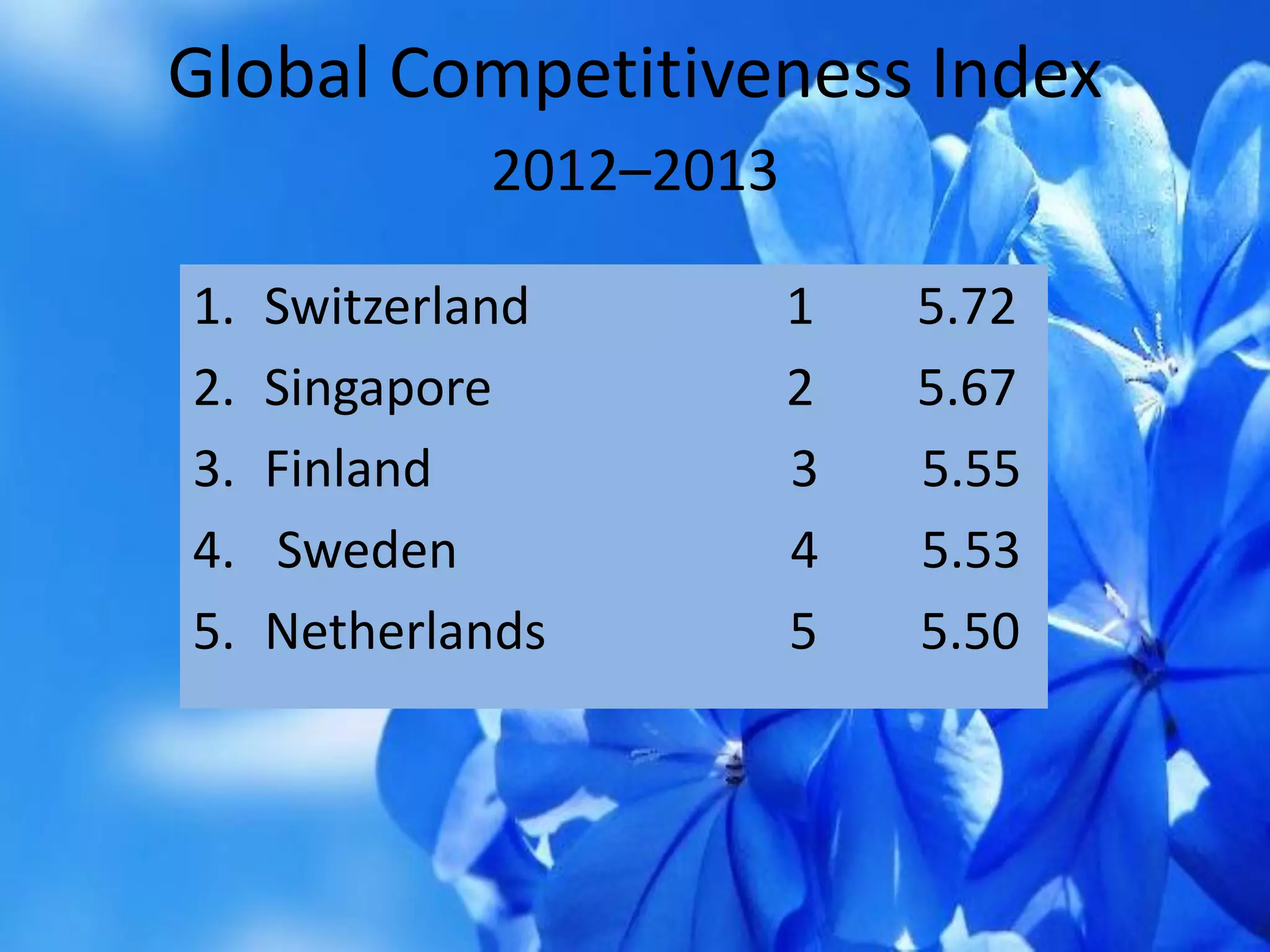
Global Competitiveness Index
2012–2013
1. Switzerland 1 5.72
2. Singapore 2 5.67
3. Finland 3 5.55
4. Sweden 4 5.53
5. Netherlands 5 5.50
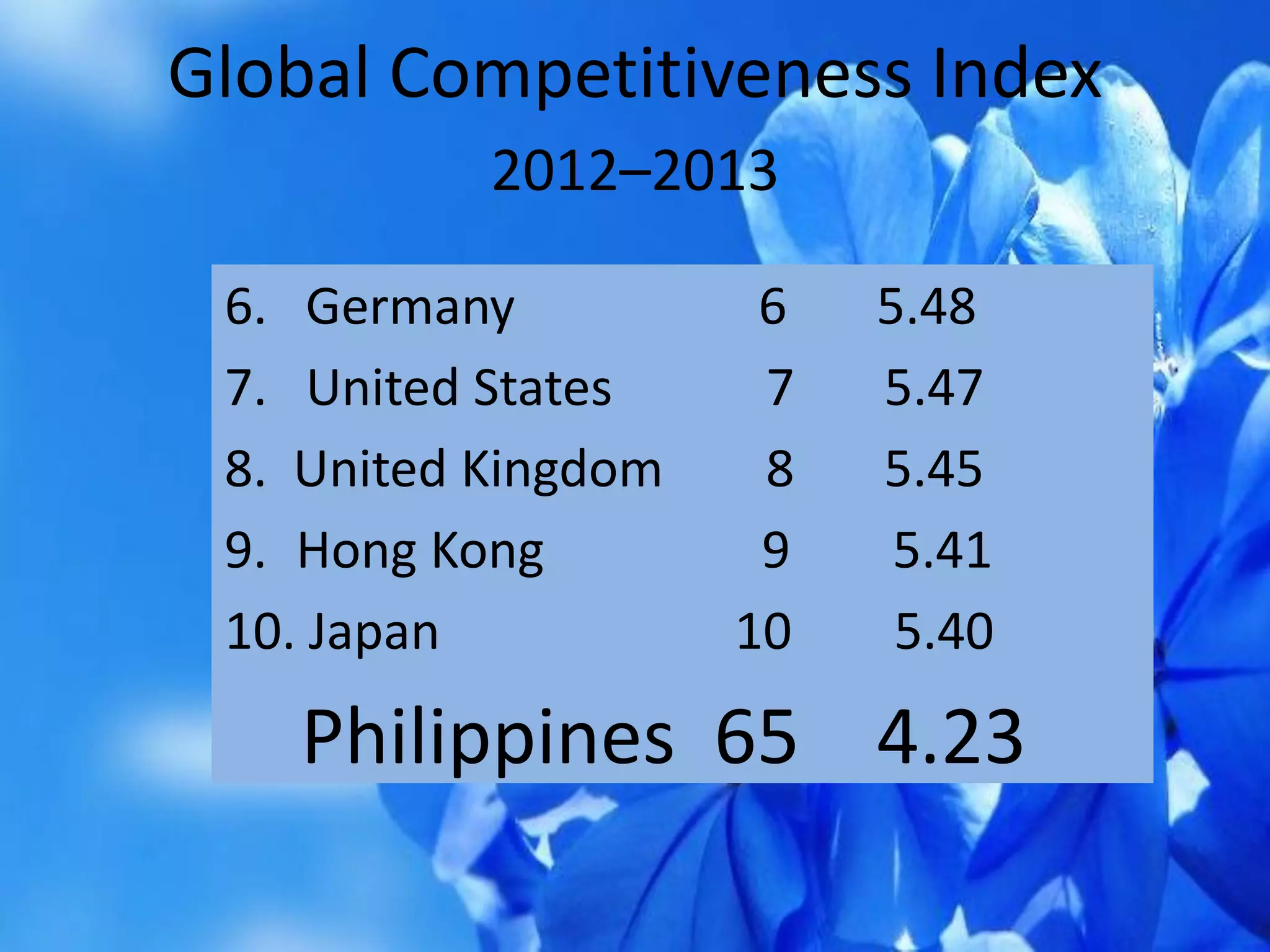
Global Competitiveness Index
2012–2013
6. Germany 6 5.48
7. United States 7 5.47
8. United Kingdom 8 5.45
9. Hong Kong 9 5.41
10. Japan 10 5.40
Philippines 65 4.23
Stages in
Development
a. GDP per capita
thresholds
b. Basic
requirements
c. Efficiency
enhancers
d. Innovation and
sophistication
factors
Philippines: Transition from stage 1 to stage
2 (17 economies)
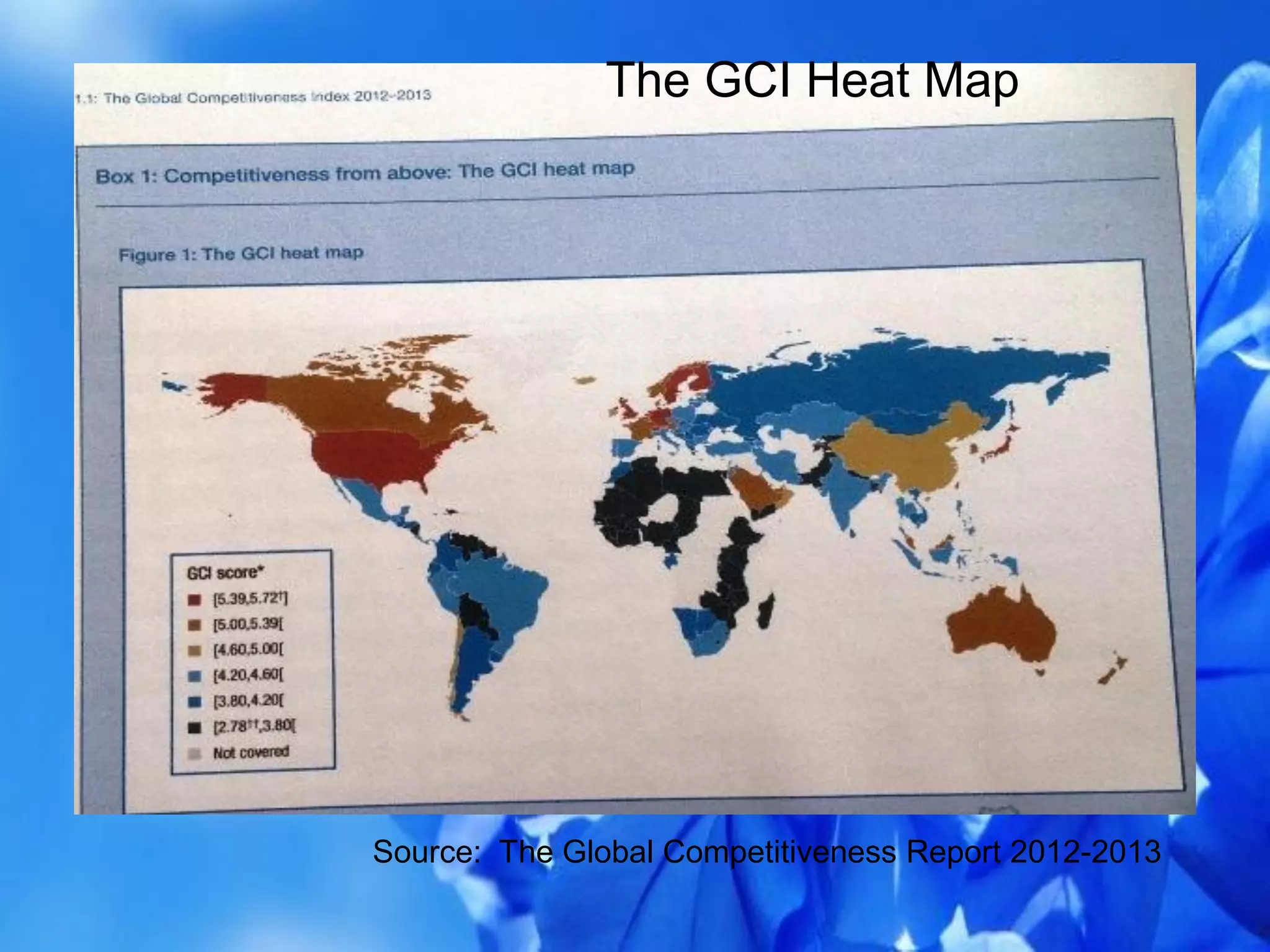
Source: The Global Competitiveness Report 2012-2013
The GCI Heat Map
• Facebook
• Twitter
• Blog
• Youtube
• hackers
Facebook users (million users 2012)
World 1,100
Asia Pacific 390
Philippines 29.79
Mobile phones in the Philippines
 The Philippines has 106.4 M mobile
subscribers and 10.8 internet users
Added: 03/13/2012 from eMarketer
Published: 03/13/201
 Mobile penetration is 94% while is
32% and social media is 28%
from eMarketer Published: 03/13/2012
Digital Divide
Of those in the Philippines with
internet access, search is used
by 56% Media and
Entertainment central to daily
life in the Philippines
Source: 07/29/2010 from Synovate Published: 07/29/2010

Introduction of ICT

  • 2.
    The new Informationand Communication Technologies (ICTs) have been a driving force of the globalized world in which we find ourselves today. Do ICTs have a role in helping to turn the global situation around?
  • 3.
    Internationally, the spreadand appropriation of ICTs is a key globalization driver and knowledge carrier. In these circumstances, societies need to build communications systems and manage them well, develop infrastructure and the capacity to use it, and implement good policy and regulation. In the right environments, both business and non-profit enterprise are effective in rapidly expanding
  • 4.
    Marshall McLuhan coined theterm ‘global village’ in 1962, was referring to the removal of space and time barriers in human communication as a result of the communication revolution taking place. Today, we are living in a global village in every sense of the term.
  • 5.
    The use ofICTs assist in sharing information more effectively and delivering better services to the public. Wisely deployed, ‘ICTs, can potentially impact almost every sector, making development budgets, private sector and commitments from development partners go further in terms of cost effectiveness, impact and reach’ (UNDP 2005,p. 1).
  • 6.
    ICTs help toincrease transparency and accountability and decrease corruption. They promote economic growth by improving the interface with business and empowering citizens to participate in advancing good governance.
  • 7.
    ICTs also helpto accelerate the pace of sustainable human development and to increase the effectiveness of new and more responsive solutions in the fields of health, education and related MDG focus areas’ (UNDP 2005, p. 1).
  • 8.
    There’s a beliefthat ICT potentially has the capacity towards the improvement of many different aspects of life, from alleviating poverty to strengthening the democratic polity.
  • 9.
    A belief thatICT will deliver its potential benefit on specific developmental aims, such as enhancement of livelihoods in rural areas (Duncombe and Heeks 2002), or improved government services (Krishna and Walsham 2005) The Role of ICT and Development
  • 10.
    Perspective • The progressiveperspective considers ICT as enabling transformations in multiple domains of human activities, but they can be accommodated within the existing international and local social order. • The disruptive perspective is premised on the highly political and controversial nature of development, both as a concept and as an area of policy for international and local action, and reveal conflicts of interest and struggles of power as a necessary part of IS innovation in developing countries
  • 11.
    Communication and networking enabledby information and communication technologies (ICTs) are proving to be economically, socially, and politically transformative over time. For example, in both poor and wealthy countries, mobile phone use has been skyrocketing and facilitating the expansion of markets, social business, and public services.
  • 12.
    In fact, anentire range of economic services, enabled by mobile phones, has begun to emerge: micro finance and insurance, marketing and distribution (for example, farmers and fishermen connecting with markets, reduced distribution margins, and buyer control
  • 13.
    Personal services, andpublic services (such as telehealth and distance education) and beyond the economic impacts, improvements are being made in other freedoms or dimensions of well-being — personal security, political participation and accountability, social peace, dignity, and opportunity
  • 14.
    In the rightenvironments, both business and non-profit enterprise are effective in rapidly expanding connectivity, using low-margin, high-volume business models. Affordable mobile Internet — smart phones and data services — exists today in wealthier societies and could be near universal in the next generation.
  • 15.
    These developments are important,where they are thriving. But we should not forget the negative aspects and possibilities of communications- based transformation, such as mobile phones being used to fan violence, cybercrime and terrorism, and our vulnerability to disruption of communication.
  • 16.
  • 17.
    Paradigm 1: Politics/Administration Dichotomy, 1900-1926 Paradigm2: The Principles of Administration, 1926-1937 Paradigm 3: Public Administration as a Political Science, 1950-1970 Paradigm 4: Public Administration as Management, 1956 -1970 Paradigm 5: Public Administration as Public Administration, 1970 Paradigm 6: From Government to Governance, 1990 Period of Orthodoxy Scientific management Bureaucracy POSDECORB The Most Serious Challenge Administrative Behavior Public Management New Public Administration Reinventing Government New Public Management New Public Service Post Modernism The Future Digital (e) Governance Evolution of Paradigm Source www.ginandjar.com PA as a Developing Discipline
  • 18.
    • Information iscentral resource for all activities • In pursuing the democratic/political processing in managing resources, executing functions, measuring performance, and in service delivery, information is the basic ingredient (Isaac-Hency 1997:132) Source:Ginandjar Kartasasmita. (2013)
  • 19.
    The Role ofInternet • Internet is a network or networks of one to one, one to many, many to many, and many to one, local, national and global information and communication technologies with relatively open standards, and protocols and comparatively low barriers to entry. Source:Ginandjar Kartasasmita. (2013)
  • 20.
    Opportunities and Risk •Management in the public sector is being altered and maybe altered even more fundamentally in the future by rapid advances in technology in particular, information, communications technology (ICT) Source:Ginandjar Kartasasmita. (2013)
  • 21.
    The information agehas been driven and dominated by technopreneurs — a small army of ‘geeks’ who have reshaped our world faster than any political leader has ever done…. We now have to apply these technologies for saving lives, improving livelihoods and lifting millions of people out of squalor, misery and suffering. In short, the time has come to move our focus from the geeks to the meek. (Sir Arthur C. Clarke)
  • 22.
    Kenichi Ohmae’s (1990) metaphorof a ‘Borderless World’ and Thomas Friedman’s (2005) concept of a ‘Flat World’ might sound a bit stale to some. But in the current global crisis, one could argue to the contrary — that they are absolutely right.
  • 23.
    Moreover, Servaes’s (2000) viewthat strengthening the educational sector through the use of technology is a necessary precondition to meeting the challenges of a global world seems to ring more true today than it did at the beginning of the millennium.
  • 24.
    In its 2001Global Technology Index, the Philippines slipped from its 1999 ranking of 32 and 38 out of 49 attributed “mainly to the decline of the number of computers per capita, weak deployment of cellular access and small population of internet users.” ICTs in the Philippines
  • 25.
    ICTs in thePhilippines • In 2002, the Philippines ranked 76th out of the 165 countries indexed by ICT diffusion 22 in a 2004 study conducted by UNCTAD. This is an outstanding improvement from its rank of 126th in 1995, but it is worthy to note that the Philippines has held its 2002 ranking since 1999.
  • 26.
    • In 2003-2004a new type of public sphere more participatory and intentional’, we have seen ICTs completely transform our lives, including the way politics and governance are played out. This started in Asia with the now famous ‘coup de text’ in the Philippines
  • 27.
  • 28.
    Measuring Competitiveness For morethan three decades, the World Economic Forum’s annual Global Competitiveness Reports have studied and benchmarked the many factors underpinning national competitiveness.
  • 29.
    Many determinants driveproductivity and competitiveness. Understanding the factors behind this process has occupied the minds of economists for hundreds of years, engendering theories ranging from Adam Smith’s focus on specialization and the division of labor to neoclassical economists’ emphasis on investment in physical capital and infrastructure..
  • 30.
    More recently, tointerest in other mechanisms such as education and training, technological progress, macroeconomic stability, good governance, firm sophistication, and market efficiency, among others. While all of these factors are likely to be important for competitiveness and growth, they are not mutually exclusive—two or more of them can be significant at the same time, and in fact that is what has been shown in the economic literature.
  • 31.
    12 Pillars ofCompetitiveness Philippine Ranking 1. Institutions 94 3.57 2. Infrastructure 98 3.19 3. Macroeconomic Environment 36 5.33 4. Health and Primary Education 98 5.31 5. Higher Education and Learning 64 4.30 6. Goods Market Efficiency 86 4.17
  • 32.
    Philippine Ranking 7. andMarket Efficiency 103 4.019 8. Financial Market Development 58 4.25 9. Technological Readiness 79 3.63 10. Market Size 35 4.62 11. Innovation 49 4.23 12. Business Sophistication 94 2.97 12 Pillars of Competitiveness
  • 34.
    Stages in Development a. GDPper capita thresholds b. Basic requirements c. Efficiency enhancers d. Innovation and sophistication factors 64 3.60 61 4.17 80 4.35 65 4.23 Philippine Ranking
  • 35.
    Global Competitiveness Index 2012–2013 1.Switzerland 1 5.72 2. Singapore 2 5.67 3. Finland 3 5.55 4. Sweden 4 5.53 5. Netherlands 5 5.50
  • 36.
    Global Competitiveness Index 2012–2013 6.Germany 6 5.48 7. United States 7 5.47 8. United Kingdom 8 5.45 9. Hong Kong 9 5.41 10. Japan 10 5.40 Philippines 65 4.23
  • 37.
    Stages in Development a. GDPper capita thresholds b. Basic requirements c. Efficiency enhancers d. Innovation and sophistication factors Philippines: Transition from stage 1 to stage 2 (17 economies)
  • 38.
    Source: The GlobalCompetitiveness Report 2012-2013 The GCI Heat Map
  • 39.
    • Facebook • Twitter •Blog • Youtube • hackers
  • 40.
    Facebook users (millionusers 2012) World 1,100 Asia Pacific 390 Philippines 29.79
  • 41.
    Mobile phones inthe Philippines  The Philippines has 106.4 M mobile subscribers and 10.8 internet users Added: 03/13/2012 from eMarketer Published: 03/13/201  Mobile penetration is 94% while is 32% and social media is 28% from eMarketer Published: 03/13/2012
  • 42.
    Digital Divide Of thosein the Philippines with internet access, search is used by 56% Media and Entertainment central to daily life in the Philippines Source: 07/29/2010 from Synovate Published: 07/29/2010