Unit 6: Information Communication Technology
(ICT)
Prepared by: Cherrylyn T. Magano LPT
The twenty – first century has been characterized as the information
age. No doubt, one of the greatest achievements of this age has something
to do with the technology, especially the increasing power of
communications. ICT is providing an extra ordinary opportunity to hope our
critical thinking and problem - solving skills, communication skills, creativity
and innovation.
ICT - is an extended term for information technology (IT) which stresses
the role of unified communications and the integration of
telecommunications. The phrase information and communications
technology has been used by academic researchers since the 1980’s, and
the abbreviation ICT became popular after it was used in a report to the
UK government by Dennis Stevenson in 1997.
Benefits of ICT to:
1. Economic
2. Political
3. Cultural
4. Personal
Researcher make it clear that ICT advances social improvement by
sharing learning, encouraging social innovativeness, expanding popularity
based support and upgrading social cohesion. We are challenged to
harmless the potential of information and communication technology to
promote the attainment of a move peaceful, just and prosperous world.
ICT positively affected the life of the members of
the society or the digital citizens through:
Education – Many educators are already using and infusing technology
as a teaching learning pedagogy through the use of different platforms.
Business - Most entrepreneurs are making use of the internet and
different social networking sites to promote their business and
products
Government - in the Philippines, many transaction with government
offices are now possible and available online. Application for birth
certificates, passport, NBI and like are maximized by some Filipinos
Computers, e-mail, internet, fax machines, mobile phones are only
among the information communication tools that can be considered an
integral part of work activities in almost all companies or institutions in
the Philippines and abroad. The development and access of different
technologies like wireless networking and mobile devices significantly
transformed user into content producers.
ICT and Global Networks
With ICT in schools, learners are not only consumers but content
creators as they write, edit, publish, participate, co – create and
collaborate with others through the use of technologies. ICT hastens
global and democratic network across the planet. The Internet is an
apparatus for causal connection as well as open spaces where
individuals can voice out their issues.
ICT can generate global social awareness through social network
sites. Social networking sites also facilitate the mobilization of grass root
movements and advocates especially among the younger generation. ICT
promotes social development by sharing knowledge, fostering cultural
activity, increasing democratic participation, and advances have improved
life and brought the world’s people closer.
History of ICT
COMPUTER
• 300 BC - Abacus, 1st calculator
• 1833 – Charles Babbage - designed the Analytic Engine which was
became the concept of a digital programmable computer.
RADIO AND TELEVISION
• 1894 - Guglielmo Marconi invented the “wireless telegraphy” (radio
telegraph system) which paved way to the development of Radio.
• 1920’s – Commercial Radio, Earliest Television transmission.
• 1940’S – Colored Television
TELEPHONE
• 1876 – Alexander Graham Bell invented the telephone
• 1930’s – widespread od telephone sets
• 1970’s – mobile phone technology
• 1980’s – earliest mobile phone sold
Late 20th century- Computer Development
• 1971 introduction of the first microprocessor by intel
• 1981 initial version of computers by IBM
• 1991 creation of the World Wide Web by Tim Lee
Recent development of ICT
Desktop computers were made portable because of laptops and
tablets.
Mobile phones innovation: internet access, camera, am/fm radio,
television, data storage, calculators etc.
DISADVANTAGE OF THE USE OF ICT
1. Cost – More and more resources are being put into ICT in schools –
in cost of laptops, wireless broadband, projector for example
contribute a large percentage of the school’s budget.
2. Misuse of ICT - instead of using their laptops or tablets for their
studies and online tests. More often than not students stay away
and visit social networking sites like Facebook or Twitter. Students
would be too focused on playing games or visiting social networking
sites resulting to lower academic grades.
3. School Bags + laptops - each student who owns a laptop with heavy
textbooks, notes and homework is quite a burden to the student’s back.
Schools are becoming more dependent on e-learning (learning on the
internet) but textbooks are mostly print publications. Hence, the weight
of this laptop, textbooks, and homework may bear health consequences
in the near future.
Natural consequences of advancements in ICT
Discrepancy in peoples access and skill related to ICT
Factors : geographical location, economy, income, age, education, race and
government support among others.
Digital DIVIDE
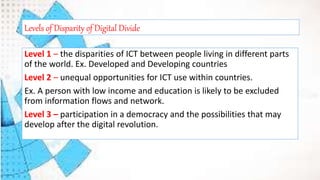
Level 1 – the disparities of ICT between people living in different parts
of the world. Ex. Developed and Developing countries
Level 2 – unequal opportunities for ICT use within countries.
Ex. A person with low income and education is likely to be excluded
from information flows and network.
Level 3 – participation in a democracy and the possibilities that may
develop after the digital revolution.
Levels of Disparity of Digital Divide
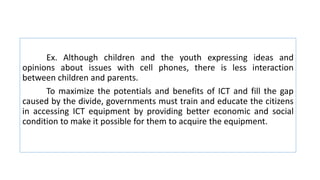
Ex. Although children and the youth expressing ideas and
opinions about issues with cell phones, there is less interaction
between children and parents.
To maximize the potentials and benefits of ICT and fill the gap
caused by the divide, governments must train and educate the citizens
in accessing ICT equipment by providing better economic and social
condition to make it possible for them to acquire the equipment.

Unit 6: Information Communication Technology (ICT)

  • 1.
    Unit 6: InformationCommunication Technology (ICT) Prepared by: Cherrylyn T. Magano LPT
  • 2.
    The twenty –first century has been characterized as the information age. No doubt, one of the greatest achievements of this age has something to do with the technology, especially the increasing power of communications. ICT is providing an extra ordinary opportunity to hope our critical thinking and problem - solving skills, communication skills, creativity and innovation.
  • 3.
    ICT - isan extended term for information technology (IT) which stresses the role of unified communications and the integration of telecommunications. The phrase information and communications technology has been used by academic researchers since the 1980’s, and the abbreviation ICT became popular after it was used in a report to the UK government by Dennis Stevenson in 1997.
  • 4.
    Benefits of ICTto: 1. Economic 2. Political 3. Cultural 4. Personal
  • 5.
    Researcher make itclear that ICT advances social improvement by sharing learning, encouraging social innovativeness, expanding popularity based support and upgrading social cohesion. We are challenged to harmless the potential of information and communication technology to promote the attainment of a move peaceful, just and prosperous world.
  • 6.
    ICT positively affectedthe life of the members of the society or the digital citizens through:
  • 7.
    Education – Manyeducators are already using and infusing technology as a teaching learning pedagogy through the use of different platforms.
  • 8.
    Business - Mostentrepreneurs are making use of the internet and different social networking sites to promote their business and products
  • 9.
    Government - inthe Philippines, many transaction with government offices are now possible and available online. Application for birth certificates, passport, NBI and like are maximized by some Filipinos
  • 10.
    Computers, e-mail, internet,fax machines, mobile phones are only among the information communication tools that can be considered an integral part of work activities in almost all companies or institutions in the Philippines and abroad. The development and access of different technologies like wireless networking and mobile devices significantly transformed user into content producers.
  • 11.
    ICT and GlobalNetworks With ICT in schools, learners are not only consumers but content creators as they write, edit, publish, participate, co – create and collaborate with others through the use of technologies. ICT hastens global and democratic network across the planet. The Internet is an apparatus for causal connection as well as open spaces where individuals can voice out their issues.
  • 12.
    ICT can generateglobal social awareness through social network sites. Social networking sites also facilitate the mobilization of grass root movements and advocates especially among the younger generation. ICT promotes social development by sharing knowledge, fostering cultural activity, increasing democratic participation, and advances have improved life and brought the world’s people closer.
  • 13.
  • 14.
    COMPUTER • 300 BC- Abacus, 1st calculator • 1833 – Charles Babbage - designed the Analytic Engine which was became the concept of a digital programmable computer. RADIO AND TELEVISION • 1894 - Guglielmo Marconi invented the “wireless telegraphy” (radio telegraph system) which paved way to the development of Radio. • 1920’s – Commercial Radio, Earliest Television transmission. • 1940’S – Colored Television
  • 15.
    TELEPHONE • 1876 –Alexander Graham Bell invented the telephone • 1930’s – widespread od telephone sets • 1970’s – mobile phone technology • 1980’s – earliest mobile phone sold Late 20th century- Computer Development • 1971 introduction of the first microprocessor by intel • 1981 initial version of computers by IBM • 1991 creation of the World Wide Web by Tim Lee
  • 16.
    Recent development ofICT Desktop computers were made portable because of laptops and tablets. Mobile phones innovation: internet access, camera, am/fm radio, television, data storage, calculators etc.
  • 17.
    DISADVANTAGE OF THEUSE OF ICT 1. Cost – More and more resources are being put into ICT in schools – in cost of laptops, wireless broadband, projector for example contribute a large percentage of the school’s budget. 2. Misuse of ICT - instead of using their laptops or tablets for their studies and online tests. More often than not students stay away and visit social networking sites like Facebook or Twitter. Students would be too focused on playing games or visiting social networking sites resulting to lower academic grades.
  • 18.
    3. School Bags+ laptops - each student who owns a laptop with heavy textbooks, notes and homework is quite a burden to the student’s back. Schools are becoming more dependent on e-learning (learning on the internet) but textbooks are mostly print publications. Hence, the weight of this laptop, textbooks, and homework may bear health consequences in the near future.
  • 19.
    Natural consequences ofadvancements in ICT Discrepancy in peoples access and skill related to ICT Factors : geographical location, economy, income, age, education, race and government support among others. Digital DIVIDE
  • 20.
    Level 1 –the disparities of ICT between people living in different parts of the world. Ex. Developed and Developing countries Level 2 – unequal opportunities for ICT use within countries. Ex. A person with low income and education is likely to be excluded from information flows and network. Level 3 – participation in a democracy and the possibilities that may develop after the digital revolution. Levels of Disparity of Digital Divide
  • 21.
    Ex. Although childrenand the youth expressing ideas and opinions about issues with cell phones, there is less interaction between children and parents. To maximize the potentials and benefits of ICT and fill the gap caused by the divide, governments must train and educate the citizens in accessing ICT equipment by providing better economic and social condition to make it possible for them to acquire the equipment.