Digital Divide What? Where? Who? An introduction to concepts, issues and some solutions Julie Lindsay  for the Flat Classroom Workshop @HK, September 2009
Definition The digital divide is a term used to refer to the gap between people who have access to the internet and those that do not. It can also refer to the skills people have – the divide between peoples who are at ease using technology to access and analyze information and those who are not. Taking IT Global
Two main aspects Access to computers and related technologies Technological literacy
According to Andy Carvin……. It’s the gap that exists between populations in terms of: Access to information and communication technologies (ICTs) Literacy skills and ability to use ICTs effectively The availability and accessibility of high quality, relevant content - and opportunities to produce it AKA the ABC’s:  A ccess,  B asic Skills,  C ontent www.digitaldivide.net
Crossing the Content Divide Internet access isn’t worth much without content that is... Locally Relevant Culturally Relevant Linguistically Relevant Literacy Level Appropriate Accessible for People with Disabilities
Web 2.0: The Read/Write web Bridging the digital divide Everyone is a producer Everyone is a consumer Text, images, video Social networking
Internet access globally in 2004
Trend for mobile technology in developing countries
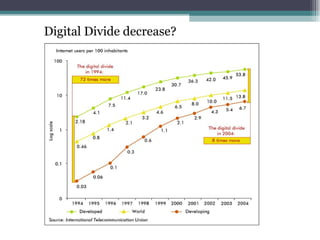
Digital Divide decrease?
Issues Developing countries – poverty, poor infrastructure Old PCs to third world countries – helps to provide hardware….what about literacy? Hardware support and infrastructure Access to online resources
Global Digital Divide In today's society, jobs and education are directly related to the internet, in that the advantages that come from the internet are so significant that neglecting them would leave a company vulnerable in a changing market. Economic advantage  Social advantage Educational advantage
Education and Resources Digital equity through distribution of and access to resources Open-source – FOSS Developed nations have competitive edge Technology makes learning in different ways possible Technology offers a unique opportunity to extend learning support beyond the classroom, something that has been difficult to do until now.
Solutions Government policy NGO’s help establish digital literacy programs Community service programs Web 2.0 – Internet with read/write access Social software – engaged communities Mobile computing and wireless access
Grameen Phone " One of their best known accomplishments is the digital divide initiative known as the  Grameen Phone  program.  Women are given loans to start small telecom businesses in their home village. They receive a mobile phone and training, then make that phone available to villagers for community use. For villages with no other telecommunications link to the outside world, the Grameen Phone program has created new opportunities for local residents while helping women achieve improved socioeconomic status. ….” Muhammed Yunus and Nobel Peace Prize 2006
Hole in the Wall The "Hole in the Wall" project is a testament to the competency and capacity of children to construct their own knowledge in a community of practice. Internet access can connect children to each other and the 21st century.
Hole in the Wall
XO Laptop - $100 Nicholas Negroponte Catalyst for a new generation of laptops

Digital Divide Introduction

  • 1.
    Digital Divide What?Where? Who? An introduction to concepts, issues and some solutions Julie Lindsay for the Flat Classroom Workshop @HK, September 2009
  • 2.
    Definition The digitaldivide is a term used to refer to the gap between people who have access to the internet and those that do not. It can also refer to the skills people have – the divide between peoples who are at ease using technology to access and analyze information and those who are not. Taking IT Global
  • 3.
    Two main aspectsAccess to computers and related technologies Technological literacy
  • 4.
    According to AndyCarvin……. It’s the gap that exists between populations in terms of: Access to information and communication technologies (ICTs) Literacy skills and ability to use ICTs effectively The availability and accessibility of high quality, relevant content - and opportunities to produce it AKA the ABC’s: A ccess, B asic Skills, C ontent www.digitaldivide.net
  • 5.
    Crossing the ContentDivide Internet access isn’t worth much without content that is... Locally Relevant Culturally Relevant Linguistically Relevant Literacy Level Appropriate Accessible for People with Disabilities
  • 6.
    Web 2.0: TheRead/Write web Bridging the digital divide Everyone is a producer Everyone is a consumer Text, images, video Social networking
  • 7.
  • 8.
    Trend for mobiletechnology in developing countries
  • 9.
  • 10.
    Issues Developing countries– poverty, poor infrastructure Old PCs to third world countries – helps to provide hardware….what about literacy? Hardware support and infrastructure Access to online resources
  • 11.
    Global Digital DivideIn today's society, jobs and education are directly related to the internet, in that the advantages that come from the internet are so significant that neglecting them would leave a company vulnerable in a changing market. Economic advantage Social advantage Educational advantage
  • 12.
    Education and ResourcesDigital equity through distribution of and access to resources Open-source – FOSS Developed nations have competitive edge Technology makes learning in different ways possible Technology offers a unique opportunity to extend learning support beyond the classroom, something that has been difficult to do until now.
  • 13.
    Solutions Government policyNGO’s help establish digital literacy programs Community service programs Web 2.0 – Internet with read/write access Social software – engaged communities Mobile computing and wireless access
  • 14.
    Grameen Phone "One of their best known accomplishments is the digital divide initiative known as the Grameen Phone program. Women are given loans to start small telecom businesses in their home village. They receive a mobile phone and training, then make that phone available to villagers for community use. For villages with no other telecommunications link to the outside world, the Grameen Phone program has created new opportunities for local residents while helping women achieve improved socioeconomic status. ….” Muhammed Yunus and Nobel Peace Prize 2006
  • 15.
    Hole in theWall The "Hole in the Wall" project is a testament to the competency and capacity of children to construct their own knowledge in a community of practice. Internet access can connect children to each other and the 21st century.
  • 16.
  • 17.
    XO Laptop -$100 Nicholas Negroponte Catalyst for a new generation of laptops