Tfflndsf pb]:ox?
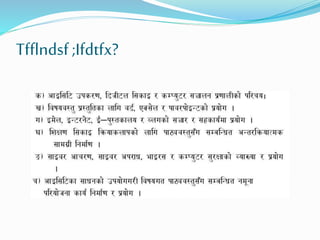
Tfflndsf ;Ifdtfx?
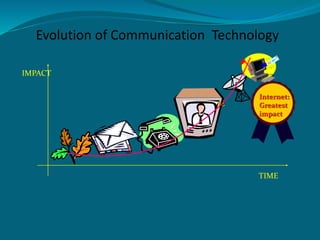
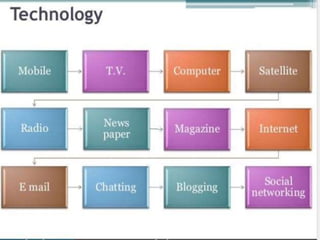
Evolution of Communication Technology
TIME
TIME
IMPACT
Internet:
Greatest
impact
“There can be infinite uses of the computer and of new age
technology, but if teachers themselves are not able to bring it
into the classroom and make it work, then it fails.” -
Nancy Kassebaum
The Relationship of ICT and
Education
Coffin, Walter, and Brisebois 8
Ebsco username: merrittbc
Ebsco password: inspire
MODERN APPROACH
OF EDUCATION
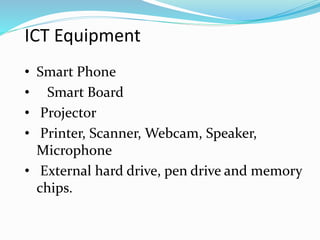
ICT Equipment
• Smart Phone
• Smart Board
• Projector
• Printer, Scanner, Webcam, Speaker,
Microphone
• External hard drive, pen drive and memory
chips.
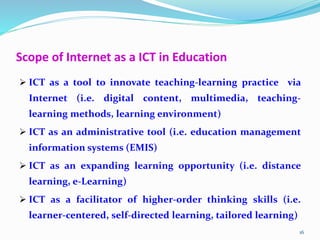
Scope of Internet as a ICT in Education
 ICT as a tool to innovate teaching-learning practice via
Internet (i.e. digital content, multimedia, teaching-
learning methods, learning environment)
 ICT as an administrative tool (i.e. education management
information systems (EMIS)
 ICT as an expanding learning opportunity (i.e. distance
learning, e-Learning)
 ICT as a facilitator of higher-order thinking skills (i.e.
learner-centered, self-directed learning, tailored learning)
16
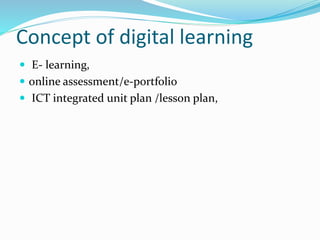
Concept of digital learning
 E- learning,
 online assessment/e-portfolio
 ICT integrated unit plan /lesson plan,
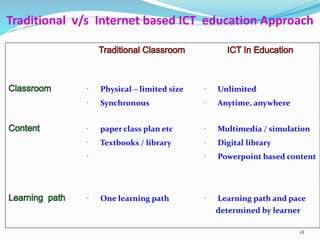
Traditional v/s Internet based ICT education Approach
18
 Physical – limited size
 Synchronous
 Unlimited
 Anytime, anywhere
 paper class plan etc
 Textbooks / library

 Multimedia / simulation
 Digital library
 Powerpoint based content
 One learning path  Learning path and pace
determined by learner
Psychology of using Teaching Aids which include
ICTs
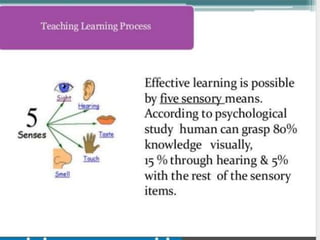
 Hear is an effective saying
I hear, I forget : Verbal description only are not enough for
learners to remember and understand. Visualization of
objects especially in science and technology is important
I see, I remember: Knowledge that is gained through the site
is more colorful, accurate and permanent. It is said that 80%
of our knowledge is gained through our eyes.
ICT can help learning
 Develop understanding
 Speed and automatic functions of ICT can enable teachers to
demonstrate, explore or explain aspects of their teaching, and
students learning, more effectively e.g. use of a spread sheet to
perform calculations in order that patterns can be concentrated on
rather than the calculating.
ICT can help learning
 Extend access to sources
 the capacity and range of ICT can enable teachers and students to
gain access to historical, recent or immediate information, through,
for example, accessing information on CD-ROM or the Internet
 Enhance enquiry skills
 search for and compare information from different sources
Communication and collaboration
 e-mail: Create and Manage e-mail account
 Internet: Google search and search customization,
Google Translation, Cloud Services (One Drive,
Google Drive), Video Conference, YouTube (Upload
and Download, subtitles) and other social media and
collaboration.
 Blogging: Creating blog with basic features using
blogger.com
Interactive content creation
 Mobile apps
 Introduction to Wiki space
 Subject specific tools (web 2.0)
 Science: Virtual Lab, PHET, Open learn, Google Sky, Khan
Academy ,
 Math: MATHEMATICA, Math lab, Geogerba ,Torsi a.
Khan Academy, Use of scientific calculator
 English Language: Dictionary ,Translator , Hello English,
English club, ABC teach,
 Social Science: Google Map,PBS, Google Earth, World Atlas
Security and safe surfing
 Cyber Ethics and Security
 Ethics in using digital documents,
 Intellectual Property Right (Trademark, Patent,
Copyright),
 Antivirus and virus scanning.
 Cybercrime and protection (Awareness, Cyber Law)
Thank You

Ict for education teachers training modoule

  • 2.
  • 3.
  • 4.
    Evolution of CommunicationTechnology TIME TIME IMPACT Internet: Greatest impact
  • 5.
    “There can beinfinite uses of the computer and of new age technology, but if teachers themselves are not able to bring it into the classroom and make it work, then it fails.” - Nancy Kassebaum
  • 8.
    The Relationship ofICT and Education Coffin, Walter, and Brisebois 8 Ebsco username: merrittbc Ebsco password: inspire MODERN APPROACH OF EDUCATION
  • 11.
    ICT Equipment • SmartPhone • Smart Board • Projector • Printer, Scanner, Webcam, Speaker, Microphone • External hard drive, pen drive and memory chips.
  • 16.
    Scope of Internetas a ICT in Education  ICT as a tool to innovate teaching-learning practice via Internet (i.e. digital content, multimedia, teaching- learning methods, learning environment)  ICT as an administrative tool (i.e. education management information systems (EMIS)  ICT as an expanding learning opportunity (i.e. distance learning, e-Learning)  ICT as a facilitator of higher-order thinking skills (i.e. learner-centered, self-directed learning, tailored learning) 16
  • 17.
    Concept of digitallearning  E- learning,  online assessment/e-portfolio  ICT integrated unit plan /lesson plan,
  • 18.
    Traditional v/s Internetbased ICT education Approach 18  Physical – limited size  Synchronous  Unlimited  Anytime, anywhere  paper class plan etc  Textbooks / library   Multimedia / simulation  Digital library  Powerpoint based content  One learning path  Learning path and pace determined by learner
  • 19.
    Psychology of usingTeaching Aids which include ICTs  Hear is an effective saying I hear, I forget : Verbal description only are not enough for learners to remember and understand. Visualization of objects especially in science and technology is important I see, I remember: Knowledge that is gained through the site is more colorful, accurate and permanent. It is said that 80% of our knowledge is gained through our eyes.
  • 20.
    ICT can helplearning  Develop understanding  Speed and automatic functions of ICT can enable teachers to demonstrate, explore or explain aspects of their teaching, and students learning, more effectively e.g. use of a spread sheet to perform calculations in order that patterns can be concentrated on rather than the calculating.
  • 21.
    ICT can helplearning  Extend access to sources  the capacity and range of ICT can enable teachers and students to gain access to historical, recent or immediate information, through, for example, accessing information on CD-ROM or the Internet  Enhance enquiry skills  search for and compare information from different sources
  • 23.
    Communication and collaboration e-mail: Create and Manage e-mail account  Internet: Google search and search customization, Google Translation, Cloud Services (One Drive, Google Drive), Video Conference, YouTube (Upload and Download, subtitles) and other social media and collaboration.  Blogging: Creating blog with basic features using blogger.com
  • 24.
    Interactive content creation Mobile apps  Introduction to Wiki space  Subject specific tools (web 2.0)  Science: Virtual Lab, PHET, Open learn, Google Sky, Khan Academy ,  Math: MATHEMATICA, Math lab, Geogerba ,Torsi a. Khan Academy, Use of scientific calculator  English Language: Dictionary ,Translator , Hello English, English club, ABC teach,  Social Science: Google Map,PBS, Google Earth, World Atlas
  • 25.
    Security and safesurfing  Cyber Ethics and Security  Ethics in using digital documents,  Intellectual Property Right (Trademark, Patent, Copyright),  Antivirus and virus scanning.  Cybercrime and protection (Awareness, Cyber Law)
  • 27.