FOUNDATIONS OF
ENGINEERING
CHAPTER # 8
Tables and Graphs
DEPENDENT & INDEPENDENT VARIABLES
Cause and effects
Variables as Independent (cause) & other as Dependent (Effect)
For example: Assume an engineer is studying an automobile (the system) and
is interested in the factors that affect its speed.
The dependent variable -> speed
Some independent variables -> Rate of fuel entering the engine f, tire
pressure p, air temperature T, air pressure P, road grade r, car mass m etc
S = s (f,p,T,P,r,m)
TABLES
It is the best way to present technical data
It is a convenient way to list dependent & independent variables
The independent -> left most side
Dependent -> right most side
Table example 8.1
Significant figure should be in mind
Units should be properly reported
GRAPHS
To represent tabulated data, graph is best suited way.
To represent data in graphs is an art, those who are good at it are often able
to see things in data that are missed by others.
A well-constructed graph is self contained just like a well constructed table;
also it must communicate information accurately & rapidly
Title should be descriptive like effect of fuel rate and road grade on car speed
not like car speed v fuel consumption
Dependent -> ordinate (y-axis)
Independent -> abscissa (x-axis)
The units are enclosed in parenthesis or separated by the label by a comma
Each axis is graduated with tick marks
Properly spaced
We can use SI unit multiplier in case the number is too long
& if the gaps between the numbers is too big then we use logarithmic scale
Data points & complex numbers are represented by as in book
Lines representation as in book
Symbols are generally represented in three ways in graph
Figure title
Legends
Adjacent to the lines
Data may be categorized into
Observed: Data are often simply presented without an attempt to smooth them or correlate
them with a mathematical model
Empirical: Data are presented with a smooth line, which may be determined by a
mathematical model or perhaps it is just the author’s best judgment of where the data points
would have fallen had there been no error in the experiment
Theoretical: Data are generated by mathematical model
LINEAR EQUATIONS
(x1,y1) and (x2,y2) establish a straight line
(x,y) is an arbitrary point on the line
Slope = m = y2-y1/x2-x1 if x2 not equals to x1
Equation for slope = m =y –y1/ x -x1
y = mx + b
b=y – intercept i.e here x=0
a=x – intercept i.e here y=0
POWER EQUATIONS
rectilinear graph, log-log graph
 y = k x ^m -> this eq show parabola if m is +ive
Otherwise we take log and get a straight line
The slope of log-log graph is not meaningful
For slope we use rectilinear graph
If m is –ive in above case then y = k x ^m shows a hyperbola
EXPONENTIAL EQUATIONS
y= K B^ mx where B is desired base i.e 2, e or 10
Here we used B =10
& find out the calculations on semi log graph
Semi log graph has an advantage that we doesn’t need to calculate log y
because the graph does itself
TRANSFORMING NON-LINEAR
EQUATION INTO LINEAR EQUATION
It can be easily understand with the help of table 8.2 and with example 8.1
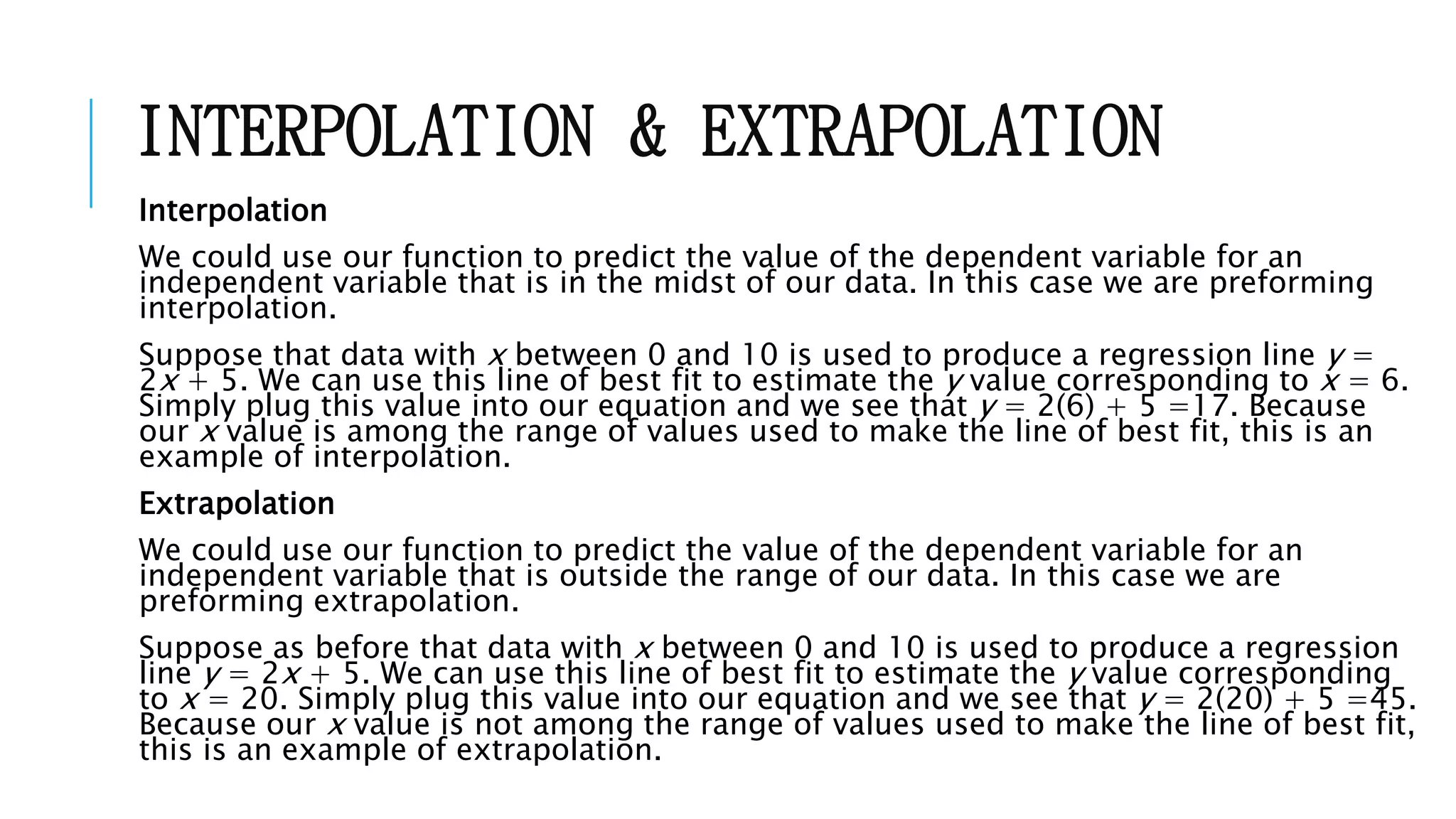
INTERPOLATION & EXTRAPOLATION
Interpolation
We could use our function to predict the value of the dependent variable for an
independent variable that is in the midst of our data. In this case we are preforming
interpolation.
Suppose that data with x between 0 and 10 is used to produce a regression line y =
2x + 5. We can use this line of best fit to estimate the y value corresponding to x = 6.
Simply plug this value into our equation and we see that y = 2(6) + 5 =17. Because
our x value is among the range of values used to make the line of best fit, this is an
example of interpolation.
Extrapolation
We could use our function to predict the value of the dependent variable for an
independent variable that is outside the range of our data. In this case we are
preforming extrapolation.
Suppose as before that data with x between 0 and 10 is used to produce a regression
line y = 2x + 5. We can use this line of best fit to estimate the y value corresponding
to x = 20. Simply plug this value into our equation and we see that y = 2(20) + 5 =45.
Because our x value is not among the range of values used to make the line of best fit,
this is an example of extrapolation.
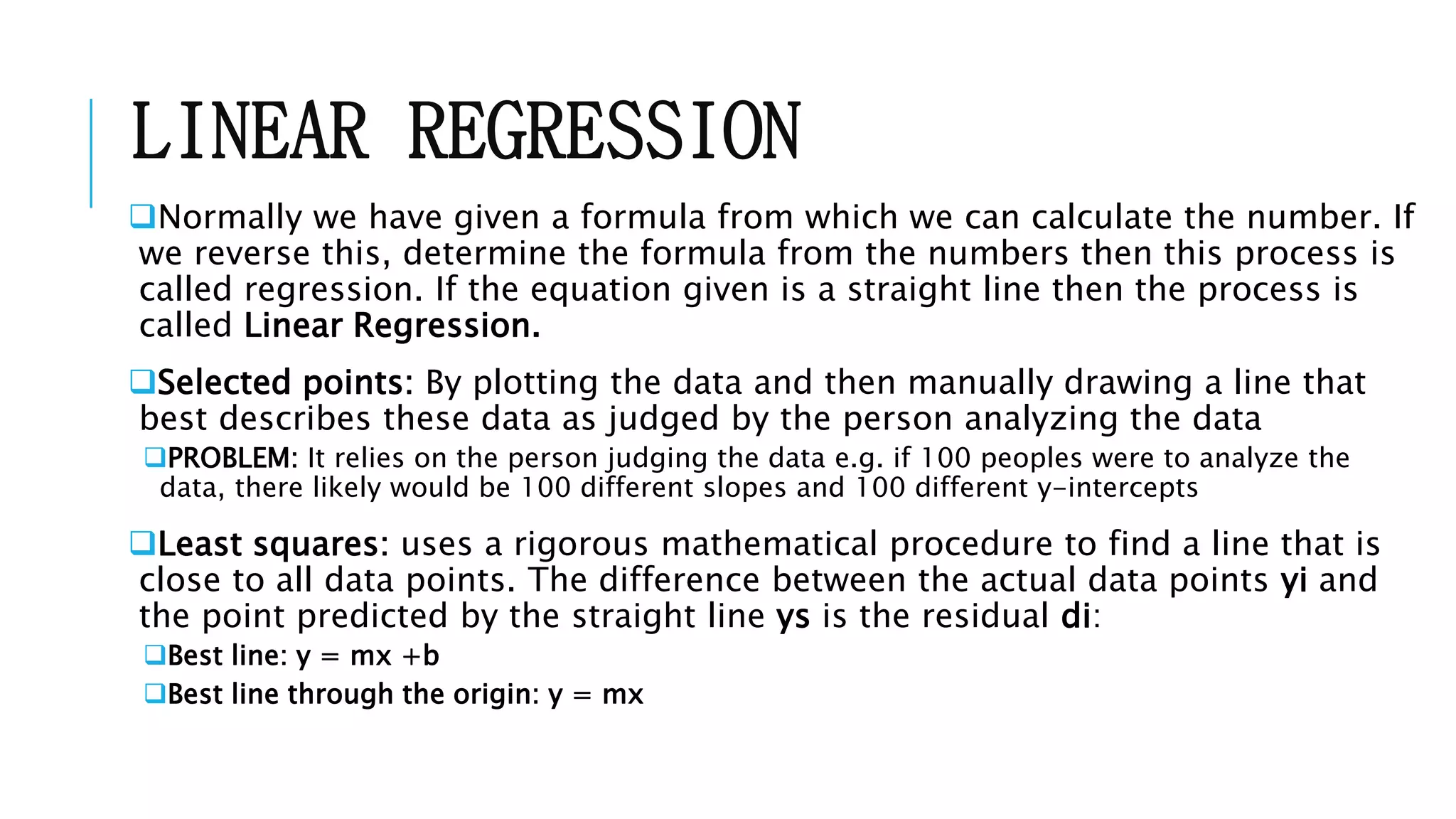
LINEAR REGRESSION
Normally we have given a formula from which we can calculate the number. If
we reverse this, determine the formula from the numbers then this process is
called regression. If the equation given is a straight line then the process is
called Linear Regression.
Selected points: By plotting the data and then manually drawing a line that
best describes these data as judged by the person analyzing the data
PROBLEM: It relies on the person judging the data e.g. if 100 peoples were to analyze the
data, there likely would be 100 different slopes and 100 different y-intercepts
Least squares: uses a rigorous mathematical procedure to find a line that is
close to all data points. The difference between the actual data points yi and
the point predicted by the straight line ys is the residual di:
Best line: y = mx +b
Best line through the origin: y = mx

Chapter#8

  • 1.
  • 2.
  • 3.
    DEPENDENT & INDEPENDENTVARIABLES Cause and effects Variables as Independent (cause) & other as Dependent (Effect) For example: Assume an engineer is studying an automobile (the system) and is interested in the factors that affect its speed. The dependent variable -> speed Some independent variables -> Rate of fuel entering the engine f, tire pressure p, air temperature T, air pressure P, road grade r, car mass m etc S = s (f,p,T,P,r,m)
  • 4.
    TABLES It is thebest way to present technical data It is a convenient way to list dependent & independent variables The independent -> left most side Dependent -> right most side Table example 8.1 Significant figure should be in mind Units should be properly reported
  • 5.
    GRAPHS To represent tabulateddata, graph is best suited way. To represent data in graphs is an art, those who are good at it are often able to see things in data that are missed by others. A well-constructed graph is self contained just like a well constructed table; also it must communicate information accurately & rapidly Title should be descriptive like effect of fuel rate and road grade on car speed not like car speed v fuel consumption Dependent -> ordinate (y-axis) Independent -> abscissa (x-axis) The units are enclosed in parenthesis or separated by the label by a comma Each axis is graduated with tick marks
  • 6.
    Properly spaced We canuse SI unit multiplier in case the number is too long & if the gaps between the numbers is too big then we use logarithmic scale Data points & complex numbers are represented by as in book Lines representation as in book Symbols are generally represented in three ways in graph Figure title Legends Adjacent to the lines Data may be categorized into Observed: Data are often simply presented without an attempt to smooth them or correlate them with a mathematical model Empirical: Data are presented with a smooth line, which may be determined by a mathematical model or perhaps it is just the author’s best judgment of where the data points would have fallen had there been no error in the experiment Theoretical: Data are generated by mathematical model
  • 7.
    LINEAR EQUATIONS (x1,y1) and(x2,y2) establish a straight line (x,y) is an arbitrary point on the line Slope = m = y2-y1/x2-x1 if x2 not equals to x1 Equation for slope = m =y –y1/ x -x1 y = mx + b b=y – intercept i.e here x=0 a=x – intercept i.e here y=0
  • 8.
    POWER EQUATIONS rectilinear graph,log-log graph  y = k x ^m -> this eq show parabola if m is +ive Otherwise we take log and get a straight line The slope of log-log graph is not meaningful For slope we use rectilinear graph If m is –ive in above case then y = k x ^m shows a hyperbola
  • 9.
    EXPONENTIAL EQUATIONS y= KB^ mx where B is desired base i.e 2, e or 10 Here we used B =10 & find out the calculations on semi log graph Semi log graph has an advantage that we doesn’t need to calculate log y because the graph does itself
  • 10.
    TRANSFORMING NON-LINEAR EQUATION INTOLINEAR EQUATION It can be easily understand with the help of table 8.2 and with example 8.1
  • 11.
    INTERPOLATION & EXTRAPOLATION Interpolation Wecould use our function to predict the value of the dependent variable for an independent variable that is in the midst of our data. In this case we are preforming interpolation. Suppose that data with x between 0 and 10 is used to produce a regression line y = 2x + 5. We can use this line of best fit to estimate the y value corresponding to x = 6. Simply plug this value into our equation and we see that y = 2(6) + 5 =17. Because our x value is among the range of values used to make the line of best fit, this is an example of interpolation. Extrapolation We could use our function to predict the value of the dependent variable for an independent variable that is outside the range of our data. In this case we are preforming extrapolation. Suppose as before that data with x between 0 and 10 is used to produce a regression line y = 2x + 5. We can use this line of best fit to estimate the y value corresponding to x = 20. Simply plug this value into our equation and we see that y = 2(20) + 5 =45. Because our x value is not among the range of values used to make the line of best fit, this is an example of extrapolation.
  • 12.
    LINEAR REGRESSION Normally wehave given a formula from which we can calculate the number. If we reverse this, determine the formula from the numbers then this process is called regression. If the equation given is a straight line then the process is called Linear Regression. Selected points: By plotting the data and then manually drawing a line that best describes these data as judged by the person analyzing the data PROBLEM: It relies on the person judging the data e.g. if 100 peoples were to analyze the data, there likely would be 100 different slopes and 100 different y-intercepts Least squares: uses a rigorous mathematical procedure to find a line that is close to all data points. The difference between the actual data points yi and the point predicted by the straight line ys is the residual di: Best line: y = mx +b Best line through the origin: y = mx