



INTRODUCING
SOCIOLOGY
Defining the Discipline and Its History
What is sociology?
Per Kendall, sociology is the “systematic study of
   human society and social interaction”
 Multiple scopes of analysis (macro, micro)

 Based on scientific research, not „common sense‟,
   hunches, personal convictions, etc.
It is possible to systematically to study groups of
   peoples because:
 People are social beings

 People act in routine, predictable ways (most of
   the time)
Do people act in predictable ways?

When you woke up this morning, how did you
 „choose‟ to dress?
            Clearly the „deck is stacked‟ in favor of people acting in
            predictable ways and thus a scientific study of society is
                                    possible!
Sociology helps us debunk social
myths
Answer true or false to the following statements:
1. The South was less segregated in 1950 than it
   was in 1890
2. States that have legalized gay marriage have
   much higher divorce rates
3. The reasons that people commit suicide cannot
   be measured by anything individualistic ones
   (ex. a sense of personal despair)
4. Countries with an established church (i.e. the
   Catholic Church in Spain, the Church of
   England) have higher rates of religious devotion
   than countries without a history of an official
   state church.
The answer to all these is
FALSE!!!
1.   Jim Crow Laws didn‟t take effect until the early
     1900‟s. Until then, it was quite common for white
     males to get haircuts, for example, from black
     barbers.
2.   5 out of the 10 states/jurisdictions with the lowest
     divorce rates are part of 9 jurisdictions that
     recognize/perform gay marriage (Link to article)
3.   Certain social groups are more likely to commit
     suicide and suicide is more prevalent in times of
     social change
4.   The US has never had an official state
     church, yet church attendance is far higher than
     in Western European countries (many of whom
     still have a state church)
Why sociology over casual
observation?
  Common sense is not at all common, nor does
   it make sense
  Our observations are biased by our own

   assumptions and experiences
  What seems like individual choices might
   actually be socially conditioned responses (ex.
   What we wear)
 “Things are not what they seem”
 -Famed sociologist Peter Berger
The Study of the Painfully
Obvious?
 Link
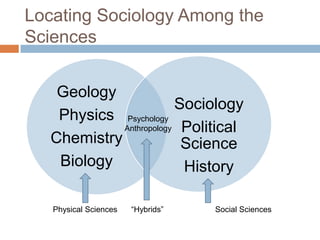
Locating Sociology Among the
Sciences


    Geology
                         Sociology
    Physics Psychology
             Anthropology Political
   Chemistry              Science
    Biology               History

   Physical Sciences   “Hybrids”   Social Sciences
Sociology and Biblical
Revelation
We are created in God‟s image (Gen. 1:27) and
  thus, sociology teaches about ourselves and
  God. Sociology is practical for ministers in that
  it helps us:
 Understand society

 Understand group dynamics

 Equips to do research on people

 Helps us sift between social myths and reality
  when making sense of social changes
 Separate data from interpretation
Sociology and Biblical Revelation,
pt.2
   Sociology has many common assumptions of
    the biblical worldview, but diverges greatly in
    others.
     Emphasis  on structures, institutions, and
      processes, rather than „ultimate meaning‟ or the
      existence of God
   Sociologists do, however, study world faiths to
    determine their social and subjective
    significance
   While most sociologists are value-free in their
    research, their pre-existing assumptions affect
    the types of questions they ask and how they
Sociology‟s Original Sin

   Combination of Scientific Revolution (17th
    century) and 18th century political revolutions
    (USA, France) upended existing assumptions
    of society
   In this environment, French philosopher
    Auguste Comte proposed that society was
    governed by scientific laws (statics and
    dynamics)
   Coined the term sociology from Latin socius
    (social) and Greek logos (study of)
   Sociologists would be high priests of this new
    religion
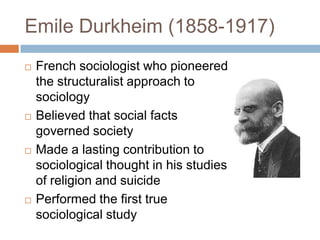
Emile Durkheim (1858-1917)
   French sociologist who pioneered
    the structuralist approach to
    sociology
   Believed that social facts
    governed society
   Made a lasting contribution to
    sociological thought in his studies
    of religion and suicide
   Performed the first true
    sociological study
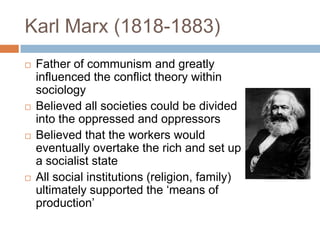
Karl Marx (1818-1883)
   Father of communism and greatly
    influenced the conflict theory within
    sociology
   Believed all societies could be divided
    into the oppressed and oppressors
   Believed that the workers would
    eventually overtake the rich and set up
    a socialist state
   All social institutions (religion, family)
    ultimately supported the „means of
    production‟
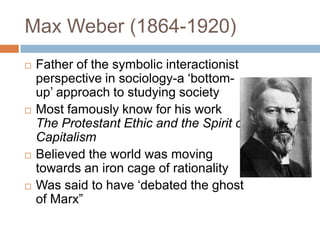
Max Weber (1864-1920)
   Father of the symbolic interactionist
    perspective in sociology-a „bottom-
    up‟ approach to studying society
   Most famously know for his work
    The Protestant Ethic and the Spirit of
    Capitalism
   Believed the world was moving
    towards an iron cage of rationality
   Was said to have „debated the ghost
    of Marx”
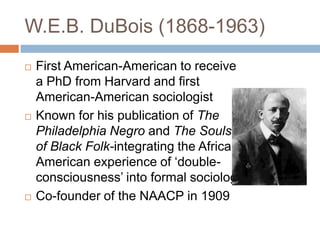
W.E.B. DuBois (1868-1963)
   First American-American to receive
    a PhD from Harvard and first
    American-American sociologist
   Known for his publication of The
    Philadelphia Negro and The Souls
    of Black Folk-integrating the African-
    American experience of „double-
    consciousness‟ into formal sociology
   Co-founder of the NAACP in 1909
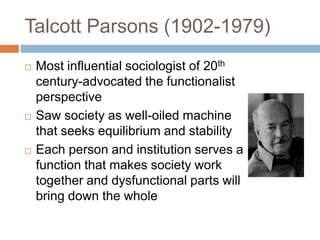
Talcott Parsons (1902-1979)
   Most influential sociologist of 20th
    century-advocated the functionalist
    perspective
   Saw society as well-oiled machine
    that seeks equilibrium and stability
   Each person and institution serves a
    function that makes society work
    together and dysfunctional parts will
    bring down the whole
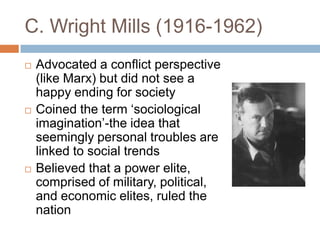
C. Wright Mills (1916-1962)
   Advocated a conflict perspective
    (like Marx) but did not see a
    happy ending for society
   Coined the term „sociological
    imagination‟-the idea that
    seemingly personal troubles are
    linked to social trends
   Believed that a power elite,
    comprised of military, political,
    and economic elites, ruled the
    nation

Introducing sociology

  • 1.
  • 2.
    What is sociology? PerKendall, sociology is the “systematic study of human society and social interaction”  Multiple scopes of analysis (macro, micro)  Based on scientific research, not „common sense‟, hunches, personal convictions, etc. It is possible to systematically to study groups of peoples because:  People are social beings  People act in routine, predictable ways (most of the time)
  • 3.
    Do people actin predictable ways? When you woke up this morning, how did you „choose‟ to dress? Clearly the „deck is stacked‟ in favor of people acting in predictable ways and thus a scientific study of society is possible!
  • 4.
    Sociology helps usdebunk social myths Answer true or false to the following statements: 1. The South was less segregated in 1950 than it was in 1890 2. States that have legalized gay marriage have much higher divorce rates 3. The reasons that people commit suicide cannot be measured by anything individualistic ones (ex. a sense of personal despair) 4. Countries with an established church (i.e. the Catholic Church in Spain, the Church of England) have higher rates of religious devotion than countries without a history of an official state church.
  • 5.
    The answer toall these is FALSE!!! 1. Jim Crow Laws didn‟t take effect until the early 1900‟s. Until then, it was quite common for white males to get haircuts, for example, from black barbers. 2. 5 out of the 10 states/jurisdictions with the lowest divorce rates are part of 9 jurisdictions that recognize/perform gay marriage (Link to article) 3. Certain social groups are more likely to commit suicide and suicide is more prevalent in times of social change 4. The US has never had an official state church, yet church attendance is far higher than in Western European countries (many of whom still have a state church)
  • 6.
    Why sociology overcasual observation?  Common sense is not at all common, nor does it make sense  Our observations are biased by our own assumptions and experiences  What seems like individual choices might actually be socially conditioned responses (ex. What we wear) “Things are not what they seem” -Famed sociologist Peter Berger
  • 7.
    The Study ofthe Painfully Obvious? Link
  • 8.
    Locating Sociology Amongthe Sciences Geology Sociology Physics Psychology Anthropology Political Chemistry Science Biology History Physical Sciences “Hybrids” Social Sciences
  • 9.
    Sociology and Biblical Revelation Weare created in God‟s image (Gen. 1:27) and thus, sociology teaches about ourselves and God. Sociology is practical for ministers in that it helps us:  Understand society  Understand group dynamics  Equips to do research on people  Helps us sift between social myths and reality when making sense of social changes  Separate data from interpretation
  • 10.
    Sociology and BiblicalRevelation, pt.2  Sociology has many common assumptions of the biblical worldview, but diverges greatly in others.  Emphasis on structures, institutions, and processes, rather than „ultimate meaning‟ or the existence of God  Sociologists do, however, study world faiths to determine their social and subjective significance  While most sociologists are value-free in their research, their pre-existing assumptions affect the types of questions they ask and how they
  • 11.
    Sociology‟s Original Sin  Combination of Scientific Revolution (17th century) and 18th century political revolutions (USA, France) upended existing assumptions of society  In this environment, French philosopher Auguste Comte proposed that society was governed by scientific laws (statics and dynamics)  Coined the term sociology from Latin socius (social) and Greek logos (study of)  Sociologists would be high priests of this new religion
  • 12.
    Emile Durkheim (1858-1917)  French sociologist who pioneered the structuralist approach to sociology  Believed that social facts governed society  Made a lasting contribution to sociological thought in his studies of religion and suicide  Performed the first true sociological study
  • 13.
    Karl Marx (1818-1883)  Father of communism and greatly influenced the conflict theory within sociology  Believed all societies could be divided into the oppressed and oppressors  Believed that the workers would eventually overtake the rich and set up a socialist state  All social institutions (religion, family) ultimately supported the „means of production‟
  • 14.
    Max Weber (1864-1920)  Father of the symbolic interactionist perspective in sociology-a „bottom- up‟ approach to studying society  Most famously know for his work The Protestant Ethic and the Spirit of Capitalism  Believed the world was moving towards an iron cage of rationality  Was said to have „debated the ghost of Marx”
  • 15.
    W.E.B. DuBois (1868-1963)  First American-American to receive a PhD from Harvard and first American-American sociologist  Known for his publication of The Philadelphia Negro and The Souls of Black Folk-integrating the African- American experience of „double- consciousness‟ into formal sociology  Co-founder of the NAACP in 1909
  • 16.
    Talcott Parsons (1902-1979)  Most influential sociologist of 20th century-advocated the functionalist perspective  Saw society as well-oiled machine that seeks equilibrium and stability  Each person and institution serves a function that makes society work together and dysfunctional parts will bring down the whole
  • 17.
    C. Wright Mills(1916-1962)  Advocated a conflict perspective (like Marx) but did not see a happy ending for society  Coined the term „sociological imagination‟-the idea that seemingly personal troubles are linked to social trends  Believed that a power elite, comprised of military, political, and economic elites, ruled the nation

Editor's Notes

  • #11 Notes:Sociology differs in that many sociologists would claim that truth is socially constructed….that there is not objective source of truth. Christians find truth in the word of God regardless of societal consensus. Debating the existence of God is not the realm of sociology, but finding the social meaning of religion and the affects of religion on society is.Pre-existing assumptions: Humans are a ‘blank slate’, Humans are morally neutral, not inherently sinfulIf you think that religion is used to oppress people, then you look for ways to prove that religious figures, by telling people to focus on the hereafter, are conspiring in their oppression. If you think that religion is the glue of society, then you will do research on ways that religion binds people together.
  • #12 Lecture NoteComnte believed three successive stages: the theological, the metaphysical, and the positivetheological stage, the human mind, in its search for the primary and final causes of phenomena, explains the apparent anomalies in the universe as interventions of supernatural agents. The second stage is only a simple modification of the first: the questions remain the same, but in the answers supernatural agents are replaced by abstract ideas, like universal human rights w/o reference to GodIn the positive state, the mind stops looking for causes of phenomena, and limits itself strictly to laws governing them; likewise, absolute notions are replaced by relative ones. In simple languages, he believed that science, rather than the Bible, would replace religion in its ability to explain how the world works.
  • #13 Durkeimhypthesized correctly that suicide was more likely in people who had lower levels of group solidarity and in societies in transition. He was correct in that he found that more Protestants than Catholics, unmarried people than married people, and lesser educated groups were more likely to committ suicide. From his research, he divided suicides into altruistic, anomic , and egoistic suicide.Altruistic-over concern for others-like terrorists who strap bombs to themselvesAnomic-Suicide that occurs in times of rapid social changeEgoistic-Due to loneliness and a commitment to personal values/reliance