Sociology – 11 th  Ed. John J. Macionis Seeing Ourselves: Classic, Contemporary, and Cross-Cultural Readings in Sociology, 7/E
Introduction to Sociology Marty W. Deane – Instructor Sociology – ASOC 115 MWF 11:30-12:25 –  Class # 8488 Office Hours – M/W 5:30-6:30 Graduate Office 306 Soc. Dept.
What Is Sociology? “ ...The  systematic study  of  human society   and  social behavior” Systematic Scientific discipline that focuses attention on patterns of behavior Human society Group behavior is primary focus; how groups influence individuals and vice versa At the “heart of sociology” The sociological perspective which offers a unique view of society
…and WHY DO PEOPLE DO THE THINGS THEY DO?
During class, carefully observe the interaction and behavior of the instructor and the other students.   What patterns do you see in who speaks?  What about how people use space?  What categories of people are taking the class in the first place… Think: race, social class, and gender, age.
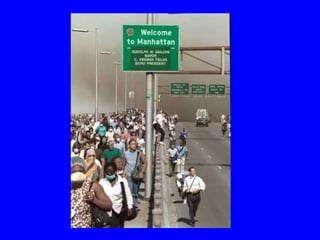
VA TECH Shooting  as a Societal Issue
EXAMPLES OF THINGS TO CONSIDER: Virginia Tech Shootings  – What was the reason for such a massacre?  (how could society have contributed?) When did it become a societal issue versus a personal issue?  (Sociological  V.  Psychological) What was the response to the shootings? Could Columbine have been an effect?
VA. TECH STUDENTS Police Response
Why Take Sociology? Education and liberal arts Well-rounded as a person Social expectations More appreciation for diversity The global village Domestic social marginality Enhanced life chances Micro and macro understanding Increase social potentials
To Understand Sociology: TWO things you must develop: Sociological Perspective Sociological Imagination
The Sociological Perspective
Keep in mind, that the perspective you take influences what you see One perspective emphasizes certain aspects of an event Another perspective accepts different aspects of the same event Same event – seen in different ways.
What do you see?
WHAT DO YOU SEE HERE?
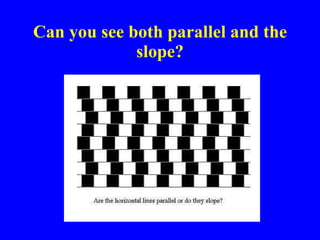
Can you see both parallel and the slope?
Benefits of the Sociological Perspective Helps us assess the truth of common sense Helps us assess both opportunities and constraints in our lives Empowers us to be active participants in our society Helps us live in a diverse world
 
Importance of Global Perspective (as a sociological perspective) Where we live makes a great difference in shaping our lives Societies throughout the world are increasingly interconnected through technology and economics Many problems that we faced in the united states are more serious elsewhere Thinking globally is a good way to learn more about ourselves
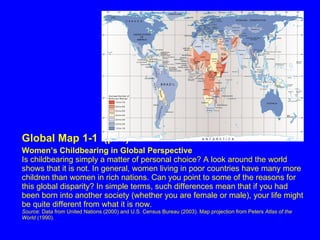
Global Map 1-1  (p. 4)   Women’s Childbearing in Global Perspective Is childbearing simply a matter of personal choice? A look around the world shows that it is not. In general, women living in poor countries have many more children than women in rich nations. Can you point to some of the reasons for this global disparity? In simple terms, such differences mean that if you had been born into another society (whether you are female or male), your life might be quite different from what it is now. Source : Data from United Nations (2000) and U.S. Census Bureau (2003). Map projection from Peters  Atlas of the World  (1990).
The Sociological Perspective: Peter Berger (1963) Seeing the  general  in the  particular Sociologists identify general social patterns  in the behavior of particular individuals Individuals are unique but, society’s social forces shape us into “kinds” of people (e.g. Women, Catholics, Hispanics) Seeing the  strange  in the  familiar Giving up the idea that human behavior is simply a matter of what individuals  decide  to do (e.g. who is more likely to divorce?)  Understanding that society shapes our lives
Sociological Perspective People are influenced by their society An individual’s identity is socially bestowed  (who we are – and how people treat us are usually consequences of our social location in society) Our personalities are shaped by the way we are accepted, rejected, and defined by other people.   (e.g. are we worthy – depends on the values of the groups in which we are immersed)
Applying the Sociological Perspective Periods of crisis or social change prompt people to think sociologically: (e.g. Great Depression: Something is wrong with me, I can’t find a job! (personal) Thinking sociologically : The economy has collapsed there are few jobs to be found – it isn’t just me)
Sociological Imagination C. Wright Mills 1959
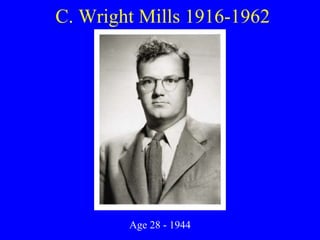
C. Wright Mills 1916-1962 Age 28 - 1944
C. Wright Mills Mills traveled via motorcycle back and forth to Columbia University
C. Wright Mills’ Sociological Imagination The power of the sociological perspective lies not just in changing individual lives but in transforming society Society, (not personal failings) is a root cause of social problems The sociological imagination transforms personal problems into public issues
Sociological Imagination … .enables us to grasp the connection between history and biography Turns personal problems into public issues The Society in which we grow up, and our particular location in that society, lie at the center of what we do and what we think. To understand others issues – think of the social forces that are affecting their lives.
Beloit College Mindset List College Entry  - Class of 2011 What Berlin Wall? They never rolled down a car window They grew up with bottled water Women have always been police chiefs in major cities They grew up in Wayne’s world Classmates could include Michelle Wie, Jordin Sparks , and Bart Simpson *Beloit College is in Wisconsin and started doing the lists in 2002 They were started to prevent “hardening of the references”
Mindset Continued…. Incoming 2011…. … U2 has always been more than a spy plane Being a latchkey kid has never been a big deal They’re always texting one another MTV has never featured music videos Most phone calls have never been private They drove their parents crazy with the Bevis and Butt-head laugh
Mills Basic Assumptions Human beings cannot be understood apart from the social and historical structures in which they are formed and in which they interact The sociological imagination is simply a “quality of mind” that allows us to grasp “history” and biography” and the relations between the two within society.
Major Sociological Theories
All the Discussion about Perspective – Leads to “The Big Three” Structural-Functional - Macro Social Conflict - Macro Symbolic Interactionism - Micro
Sociological Theory Theory : a statement of how and why facts are related Explains social behavior to the real world Theoretical paradigm : a set of fundamental assumptions that guides theory
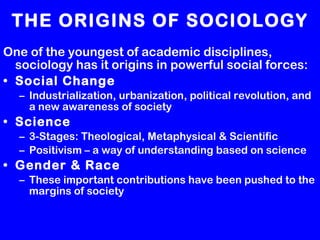
THE ORIGINS OF SOCIOLOGY One of the youngest of academic disciplines, sociology has it origins in powerful social forces: Social Change Industrialization, urbanization, political revolution, and a new awareness of society Science 3-Stages: Theological, Metaphysical & Scientific Positivism – a way of understanding based on science  Gender & Race These important contributions have been pushed to the margins of society
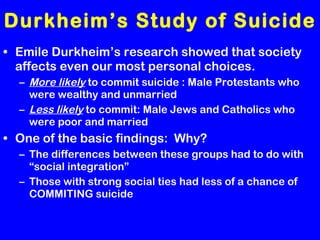
Durkheim’s Study of Suicide Emile Durkheim’s research showed that society affects even our most personal choices. More likely  to commit suicide : Male Protestants who were wealthy and unmarried Less likely  to commit: Male Jews and Catholics who were poor and married One of the basic findings:  Why? The differences between these groups had to do with “social integration” Those with strong social ties had less of a chance of COMMITING suicide
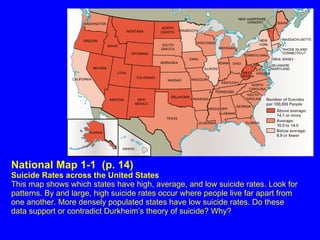
National Map 1-1  (p. 14) Suicide Rates across the United States This map shows which states have high, average, and low suicide rates. Look for patterns. By and large, high suicide rates occur where people live far apart from one another. More densely populated states have low suicide rates. Do these data support or contradict Durkheim’s theory of suicide? Why?
Teenage Wasteland 1967-1994
History and Biography Jimmie Hendrix 1970 Janis Joplin - 1970 Jim Morrison 1971
Structural –Functional Paradigm The basics A macro-level orientation, concerned with broad patterns that shape society as a whole Views society as a complex system whose parts work together to promote solidarity and stability  Key elements : Social structure refers to any relatively stable patterns of social behavior found in social institutions Social function refers to the consequences for the operation of society as a whole
Who’s Who in Structural-Functional Paradigm Auguste Comte Importance of social integration during times of rapid change Emile Durkheim Helped establish sociology as a university discipline/Major study of suicide Herbert Spencer Compared society to the human body, organic approach Talcott Parsons Sought to identify tasks that every society must perform Robert K. Merton Manifest functions are recognized and intended consequences Latent functions are unrecognized and unintended consequences Social dysfunctions are undesirable consequences
Social-Conflict Paradigm The Basics : A macro-oriented paradigm Views society as an arena of inequality that generates conflict and social change Key elements : Society is structured in ways to benefit a few at the expense of the majority Factors such as race, sex, class, and age are linked to social inequality Dominant group vs. Minority group relations Incompatible interests and major differences
Who’s Who in Social-Conflict Paradigm Karl Marx Society is a complex system characterized by inequality and conflict that generate social change W.E.B. DuBois Race as the major problem facing the United States in the twentieth century Jane Adams Although trained at the University of Chicago – was not considered a serious Sociologist because she was female Harriet Martineau First female Sociologist and fought for changes in educational policy – so women could have choices other than home.
Symbolic  Interaction Paradigm The Basics : A micro-level orientation, a close-up focus on social interactions in specific situations   Views society as the product of everyday interactions of individuals Key elements :  Society is nothing more than the shared reality that people construct as they interact with one another Society is a complex, ever-changing mosaic of subjective meanings
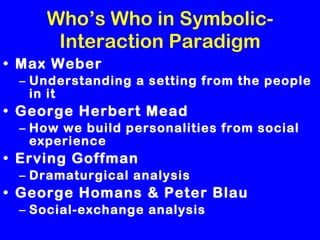
Who’s Who in Symbolic-Interaction Paradigm Max Weber Understanding a setting from the people in it George Herbert Mead How we build personalities from social experience Erving Goffman Dramaturgical analysis George Homans & Peter Blau Social-exchange analysis
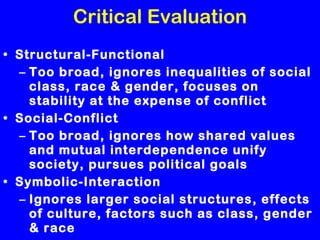
Critical Evaluation Structural-Functional Too broad, ignores inequalities of social class, race & gender, focuses on stability at the expense of conflict Social-Conflict Too broad, ignores how shared values and mutual interdependence unify society, pursues political goals Symbolic-Interaction Ignores larger social structures, effects of culture, factors such as class, gender & race
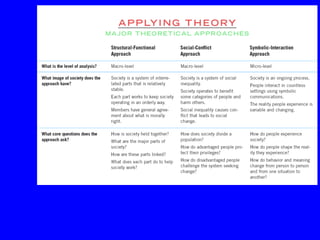
Applying Theory  (p. 22) Major Theoretical Perspectives

Chapter 1

  • 1.
    Sociology – 11th Ed. John J. Macionis Seeing Ourselves: Classic, Contemporary, and Cross-Cultural Readings in Sociology, 7/E
  • 2.
    Introduction to SociologyMarty W. Deane – Instructor Sociology – ASOC 115 MWF 11:30-12:25 – Class # 8488 Office Hours – M/W 5:30-6:30 Graduate Office 306 Soc. Dept.
  • 3.
    What Is Sociology?“ ...The systematic study of human society and social behavior” Systematic Scientific discipline that focuses attention on patterns of behavior Human society Group behavior is primary focus; how groups influence individuals and vice versa At the “heart of sociology” The sociological perspective which offers a unique view of society
  • 4.
    …and WHY DOPEOPLE DO THE THINGS THEY DO?
  • 5.
    During class, carefullyobserve the interaction and behavior of the instructor and the other students. What patterns do you see in who speaks? What about how people use space? What categories of people are taking the class in the first place… Think: race, social class, and gender, age.
  • 6.
    VA TECH Shooting as a Societal Issue
  • 7.
    EXAMPLES OF THINGSTO CONSIDER: Virginia Tech Shootings – What was the reason for such a massacre? (how could society have contributed?) When did it become a societal issue versus a personal issue? (Sociological V. Psychological) What was the response to the shootings? Could Columbine have been an effect?
  • 8.
    VA. TECH STUDENTSPolice Response
  • 9.
    Why Take Sociology?Education and liberal arts Well-rounded as a person Social expectations More appreciation for diversity The global village Domestic social marginality Enhanced life chances Micro and macro understanding Increase social potentials
  • 10.
    To Understand Sociology:TWO things you must develop: Sociological Perspective Sociological Imagination
  • 11.
  • 12.
    Keep in mind,that the perspective you take influences what you see One perspective emphasizes certain aspects of an event Another perspective accepts different aspects of the same event Same event – seen in different ways.
  • 13.
  • 14.
    WHAT DO YOUSEE HERE?
  • 15.
    Can you seeboth parallel and the slope?
  • 16.
    Benefits of theSociological Perspective Helps us assess the truth of common sense Helps us assess both opportunities and constraints in our lives Empowers us to be active participants in our society Helps us live in a diverse world
  • 17.
  • 18.
    Importance of GlobalPerspective (as a sociological perspective) Where we live makes a great difference in shaping our lives Societies throughout the world are increasingly interconnected through technology and economics Many problems that we faced in the united states are more serious elsewhere Thinking globally is a good way to learn more about ourselves
  • 19.
    Global Map 1-1 (p. 4) Women’s Childbearing in Global Perspective Is childbearing simply a matter of personal choice? A look around the world shows that it is not. In general, women living in poor countries have many more children than women in rich nations. Can you point to some of the reasons for this global disparity? In simple terms, such differences mean that if you had been born into another society (whether you are female or male), your life might be quite different from what it is now. Source : Data from United Nations (2000) and U.S. Census Bureau (2003). Map projection from Peters Atlas of the World (1990).
  • 20.
    The Sociological Perspective:Peter Berger (1963) Seeing the general in the particular Sociologists identify general social patterns in the behavior of particular individuals Individuals are unique but, society’s social forces shape us into “kinds” of people (e.g. Women, Catholics, Hispanics) Seeing the strange in the familiar Giving up the idea that human behavior is simply a matter of what individuals decide to do (e.g. who is more likely to divorce?) Understanding that society shapes our lives
  • 21.
    Sociological Perspective Peopleare influenced by their society An individual’s identity is socially bestowed (who we are – and how people treat us are usually consequences of our social location in society) Our personalities are shaped by the way we are accepted, rejected, and defined by other people. (e.g. are we worthy – depends on the values of the groups in which we are immersed)
  • 22.
    Applying the SociologicalPerspective Periods of crisis or social change prompt people to think sociologically: (e.g. Great Depression: Something is wrong with me, I can’t find a job! (personal) Thinking sociologically : The economy has collapsed there are few jobs to be found – it isn’t just me)
  • 23.
    Sociological Imagination C.Wright Mills 1959
  • 24.
    C. Wright Mills1916-1962 Age 28 - 1944
  • 25.
    C. Wright MillsMills traveled via motorcycle back and forth to Columbia University
  • 26.
    C. Wright Mills’Sociological Imagination The power of the sociological perspective lies not just in changing individual lives but in transforming society Society, (not personal failings) is a root cause of social problems The sociological imagination transforms personal problems into public issues
  • 27.
    Sociological Imagination ….enables us to grasp the connection between history and biography Turns personal problems into public issues The Society in which we grow up, and our particular location in that society, lie at the center of what we do and what we think. To understand others issues – think of the social forces that are affecting their lives.
  • 28.
    Beloit College MindsetList College Entry - Class of 2011 What Berlin Wall? They never rolled down a car window They grew up with bottled water Women have always been police chiefs in major cities They grew up in Wayne’s world Classmates could include Michelle Wie, Jordin Sparks , and Bart Simpson *Beloit College is in Wisconsin and started doing the lists in 2002 They were started to prevent “hardening of the references”
  • 29.
    Mindset Continued…. Incoming2011…. … U2 has always been more than a spy plane Being a latchkey kid has never been a big deal They’re always texting one another MTV has never featured music videos Most phone calls have never been private They drove their parents crazy with the Bevis and Butt-head laugh
  • 30.
    Mills Basic AssumptionsHuman beings cannot be understood apart from the social and historical structures in which they are formed and in which they interact The sociological imagination is simply a “quality of mind” that allows us to grasp “history” and biography” and the relations between the two within society.
  • 31.
  • 32.
    All the Discussionabout Perspective – Leads to “The Big Three” Structural-Functional - Macro Social Conflict - Macro Symbolic Interactionism - Micro
  • 33.
    Sociological Theory Theory: a statement of how and why facts are related Explains social behavior to the real world Theoretical paradigm : a set of fundamental assumptions that guides theory
  • 34.
    THE ORIGINS OFSOCIOLOGY One of the youngest of academic disciplines, sociology has it origins in powerful social forces: Social Change Industrialization, urbanization, political revolution, and a new awareness of society Science 3-Stages: Theological, Metaphysical & Scientific Positivism – a way of understanding based on science Gender & Race These important contributions have been pushed to the margins of society
  • 35.
    Durkheim’s Study ofSuicide Emile Durkheim’s research showed that society affects even our most personal choices. More likely to commit suicide : Male Protestants who were wealthy and unmarried Less likely to commit: Male Jews and Catholics who were poor and married One of the basic findings: Why? The differences between these groups had to do with “social integration” Those with strong social ties had less of a chance of COMMITING suicide
  • 36.
    National Map 1-1 (p. 14) Suicide Rates across the United States This map shows which states have high, average, and low suicide rates. Look for patterns. By and large, high suicide rates occur where people live far apart from one another. More densely populated states have low suicide rates. Do these data support or contradict Durkheim’s theory of suicide? Why?
  • 37.
  • 38.
    History and BiographyJimmie Hendrix 1970 Janis Joplin - 1970 Jim Morrison 1971
  • 39.
    Structural –Functional ParadigmThe basics A macro-level orientation, concerned with broad patterns that shape society as a whole Views society as a complex system whose parts work together to promote solidarity and stability Key elements : Social structure refers to any relatively stable patterns of social behavior found in social institutions Social function refers to the consequences for the operation of society as a whole
  • 40.
    Who’s Who inStructural-Functional Paradigm Auguste Comte Importance of social integration during times of rapid change Emile Durkheim Helped establish sociology as a university discipline/Major study of suicide Herbert Spencer Compared society to the human body, organic approach Talcott Parsons Sought to identify tasks that every society must perform Robert K. Merton Manifest functions are recognized and intended consequences Latent functions are unrecognized and unintended consequences Social dysfunctions are undesirable consequences


  • 41.
    Social-Conflict Paradigm TheBasics : A macro-oriented paradigm Views society as an arena of inequality that generates conflict and social change Key elements : Society is structured in ways to benefit a few at the expense of the majority Factors such as race, sex, class, and age are linked to social inequality Dominant group vs. Minority group relations Incompatible interests and major differences
  • 42.
    Who’s Who inSocial-Conflict Paradigm Karl Marx Society is a complex system characterized by inequality and conflict that generate social change W.E.B. DuBois Race as the major problem facing the United States in the twentieth century Jane Adams Although trained at the University of Chicago – was not considered a serious Sociologist because she was female Harriet Martineau First female Sociologist and fought for changes in educational policy – so women could have choices other than home.
  • 43.
    Symbolic InteractionParadigm The Basics : A micro-level orientation, a close-up focus on social interactions in specific situations Views society as the product of everyday interactions of individuals Key elements : Society is nothing more than the shared reality that people construct as they interact with one another Society is a complex, ever-changing mosaic of subjective meanings
  • 44.
    Who’s Who inSymbolic-Interaction Paradigm Max Weber Understanding a setting from the people in it George Herbert Mead How we build personalities from social experience Erving Goffman Dramaturgical analysis George Homans & Peter Blau Social-exchange analysis
  • 45.
    Critical Evaluation Structural-FunctionalToo broad, ignores inequalities of social class, race & gender, focuses on stability at the expense of conflict Social-Conflict Too broad, ignores how shared values and mutual interdependence unify society, pursues political goals Symbolic-Interaction Ignores larger social structures, effects of culture, factors such as class, gender & race
  • 46.
    Applying Theory (p. 22) Major Theoretical Perspectives