• 1. What is Sociology? Chapter 1 Introduction to Sociology Ninth 
Edition Anthony Giddens, Mitchell Duneier, Richard P. 
Appelbaum, & Deborah Carr 
• 2. Learning Objectives • Basic Concepts – Learn what sociology 
encompasses and how everyday topics are shaped by social 
and historical forces – Recognize that sociology involves not 
only acquiring knowledge but also developing a sociological 
imagination • The Development of Sociological Thinking – 
Learn how sociology originated and understand the 
significance of the intellectual contributions of early 
sociologists 
• 3. Learning Objectives • Modern Theoretical Approaches – Be 
able to identify some of the leading theorists and distinguish 
between their theoretical approaches to social life • How Can 
Sociology Help Us? – Identify the practical implications of 
sociology 
• 4. Basic Concepts • What is Sociology? • Sociology is the 
scientific study of the connection between the individual and 
social structure. • Sociology examines the underlying patterns 
in human behavior and our relationships with one another. • 
C. Wright Mills (1959) coined the term the sociological 
imagination 
• 5. Basic Concepts • Social Construction – An idea or practice that 
a group of people agree exists • Maintained over time by 
people taking its existence for granted • What people think 
and do are products of culture and history
• 6. Basic Concepts • Socialization – The social processes through 
which children develop an awareness of social norms and 
values and achieve a distinct sense of self • An explanation 
for social order • Norms reflect divisions of power and class 
• 7. Basic Concepts • Agency and Structure – Concepts that 
suggest to what extent an individual's life is determined by 
social forces • Sociological explanations are probabilistic • 
Individuals have the capacity to deviate from patterns, to go 
against the odds 
• 8. Basic Concepts • Social Change – How are the times in which 
we are living different from the times that came before? • 
Social life is dynamic; it is constantly changing • 
Understanding the present relies on understanding the past 
• 
• 9. The Development of Sociological Thinking • Sociology is 
rooted in questions about social change, social conflict, and 
social problems brought on by industrialization and 
urbanization. • Early sociologists continue to influence 
contemporary sociology. 
• 10. • Auguste Comte – French philosopher who coined the term 
sociology – How do societies overcome chaos? – Scientific 
knowledge can be used to improve people’s lives 
• 11. • Émile Durkheim – Used scientific principles and methods to 
study social facts – Organic solidarity comes from the 
interdependence of society’s different parts and shared 
values.
• 12. • Émile Durkheim – Study of suicide examined the anomie 
that comes when social constraints break down during 
periods of rapid social change. 
• 13. • Karl Marx – In his materialist conception of history, the 
driving force for social change and the source of conflict in 
society is economics. – Conflict brought on by the 
exploitation of the poor by the rich under capitalism will 
bring social change. 
• 14. • Max Weber – Values and ideas drive social change – 
Christian beliefs led to capitalism 
• 15. • Max Weber – Bureaucracy—a type of organization marked 
by a clear hierarchy of authority and the existence of written 
rules of procedure and staffed by full-time, salaried officials 
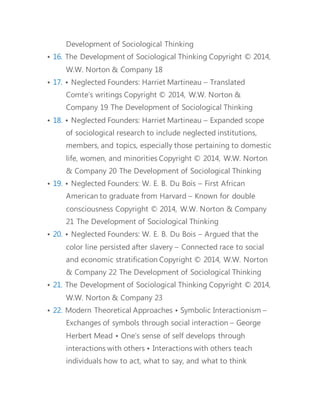
• 16. The Development of Sociological Thinking 
• 17. • Neglected Founders: Harriet Martineau – Translated 
Comte’s writings 
• 18. • Neglected Founders: Harriet Martineau – Expanded scope 
of sociological research to include neglected institutions, 
members, and topics, especially those pertaining to domestic 
life, women, and 
• 19. • Neglected Founders: W. E. B. Du Bois – First African 
American to graduate from Harvard – Known for double 
consciousness 
• 20. • Neglected Founders: W. E. B. Du Bois – Argued that the 
color line persisted after slavery – Connected race to social 
and economic stratification
• 21. The Development of Sociological Thinking 22. Modern 
Theoretical Approaches • Symbolic Interactionism – 
Exchanges of symbols through social interaction – George 
Herbert Mead • One’s sense of self develops through 
interactions with others • Interactions with others teach 
individuals how to act, what to say, and what to 
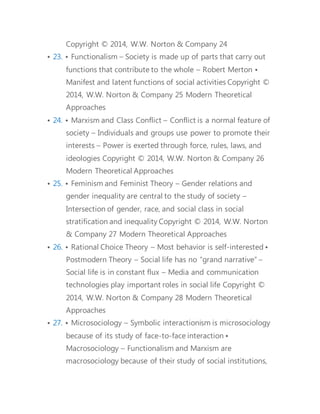
• 23. • Functionalism – Society is made up of parts that carry out 
functions that contribute to the whole – Robert Merton • 
Manifest and latent functions of social activities 
• 24. • Marxism and Class Conflict – Conflict is a normal feature of 
society – Individuals and groups use power to promote their 
interests – Power is exerted through force, rules, laws, and 
ideologies 
• 25. • Feminism and Feminist Theory – Gender relations and 
gender inequality are central to the study of society – 
Intersection of gender, race, and social class in social 
stratification and inequality 
• 26. • Rational Choice Theory – Most behavior is self-interested • 
Postmodern Theory – Social life has no “grand narrative” – 
Social life is in constant flux – Media and communication 
technologies play important roles in social 
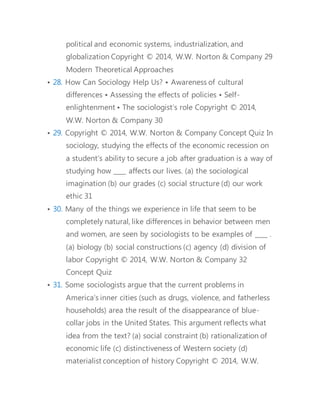
• 27. • Microsociology – Symbolic interactionism is microsociology 
because of its study of face-to-face interaction • 
Macrosociology – Functionalism and Marxism are 
macrosociology because of their study of social institutions, 
political and economic systems, industrialization, and
globalization 
• 28. How Can Sociology Help Us? • Awareness of cultural 
differences • Assessing the effects of policies • Self-enlightenment 
• The sociologist’s role 
• 29. In sociology, studying the effects of the economic recession 
on a student’s ability to secure a job after graduation is a 
way of studying how ____ affects our lives. (a) the sociological 
imagination (b) our grades (c) social structure (d) our work 
ethic 31 
• 30. Many of the things we experience in life that seem to be 
completely natural, like differences in behavior between men 
and women, are seen by sociologists to be examples of ____ . 
(a) biology (b) social constructions (c) agency (d) division of 
labor 
• 31. Some sociologists argue that the current problems in 
America’s inner cities (such as drugs, violence, and fatherless 
households) area the result of the disappearance of blue-collar 
jobs in the United States. This argument reflects what 
idea from the text? (a) social constraint (b) rationalization of 
economic life (c) distinctiveness of Western society (d) 
materialist conception of history 
• 32. A bureaucracy is a type of organization that depends on 
which of the following? (a) office buildings (b) division of 
labor (c) social constraint (d) computer systems 
• 33. The ability of individuals or members of a group to achieve 
aims or further their interests, even in the face of the
resistance of others, is called ___ . (a) determination (b) 
violence (c) power (d) ideology 
• 34. A study of university admissions that compares the impact of 
gender and social class on probability of admission before 
World War II and after World War II is an example of ___ . (a) 
Marxism (b) macrosociology (c) functionalism (d) 
microsociology 
• 35. Healthy older Americans often encounter exclusionary 
treatment when younger people assume they are 
feebleminded and thus overlook them for jobs they are fully 
capable of doing. How would functionalism and symbolic 
interactionism explain the dynamics of prejudice against the 
elderly? 
• 36. Coffee drinking is a cultural fixture that says as much about 
us as it does about the bean itself. Coffee is more than a 
simple product designed to quench a person’s thirst and 
fend off drowsiness. Discuss five sociological features of 
coffee consumption that show its “sociological” nature. 
• 37. This concludes the Lecture PowerPoint presentation for 
Chapter 1

Vermette - Transcript - Chapter 1 what is sociology?

  • 1.
    • 1. Whatis Sociology? Chapter 1 Introduction to Sociology Ninth Edition Anthony Giddens, Mitchell Duneier, Richard P. Appelbaum, & Deborah Carr • 2. Learning Objectives • Basic Concepts – Learn what sociology encompasses and how everyday topics are shaped by social and historical forces – Recognize that sociology involves not only acquiring knowledge but also developing a sociological imagination • The Development of Sociological Thinking – Learn how sociology originated and understand the significance of the intellectual contributions of early sociologists • 3. Learning Objectives • Modern Theoretical Approaches – Be able to identify some of the leading theorists and distinguish between their theoretical approaches to social life • How Can Sociology Help Us? – Identify the practical implications of sociology • 4. Basic Concepts • What is Sociology? • Sociology is the scientific study of the connection between the individual and social structure. • Sociology examines the underlying patterns in human behavior and our relationships with one another. • C. Wright Mills (1959) coined the term the sociological imagination • 5. Basic Concepts • Social Construction – An idea or practice that a group of people agree exists • Maintained over time by people taking its existence for granted • What people think and do are products of culture and history
  • 2.
    • 6. BasicConcepts • Socialization – The social processes through which children develop an awareness of social norms and values and achieve a distinct sense of self • An explanation for social order • Norms reflect divisions of power and class • 7. Basic Concepts • Agency and Structure – Concepts that suggest to what extent an individual's life is determined by social forces • Sociological explanations are probabilistic • Individuals have the capacity to deviate from patterns, to go against the odds • 8. Basic Concepts • Social Change – How are the times in which we are living different from the times that came before? • Social life is dynamic; it is constantly changing • Understanding the present relies on understanding the past • • 9. The Development of Sociological Thinking • Sociology is rooted in questions about social change, social conflict, and social problems brought on by industrialization and urbanization. • Early sociologists continue to influence contemporary sociology. • 10. • Auguste Comte – French philosopher who coined the term sociology – How do societies overcome chaos? – Scientific knowledge can be used to improve people’s lives • 11. • Émile Durkheim – Used scientific principles and methods to study social facts – Organic solidarity comes from the interdependence of society’s different parts and shared values.
  • 3.
    • 12. •Émile Durkheim – Study of suicide examined the anomie that comes when social constraints break down during periods of rapid social change. • 13. • Karl Marx – In his materialist conception of history, the driving force for social change and the source of conflict in society is economics. – Conflict brought on by the exploitation of the poor by the rich under capitalism will bring social change. • 14. • Max Weber – Values and ideas drive social change – Christian beliefs led to capitalism • 15. • Max Weber – Bureaucracy—a type of organization marked by a clear hierarchy of authority and the existence of written rules of procedure and staffed by full-time, salaried officials • 16. The Development of Sociological Thinking • 17. • Neglected Founders: Harriet Martineau – Translated Comte’s writings • 18. • Neglected Founders: Harriet Martineau – Expanded scope of sociological research to include neglected institutions, members, and topics, especially those pertaining to domestic life, women, and • 19. • Neglected Founders: W. E. B. Du Bois – First African American to graduate from Harvard – Known for double consciousness • 20. • Neglected Founders: W. E. B. Du Bois – Argued that the color line persisted after slavery – Connected race to social and economic stratification
  • 4.
    • 21. TheDevelopment of Sociological Thinking 22. Modern Theoretical Approaches • Symbolic Interactionism – Exchanges of symbols through social interaction – George Herbert Mead • One’s sense of self develops through interactions with others • Interactions with others teach individuals how to act, what to say, and what to • 23. • Functionalism – Society is made up of parts that carry out functions that contribute to the whole – Robert Merton • Manifest and latent functions of social activities • 24. • Marxism and Class Conflict – Conflict is a normal feature of society – Individuals and groups use power to promote their interests – Power is exerted through force, rules, laws, and ideologies • 25. • Feminism and Feminist Theory – Gender relations and gender inequality are central to the study of society – Intersection of gender, race, and social class in social stratification and inequality • 26. • Rational Choice Theory – Most behavior is self-interested • Postmodern Theory – Social life has no “grand narrative” – Social life is in constant flux – Media and communication technologies play important roles in social • 27. • Microsociology – Symbolic interactionism is microsociology because of its study of face-to-face interaction • Macrosociology – Functionalism and Marxism are macrosociology because of their study of social institutions, political and economic systems, industrialization, and
  • 5.
    globalization • 28.How Can Sociology Help Us? • Awareness of cultural differences • Assessing the effects of policies • Self-enlightenment • The sociologist’s role • 29. In sociology, studying the effects of the economic recession on a student’s ability to secure a job after graduation is a way of studying how ____ affects our lives. (a) the sociological imagination (b) our grades (c) social structure (d) our work ethic 31 • 30. Many of the things we experience in life that seem to be completely natural, like differences in behavior between men and women, are seen by sociologists to be examples of ____ . (a) biology (b) social constructions (c) agency (d) division of labor • 31. Some sociologists argue that the current problems in America’s inner cities (such as drugs, violence, and fatherless households) area the result of the disappearance of blue-collar jobs in the United States. This argument reflects what idea from the text? (a) social constraint (b) rationalization of economic life (c) distinctiveness of Western society (d) materialist conception of history • 32. A bureaucracy is a type of organization that depends on which of the following? (a) office buildings (b) division of labor (c) social constraint (d) computer systems • 33. The ability of individuals or members of a group to achieve aims or further their interests, even in the face of the
  • 6.
    resistance of others,is called ___ . (a) determination (b) violence (c) power (d) ideology • 34. A study of university admissions that compares the impact of gender and social class on probability of admission before World War II and after World War II is an example of ___ . (a) Marxism (b) macrosociology (c) functionalism (d) microsociology • 35. Healthy older Americans often encounter exclusionary treatment when younger people assume they are feebleminded and thus overlook them for jobs they are fully capable of doing. How would functionalism and symbolic interactionism explain the dynamics of prejudice against the elderly? • 36. Coffee drinking is a cultural fixture that says as much about us as it does about the bean itself. Coffee is more than a simple product designed to quench a person’s thirst and fend off drowsiness. Discuss five sociological features of coffee consumption that show its “sociological” nature. • 37. This concludes the Lecture PowerPoint presentation for Chapter 1