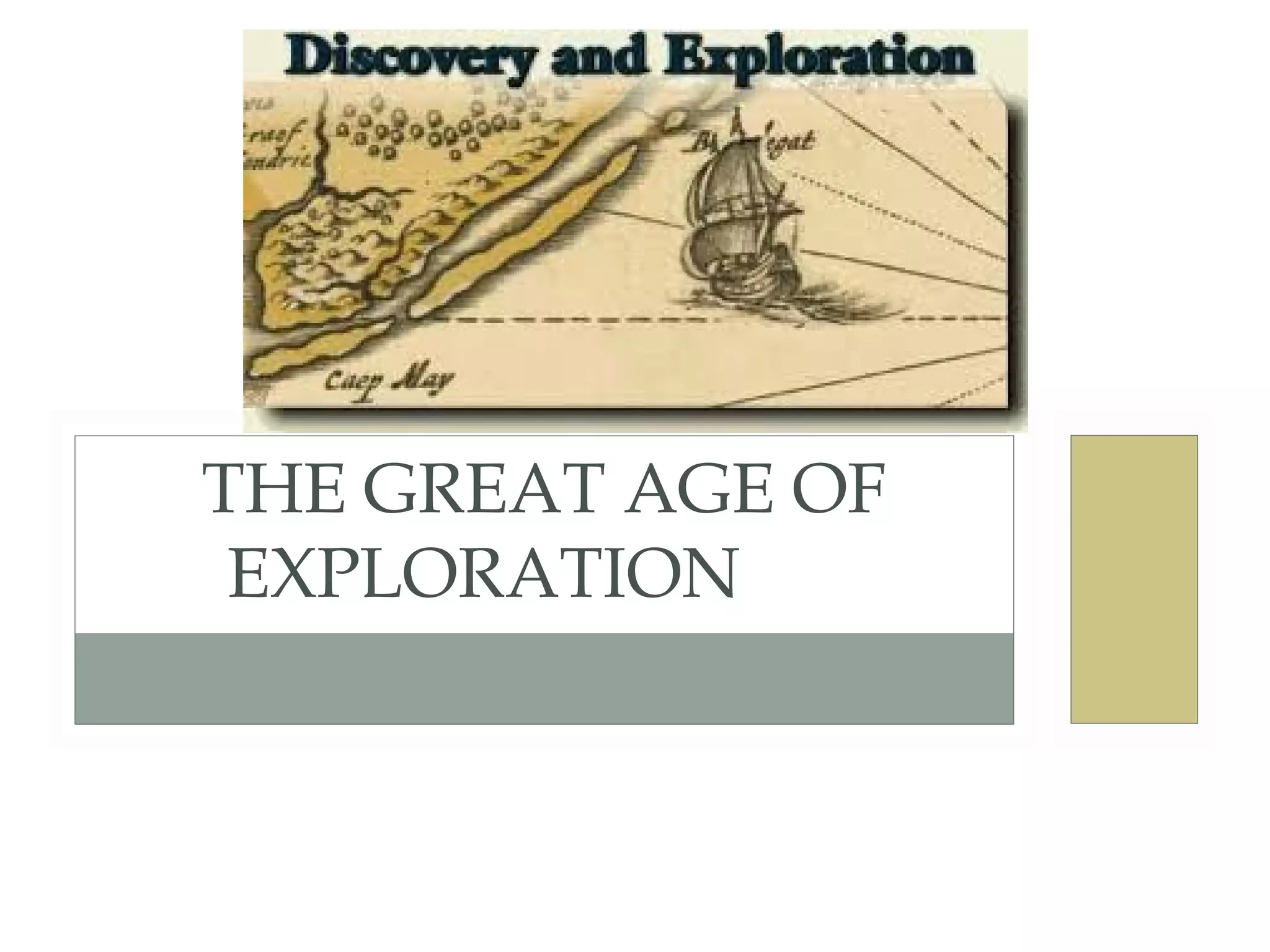
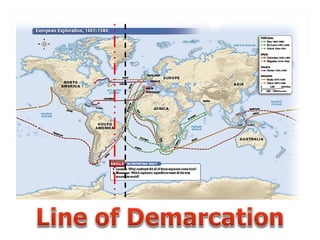
THE GREAT AGE OF
EXPLORATION
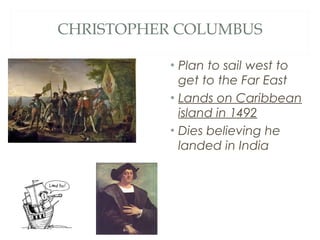
CHRISTOPHER COLUMBUS
• Plan to sail west to
get to the Far East
• Lands on Caribbean
island in 1492
• Dies believing he
landed in India
• 1501 – Amerigo Vespucci, an Italian
sailing for Portugal, explored the coast
of Brazil. He drew maps and wrote
about what he saw.
• 1507 – a mapmaker read Vespucci’s
observations and named the “new”
continent America in his honor.
• 1519 - Ferdinand Magellan left Spain
and was the first explorer to sail
around the tip of South America and
circumnavigate, or go all the way
around, the globe.
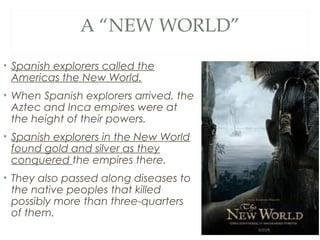
A “NEW WORLD”
• Spanish explorers called the
Americas the New World.
• When Spanish explorers arrived, the
Aztec and Inca empires were at
the height of their powers.
• Spanish explorers in the New World
found gold and silver as they
conquered the empires there.
• They also passed along diseases to
the native peoples that killed
possibly more than three-quarters
of them.
THE ENGLISH AND FRENCH IN
AMERICA
• Since the Spanish and
Portuguese already held
the southern routes
through the Americas,
the English and French
explored northern routes.
• Although a northern
route to Asia was not
established, these
explorers claimed
northern lands for
England and for France.
ENGLISH EXPLORATION
• 1497 & 1498 – Supported by King Henry VII, Italian
explorer John Cabot sailed along the northeast
coast of North America and claimed the land for
England.
• Elizabeth I – provided money for Francis Drake, John
Hawkins, and Walter Raleigh.
THE SPANISH ARMADA
• The Spanish controlled the gold
and silver from the former Aztec
and Inca empires.
• An English sailor named Francis
Drake began stealing gold and
silver from the Spanish ships.
• The Spanish were angry with the
English for these raids and sent
130 ships, known as the Spanish
Armada, to attack England.
• The English ships were faster and
had better weapons. They were
able to defeat the Spanish.
A NEW EUROPEAN WORLDVIEW
• The explorations brought new knowledge
and geography and proved that some old
beliefs were wrong.
• Geographers made more-accurate maps
that reflected new knowledge.
• New trade routes gave more opportunities
for wealth and resources.
• Europeans spread their influence around the
world by establishing colonies and setting up
new trade routes.
A NEW EUROPEAN WORLDVIEW
• The explorations brought new knowledge
and geography and proved that some old
beliefs were wrong.
• Geographers made more-accurate maps
that reflected new knowledge.
• New trade routes gave more opportunities
for wealth and resources.
• Europeans spread their influence around the
world by establishing colonies and setting up
new trade routes.

Intro to exploration

  • 1.
    THE GREAT AGEOF EXPLORATION
  • 2.
    CHRISTOPHER COLUMBUS • Planto sail west to get to the Far East • Lands on Caribbean island in 1492 • Dies believing he landed in India
  • 3.
    • 1501 –Amerigo Vespucci, an Italian sailing for Portugal, explored the coast of Brazil. He drew maps and wrote about what he saw. • 1507 – a mapmaker read Vespucci’s observations and named the “new” continent America in his honor. • 1519 - Ferdinand Magellan left Spain and was the first explorer to sail around the tip of South America and circumnavigate, or go all the way around, the globe.
  • 5.
    A “NEW WORLD” •Spanish explorers called the Americas the New World. • When Spanish explorers arrived, the Aztec and Inca empires were at the height of their powers. • Spanish explorers in the New World found gold and silver as they conquered the empires there. • They also passed along diseases to the native peoples that killed possibly more than three-quarters of them.
  • 6.
    THE ENGLISH ANDFRENCH IN AMERICA • Since the Spanish and Portuguese already held the southern routes through the Americas, the English and French explored northern routes. • Although a northern route to Asia was not established, these explorers claimed northern lands for England and for France.
  • 7.
    ENGLISH EXPLORATION • 1497& 1498 – Supported by King Henry VII, Italian explorer John Cabot sailed along the northeast coast of North America and claimed the land for England. • Elizabeth I – provided money for Francis Drake, John Hawkins, and Walter Raleigh.
  • 8.
    THE SPANISH ARMADA •The Spanish controlled the gold and silver from the former Aztec and Inca empires. • An English sailor named Francis Drake began stealing gold and silver from the Spanish ships. • The Spanish were angry with the English for these raids and sent 130 ships, known as the Spanish Armada, to attack England. • The English ships were faster and had better weapons. They were able to defeat the Spanish.
  • 9.
    A NEW EUROPEANWORLDVIEW • The explorations brought new knowledge and geography and proved that some old beliefs were wrong. • Geographers made more-accurate maps that reflected new knowledge. • New trade routes gave more opportunities for wealth and resources. • Europeans spread their influence around the world by establishing colonies and setting up new trade routes.
  • 10.
    A NEW EUROPEANWORLDVIEW • The explorations brought new knowledge and geography and proved that some old beliefs were wrong. • Geographers made more-accurate maps that reflected new knowledge. • New trade routes gave more opportunities for wealth and resources. • Europeans spread their influence around the world by establishing colonies and setting up new trade routes.