Freedom for Africa
Africa follows Asia
ď‚— After India gained
independence, many other Asian
countries sought
independence, mostly peacefully.
ď‚— African groups, like Asian
groups, experienced nationalistic
movements.
ď‚— People of Africa wanted freedom from
European control, after World War II.
Ghana
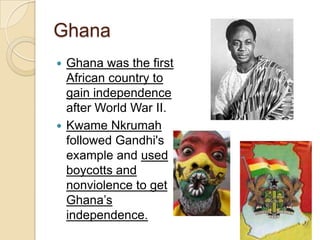
ď‚— Ghana was the first
African country to
gain independence
after World War II.
ď‚— Kwame Nkrumah
followed Gandhi's
example and used
boycotts and
nonviolence to get
Ghana’s
independence.
Algeria
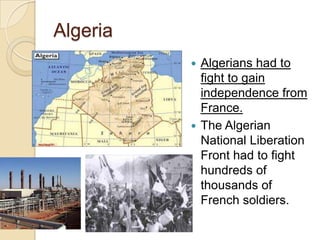
ď‚— Algerians had to
fight to gain
independence from
France.
ď‚— The Algerian
National Liberation
Front had to fight
hundreds of
thousands of
French soldiers.
Kenya
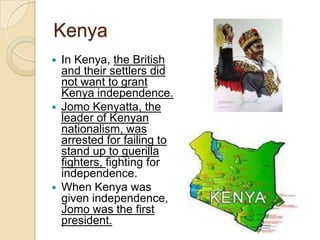
ď‚— In Kenya, the British
and their settlers did
not want to grant
Kenya independence.
ď‚— Jomo Kenyatta, the
leader of Kenyan
nationalism, was
arrested for failing to
stand up to guerilla
fighters, fighting for
independence.
ď‚— When Kenya was
given independence,
Jomo was the first
president.
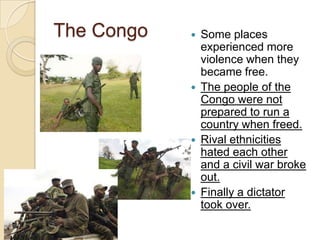
The Congo ď‚— Some places
experienced more
violence when they
became free.
ď‚— The people of the
Congo were not
prepared to run a
country when freed.
ď‚— Rival ethnicities
hated each other
and a civil war broke
out.
ď‚— Finally a dictator
took over.
South Africa
ď‚— South Africa was an unusual country,
granted independence prior to both
World Wars.
ď‚— However, the small white South
African population created a political
system that kept the majority black
South African population out of power.
Apartheid
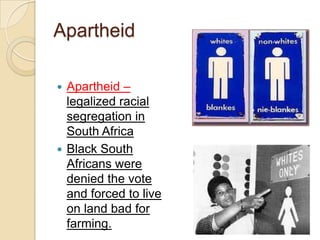
 Apartheid –
legalized racial
segregation in
South Africa
ď‚— Black South
Africans were
denied the vote
and forced to live
on land bad for
farming.
The African National
Congress
ď‚— Groups protested this racist policy.
ď‚— The most famous group to protest
apartheid was the African National
Congress.
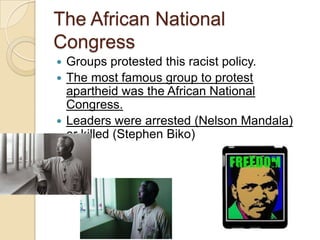
ď‚— Leaders were arrested (Nelson Mandala)
or killed (Stephen Biko)
Equality
ď‚— In 1989, a new president was elected and
began to end apartheid.
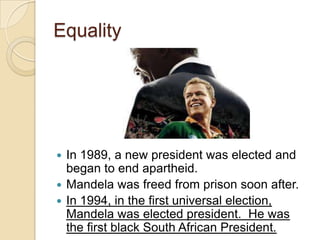
ď‚— Mandela was freed from prison soon after.
ď‚— In 1994, in the first universal election,
Mandela was elected president. He was
the first black South African President.

Freedom for africa

  • 1.
  • 2.
    Africa follows Asia ď‚—After India gained independence, many other Asian countries sought independence, mostly peacefully. ď‚— African groups, like Asian groups, experienced nationalistic movements. ď‚— People of Africa wanted freedom from European control, after World War II.
  • 3.
    Ghana  Ghana wasthe first African country to gain independence after World War II.  Kwame Nkrumah followed Gandhi's example and used boycotts and nonviolence to get Ghana’s independence.
  • 4.
    Algeria ď‚— Algerians hadto fight to gain independence from France. ď‚— The Algerian National Liberation Front had to fight hundreds of thousands of French soldiers.
  • 5.
    Kenya ď‚— In Kenya,the British and their settlers did not want to grant Kenya independence. ď‚— Jomo Kenyatta, the leader of Kenyan nationalism, was arrested for failing to stand up to guerilla fighters, fighting for independence. ď‚— When Kenya was given independence, Jomo was the first president.
  • 6.
    The Congo ď‚—Some places experienced more violence when they became free. ď‚— The people of the Congo were not prepared to run a country when freed. ď‚— Rival ethnicities hated each other and a civil war broke out. ď‚— Finally a dictator took over.
  • 7.
    South Africa ď‚— SouthAfrica was an unusual country, granted independence prior to both World Wars. ď‚— However, the small white South African population created a political system that kept the majority black South African population out of power.
  • 8.
    Apartheid  Apartheid – legalizedracial segregation in South Africa  Black South Africans were denied the vote and forced to live on land bad for farming.
  • 9.
    The African National Congress ď‚—Groups protested this racist policy. ď‚— The most famous group to protest apartheid was the African National Congress. ď‚— Leaders were arrested (Nelson Mandala) or killed (Stephen Biko)
  • 10.
    Equality ď‚— In 1989,a new president was elected and began to end apartheid. ď‚— Mandela was freed from prison soon after. ď‚— In 1994, in the first universal election, Mandela was elected president. He was the first black South African President.