Samson, Chaewon, Natalie
Background  In the late 1500s A.D. the Dutch enjoyed one of the highest standards of living among all the Europeans. They had grown wealthy through trade and commerce. In the late 16th century, the Dutch had thrown off Spanish control in Europe and entered into a period of frantic economic expansion.
What did they expect to gain? Although they gained fair amount of wealth and power, their homeland was small, and there was little room for farming or manufacturing. In order to maintain their wealth, the Dutch decided to look at colonizing new lands.
What were they looking for? More land More wealth More power Slaves for trade Better trade routes Destruction of Portuguese trade monopoly in South East Asia
Who supported exploration? The Dutch East India Company The Dutch West India Company Dutch King / Government  Henry Hudson (and his crew Half Moon) Dutch Navy Dutch Merchants
Where and when did the explorers go? Caribbean-  Netherlands Antilles (1620) Virgin Islands (1625) Tobago (1625-1677) South America-  Chile (1600) Guyana (1616) Brazil (1630)  Suriname (1650)
How were voyages financed? Government Merchants VOC (United East Indian Company)  GWC (Chartered West Indian company) Amsterdam, the world financial center Gained more wealth from the colonized countries for future exploration
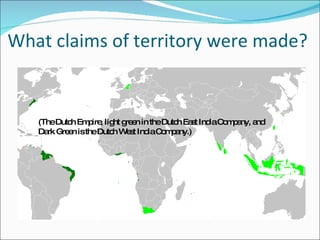
What claims of territory were made? (The Dutch Empire, light green in the Dutch East India Company, and Dark Green is the Dutch West India Company.)
What did the Europeans think of the people they found? The Dutch had their ideas about the Americans.  Admiration for the achievement in music, science, technology, and sports. The Dutch looked down on the Africans. Made  all African slaves and treated them harshly.
Fall of the GWC and VOC GWC:  Loss of territories VOC: Corruption Dividend policy Morbidity and Mortality Rate Political and Environmental Change Trade inefficiency
How did the Europeans benefit form the explorer journeys? Removed power from rival states Huge economic boost Land for agriculture Built better trade routes Increased chance for imbalance of trade Increased piracy possibility
Bibliography &quot;The History of New Netherland and the Half Moon.&quot; 4 Feb. 2009 <http://www.newnetherland.org/history.html>.  Welling, George M. &quot;The United States of America and the Netherlands.&quot;  From Revolution to Reconstruction . 6 Mar. 2003. 4 Feb. 2009 <http://odur.let.rug.nl/~usa/E/newnetherlands/nl1.htm>.  &quot;Dutch colonization of the Americas.&quot; 13 JAN 2009. Wikipedia. 28 Jan 2009 <http://en.wikipedia.org/wiki/Dutch_colonization_of_the_Americas>. Karam, Andrew. &quot;Dutch Exploration and Colonization.&quot; 28 JAN 2009. BookRags. 28 Jan 2009 <http://www.oozyte.com/>. &quot;Dutch Exploration.&quot;  The Past Belongs to Kids . KidsPast.com. 28 Jan 2009<http://www.kidspast.com/world-history/0321-dutch-exploration.php>. &quot;Dutch Colonies.&quot;  nps.gov . Kingston. 29 JAN 2009 <http://www.nps.gov/nr/travel/kingston/colonization.htm>. &quot;Dutch Empire.&quot; 13 JAN 2009. Wikipedia. 28 Jan 2009 <http://en.wikipedia.org/wiki/Dutch_colonization_of_the_Americas>.

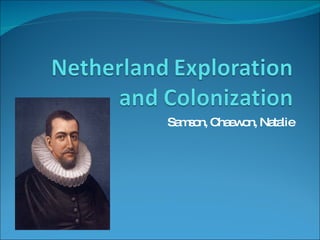
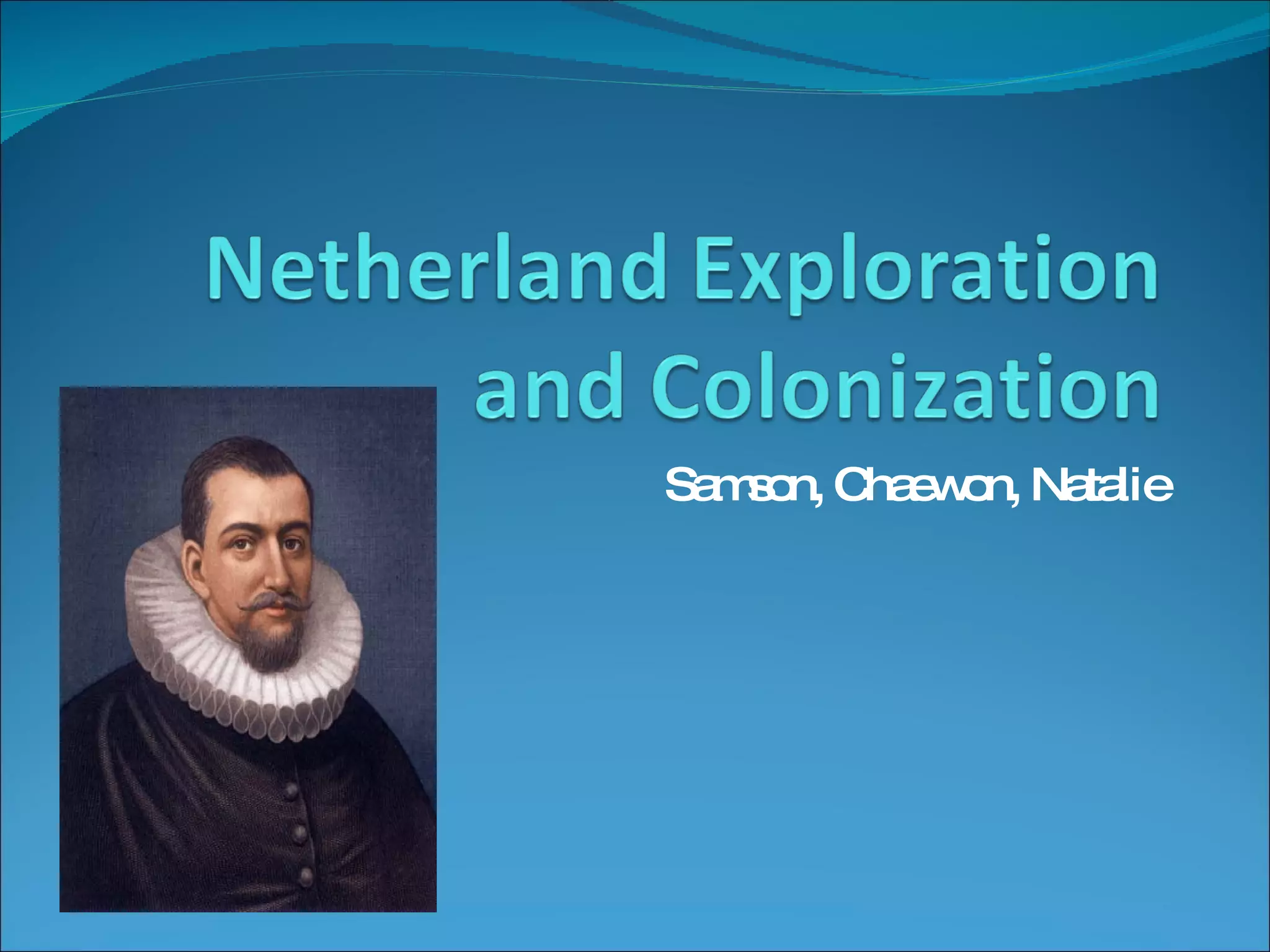
Netherland Exploration and Colonization

  • 1.
  • 2.
    Background Inthe late 1500s A.D. the Dutch enjoyed one of the highest standards of living among all the Europeans. They had grown wealthy through trade and commerce. In the late 16th century, the Dutch had thrown off Spanish control in Europe and entered into a period of frantic economic expansion.
  • 3.
    What did theyexpect to gain? Although they gained fair amount of wealth and power, their homeland was small, and there was little room for farming or manufacturing. In order to maintain their wealth, the Dutch decided to look at colonizing new lands.
  • 4.
    What were theylooking for? More land More wealth More power Slaves for trade Better trade routes Destruction of Portuguese trade monopoly in South East Asia
  • 5.
    Who supported exploration?The Dutch East India Company The Dutch West India Company Dutch King / Government Henry Hudson (and his crew Half Moon) Dutch Navy Dutch Merchants
  • 6.
    Where and whendid the explorers go? Caribbean- Netherlands Antilles (1620) Virgin Islands (1625) Tobago (1625-1677) South America- Chile (1600) Guyana (1616) Brazil (1630) Suriname (1650)
  • 7.
    How were voyagesfinanced? Government Merchants VOC (United East Indian Company) GWC (Chartered West Indian company) Amsterdam, the world financial center Gained more wealth from the colonized countries for future exploration
  • 8.
    What claims ofterritory were made? (The Dutch Empire, light green in the Dutch East India Company, and Dark Green is the Dutch West India Company.)
  • 9.
    What did theEuropeans think of the people they found? The Dutch had their ideas about the Americans. Admiration for the achievement in music, science, technology, and sports. The Dutch looked down on the Africans. Made all African slaves and treated them harshly.
  • 10.
    Fall of theGWC and VOC GWC: Loss of territories VOC: Corruption Dividend policy Morbidity and Mortality Rate Political and Environmental Change Trade inefficiency
  • 11.
    How did theEuropeans benefit form the explorer journeys? Removed power from rival states Huge economic boost Land for agriculture Built better trade routes Increased chance for imbalance of trade Increased piracy possibility
  • 12.
    Bibliography &quot;The Historyof New Netherland and the Half Moon.&quot; 4 Feb. 2009 <http://www.newnetherland.org/history.html>. Welling, George M. &quot;The United States of America and the Netherlands.&quot; From Revolution to Reconstruction . 6 Mar. 2003. 4 Feb. 2009 <http://odur.let.rug.nl/~usa/E/newnetherlands/nl1.htm>. &quot;Dutch colonization of the Americas.&quot; 13 JAN 2009. Wikipedia. 28 Jan 2009 <http://en.wikipedia.org/wiki/Dutch_colonization_of_the_Americas>. Karam, Andrew. &quot;Dutch Exploration and Colonization.&quot; 28 JAN 2009. BookRags. 28 Jan 2009 <http://www.oozyte.com/>. &quot;Dutch Exploration.&quot; The Past Belongs to Kids . KidsPast.com. 28 Jan 2009<http://www.kidspast.com/world-history/0321-dutch-exploration.php>. &quot;Dutch Colonies.&quot; nps.gov . Kingston. 29 JAN 2009 <http://www.nps.gov/nr/travel/kingston/colonization.htm>. &quot;Dutch Empire.&quot; 13 JAN 2009. Wikipedia. 28 Jan 2009 <http://en.wikipedia.org/wiki/Dutch_colonization_of_the_Americas>.