Earth and Space Science
 Element: a substance that cannot be broken
down into simpler chemical substances.
 Atom: smallest particle of an element that
still has the properties of that element.
 Nucleus: center of an atom.
 Atomic nuclei are composed of 2 subatomic
particles:
Protons:  Positively charged
 Large in size
 The number of protons in the
nucleus determines the identity
of an element. This is the
atomic number of the element.
 Atomic number: The number of protons in
the nucleus of an atom
Neutrons:  Neutral charge
 Same size as protons
Neutrons add mass to the nucleus.
 Atomic Mass: The number of protons + the
number of neutrons in the nucleus
(sometimes referred to as the mass number)
 Electrons are negatively charged particles that
orbit the nucleus in an electron cloud, which
is outside the nucleus, but totally surrounds
the nucleus.
 Electrons are very small. They are so small
the mass of an individual electron cannot be
measured.
 In an atom, the number of protons=the
number of electrons, atoms have no electric
charge
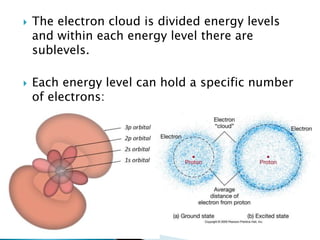
 The electron cloud is divided energy levels
and within each energy level there are
sublevels.
 Each energy level can hold a specific number
of electrons:
 1st energy level holds up to 2 electrons (s
sublevel holds both electrons)
 2nd energy level holds up to 8 electrons (s
sublevel holds 2 and the p sublevel holds 6)
 3rd energy level holds up to 18 electrons (s
holds 2, p holds 6 and the d sublevel holds 10)
 4th energy level holds up to 32 electrons (s
holds 2, p holds 6, d holds 10 and the f
sublevel holds 14)
 Isotopes: atoms of the same element that
have a differing number of neutrons in their
nuclei.
 The different number of neutrons gives
isotopes different atomic masses.
Ex. Carbon-12 6 protons, 6 neutrons
Carbon-14 6 protons, 8 neutrons
 Isotopes of Hydrogen and Carbon
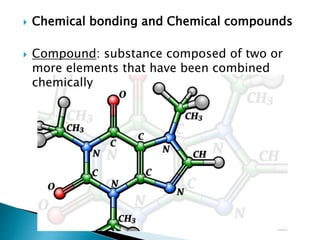
 Chemical bonding and Chemical compounds
 Compound: substance composed of two or
more elements that have been combined
chemically
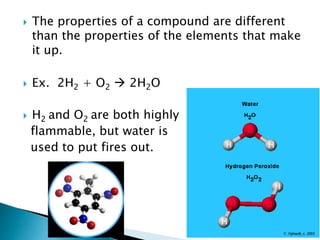
 The properties of a compound are different
than the properties of the elements that make
it up.
 Ex. 2H2 + O2  2H2O
 H2 and O2 are both highly
flammable, but water is
used to put fires out.
 Chemical bonds hold compounds together.
 There are two main types of chemical bonds:
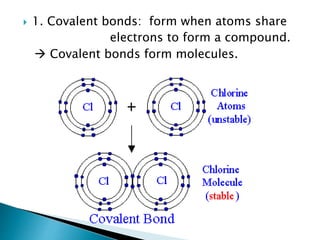
 1. Covalent bonds: form when atoms share
electrons to form a compound.
 Covalent bonds form molecules.
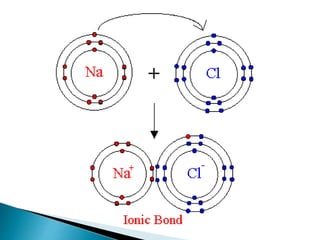
 2. Ionic bonds: form when electrons are
transferred from one atom to another.
 Ions are atoms have gained or lost electrons,
so they have an electrical charge.
 Atoms that gain electrons have a negative
charge, and are called anions
 Atoms that lose electrons have a positive
charge, and are called cations.
 Ionic bonds do not form molecules.
 Chemical equations
 Chemical equations must obey the Law of
Conservation of Matter, so the number of
atoms available before a reaction must equal
the number of atoms available after the
reaction.
 This is called a balanced equation.
2H2 + O2  2H2O
4 atoms H2 4 atoms H2
2 atoms O2 2 atoms O2
6 atoms 6 atoms
 Every chemical reaction has 2 parts: the
reactants (that join together chemically) and
the products (what is formed in the reaction.)
2H2 + O2  2H2O
reactants product
 Solutions and Mixtures
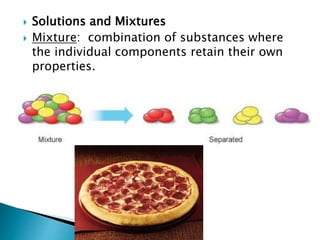
 Mixture: combination of substances where
the individual components retain their own
properties.
 Two types of mixtures:
1. Homogeneous  uniformly mixed parts
2. Heterogeneous  not uniformly mixed parts
 Mixtures can be separated by physical
processes.
 Solution: a mixture where one substance (the
solute) is dissolved in another (the solvent).
Water is the universal solvent.
 Acids and Bases
 Acid: a substance that released H+ ions when
mixed with water.
 Acids have a pH of 0 – 6.
Ex. HCl  H+ + Cl-
 Base: a substance that releases OH- ions
when mixed with water.
 Bases have a pH of 8 – 14.
Ex. NaOH  Na+ + OH-
 A pH of 7 is neutral. It is neither acid nor base.
 The pH scale measures the concentration of
H+ ions in solution. The greater the
concentration of hydrogen in the solution, the
lower the pH. As the concentration of
hydrogen in the solution decreases, the pH
gets higher.
 The pH scale shows an exponential
relationship.
 Each number on the pH scale represents a
factor of 10. What does this mean?
 An acid with a pH of 0 is 10 times
stronger than an acid with a pH of 1 and
it is 1,000,000 times stronger than an
acid with a pH of 6.
 Acids and bases have the ability to neutralize
each other.
 When an acid and a base of equal strength
are mixed, the result is a neutral solution.
 Ex. HCl + NaOH  NaCl + H2O
 Every neutralization reaction will result in an
ionic compound that is dissolved in water and
the pH will always be 7.
 Indicators
 Indicators are chemicals that change color in
the presence of other chemicals.
 There are many indicators that tell whether a
solution is acid or base, but these are some of
the most common:
 Litmus paper: blue litmus turns red in an acid
red litmus turns blue in a base
Bromthymol blue: blue in a base and yellow
in an acid
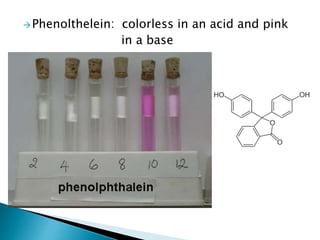
Phenolthelein: colorless in an acid and pink
in a base
 Properties of Water
 Water is a polar molecule. This means that it
bonds covalently, but electrons are not
shared equally between the hydrogen atoms
and the oxygen atom.
 Since more electrons can be found orbiting
the oxygen portion of the molecule, that end
has a negative charge.
 Since fewer electrons can be found around
the hydrogen atoms that end has a positive
charge.
Because of the difference in charge the
molecule acts like a magnet.
The positive hydrogen end of the molecule
attracts negative ions and compounds and
the negative end attracts positive ions and
compounds.
Because of this attraction, ionic compounds
(ex. Salt) and polar compounds (ex. Sugar)
dissolve in water.
 Water molecules also attract other water
molecules.
 This attraction forms a weak bond called a
hydrogen bond.
 Hydrogen bonds hold many important
molecules together (ex. Proteins).
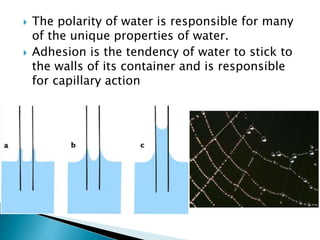
 The polarity of water is responsible for many
of the unique properties of water.
 Adhesion is the tendency of water to stick to
the walls of its container and is responsible
for capillary action
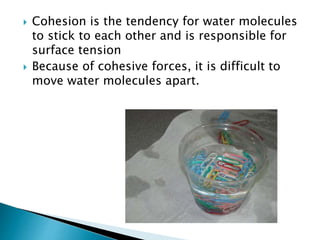
 Cohesion is the tendency for water molecules
to stick to each other and is responsible for
surface tension
 Because of cohesive forces, it is difficult to
move water molecules apart.
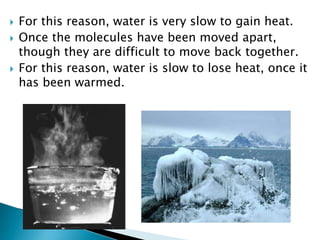
 For this reason, water is very slow to gain heat.
 Once the molecules have been moved apart,
though they are difficult to move back together.
 For this reason, water is slow to lose heat, once it
has been warmed.
 Cohesive forces are also the reason that water
expands when it freezes.
 The hydrogen bonds between water
molecules are frozen in place, which makes
the molecules less mobile, causing them to
remain farther apart.
 Movement of molecules
 Molecules of all substances are constantly in
motion and are constantly trying to distribute
themselves evenly. They do this
spontaneously without the use of energy
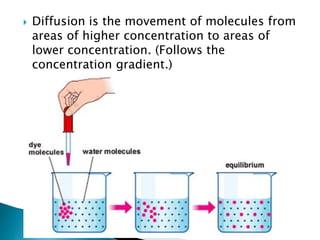
 Diffusion is the movement of molecules from
areas of higher concentration to areas of
lower concentration. (Follows the
concentration gradient.)
 Factors affecting diffusion:
1. Concentration
Most important factor
Steep concentration gradient = fast diffusion
2. Temperature
Higher temperature = fast diffusion
3. Pressure
Higher pressure = fast diffusion
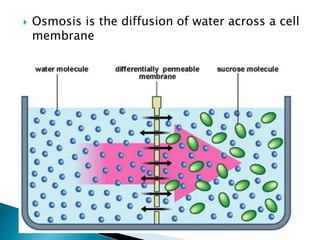
 Osmosis is the diffusion of water across a cell
membrane
 Facilitated diffusion is the diffusion of large
molecules using carrier molecules.
 Active transport IS NOT a type of diffusion.
 It moves molecules from areas of low
concentration to higher concentration (against
the concentration gradient.)
 It uses energy.

Basic Chemistry Review.pptx

  • 1.
  • 2.
     Element: asubstance that cannot be broken down into simpler chemical substances.  Atom: smallest particle of an element that still has the properties of that element.
  • 3.
     Nucleus: centerof an atom.  Atomic nuclei are composed of 2 subatomic particles: Protons:  Positively charged  Large in size  The number of protons in the nucleus determines the identity of an element. This is the atomic number of the element.
  • 4.
     Atomic number:The number of protons in the nucleus of an atom Neutrons:  Neutral charge  Same size as protons Neutrons add mass to the nucleus.
  • 5.
     Atomic Mass:The number of protons + the number of neutrons in the nucleus (sometimes referred to as the mass number)
  • 6.
     Electrons arenegatively charged particles that orbit the nucleus in an electron cloud, which is outside the nucleus, but totally surrounds the nucleus.  Electrons are very small. They are so small the mass of an individual electron cannot be measured.
  • 7.
     In anatom, the number of protons=the number of electrons, atoms have no electric charge
  • 8.
     The electroncloud is divided energy levels and within each energy level there are sublevels.  Each energy level can hold a specific number of electrons:
  • 9.
     1st energylevel holds up to 2 electrons (s sublevel holds both electrons)  2nd energy level holds up to 8 electrons (s sublevel holds 2 and the p sublevel holds 6)  3rd energy level holds up to 18 electrons (s holds 2, p holds 6 and the d sublevel holds 10)  4th energy level holds up to 32 electrons (s holds 2, p holds 6, d holds 10 and the f sublevel holds 14)
  • 11.
     Isotopes: atomsof the same element that have a differing number of neutrons in their nuclei.  The different number of neutrons gives isotopes different atomic masses. Ex. Carbon-12 6 protons, 6 neutrons Carbon-14 6 protons, 8 neutrons
  • 12.
     Isotopes ofHydrogen and Carbon
  • 13.
     Chemical bondingand Chemical compounds  Compound: substance composed of two or more elements that have been combined chemically
  • 14.
     The propertiesof a compound are different than the properties of the elements that make it up.  Ex. 2H2 + O2  2H2O  H2 and O2 are both highly flammable, but water is used to put fires out.
  • 16.
     Chemical bondshold compounds together.  There are two main types of chemical bonds:
  • 17.
     1. Covalentbonds: form when atoms share electrons to form a compound.  Covalent bonds form molecules.
  • 18.
     2. Ionicbonds: form when electrons are transferred from one atom to another.  Ions are atoms have gained or lost electrons, so they have an electrical charge.  Atoms that gain electrons have a negative charge, and are called anions  Atoms that lose electrons have a positive charge, and are called cations.  Ionic bonds do not form molecules.
  • 20.
     Chemical equations Chemical equations must obey the Law of Conservation of Matter, so the number of atoms available before a reaction must equal the number of atoms available after the reaction.
  • 21.
     This iscalled a balanced equation. 2H2 + O2  2H2O 4 atoms H2 4 atoms H2 2 atoms O2 2 atoms O2 6 atoms 6 atoms
  • 22.
     Every chemicalreaction has 2 parts: the reactants (that join together chemically) and the products (what is formed in the reaction.) 2H2 + O2  2H2O reactants product
  • 24.
     Solutions andMixtures  Mixture: combination of substances where the individual components retain their own properties.
  • 25.
     Two typesof mixtures: 1. Homogeneous  uniformly mixed parts 2. Heterogeneous  not uniformly mixed parts
  • 26.
     Mixtures canbe separated by physical processes.  Solution: a mixture where one substance (the solute) is dissolved in another (the solvent). Water is the universal solvent.
  • 28.
     Acids andBases  Acid: a substance that released H+ ions when mixed with water.  Acids have a pH of 0 – 6. Ex. HCl  H+ + Cl-
  • 29.
     Base: asubstance that releases OH- ions when mixed with water.  Bases have a pH of 8 – 14. Ex. NaOH  Na+ + OH-
  • 30.
     A pHof 7 is neutral. It is neither acid nor base.
  • 31.
     The pHscale measures the concentration of H+ ions in solution. The greater the concentration of hydrogen in the solution, the lower the pH. As the concentration of hydrogen in the solution decreases, the pH gets higher.
  • 32.
     The pHscale shows an exponential relationship.  Each number on the pH scale represents a factor of 10. What does this mean?  An acid with a pH of 0 is 10 times stronger than an acid with a pH of 1 and it is 1,000,000 times stronger than an acid with a pH of 6.
  • 33.
     Acids andbases have the ability to neutralize each other.  When an acid and a base of equal strength are mixed, the result is a neutral solution.  Ex. HCl + NaOH  NaCl + H2O
  • 34.
     Every neutralizationreaction will result in an ionic compound that is dissolved in water and the pH will always be 7.
  • 35.
     Indicators  Indicatorsare chemicals that change color in the presence of other chemicals.
  • 36.
     There aremany indicators that tell whether a solution is acid or base, but these are some of the most common:  Litmus paper: blue litmus turns red in an acid red litmus turns blue in a base
  • 37.
    Bromthymol blue: bluein a base and yellow in an acid
  • 38.
    Phenolthelein: colorless inan acid and pink in a base
  • 39.
     Properties ofWater  Water is a polar molecule. This means that it bonds covalently, but electrons are not shared equally between the hydrogen atoms and the oxygen atom.
  • 40.
     Since moreelectrons can be found orbiting the oxygen portion of the molecule, that end has a negative charge.  Since fewer electrons can be found around the hydrogen atoms that end has a positive charge.
  • 41.
    Because of thedifference in charge the molecule acts like a magnet. The positive hydrogen end of the molecule attracts negative ions and compounds and the negative end attracts positive ions and compounds. Because of this attraction, ionic compounds (ex. Salt) and polar compounds (ex. Sugar) dissolve in water.
  • 42.
     Water moleculesalso attract other water molecules.  This attraction forms a weak bond called a hydrogen bond.  Hydrogen bonds hold many important molecules together (ex. Proteins).
  • 43.
     The polarityof water is responsible for many of the unique properties of water.  Adhesion is the tendency of water to stick to the walls of its container and is responsible for capillary action
  • 44.
     Cohesion isthe tendency for water molecules to stick to each other and is responsible for surface tension  Because of cohesive forces, it is difficult to move water molecules apart.
  • 45.
     For thisreason, water is very slow to gain heat.  Once the molecules have been moved apart, though they are difficult to move back together.  For this reason, water is slow to lose heat, once it has been warmed.
  • 46.
     Cohesive forcesare also the reason that water expands when it freezes.  The hydrogen bonds between water molecules are frozen in place, which makes the molecules less mobile, causing them to remain farther apart.
  • 47.
     Movement ofmolecules  Molecules of all substances are constantly in motion and are constantly trying to distribute themselves evenly. They do this spontaneously without the use of energy
  • 48.
     Diffusion isthe movement of molecules from areas of higher concentration to areas of lower concentration. (Follows the concentration gradient.)
  • 49.
     Factors affectingdiffusion: 1. Concentration Most important factor Steep concentration gradient = fast diffusion 2. Temperature Higher temperature = fast diffusion 3. Pressure Higher pressure = fast diffusion
  • 50.
     Osmosis isthe diffusion of water across a cell membrane
  • 51.
     Facilitated diffusionis the diffusion of large molecules using carrier molecules.
  • 52.
     Active transportIS NOT a type of diffusion.  It moves molecules from areas of low concentration to higher concentration (against the concentration gradient.)  It uses energy.