DEVELOPING POSITIVE
RELATIONSHIPS
‘DEVELOPING POSITIVE RELATIONSHIPS WITH
PARENTS’
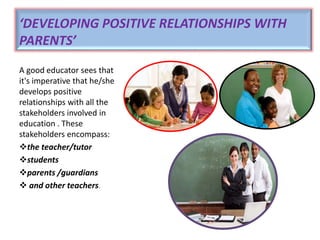
A good educator sees that
it's imperative that he/she
develops positive
relationships with all the
stakeholders involved in
education . These
stakeholders encompass:
the teacher/tutor
students
parents /guardians
 and other teachers.
As an educator, why
is it important to
develop positive
relationships ?
Are there
benefits to be
derived?
BENEFITS
• Parents get ideas from school on how to help and support their children,
and by learning more about the school's academic program and how it
works.
• Substantial evidence exists showing that parent involvement benefits
students, including raising their academic achievement.
• Other benefits are increased motivation for learning, improved behaviour,
more regular attendance, and a more positive attitude about homework
and school in general.
• With parental involvement it can allot more time for teachers to focus
more on the task of teaching children.
• By having more contact with parents, teachers learn more about their
students' needs and home environment, which is information they can
apply toward better meeting those needs.
• The moral and willingness of teachers to perform increase.
There are many strategies teachers can employ to
encourage positive relationships with their
students and parents.
What strategies
can I implement
to achieve
positive
relationships?
Strategies for developing positive relationships with
students:
1. Communicate positive expectations to your
students.
Research has shown that expectations impact on
student academic performance (Kerman,
Kimball, & Martin, 1980).Tell students directly
that you believe that they have the ability to do
well. Your belief in them will inspire their success.
2. Tell students that they have the ability to do
well.
When you tell your students you have
confidence that they can handle a difficult
assignment or improve their behaviour, you
impart a very powerful message. Students often
will work hard and behave appropriately to prove
that your confidence in them is justified.
Students need to know that their teachers
respect them and have confidence in them.
Strategies for developing positive relationships with
students cont’d :
3. Correcting Students in a Constructive Way
Correcting and disciplining students for inappropriate behaviours is
a necessary and important part of every teacher's job. According to
Coloroso (2002) the goal in correcting students should be to have
them reflect on what they did,develop their own self-discipline by
owning up to mistakes, correct, while leaving dignity intact and
make a better choice in the future thereby building positive
relationships.
4. Demonstrating Caring
Demonstrating caring is one of the most powerful ways to build
positive relationships with your students (Kerman et al., 1980).
When your actions and words communicate that you sincerely care
for your students, they are more likely to want to perform well for
you and enjoy coming to school.
As part of the equation, teachers also need to employ
strategies to develop positive relationships with the
parents of their charges.
Strategies for developing positive relationships
with parents.
1. Listen actively
Teachers should put themselves in parents’ and
students’ shoes and parents should put themselves
in the teacher’s shoes. Show compassion,
sensitivity, empathy and mutual respect for each
other. All parties should try to understand the
other’s perspective.
.
2. Be Very Specific
Provide ways parents can support their child at
home: "You can help your child with her math
homework by asking her to explain how she got an
answer," or "As you're reading stories at night, ask
your child to make predictions. This strengthens
reading comprehension."
3. Declare Your Intention
Tell parents that you want to partner with them, that you
appreciate their support, and look forward to working together
for the benefit of the students.
4. Communicate Often and in Various Forms
Provide information about what's going on in class what
students are learning, what they've accomplished, what you're
excited about, what they're excited about, and the learning and
growth you're seeing. Make phone calls and have teacher parent
conferences to discuss the child’s challenges if any and progress.
Strategies for developing positive relationships with
parents cont’d
Teachers also need to employ strategies to develop
positive relationships with other teachers/colleagues in
education.
Strategies for developing positive relationships with
other teachers/colleagues
1. Being a team member.
Teaching involves working in teams or being
part of a team. As such the roles of all
members and specifically your own should be
defined in that you will need to learn about
the other team members, their roles,
previously established methods of working
and any review practices. Contribute to the
team in a positive manner.
2. Working with others.
Do not operate in isolation and behave as
you know it all. “No man is an island”. Do not
be afraid to turn to other colleagues for
assistance . Help others when / if you can
because people will respect someone they
can rely on and will be more likely to return
the favour.
Strategies for developing positive relationships with
other teachers/colleagues cont’d
3. Sharing information/knowledge:
Teachers learn or acquire new successful strategies to teach their students
and to this extent they can share these strategies with their colleagues so
that they too can achieve success with their students in the classroom.
4. Respecting the views/opinions of each other:
An important aspect of building positive relationships with your colleagues
is learning to respect and value their view points/opinions which may at
times differ from that of your own. Every one is different and this will also
apply to differences in teaching styles and delivery of content of the
curriculum.
CONCLUSION
Teachers and parents need to find ways to complement
each other’s skills and knowledge. By focusing on the
student and developing effective communication
techniques, they can work together to build an education
plan that meets and or surpasses the student’s needs
and has the support of school and family thereby
building positive and strong relationships. Webster-
Stratton (1999) states that positive adult-child relationship
built on trust, understanding, and caring will foster children’s
co-operation and motivation and increase their positive
outcomes at school.
References
• Coloroso, B. (2002). Kids are worth it! Giving your child the gift of inner
discipline. New York: HarperCollins
• Kerman, S., Kimball, T., & Martin, M. (1980). Teacher expectations and
student achievement. Bloomingdale, IN: Phi Delta Kappa.
• Webster-Stratton, C (1999). How to promote children’s social and
emotional competence. London: Sage.
Online References
Building Parent-Teacher Relationships
http://www.readingrockets.org/article/building-parent-teacher-relationships
Developing Positive Teacher-Student Relations
http://www.ascd.org/publications/books/105124/chapters/Developing_Positive_Teac
her-Student_Relations.aspx
Relationships with colleagues
http://www.new2teaching.org.uk/tzone/education/workingrelationships/
20 Tips for Developing Positive Relationships With Parents
http://www.edutopia.org/blog/20-tips-developing-positive-relationships-
parents-elena-aguilar

Developing positive relationships

  • 1.
  • 2.
    ‘DEVELOPING POSITIVE RELATIONSHIPSWITH PARENTS’ A good educator sees that it's imperative that he/she develops positive relationships with all the stakeholders involved in education . These stakeholders encompass: the teacher/tutor students parents /guardians  and other teachers.
  • 3.
    As an educator,why is it important to develop positive relationships ? Are there benefits to be derived?
  • 4.
    BENEFITS • Parents getideas from school on how to help and support their children, and by learning more about the school's academic program and how it works. • Substantial evidence exists showing that parent involvement benefits students, including raising their academic achievement. • Other benefits are increased motivation for learning, improved behaviour, more regular attendance, and a more positive attitude about homework and school in general. • With parental involvement it can allot more time for teachers to focus more on the task of teaching children. • By having more contact with parents, teachers learn more about their students' needs and home environment, which is information they can apply toward better meeting those needs. • The moral and willingness of teachers to perform increase.
  • 5.
    There are manystrategies teachers can employ to encourage positive relationships with their students and parents. What strategies can I implement to achieve positive relationships?
  • 6.
    Strategies for developingpositive relationships with students: 1. Communicate positive expectations to your students. Research has shown that expectations impact on student academic performance (Kerman, Kimball, & Martin, 1980).Tell students directly that you believe that they have the ability to do well. Your belief in them will inspire their success. 2. Tell students that they have the ability to do well. When you tell your students you have confidence that they can handle a difficult assignment or improve their behaviour, you impart a very powerful message. Students often will work hard and behave appropriately to prove that your confidence in them is justified. Students need to know that their teachers respect them and have confidence in them.
  • 7.
    Strategies for developingpositive relationships with students cont’d : 3. Correcting Students in a Constructive Way Correcting and disciplining students for inappropriate behaviours is a necessary and important part of every teacher's job. According to Coloroso (2002) the goal in correcting students should be to have them reflect on what they did,develop their own self-discipline by owning up to mistakes, correct, while leaving dignity intact and make a better choice in the future thereby building positive relationships. 4. Demonstrating Caring Demonstrating caring is one of the most powerful ways to build positive relationships with your students (Kerman et al., 1980). When your actions and words communicate that you sincerely care for your students, they are more likely to want to perform well for you and enjoy coming to school.
  • 8.
    As part ofthe equation, teachers also need to employ strategies to develop positive relationships with the parents of their charges.
  • 9.
    Strategies for developingpositive relationships with parents. 1. Listen actively Teachers should put themselves in parents’ and students’ shoes and parents should put themselves in the teacher’s shoes. Show compassion, sensitivity, empathy and mutual respect for each other. All parties should try to understand the other’s perspective. . 2. Be Very Specific Provide ways parents can support their child at home: "You can help your child with her math homework by asking her to explain how she got an answer," or "As you're reading stories at night, ask your child to make predictions. This strengthens reading comprehension."
  • 10.
    3. Declare YourIntention Tell parents that you want to partner with them, that you appreciate their support, and look forward to working together for the benefit of the students. 4. Communicate Often and in Various Forms Provide information about what's going on in class what students are learning, what they've accomplished, what you're excited about, what they're excited about, and the learning and growth you're seeing. Make phone calls and have teacher parent conferences to discuss the child’s challenges if any and progress. Strategies for developing positive relationships with parents cont’d
  • 11.
    Teachers also needto employ strategies to develop positive relationships with other teachers/colleagues in education.
  • 12.
    Strategies for developingpositive relationships with other teachers/colleagues 1. Being a team member. Teaching involves working in teams or being part of a team. As such the roles of all members and specifically your own should be defined in that you will need to learn about the other team members, their roles, previously established methods of working and any review practices. Contribute to the team in a positive manner. 2. Working with others. Do not operate in isolation and behave as you know it all. “No man is an island”. Do not be afraid to turn to other colleagues for assistance . Help others when / if you can because people will respect someone they can rely on and will be more likely to return the favour.
  • 13.
    Strategies for developingpositive relationships with other teachers/colleagues cont’d 3. Sharing information/knowledge: Teachers learn or acquire new successful strategies to teach their students and to this extent they can share these strategies with their colleagues so that they too can achieve success with their students in the classroom. 4. Respecting the views/opinions of each other: An important aspect of building positive relationships with your colleagues is learning to respect and value their view points/opinions which may at times differ from that of your own. Every one is different and this will also apply to differences in teaching styles and delivery of content of the curriculum.
  • 14.
    CONCLUSION Teachers and parentsneed to find ways to complement each other’s skills and knowledge. By focusing on the student and developing effective communication techniques, they can work together to build an education plan that meets and or surpasses the student’s needs and has the support of school and family thereby building positive and strong relationships. Webster- Stratton (1999) states that positive adult-child relationship built on trust, understanding, and caring will foster children’s co-operation and motivation and increase their positive outcomes at school.
  • 15.
    References • Coloroso, B.(2002). Kids are worth it! Giving your child the gift of inner discipline. New York: HarperCollins • Kerman, S., Kimball, T., & Martin, M. (1980). Teacher expectations and student achievement. Bloomingdale, IN: Phi Delta Kappa. • Webster-Stratton, C (1999). How to promote children’s social and emotional competence. London: Sage.
  • 16.
    Online References Building Parent-TeacherRelationships http://www.readingrockets.org/article/building-parent-teacher-relationships Developing Positive Teacher-Student Relations http://www.ascd.org/publications/books/105124/chapters/Developing_Positive_Teac her-Student_Relations.aspx Relationships with colleagues http://www.new2teaching.org.uk/tzone/education/workingrelationships/ 20 Tips for Developing Positive Relationships With Parents http://www.edutopia.org/blog/20-tips-developing-positive-relationships- parents-elena-aguilar