OCULAR FOREIGN BODY
REMOVAL TECHNIQUES
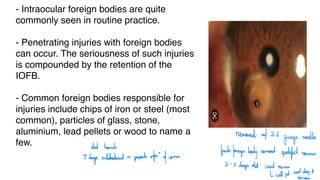
- Intraocular foreign bodies are quite
commonly seen in routine practice.
- Penetrating injuries with foreign bodies
can occur. The seriousness of such injuries
is compounded by the retention of the
IOFB.
- Common foreign bodies responsible for
injuries include chips of iron or steel (most
common), particles of glass, stone,
aluminium, lead pellets or wood to name a
few.
removed at 26
gauge
needle
stat homich
I
days antibacteria -
prevents infer" of comea
fresh foreign
body remoud:
epidefectremain
2 -
3
days old: crust
remain
I call pt.
nextday
remove
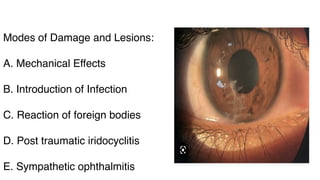
Modes of Damage and Lesions:
A. Mechanical Effects
B. Introduction of Infection
C. Reaction of foreign bodies
D. Post traumatic iridocyclitis
E. Sympathetic ophthalmitis
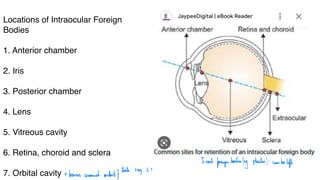
Locations of Intraocular Foreign
Bodies
1. Anterior chamber
2. Iris
3. Posterior chamber
4. Lens
5. Vitreous cavity
6. Retina, choroid and sclera
7. Orbital cavity
Inert
foreign
bodies
leg plastic): can be
left
-bones around artery
tests:Xray, CT
Management of Retained Intraocular Foreign Bodies
1. HISTORY
A careful and detailed history about the mode of injury
can tell you about the possible type of foreign body
2. OCULAR EXAMINATION
A thorough ocular examination including vision, pinhole
vision, slit lamp examination, should be done.
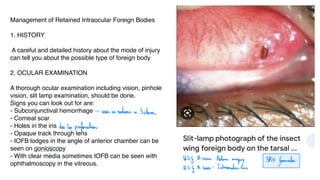
Signs you can look out for are:
- Subconjunctival hemorrhage
- Corneal scar
- Holes in the iris
- Opaque track through lens
- IOFB lodges in the angle of anterior chamber can be
seen on gonioscopy
- With clear media sometimes IOFB can be seen with
ophthalmoscopy in the vitreous.
seen as redness in Schere
due to perforation
ISG B scow: Retina
imaging SRK
faumda
US
I A scan: IntraocularLens
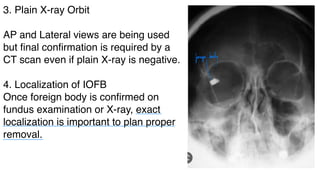
3. Plain X-ray Orbit
AP and Lateral views are being used
but final confirmation is required by a
CT scan even if plain X-ray is negative.
4. Localization of IOFB
Once foreign body is confirmed on
fundus examination or X-ray, exact
localization is important to plan proper
removal.
foreign
body
- - -
1. Radiographic localization
a. Limbal ring technique- This technique is now
obsolete. A metallic ring of corneal diameter is stitched
to the limbus. AP and lateral views are taken along with
3 exposures of patient looking straight, upwards and
downwards. The position of the foreign body is
estimated from its relationship with the metallic ring in
different positions.
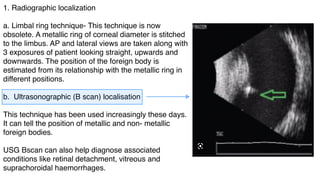
b. Ultrasonographic (B scan) localisation
This technique has been used increasingly these days.
It can tell the position of metallic and non- metallic
foreign bodies.
USG Bscan can also help diagnose associated
conditions like retinal detachment, vitreous and
suprachoroidal haemorrhages.
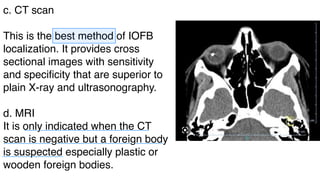
c. CT scan
This is the best method of IOFB
localization. It provides cross
sectional images with sensitivity
and specificity that are superior to
plain X-ray and ultrasonography.
d. MRI
It is only indicated when the CT
scan is negative but a foreign body
is suspected especially plastic or
wooden foreign bodies.
-
-
-
Removal of foreign bodies
1. Foreign body in cornea
Metallic small foreign bodies can be removed under
topical anesthesia with a 26G needle on the slit lamp.
Antibiotic and lubricant drops are given after removal and
patient is called for regular follow up.
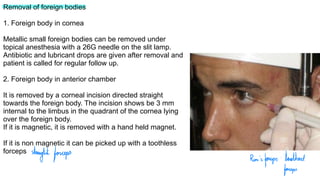
2. Foreign body in anterior chamber
It is removed by a corneal incision directed straight
towards the foreign body. The incision shows be 3 mm
internal to the limbus in the quadrant of the cornea lying
over the foreign body.
If it is magnetic, it is removed with a hand held magnet.
If it is non magnetic it can be picked up with a toothless
forceps
straight forceps Rim's
forceps:toothed
forceps
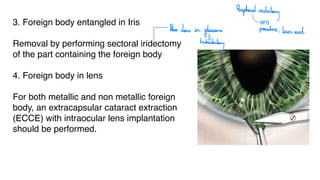
3. Foreign body entangled in Iris
Removal by performing sectoral iridectomy
of the part containing the foreign body
4. Foreign body in lens
For both metallic and non metallic foreign
body, an extracapsular cataract extraction
(ECCE) with intraocular lens implantation
should be performed.
Peripheral
iridectomy
OPB
Also done in
glaucoman procedie; laser used
trabeculectory
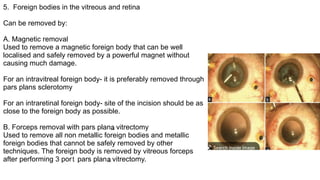
5. Foreign bodies in the vitreous and retina
Can be removed by:
A. Magnetic removal
Used to remove a magnetic foreign body that can be well
localised and safely removed by a powerful magnet without
causing much damage.
For an intravitreal foreign body- it is preferably removed through
pars plans sclerotomy
For an intraretinal foreign body- site of the incision should be as
close to the foreign body as possible.
B. Forceps removal with pars plans vitrectomy
Used to remove all non metallic foreign bodies and metallic
foreign bodies that cannot be safely removed by other
techniques. The foreign body is removed by vitreous forceps
after performing 3 pore pars plans vitrectomy.
N
M N

THANK YOU!

Intraocular foreign body removal techniques

  • 1.
  • 2.
    - Intraocular foreignbodies are quite commonly seen in routine practice. - Penetrating injuries with foreign bodies can occur. The seriousness of such injuries is compounded by the retention of the IOFB. - Common foreign bodies responsible for injuries include chips of iron or steel (most common), particles of glass, stone, aluminium, lead pellets or wood to name a few. removed at 26 gauge needle stat homich I days antibacteria - prevents infer" of comea fresh foreign body remoud: epidefectremain 2 - 3 days old: crust remain I call pt. nextday remove
  • 3.
    Modes of Damageand Lesions: A. Mechanical Effects B. Introduction of Infection C. Reaction of foreign bodies D. Post traumatic iridocyclitis E. Sympathetic ophthalmitis
  • 4.
    Locations of IntraocularForeign Bodies 1. Anterior chamber 2. Iris 3. Posterior chamber 4. Lens 5. Vitreous cavity 6. Retina, choroid and sclera 7. Orbital cavity Inert foreign bodies leg plastic): can be left -bones around artery tests:Xray, CT
  • 5.
    Management of RetainedIntraocular Foreign Bodies 1. HISTORY A careful and detailed history about the mode of injury can tell you about the possible type of foreign body 2. OCULAR EXAMINATION A thorough ocular examination including vision, pinhole vision, slit lamp examination, should be done. Signs you can look out for are: - Subconjunctival hemorrhage - Corneal scar - Holes in the iris - Opaque track through lens - IOFB lodges in the angle of anterior chamber can be seen on gonioscopy - With clear media sometimes IOFB can be seen with ophthalmoscopy in the vitreous. seen as redness in Schere due to perforation ISG B scow: Retina imaging SRK faumda US I A scan: IntraocularLens
  • 6.
    3. Plain X-rayOrbit AP and Lateral views are being used but final confirmation is required by a CT scan even if plain X-ray is negative. 4. Localization of IOFB Once foreign body is confirmed on fundus examination or X-ray, exact localization is important to plan proper removal. foreign body - - -
  • 7.
    1. Radiographic localization a.Limbal ring technique- This technique is now obsolete. A metallic ring of corneal diameter is stitched to the limbus. AP and lateral views are taken along with 3 exposures of patient looking straight, upwards and downwards. The position of the foreign body is estimated from its relationship with the metallic ring in different positions. b. Ultrasonographic (B scan) localisation This technique has been used increasingly these days. It can tell the position of metallic and non- metallic foreign bodies. USG Bscan can also help diagnose associated conditions like retinal detachment, vitreous and suprachoroidal haemorrhages.
  • 8.
    c. CT scan Thisis the best method of IOFB localization. It provides cross sectional images with sensitivity and specificity that are superior to plain X-ray and ultrasonography. d. MRI It is only indicated when the CT scan is negative but a foreign body is suspected especially plastic or wooden foreign bodies. - - -
  • 9.
    Removal of foreignbodies 1. Foreign body in cornea Metallic small foreign bodies can be removed under topical anesthesia with a 26G needle on the slit lamp. Antibiotic and lubricant drops are given after removal and patient is called for regular follow up. 2. Foreign body in anterior chamber It is removed by a corneal incision directed straight towards the foreign body. The incision shows be 3 mm internal to the limbus in the quadrant of the cornea lying over the foreign body. If it is magnetic, it is removed with a hand held magnet. If it is non magnetic it can be picked up with a toothless forceps straight forceps Rim's forceps:toothed forceps
  • 10.
    3. Foreign bodyentangled in Iris Removal by performing sectoral iridectomy of the part containing the foreign body 4. Foreign body in lens For both metallic and non metallic foreign body, an extracapsular cataract extraction (ECCE) with intraocular lens implantation should be performed. Peripheral iridectomy OPB Also done in glaucoman procedie; laser used trabeculectory
  • 11.
    5. Foreign bodiesin the vitreous and retina Can be removed by: A. Magnetic removal Used to remove a magnetic foreign body that can be well localised and safely removed by a powerful magnet without causing much damage. For an intravitreal foreign body- it is preferably removed through pars plans sclerotomy For an intraretinal foreign body- site of the incision should be as close to the foreign body as possible. B. Forceps removal with pars plans vitrectomy Used to remove all non metallic foreign bodies and metallic foreign bodies that cannot be safely removed by other techniques. The foreign body is removed by vitreous forceps after performing 3 pore pars plans vitrectomy. N M N
  • 12.