Business
Environment
MBA
MANISH SHARMA
1
Monetary Policy
• Set of policies by the monetary authority
(Central Bank) which regulates the money
supply and credit flows in the economy in
order to achieve certain macroeconomic goals
are called the monetary policy.
• In India, RBI plays the role of central bank and
decides the monetary policy.
2
Objectives of monetary policy
• Economic growth
• Increase in employment
• Price stability and inflation control
• Exchange rate stability
• Balance of payments equilibrium
• Reducing income inequality
3
Instruments of monetary policy
• All the instruments of the monetary policy can
be categorized under two categories
Quantitative measures– Bank rate, Repo rate,
Reverse repo rate, CRR, SLR, Open market
operations
Qualitative measures – credit rationing,
change in margin requirements, moral
suasion, direct controls
4
Bank rate
• Bank rate is the discount rate at which RBI lends
money to the commercial banks by discounting the
eligible bills.
• Increase in bank rate is likely to increase all other
interest rates and decrease the total money supply.
This is a type of contractionary monetary policy.
• Decrease in bank rate is likely to decrease all other
interest rates and increase the total money supply.
This is a type of expansionary monetary policy.
5
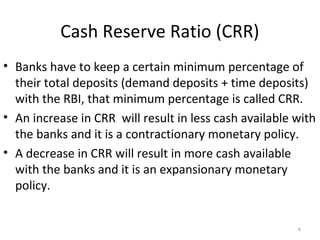
Cash Reserve Ratio (CRR)
• Banks have to keep a certain minimum percentage of
their total deposits (demand deposits + time deposits)
with the RBI, that minimum percentage is called CRR.
• An increase in CRR will result in less cash available with
the banks and it is a contractionary monetary policy.
• A decrease in CRR will result in more cash available
with the banks and it is an expansionary monetary
policy.
6
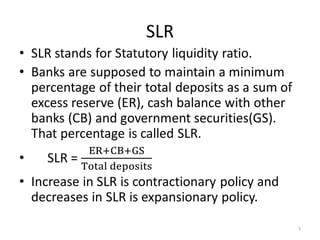
SLR
7
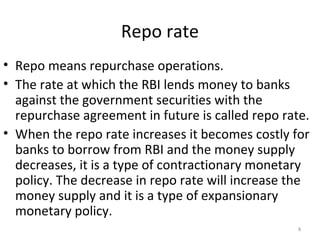
Repo rate
• Repo means repurchase operations.
• The rate at which the RBI lends money to banks
against the government securities with the
repurchase agreement in future is called repo rate.
• When the repo rate increases it becomes costly for
banks to borrow from RBI and the money supply
decreases, it is a type of contractionary monetary
policy. The decrease in repo rate will increase the
money supply and it is a type of expansionary
monetary policy.
8
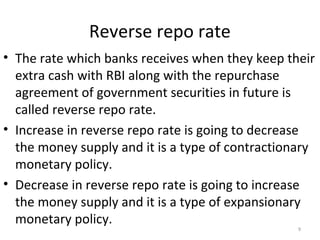
Reverse repo rate
• The rate which banks receives when they keep their
extra cash with RBI along with the repurchase
agreement of government securities in future is
called reverse repo rate.
• Increase in reverse repo rate is going to decrease
the money supply and it is a type of contractionary
monetary policy.
• Decrease in reverse repo rate is going to increase
the money supply and it is a type of expansionary
monetary policy.
9
Open market operations
• Buying and selling of government securities by the
RBI in the open market is called the open market
operations.
• When RBI buys government securities the money
supply is going to increase and it is a type of
expansionary monetary policy.
• When RBI sells government securities the money
supply is going to decrease and it is a type of
contractionary monetary policy.
10
Qualitative measures-1
• It is also called the selective credit controls since
these policies are going to affect only certain
selected parts.
• Credit rationing is controlling the amount of credit
available for certain sectors in order to ensure that
all sectors get adequate amount of credit.
• Change in margin requirements is going to affect
minimum amount of money that an individual is
required to use from his own resources when he
borrows money from the bank.
11
Qualitative measures-2
• Moral suasion is a method used by RBI like
persuading and convincing the banks to
undertake certain actions in the economic
interests of the country.
• When all methods prove ineffective, RBI can
take direct actions by clearly specifying the
way in which banks have to operate.
12

Monetary policy

  • 1.
  • 2.
    Monetary Policy • Setof policies by the monetary authority (Central Bank) which regulates the money supply and credit flows in the economy in order to achieve certain macroeconomic goals are called the monetary policy. • In India, RBI plays the role of central bank and decides the monetary policy. 2
  • 3.
    Objectives of monetarypolicy • Economic growth • Increase in employment • Price stability and inflation control • Exchange rate stability • Balance of payments equilibrium • Reducing income inequality 3
  • 4.
    Instruments of monetarypolicy • All the instruments of the monetary policy can be categorized under two categories Quantitative measures– Bank rate, Repo rate, Reverse repo rate, CRR, SLR, Open market operations Qualitative measures – credit rationing, change in margin requirements, moral suasion, direct controls 4
  • 5.
    Bank rate • Bankrate is the discount rate at which RBI lends money to the commercial banks by discounting the eligible bills. • Increase in bank rate is likely to increase all other interest rates and decrease the total money supply. This is a type of contractionary monetary policy. • Decrease in bank rate is likely to decrease all other interest rates and increase the total money supply. This is a type of expansionary monetary policy. 5
  • 6.
    Cash Reserve Ratio(CRR) • Banks have to keep a certain minimum percentage of their total deposits (demand deposits + time deposits) with the RBI, that minimum percentage is called CRR. • An increase in CRR will result in less cash available with the banks and it is a contractionary monetary policy. • A decrease in CRR will result in more cash available with the banks and it is an expansionary monetary policy. 6
  • 7.
  • 8.
    Repo rate • Repomeans repurchase operations. • The rate at which the RBI lends money to banks against the government securities with the repurchase agreement in future is called repo rate. • When the repo rate increases it becomes costly for banks to borrow from RBI and the money supply decreases, it is a type of contractionary monetary policy. The decrease in repo rate will increase the money supply and it is a type of expansionary monetary policy. 8
  • 9.
    Reverse repo rate •The rate which banks receives when they keep their extra cash with RBI along with the repurchase agreement of government securities in future is called reverse repo rate. • Increase in reverse repo rate is going to decrease the money supply and it is a type of contractionary monetary policy. • Decrease in reverse repo rate is going to increase the money supply and it is a type of expansionary monetary policy. 9
  • 10.
    Open market operations •Buying and selling of government securities by the RBI in the open market is called the open market operations. • When RBI buys government securities the money supply is going to increase and it is a type of expansionary monetary policy. • When RBI sells government securities the money supply is going to decrease and it is a type of contractionary monetary policy. 10
  • 11.
    Qualitative measures-1 • Itis also called the selective credit controls since these policies are going to affect only certain selected parts. • Credit rationing is controlling the amount of credit available for certain sectors in order to ensure that all sectors get adequate amount of credit. • Change in margin requirements is going to affect minimum amount of money that an individual is required to use from his own resources when he borrows money from the bank. 11
  • 12.
    Qualitative measures-2 • Moralsuasion is a method used by RBI like persuading and convincing the banks to undertake certain actions in the economic interests of the country. • When all methods prove ineffective, RBI can take direct actions by clearly specifying the way in which banks have to operate. 12