Interview
To better understand the
interview process:
the before, during, and after
To be aware of the
appropriate interviewing
behaviors .
To learn about behavioral
interviewing.
To practice interviewing skills
Goals of the Candidate (you):
To obtain information about the job/organization.
To communicate important information about yourself.
To make a positive impression upon the employer.
Goals of the Interviewer:
To promote the organization and attract the best candidate.
To assess if qualifications match the job requirements.
To determine candidate fit with the organization and staff
Goals of the Interview
Skills/Qualities Sought by Employers	
  
§ Ability to learn
§ Technical Skills
§ Communication skills
§ Critical thinking
§ Personal management
§ Teamwork
§ Leadership
§ Adaptability
§ Organiza)on	
  Skills	
  
§ 	
  	
  	
  Mo)va)on	
  
§ 	
  	
  	
  Problem	
  Solving	
  
§ 	
  	
  	
  Maturity	
  
§ 	
  	
  	
  Professional	
  Judgment	
  
Before the Interview
Research the industry/company
Identify reasons for wanting to work or having
interest in that industry/company
Recall situations that show favorable behaviors/
actions
Analyze the skills the employer is seeking
Practice answering common interview questions
Prepare questions to ask the employer
Company/Industry Research	
  
§ Learn more about the industry
§ haleebfoods.com
§ nestle.com
§ Hum.tv.com
§ Informational Interviews &
Networking
§ Learn about the company
§ Business
§ Policies
§ Portfolio
Dress for the Interview
Business professional dress, unless notified
otherwise
Carry a binder/portfolio to contain resumes,
personal calendar, pen
Don’t chew gum or bring beverages or food
Don’t use hard perfume.
	
  
Dress to Impress- Women	


§ According	
  the	
  seasons	
  	
  
§ Mul)-­‐colored	
  	
  
§ Normal	
  Hair	
  style	


Dress to Impress- Men 	
  
§ Invest	
  in	
  a	
  conserva)ve	
  color	


§ Check	
  for	
  proper	
  fit	
  
§ Wear	
  socks	
  that	
  match	
  your	
  trousers	
  
§ Clean	
  your	
  shoes	
  
§ The	
  )e	
  knot	
  should	
  be	
  small	
  
Interview Structure	
  
§ Pre-Interview
§ Greeting, Introduction, “Small Talk”
§ Information Exchange
§ Interview questions/responses
§ Information sharing about employer
§ Interviewee’s questions
§ Closing
§ Next steps
§ Business card?
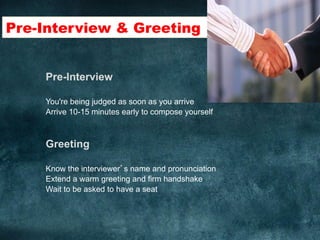
Pre-Interview & Greeting	
  
Pre-Interview
You're being judged as soon as you arrive
Arrive 10-15 minutes early to compose yourself
Greeting
Know the interviewer’s name and pronunciation
Extend a warm greeting and firm handshake
Wait to be asked to have a seat
	
  
Information Exchange 	
  
DIRECT: confirms information
Are you able to...
OPEN-ENDED: generates performance data
Tell me about a time when you…
How did you…
Describe a situation where you…
Give me an example of…
WHY QUESTIONS: reveal preferences,
motives
• One-on-One Interview – Traditional interview
• Serial or Sequential Interview - Candidates are
passed from one interviewer to another throughout
the course of the day. Sequential may last day,
weeks or longer.
• Panel Interview – Appear before a committee or
panel of interviewers
• Group Interview – Interview simultaneously with
other candidates for the same
position
	
  
Tell me about yourself… 	
  
A dreaded, but very common question.
Importance:
§ First Impression still malleable
§ Tone of interview
§ Provide depth to resume
§ Insight into who you are
	
  
Share	
  informa)on	
  
the	
  employer	
  may	
  
not	
  already	
  know	
  	
  
and	
  present	
  it	
  in	
  	
  a	
  
way	
  that	
  connects	
  to	
  
the	
  posi)on	


  you	
  
are	
  seeking.	
  	
  
Direct questions often require only a short answer
with minimal elaboration.
Examples:
§ Are you able to …
§ Are you willing to relocate?
§ Are you willing to travel?
	
  
Behavioral Interviewing	
  
“The best predictor of future performance is
past performance in similar situations.”
Provide specific examples/situations based on
actual past behaviors, instead of based on
responses to hypothetical questions.
	
  
Question:
Have you ever had to deal with an
upset customer? If so, what how did you
deal with it? What happened?
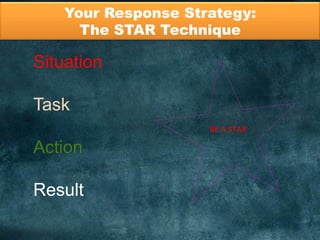
Your Response Strategy:
The STAR Technique 	
  
Situation
Task
Action
Result
	
  
BE	
  A	
  STAR	
  
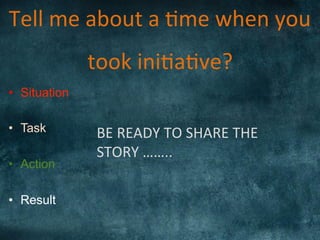
Tell	
  me	
  about	
  a	
  )me	
  when	
  you	
  	
  
took	
  ini)a)ve?	
  
•  Situation
•  Task
•  Action
•  Result
BE	
  READY	
  TO	
  SHARE	
  THE	
  
STORY	
  ……..	
  
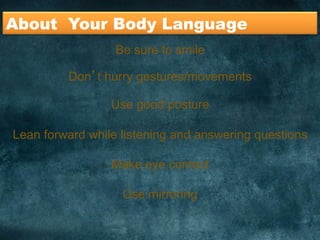
About Your Body Language	
  
Be sure to smile
Don’t hurry gestures/movements
Use good posture
Lean forward while listening and answering questions
Make eye contact
Use mirroring
	
  
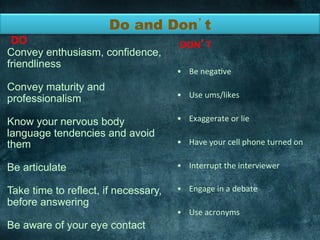
Do and Don’t	
  
DO
Convey enthusiasm, confidence,
friendliness
Convey maturity and
professionalism
Know your nervous body
language tendencies and avoid
them
Be articulate
Take time to reflect, if necessary,
before answering
Be aware of your eye contact


  DON’T	


•  Be	
  nega)ve	
  
•  Use	
  ums/likes	
  
•  Exaggerate	
  or	
  lie	
  
•  Have	
  your	
  cell	
  phone	
  turned	
  on	
  
•  Interrupt	
  the	
  interviewer	
  
•  Engage	
  in	
  a	
  debate	
  
•  Use	
  acronyms	


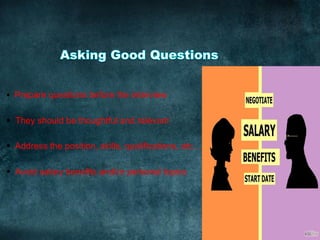
§  Prepare questions before the interview
§  They should be thoughtful and relevant
§  Address the position, skills, qualifications, etc…
§  Avoid salary benefits and/or personal topics
	
  
Factors Rated
• Education – As it relates to the position
• Cognitive Abilities – Judgment, logic, thought processes etc.
• Manner, Personal Traits – Social poise, sense of humor,
mannerism, self confidence, listening skills etc.
• Appearance – Grooming, Dress, Hygiene, Health
• Attitude – Enthusiastic, outlook, willing to work hard, ability to
accept criticism, interaction with work environment / people
• Level of Motivation – Initiative, energetic, ambitious, goal
oriented, accomplishments and achievements
• Leadership Qualities – Mature, responsible, stable
• Interest – Interest in position and company
• Overall Impression
	
  
Interview	
  is	
  not	
  only	
  tes)ng	
  
you	
  but	
  also	
  mee)ng	
  with	
  
you	
  .	


Asif	
  Jamal	
  
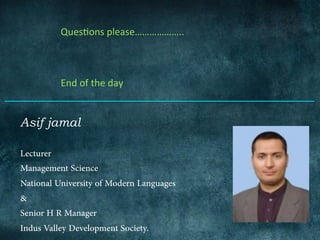
Asif jamal
	
  
Lecturer
Management Science
National University of Modern Languages
&
Senior H R Manager
Indus Valley Development Society.
Ques)ons	
  please………………..	


End	
  of	
  the	
  day	
  

Interviw techn workshop

  • 1.
  • 2.
    To better understandthe interview process: the before, during, and after To be aware of the appropriate interviewing behaviors . To learn about behavioral interviewing. To practice interviewing skills
  • 3.
    Goals of theCandidate (you): To obtain information about the job/organization. To communicate important information about yourself. To make a positive impression upon the employer. Goals of the Interviewer: To promote the organization and attract the best candidate. To assess if qualifications match the job requirements. To determine candidate fit with the organization and staff Goals of the Interview
  • 4.
    Skills/Qualities Sought byEmployers   § Ability to learn § Technical Skills § Communication skills § Critical thinking § Personal management § Teamwork § Leadership § Adaptability § Organiza)on  Skills   §       Mo)va)on   §       Problem  Solving   §       Maturity   §       Professional  Judgment  
  • 5.
    Before the Interview Researchthe industry/company Identify reasons for wanting to work or having interest in that industry/company Recall situations that show favorable behaviors/ actions Analyze the skills the employer is seeking Practice answering common interview questions Prepare questions to ask the employer
  • 6.
    Company/Industry Research   § Learnmore about the industry § haleebfoods.com § nestle.com § Hum.tv.com § Informational Interviews & Networking § Learn about the company § Business § Policies § Portfolio
  • 7.
    Dress for theInterview Business professional dress, unless notified otherwise Carry a binder/portfolio to contain resumes, personal calendar, pen Don’t chew gum or bring beverages or food Don’t use hard perfume.  
  • 8.
    Dress to Impress-Women     § According  the  seasons     § Mul)-­‐colored     § Normal  Hair  style        
  • 9.
    Dress to Impress-Men   § Invest  in  a  conserva)ve  color     § Check  for  proper  fit   § Wear  socks  that  match  your  trousers   § Clean  your  shoes   § The  )e  knot  should  be  small  
  • 11.
    Interview Structure   § Pre-Interview § Greeting,Introduction, “Small Talk” § Information Exchange § Interview questions/responses § Information sharing about employer § Interviewee’s questions § Closing § Next steps § Business card?
  • 12.
    Pre-Interview & Greeting   Pre-Interview You're being judged as soon as you arrive Arrive 10-15 minutes early to compose yourself Greeting Know the interviewer’s name and pronunciation Extend a warm greeting and firm handshake Wait to be asked to have a seat  
  • 13.
    Information Exchange   DIRECT: confirms information Are you able to... OPEN-ENDED: generates performance data Tell me about a time when you… How did you… Describe a situation where you… Give me an example of… WHY QUESTIONS: reveal preferences, motives
  • 14.
    • One-on-One Interview –Traditional interview • Serial or Sequential Interview - Candidates are passed from one interviewer to another throughout the course of the day. Sequential may last day, weeks or longer. • Panel Interview – Appear before a committee or panel of interviewers • Group Interview – Interview simultaneously with other candidates for the same position  
  • 15.
    Tell me aboutyourself…   A dreaded, but very common question. Importance: § First Impression still malleable § Tone of interview § Provide depth to resume § Insight into who you are   Share  informa)on   the  employer  may   not  already  know     and  present  it  in    a   way  that  connects  to   the  posi)on              you   are  seeking.    
  • 16.
    Direct questions oftenrequire only a short answer with minimal elaboration. Examples: § Are you able to … § Are you willing to relocate? § Are you willing to travel?  
  • 17.
    Behavioral Interviewing   “Thebest predictor of future performance is past performance in similar situations.” Provide specific examples/situations based on actual past behaviors, instead of based on responses to hypothetical questions.  
  • 18.
    Question: Have you everhad to deal with an upset customer? If so, what how did you deal with it? What happened?
  • 19.
    Your Response Strategy: TheSTAR Technique   Situation Task Action Result   BE  A  STAR  
  • 20.
    Tell  me  about  a  )me  when  you     took  ini)a)ve?   •  Situation •  Task •  Action •  Result BE  READY  TO  SHARE  THE   STORY  ……..  
  • 21.
    About Your BodyLanguage   Be sure to smile Don’t hurry gestures/movements Use good posture Lean forward while listening and answering questions Make eye contact Use mirroring  
  • 22.
    Do and Don’t   DO Convey enthusiasm, confidence, friendliness Convey maturity and professionalism Know your nervous body language tendencies and avoid them Be articulate Take time to reflect, if necessary, before answering Be aware of your eye contact    DON’T     •  Be  nega)ve   •  Use  ums/likes   •  Exaggerate  or  lie   •  Have  your  cell  phone  turned  on   •  Interrupt  the  interviewer   •  Engage  in  a  debate   •  Use  acronyms    
  • 23.
    §  Prepare questionsbefore the interview §  They should be thoughtful and relevant §  Address the position, skills, qualifications, etc… §  Avoid salary benefits and/or personal topics  
  • 24.
    Factors Rated • Education –As it relates to the position • Cognitive Abilities – Judgment, logic, thought processes etc. • Manner, Personal Traits – Social poise, sense of humor, mannerism, self confidence, listening skills etc. • Appearance – Grooming, Dress, Hygiene, Health • Attitude – Enthusiastic, outlook, willing to work hard, ability to accept criticism, interaction with work environment / people • Level of Motivation – Initiative, energetic, ambitious, goal oriented, accomplishments and achievements • Leadership Qualities – Mature, responsible, stable • Interest – Interest in position and company • Overall Impression  
  • 25.
    Interview  is  not  only  tes)ng   you  but  also  mee)ng  with   you  .     Asif  Jamal  
  • 26.
    Asif jamal   Lecturer ManagementScience National University of Modern Languages & Senior H R Manager Indus Valley Development Society. Ques)ons  please………………..         End  of  the  day