Developing Interview Skills
Dr. Joseph Bell
&
Pulak Barua
Venue: UB Training Centre
Building 13
Date: 19 March 2019, Tuesday
Time: 11:00 – 02:00
Workshop Outcomes:
Knowledge of:
Types of interviews
Interview preparation steps & tips
Stages of an interview
Developing effective answers
Interviews
•Interview = A meeting with an objective
•Employer’s objective is to find the best person for the job
• Employer: reviews candidate’s experience and abilities
• Can you do the job? (skills, abilities, qualifications)
• Will you do the job? (interest, attitude & motivation)
• How will you fit into the organisation? (personality)
•You: impress employer and assess position on offer
• What does this position offer me?
• How does it fit with my career plans?
•You must prove that you are the most suitable candidate for
this position
Types of Interviews
•Behavioral Interview
• Stress Interview
• Phone Interview
•Technical Interview
•Group interviews
•Panel Interview
•Role Plays
Behavioral Interview
•A common type of job interview
•Also called a competency-based interview
•A job candidate's previous behaviors are the best
indicators of future performance.
•Candidates are asked to recall specific instances
where they were faced with a set of circumstances,
and how they reacted.
Phone Interviews
To narrow down the number of candidates
before deciding on a shortlist for face to face
interviews.
If a job applicant is a significant distance
away from the premises of the hiring
company such as abroad or in another state.
Stress interviews
• A series of interviews to intimidate the
candidate and keep him/her off-balance.
• To find out how the candidate handles stress.
• To test an applicant's behavior in a busy
environment.
• Questions about handling work overload,
dealing with multiple projects, and handling
conflict are typical.
Technical Interviews
•Problem solving and creativity.
•Sometimes these interviews will be on a computer
module with multiple-choice questions.
Activity – 1
• Suppose you’re a cashier at checkout counter at Hyper Panda. What
levels of skills, experience and knowledge do you think are necessary
for effective performance?
• List 3 points:
1.
2.
3.
The recruitment process
• Advertisement in a shop window, in a newspaper or websites.
• Application form or sending a resume
• Recruiters assess whether or not you have the right skills, experience
and knowledge.
• If they think that you may be suitable, they will ask you to attend an
interview in order to find out in more detail about your possible
aptitude for the job.
The application form and other materials
• Variety in application forms.
• Larger organizations will probably have more formal procedures. As
well as an application form, they may also send you information
about the main duties of the job and the level of skills, experience
and knowledge they are looking for.
• Read through all the information very carefully.
• Research the company.
• Draft out your answers in rough.
• Make sure that your answers demonstrate that you can meet the
criteria for the job.
What does an interview involve?
• Entering the interview room.
• Greetings & introduction.
• Asked to sit down.
• Informal chat for ice-breaking.
• Briefing to you about the job and the organization.
• You are asked questions.
• You are given the opportunity to ask questions.
• The interviewer thanks you and tells you how and when they
will be getting in touch with you.
Activity – 2
• Abdullah is looking for a job. He sees an advertisement in the paper for an
assistant at Al Nahdi Pharmacy. He rings up and asks for an application
form. When it arrives he asks his sister to complete it for him because he
doesn’t have enough time to read the form.
• He is asked to attend an interview. The interviewer asks questions relating
to the form and Abdullah bluffs his way through them because he is not
clear about what is on the form. He doesn’t get the job. Advise Abdullah on
how he should have prepared for the interview.
• List 3 points:
1.
2.
3.
Pre-interview Preparation
•Documents
•Professional Attire
•Prepare Route
•Prepare answers to possible questions
Documents
•Copy of resume for each interviewer +1
•Pen & paper
•Interview Agenda: your questions
•Copy of job posting
•References
•Portfolio (optional depending on career)
Professional Attire
A day or two before the interview:
• Try on your intended outfit.
• Check for stains, rips, missing button, creases, etc.
• Coordinate accessories (tie, belt, socks, shoes etc.).
• Set aside in a “safe” spot.
• Dress one step above.
Prepare Your Route
• Confirm address, including suite number, and interviewer’s
name(s)
• Print a map of the route / write directions.
• Trial run (before day of interview).
• Check for construction signs.
•Locate available parking lot options.
• Set aside change/credit card (if needed).
Prepare Your Answers
• Use recent examples where you excelled
• Identify your skills throughout your response
• Use industry terms (acronyms or industry slang)
• Avoid casual language
• Be objective, not subjective…just the facts
• Include amounts, dollars, time frames, percentages, numbers, etc.
• Length: 1-3 minutes
• Practice, practice, practice!
Ten Common Questions to Expect
• Tell me about yourself.
• What is your greatest achievement?
• Tell me about a time you save time or money.
• What is your greatest strength?
• Can you tell me about your computer skills?
• Tell me about a time where you had to handle a challenging co-worker or
customer.
• Can you describe a time when you went above and beyond the call of duty?
• What do you believe is your professional weakness?
• Where do you see yourself in five years?
• Why do you want to work for this company?
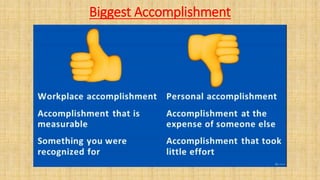
Biggest Accomplishment
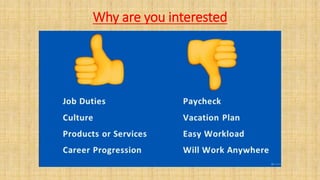
Why are you interested
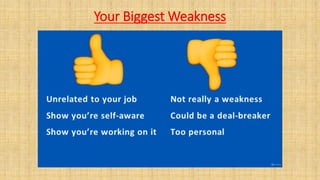
Your Biggest Weakness
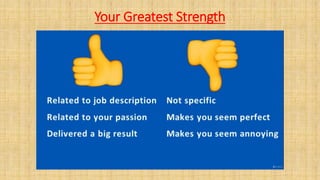
Your Greatest Strength
Video clip: Tell me about yourself.
Activity – 3
• Suppose you’re a floor supervisor at Red Tag. Now you want to
appear in an interview for the post of the manager at Jarir Book Store.
How are you going to answer the questions?
• Q: Tell me about your current job.
• Q: Why do you want the job?
• Q: What interests you about the job?
• Q: What are your strengths and weaknesses?
• Q: What skills and qualities could you bring to the job?
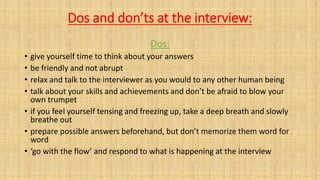
Dos and don’ts at the interview:
Dos:
• give yourself time to think about your answers
• be friendly and not abrupt
• relax and talk to the interviewer as you would to any other human being
• talk about your skills and achievements and don’t be afraid to blow your
own trumpet
• if you feel yourself tensing and freezing up, take a deep breath and slowly
breathe out
• prepare possible answers beforehand, but don’t memorize them word for
word
• ‘go with the flow’ and respond to what is happening at the interview
Dos and don’ts at the interview:
Don’ts:
• play down your skills and experience
• sound too abrupt – this may happen if you feel shy and nervous
• get annoyed with your interviewer, even if you think the questions are
silly or irrelevant
• run down your previous work place
Types of question
1. Closed questions: to confirm information.
For example: ‘Are you still working?’
You do not need to give a long explanation in response to this type of question;
usually just a ‘yes’ or ‘no’.
2. Factual questions: to find out specific information.
For example: ‘When did you leave your last job?’
Give a brief answer including all the necessary information, without much detail.
3. Open questions: most questions are of this type.
For example: ‘Can you tell me something about your current job?’
‘What skills and experience do you have which make you a suitable
candidate for this job?’
These questions need fuller answers. They give you an opportunity to demonstrate
that you are the best candidate for the job.
Activity – 4
Write down whether each of the following is a closed, open or factual
question.
(a) How many years did you work there for?
(b) Could you tell me a little about what happened?
(c) Is that your preferred option?
(d) Why are you interested in the job?
Tips for Your Arrival
• Be “on” before entering the building.
• Arrive 10 minutes before appointment.
• Pleasantly greet receptionist and identify yourself.
• While waiting, review your answers.
• Avoid fidgeting, chewing gum, talking on cell phone or texting.
First Impressions
•Studies show that an interviewer forms
judgments within four minutes of meeting you.
•Much of the impact you create in an interview is
based on your visual and nonverbal
presentation.
Your First Impression
• Greet the interviewer with a comfortably firm handshake, eager smile
and direct eye contact.
• Allow interviewer to indicate where to sit.
• Have documents in order, and offer copy of resume to each
interviewer.
• Assume a receptive posture.
• Breathe and try to relax…remember: you are prepared!
What You Say and How You Say It
• Preparing your answers is a great start!
• Being aware of how you are presenting your answers is also
important.
• Verbal and non-verbal (body language) communication is important
too.
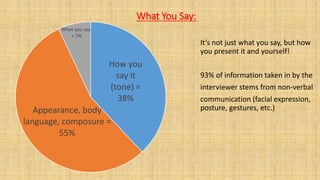
What You Say:
How you
say it
(tone) =
38%
Appearance, body
language, composure =
55%
What you say
= 7%
It’s not just what you say, but how
you present it and yourself!
93% of information taken in by the
interviewer stems from non-verbal
communication (facial expression,
posture, gestures, etc.)
Non-verbal Communication
Non-verbal communication is composed of appearance, posture and
body language.
• Appearance:
Personal hygiene and clothing
• Posture:
Attentive listening position
Avoid slouching or sitting on edge
Make comfortable (slight) adjustments
Avoid crossing your legs and arms
Allow for a personal space of about 36 inches
Non-verbal Communication
Body Language:
• Your words will explain your background, but at the same time, your
body language will give out a lot more information.
• Becoming more aware of your own body language can increase your
chances of getting the job.
• Reading the interviewer’s body language can be a useful tool to gauge
your presentation.
Body Language
Body language includes:
• Hands
• Handshake
• Eye contact
• Facial signals and head movements
Your Hands
• Hand movements can liven up an interview, but should be used in
moderation, and below eye level.
• Avoid crossing your arms.
• Avoid unconscious hand movements (biting nails, picking at nails,
adjusting tie, wringing hands, rubbing the back of your neck, hands in
pockets, clicking a pen, etc.)
The Handshake
•Comfortably firm; 2 - 3 shakes
•Use only 1 hand and put it all the way into the
interviewer’s hand, with palm up
•Be aware of possible perspiration
Your Eyes
Eye contact is essential and an excellent way of conveying your interest
in the job
• By looking directly at the interviewer you are giving them a sign of
trust
• Allow for eye movement to avoid staring
• Avoid looking away, down, or over your glasses when answering
questions
• Panel interview: focus on the person who posed the questions, and
‘sweep’ the others
Your Facial Signals
•Present a warm and natural smile
•Nod your head slowly in agreeance
•Avoid head bobbing
•Avoid biting / licking your lips
•Be aware if you are rubbing your nose
•Be aware of subconscious facial expressions
Interviewer’s Body Language
•Watch the amount of hand gestures the
interviewer uses to gauge your usage
•This can serve as warning sign of displeasure
(shaking their head, sighing, crossing their
arms, etc.)
Closing the Interview
• Provide a copy of your References
• Confirm the follow-up timeframe and phone number
• Restate your interest in the position and why you feel you
are the ideal candidate
• Thank the interviewer(s) for their time
• Shake the interviewer’s hand
• Remember to SMILE!
Activity – 5
Watch the video clip.
Why is it a poor interview?
Write 4 points.
Activity – 6
Watch the video clip.
Why is it a good interview?
Write 4 points.
Role play
Play the roles of
interviewees and
interviewers.
Stay positive!
The right opportunity
is waiting for you!

Developing Interview Skills

  • 1.
    Developing Interview Skills Dr.Joseph Bell & Pulak Barua Venue: UB Training Centre Building 13 Date: 19 March 2019, Tuesday Time: 11:00 – 02:00
  • 2.
    Workshop Outcomes: Knowledge of: Typesof interviews Interview preparation steps & tips Stages of an interview Developing effective answers
  • 3.
    Interviews •Interview = Ameeting with an objective •Employer’s objective is to find the best person for the job • Employer: reviews candidate’s experience and abilities • Can you do the job? (skills, abilities, qualifications) • Will you do the job? (interest, attitude & motivation) • How will you fit into the organisation? (personality) •You: impress employer and assess position on offer • What does this position offer me? • How does it fit with my career plans? •You must prove that you are the most suitable candidate for this position
  • 4.
    Types of Interviews •BehavioralInterview • Stress Interview • Phone Interview •Technical Interview •Group interviews •Panel Interview •Role Plays
  • 5.
    Behavioral Interview •A commontype of job interview •Also called a competency-based interview •A job candidate's previous behaviors are the best indicators of future performance. •Candidates are asked to recall specific instances where they were faced with a set of circumstances, and how they reacted.
  • 6.
    Phone Interviews To narrowdown the number of candidates before deciding on a shortlist for face to face interviews. If a job applicant is a significant distance away from the premises of the hiring company such as abroad or in another state.
  • 7.
    Stress interviews • Aseries of interviews to intimidate the candidate and keep him/her off-balance. • To find out how the candidate handles stress. • To test an applicant's behavior in a busy environment. • Questions about handling work overload, dealing with multiple projects, and handling conflict are typical.
  • 8.
    Technical Interviews •Problem solvingand creativity. •Sometimes these interviews will be on a computer module with multiple-choice questions.
  • 9.
    Activity – 1 •Suppose you’re a cashier at checkout counter at Hyper Panda. What levels of skills, experience and knowledge do you think are necessary for effective performance? • List 3 points: 1. 2. 3.
  • 10.
    The recruitment process •Advertisement in a shop window, in a newspaper or websites. • Application form or sending a resume • Recruiters assess whether or not you have the right skills, experience and knowledge. • If they think that you may be suitable, they will ask you to attend an interview in order to find out in more detail about your possible aptitude for the job.
  • 11.
    The application formand other materials • Variety in application forms. • Larger organizations will probably have more formal procedures. As well as an application form, they may also send you information about the main duties of the job and the level of skills, experience and knowledge they are looking for. • Read through all the information very carefully. • Research the company. • Draft out your answers in rough. • Make sure that your answers demonstrate that you can meet the criteria for the job.
  • 12.
    What does aninterview involve? • Entering the interview room. • Greetings & introduction. • Asked to sit down. • Informal chat for ice-breaking. • Briefing to you about the job and the organization. • You are asked questions. • You are given the opportunity to ask questions. • The interviewer thanks you and tells you how and when they will be getting in touch with you.
  • 13.
    Activity – 2 •Abdullah is looking for a job. He sees an advertisement in the paper for an assistant at Al Nahdi Pharmacy. He rings up and asks for an application form. When it arrives he asks his sister to complete it for him because he doesn’t have enough time to read the form. • He is asked to attend an interview. The interviewer asks questions relating to the form and Abdullah bluffs his way through them because he is not clear about what is on the form. He doesn’t get the job. Advise Abdullah on how he should have prepared for the interview. • List 3 points: 1. 2. 3.
  • 14.
  • 15.
    Documents •Copy of resumefor each interviewer +1 •Pen & paper •Interview Agenda: your questions •Copy of job posting •References •Portfolio (optional depending on career)
  • 16.
    Professional Attire A dayor two before the interview: • Try on your intended outfit. • Check for stains, rips, missing button, creases, etc. • Coordinate accessories (tie, belt, socks, shoes etc.). • Set aside in a “safe” spot. • Dress one step above.
  • 17.
    Prepare Your Route •Confirm address, including suite number, and interviewer’s name(s) • Print a map of the route / write directions. • Trial run (before day of interview). • Check for construction signs. •Locate available parking lot options. • Set aside change/credit card (if needed).
  • 18.
    Prepare Your Answers •Use recent examples where you excelled • Identify your skills throughout your response • Use industry terms (acronyms or industry slang) • Avoid casual language • Be objective, not subjective…just the facts • Include amounts, dollars, time frames, percentages, numbers, etc. • Length: 1-3 minutes • Practice, practice, practice!
  • 19.
    Ten Common Questionsto Expect • Tell me about yourself. • What is your greatest achievement? • Tell me about a time you save time or money. • What is your greatest strength? • Can you tell me about your computer skills? • Tell me about a time where you had to handle a challenging co-worker or customer. • Can you describe a time when you went above and beyond the call of duty? • What do you believe is your professional weakness? • Where do you see yourself in five years? • Why do you want to work for this company?
  • 20.
  • 21.
    Why are youinterested
  • 22.
  • 23.
  • 24.
    Video clip: Tellme about yourself.
  • 25.
    Activity – 3 •Suppose you’re a floor supervisor at Red Tag. Now you want to appear in an interview for the post of the manager at Jarir Book Store. How are you going to answer the questions? • Q: Tell me about your current job. • Q: Why do you want the job? • Q: What interests you about the job? • Q: What are your strengths and weaknesses? • Q: What skills and qualities could you bring to the job?
  • 26.
    Dos and don’tsat the interview: Dos: • give yourself time to think about your answers • be friendly and not abrupt • relax and talk to the interviewer as you would to any other human being • talk about your skills and achievements and don’t be afraid to blow your own trumpet • if you feel yourself tensing and freezing up, take a deep breath and slowly breathe out • prepare possible answers beforehand, but don’t memorize them word for word • ‘go with the flow’ and respond to what is happening at the interview
  • 27.
    Dos and don’tsat the interview: Don’ts: • play down your skills and experience • sound too abrupt – this may happen if you feel shy and nervous • get annoyed with your interviewer, even if you think the questions are silly or irrelevant • run down your previous work place
  • 28.
    Types of question 1.Closed questions: to confirm information. For example: ‘Are you still working?’ You do not need to give a long explanation in response to this type of question; usually just a ‘yes’ or ‘no’. 2. Factual questions: to find out specific information. For example: ‘When did you leave your last job?’ Give a brief answer including all the necessary information, without much detail. 3. Open questions: most questions are of this type. For example: ‘Can you tell me something about your current job?’ ‘What skills and experience do you have which make you a suitable candidate for this job?’ These questions need fuller answers. They give you an opportunity to demonstrate that you are the best candidate for the job.
  • 29.
    Activity – 4 Writedown whether each of the following is a closed, open or factual question. (a) How many years did you work there for? (b) Could you tell me a little about what happened? (c) Is that your preferred option? (d) Why are you interested in the job?
  • 30.
    Tips for YourArrival • Be “on” before entering the building. • Arrive 10 minutes before appointment. • Pleasantly greet receptionist and identify yourself. • While waiting, review your answers. • Avoid fidgeting, chewing gum, talking on cell phone or texting.
  • 31.
    First Impressions •Studies showthat an interviewer forms judgments within four minutes of meeting you. •Much of the impact you create in an interview is based on your visual and nonverbal presentation.
  • 32.
    Your First Impression •Greet the interviewer with a comfortably firm handshake, eager smile and direct eye contact. • Allow interviewer to indicate where to sit. • Have documents in order, and offer copy of resume to each interviewer. • Assume a receptive posture. • Breathe and try to relax…remember: you are prepared!
  • 33.
    What You Sayand How You Say It • Preparing your answers is a great start! • Being aware of how you are presenting your answers is also important. • Verbal and non-verbal (body language) communication is important too.
  • 34.
    What You Say: Howyou say it (tone) = 38% Appearance, body language, composure = 55% What you say = 7% It’s not just what you say, but how you present it and yourself! 93% of information taken in by the interviewer stems from non-verbal communication (facial expression, posture, gestures, etc.)
  • 35.
    Non-verbal Communication Non-verbal communicationis composed of appearance, posture and body language. • Appearance: Personal hygiene and clothing • Posture: Attentive listening position Avoid slouching or sitting on edge Make comfortable (slight) adjustments Avoid crossing your legs and arms Allow for a personal space of about 36 inches
  • 36.
    Non-verbal Communication Body Language: •Your words will explain your background, but at the same time, your body language will give out a lot more information. • Becoming more aware of your own body language can increase your chances of getting the job. • Reading the interviewer’s body language can be a useful tool to gauge your presentation.
  • 37.
    Body Language Body languageincludes: • Hands • Handshake • Eye contact • Facial signals and head movements
  • 38.
    Your Hands • Handmovements can liven up an interview, but should be used in moderation, and below eye level. • Avoid crossing your arms. • Avoid unconscious hand movements (biting nails, picking at nails, adjusting tie, wringing hands, rubbing the back of your neck, hands in pockets, clicking a pen, etc.)
  • 39.
    The Handshake •Comfortably firm;2 - 3 shakes •Use only 1 hand and put it all the way into the interviewer’s hand, with palm up •Be aware of possible perspiration
  • 40.
    Your Eyes Eye contactis essential and an excellent way of conveying your interest in the job • By looking directly at the interviewer you are giving them a sign of trust • Allow for eye movement to avoid staring • Avoid looking away, down, or over your glasses when answering questions • Panel interview: focus on the person who posed the questions, and ‘sweep’ the others
  • 41.
    Your Facial Signals •Presenta warm and natural smile •Nod your head slowly in agreeance •Avoid head bobbing •Avoid biting / licking your lips •Be aware if you are rubbing your nose •Be aware of subconscious facial expressions
  • 42.
    Interviewer’s Body Language •Watchthe amount of hand gestures the interviewer uses to gauge your usage •This can serve as warning sign of displeasure (shaking their head, sighing, crossing their arms, etc.)
  • 43.
    Closing the Interview •Provide a copy of your References • Confirm the follow-up timeframe and phone number • Restate your interest in the position and why you feel you are the ideal candidate • Thank the interviewer(s) for their time • Shake the interviewer’s hand • Remember to SMILE!
  • 44.
    Activity – 5 Watchthe video clip. Why is it a poor interview? Write 4 points.
  • 45.
    Activity – 6 Watchthe video clip. Why is it a good interview? Write 4 points.
  • 46.
    Role play Play theroles of interviewees and interviewers.
  • 47.
    Stay positive! The rightopportunity is waiting for you!