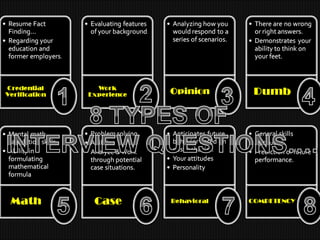
BeThe Star In Every Interview!
Effective Interviewing Strategies
The interview is one of the most important steps
to getting a job.
The cover letter and resume can interest an
employer, but the interview will make or break
your chances of landing the job.
It is normal to be nervous and scared, but being
prepared will help you do your very best.
It is normal to be nervous and scared, but being
prepared will help you do your very best.
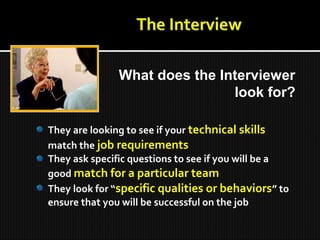
They are looking to see if your technical skills
match the job requirements
They ask specific questions to see if you will be a
good match for a particular team
They look for “specific qualities or behaviors” to
ensure that you will be successful on the job
What does the Interviewer
look for?
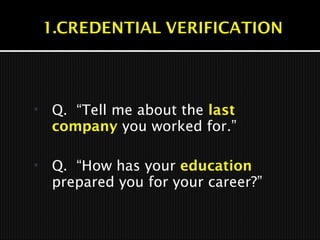
 Q. “Tell me about the last
company you worked for.”
 Q. “How has your education
prepared you for your career?”
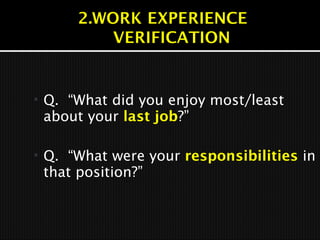
 Q. “What did you enjoy most/least
about your last job?”
 Q. “What were your responsibilities in
that position?”
 Q. “What are your strengths and
weaknesses?”
 Q. “How would you handle a
difficult boss or co-worker?”
 Q.“How would you redesign the
teddy bear?”
 Q. “What kind of animal would
you be?”
 Q. “What sort of decisions do you
find the most difficult to make?”
 Q. “Give an example of a time you
identified a process that needed
improvement and how you initiated
changes to work toward that
improvement.”
 Q. “Have you ever had a project or
idea criticized? What was your
response?”
 Q. “How do you resolve disputes
with co-workers or bosses?”
Open ended: These often begin with “Tell
Me…”, “Describe…”,”When”.
Close-ended: Used most often to verify or
confirm information.
Why questions: Used to reveal rationale for
decisions made or level of motivation
Behavioral interview questions can be…
Prepare for this type of interview by:
 Identifying 6 to 8 examples of past
experiences that demonstrated your top
behaviors and skills that employers
seek.
 Be prepared to use examples from
work, classes, volunteer work and extra
curricular activities.
 Make ½ of your examples positive. These
are accomplishments and goals you met.
 Make the other ½ the aspects that started
out as negative and ended up positively,
or you did your best trying for the best
outcome.
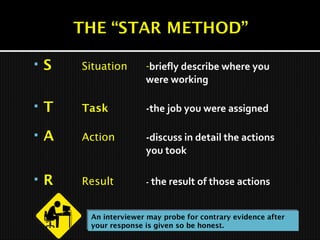
Don’t forget the StAr…
 S Situation -briefly describe where you
were working
 T Task -the job you were assigned
 A Action -discuss in detail the actions
you took
 R Result - the result of those actions
An interviewer may probe for contrary evidence after
your response is given so be honest.
An interviewer may probe for contrary evidence after
your response is given so be honest.
 Q. “Can you give me a specific
example of your leadership skills?”
 Q. “Give me an example of a time
you had to respond in a high-
pressure situation?”
 Competency interviewing uses Behavioral
Interview techniques to judge your past
performance as a predictor of future
performance.
 Q. “Describe a situation…”
 Q. “Tell me about a time when…”
 Q. “What would you do if…”
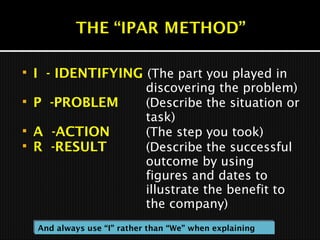
 I - IDENTIFYING (The part you played in
discovering the problem)
 P -PROBLEM (Describe the situation or
task)
 A -ACTION (The step you took)
 R -RESULT (Describe the successful
outcome by using
figures and dates to
illustrate the benefit to
the company)
And always use “I” rather than “We” when explainingAnd always use “I” rather than “We” when explaining
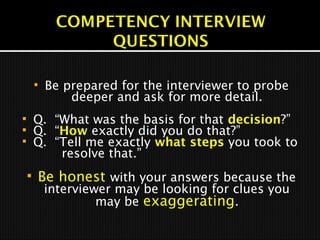
 Be prepared for the interviewer to probe
deeper and ask for more detail.
 Q. “What was the basis for that decision?”
 Q. “How exactly did you do that?”
 Q. “Tell me exactly what steps you took to
resolve that.”
 Be honest with your answers because the
interviewer may be looking for clues you
may be exaggerating.
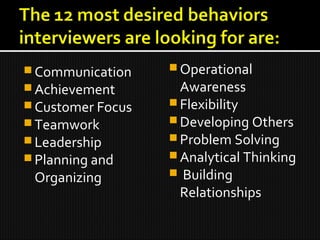
 Communication
 Achievement
 Customer Focus
 Teamwork
 Leadership
 Planning and
Organizing
 Operational
Awareness
 Flexibility
 Developing Others
 Problem Solving
 Analytical Thinking
 Building
Relationships
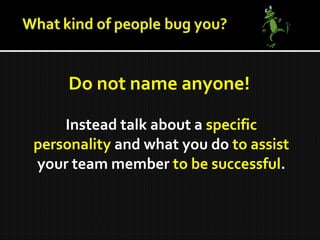
Do not name anyone!
Instead talk about a specific
personality and what you do to assist
your team member to be successful.
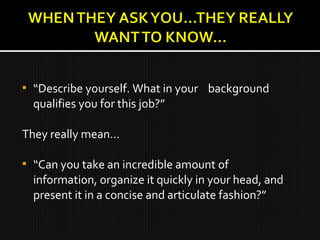
 “Describe yourself. What in your background
qualifies you for this job?”
They really mean…
 “Can you take an incredible amount of
information, organize it quickly in your head, and
present it in a concise and articulate fashion?”
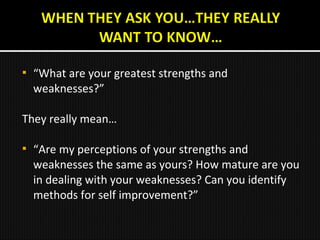
 “What are your greatest strengths and
weaknesses?”
They really mean…
 “Are my perceptions of your strengths and
weaknesses the same as yours? How mature are you
in dealing with your weaknesses? Can you identify
methods for self improvement?”
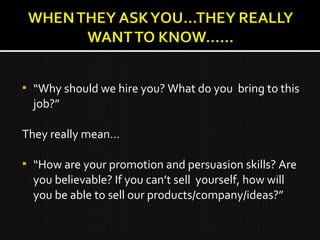
 “Why should we hire you? What do you bring to this
job?”
They really mean…
 “How are your promotion and persuasion skills? Are
you believable? If you can’t sell yourself, how will
you be able to sell our products/company/ideas?”
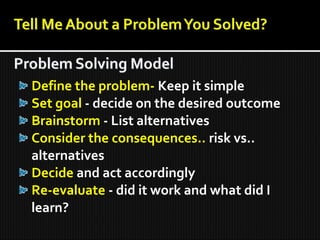
Define the problem- Keep it simple
Set goal - decide on the desired outcome
Brainstorm - List alternatives
Consider the consequences.. risk vs..
alternatives
Decide and act accordingly
Re-evaluate - did it work and what did I
learn?
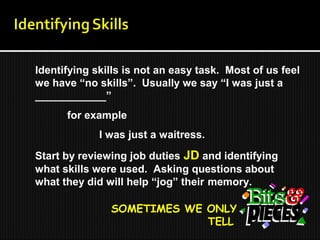
Identifying skills is not an easy task. Most of us feel
we have “no skills”. Usually we say “I was just a
____________”
for example
I was just a waitress.
Start by reviewing job duties JD and identifying
what skills were used. Asking questions about
what they did will help “jog” their memory.
SOMETIMES WE ONLY
TELL
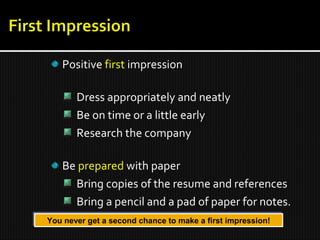
Positive first impression
Dress appropriately and neatly
Be on time or a little early
Research the company
Be prepared with paper
Bring copies of the resume and references
Bring a pencil and a pad of paper for notes.
You never get a second chance to make a first impression!You never get a second chance to make a first impression!
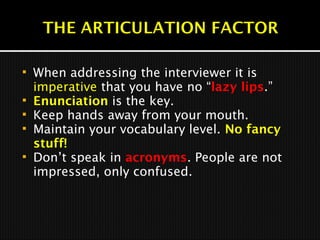
 When addressing the interviewer it is
imperative that you have no “lazy lips.”
 Enunciation is the key.
 Keep hands away from your mouth.
 Maintain your vocabulary level. No fancy
stuff!
 Don’t speak in acronyms. People are not
impressed, only confused.
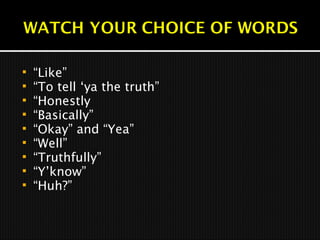
 “Like”
 “To tell ‘ya the truth”
 “Honestly
 “Basically”
 “Okay” and “Yea”
 “Well”
 “Truthfully”
 “Y’know”
 “Huh?”
 This is the process of mirroring the
personality of the person to whom
you are speaking.
 This is based on the fact that we like
people who are like us.
 The halo effect…anyone who is like
me must be a good person.
 Match the voice pitch, tempo, body
language, and posture of the
interviewer.
 The rate of speech (tempo) is more
important than the pitch.
 Reflect the facial expressions and
posture of the interviewer without
going to extremes.
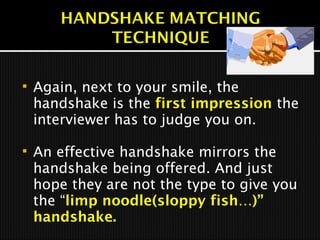
 Again, next to your smile, the
handshake is the first impression the
interviewer has to judge you on.
 An effective handshake mirrors the
handshake being offered. And just
hope they are not the type to give you
the “limp noodle(sloppy fish…)”
handshake.
The questions the interviewer asks helps
them decide if you are the right person for the
job.
The questions you ask the interviewer helps
you decide if this is the right place for you to
be.
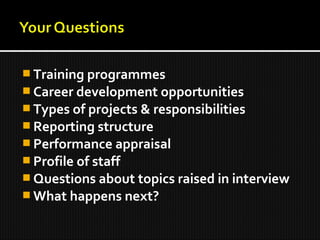
 Training programmes
 Career development opportunities
 Types of projects & responsibilities
 Reporting structure
 Performance appraisal
 Profile of staff
 Questions about topics raised in interview
 What happens next?
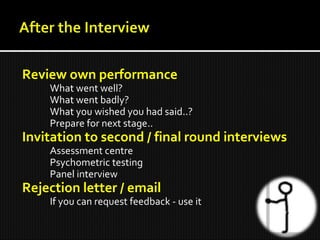
Review own performance
What went well?
What went badly?
What you wished you had said..?
Prepare for next stage..
Invitation to second / final round interviews
Assessment centre
Psychometric testing
Panel interview
Rejection letter / email
If you can request feedback - use it
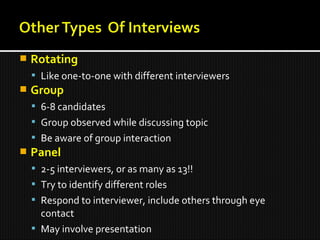
 Rotating
 Like one-to-one with different interviewers
 Group
 6-8 candidates
 Group observed while discussing topic
 Be aware of group interaction
 Panel
 2-5 interviewers, or as many as 13!!
 Try to identify different roles
 Respond to interviewer, include others through eye
contact
 May involve presentation
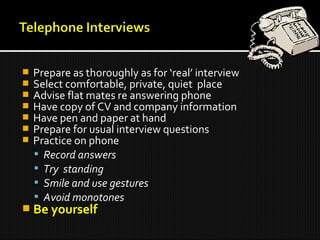
 Prepare as thoroughly as for ‘real’ interview
 Select comfortable, private, quiet place
 Advise flat mates re answering phone
 Have copy of CV and company information
 Have pen and paper at hand
 Prepare for usual interview questions
 Practice on phone
 Record answers
 Try standing
 Smile and use gestures
 Avoid monotones
 Be yourself
 WHEN YOU ARE IN AN INTERVIEW, YOU NEED
TO TELL STORIES.
 YOU CAN LEAD PEOPLE TO BELIEVE BY TELLING
STORIES.
 STORIES SELL!
 KNOW NOT ONLY THE COMPANY’S
BACKGROUND, BUT YOUR OWN. KNOW YOUR
RESUME AND BE ABLE TO RECALL PERSONAL
EVENTS.
 The more prepared you are the easier it is
to be comfortable in this unique
experience, and to be yourself.
 Always be honest. After interviewing
perhaps 100’s of candidates over the
years…interviewers are excellent at
discerning sincerity, honestly and a true
desire to become a professional!
 Good Luck!!!
 The more prepared you are the easier it is
to be comfortable in this unique
experience, and to be yourself.
 Always be honest. After interviewing
perhaps 100’s of candidates over the
years…interviewers are excellent at
discerning sincerity, honestly and a true
desire to become a professional!
 Good Luck!!!

Interview

  • 1.
    BeThe Star InEvery Interview! Effective Interviewing Strategies
  • 2.
    The interview isone of the most important steps to getting a job. The cover letter and resume can interest an employer, but the interview will make or break your chances of landing the job. It is normal to be nervous and scared, but being prepared will help you do your very best. It is normal to be nervous and scared, but being prepared will help you do your very best.
  • 4.
    They are lookingto see if your technical skills match the job requirements They ask specific questions to see if you will be a good match for a particular team They look for “specific qualities or behaviors” to ensure that you will be successful on the job What does the Interviewer look for?
  • 7.
     Q. “Tellme about the last company you worked for.”  Q. “How has your education prepared you for your career?”
  • 8.
     Q. “Whatdid you enjoy most/least about your last job?”  Q. “What were your responsibilities in that position?”
  • 9.
     Q. “Whatare your strengths and weaknesses?”  Q. “How would you handle a difficult boss or co-worker?”
  • 10.
     Q.“How wouldyou redesign the teddy bear?”  Q. “What kind of animal would you be?”
  • 12.
     Q. “Whatsort of decisions do you find the most difficult to make?”  Q. “Give an example of a time you identified a process that needed improvement and how you initiated changes to work toward that improvement.”
  • 13.
     Q. “Haveyou ever had a project or idea criticized? What was your response?”  Q. “How do you resolve disputes with co-workers or bosses?”
  • 14.
    Open ended: Theseoften begin with “Tell Me…”, “Describe…”,”When”. Close-ended: Used most often to verify or confirm information. Why questions: Used to reveal rationale for decisions made or level of motivation Behavioral interview questions can be…
  • 15.
    Prepare for thistype of interview by:  Identifying 6 to 8 examples of past experiences that demonstrated your top behaviors and skills that employers seek.  Be prepared to use examples from work, classes, volunteer work and extra curricular activities.
  • 16.
     Make ½of your examples positive. These are accomplishments and goals you met.  Make the other ½ the aspects that started out as negative and ended up positively, or you did your best trying for the best outcome. Don’t forget the StAr…
  • 17.
     S Situation-briefly describe where you were working  T Task -the job you were assigned  A Action -discuss in detail the actions you took  R Result - the result of those actions An interviewer may probe for contrary evidence after your response is given so be honest. An interviewer may probe for contrary evidence after your response is given so be honest.
  • 18.
     Q. “Canyou give me a specific example of your leadership skills?”  Q. “Give me an example of a time you had to respond in a high- pressure situation?”
  • 19.
     Competency interviewinguses Behavioral Interview techniques to judge your past performance as a predictor of future performance.  Q. “Describe a situation…”  Q. “Tell me about a time when…”  Q. “What would you do if…”
  • 20.
     I -IDENTIFYING (The part you played in discovering the problem)  P -PROBLEM (Describe the situation or task)  A -ACTION (The step you took)  R -RESULT (Describe the successful outcome by using figures and dates to illustrate the benefit to the company) And always use “I” rather than “We” when explainingAnd always use “I” rather than “We” when explaining
  • 21.
     Be preparedfor the interviewer to probe deeper and ask for more detail.  Q. “What was the basis for that decision?”  Q. “How exactly did you do that?”  Q. “Tell me exactly what steps you took to resolve that.”  Be honest with your answers because the interviewer may be looking for clues you may be exaggerating.
  • 22.
     Communication  Achievement Customer Focus  Teamwork  Leadership  Planning and Organizing  Operational Awareness  Flexibility  Developing Others  Problem Solving  Analytical Thinking  Building Relationships
  • 23.
    Do not nameanyone! Instead talk about a specific personality and what you do to assist your team member to be successful.
  • 24.
     “Describe yourself.What in your background qualifies you for this job?” They really mean…  “Can you take an incredible amount of information, organize it quickly in your head, and present it in a concise and articulate fashion?”
  • 25.
     “What areyour greatest strengths and weaknesses?” They really mean…  “Are my perceptions of your strengths and weaknesses the same as yours? How mature are you in dealing with your weaknesses? Can you identify methods for self improvement?”
  • 26.
     “Why shouldwe hire you? What do you bring to this job?” They really mean…  “How are your promotion and persuasion skills? Are you believable? If you can’t sell yourself, how will you be able to sell our products/company/ideas?”
  • 27.
    Define the problem-Keep it simple Set goal - decide on the desired outcome Brainstorm - List alternatives Consider the consequences.. risk vs.. alternatives Decide and act accordingly Re-evaluate - did it work and what did I learn?
  • 28.
    Identifying skills isnot an easy task. Most of us feel we have “no skills”. Usually we say “I was just a ____________” for example I was just a waitress. Start by reviewing job duties JD and identifying what skills were used. Asking questions about what they did will help “jog” their memory. SOMETIMES WE ONLY TELL
  • 30.
    Positive first impression Dressappropriately and neatly Be on time or a little early Research the company Be prepared with paper Bring copies of the resume and references Bring a pencil and a pad of paper for notes. You never get a second chance to make a first impression!You never get a second chance to make a first impression!
  • 31.
     When addressingthe interviewer it is imperative that you have no “lazy lips.”  Enunciation is the key.  Keep hands away from your mouth.  Maintain your vocabulary level. No fancy stuff!  Don’t speak in acronyms. People are not impressed, only confused.
  • 32.
     “Like”  “Totell ‘ya the truth”  “Honestly  “Basically”  “Okay” and “Yea”  “Well”  “Truthfully”  “Y’know”  “Huh?”
  • 33.
     This isthe process of mirroring the personality of the person to whom you are speaking.  This is based on the fact that we like people who are like us.  The halo effect…anyone who is like me must be a good person.
  • 34.
     Match thevoice pitch, tempo, body language, and posture of the interviewer.  The rate of speech (tempo) is more important than the pitch.  Reflect the facial expressions and posture of the interviewer without going to extremes.
  • 35.
     Again, nextto your smile, the handshake is the first impression the interviewer has to judge you on.  An effective handshake mirrors the handshake being offered. And just hope they are not the type to give you the “limp noodle(sloppy fish…)” handshake.
  • 36.
    The questions theinterviewer asks helps them decide if you are the right person for the job. The questions you ask the interviewer helps you decide if this is the right place for you to be.
  • 37.
     Training programmes Career development opportunities  Types of projects & responsibilities  Reporting structure  Performance appraisal  Profile of staff  Questions about topics raised in interview  What happens next?
  • 38.
    Review own performance Whatwent well? What went badly? What you wished you had said..? Prepare for next stage.. Invitation to second / final round interviews Assessment centre Psychometric testing Panel interview Rejection letter / email If you can request feedback - use it
  • 39.
     Rotating  Likeone-to-one with different interviewers  Group  6-8 candidates  Group observed while discussing topic  Be aware of group interaction  Panel  2-5 interviewers, or as many as 13!!  Try to identify different roles  Respond to interviewer, include others through eye contact  May involve presentation
  • 40.
     Prepare asthoroughly as for ‘real’ interview  Select comfortable, private, quiet place  Advise flat mates re answering phone  Have copy of CV and company information  Have pen and paper at hand  Prepare for usual interview questions  Practice on phone  Record answers  Try standing  Smile and use gestures  Avoid monotones  Be yourself
  • 41.
     WHEN YOUARE IN AN INTERVIEW, YOU NEED TO TELL STORIES.  YOU CAN LEAD PEOPLE TO BELIEVE BY TELLING STORIES.  STORIES SELL!  KNOW NOT ONLY THE COMPANY’S BACKGROUND, BUT YOUR OWN. KNOW YOUR RESUME AND BE ABLE TO RECALL PERSONAL EVENTS.
  • 42.
     The moreprepared you are the easier it is to be comfortable in this unique experience, and to be yourself.  Always be honest. After interviewing perhaps 100’s of candidates over the years…interviewers are excellent at discerning sincerity, honestly and a true desire to become a professional!  Good Luck!!!  The more prepared you are the easier it is to be comfortable in this unique experience, and to be yourself.  Always be honest. After interviewing perhaps 100’s of candidates over the years…interviewers are excellent at discerning sincerity, honestly and a true desire to become a professional!  Good Luck!!!