Meaning of an interview
The word interview comes from Latin and middle French words meaning to
“see between” or “see each other”. Generally, an interview means a private
meeting between people when questions are asked and answered.
• Interview = A meeting with an objective
• Employer’s objective is to find the best person for the job.
• Employer: reviews candidate’s experience and abilities
• Can you do the job? (skills, abilities, qualifications)
• Will you do the job? (interest, attitude & motivation)
• How will you fit into the organisation? (personality)
Facts of Interviewing
• Interviews are the most widely used process for
screening job applicants.
• They provide the most direct information about
a candidate’s background, personality, and skills.
• The purpose of an interview is to receive the job
offer.
Know Yourself
• Employment objective and how it relates to the position and the employer
• Educational background and how it relates to the position and the employer
• Work experience
• Abilities and skills
Always be able to give examples!
Know the Employer
• Research! Research! Research!
• Prepare to demonstrate your knowledge of the profession and the company
• Prepare to give reasons for your interest in working in that
profession/company
• Develop questions in advance to ask about the job/organization
Interview Preparation
• Situational Knowledge
• Where/when the interview takes place
• Arrive 10 minutes early!
• Physical Preparation
• Get plenty of rest
• Dress for success
• Mental Preparation
• Knowledge of company
• Practice a mock interview
• Written Preparation
• Take extra resumes, references, etc.
• Make notes
• Ask questions
Preparation is the key to success
• Review own skills, experiences and qualities
• Check CV
• Anticipate questions and identify relevant examples
• Research organisation
• Websites, reports, articles, company literature, etc
• Contacts with knowledge of organisation or sector
• Relevant articles in the press
• Personal visit or telephone call
• Research job and occupational area
• Job description – or similar
• Current issues
• Prepare your questions
• Practice
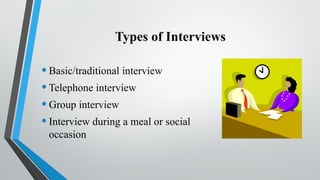
Types of Interviews
•Basic/traditional interview
•Telephone interview
•Group interview
•Interview during a meal or social
occasion
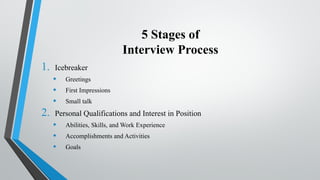
5 Stages of
Interview Process
1. Icebreaker
• Greetings
• First Impressions
• Small talk
2. Personal Qualifications and Interest in Position
• Abilities, Skills, and Work Experience
• Accomplishments and Activities
• Goals
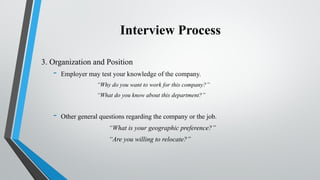
Interview Process
3. Organization and Position
- Employer may test your knowledge of the company.
“Why do you want to work for this company?”
“What do you know about this department?”
- Other general questions regarding the company or the job.
“What is your geographic preference?”
“Are you willing to relocate?”
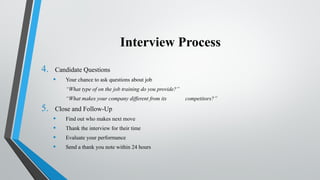
Interview Process
4. Candidate Questions
• Your chance to ask questions about job
“What type of on the job training do you provide?”
“What makes your company different from its competitors?”
5. Close and Follow-Up
• Find out who makes next move
• Thank the interview for their time
• Evaluate your performance
• Send a thank you note within 24 hours
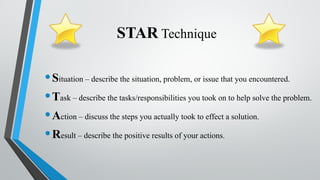
STAR Technique
•Situation – describe the situation, problem, or issue that you encountered.
•Task – describe the tasks/responsibilities you took on to help solve the problem.
•Action – discuss the steps you actually took to effect a solution.
•Result – describe the positive results of your actions.
Tips for Successful Interviewing
• Interviewing is a two-way process
• Never give “yes” or “no” answers
• Listen carefully and react
• Use specific examples to make your case
• The interview begins the minute you step onto the company
• Be positive!
Tips for Successful Interviewing
• Think like an employer
• Don’t criticize past employers or co-workers
• Be aware of illegal questions
• Maintain professionalism, even if the employer does not
• Be prepared for the unexpected
• Be aware of body language
• Be well-groomed
Watch the Body Language
• First impressions are very powerful
• Allow time to relax
• Dress appropriately
• Entrance, introductions & handshake
• Smile and make eye contact
• Be aware of own movements
• Watch body language of interviewer
Typical Questions
• About you
• Tell me about yourself - Bring me up to date with your CV?
• Why did you choose that particular degree programme?
• What experience have you had that is relevant to this post?
• What would you consider your major achievements to date?
• About the job
• What interests you about this job?
• What do you know about this organisation?
• What other options are you considering?
• How do you see your career developing – 5 years?
• If you were Head of Department, what would be your priorities?
• General knowledge
• What do you think of the Government’s policy on college fees?
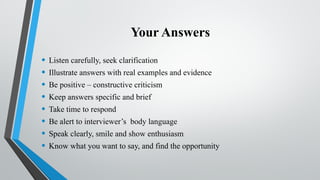
Your Answers
• Listen carefully, seek clarification
• Illustrate answers with real examples and evidence
• Be positive – constructive criticism
• Keep answers specific and brief
• Take time to respond
• Be alert to interviewer’s body language
• Speak clearly, smile and show enthusiasm
• Know what you want to say, and find the opportunity
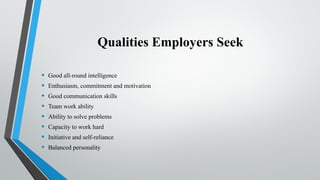
Qualities Employers Seek
• Good all-round intelligence
• Enthusiasm, commitment and motivation
• Good communication skills
• Team work ability
• Ability to solve problems
• Capacity to work hard
• Initiative and self-reliance
• Balanced personality
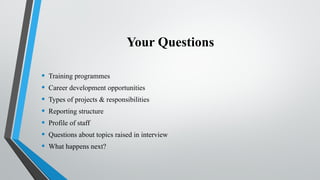
Your Questions
• Training programmes
• Career development opportunities
• Types of projects & responsibilities
• Reporting structure
• Profile of staff
• Questions about topics raised in interview
• What happens next?
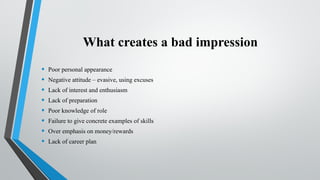
What creates a bad impression
• Poor personal appearance
• Negative attitude – evasive, using excuses
• Lack of interest and enthusiasm
• Lack of preparation
• Poor knowledge of role
• Failure to give concrete examples of skills
• Over emphasis on money/rewards
• Lack of career plan
After the Interview
 Review own performance
what went well
what went badly
what you wished you had said
prepare for next stage
 Invitation to second / final round interviews
assessment centre
psychometric testing
panel interview
 Rejection letter / email
if you can request feedback - use it
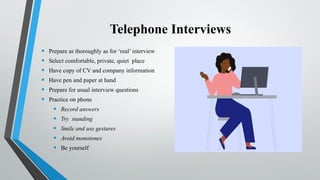
Telephone Interviews
• Prepare as thoroughly as for ‘real’ interview
• Select comfortable, private, quiet place
• Have copy of CV and company information
• Have pen and paper at hand
• Prepare for usual interview questions
• Practice on phone
• Record answers
• Try standing
• Smile and use gestures
• Avoid monotones
• Be yourself
Other Types Of Interviews
• Rotating
• Like one-to-one with different interviewers
• Group
• 6-8 candidates
• Group observed while discussing topic
• Be aware of group interaction
• Panel
• 2-5 interviewers, or as many as 13!!
• Try to identify different roles
• Respond to interviewer, include others through eye contact
• May involve presentation
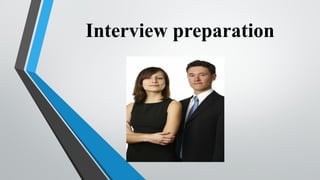
Interview preparation
Before The Interview
• Research the potential employer
• Review the job description and be able to match your experience and
education with the duties of the position
• Prepare a 1 to 2 minute script about yourself
• Make sure you have the appropriate interview attire
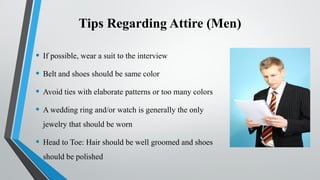
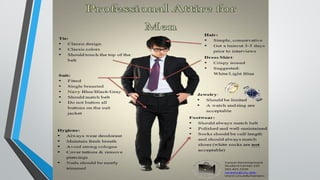
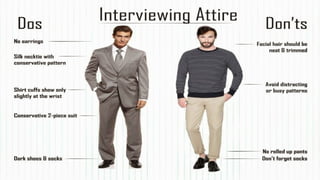
Tips Regarding Attire (Men)
• If possible, wear a suit to the interview
• Belt and shoes should be same color
• Avoid ties with elaborate patterns or too many colors
• A wedding ring and/or watch is generally the only
jewelry that should be worn
• Head to Toe: Hair should be well groomed and shoes
should be polished
Who Would You Hire?
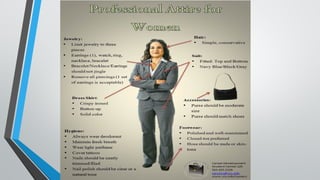
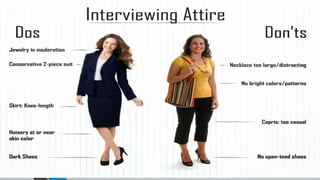
Tips Regarding Attire (Women)
• A suit or dress is preferable
• Skirts should meet at the top of the knee or longer
• The amount of jewelry should be minimized
• Make-up should be light
• Avoid perfumes and scented powders
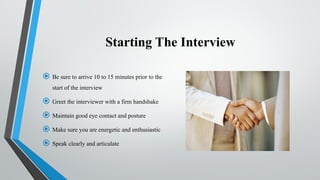
Starting The Interview
 Be sure to arrive 10 to 15 minutes prior to the
start of the interview
 Greet the interviewer with a firm handshake
 Maintain good eye contact and posture
 Make sure you are energetic and enthusiastic
 Speak clearly and articulate
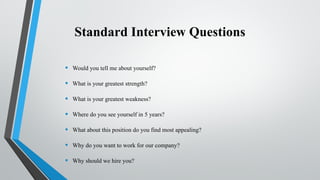
Standard Interview Questions
• Would you tell me about yourself?
• What is your greatest strength?
• What is your greatest weakness?
• Where do you see yourself in 5 years?
• What about this position do you find most appealing?
• Why do you want to work for our company?
• Why should we hire you?
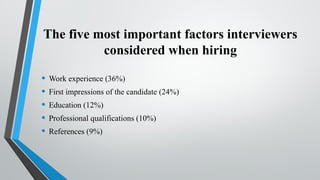
The five most important factors interviewers
considered when hiring
• Work experience (36%)
• First impressions of the candidate (24%)
• Education (12%)
• Professional qualifications (10%)
• References (9%)
Ask Questions
• What are your expectations of the employees in your company?
• What are the strengths and weaknesses of your organization?
• Describe a typical day on the job in this position.
• Avoid asking questions about salary and benefits.
Graceful Exits
 Thank you for your time.
 I appreciate it.
 I will be looking forward to hearing from you.
38
After the Interview
• Evaluate your performance
• Send a thank-you note within 24 hours
• Keep records of important dates and details for the
follow-up
Thank You

Presentation on interview preparation.pt

  • 2.
    Meaning of aninterview The word interview comes from Latin and middle French words meaning to “see between” or “see each other”. Generally, an interview means a private meeting between people when questions are asked and answered. • Interview = A meeting with an objective • Employer’s objective is to find the best person for the job. • Employer: reviews candidate’s experience and abilities • Can you do the job? (skills, abilities, qualifications) • Will you do the job? (interest, attitude & motivation) • How will you fit into the organisation? (personality)
  • 3.
    Facts of Interviewing •Interviews are the most widely used process for screening job applicants. • They provide the most direct information about a candidate’s background, personality, and skills. • The purpose of an interview is to receive the job offer.
  • 4.
    Know Yourself • Employmentobjective and how it relates to the position and the employer • Educational background and how it relates to the position and the employer • Work experience • Abilities and skills Always be able to give examples!
  • 5.
    Know the Employer •Research! Research! Research! • Prepare to demonstrate your knowledge of the profession and the company • Prepare to give reasons for your interest in working in that profession/company • Develop questions in advance to ask about the job/organization
  • 6.
    Interview Preparation • SituationalKnowledge • Where/when the interview takes place • Arrive 10 minutes early! • Physical Preparation • Get plenty of rest • Dress for success • Mental Preparation • Knowledge of company • Practice a mock interview • Written Preparation • Take extra resumes, references, etc. • Make notes • Ask questions
  • 7.
    Preparation is thekey to success • Review own skills, experiences and qualities • Check CV • Anticipate questions and identify relevant examples • Research organisation • Websites, reports, articles, company literature, etc • Contacts with knowledge of organisation or sector • Relevant articles in the press • Personal visit or telephone call • Research job and occupational area • Job description – or similar • Current issues • Prepare your questions • Practice
  • 8.
    Types of Interviews •Basic/traditionalinterview •Telephone interview •Group interview •Interview during a meal or social occasion
  • 9.
    5 Stages of InterviewProcess 1. Icebreaker • Greetings • First Impressions • Small talk 2. Personal Qualifications and Interest in Position • Abilities, Skills, and Work Experience • Accomplishments and Activities • Goals
  • 10.
    Interview Process 3. Organizationand Position - Employer may test your knowledge of the company. “Why do you want to work for this company?” “What do you know about this department?” - Other general questions regarding the company or the job. “What is your geographic preference?” “Are you willing to relocate?”
  • 11.
    Interview Process 4. CandidateQuestions • Your chance to ask questions about job “What type of on the job training do you provide?” “What makes your company different from its competitors?” 5. Close and Follow-Up • Find out who makes next move • Thank the interview for their time • Evaluate your performance • Send a thank you note within 24 hours
  • 12.
    STAR Technique •Situation –describe the situation, problem, or issue that you encountered. •Task – describe the tasks/responsibilities you took on to help solve the problem. •Action – discuss the steps you actually took to effect a solution. •Result – describe the positive results of your actions.
  • 13.
    Tips for SuccessfulInterviewing • Interviewing is a two-way process • Never give “yes” or “no” answers • Listen carefully and react • Use specific examples to make your case • The interview begins the minute you step onto the company • Be positive!
  • 14.
    Tips for SuccessfulInterviewing • Think like an employer • Don’t criticize past employers or co-workers • Be aware of illegal questions • Maintain professionalism, even if the employer does not • Be prepared for the unexpected • Be aware of body language • Be well-groomed
  • 16.
    Watch the BodyLanguage • First impressions are very powerful • Allow time to relax • Dress appropriately • Entrance, introductions & handshake • Smile and make eye contact • Be aware of own movements • Watch body language of interviewer
  • 17.
    Typical Questions • Aboutyou • Tell me about yourself - Bring me up to date with your CV? • Why did you choose that particular degree programme? • What experience have you had that is relevant to this post? • What would you consider your major achievements to date? • About the job • What interests you about this job? • What do you know about this organisation? • What other options are you considering? • How do you see your career developing – 5 years? • If you were Head of Department, what would be your priorities? • General knowledge • What do you think of the Government’s policy on college fees?
  • 18.
    Your Answers • Listencarefully, seek clarification • Illustrate answers with real examples and evidence • Be positive – constructive criticism • Keep answers specific and brief • Take time to respond • Be alert to interviewer’s body language • Speak clearly, smile and show enthusiasm • Know what you want to say, and find the opportunity
  • 19.
    Qualities Employers Seek •Good all-round intelligence • Enthusiasm, commitment and motivation • Good communication skills • Team work ability • Ability to solve problems • Capacity to work hard • Initiative and self-reliance • Balanced personality
  • 20.
    Your Questions • Trainingprogrammes • Career development opportunities • Types of projects & responsibilities • Reporting structure • Profile of staff • Questions about topics raised in interview • What happens next?
  • 21.
    What creates abad impression • Poor personal appearance • Negative attitude – evasive, using excuses • Lack of interest and enthusiasm • Lack of preparation • Poor knowledge of role • Failure to give concrete examples of skills • Over emphasis on money/rewards • Lack of career plan
  • 22.
    After the Interview Review own performance what went well what went badly what you wished you had said prepare for next stage  Invitation to second / final round interviews assessment centre psychometric testing panel interview  Rejection letter / email if you can request feedback - use it
  • 23.
    Telephone Interviews • Prepareas thoroughly as for ‘real’ interview • Select comfortable, private, quiet place • Have copy of CV and company information • Have pen and paper at hand • Prepare for usual interview questions • Practice on phone • Record answers • Try standing • Smile and use gestures • Avoid monotones • Be yourself
  • 24.
    Other Types OfInterviews • Rotating • Like one-to-one with different interviewers • Group • 6-8 candidates • Group observed while discussing topic • Be aware of group interaction • Panel • 2-5 interviewers, or as many as 13!! • Try to identify different roles • Respond to interviewer, include others through eye contact • May involve presentation
  • 25.
  • 26.
    Before The Interview •Research the potential employer • Review the job description and be able to match your experience and education with the duties of the position • Prepare a 1 to 2 minute script about yourself • Make sure you have the appropriate interview attire
  • 27.
    Tips Regarding Attire(Men) • If possible, wear a suit to the interview • Belt and shoes should be same color • Avoid ties with elaborate patterns or too many colors • A wedding ring and/or watch is generally the only jewelry that should be worn • Head to Toe: Hair should be well groomed and shoes should be polished
  • 30.
  • 31.
    Tips Regarding Attire(Women) • A suit or dress is preferable • Skirts should meet at the top of the knee or longer • The amount of jewelry should be minimized • Make-up should be light • Avoid perfumes and scented powders
  • 34.
    Starting The Interview Be sure to arrive 10 to 15 minutes prior to the start of the interview  Greet the interviewer with a firm handshake  Maintain good eye contact and posture  Make sure you are energetic and enthusiastic  Speak clearly and articulate
  • 35.
    Standard Interview Questions •Would you tell me about yourself? • What is your greatest strength? • What is your greatest weakness? • Where do you see yourself in 5 years? • What about this position do you find most appealing? • Why do you want to work for our company? • Why should we hire you?
  • 36.
    The five mostimportant factors interviewers considered when hiring • Work experience (36%) • First impressions of the candidate (24%) • Education (12%) • Professional qualifications (10%) • References (9%)
  • 37.
    Ask Questions • Whatare your expectations of the employees in your company? • What are the strengths and weaknesses of your organization? • Describe a typical day on the job in this position. • Avoid asking questions about salary and benefits.
  • 38.
    Graceful Exits  Thankyou for your time.  I appreciate it.  I will be looking forward to hearing from you. 38
  • 39.
    After the Interview •Evaluate your performance • Send a thank-you note within 24 hours • Keep records of important dates and details for the follow-up
  • 40.