Interview skills
you need
to know.
Think candidates
are the only ones
who need to
prepare for a job
interview?
Think candidates
are the only ones
who need to
prepare for a job
interview?
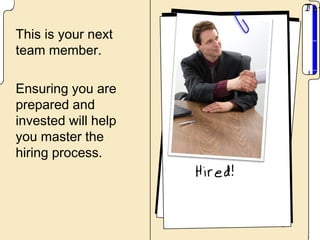
This is your next
team member.

Ensuring you are
prepared and
invested will help
you master the
hiring process.
After all,
you are representing your branch or
department, and STCU.
First impressions mean everything.

Not only are you forming a first
impression about the candidate, they are
forming his or her first opinion of you,
too.

How well you interact with the candidate
speaks to your leadership style, the
department and STCU.
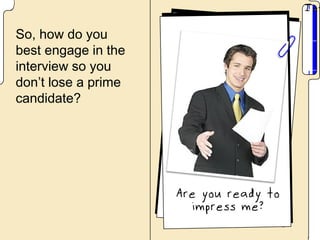
So, how do you
best engage in the
interview so you
don’t lose a prime
candidate?
Practice these five skills:


          Prepare
Practice these five skills:


          Prepare


          Be involved
Practice these five skills:


          Prepare


          Be involved


          Ask appropriate
          questions
Practice these five skills:

                              Ask
          Prepare             questions
                              with purpose


          Be involved


          Ask appropriate
          questions
Practice these five skills:

                              Ask
          Prepare             questions
                              with purpose

                              Be aware of
          Be involved         your reactions

          Ask appropriate
          questions
Prepare
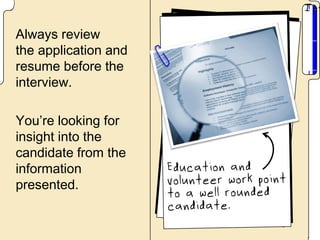
Always review
the application and
resume before the
interview.

You’re looking for
insight into the
candidate from the
information
presented.
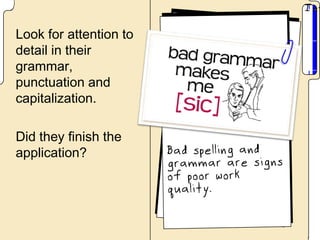
Look for attention to
detail in their
grammar,
punctuation and
capitalization.

Did they finish the
application?
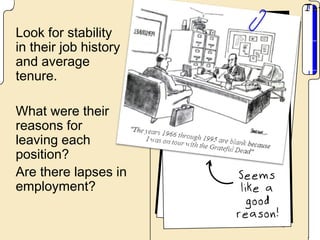
Look for stability
in their job history
and average
tenure.

What were their
reasons for
leaving each
position?
Are there lapses in
employment?
Prepare questions related to skills and job-
related scenarios which will help you
determine the candidate’s experience and
knowledge.

HR will prepare questions that address
behavior and cultural fit.

When combined, these questions will ensure
you find the most qualified candidate.
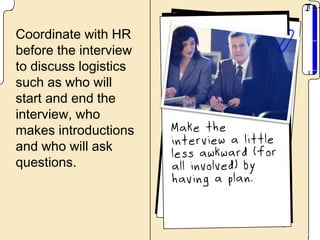
Coordinate with HR
before the interview
to discuss logistics
such as who will
start and end the
interview, who
makes introductions
and who will ask
questions.
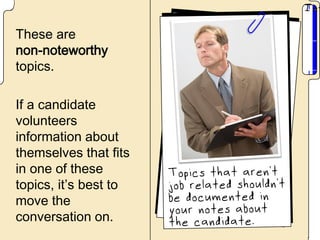
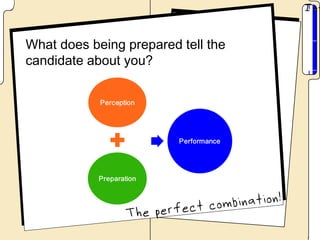
What does being prepared tell the
candidate about you?
Being prepared for the interview
demonstrates your respect and
appreciation for the candidate’s time.

It also establishes what it will be like to
work with you day-to-day as their
supervisor.
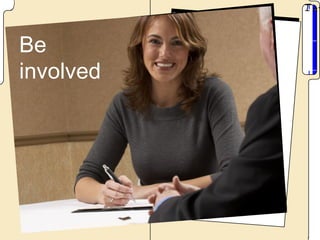
Be
involved
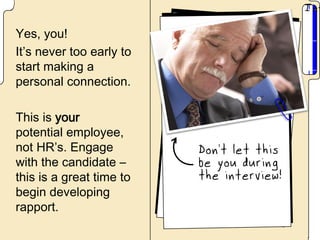
Yes, you!
It’s never too early to
start making a
personal connection.

This is your
potential employee,
not HR’s. Engage
with the candidate –
this is a great time to
begin developing
rapport.
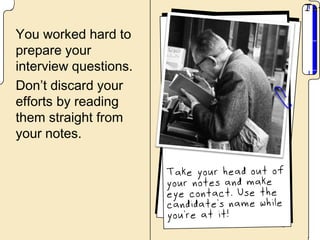
You worked hard to
prepare your
interview questions.
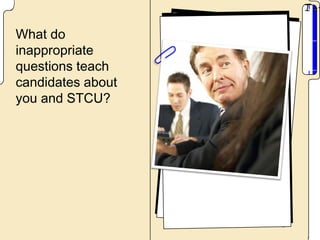
Don’t discard your
efforts by reading
them straight from
your notes.
Think of the interview as a conversation.

Don’t feel obligated to stick to the questions
you’ve prepared – listen for clues in the
candidate’s responses which may need
additional follow up.
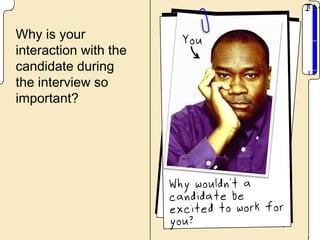
Why is your
interaction with the
candidate during
the interview so
important?
Your interaction with the candidate
during the interview process is an early
demonstration of how you will interact
with them on the job – this is a great
opportunity to make them eager to work
with you!
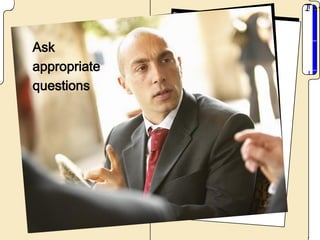
Ask
appropriate
questions
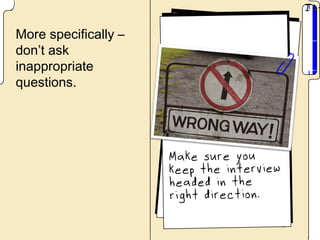
More specifically –
don’t ask
inappropriate
questions.
What’s inappropriate?

Equal Employment Opportunity
Commission (EEOC) laws make it illegal
for employers to discriminate against an
employee or potential employee in certain
workplaces.
Stay away from questions about:

• age                      •   pregnancy
• disability               •   race or color
• medical history or       •   religion
  family medical history   •   sex
• national origin
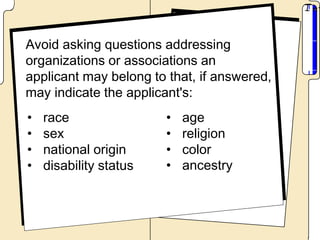
Avoid asking questions addressing
organizations or associations an
applicant may belong to that, if answered,
may indicate the applicant's:
•   race                •   age
•   sex                 •   religion
•   national origin     •   color
•   disability status   •   ancestry
These are
non-noteworthy
topics.

If a candidate
volunteers
information about
themselves that fits
in one of these
topics, it’s best to
move the
conversation on.
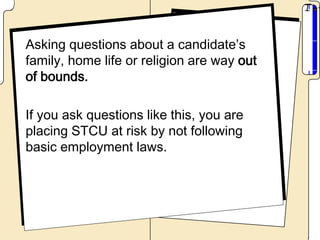
What do
inappropriate
questions teach
candidates about
you and STCU?
Asking questions about a candidate’s
family, home life or religion are way out
of bounds.

If you ask questions like this, you are
placing STCU at risk by not following
basic employment laws.
Ask
questions
with a purpose
You typically have
one hour to find out
if a candidate will fit
in with STCU for the
next five to ten
years.

Make the time
count.
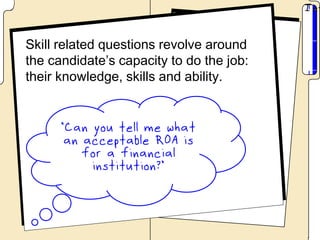
Skill related questions revolve around
the candidate’s capacity to do the job:
their knowledge, skills and ability.
Skill related questions revolve around
the candidate’s capacity to do the job:
their knowledge, skills and ability.
Behavior related questions ask how an
employee has behaved in the past.
Questions can be geared towards
behaviors that you would or would not
like to see in an employee.
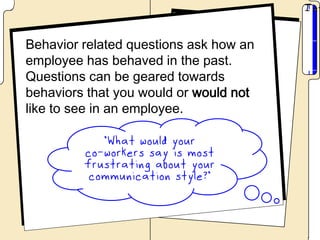
Behavior related questions ask how an
employee has behaved in the past.
Questions can be geared towards
behaviors that you would or would not
like to see in an employee.
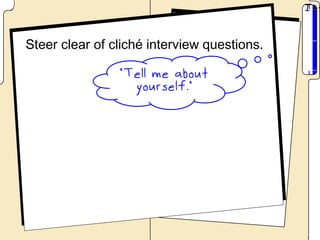
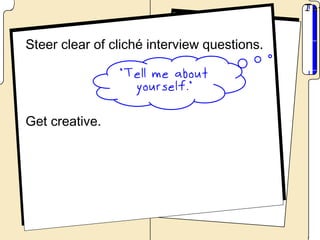
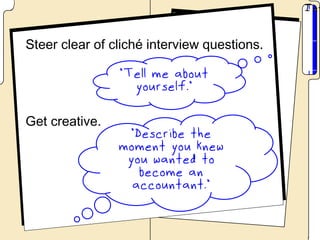
Steer clear of cliché interview questions.


Get creative.
Steer clear of cliché interview questions.


Get creative.
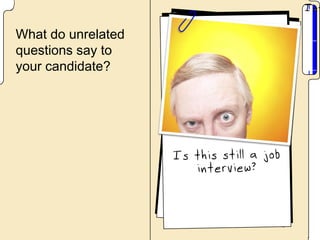
What do unrelated
questions say to
your candidate?
If your questions aren’t related to
determining the specific needs and
qualifications of your position, you risk
hiring the wrong person.
Be aware of
your reactions
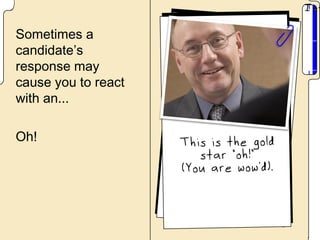
Sometimes a
candidate’s
response may
cause you to react
with an...

Oh!
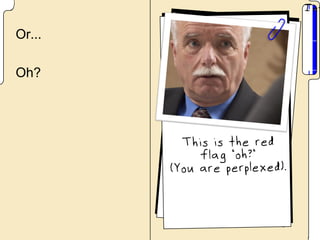
Or...

Oh?
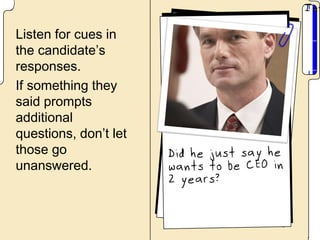
Listen for cues in
the candidate’s
responses.
If something they
said prompts
additional
questions, don’t let
those go
unanswered.
You’ve only known this person for forty
minutes – give them a chance to clarify
anything that puts you on high alert.

Conversely, confirm their
accomplishments before basking in their
greatness.
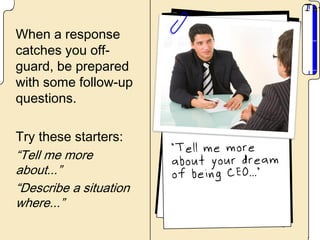
When a response
catches you off-
guard, be prepared
with some follow-up
questions.

Try these starters:
“Tell me more
about...”
“Describe a situation
where...”
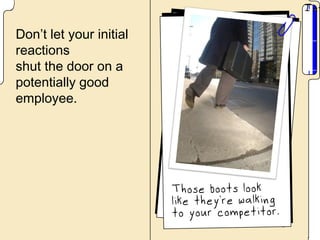
Don’t let your initial
reactions
shut the door on a
potentially good
employee.
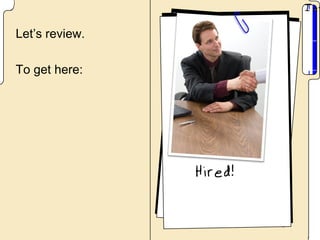
Let’s review.

To get here:
You need to do this:


         Prepare
You need to do this:


         Prepare


         Be involved
You need to do this:


         Prepare


         Be involved


         Ask appropriate
         questions
You need to do this:

                           Ask
         Prepare           questions
                           with purpose


         Be involved


         Ask appropriate
         questions
You need to do this:

                           Ask
         Prepare           questions
                           with purpose

                           Be aware of
         Be involved       your reactions

         Ask appropriate
         questions
You need to do this:

                           Ask
         Prepare           questions
                           with purpose

                           Be aware of
         Be involved       your reactions

         Ask appropriate
         questions
Images
@2012 Jupiterimages Corporation


Resources
Deborah S. Hildebrand. (March 20, 2009). What a Job Interview Says
About the Employer. In Career Advice. Retrieved April 10, 2012, from
http://deborah-s-hildebrand.suite101.com/what-a-job-interview-says-
about-the-employer-a103556.


Wade A. Mitchell. (September 16, 2002). A bad job interview can
reveal what a company is really like. In TechRepublic. Retrieved April
10, 2012, from http://www.techrepublic.com/article/a-bad-job-
interview-can-reveal-what-a-company-is-really-like/1049480#talkback.

Dr. John Sullivan. (March 25, 2011). 20 Reasons Why Weak
Managers Never Hire A-level Talent. In ere.net. Retrieved April 10,
2012, from http://www.ere.net/2011/03/25/20-reasons-why-weak-
managers-never-hire-a-level-talent/.

Interviewing Skills for Hiring Managers

  • 1.
  • 2.
    Think candidates are theonly ones who need to prepare for a job interview?
  • 3.
    Think candidates are theonly ones who need to prepare for a job interview?
  • 4.
    This is yournext team member. Ensuring you are prepared and invested will help you master the hiring process.
  • 5.
    After all, you arerepresenting your branch or department, and STCU.
  • 6.
    First impressions meaneverything. Not only are you forming a first impression about the candidate, they are forming his or her first opinion of you, too. How well you interact with the candidate speaks to your leadership style, the department and STCU.
  • 7.
    So, how doyou best engage in the interview so you don’t lose a prime candidate?
  • 8.
  • 9.
    Practice these fiveskills: Prepare
  • 10.
    Practice these fiveskills: Prepare Be involved
  • 11.
    Practice these fiveskills: Prepare Be involved Ask appropriate questions
  • 12.
    Practice these fiveskills: Ask Prepare questions with purpose Be involved Ask appropriate questions
  • 13.
    Practice these fiveskills: Ask Prepare questions with purpose Be aware of Be involved your reactions Ask appropriate questions
  • 14.
  • 15.
    Always review the applicationand resume before the interview. You’re looking for insight into the candidate from the information presented.
  • 16.
    Look for attentionto detail in their grammar, punctuation and capitalization. Did they finish the application?
  • 17.
    Look for stability intheir job history and average tenure. What were their reasons for leaving each position? Are there lapses in employment?
  • 18.
    Prepare questions relatedto skills and job- related scenarios which will help you determine the candidate’s experience and knowledge. HR will prepare questions that address behavior and cultural fit. When combined, these questions will ensure you find the most qualified candidate.
  • 19.
    Coordinate with HR beforethe interview to discuss logistics such as who will start and end the interview, who makes introductions and who will ask questions.
  • 20.
    What does beingprepared tell the candidate about you?
  • 21.
    Being prepared forthe interview demonstrates your respect and appreciation for the candidate’s time. It also establishes what it will be like to work with you day-to-day as their supervisor.
  • 22.
  • 23.
    Yes, you! It’s nevertoo early to start making a personal connection. This is your potential employee, not HR’s. Engage with the candidate – this is a great time to begin developing rapport.
  • 24.
    You worked hardto prepare your interview questions. Don’t discard your efforts by reading them straight from your notes.
  • 25.
    Think of theinterview as a conversation. Don’t feel obligated to stick to the questions you’ve prepared – listen for clues in the candidate’s responses which may need additional follow up.
  • 26.
    Why is your interactionwith the candidate during the interview so important?
  • 27.
    Your interaction withthe candidate during the interview process is an early demonstration of how you will interact with them on the job – this is a great opportunity to make them eager to work with you!
  • 28.
  • 29.
    More specifically – don’task inappropriate questions.
  • 30.
    What’s inappropriate? Equal EmploymentOpportunity Commission (EEOC) laws make it illegal for employers to discriminate against an employee or potential employee in certain workplaces.
  • 31.
    Stay away fromquestions about: • age • pregnancy • disability • race or color • medical history or • religion family medical history • sex • national origin
  • 32.
    Avoid asking questionsaddressing organizations or associations an applicant may belong to that, if answered, may indicate the applicant's: • race • age • sex • religion • national origin • color • disability status • ancestry
  • 33.
    These are non-noteworthy topics. If acandidate volunteers information about themselves that fits in one of these topics, it’s best to move the conversation on.
  • 34.
  • 35.
    Asking questions abouta candidate’s family, home life or religion are way out of bounds. If you ask questions like this, you are placing STCU at risk by not following basic employment laws.
  • 36.
  • 37.
    You typically have onehour to find out if a candidate will fit in with STCU for the next five to ten years. Make the time count.
  • 38.
    Skill related questionsrevolve around the candidate’s capacity to do the job: their knowledge, skills and ability.
  • 39.
    Skill related questionsrevolve around the candidate’s capacity to do the job: their knowledge, skills and ability.
  • 40.
    Behavior related questionsask how an employee has behaved in the past. Questions can be geared towards behaviors that you would or would not like to see in an employee.
  • 41.
    Behavior related questionsask how an employee has behaved in the past. Questions can be geared towards behaviors that you would or would not like to see in an employee.
  • 42.
    Steer clear ofcliché interview questions.
  • 43.
    Steer clear ofcliché interview questions.
  • 44.
    Steer clear ofcliché interview questions. Get creative.
  • 45.
    Steer clear ofcliché interview questions. Get creative.
  • 46.
    What do unrelated questionssay to your candidate?
  • 47.
    If your questionsaren’t related to determining the specific needs and qualifications of your position, you risk hiring the wrong person.
  • 48.
  • 49.
  • 50.
  • 51.
    Listen for cuesin the candidate’s responses. If something they said prompts additional questions, don’t let those go unanswered.
  • 52.
    You’ve only knownthis person for forty minutes – give them a chance to clarify anything that puts you on high alert. Conversely, confirm their accomplishments before basking in their greatness.
  • 53.
    When a response catchesyou off- guard, be prepared with some follow-up questions. Try these starters: “Tell me more about...” “Describe a situation where...”
  • 54.
    Don’t let yourinitial reactions shut the door on a potentially good employee.
  • 55.
  • 56.
    You need todo this:
  • 57.
    You need todo this: Prepare
  • 58.
    You need todo this: Prepare Be involved
  • 59.
    You need todo this: Prepare Be involved Ask appropriate questions
  • 60.
    You need todo this: Ask Prepare questions with purpose Be involved Ask appropriate questions
  • 61.
    You need todo this: Ask Prepare questions with purpose Be aware of Be involved your reactions Ask appropriate questions
  • 62.
    You need todo this: Ask Prepare questions with purpose Be aware of Be involved your reactions Ask appropriate questions
  • 63.
    Images @2012 Jupiterimages Corporation Resources DeborahS. Hildebrand. (March 20, 2009). What a Job Interview Says About the Employer. In Career Advice. Retrieved April 10, 2012, from http://deborah-s-hildebrand.suite101.com/what-a-job-interview-says- about-the-employer-a103556. Wade A. Mitchell. (September 16, 2002). A bad job interview can reveal what a company is really like. In TechRepublic. Retrieved April 10, 2012, from http://www.techrepublic.com/article/a-bad-job- interview-can-reveal-what-a-company-is-really-like/1049480#talkback. Dr. John Sullivan. (March 25, 2011). 20 Reasons Why Weak Managers Never Hire A-level Talent. In ere.net. Retrieved April 10, 2012, from http://www.ere.net/2011/03/25/20-reasons-why-weak- managers-never-hire-a-level-talent/.