Guide to Interviewing
2
Interviews
Interviews are in essence guided dialogues to
gain information, made effective by using a well
prepared interview guide.
3
Three steps in successful interviewing
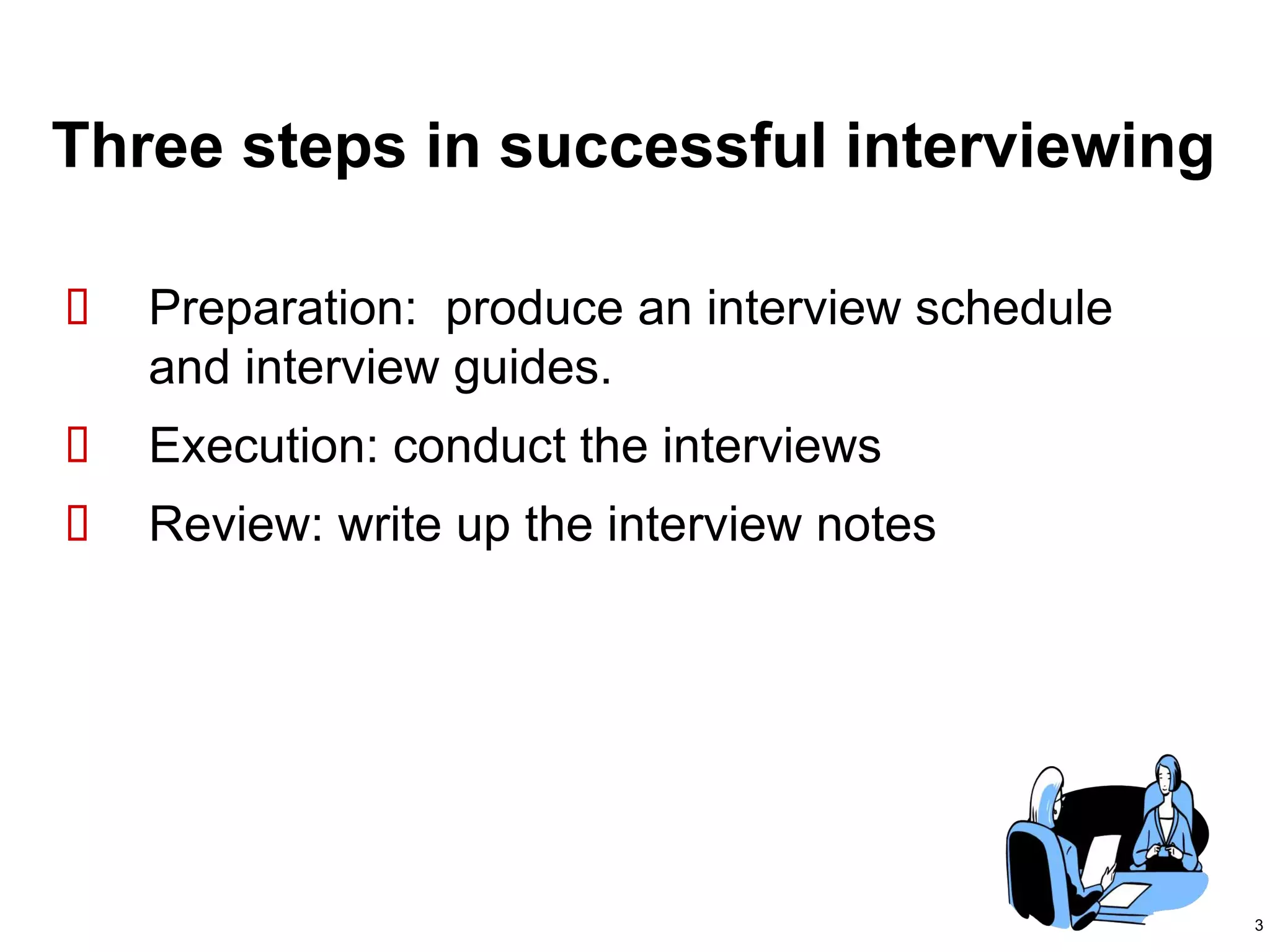
 Preparation: produce an interview schedule
and interview guides.
 Execution: conduct the interviews
 Review: write up the interview notes
4
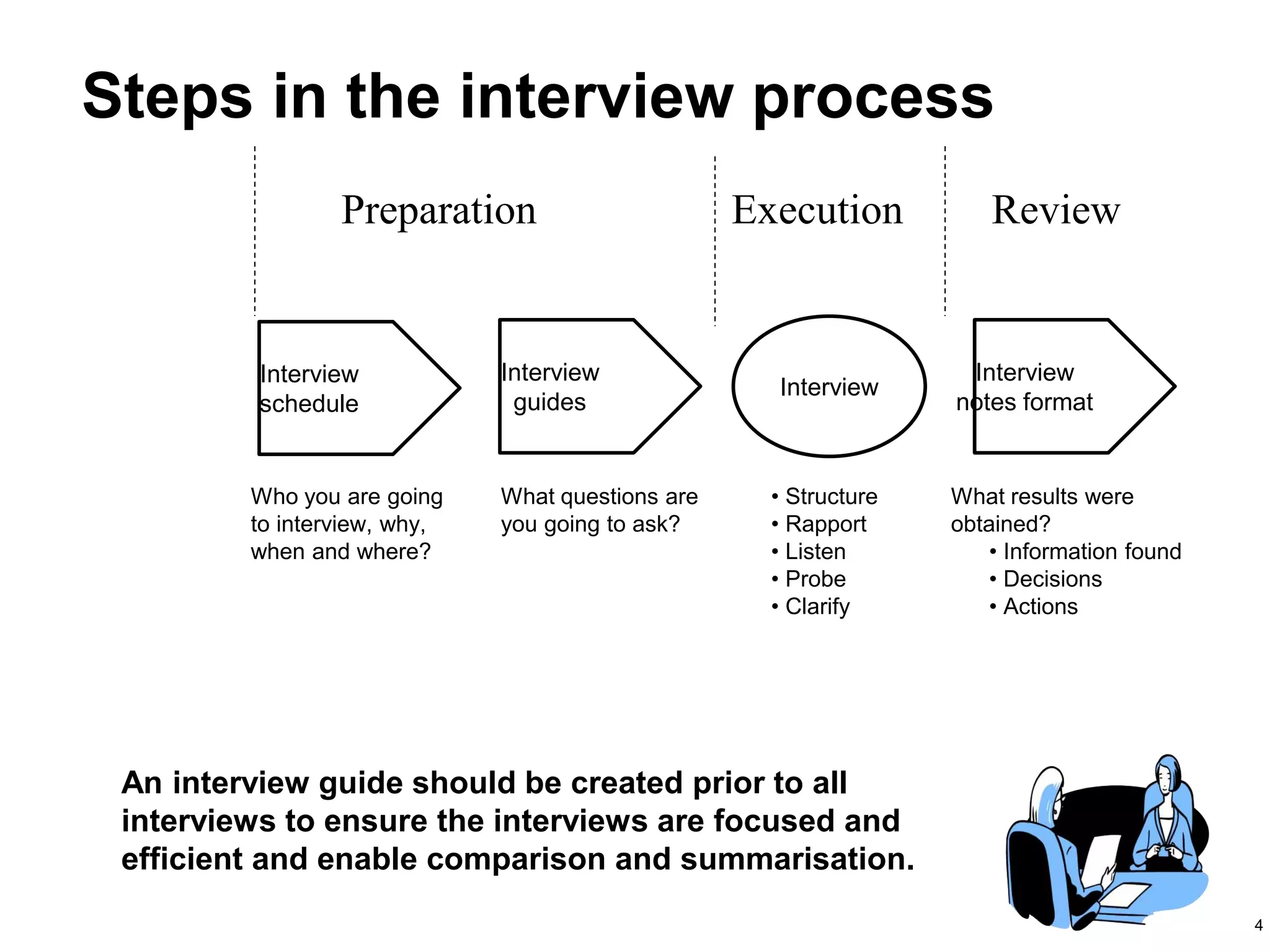
Interview
schedule
Interview
Interview
guides
Interview
notes format
Who you are going
to interview, why,
when and where?
What questions are
you going to ask?
What results were
obtained?
• Information found
• Decisions
• Actions
• Structure
• Rapport
• Listen
• Probe
• Clarify
An interview guide should be created prior to all
interviews to ensure the interviews are focused and
efficient and enable comparison and summarisation.
Steps in the interview process
Preparation Execution Review
5
Preparing the interview schedule
• Identify what the objectives of the interviews are,
what information you need to find out
• Identify who needs to be interviewed to obtain
background asap
• Set the interview
6
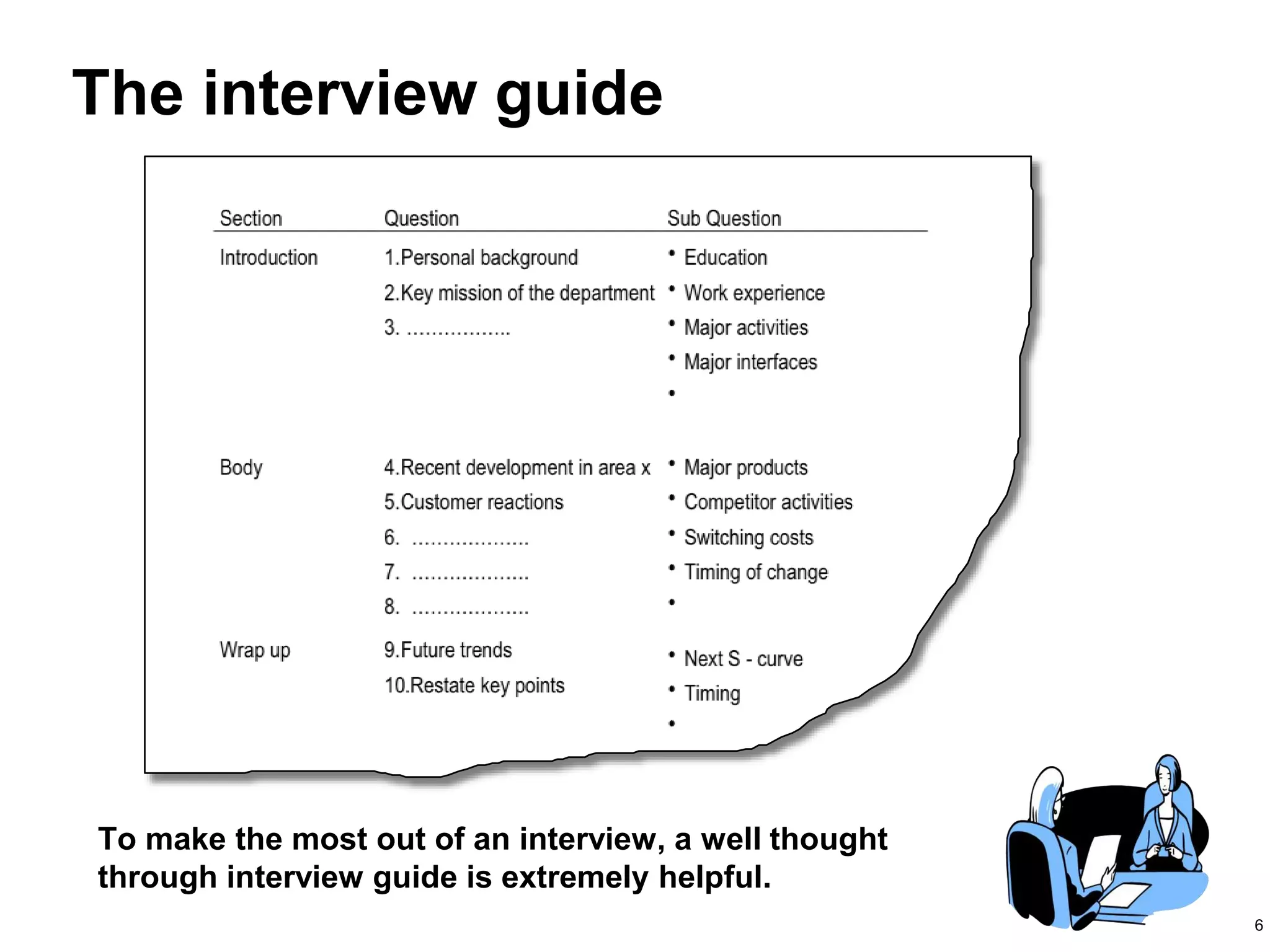
To make the most out of an interview, a well thought
through interview guide is extremely helpful.
The interview guide
7
Preparing the interview guide
• Determine the objectives of the interview.
• Plan the structure of the interview.
• Prepare interview questions.
• Prepare additional notes if they assist. For
example having an organisation chart helps in
clarifying roles and responsibilities.
The interview guide enables standardisation of
interviews for effective comparison and summarisation
8
Focused
Many interviewees tend to go ‘off on tangents’ during interviews. Your interview
guide should clearly state the boundaries for your interview. These should be
stated generally at the beginning with more specific instructions to refocus when
appropriate.
Quantifiable
Open questions tend to produce long answers that are difficult to quantify and
compare. If you need measured responses ask the interviewee to assign a value
to their answer so direct comparisons to be made. For example How reliable is the
current system, what score would you give it out of ten?
Complete
Check that the guide addresses all the objectives of the interview and have a
colleague review it.
Guidelines for structuring an interview
9
Interview execution
Interviews are exceptionally rich sources of information. However,
no two interviewees are alike: some tend to ramble, others are
suspicious and curt, some will need only the slightest
encouragement to speak their minds, while others will have to be
guided along.
The interviewer’s job is to conduct the interview to gather the
information required, which takes skill, practice and structure.
Once you have concluded your interviews, they must be
summarised to yield the ‘big picture’.
Your questions should therefore allow for valid comparison and
summarisation of your interviewee’s viewpoints.
10
 Listen to the answers and request clarification if necessary
 Avoid making criticisms or taking sides
 Keep control of the interview: refocus the interviewee if they are
rambling or clarify if they misunderstood the question
 Stay focused and follow your interview guide
 Allow the interviewee to ask questions
How to conduct the interview
Introduction
Body
Wrap-up
 Conduct at their place of work where possible
 Always state the reason for the interview and how it will be conducted
 Put the interviewee at ease
 Ask the interviewee if they agree to you taking notes
 Thank the interviewee
 Advise them what the next steps are and the timeframe
11
Build rapport
Your interview needs to balance the building of rapport and collecting of required
information.
Introduction
Gain rapport first. Explain the context, set the tone, and make the interviewee feel
at ease. The introduction serves to:
• Introduce yourself
• Gauge the interviewee’s style, expectations and concerns
• Confirm the timeframe
Sequence the interview items
Items should be ordered by importance and sensitivity. The more sensitive your
interviewee, the more important it is to avoid an ‘inquisitorial’ interview tone. A non-
threatening format for interviews involves the careful arrangement of interview
topics:
• General before specific
• External before internal
• Historic before current
12
Listen and question
Listen
To reassure the interviewee you are listening and to gain information:
• use non-verbal cues such as head nods to show you are listening.
• wait until the current question is answered before preparing the next one
• listen for emotions and attitudes as well as facts
• interrupt only if you sense avoidance of answering the question or if the
interviewee has drifted too far from the topic
• request clarification and ask follow on questions
Ask open questions
To initiate discussion on a broad subject and to encourage a comprehensive
explanation:
• use clear, direct phrasing that asks a single question
• ask how, what or when but avoid the intimidating why question
Ask closed questions
To elicit a specific reply:
• use this type of question sparingly to avoid appearing as an
interrogator
• ask in order to understand rather than impress
• be concise
13
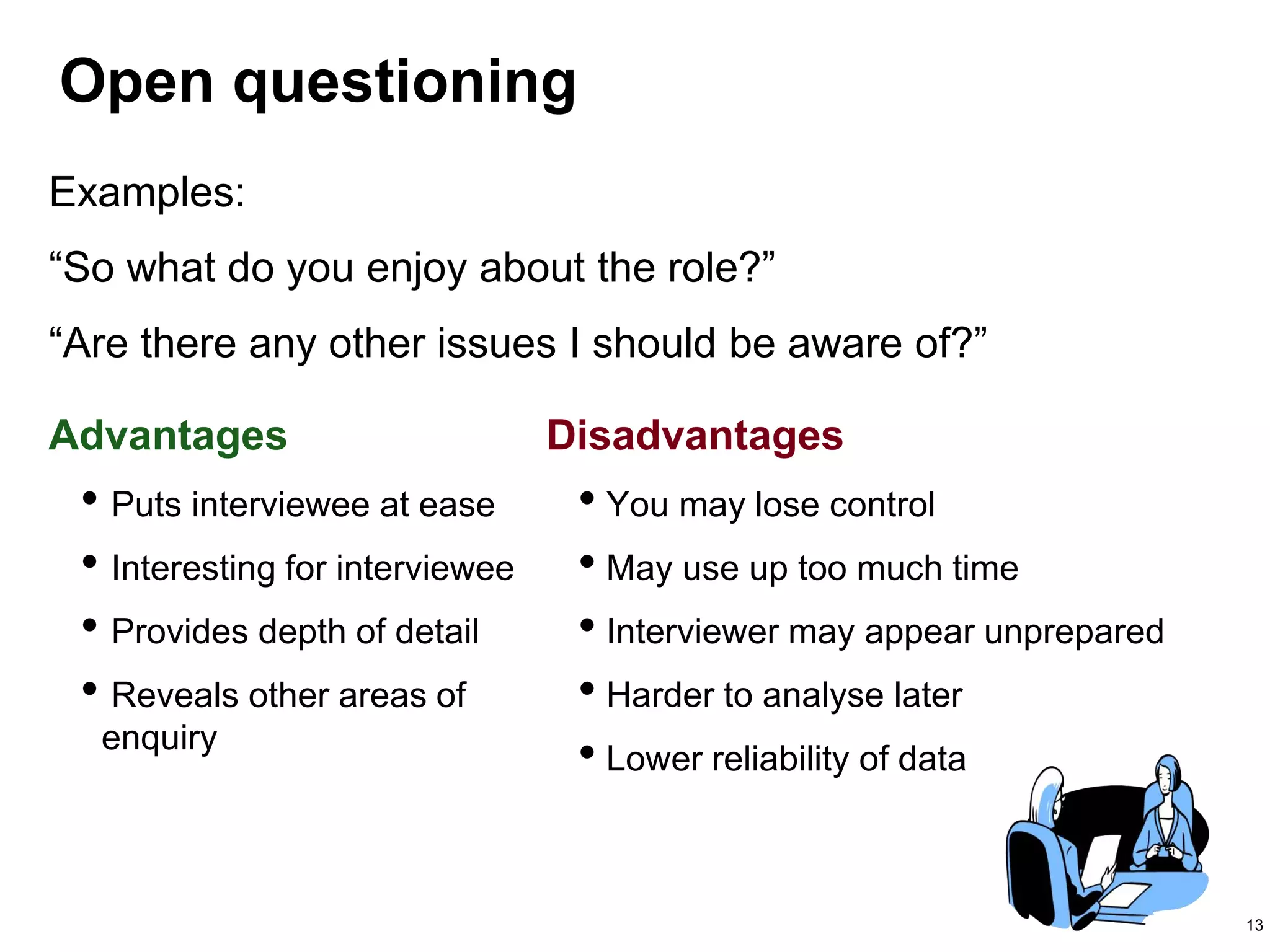
Open questioning
Advantages Disadvantages
• Puts interviewee at ease
• Interesting for interviewee
• Provides depth of detail
• Reveals other areas of
enquiry
• You may lose control
• May use up too much time
• Interviewer may appear unprepared
• Harder to analyse later
• Lower reliability of data
Examples:
“So what do you enjoy about the role?”
“Are there any other issues I should be aware of?”
14
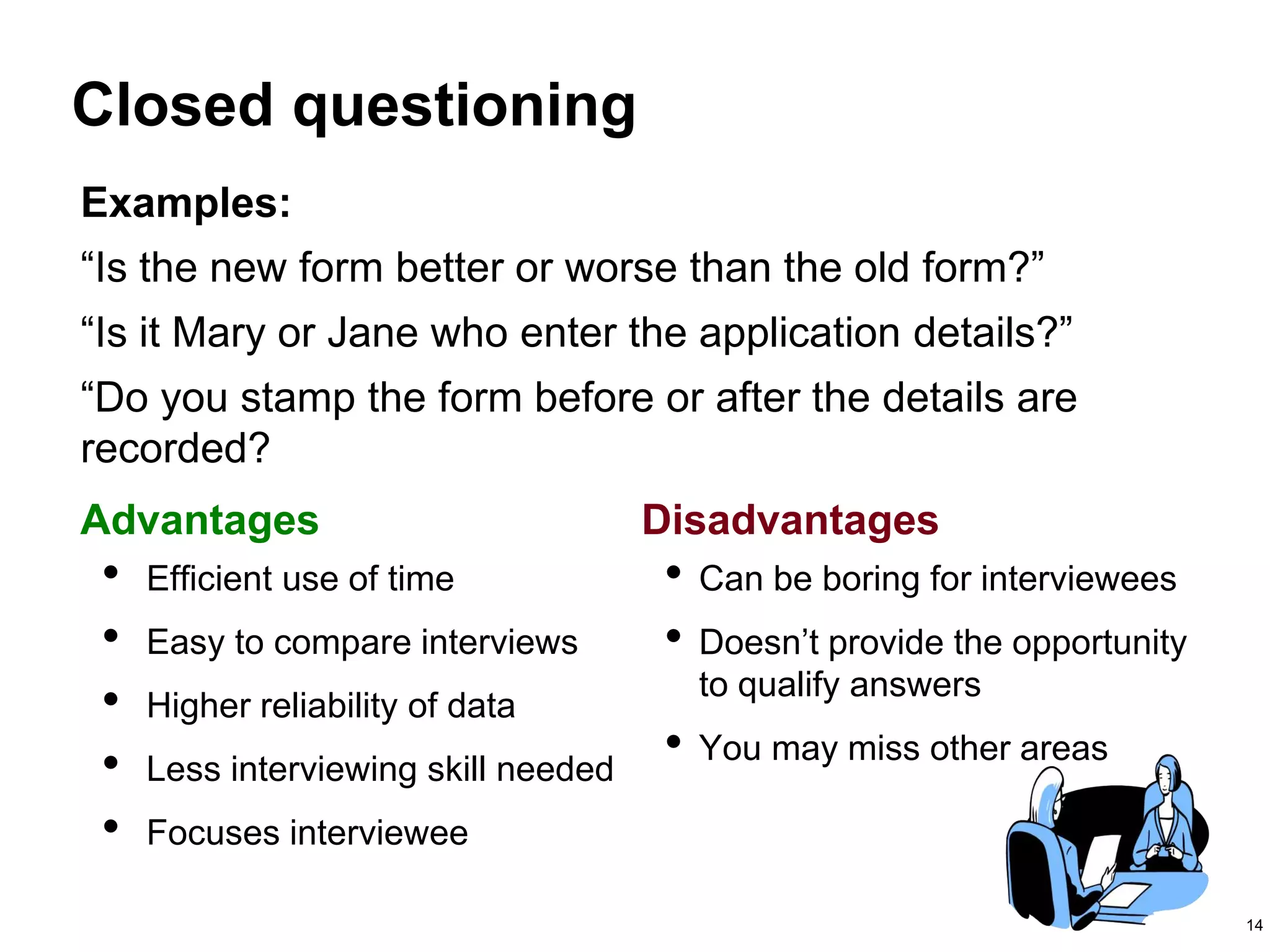
Closed questioning
Advantages Disadvantages
• Efficient use of time
• Easy to compare interviews
• Higher reliability of data
• Less interviewing skill needed
• Focuses interviewee
• Can be boring for interviewees
• Doesn’t provide the opportunity
to qualify answers
• You may miss other areas
Examples:
“Is the new form better or worse than the old form?”
“Is it Mary or Jane who enter the application details?”
“Do you stamp the form before or after the details are
recorded?
15
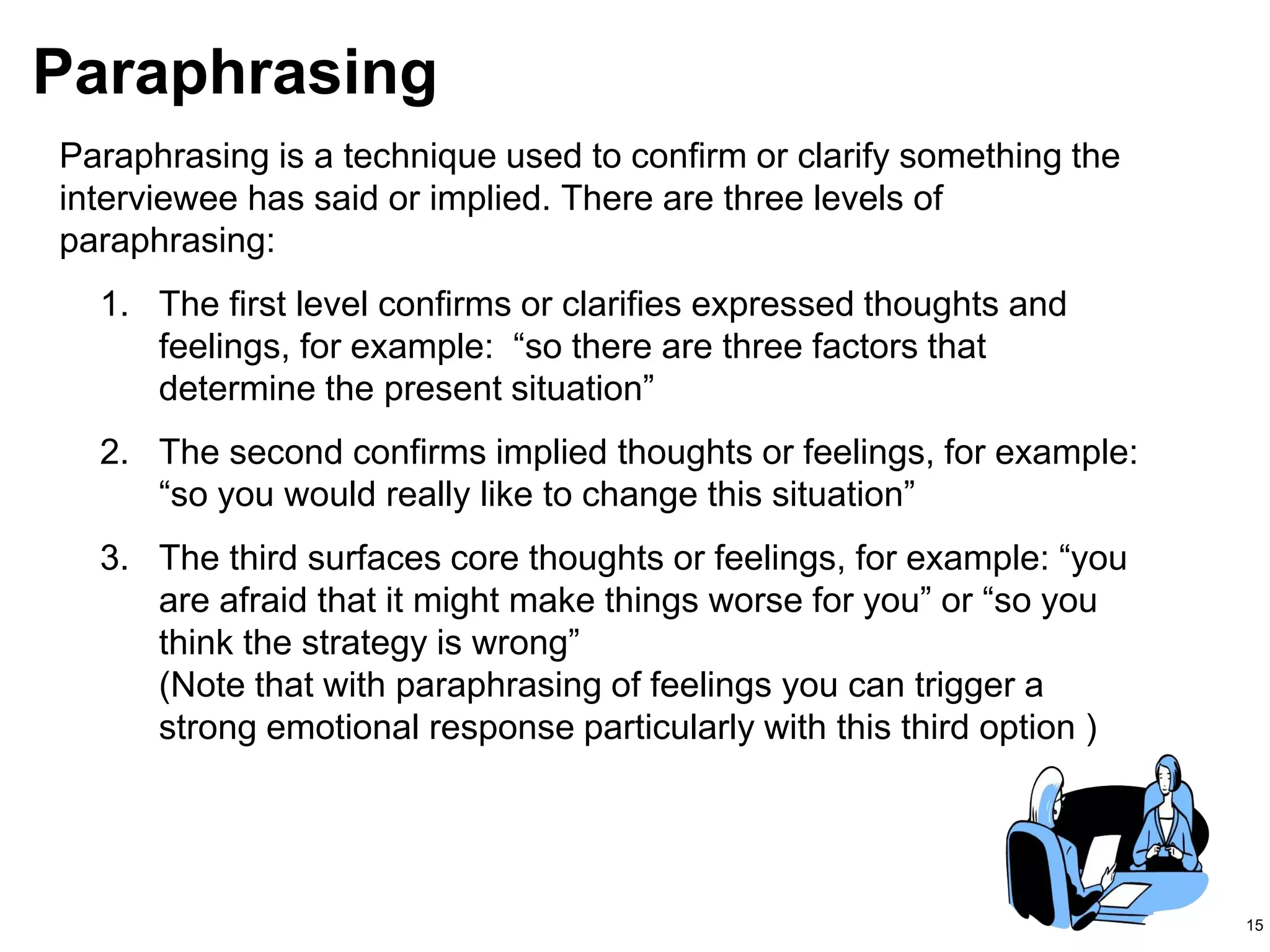
Paraphrasing
Paraphrasing is a technique used to confirm or clarify something the
interviewee has said or implied. There are three levels of
paraphrasing:
1. The first level confirms or clarifies expressed thoughts and
feelings, for example: “so there are three factors that
determine the present situation”
2. The second confirms implied thoughts or feelings, for example:
“so you would really like to change this situation”
3. The third surfaces core thoughts or feelings, for example: “you
are afraid that it might make things worse for you” or “so you
think the strategy is wrong”
(Note that with paraphrasing of feelings you can trigger a
strong emotional response particularly with this third option )
16
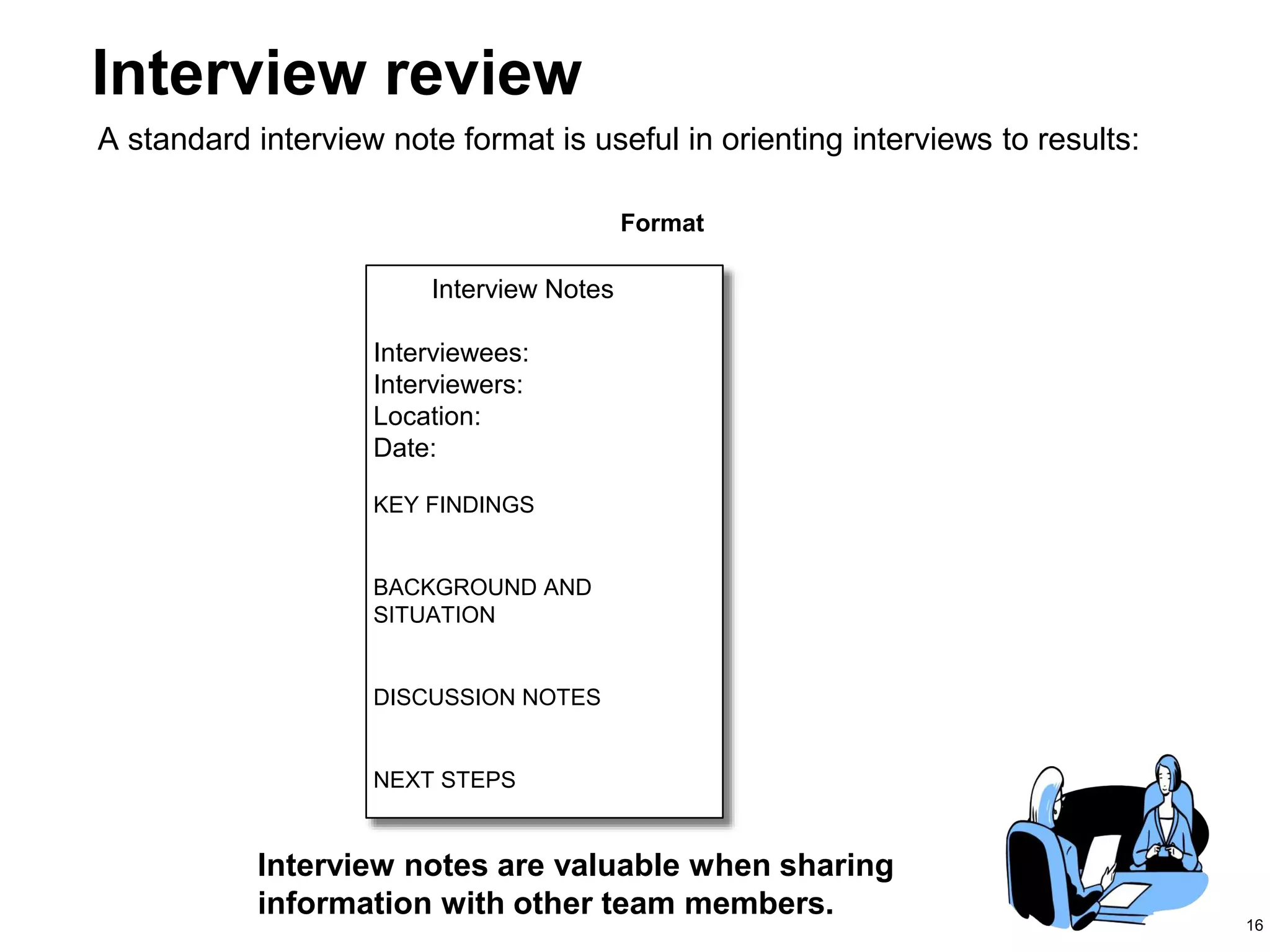
Interview notes are valuable when sharing
information with other team members.
Interview Notes
Interviewees:
Interviewers:
Location:
Date:
KEY FINDINGS
BACKGROUND AND
SITUATION
DISCUSSION NOTES
NEXT STEPS
Format
Interview review
A standard interview note format is useful in orienting interviews to results:
17
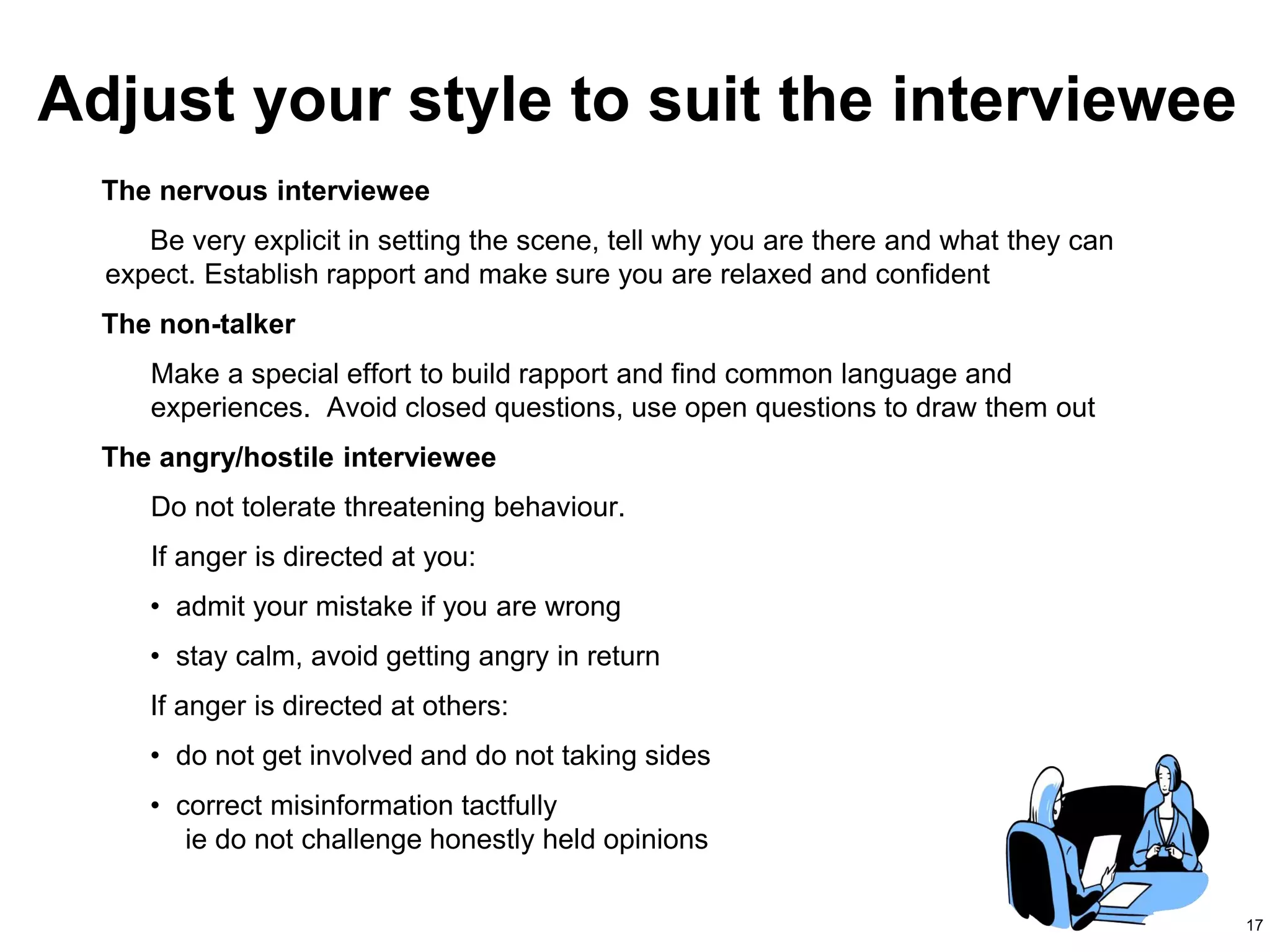
The nervous interviewee
Be very explicit in setting the scene, tell why you are there and what they can
expect. Establish rapport and make sure you are relaxed and confident
The non-talker
Make a special effort to build rapport and find common language and
experiences. Avoid closed questions, use open questions to draw them out
The angry/hostile interviewee
Do not tolerate threatening behaviour.
If anger is directed at you:
• admit your mistake if you are wrong
• stay calm, avoid getting angry in return
If anger is directed at others:
• do not get involved and do not taking sides
• correct misinformation tactfully
ie do not challenge honestly held opinions
Adjust your style to suit the interviewee
18
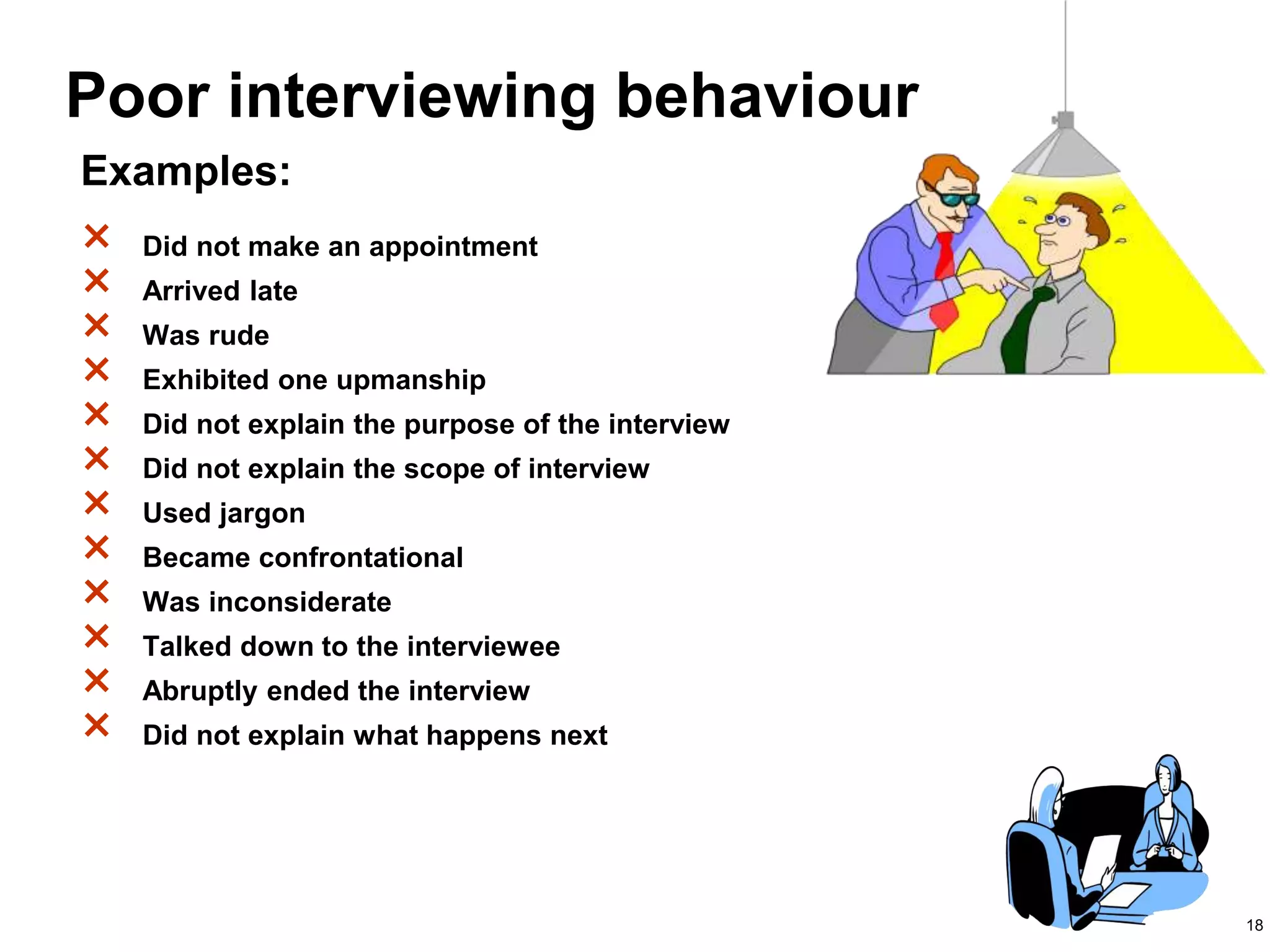
Poor interviewing behaviour
× Did not make an appointment
× Arrived late
× Was rude
× Exhibited one upmanship
× Did not explain the purpose of the interview
× Did not explain the scope of interview
× Used jargon
× Became confrontational
× Was inconsiderate
× Talked down to the interviewee
× Abruptly ended the interview
× Did not explain what happens next
Examples:
19
Do not
× Arrive without warning
× Forget interviewee’s name or role
× Show off
× Criticise
× Interrupt
× Be impatient
× Use coarse language
× Fidget, lounge or appear bored
× Go over time without agreement from interviewee
× Fail to thank the interviewee for their time
20
Do
 Create rapport
 Make notes
 Be sincere
 Be objective
 Be courteous
 Verify your findings
 Separate fact from fiction
 Pitch the interview at the right level
 Keep within the scope of the interview
 Establish the option to ask follow up questions
 Wrap up the interview and thank the interviewee
for their time.

Guide to Interviewing

  • 1.
  • 2.
    2 Interviews Interviews are inessence guided dialogues to gain information, made effective by using a well prepared interview guide.
  • 3.
    3 Three steps insuccessful interviewing  Preparation: produce an interview schedule and interview guides.  Execution: conduct the interviews  Review: write up the interview notes
  • 4.
    4 Interview schedule Interview Interview guides Interview notes format Who youare going to interview, why, when and where? What questions are you going to ask? What results were obtained? • Information found • Decisions • Actions • Structure • Rapport • Listen • Probe • Clarify An interview guide should be created prior to all interviews to ensure the interviews are focused and efficient and enable comparison and summarisation. Steps in the interview process Preparation Execution Review
  • 5.
    5 Preparing the interviewschedule • Identify what the objectives of the interviews are, what information you need to find out • Identify who needs to be interviewed to obtain background asap • Set the interview
  • 6.
    6 To make themost out of an interview, a well thought through interview guide is extremely helpful. The interview guide
  • 7.
    7 Preparing the interviewguide • Determine the objectives of the interview. • Plan the structure of the interview. • Prepare interview questions. • Prepare additional notes if they assist. For example having an organisation chart helps in clarifying roles and responsibilities. The interview guide enables standardisation of interviews for effective comparison and summarisation
  • 8.
    8 Focused Many interviewees tendto go ‘off on tangents’ during interviews. Your interview guide should clearly state the boundaries for your interview. These should be stated generally at the beginning with more specific instructions to refocus when appropriate. Quantifiable Open questions tend to produce long answers that are difficult to quantify and compare. If you need measured responses ask the interviewee to assign a value to their answer so direct comparisons to be made. For example How reliable is the current system, what score would you give it out of ten? Complete Check that the guide addresses all the objectives of the interview and have a colleague review it. Guidelines for structuring an interview
  • 9.
    9 Interview execution Interviews areexceptionally rich sources of information. However, no two interviewees are alike: some tend to ramble, others are suspicious and curt, some will need only the slightest encouragement to speak their minds, while others will have to be guided along. The interviewer’s job is to conduct the interview to gather the information required, which takes skill, practice and structure. Once you have concluded your interviews, they must be summarised to yield the ‘big picture’. Your questions should therefore allow for valid comparison and summarisation of your interviewee’s viewpoints.
  • 10.
    10  Listen tothe answers and request clarification if necessary  Avoid making criticisms or taking sides  Keep control of the interview: refocus the interviewee if they are rambling or clarify if they misunderstood the question  Stay focused and follow your interview guide  Allow the interviewee to ask questions How to conduct the interview Introduction Body Wrap-up  Conduct at their place of work where possible  Always state the reason for the interview and how it will be conducted  Put the interviewee at ease  Ask the interviewee if they agree to you taking notes  Thank the interviewee  Advise them what the next steps are and the timeframe
  • 11.
    11 Build rapport Your interviewneeds to balance the building of rapport and collecting of required information. Introduction Gain rapport first. Explain the context, set the tone, and make the interviewee feel at ease. The introduction serves to: • Introduce yourself • Gauge the interviewee’s style, expectations and concerns • Confirm the timeframe Sequence the interview items Items should be ordered by importance and sensitivity. The more sensitive your interviewee, the more important it is to avoid an ‘inquisitorial’ interview tone. A non- threatening format for interviews involves the careful arrangement of interview topics: • General before specific • External before internal • Historic before current
  • 12.
    12 Listen and question Listen Toreassure the interviewee you are listening and to gain information: • use non-verbal cues such as head nods to show you are listening. • wait until the current question is answered before preparing the next one • listen for emotions and attitudes as well as facts • interrupt only if you sense avoidance of answering the question or if the interviewee has drifted too far from the topic • request clarification and ask follow on questions Ask open questions To initiate discussion on a broad subject and to encourage a comprehensive explanation: • use clear, direct phrasing that asks a single question • ask how, what or when but avoid the intimidating why question Ask closed questions To elicit a specific reply: • use this type of question sparingly to avoid appearing as an interrogator • ask in order to understand rather than impress • be concise
  • 13.
    13 Open questioning Advantages Disadvantages •Puts interviewee at ease • Interesting for interviewee • Provides depth of detail • Reveals other areas of enquiry • You may lose control • May use up too much time • Interviewer may appear unprepared • Harder to analyse later • Lower reliability of data Examples: “So what do you enjoy about the role?” “Are there any other issues I should be aware of?”
  • 14.
    14 Closed questioning Advantages Disadvantages •Efficient use of time • Easy to compare interviews • Higher reliability of data • Less interviewing skill needed • Focuses interviewee • Can be boring for interviewees • Doesn’t provide the opportunity to qualify answers • You may miss other areas Examples: “Is the new form better or worse than the old form?” “Is it Mary or Jane who enter the application details?” “Do you stamp the form before or after the details are recorded?
  • 15.
    15 Paraphrasing Paraphrasing is atechnique used to confirm or clarify something the interviewee has said or implied. There are three levels of paraphrasing: 1. The first level confirms or clarifies expressed thoughts and feelings, for example: “so there are three factors that determine the present situation” 2. The second confirms implied thoughts or feelings, for example: “so you would really like to change this situation” 3. The third surfaces core thoughts or feelings, for example: “you are afraid that it might make things worse for you” or “so you think the strategy is wrong” (Note that with paraphrasing of feelings you can trigger a strong emotional response particularly with this third option )
  • 16.
    16 Interview notes arevaluable when sharing information with other team members. Interview Notes Interviewees: Interviewers: Location: Date: KEY FINDINGS BACKGROUND AND SITUATION DISCUSSION NOTES NEXT STEPS Format Interview review A standard interview note format is useful in orienting interviews to results:
  • 17.
    17 The nervous interviewee Bevery explicit in setting the scene, tell why you are there and what they can expect. Establish rapport and make sure you are relaxed and confident The non-talker Make a special effort to build rapport and find common language and experiences. Avoid closed questions, use open questions to draw them out The angry/hostile interviewee Do not tolerate threatening behaviour. If anger is directed at you: • admit your mistake if you are wrong • stay calm, avoid getting angry in return If anger is directed at others: • do not get involved and do not taking sides • correct misinformation tactfully ie do not challenge honestly held opinions Adjust your style to suit the interviewee
  • 18.
    18 Poor interviewing behaviour ×Did not make an appointment × Arrived late × Was rude × Exhibited one upmanship × Did not explain the purpose of the interview × Did not explain the scope of interview × Used jargon × Became confrontational × Was inconsiderate × Talked down to the interviewee × Abruptly ended the interview × Did not explain what happens next Examples:
  • 19.
    19 Do not × Arrivewithout warning × Forget interviewee’s name or role × Show off × Criticise × Interrupt × Be impatient × Use coarse language × Fidget, lounge or appear bored × Go over time without agreement from interviewee × Fail to thank the interviewee for their time
  • 20.
    20 Do  Create rapport Make notes  Be sincere  Be objective  Be courteous  Verify your findings  Separate fact from fiction  Pitch the interview at the right level  Keep within the scope of the interview  Establish the option to ask follow up questions  Wrap up the interview and thank the interviewee for their time.

Editor's Notes

  • #3 Notes: _________________________________________________________ _________________________________________________________ _________________________________________________________ _________________________________________________________ _________________________________________________________ _________________________________________________________ _________________________________________________________ _________________________________________________________ _________________________________________________________ _________________________________________________________ _________________________________________________________ _________________________________________________________
  • #4 Notes:
  • #6 Notes: _________________________________________________________ _________________________________________________________ _________________________________________________________ _________________________________________________________ _________________________________________________________ _________________________________________________________ _________________________________________________________ _________________________________________________________ _________________________________________________________ _________________________________________________________ _________________________________________________________ _________________________________________________________
  • #8 Notes: _________________________________________________________ _________________________________________________________ _________________________________________________________ _________________________________________________________ _________________________________________________________ _________________________________________________________ _________________________________________________________ _________________________________________________________ _________________________________________________________ _________________________________________________________ _________________________________________________________ _________________________________________________________
  • #11 Notes:
  • #14 Notes:
  • #15 Notes:
  • #19 Notes: