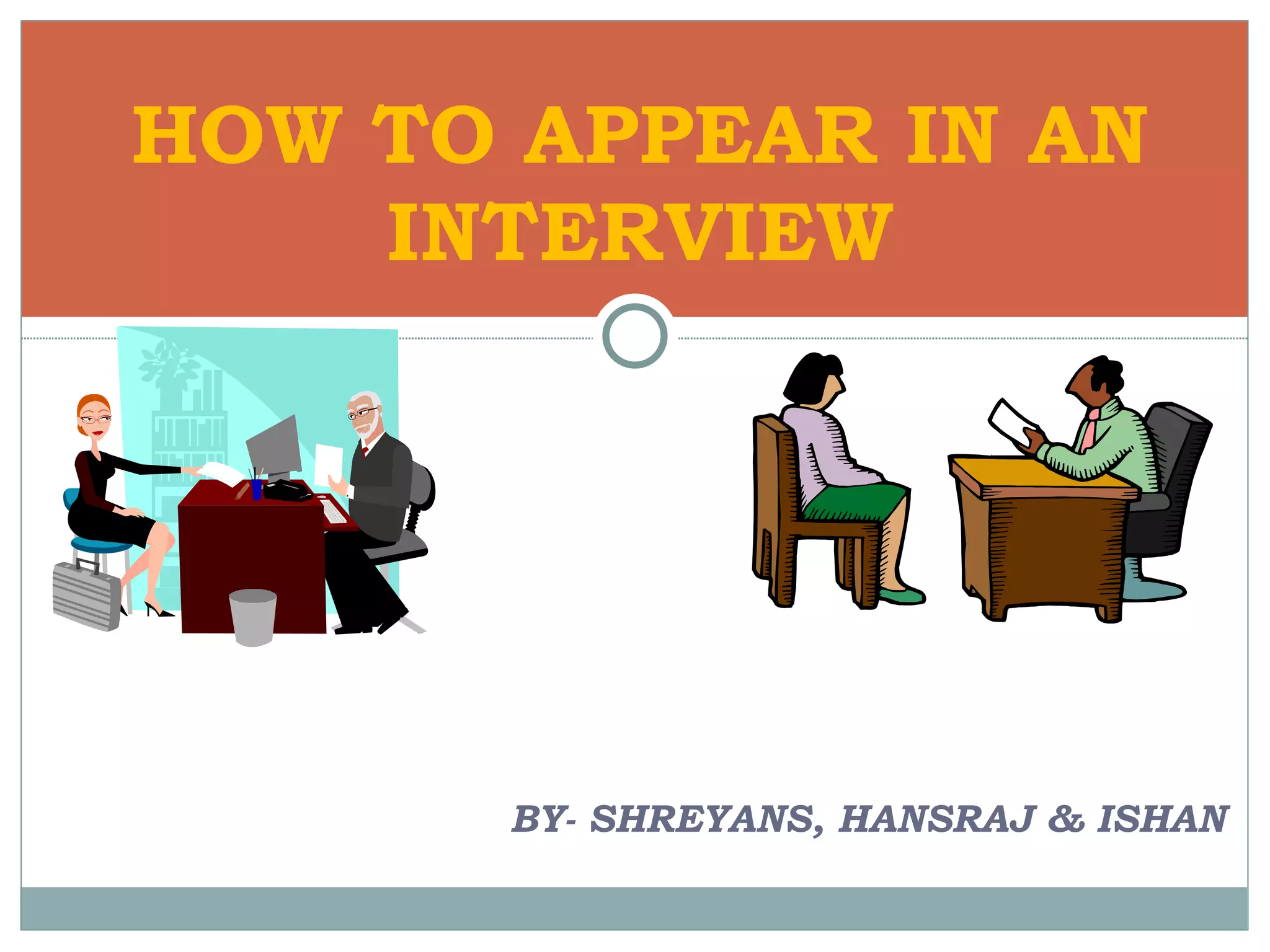
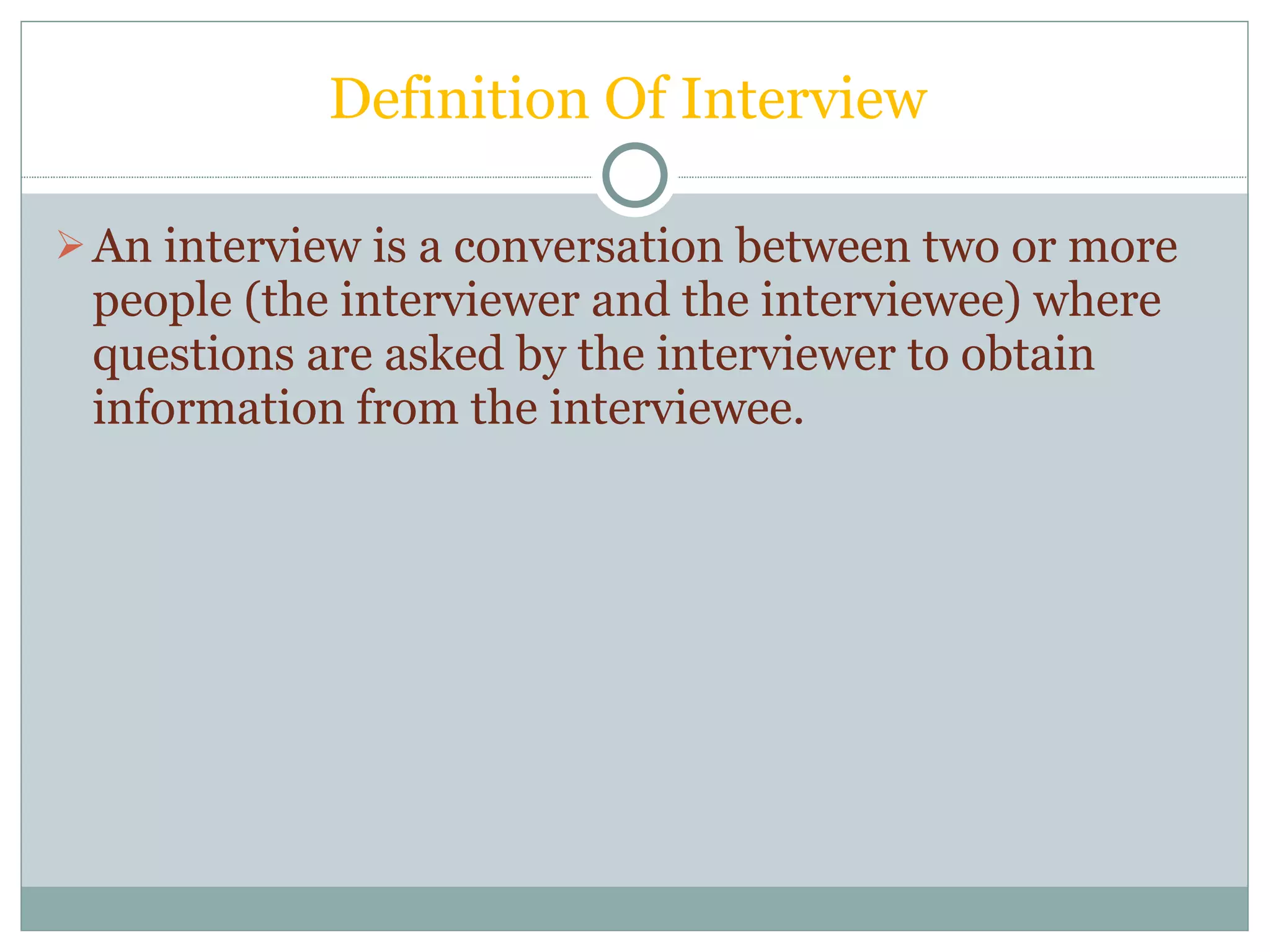
BY- SHREYANS, HANSRAJ & ISHAN HOW TO APPEAR IN AN INTERVIEW
Definition Of Interview  An interview is a conversation between two or more people (the interviewer and the interviewee) where questions are asked by the interviewer to obtain information from the interviewee.
Before The Interview Get your career goals in focus  Identify your main  strengths  related to the job Gather  specific  accomplishments to back up your skills Research the company Find out the dress code in advance and dress accordingly Practice with yourself or with a friend
Home Work TO Be Done Employers’ Web Sites Best place to “see” the company as it wants to be seen Check the annual report, look for press releases Look for the “head of R&D” Research Sources Get vital statistics and independent perspectives on the employer from On-line resources Look at financial data, list of competitors News Sources Find general interest web sites to see what they say about this employer Find hometown newspapers on-line to read about this employer Trade Journals Read these for new products, find its place in the industry .
Few Items You Should Bring On A Interv iew You should bring at least one spare copy of your resume. If you know that you will be interviewed by multiple people, you should bring a copy of your resume for each.  If you are applying for a job that has specific certification or licensing requirements. you should bring proof of your eligibility.  employers are more likely to choose a candidate whose paperwork is already in order.
Portfolio A portfolio could be as simple as examples of your work on past projects. No matter the depth of your portfolio.  Limit the number of pieces in your portfolio to your best. During an interview, you will have only a few minutes that you can devote to showing off your work. While you may make arrangements to leave your portfolio behind after the interview, you will want to be sure that your interviewer has already seen your best pieces.  If it is on a CD or DVD, you may need to make arrangements to have some sort of player available.
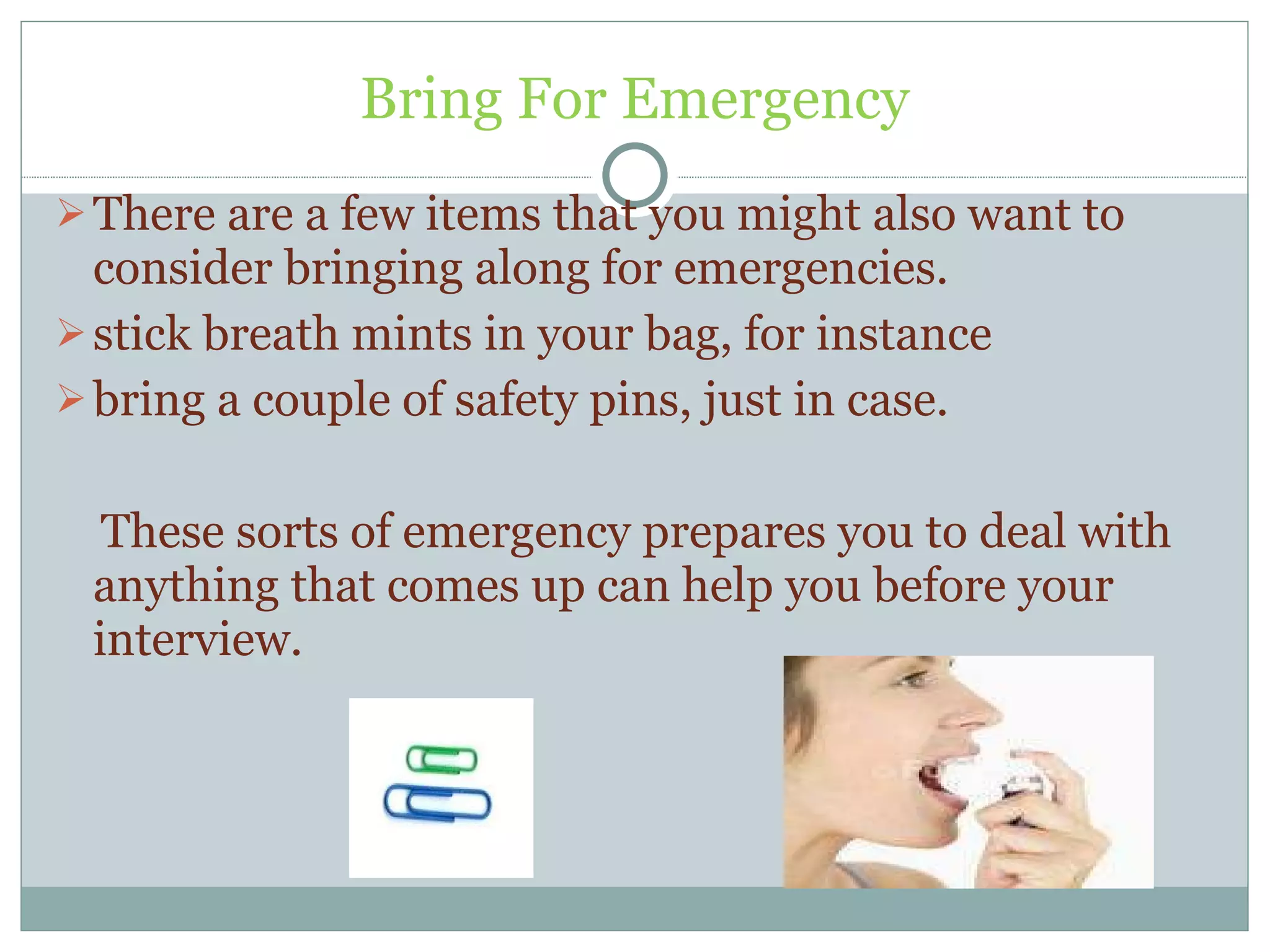
Bring For Emergency There are a few items that you might also want to consider bringing along for emergencies.  stick breath mints in your bag, for instance bring a couple of safety pins, just in case. These sorts of emergency prepares you to deal with anything that comes up can help you before your interview.
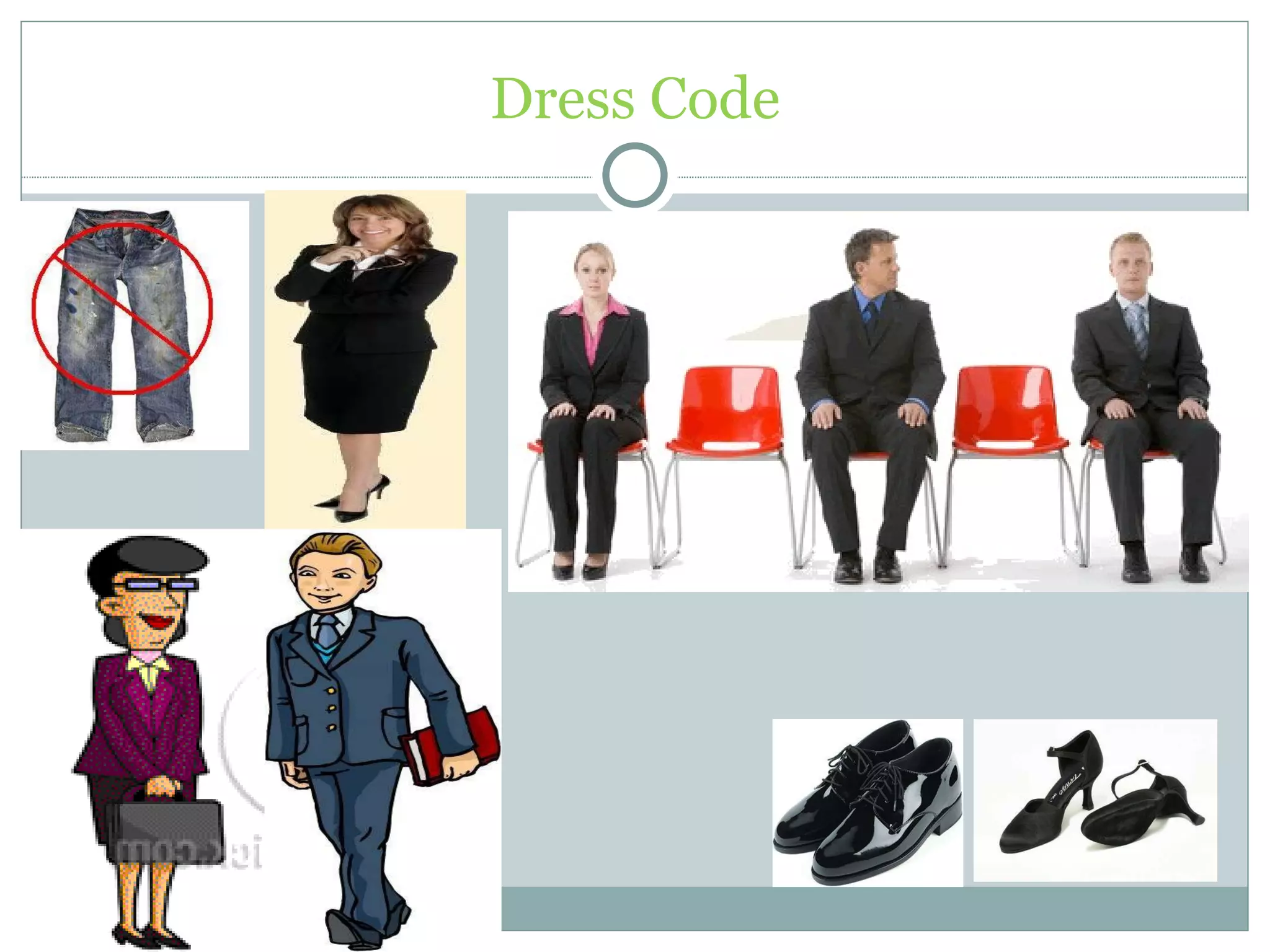
Dress Code
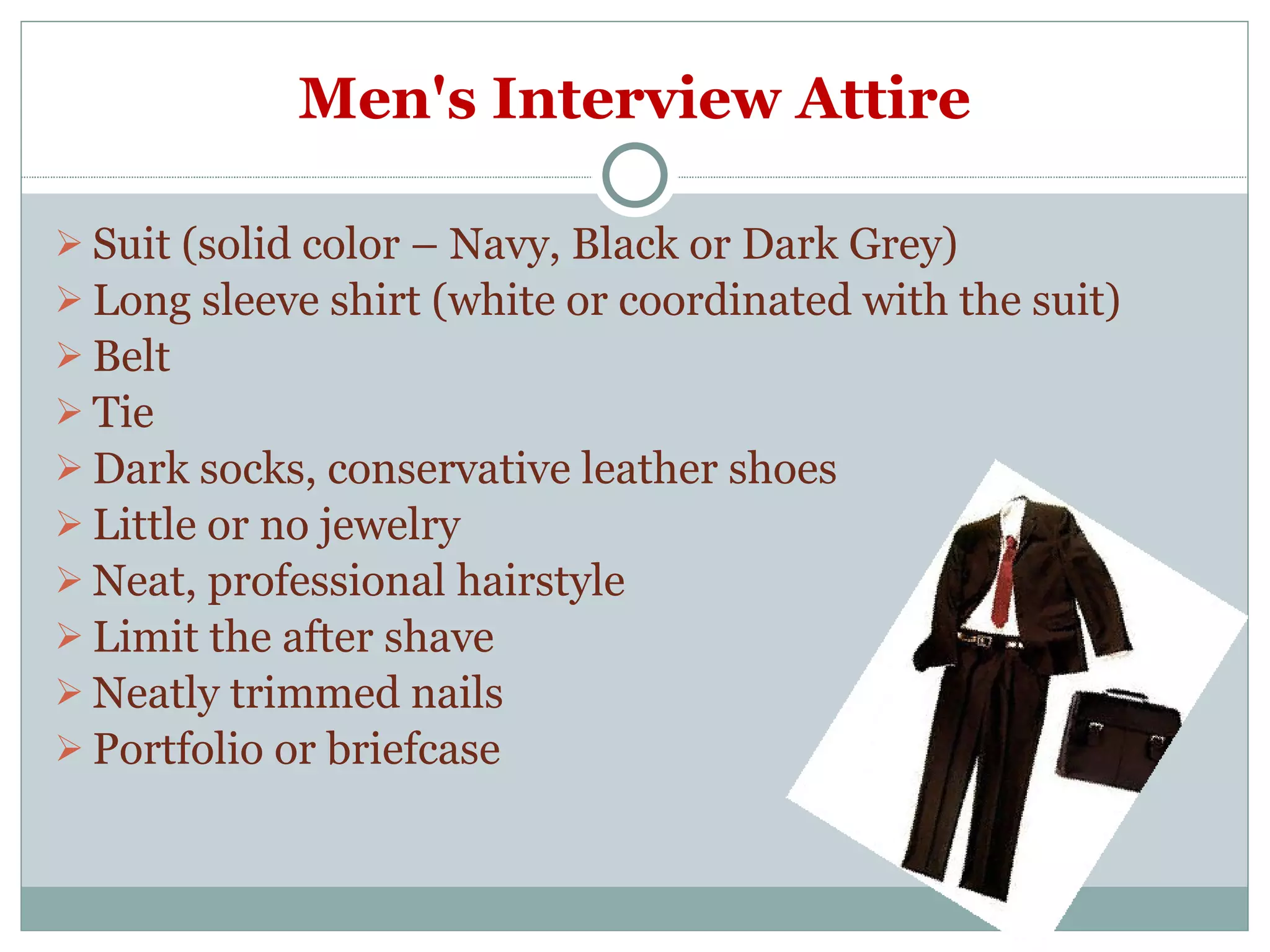
Men's Interview Attire Suit (solid color – Navy, Black or Dark Grey) Long sleeve shirt (white or coordinated with the suit) Belt Tie Dark socks, conservative leather shoes Little or no jewelry Neat, professional hairstyle Limit the after shave Neatly trimmed nails Portfolio or briefcase
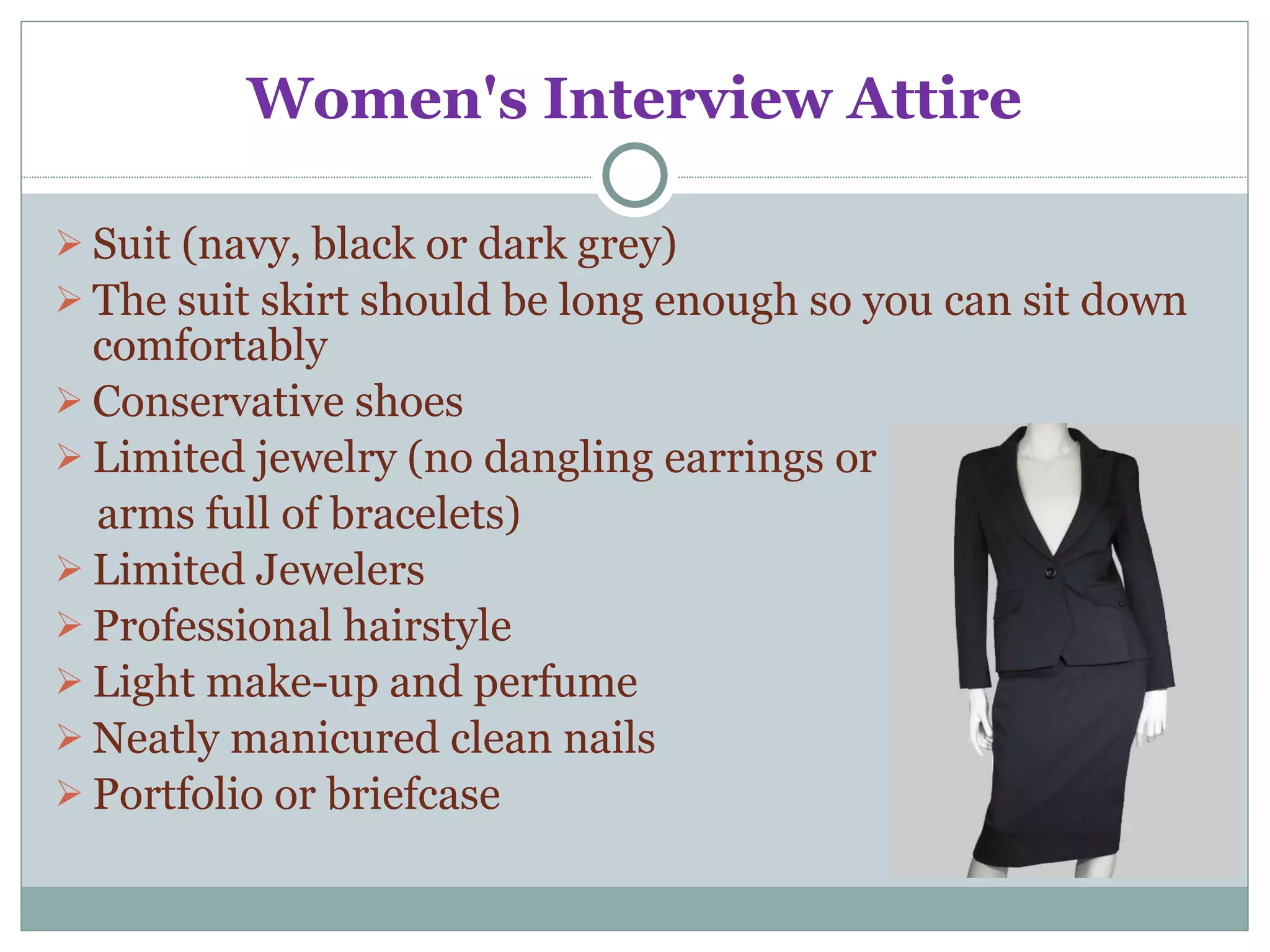
Women's Interview Attire Suit (navy, black or dark grey) The suit skirt should be long enough so you can sit down comfortably Conservative shoes Limited jewelry (no dangling earrings or  arms full of bracelets) Limited Jewelers  Professional hairstyle Light make-up and perfume Neatly manicured clean nails Portfolio or briefcase
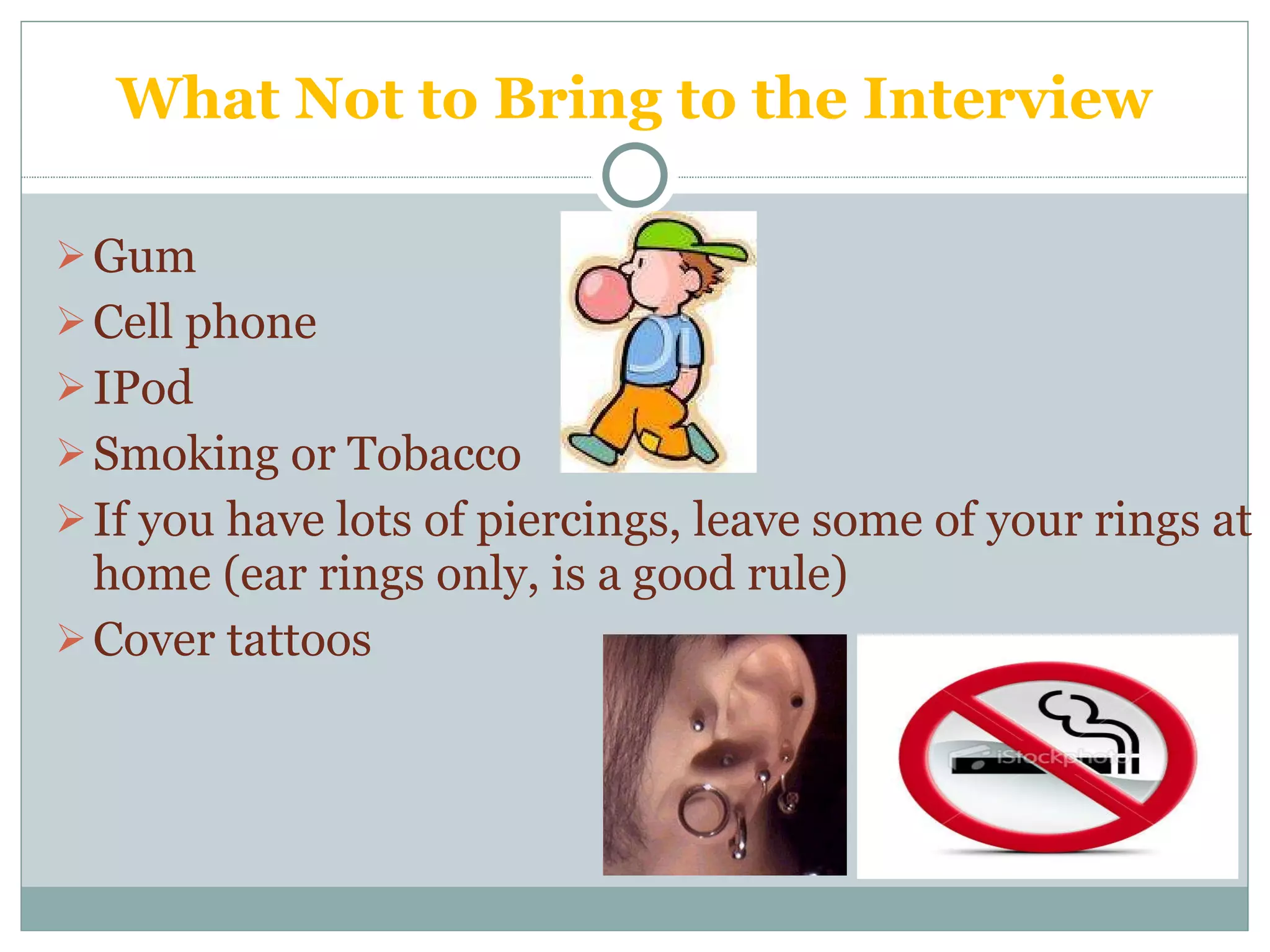
What Not to Bring to the Interview Gum Cell phone IPod Smoking or Tobacco  If you have lots of piercings, leave some of your rings at home (ear rings only, is a good rule) Cover tattoos
STRESS Only a fool would tell you that looking for a job isn’t stressful even bigger fool to tell you that interviews will not produce stress. After all, you’re in an unfamiliar setting, meeting strangers, risking your ego Even a simple conversation that can affect the rest of your life.
ABC Of Interview ABC ’s of the Job Interview A lways B eware of C rash and Burn
A- Always A lways Research the company with a focus on customers and competition Research can be done on the internet, by reading annual reports, and by talking with credible people in the industry Provide examples of when you have successfully worked in team environments  Demonstrate creativity and responsibility
B- Beware B eware of Having an “I” attitude Don’t overstate your accomplishments - be honest Negotiating too early Doing this during the job interview sends a message that you are more interested in money than the job Being too casual with the interview Recognize that the job interview starts when you first arrive and does not end until you are out the door and on your way home
C- Crash & Burn C rash and Burn Displaying bad manners Poor etiquette and boorish manners send a message to the interviewer that you will behave that way with clients Demeaning your current or past employer It is a very small world, and reputations are made and broken on the basis of sometimes unknown relationships Being dishonest An interview is the time to put the best spin possible on your career, but not at the cost of your integrity
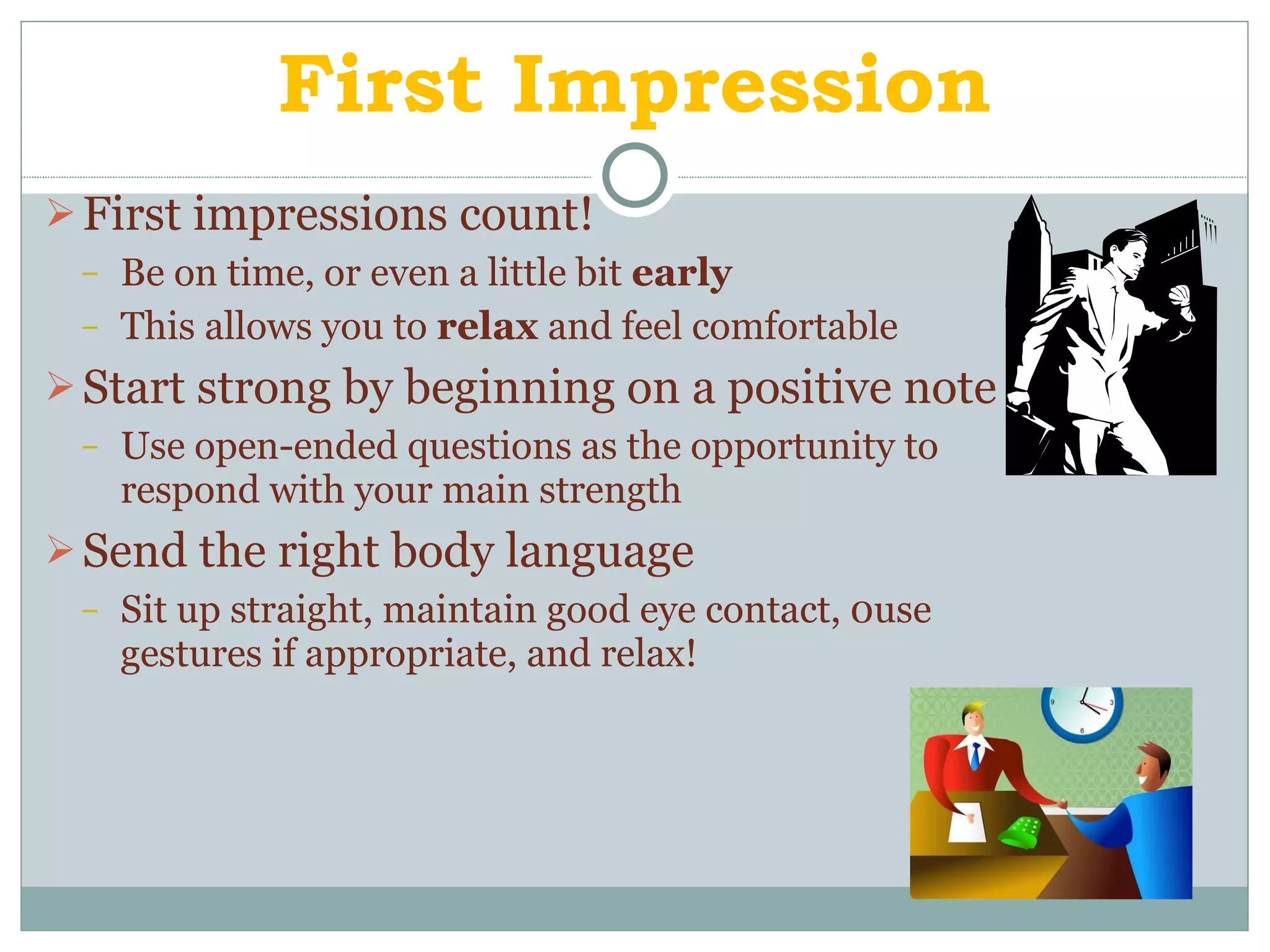
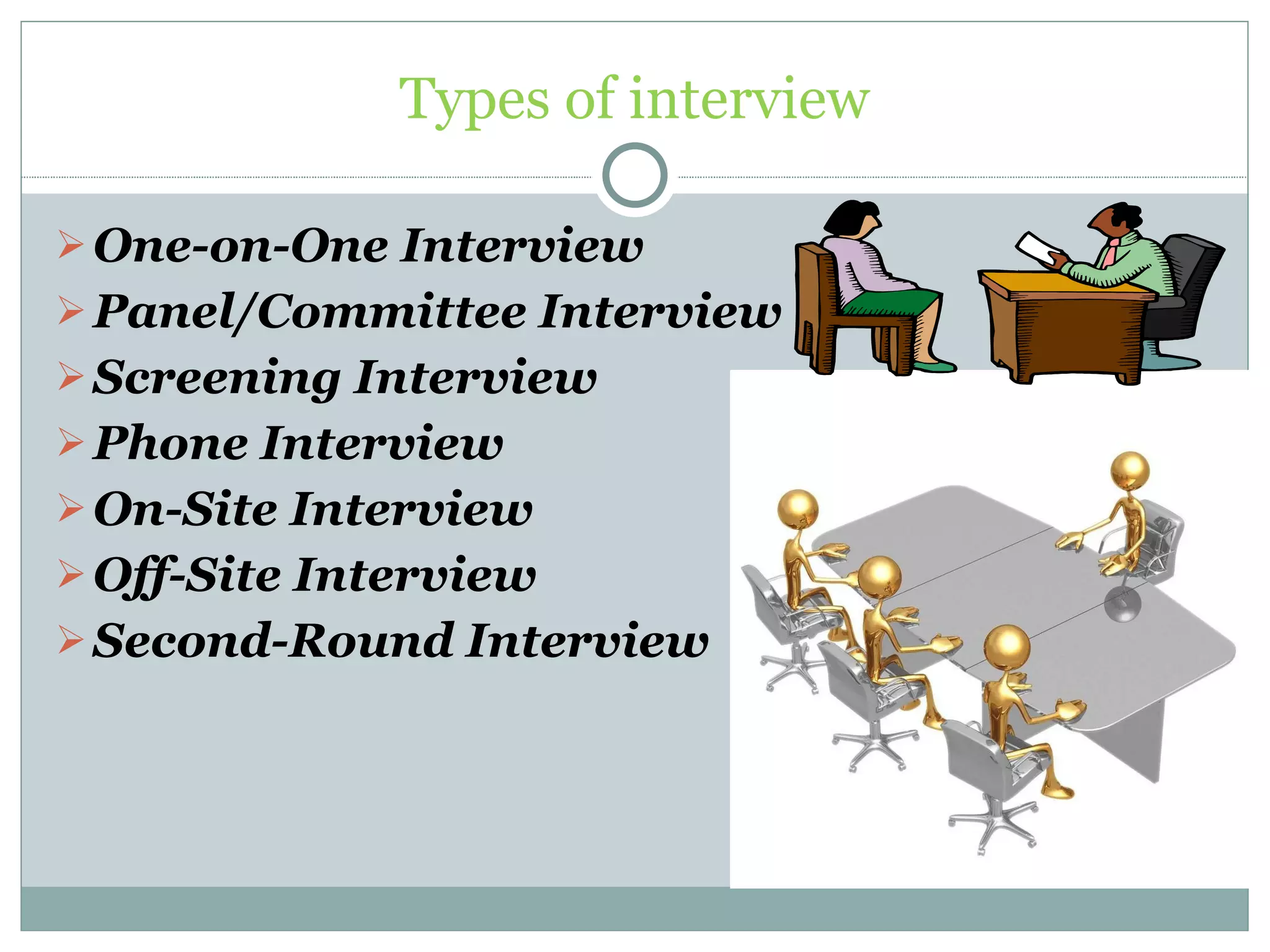
First Impression First impressions count! Be on time, or even a little bit  early This allows you to  relax  and feel comfortable Start strong by beginning on a positive note Use open-ended questions as the opportunity to respond with your main strength Send the right body language Sit up straight, maintain good eye contact, 0use gestures if appropriate, and relax!
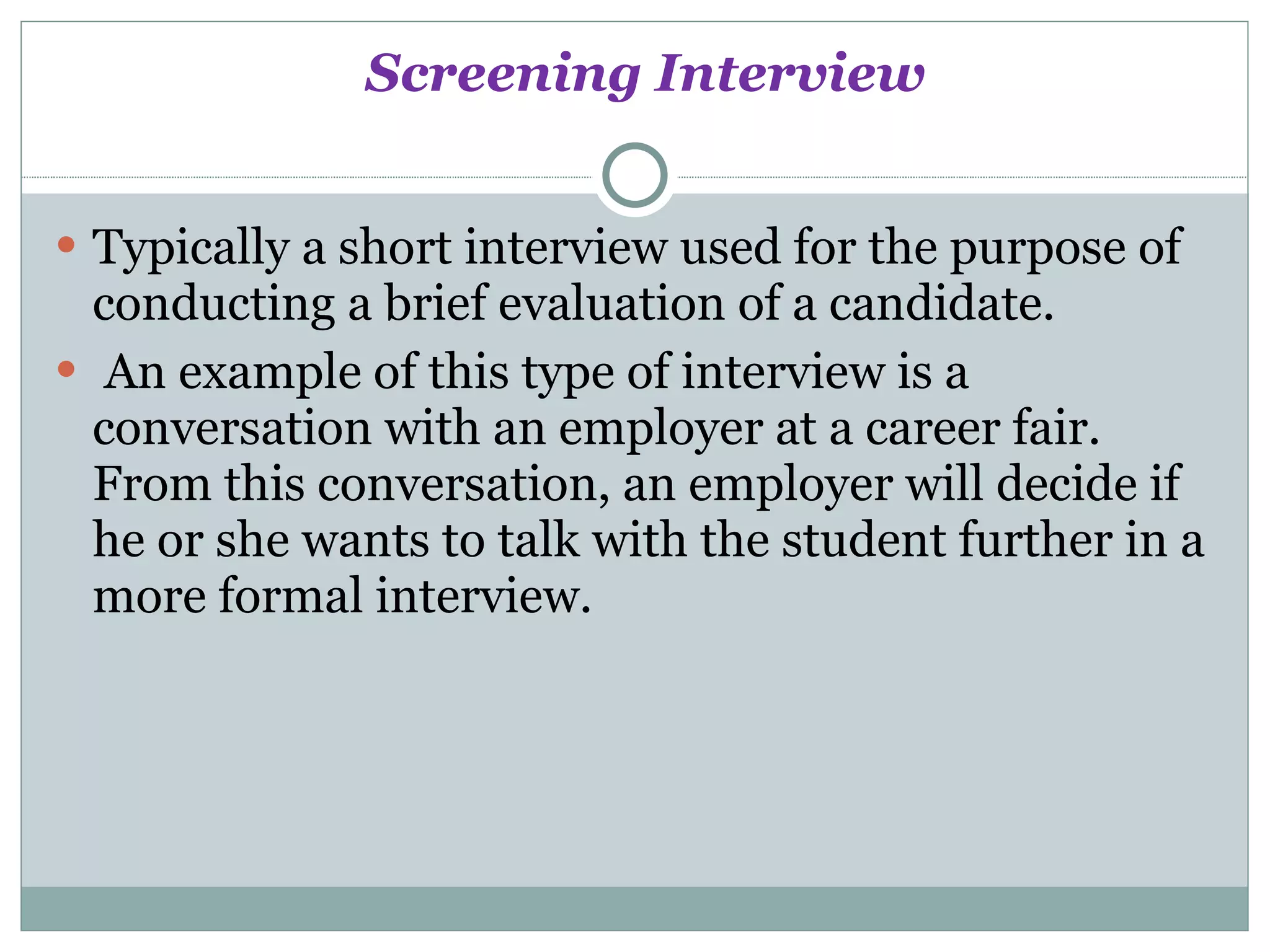
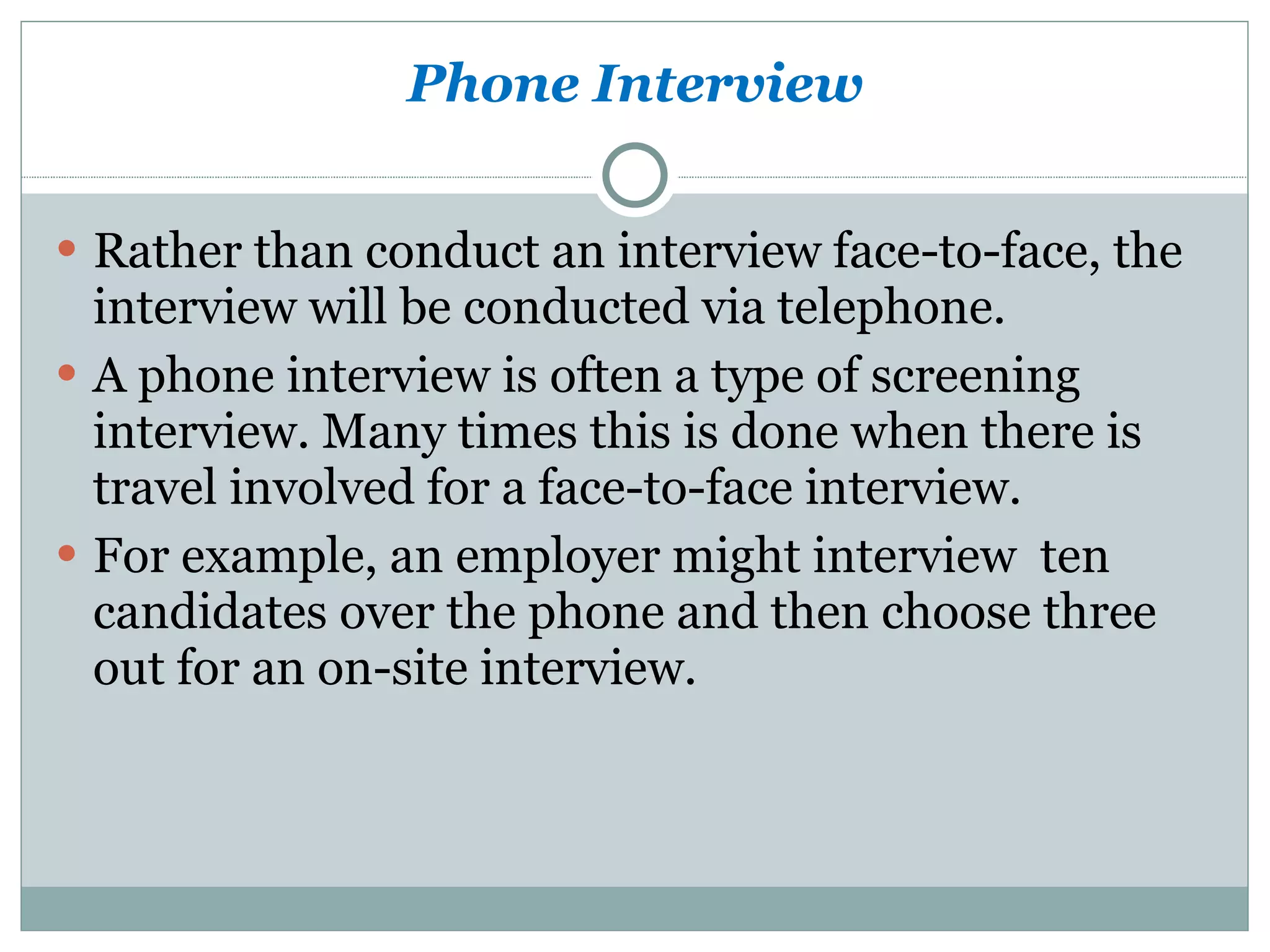
Types of interview One-on-One Interview Panel/Committee Interview Screening Interview Phone Interview On-Site Interview Off-Site Interview Second-Round Interview
Screening Interview Typically a short interview used for the purpose of conducting a brief evaluation of a candidate. An example of this type of interview is a conversation with an employer at a career fair. From this conversation, an employer will decide if he or she wants to talk with the student further in a more formal interview.
Phone Interview Rather than conduct an interview face-to-face, the interview will be conducted via telephone.  A phone interview is often a type of screening interview. Many times this is done when there is travel involved for a face-to-face interview.  For example, an employer might interview  ten candidates over the phone and then choose three out for an on-site interview.
On-off site interview On-Site Interview An interview conducted the location of the company/organization. If the company location is not in the local area, and travel is involved, an on-site interview can be a second-round interview. Off-Site Interview An interview that occurs outside of an organization.
Second-Round Interview An interview conducted after a formal, initial interview. The rest interview has conformed that you may be a good match for the job and the organization;  The second is designed to enter deeply into your skills and interests, and to allow others in the organization to meet and evaluate you.
Methods OF INTERVIEWS Traditional Behavioral/Emotional /Story Telling Case-Method, Cased-Based.
Traditional Requires you to relay factual information Employer is taking your word at face value Sample Questions: Tell me about yourself. Why did you choose your major? What is a weakness you have? Why are you interested in this position?
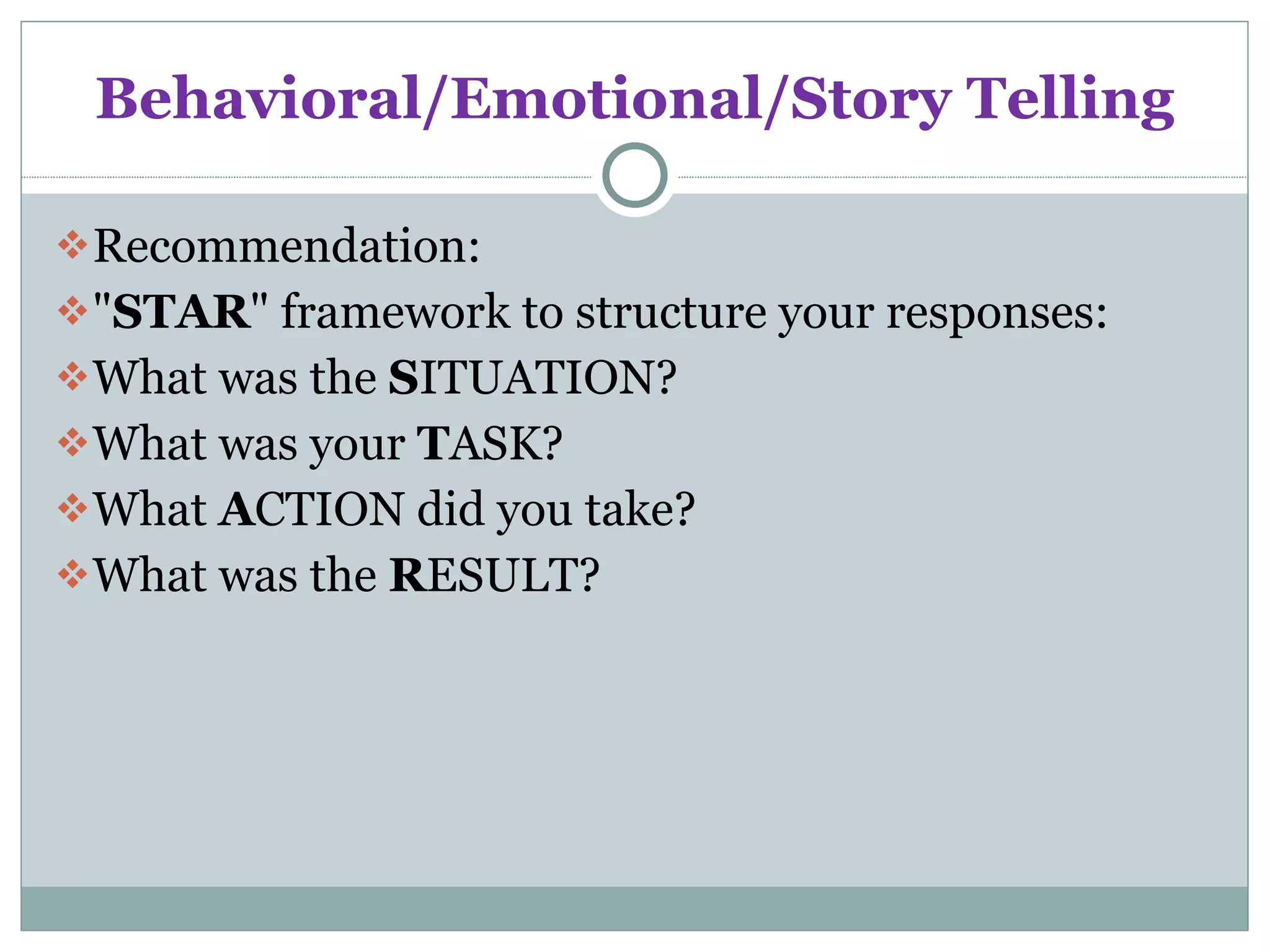
Behavioral/Emotional/Story Telling Recommendation: " STAR " framework to structure your responses: What was the  S ITUATION? What was your  T ASK? What  A CTION did you take? What was the  R ESULT?
Case-Method/Case-Based Commonly used interview method in business and consulting fields. Interviewee is requested to analyze a problem/situation and present a solution. Employer assesses analytical ability /thought  process, not the accurateness of the response.
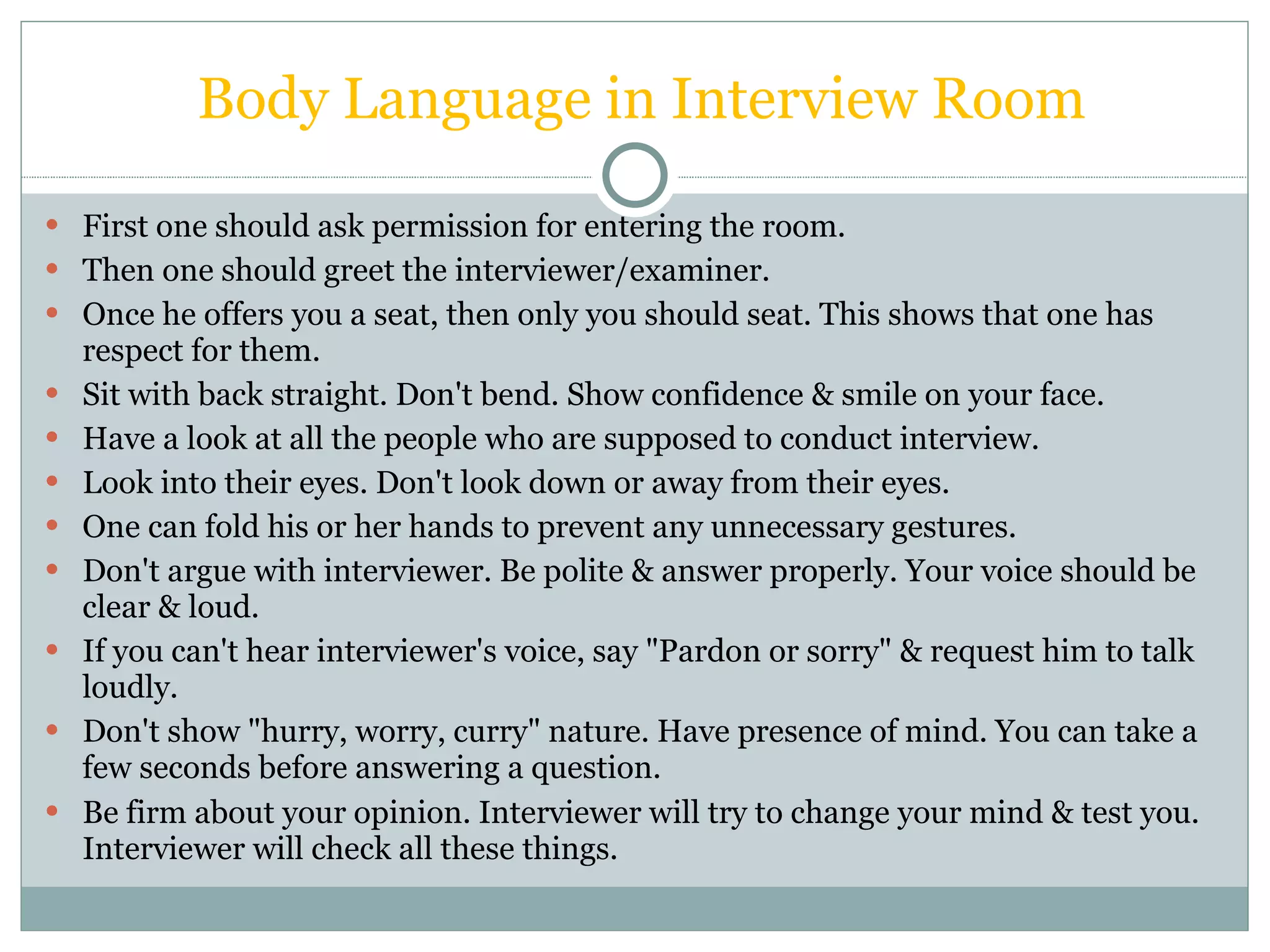
Body Language in Interview Room First one should ask permission for entering the room. Then one should greet the interviewer/examiner. Once he offers you a seat, then only you should seat. This shows that one has respect for them. Sit with back straight. Don't bend. Show confidence & smile on your face. Have a look at all the people who are supposed to conduct interview. Look into their eyes. Don't look down or away from their eyes. One can fold his or her hands to prevent any unnecessary gestures. Don't argue with interviewer. Be polite & answer properly. Your voice should be clear & loud. If you can't hear interviewer's voice, say "Pardon or sorry" & request him to talk loudly. Don't show "hurry, worry, curry" nature. Have presence of mind. You can take a few seconds before answering a question. Be firm about your opinion. Interviewer will try to change your mind & test you. Interviewer will check all these things.
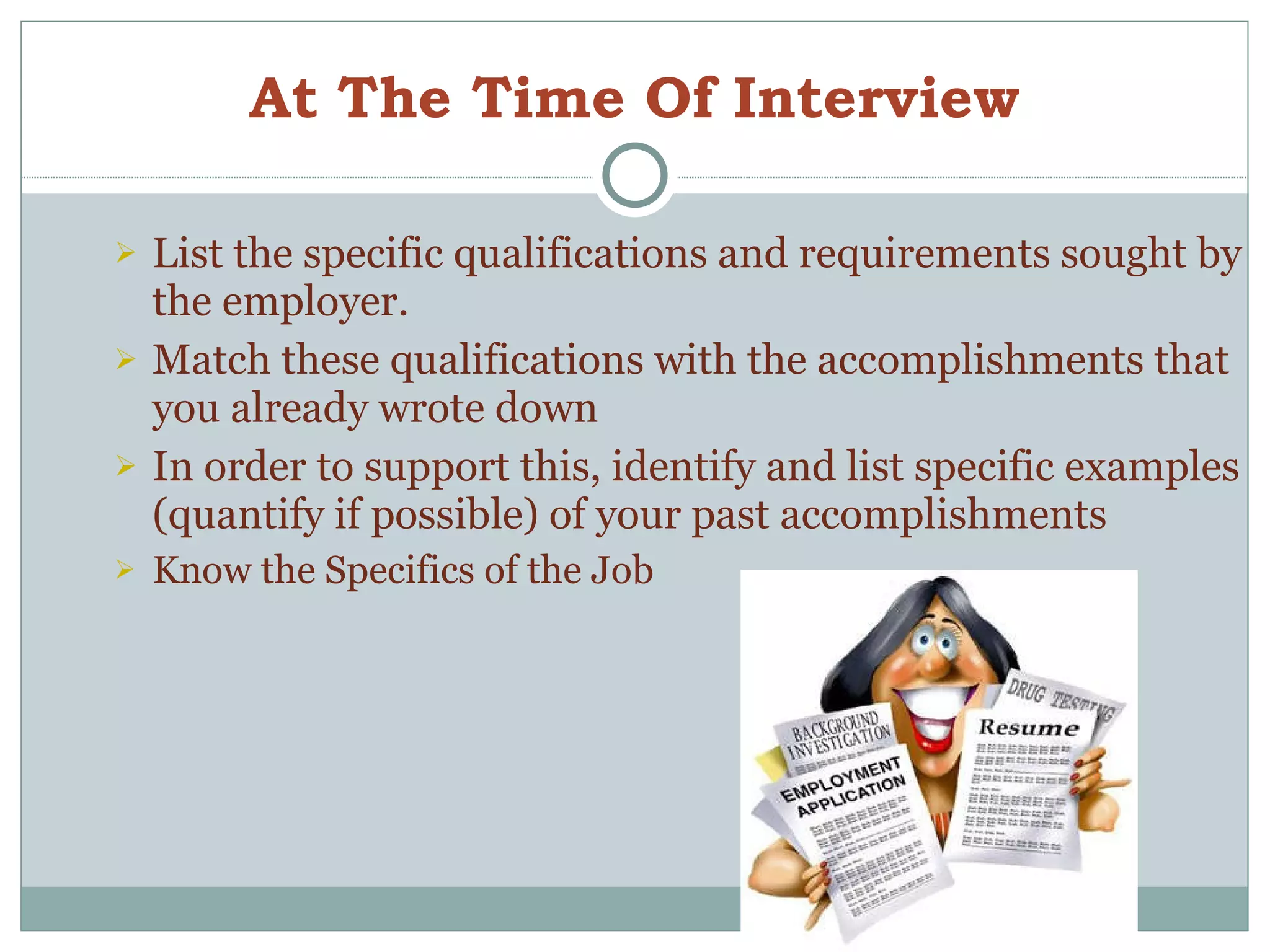
At The Time Of Interview List the specific qualifications and requirements sought by the employer. Match these qualifications with the accomplishments that you already wrote down In order to support this, identify and list specific examples (quantify if possible) of your past accomplishments Know the Specifics of the Job
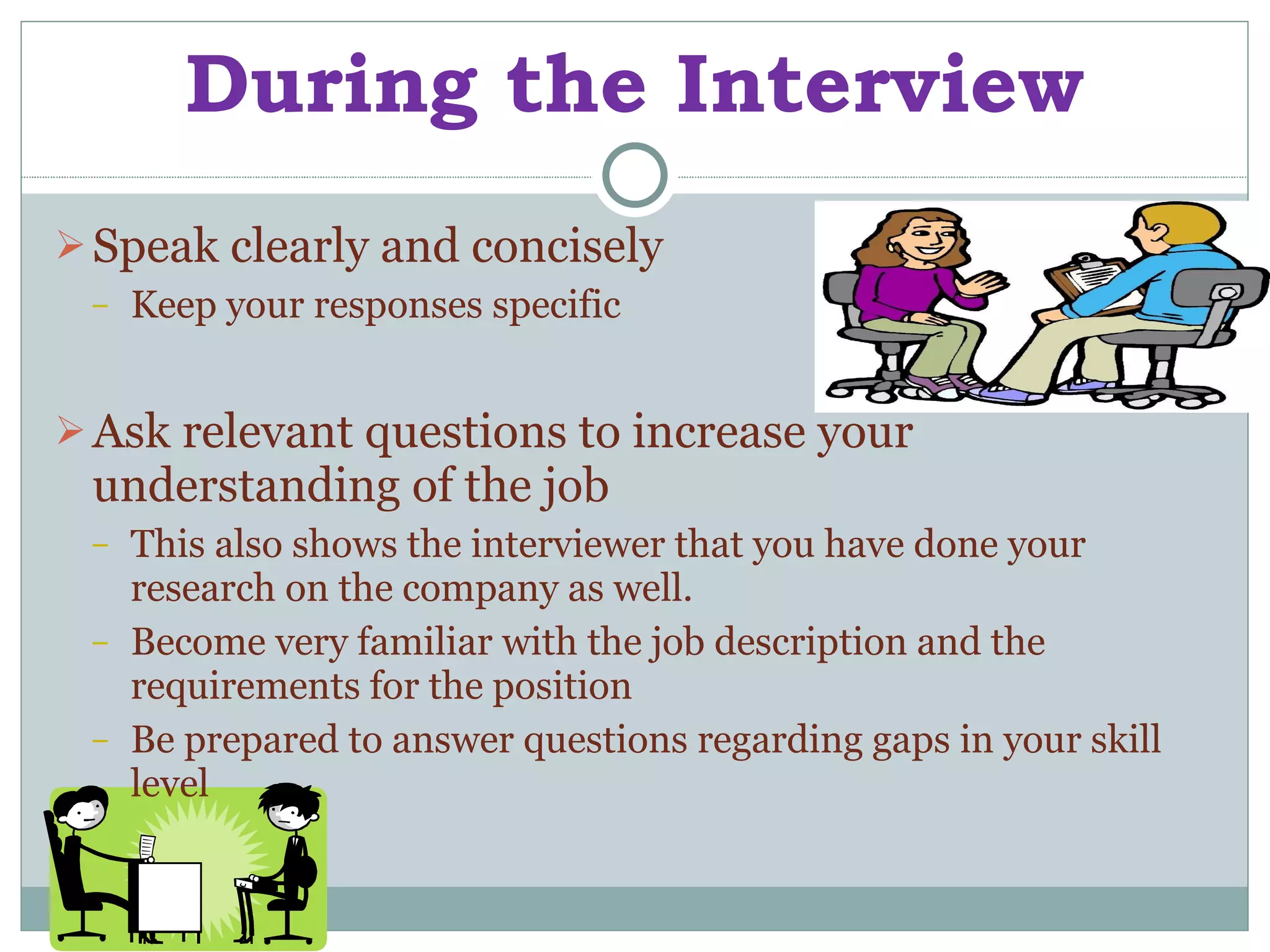
During the Interview Speak clearly and concisely Keep your responses specific Ask relevant questions to increase your understanding of the job This also shows the interviewer that you have done your research on the company as well. Become very familiar with the job description and the requirements for the position Be prepared to answer questions regarding gaps in your skill level
Questions To Ask “ What’s Your Ideal Employee Like?” This question will give you an idea as to the working style of your boss, and whether or not your styles are similar “ How Do You Measure Success on the Job? ” If you want to excel at this job, you need to know how that will be determined by your boss. You may also want to ask about the typical career path for successful employees (you want to work for a manager who recognizes and rewards excellence).
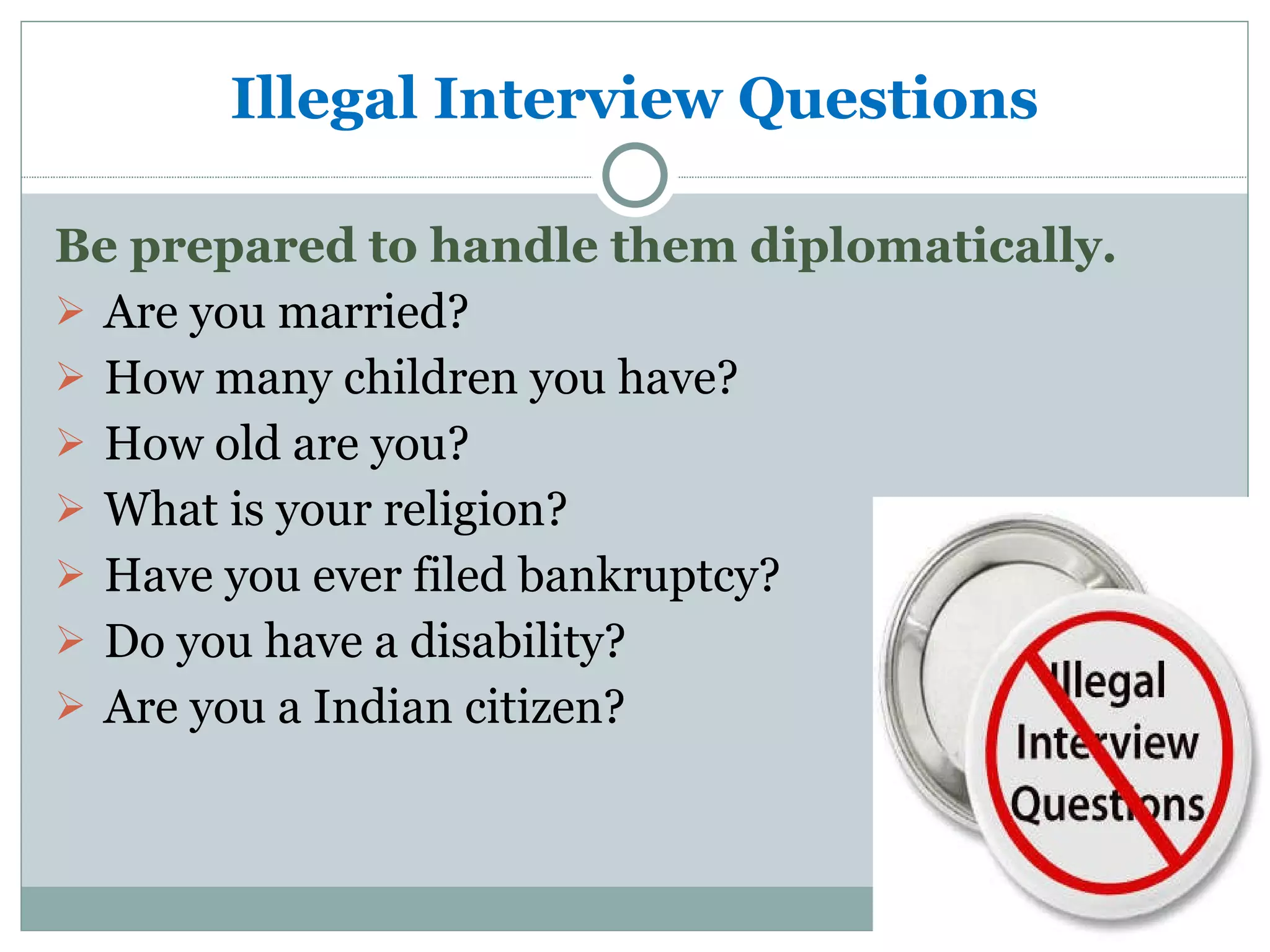
Illegal Interview Questions Be prepared to handle them diplomatically. Are you married? How many children you have? How old are you? What is your religion? Have you ever filed bankruptcy? Do you have a disability? Are you a Indian citizen?
Tough Questions How to prepare for the tough questions you know you will have to answer: ‘ Future’ Question Don’t focus on specific career plans, but talk about things that are professionally important to you and how you will achieve them ‘ Why’ Question It may be hard to praise yourself, so practice in front of a mirror Be confident, not boastful
Close Positively Thank You  &  A Firm  Handshake
After The Interview Write a   THANK YOU Letter or E-mail Add pertinent information you might have left out during the interview. Reiterate your  interest  in the job Ask about your timetable and follow up with a phone call Cordially inquire and  reiterate your interest again
Bibliography www.google.com Essential of Business Communication (OC-26 to 36) www.yahoo.com   Career service center. http://www.mckinsey.com
 

How to appear in an interview

  • 1.
    BY- SHREYANS, HANSRAJ& ISHAN HOW TO APPEAR IN AN INTERVIEW
  • 2.
    Definition Of Interview An interview is a conversation between two or more people (the interviewer and the interviewee) where questions are asked by the interviewer to obtain information from the interviewee.
  • 3.
    Before The InterviewGet your career goals in focus Identify your main strengths related to the job Gather specific accomplishments to back up your skills Research the company Find out the dress code in advance and dress accordingly Practice with yourself or with a friend
  • 4.
    Home Work TOBe Done Employers’ Web Sites Best place to “see” the company as it wants to be seen Check the annual report, look for press releases Look for the “head of R&D” Research Sources Get vital statistics and independent perspectives on the employer from On-line resources Look at financial data, list of competitors News Sources Find general interest web sites to see what they say about this employer Find hometown newspapers on-line to read about this employer Trade Journals Read these for new products, find its place in the industry .
  • 5.
    Few Items YouShould Bring On A Interv iew You should bring at least one spare copy of your resume. If you know that you will be interviewed by multiple people, you should bring a copy of your resume for each. If you are applying for a job that has specific certification or licensing requirements. you should bring proof of your eligibility. employers are more likely to choose a candidate whose paperwork is already in order.
  • 6.
    Portfolio A portfoliocould be as simple as examples of your work on past projects. No matter the depth of your portfolio. Limit the number of pieces in your portfolio to your best. During an interview, you will have only a few minutes that you can devote to showing off your work. While you may make arrangements to leave your portfolio behind after the interview, you will want to be sure that your interviewer has already seen your best pieces. If it is on a CD or DVD, you may need to make arrangements to have some sort of player available.
  • 7.
    Bring For EmergencyThere are a few items that you might also want to consider bringing along for emergencies. stick breath mints in your bag, for instance bring a couple of safety pins, just in case. These sorts of emergency prepares you to deal with anything that comes up can help you before your interview.
  • 8.
  • 9.
    Men's Interview AttireSuit (solid color – Navy, Black or Dark Grey) Long sleeve shirt (white or coordinated with the suit) Belt Tie Dark socks, conservative leather shoes Little or no jewelry Neat, professional hairstyle Limit the after shave Neatly trimmed nails Portfolio or briefcase
  • 10.
    Women's Interview AttireSuit (navy, black or dark grey) The suit skirt should be long enough so you can sit down comfortably Conservative shoes Limited jewelry (no dangling earrings or arms full of bracelets) Limited Jewelers Professional hairstyle Light make-up and perfume Neatly manicured clean nails Portfolio or briefcase
  • 11.
    What Not toBring to the Interview Gum Cell phone IPod Smoking or Tobacco If you have lots of piercings, leave some of your rings at home (ear rings only, is a good rule) Cover tattoos
  • 12.
    STRESS Only afool would tell you that looking for a job isn’t stressful even bigger fool to tell you that interviews will not produce stress. After all, you’re in an unfamiliar setting, meeting strangers, risking your ego Even a simple conversation that can affect the rest of your life.
  • 13.
    ABC Of InterviewABC ’s of the Job Interview A lways B eware of C rash and Burn
  • 14.
    A- Always Always Research the company with a focus on customers and competition Research can be done on the internet, by reading annual reports, and by talking with credible people in the industry Provide examples of when you have successfully worked in team environments Demonstrate creativity and responsibility
  • 15.
    B- Beware Beware of Having an “I” attitude Don’t overstate your accomplishments - be honest Negotiating too early Doing this during the job interview sends a message that you are more interested in money than the job Being too casual with the interview Recognize that the job interview starts when you first arrive and does not end until you are out the door and on your way home
  • 16.
    C- Crash &Burn C rash and Burn Displaying bad manners Poor etiquette and boorish manners send a message to the interviewer that you will behave that way with clients Demeaning your current or past employer It is a very small world, and reputations are made and broken on the basis of sometimes unknown relationships Being dishonest An interview is the time to put the best spin possible on your career, but not at the cost of your integrity
  • 17.
    First Impression Firstimpressions count! Be on time, or even a little bit early This allows you to relax and feel comfortable Start strong by beginning on a positive note Use open-ended questions as the opportunity to respond with your main strength Send the right body language Sit up straight, maintain good eye contact, 0use gestures if appropriate, and relax!
  • 18.
    Types of interviewOne-on-One Interview Panel/Committee Interview Screening Interview Phone Interview On-Site Interview Off-Site Interview Second-Round Interview
  • 19.
    Screening Interview Typicallya short interview used for the purpose of conducting a brief evaluation of a candidate. An example of this type of interview is a conversation with an employer at a career fair. From this conversation, an employer will decide if he or she wants to talk with the student further in a more formal interview.
  • 20.
    Phone Interview Ratherthan conduct an interview face-to-face, the interview will be conducted via telephone. A phone interview is often a type of screening interview. Many times this is done when there is travel involved for a face-to-face interview. For example, an employer might interview ten candidates over the phone and then choose three out for an on-site interview.
  • 21.
    On-off site interviewOn-Site Interview An interview conducted the location of the company/organization. If the company location is not in the local area, and travel is involved, an on-site interview can be a second-round interview. Off-Site Interview An interview that occurs outside of an organization.
  • 22.
    Second-Round Interview Aninterview conducted after a formal, initial interview. The rest interview has conformed that you may be a good match for the job and the organization; The second is designed to enter deeply into your skills and interests, and to allow others in the organization to meet and evaluate you.
  • 23.
    Methods OF INTERVIEWSTraditional Behavioral/Emotional /Story Telling Case-Method, Cased-Based.
  • 24.
    Traditional Requires youto relay factual information Employer is taking your word at face value Sample Questions: Tell me about yourself. Why did you choose your major? What is a weakness you have? Why are you interested in this position?
  • 25.
    Behavioral/Emotional/Story Telling Recommendation:" STAR " framework to structure your responses: What was the S ITUATION? What was your T ASK? What A CTION did you take? What was the R ESULT?
  • 26.
    Case-Method/Case-Based Commonly usedinterview method in business and consulting fields. Interviewee is requested to analyze a problem/situation and present a solution. Employer assesses analytical ability /thought process, not the accurateness of the response.
  • 27.
    Body Language inInterview Room First one should ask permission for entering the room. Then one should greet the interviewer/examiner. Once he offers you a seat, then only you should seat. This shows that one has respect for them. Sit with back straight. Don't bend. Show confidence & smile on your face. Have a look at all the people who are supposed to conduct interview. Look into their eyes. Don't look down or away from their eyes. One can fold his or her hands to prevent any unnecessary gestures. Don't argue with interviewer. Be polite & answer properly. Your voice should be clear & loud. If you can't hear interviewer's voice, say "Pardon or sorry" & request him to talk loudly. Don't show "hurry, worry, curry" nature. Have presence of mind. You can take a few seconds before answering a question. Be firm about your opinion. Interviewer will try to change your mind & test you. Interviewer will check all these things.
  • 28.
    At The TimeOf Interview List the specific qualifications and requirements sought by the employer. Match these qualifications with the accomplishments that you already wrote down In order to support this, identify and list specific examples (quantify if possible) of your past accomplishments Know the Specifics of the Job
  • 29.
    During the InterviewSpeak clearly and concisely Keep your responses specific Ask relevant questions to increase your understanding of the job This also shows the interviewer that you have done your research on the company as well. Become very familiar with the job description and the requirements for the position Be prepared to answer questions regarding gaps in your skill level
  • 30.
    Questions To Ask“ What’s Your Ideal Employee Like?” This question will give you an idea as to the working style of your boss, and whether or not your styles are similar “ How Do You Measure Success on the Job? ” If you want to excel at this job, you need to know how that will be determined by your boss. You may also want to ask about the typical career path for successful employees (you want to work for a manager who recognizes and rewards excellence).
  • 31.
    Illegal Interview QuestionsBe prepared to handle them diplomatically. Are you married? How many children you have? How old are you? What is your religion? Have you ever filed bankruptcy? Do you have a disability? Are you a Indian citizen?
  • 32.
    Tough Questions Howto prepare for the tough questions you know you will have to answer: ‘ Future’ Question Don’t focus on specific career plans, but talk about things that are professionally important to you and how you will achieve them ‘ Why’ Question It may be hard to praise yourself, so practice in front of a mirror Be confident, not boastful
  • 33.
    Close Positively ThankYou & A Firm Handshake
  • 34.
    After The InterviewWrite a THANK YOU Letter or E-mail Add pertinent information you might have left out during the interview. Reiterate your interest in the job Ask about your timetable and follow up with a phone call Cordially inquire and reiterate your interest again
  • 35.
    Bibliography www.google.com Essentialof Business Communication (OC-26 to 36) www.yahoo.com Career service center. http://www.mckinsey.com
  • 36.