
INTERRUPTS 
321 
COMPUTER ARCHITECTURE AND ORGANIZATION 
MS SAIMA AMBER 
Presented By: 
Zara Tariq 2011/comp/BSCS/12537 1112639 
Yumna Furqan 2011/comp/BSCS/12535 1112637
INTERRUPTS 
 A signal from a device attached to a computer or from a program within the 
computer which causes the main program that operates the computer to stop 
and figure out what to do next. 
 Almost all personal (or larger) computers today are interrupt-driven 
 Mechanism by which other modules(e.g I/O) may interrupt normal sequence 
of processing. 
 Forced transfer of control to a procedure(handler) due to the external 
events(interrupts) or due to an erroneous(exceptions). 
Presented to Ms. Saima Amber
INTERRUPT HANDLING 
 Mechanism 
 Allows interrupts/exceptions to be handled transparently to the executing 
process (application programs and operating system) 
 Procedure 
 When an interrupt Is received or an exception condition detection, the 
current task is suspended and transfer automatically goes to a handler 
 After the handler is complete, the interrupted task resumes without loss of 
continuity, unless recovery is not possible or the interrupt causes the 
currently running task to be terminated. 
Presented to Ms. Saima Amber
TYPES OF INTERRUPTS 
 Program – Something that occurs as a result of program execution 
such as illegal instructions, arithmetic overflow, divide by zero, or 
memory handling error 
 Timer – Generated by one of the processor's internal timers so that 
the processor can perform some time-scheduled task 
 I/O – Generated by an I/O controller to request service from the 
processor such as keyboard, mouse, NIC, disk drive 
 Hardware failure – signifies some error condition with the 
hardware 
Presented to Ms. Saima Amber
INTERRUPT HANDLING 
 CPU receives the interrupt request (IRQ) when running a program; 
 CPU save its state of execution via a context switch; 
 Begin execution of an interrupt handler/interrupt service routine 
(ISR); 
 When ISR finishes, CPU switch state back and continue the original 
program. 
Presented to Ms. Saima Amber
PROGRAM FLOW CONTROL 
Presented to Ms. Saima Amber
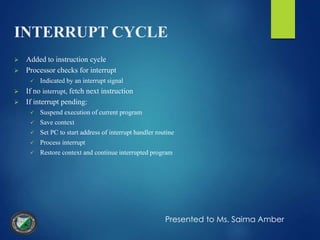
INTERRUPT CYCLE 
 Added to instruction cycle 
 Processor checks for interrupt 
 Indicated by an interrupt signal 
 If no interrupt, fetch next instruction 
 If interrupt pending: 
 Suspend execution of current program 
 Save context 
 Set PC to start address of interrupt handler routine 
 Process interrupt 
 Restore context and continue interrupted program 
Presented to Ms. Saima Amber
INSTRUCTION CYCLE (WITH INTERRUPTS) 
STATE DIAGRAM 
Presented to Ms. Saima Amber
MULTIPLE INTERRUPTS 
 Disable interrupts 
 Processor will ignore further interrupts while processing one interrupt. 
 Interrupts remain pending and are checked after first interrupt has been 
processed. 
 Interrupts handled in sequence as they occur. 
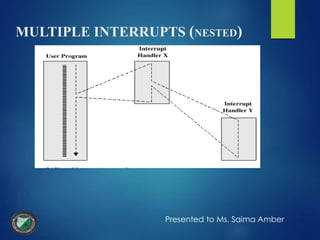
 Define priorities 
 Low priority interrupts can be interrupted by higher priority interrupts. 
 When higher priority interrupt has been processed, processor returns to 
previous interrupt. 
Presented to Ms. Saima Amber
MULTIPLE INTERRUPTS (SEQUENTIAL) 
Presented to Ms. Saima Amber
MULTIPLE INTERRUPTS (NESTED) 
Presented to Ms. Saima Amber
Thank You All For Your Kind Attention 
Your Presenters: Zara Tariq & Yumna Furqan

INTERRUPTS

  • 1.
    INTERRUPTS 321 COMPUTERARCHITECTURE AND ORGANIZATION MS SAIMA AMBER Presented By: Zara Tariq 2011/comp/BSCS/12537 1112639 Yumna Furqan 2011/comp/BSCS/12535 1112637
  • 2.
    INTERRUPTS  Asignal from a device attached to a computer or from a program within the computer which causes the main program that operates the computer to stop and figure out what to do next.  Almost all personal (or larger) computers today are interrupt-driven  Mechanism by which other modules(e.g I/O) may interrupt normal sequence of processing.  Forced transfer of control to a procedure(handler) due to the external events(interrupts) or due to an erroneous(exceptions). Presented to Ms. Saima Amber
  • 3.
    INTERRUPT HANDLING Mechanism  Allows interrupts/exceptions to be handled transparently to the executing process (application programs and operating system)  Procedure  When an interrupt Is received or an exception condition detection, the current task is suspended and transfer automatically goes to a handler  After the handler is complete, the interrupted task resumes without loss of continuity, unless recovery is not possible or the interrupt causes the currently running task to be terminated. Presented to Ms. Saima Amber
  • 4.
    TYPES OF INTERRUPTS  Program – Something that occurs as a result of program execution such as illegal instructions, arithmetic overflow, divide by zero, or memory handling error  Timer – Generated by one of the processor's internal timers so that the processor can perform some time-scheduled task  I/O – Generated by an I/O controller to request service from the processor such as keyboard, mouse, NIC, disk drive  Hardware failure – signifies some error condition with the hardware Presented to Ms. Saima Amber
  • 5.
    INTERRUPT HANDLING CPU receives the interrupt request (IRQ) when running a program;  CPU save its state of execution via a context switch;  Begin execution of an interrupt handler/interrupt service routine (ISR);  When ISR finishes, CPU switch state back and continue the original program. Presented to Ms. Saima Amber
  • 6.
    PROGRAM FLOW CONTROL Presented to Ms. Saima Amber
  • 7.
    INTERRUPT CYCLE Added to instruction cycle  Processor checks for interrupt  Indicated by an interrupt signal  If no interrupt, fetch next instruction  If interrupt pending:  Suspend execution of current program  Save context  Set PC to start address of interrupt handler routine  Process interrupt  Restore context and continue interrupted program Presented to Ms. Saima Amber
  • 8.
    INSTRUCTION CYCLE (WITHINTERRUPTS) STATE DIAGRAM Presented to Ms. Saima Amber
  • 9.
    MULTIPLE INTERRUPTS Disable interrupts  Processor will ignore further interrupts while processing one interrupt.  Interrupts remain pending and are checked after first interrupt has been processed.  Interrupts handled in sequence as they occur.  Define priorities  Low priority interrupts can be interrupted by higher priority interrupts.  When higher priority interrupt has been processed, processor returns to previous interrupt. Presented to Ms. Saima Amber
  • 10.
    MULTIPLE INTERRUPTS (SEQUENTIAL) Presented to Ms. Saima Amber
  • 11.
    MULTIPLE INTERRUPTS (NESTED) Presented to Ms. Saima Amber
  • 12.
    Thank You AllFor Your Kind Attention Your Presenters: Zara Tariq & Yumna Furqan