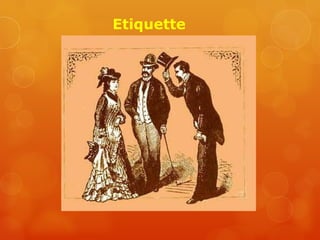
Etiquette
Etiquette ? Webster’s dictionary defines it as “ the forms , manners, and ceremonies established by convention as acceptable or required in social relations,  in a profession, or in official life .” Manners Coded Behavior Character Habits Thought
Where Etiquette is required Personal Family Home, Schools, College Social, Cultural Office When Etiquette is required Part of your  life You and the environment
Why Etiquette is required ? Professional etiquette - must for Career  builds leadership, quality, business & careers It refines skills needed for exceptional service Without Etiquette You limit your potential  Risk your image Jeopardize relationships
Differentiates them in competitive market Honors Commitments to quality and excellence Enables them to be confident in a variety of settings with a variety of  people from all walks of life Modifies distracting behaviors and develops admired conduct How Etiquette Pays Off !
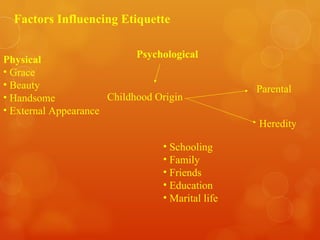
Factors Influencing Etiquette Physical Grace  Beauty Handsome External Appearance Schooling  Family Friends Education Marital life Psychological Childhood Origin Parental Heredity
Your Behavior Making Right Friends Cultivating the charm Class & Quality Enemy - The Anger Patience Tolerance - Carrier
Personal Hygiene Skin Hair Hands Nails Tooth Feet Shoes Hose Uniform Jewellery Mind & Soul Thoughts Habits Character Attitudes Prefered  Liked   Loved   Purpose Postures  Sitting Standing Talking while standing Good Posture Impatience Sitting in Groups PERSONAL ETIQUETTE
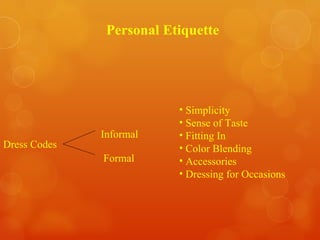
Personal Etiquette Dress Codes Informal Formal Simplicity Sense of Taste Fitting In Color Blending Accessories Dressing for Occasions
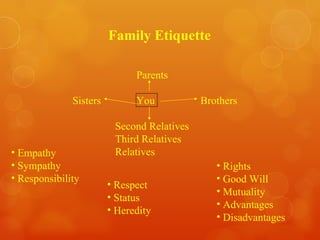
Empathy Sympathy Responsibility Rights Good Will Mutuality Advantages Disadvantages Respect Status Heredity Family Etiquette  Parents Sisters You Brothers   Second Relatives   Third Relatives   Relatives
Basic Etiquette for a happier home Don’t nag Don’t try to make your partner over Don’t criticize Give honest appreciation Pay little attentions Be courteous Don’t be Ignorant  Know first - Talk next
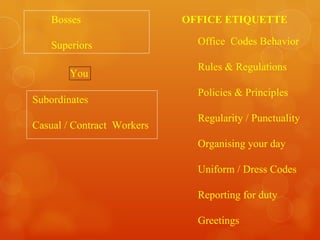
  You Office  Codes Behavior Rules & Regulations Policies & Principles Regularity / Punctuality Organising your day Uniform / Dress Codes Reporting for duty Greetings OFFICE ETIQUETTE Subordinates Casual / Contract  Workers Bosses Superiors
First Name - Formal Style Official Introductions - Acknowledgements  Business Cards Telephone Manners Helping Colleagues Managing The Boss Handling Subordinates Handling Rivals Gossips / Yapping Conflicts / Disputes / Memos Timings Answering a phone Identity Taking a message - Holding -  Short - Crisp - Clear communications Returning Calls Wrong Numbers Long Conversation Ending a Conversation Misuse Voice Mail
Some Basics of Office Etiquette Some principles which office employees can utilize to make a  contribution follows Be polite, pleasant and courteous when answering the telephone Answer promptly any telephone that rings in the office Avoid blowing and popping gum in the office Be discrete when coughing or yawning Avoid applying makeup at the desk Use positive body language Avoid eating at your desk when dealing with public Be tactful with rude people Avoid personal conversation when a client is waiting
Etiquette for Reprimanding & Counseling Begin with praise and honest appreciation Call attention to people’s mistakes indirectly  Talk about your own mistakes before criticizing the other person Ask questions instead of giving direct orders Let the other man save his face Praise the slightest improvement and praise every improvement. Be “hearty in your approbation and lavish in your praise” Give the other person a fine reputation to live up to Use encouragement. Make the fault seem easy to correct\ Make the other person happy about doing the thing you suggest
Other things office employees should watch out for follow Be punctual Avoid annoying habits Practice teamwork Discourage personal office visitors Do not use strong perfume or cologne Do not wear noisy jewellery Be tactful with rude people In fact, the efforts of employees will be more fruitful and effective if each practices the common maxim “ treat a person the way you wanted to be treated ”
Smile It costs nothing, but creates much It enriches those who receive, without improvishing those who give It happens in a flash and the memory of it sometimes lasts forever None are so rich they can get along without it, and none so poor but are richer for its benefits.
Etiquette to make People Like You Become genuinely interested in other people Smile Remember that a man’s name is to him Be a good listener. Encourage others to talk about themselves. Talk in terms of the other man’s interest. Make the other person feel important - and do it sincerely.
Etiquette to win People in your way The only way to get the best of an argument is to avoid it Show respect to other man’s opinions. Never tell a man he is wrong  If you are wrong, admit it quickly and emphatically Begin in a friendly way Get the other person saying “yes, yes” immediately Let the other man feel that the idea is his Try honestly to see things from the other person’s point of view Be sympathetic with the other person’s ideas and desires Appeal to the nobler motives Dramatize your ideas Throw down a challenge
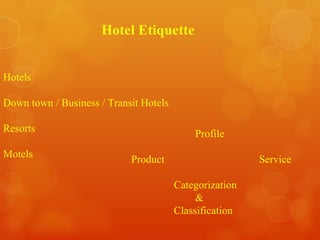
Hotels Down town / Business / Transit Hotels Resorts Motels Profile Product Service   Categorization   &   Classification Hotel Etiquette
Clean my Room Card Do not Disturb Card Hotel Rules Fire Plan Hangers Bath robe Laundry Bags Laundry list Shoe shine strip Water glasses Bottle openers  Stationary folder containing Letter Heads Envelopes Guest Comments form Post Cards Telex forms Scribbling pad Pen Ash tray with match box on coaster Candle stand with candle on coaster Magazines Room Service Menu Breakfast card hanger Business Centre pamphlet Sewing kit GUEST SUPPLIES / ROOM SUPPLIES
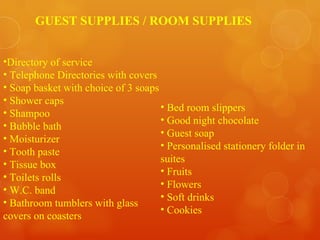
Directory of service Telephone Directories with covers Soap basket with choice of 3 soaps Shower caps Shampoo Bubble bath Moisturizer Tooth paste Tissue box Toilets rolls W.C. band Bathroom tumblers with glass covers on coasters Bed room slippers Good night chocolate Guest soap Personalised stationery folder in suites Fruits Flowers Soft drinks Cookies GUEST SUPPLIES / ROOM SUPPLIES
Bath Towels Hand Towels Face Towels Bath Mat Bath Rug LINEN
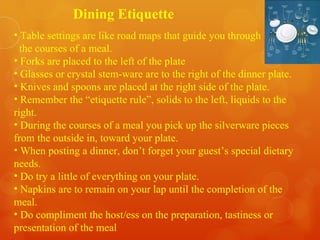
Dining Etiquette  Table settings are like road maps that guide you through  the courses of a meal. Forks are placed to the left of the plate Glasses or crystal stem-ware are to the right of the dinner plate. Knives and spoons are placed at the right side of the plate. Remember the “etiquette rule”, solids to the left, liquids to the right. During the courses of a meal you pick up the silverware pieces from the outside in, toward your plate. When posting a dinner, don’t forget your guest’s special dietary needs.  Do try a little of everything on your plate. Napkins are to remain on your lap until the completion of the meal. Do compliment the host/ess on the preparation, tastiness or presentation of the meal
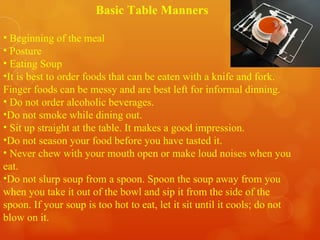
Basic Table Manners Beginning of the meal Posture Eating Soup It is best to order foods that can be eaten with a knife and fork. Finger foods can be messy and are best left for informal dinning. Do not order alcoholic beverages.  Do not smoke while dining out. Sit up straight at the table. It makes a good impression. Do not season your food before you have tasted it. Never chew with your mouth open or make loud noises when you eat.  Do not slurp soup from a spoon. Spoon the soup away from you when you take it out of the bowl and sip it from the side of the spoon. If your soup is too hot to eat, let it sit until it cools; do not blow on it.
When ordering or serving wine : Red wine generally is served with red meat; white wine with poultry or fish. A wine’s sugar content shouldn’t rival Captain Cruch. Nice people don’t drink Ripple, Thunderbird or “Mad Dog” Sweet and fortified wines should be served with dessert, not the main course. If it is your main course, get help If you feel the need to reach for the last piece of chicken, do so at your own risk. Impalement is an ugly thing. “ Finger-lickin’ good” is a slogan, not a suggestion. Napkins and sleeves are not interchangeable. Neither are shirttails and tissues, for that matter. If offered a lobster bib, by all means take advantage of it. Yes, you are supposed to eat that sprig of parsley decorating your plate. Think of it as an organic,after-dinner mint.
Basic Table Manners If food gets caught between your teeth and you can’t remove it with your tongue, leave the table and go to the mirror where you can remove the food from your teeth in private. You should not leave the table during the meal except in an emergency.  Something that you need which cannot be reached easily, politely ask the person closest to the item you need to pass it to you.  Dropping down of silver ware Food spillage off your plate Spitting Removing inedible from the mouth Offering food at table Finger Bowls
Foods to be taken by hands Bacon Bread Cookies Chips, French fries, Fried Chicken, and Hamburgers Hors d”Oeuvres, Canapse, Crudites Sandwiches Small fruits and Berries on the stem Indian Foods Snacks
Cocktail Etiquette Cocktails and Cocktail Party - Guests are mostly standing and dress attire can range from business to casual. Cocktail Buffet - Small tables and chairs are set up for guests after they fill up their plates at the buffet station. The attire is usually formal or business attire. This event can last 2-3 hours. Cocktail Reception - The most formal event. Attire is very dressy for women and usually black tie for men. The reception can be held for a distinguished guest of honor or event, such as an opening of a new performing arts center or film premier. There is so much food that the reception can count as dinner and Champagne is always served.
Tips to maneuver your way as a guest at a cocktail party Do some research on the guests attending the cocktail party. ‘Small talk’ will be much easier for you. Determine what your goals are. Whether you are social or business networking, keep in mind your goal(s) in attending this party. Do extend your hand and introduce yourself to unfamiliar guests. Maintain eye contact during introductions and conversations. Circulate (make the rounds) a little before you head to the bar or buffet table. Food and drink should not be the main goals. Don’t get drunk. Do keep conversations away from sex, politics and religin. Keep drinks and food in your left hand. Your right hand will be free for meeting, greeting and departure. If attending a cocktail party in a private home, treat household staff with dignity and respect.There are to be no personal or special requests from you to the staff.
Some Common-Sense do’s and don’ts for dinner : When at a dinner party, don’t expectorate on the floor...unless the hostess does first. Never eat peas with your knife, unless mashed potatoes are served as well. Do not ask for something which is irrelevant or N.A. Chew with your mouth closed. Everyone else at the table already knows what you are having for dinner Conversation at the table should be light, witty and extemporaneous. Death, diapers and delivery are not acceptable topics. If your infant must eat with you and your guests and junior spits his pablum all over your great aunt’s Dior gown, please don’t try to pass it off by saying: “Isn’t he the outest thing...and so smart, too!” “ Only cannibles eat standing up.”
What is the proper way to shake hands ? What exactly does RSVP mean How early should you begin teaching children etiquette  For an upcoming dinner party, I plan to give flowers as a hostess girl. That’s correct, isn’t it ? When hosting clients from overseas, where should I take them for dinner ? I’ve noticed a lot of women wearing open toe stiletto sandals at formal functions in the dead of winter. Is this appropriate ? Other General FAQ’s on Etiquette
What should you do if you are served a dish at a party that gives you an allergy? If the host is not looking, should you help yourself to another drink from the bottle? If you are seized by a coughing fit during the meal, what should you do? Your host has offered you tea which you do not drink at all You are invited to a cocktail party but you do not drink FAQ’s  At Party
You have gone to a restaurant where you find the service is very poor. Calling the waiter is very difficult. What can you do? You have seen the waiter dipping his finger in your finger bowl before bringing it to you. You do not like it. What do you do? You go to an expensive restaurant for lunch with a not-too-rich friend. You want to pick up the tab, so as not to burden him financially. He, on the other hand, insists  on paying the entire amount from his own packet. What should you do? FAQ’s  Eating Out
You have entered your train compartment in a hurry and knocked over someone’s water pitcher. Of course, it broke. The traveller is a lady with two children. What should you do? You have gone to see a movie and the person behind you is constantly talking loudly and disturbing you. FAQ’s  Travelling Your boss who is otherwise very nice is very short-tempered at times. One day he shouts at you in front of a group of visitors. You feel humiliated. What will you do? FAQ’s  At Work
Etiquette Thank you!

Business etiquette

  • 1.
  • 2.
    Etiquette ? Webster’sdictionary defines it as “ the forms , manners, and ceremonies established by convention as acceptable or required in social relations, in a profession, or in official life .” Manners Coded Behavior Character Habits Thought
  • 3.
    Where Etiquette isrequired Personal Family Home, Schools, College Social, Cultural Office When Etiquette is required Part of your life You and the environment
  • 4.
    Why Etiquette isrequired ? Professional etiquette - must for Career builds leadership, quality, business & careers It refines skills needed for exceptional service Without Etiquette You limit your potential Risk your image Jeopardize relationships
  • 5.
    Differentiates them incompetitive market Honors Commitments to quality and excellence Enables them to be confident in a variety of settings with a variety of people from all walks of life Modifies distracting behaviors and develops admired conduct How Etiquette Pays Off !
  • 6.
    Factors Influencing EtiquettePhysical Grace Beauty Handsome External Appearance Schooling Family Friends Education Marital life Psychological Childhood Origin Parental Heredity
  • 7.
    Your Behavior MakingRight Friends Cultivating the charm Class & Quality Enemy - The Anger Patience Tolerance - Carrier
  • 8.
    Personal Hygiene SkinHair Hands Nails Tooth Feet Shoes Hose Uniform Jewellery Mind & Soul Thoughts Habits Character Attitudes Prefered Liked Loved Purpose Postures Sitting Standing Talking while standing Good Posture Impatience Sitting in Groups PERSONAL ETIQUETTE
  • 9.
    Personal Etiquette DressCodes Informal Formal Simplicity Sense of Taste Fitting In Color Blending Accessories Dressing for Occasions
  • 10.
    Empathy Sympathy ResponsibilityRights Good Will Mutuality Advantages Disadvantages Respect Status Heredity Family Etiquette Parents Sisters You Brothers Second Relatives Third Relatives Relatives
  • 11.
    Basic Etiquette fora happier home Don’t nag Don’t try to make your partner over Don’t criticize Give honest appreciation Pay little attentions Be courteous Don’t be Ignorant Know first - Talk next
  • 12.
    YouOffice Codes Behavior Rules & Regulations Policies & Principles Regularity / Punctuality Organising your day Uniform / Dress Codes Reporting for duty Greetings OFFICE ETIQUETTE Subordinates Casual / Contract Workers Bosses Superiors
  • 13.
    First Name -Formal Style Official Introductions - Acknowledgements Business Cards Telephone Manners Helping Colleagues Managing The Boss Handling Subordinates Handling Rivals Gossips / Yapping Conflicts / Disputes / Memos Timings Answering a phone Identity Taking a message - Holding - Short - Crisp - Clear communications Returning Calls Wrong Numbers Long Conversation Ending a Conversation Misuse Voice Mail
  • 14.
    Some Basics ofOffice Etiquette Some principles which office employees can utilize to make a contribution follows Be polite, pleasant and courteous when answering the telephone Answer promptly any telephone that rings in the office Avoid blowing and popping gum in the office Be discrete when coughing or yawning Avoid applying makeup at the desk Use positive body language Avoid eating at your desk when dealing with public Be tactful with rude people Avoid personal conversation when a client is waiting
  • 15.
    Etiquette for Reprimanding& Counseling Begin with praise and honest appreciation Call attention to people’s mistakes indirectly Talk about your own mistakes before criticizing the other person Ask questions instead of giving direct orders Let the other man save his face Praise the slightest improvement and praise every improvement. Be “hearty in your approbation and lavish in your praise” Give the other person a fine reputation to live up to Use encouragement. Make the fault seem easy to correct\ Make the other person happy about doing the thing you suggest
  • 16.
    Other things officeemployees should watch out for follow Be punctual Avoid annoying habits Practice teamwork Discourage personal office visitors Do not use strong perfume or cologne Do not wear noisy jewellery Be tactful with rude people In fact, the efforts of employees will be more fruitful and effective if each practices the common maxim “ treat a person the way you wanted to be treated ”
  • 17.
    Smile It costsnothing, but creates much It enriches those who receive, without improvishing those who give It happens in a flash and the memory of it sometimes lasts forever None are so rich they can get along without it, and none so poor but are richer for its benefits.
  • 18.
    Etiquette to makePeople Like You Become genuinely interested in other people Smile Remember that a man’s name is to him Be a good listener. Encourage others to talk about themselves. Talk in terms of the other man’s interest. Make the other person feel important - and do it sincerely.
  • 19.
    Etiquette to winPeople in your way The only way to get the best of an argument is to avoid it Show respect to other man’s opinions. Never tell a man he is wrong If you are wrong, admit it quickly and emphatically Begin in a friendly way Get the other person saying “yes, yes” immediately Let the other man feel that the idea is his Try honestly to see things from the other person’s point of view Be sympathetic with the other person’s ideas and desires Appeal to the nobler motives Dramatize your ideas Throw down a challenge
  • 20.
    Hotels Down town/ Business / Transit Hotels Resorts Motels Profile Product Service Categorization & Classification Hotel Etiquette
  • 21.
    Clean my RoomCard Do not Disturb Card Hotel Rules Fire Plan Hangers Bath robe Laundry Bags Laundry list Shoe shine strip Water glasses Bottle openers Stationary folder containing Letter Heads Envelopes Guest Comments form Post Cards Telex forms Scribbling pad Pen Ash tray with match box on coaster Candle stand with candle on coaster Magazines Room Service Menu Breakfast card hanger Business Centre pamphlet Sewing kit GUEST SUPPLIES / ROOM SUPPLIES
  • 22.
    Directory of serviceTelephone Directories with covers Soap basket with choice of 3 soaps Shower caps Shampoo Bubble bath Moisturizer Tooth paste Tissue box Toilets rolls W.C. band Bathroom tumblers with glass covers on coasters Bed room slippers Good night chocolate Guest soap Personalised stationery folder in suites Fruits Flowers Soft drinks Cookies GUEST SUPPLIES / ROOM SUPPLIES
  • 23.
    Bath Towels HandTowels Face Towels Bath Mat Bath Rug LINEN
  • 24.
    Dining Etiquette Table settings are like road maps that guide you through the courses of a meal. Forks are placed to the left of the plate Glasses or crystal stem-ware are to the right of the dinner plate. Knives and spoons are placed at the right side of the plate. Remember the “etiquette rule”, solids to the left, liquids to the right. During the courses of a meal you pick up the silverware pieces from the outside in, toward your plate. When posting a dinner, don’t forget your guest’s special dietary needs. Do try a little of everything on your plate. Napkins are to remain on your lap until the completion of the meal. Do compliment the host/ess on the preparation, tastiness or presentation of the meal
  • 25.
    Basic Table MannersBeginning of the meal Posture Eating Soup It is best to order foods that can be eaten with a knife and fork. Finger foods can be messy and are best left for informal dinning. Do not order alcoholic beverages. Do not smoke while dining out. Sit up straight at the table. It makes a good impression. Do not season your food before you have tasted it. Never chew with your mouth open or make loud noises when you eat. Do not slurp soup from a spoon. Spoon the soup away from you when you take it out of the bowl and sip it from the side of the spoon. If your soup is too hot to eat, let it sit until it cools; do not blow on it.
  • 26.
    When ordering orserving wine : Red wine generally is served with red meat; white wine with poultry or fish. A wine’s sugar content shouldn’t rival Captain Cruch. Nice people don’t drink Ripple, Thunderbird or “Mad Dog” Sweet and fortified wines should be served with dessert, not the main course. If it is your main course, get help If you feel the need to reach for the last piece of chicken, do so at your own risk. Impalement is an ugly thing. “ Finger-lickin’ good” is a slogan, not a suggestion. Napkins and sleeves are not interchangeable. Neither are shirttails and tissues, for that matter. If offered a lobster bib, by all means take advantage of it. Yes, you are supposed to eat that sprig of parsley decorating your plate. Think of it as an organic,after-dinner mint.
  • 27.
    Basic Table MannersIf food gets caught between your teeth and you can’t remove it with your tongue, leave the table and go to the mirror where you can remove the food from your teeth in private. You should not leave the table during the meal except in an emergency. Something that you need which cannot be reached easily, politely ask the person closest to the item you need to pass it to you. Dropping down of silver ware Food spillage off your plate Spitting Removing inedible from the mouth Offering food at table Finger Bowls
  • 28.
    Foods to betaken by hands Bacon Bread Cookies Chips, French fries, Fried Chicken, and Hamburgers Hors d”Oeuvres, Canapse, Crudites Sandwiches Small fruits and Berries on the stem Indian Foods Snacks
  • 29.
    Cocktail Etiquette Cocktailsand Cocktail Party - Guests are mostly standing and dress attire can range from business to casual. Cocktail Buffet - Small tables and chairs are set up for guests after they fill up their plates at the buffet station. The attire is usually formal or business attire. This event can last 2-3 hours. Cocktail Reception - The most formal event. Attire is very dressy for women and usually black tie for men. The reception can be held for a distinguished guest of honor or event, such as an opening of a new performing arts center or film premier. There is so much food that the reception can count as dinner and Champagne is always served.
  • 30.
    Tips to maneuveryour way as a guest at a cocktail party Do some research on the guests attending the cocktail party. ‘Small talk’ will be much easier for you. Determine what your goals are. Whether you are social or business networking, keep in mind your goal(s) in attending this party. Do extend your hand and introduce yourself to unfamiliar guests. Maintain eye contact during introductions and conversations. Circulate (make the rounds) a little before you head to the bar or buffet table. Food and drink should not be the main goals. Don’t get drunk. Do keep conversations away from sex, politics and religin. Keep drinks and food in your left hand. Your right hand will be free for meeting, greeting and departure. If attending a cocktail party in a private home, treat household staff with dignity and respect.There are to be no personal or special requests from you to the staff.
  • 31.
    Some Common-Sense do’sand don’ts for dinner : When at a dinner party, don’t expectorate on the floor...unless the hostess does first. Never eat peas with your knife, unless mashed potatoes are served as well. Do not ask for something which is irrelevant or N.A. Chew with your mouth closed. Everyone else at the table already knows what you are having for dinner Conversation at the table should be light, witty and extemporaneous. Death, diapers and delivery are not acceptable topics. If your infant must eat with you and your guests and junior spits his pablum all over your great aunt’s Dior gown, please don’t try to pass it off by saying: “Isn’t he the outest thing...and so smart, too!” “ Only cannibles eat standing up.”
  • 32.
    What is theproper way to shake hands ? What exactly does RSVP mean How early should you begin teaching children etiquette For an upcoming dinner party, I plan to give flowers as a hostess girl. That’s correct, isn’t it ? When hosting clients from overseas, where should I take them for dinner ? I’ve noticed a lot of women wearing open toe stiletto sandals at formal functions in the dead of winter. Is this appropriate ? Other General FAQ’s on Etiquette
  • 33.
    What should youdo if you are served a dish at a party that gives you an allergy? If the host is not looking, should you help yourself to another drink from the bottle? If you are seized by a coughing fit during the meal, what should you do? Your host has offered you tea which you do not drink at all You are invited to a cocktail party but you do not drink FAQ’s At Party
  • 34.
    You have goneto a restaurant where you find the service is very poor. Calling the waiter is very difficult. What can you do? You have seen the waiter dipping his finger in your finger bowl before bringing it to you. You do not like it. What do you do? You go to an expensive restaurant for lunch with a not-too-rich friend. You want to pick up the tab, so as not to burden him financially. He, on the other hand, insists on paying the entire amount from his own packet. What should you do? FAQ’s Eating Out
  • 35.
    You have enteredyour train compartment in a hurry and knocked over someone’s water pitcher. Of course, it broke. The traveller is a lady with two children. What should you do? You have gone to see a movie and the person behind you is constantly talking loudly and disturbing you. FAQ’s Travelling Your boss who is otherwise very nice is very short-tempered at times. One day he shouts at you in front of a group of visitors. You feel humiliated. What will you do? FAQ’s At Work
  • 36.