Interpersonal
Communication
Introduction
 Key to interpersonal and
organizational effectiveness
Topics of Discussion
 Models of effective communication:
basic model and the pyramid of
mutuality
 Communication styles
 Native tongue exercise
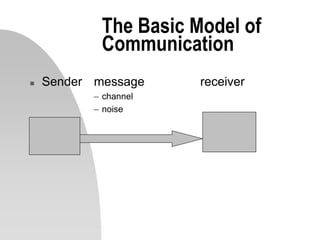
The Basic Model of
Communication
 Sender message receiver
– channel
– noise
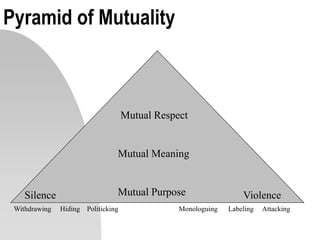
Pyramid of Mutuality
Mutual Respect
Mutual Meaning
Mutual Purpose
Silence Violence
Withdrawing Hiding Politicking Monologuing Labeling Attacking
Mutuality
 A win-win situation that is built on a
foundation of trust
 Sharing things in common
 Seeking for things in common:
 interests
 goals
 values
Mutual Purpose
 Common goals or objectives that
are built on a foundation of trust
 Something we want
Mutual Meaning
 Observations, assumptions,
conclusions, and feelings that both
parties acknowledge as valid
 Available Meaning: When ideas,
observations, and values are
acknowledged and understood,
they become part of the available
pool of common meaning
 Hidden Meaning: Through sharing
meaning we become more aware
of inconsistencies in our own
thinking
Mutual Respect
 Critical for maintaining dialogue
 Both parties choose to treat each
other with dignity, decency, and
consideration, based on the
assumption that others are
reasonable, and decent
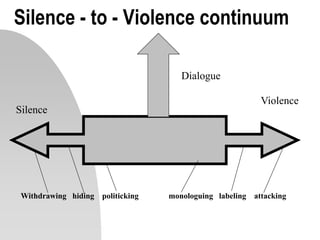
Silence - to - Violence continuum
Dialogue
Silence
Violence
Withdrawing hiding politicking monologuing labeling attacking
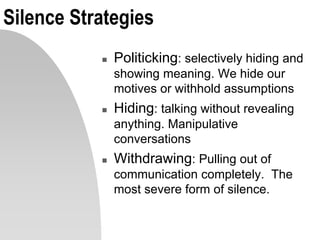
Silence Strategies
 Politicking: selectively hiding and
showing meaning. We hide our
motives or withhold assumptions
 Hiding: talking without revealing
anything. Manipulative
conversations
 Withdrawing: Pulling out of
communication completely. The
most severe form of silence.
Silence Strategies exs.
 At work
 In school
 At home
 With friends
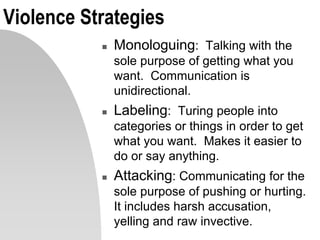
Violence Strategies
 Monologuing: Talking with the
sole purpose of getting what you
want. Communication is
unidirectional.
 Labeling: Turing people into
categories or things in order to get
what you want. Makes it easier to
do or say anything.
 Attacking: Communicating for the
sole purpose of pushing or hurting.
It includes harsh accusation,
yelling and raw invective.
Violence strategies exs.
 At work
 At school
 At home
 With friends
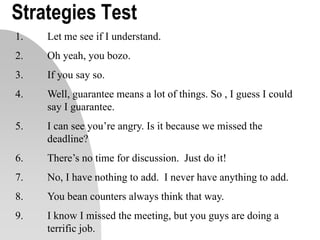
Strategies Test
1. Let me see if I understand.
2. Oh yeah, you bozo.
3. If you say so.
4. Well, guarantee means a lot of things. So , I guess I could
say I guarantee.
5. I can see you’re angry. Is it because we missed the
deadline?
6. There’s no time for discussion. Just do it!
7. No, I have nothing to add. I never have anything to add.
8. You bean counters always think that way.
9. I know I missed the meeting, but you guys are doing a
terrific job.
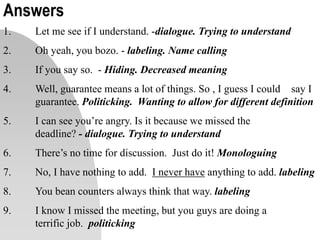
Answers
1. Let me see if I understand. -dialogue. Trying to understand
2. Oh yeah, you bozo. - labeling. Name calling
3. If you say so. - Hiding. Decreased meaning
4. Well, guarantee means a lot of things. So , I guess I could say I
guarantee. Politicking. Wanting to allow for different definition
5. I can see you’re angry. Is it because we missed the
deadline? - dialogue. Trying to understand
6. There’s no time for discussion. Just do it! Monologuing
7. No, I have nothing to add. I never have anything to add. labeling
8. You bean counters always think that way. labeling
9. I know I missed the meeting, but you guys are doing a
terrific job. politicking
Effective Communication:
A change of heart, not just a change in behaviour
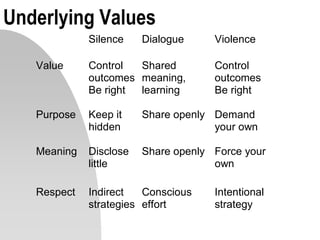
Underlying Values
Silence Dialogue Violence
Value Control
outcomes
Be right
Shared
meaning,
learning
Control
outcomes
Be right
Purpose Keep it
hidden
Share openly Demand
your own
Meaning Disclose
little
Share openly Force your
own
Respect Indirect
strategies
Conscious
effort
Intentional
strategy
3 Practice Scripts
Native Tongue Exercise
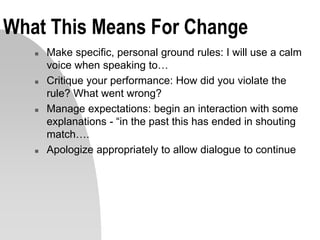
What This Means For Change
 Make specific, personal ground rules: I will use a calm
voice when speaking to…
 Critique your performance: How did you violate the
rule? What went wrong?
 Manage expectations: begin an interaction with some
explanations - “in the past this has ended in shouting
match….
 Apologize appropriately to allow dialogue to continue
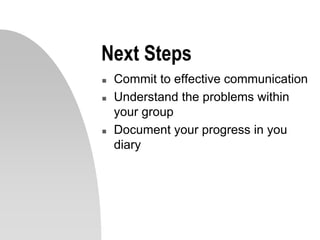
Next Steps
 Commit to effective communication
 Understand the problems within
your group
 Document your progress in you
diary

Interpersonal communication

  • 1.
  • 2.
    Introduction  Key tointerpersonal and organizational effectiveness
  • 3.
    Topics of Discussion Models of effective communication: basic model and the pyramid of mutuality  Communication styles  Native tongue exercise
  • 4.
    The Basic Modelof Communication  Sender message receiver – channel – noise
  • 5.
    Pyramid of Mutuality MutualRespect Mutual Meaning Mutual Purpose Silence Violence Withdrawing Hiding Politicking Monologuing Labeling Attacking
  • 6.
    Mutuality  A win-winsituation that is built on a foundation of trust  Sharing things in common  Seeking for things in common:  interests  goals  values
  • 7.
    Mutual Purpose  Commongoals or objectives that are built on a foundation of trust  Something we want
  • 8.
    Mutual Meaning  Observations,assumptions, conclusions, and feelings that both parties acknowledge as valid  Available Meaning: When ideas, observations, and values are acknowledged and understood, they become part of the available pool of common meaning  Hidden Meaning: Through sharing meaning we become more aware of inconsistencies in our own thinking
  • 9.
    Mutual Respect  Criticalfor maintaining dialogue  Both parties choose to treat each other with dignity, decency, and consideration, based on the assumption that others are reasonable, and decent
  • 10.
    Silence - to- Violence continuum Dialogue Silence Violence Withdrawing hiding politicking monologuing labeling attacking
  • 11.
    Silence Strategies  Politicking:selectively hiding and showing meaning. We hide our motives or withhold assumptions  Hiding: talking without revealing anything. Manipulative conversations  Withdrawing: Pulling out of communication completely. The most severe form of silence.
  • 12.
    Silence Strategies exs. At work  In school  At home  With friends
  • 13.
    Violence Strategies  Monologuing:Talking with the sole purpose of getting what you want. Communication is unidirectional.  Labeling: Turing people into categories or things in order to get what you want. Makes it easier to do or say anything.  Attacking: Communicating for the sole purpose of pushing or hurting. It includes harsh accusation, yelling and raw invective.
  • 14.
    Violence strategies exs. At work  At school  At home  With friends
  • 15.
    Strategies Test 1. Letme see if I understand. 2. Oh yeah, you bozo. 3. If you say so. 4. Well, guarantee means a lot of things. So , I guess I could say I guarantee. 5. I can see you’re angry. Is it because we missed the deadline? 6. There’s no time for discussion. Just do it! 7. No, I have nothing to add. I never have anything to add. 8. You bean counters always think that way. 9. I know I missed the meeting, but you guys are doing a terrific job.
  • 16.
    Answers 1. Let mesee if I understand. -dialogue. Trying to understand 2. Oh yeah, you bozo. - labeling. Name calling 3. If you say so. - Hiding. Decreased meaning 4. Well, guarantee means a lot of things. So , I guess I could say I guarantee. Politicking. Wanting to allow for different definition 5. I can see you’re angry. Is it because we missed the deadline? - dialogue. Trying to understand 6. There’s no time for discussion. Just do it! Monologuing 7. No, I have nothing to add. I never have anything to add. labeling 8. You bean counters always think that way. labeling 9. I know I missed the meeting, but you guys are doing a terrific job. politicking
  • 17.
    Effective Communication: A changeof heart, not just a change in behaviour
  • 18.
    Underlying Values Silence DialogueViolence Value Control outcomes Be right Shared meaning, learning Control outcomes Be right Purpose Keep it hidden Share openly Demand your own Meaning Disclose little Share openly Force your own Respect Indirect strategies Conscious effort Intentional strategy
  • 19.
  • 20.
  • 21.
    What This MeansFor Change  Make specific, personal ground rules: I will use a calm voice when speaking to…  Critique your performance: How did you violate the rule? What went wrong?  Manage expectations: begin an interaction with some explanations - “in the past this has ended in shouting match….  Apologize appropriately to allow dialogue to continue
  • 22.
    Next Steps  Committo effective communication  Understand the problems within your group  Document your progress in you diary