Whisper Down the Lane
Listening Effectively Team A Kimberly Adams Debra Aldrich Vittoria Baker Shaynelle Bordley Georgia Dimaano
Listening Definition “ The process of receiving, constructing meaning from, and responding to spoken and/or nonverbal messages.”
Listening Effectively Attending Understanding Remembering Critically Evaluating Responding
Attending Prepare mentally & physically Make complete shifts from speaker to listener roles Resist tuning out Avoid Interrupting
Understanding Identify with key points Interpret nonverbal cues Ask clarifying questions Paraphrase
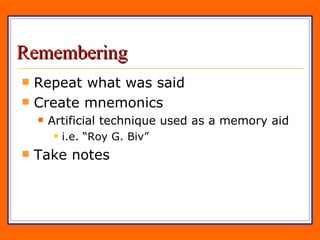
Remembering Repeat what was said Create mnemonics Artificial technique used as a memory aid i.e. “Roy G. Biv”  Take notes
Simon Says
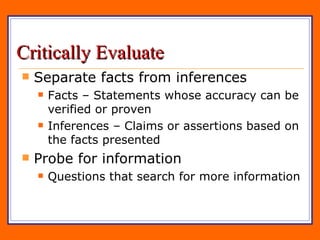
Critically Evaluate Separate facts from inferences Facts – Statements whose accuracy can be verified or proven Inferences – Claims or assertions based on the facts presented Probe for information Questions that search for more information
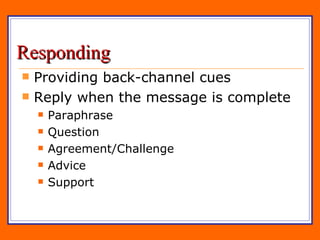
Responding Providing back-channel cues Reply when the message is complete Paraphrase Question Agreement/Challenge Advice Support
Riddles
Types of Listening Appreciative listening Discriminative listening Comprehensive listening Critical-evaluative listening Empathic listening
Appreciative Listening Focuses on the enjoyment of what is said.  You don’t have to focus in on the specifics Could be used in a casual, social setting
Discriminative Listening Gain an accurate understanding of the message Keep a close eye on verbal and non-verbal cues Could be used during a Dr’s exam to understand test results
Comprehensive Listening Learning and remembering information Use whenever you are learning a new procedure or during a lecture
Puzzles
Critical-evaluative Listening Able to judge or evaluate the information Understand and think critically about its intent May need to “read between the lines” Could be used when talking with a salesperson or someone making an apology
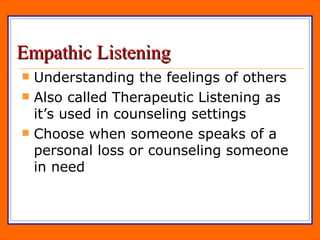
Empathic Listening Understanding the feelings of others Also called Therapeutic Listening as it’s used in counseling settings Choose when someone speaks of a personal loss or counseling someone in need
I Love Lucy
Top 10
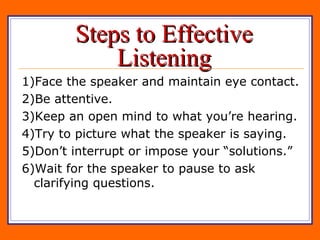
Steps to Effective Listening 1)Face the speaker and maintain eye contact. 2)Be attentive. 3)Keep an open mind to what you’re hearing. 4)Try to picture what the speaker is saying. 5)Don’t interrupt or impose your “solutions.” 6)Wait for the speaker to pause to ask clarifying questions.
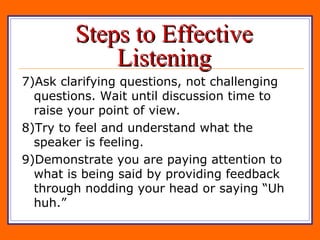
Steps to Effective Listening 7)Ask clarifying questions, not challenging questions. Wait until discussion time to raise your point of view. 8)Try to feel and understand what the speaker is feeling. 9)Demonstrate you are paying attention to what is being said by providing feedback through nodding your head or saying “Uh huh.”
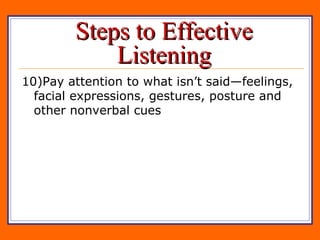
Steps to Effective Listening 10)Pay attention to what isn’t said—feelings, facial expressions, gestures, posture and other nonverbal cues
References Scholarly Article Book  Website

Listening Effectively

  • 1.
  • 2.
    Listening Effectively TeamA Kimberly Adams Debra Aldrich Vittoria Baker Shaynelle Bordley Georgia Dimaano
  • 3.
    Listening Definition “The process of receiving, constructing meaning from, and responding to spoken and/or nonverbal messages.”
  • 4.
    Listening Effectively AttendingUnderstanding Remembering Critically Evaluating Responding
  • 5.
    Attending Prepare mentally& physically Make complete shifts from speaker to listener roles Resist tuning out Avoid Interrupting
  • 6.
    Understanding Identify withkey points Interpret nonverbal cues Ask clarifying questions Paraphrase
  • 7.
    Remembering Repeat whatwas said Create mnemonics Artificial technique used as a memory aid i.e. “Roy G. Biv” Take notes
  • 8.
  • 9.
    Critically Evaluate Separatefacts from inferences Facts – Statements whose accuracy can be verified or proven Inferences – Claims or assertions based on the facts presented Probe for information Questions that search for more information
  • 10.
    Responding Providing back-channelcues Reply when the message is complete Paraphrase Question Agreement/Challenge Advice Support
  • 11.
  • 12.
    Types of ListeningAppreciative listening Discriminative listening Comprehensive listening Critical-evaluative listening Empathic listening
  • 13.
    Appreciative Listening Focuseson the enjoyment of what is said. You don’t have to focus in on the specifics Could be used in a casual, social setting
  • 14.
    Discriminative Listening Gainan accurate understanding of the message Keep a close eye on verbal and non-verbal cues Could be used during a Dr’s exam to understand test results
  • 15.
    Comprehensive Listening Learningand remembering information Use whenever you are learning a new procedure or during a lecture
  • 16.
  • 17.
    Critical-evaluative Listening Ableto judge or evaluate the information Understand and think critically about its intent May need to “read between the lines” Could be used when talking with a salesperson or someone making an apology
  • 18.
    Empathic Listening Understandingthe feelings of others Also called Therapeutic Listening as it’s used in counseling settings Choose when someone speaks of a personal loss or counseling someone in need
  • 19.
  • 20.
  • 21.
    Steps to EffectiveListening 1)Face the speaker and maintain eye contact. 2)Be attentive. 3)Keep an open mind to what you’re hearing. 4)Try to picture what the speaker is saying. 5)Don’t interrupt or impose your “solutions.” 6)Wait for the speaker to pause to ask clarifying questions.
  • 22.
    Steps to EffectiveListening 7)Ask clarifying questions, not challenging questions. Wait until discussion time to raise your point of view. 8)Try to feel and understand what the speaker is feeling. 9)Demonstrate you are paying attention to what is being said by providing feedback through nodding your head or saying “Uh huh.”
  • 23.
    Steps to EffectiveListening 10)Pay attention to what isn’t said—feelings, facial expressions, gestures, posture and other nonverbal cues
  • 24.