Sign Language
SIGN LANGUAGE
Used primarily by hearing-impaired
people,
Uses a different medium: hands,
face, and eyes (rather than vocal
tract or ears).
NOT derived from spoken language
Why Study Sign Language?
Sign Language exhibits same functional
properties and follow same universal
principles as spoken language—possible
evidence of universal grammar (UG).
Study of sign language provides unique
insight into the nature of language itself.
Brain function similarities indicate language
not based on hearing and speech.
MYTHS about sign language
It’s universal: NO. ASL =/= British sign language =/=
Spanish sign language
It’s like mime: NO. Some signs may be iconic, but
others are not (e.g.,‘apple’ in ASL). Mime can use the
whole body; sign language uses only an area between
the waist and head.
Has no grammar on its own. NO. ASL is NOT “English
on the hands”. English grammar and ASL grammar are
very different; e.g., ASL has a free word order; ASL
does not have tense markers.
Cannot convey the same meaning/complexities as
spoken language. NO. ASL speakers can express
anything they want in ASL.
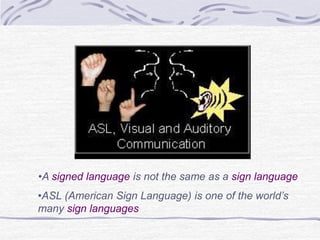
•A signed language is not the same as a sign language
•ASL (American Sign Language) is one of the world’s
many sign languages
ASL Grammar
ASL phonology
Hand-shape, location, movement, palm
orientation (features on their own may
mean nothing)
There’s also assimilation, syllabic
constraints, etc, (as in the in the
phonology of spoken languages).
ASL Grammar
ASL morphology
Parts of speech are also nouns (N),verbs (V),
adjectives (A), pronouns (Pro), adverbs (Adv).
A basic form can be inflected in ASL; e.g., Give and
different ‘aspects’ (Clark, p. 84).
Also, nouns are associated with spatial points.
Moving between those mark subject/object and
pronominal relations.
ASL classifiers (relationals) are embedded in V
signals
ASL signs can form compounds
ASL Grammar
ASL Syntax
Word order: SVO (same as English).
However, ASL tends to be a free word
order language.
ASL allows PRO drop (“subjectless”
sentences).
Facial expressions express emotions, but
also signal syntactic relationships. “Today
snow. Trip cancel.”
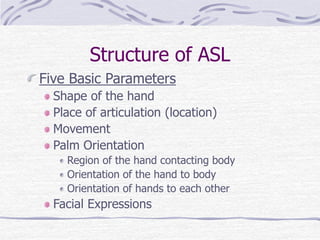
Structure of ASL
Five Basic Parameters
Shape of the hand
Place of articulation (location)
Movement
Palm Orientation
Region of the hand contacting body
Orientation of the hand to body
Orientation of hands to each other
Facial Expressions
Some differences/similarities
In spoken language, phonemes occur
linearly; in ASL primes cannot (spatial)
ASL involves discrete components, just
like spoken language
ASL has minimal pairs, as does spoken
language (words differing in only one
aspect).
Speakers of both can have dialects
and be perceived to have accents.
Sign Language
Fingerspelling/Manual Alphabet
Words without assigned signs may be
spelled
Some commonly spelled words become
lexicalized (e.g. NO)
Not the same handshape is used in every
sign language
Sign Language
Dialects and Registers
There are differences between groups within the
same language. Black ASL may have properties
(handshapes, certain position of certain fingers,
size of spaced used, etc) different from other
forms of ASL.
Also, formal vs informal contexts affect some
properties of ASL. For example, deletion is not
common in formal contexts; the signing space is
bigger in formal contexts, etc.

Introduction to Sign Language.ppt

  • 1.
  • 2.
    SIGN LANGUAGE Used primarilyby hearing-impaired people, Uses a different medium: hands, face, and eyes (rather than vocal tract or ears). NOT derived from spoken language
  • 3.
    Why Study SignLanguage? Sign Language exhibits same functional properties and follow same universal principles as spoken language—possible evidence of universal grammar (UG). Study of sign language provides unique insight into the nature of language itself. Brain function similarities indicate language not based on hearing and speech.
  • 4.
    MYTHS about signlanguage It’s universal: NO. ASL =/= British sign language =/= Spanish sign language It’s like mime: NO. Some signs may be iconic, but others are not (e.g.,‘apple’ in ASL). Mime can use the whole body; sign language uses only an area between the waist and head. Has no grammar on its own. NO. ASL is NOT “English on the hands”. English grammar and ASL grammar are very different; e.g., ASL has a free word order; ASL does not have tense markers. Cannot convey the same meaning/complexities as spoken language. NO. ASL speakers can express anything they want in ASL.
  • 5.
    •A signed languageis not the same as a sign language •ASL (American Sign Language) is one of the world’s many sign languages
  • 6.
    ASL Grammar ASL phonology Hand-shape,location, movement, palm orientation (features on their own may mean nothing) There’s also assimilation, syllabic constraints, etc, (as in the in the phonology of spoken languages).
  • 7.
    ASL Grammar ASL morphology Partsof speech are also nouns (N),verbs (V), adjectives (A), pronouns (Pro), adverbs (Adv). A basic form can be inflected in ASL; e.g., Give and different ‘aspects’ (Clark, p. 84). Also, nouns are associated with spatial points. Moving between those mark subject/object and pronominal relations. ASL classifiers (relationals) are embedded in V signals ASL signs can form compounds
  • 8.
    ASL Grammar ASL Syntax Wordorder: SVO (same as English). However, ASL tends to be a free word order language. ASL allows PRO drop (“subjectless” sentences). Facial expressions express emotions, but also signal syntactic relationships. “Today snow. Trip cancel.”
  • 9.
    Structure of ASL FiveBasic Parameters Shape of the hand Place of articulation (location) Movement Palm Orientation Region of the hand contacting body Orientation of the hand to body Orientation of hands to each other Facial Expressions
  • 10.
    Some differences/similarities In spokenlanguage, phonemes occur linearly; in ASL primes cannot (spatial) ASL involves discrete components, just like spoken language ASL has minimal pairs, as does spoken language (words differing in only one aspect). Speakers of both can have dialects and be perceived to have accents.
  • 11.
    Sign Language Fingerspelling/Manual Alphabet Wordswithout assigned signs may be spelled Some commonly spelled words become lexicalized (e.g. NO) Not the same handshape is used in every sign language
  • 12.
    Sign Language Dialects andRegisters There are differences between groups within the same language. Black ASL may have properties (handshapes, certain position of certain fingers, size of spaced used, etc) different from other forms of ASL. Also, formal vs informal contexts affect some properties of ASL. For example, deletion is not common in formal contexts; the signing space is bigger in formal contexts, etc.