Internet Exchange Points in the Middle East
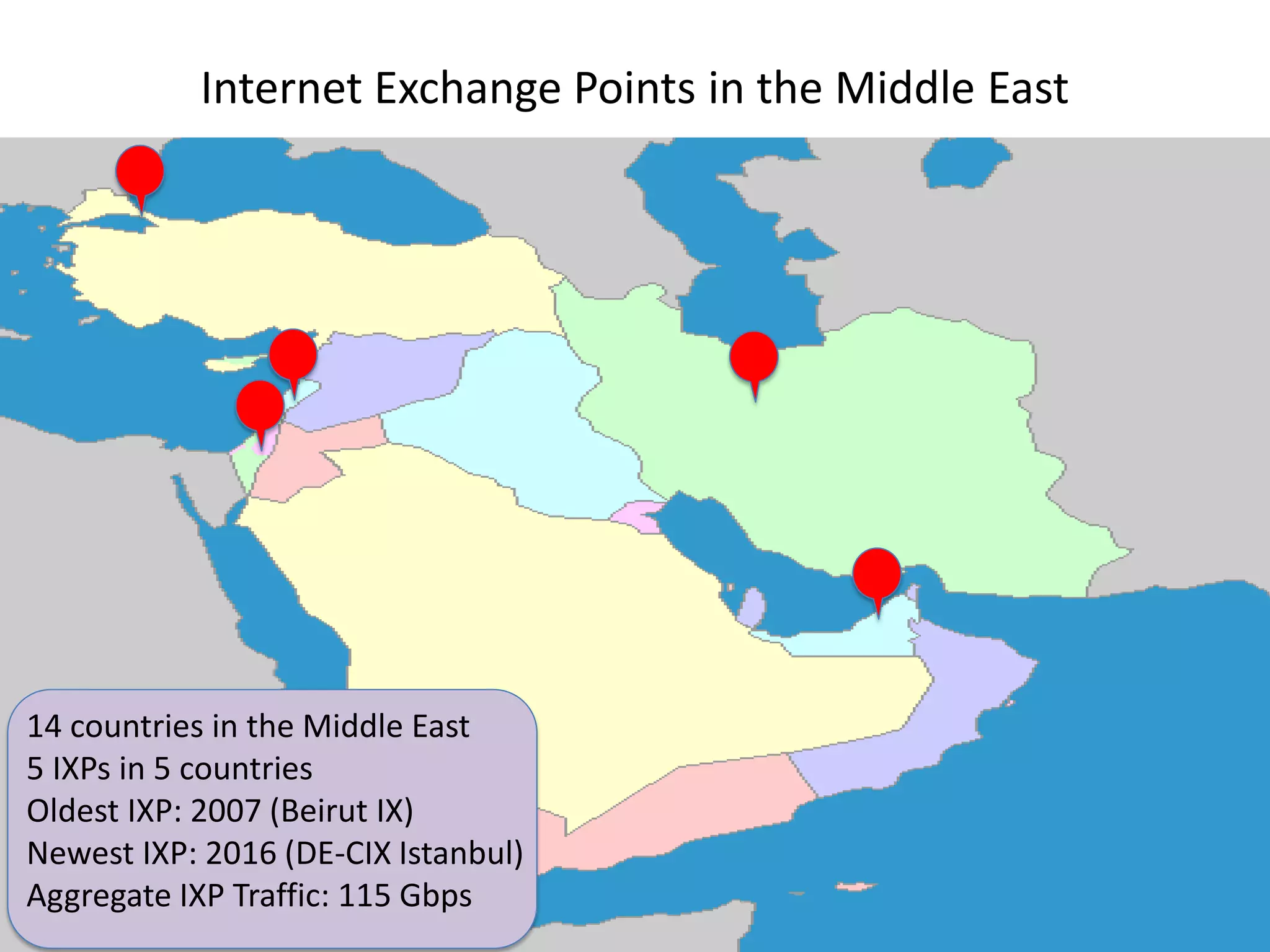
14 countries in the Middle East
5 IXPs in 5 countries
Oldest IXP: 2007 (Beirut IX)
Newest IXP: 2016 (DE-CIX Istanbul)
Aggregate IXP Traffic: 115 Gbps
0
1
2
3
4
5
6
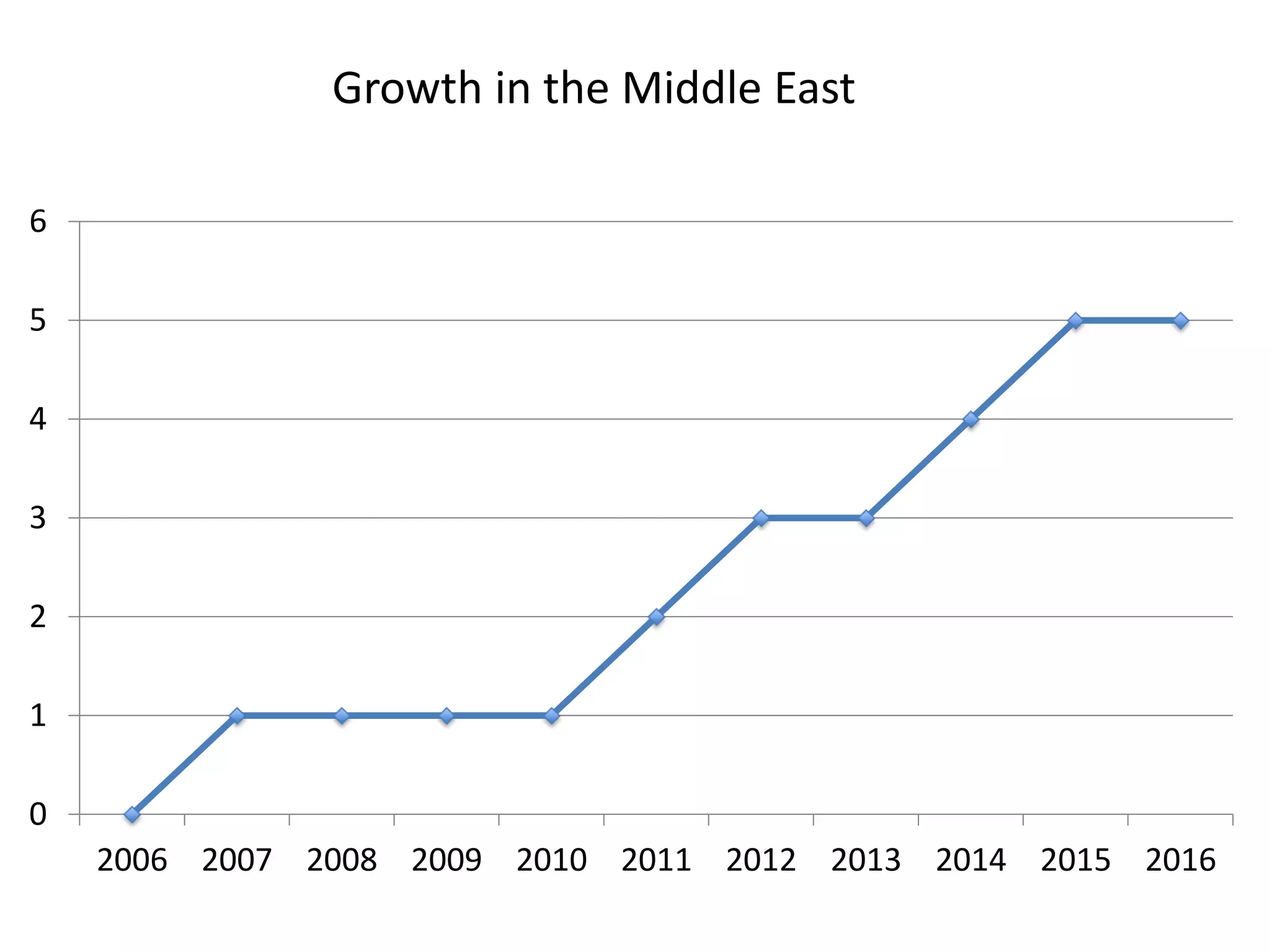
2006 2007 2008 2009 2010 2011 2012 2013 2014 2015 2016
Growth in the Middle East
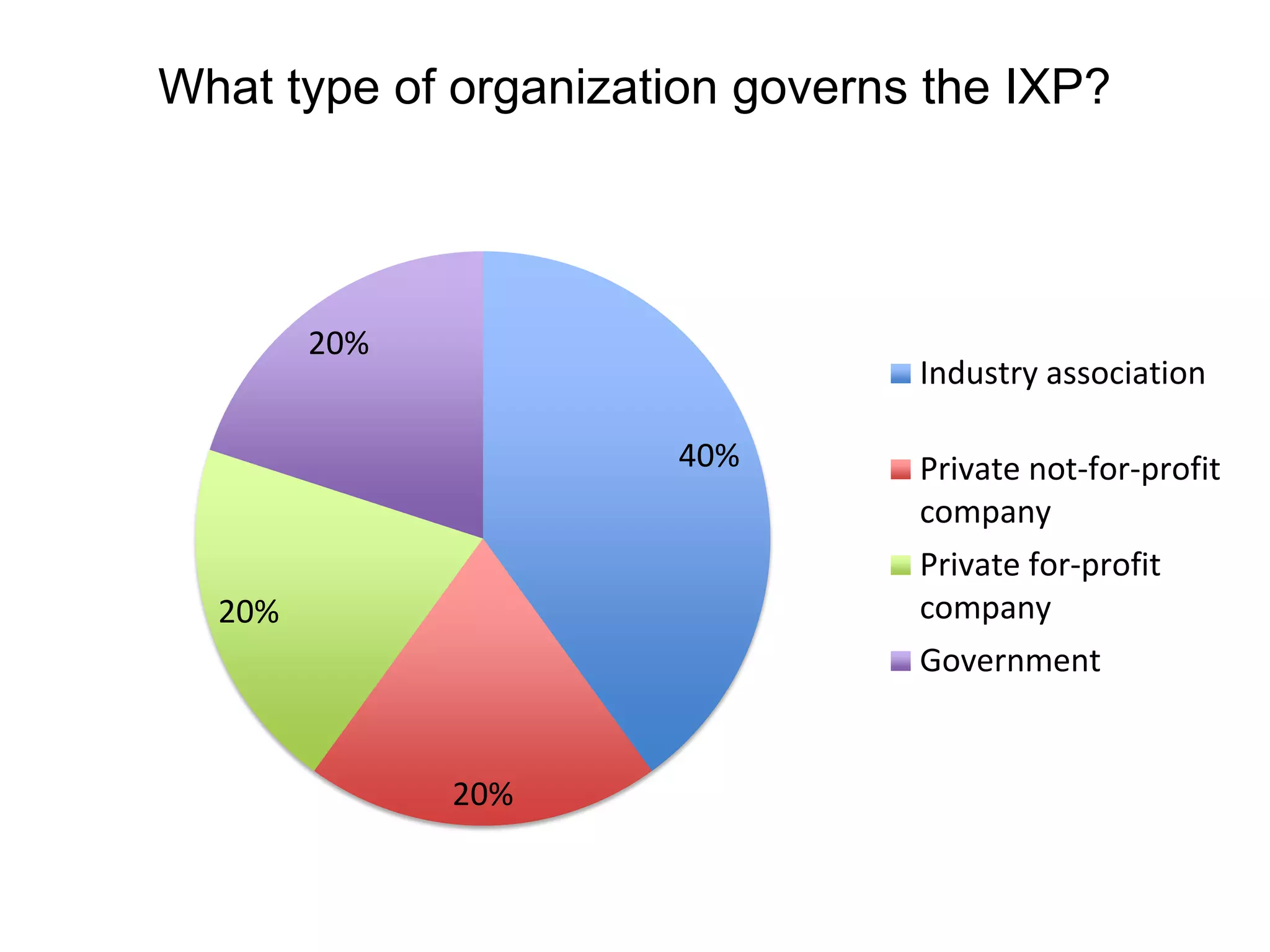
What type of organization governs the IXP?
40%
20%
20%
20%
Industry association
Private not-for-profit
company
Private for-profit
company
Government
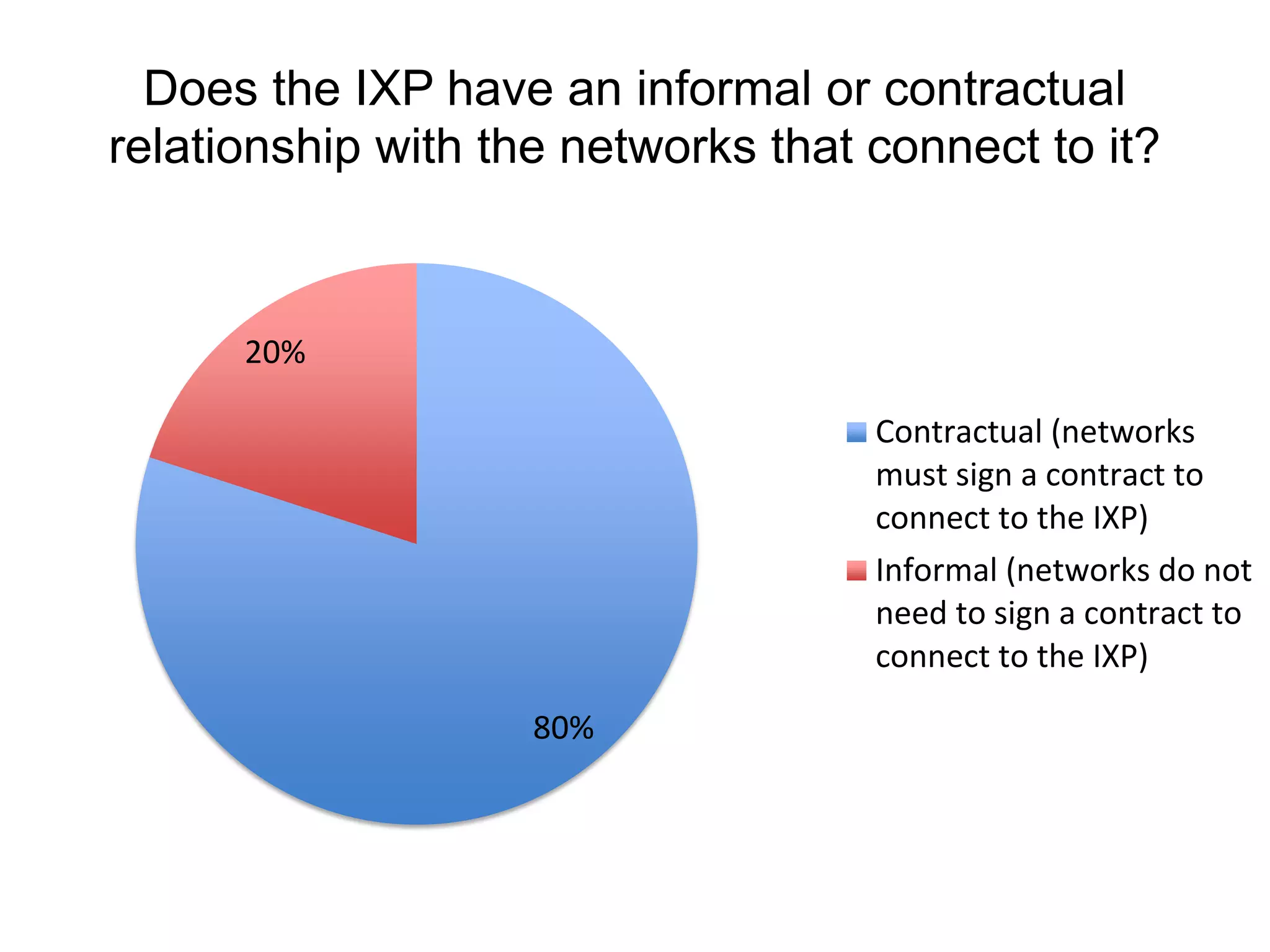
Does the IXP have an informal or contractual
relationship with the networks that connect to it?
80%
20%
Contractual (networks
must sign a contract to
connect to the IXP)
Informal (networks do not
need to sign a contract to
connect to the IXP)
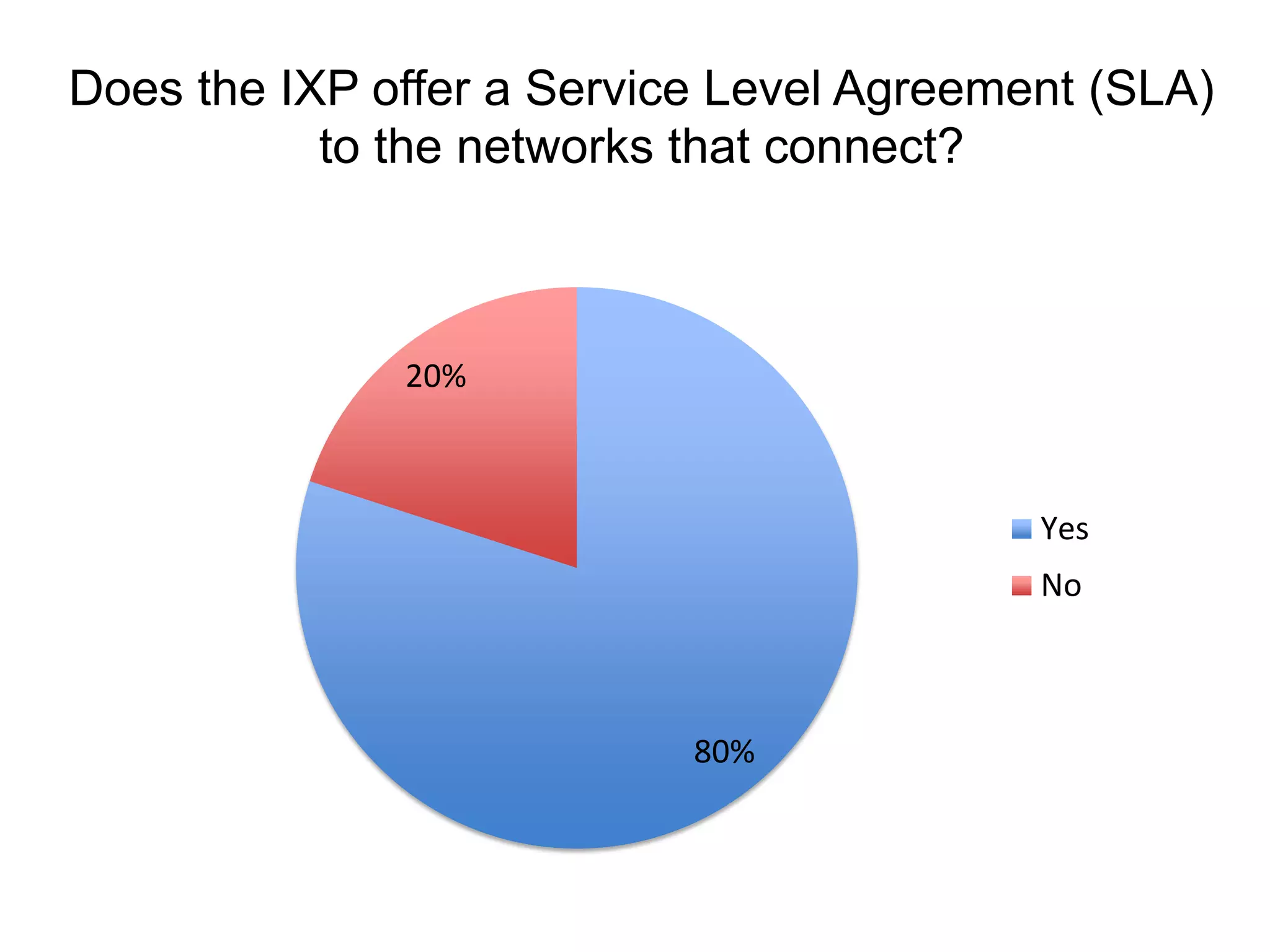
Does the IXP offer a Service Level Agreement (SLA)
to the networks that connect?
80%
20%
Yes
No
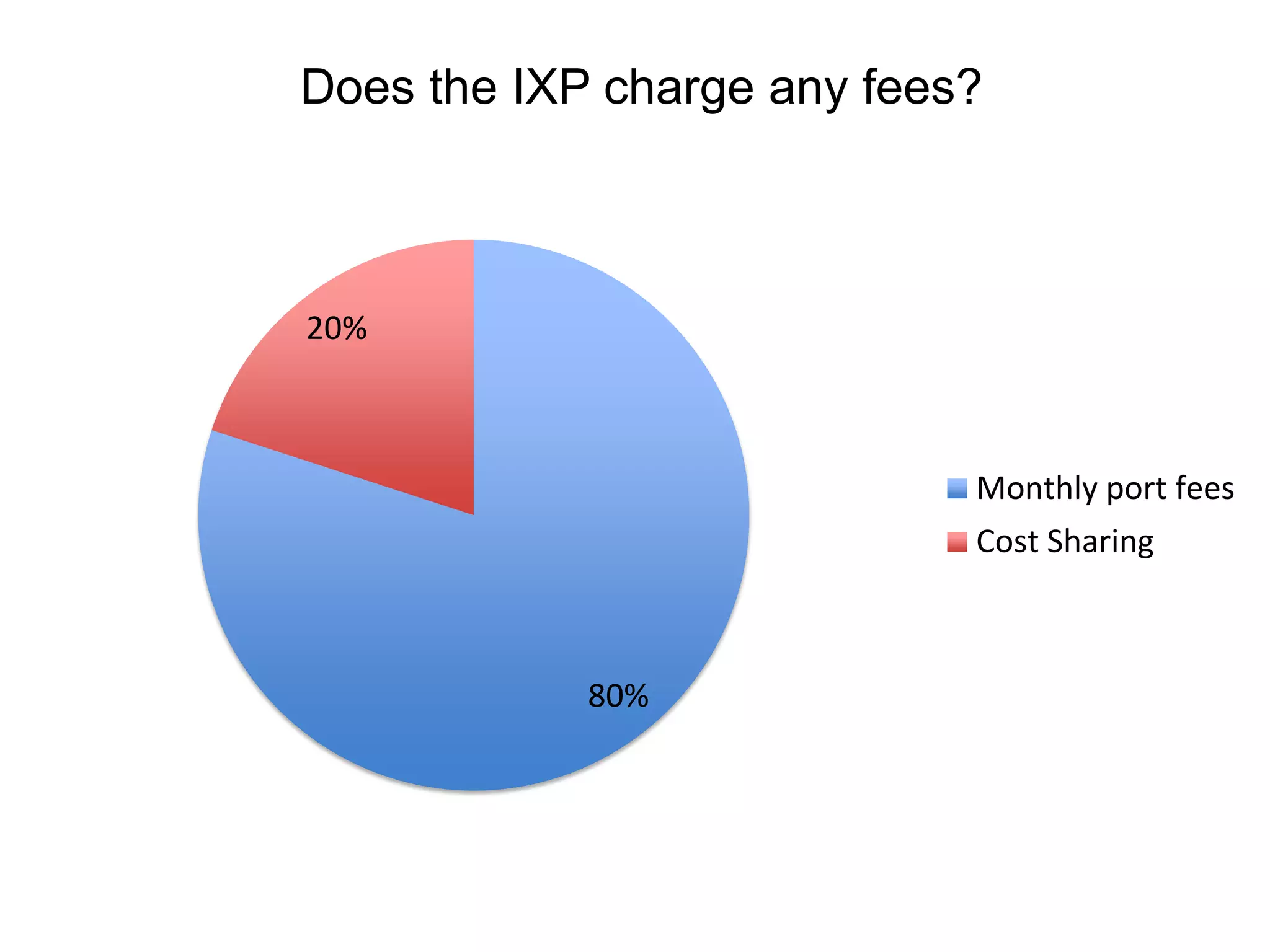
Does the IXP charge any fees?
80%
20%
Monthly port fees
Cost Sharing
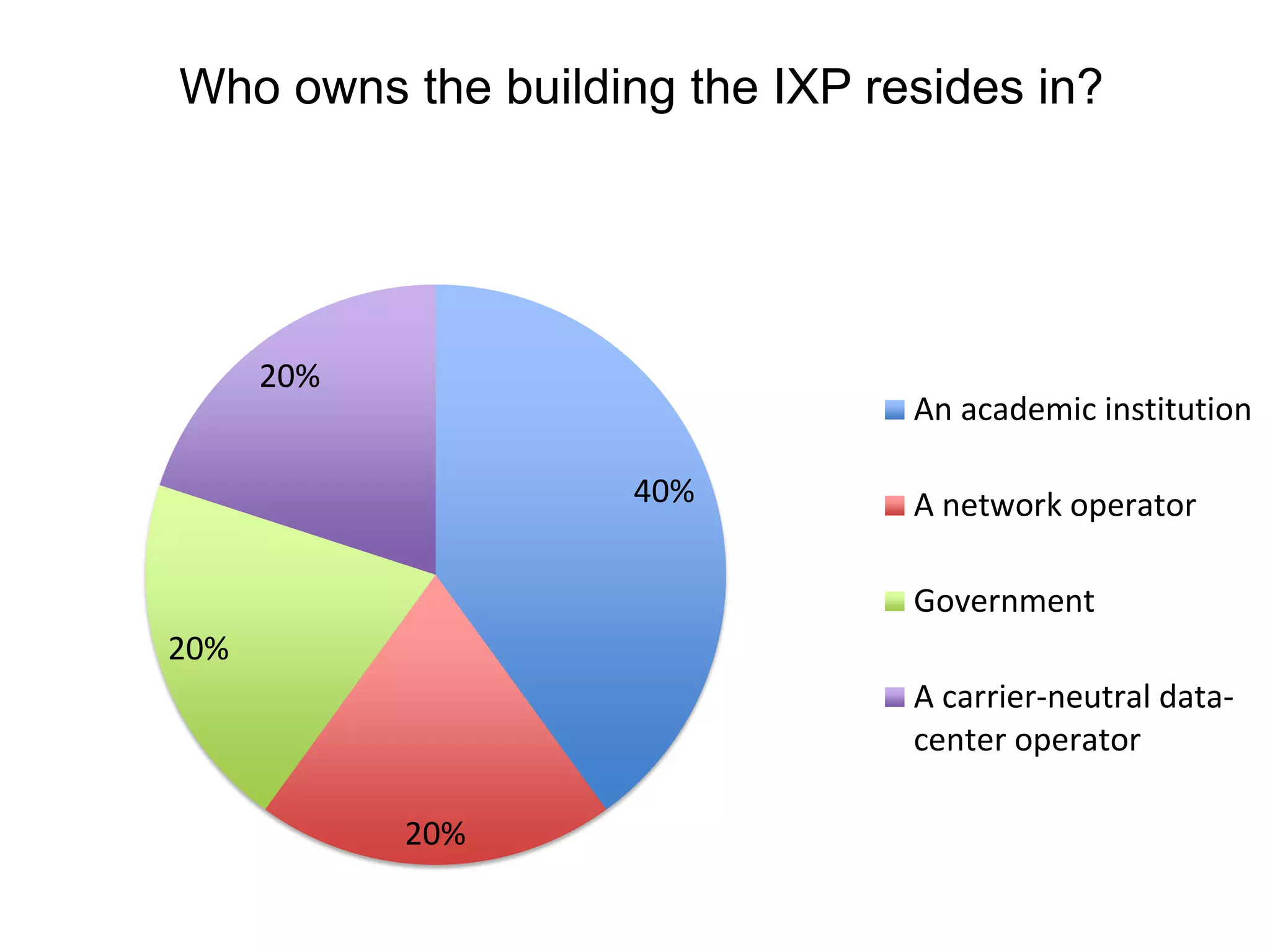
Who owns the building the IXP resides in?
40%
20%
20%
20%
An academic institution
A network operator
Government
A carrier-neutral data-
center operator
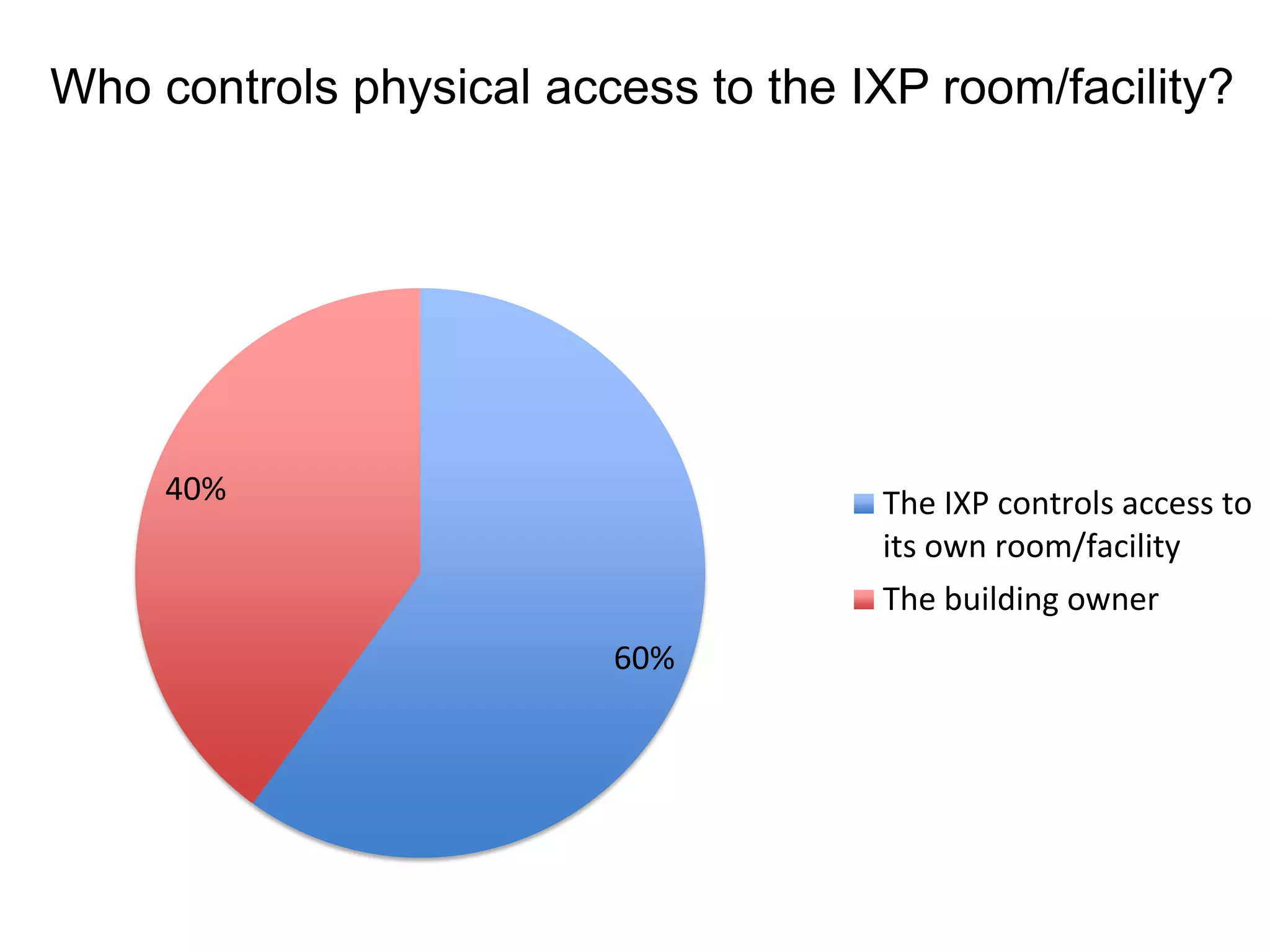
Who controls physical access to the IXP room/facility?
60%
40% The IXP controls access to
its own room/facility
The building owner
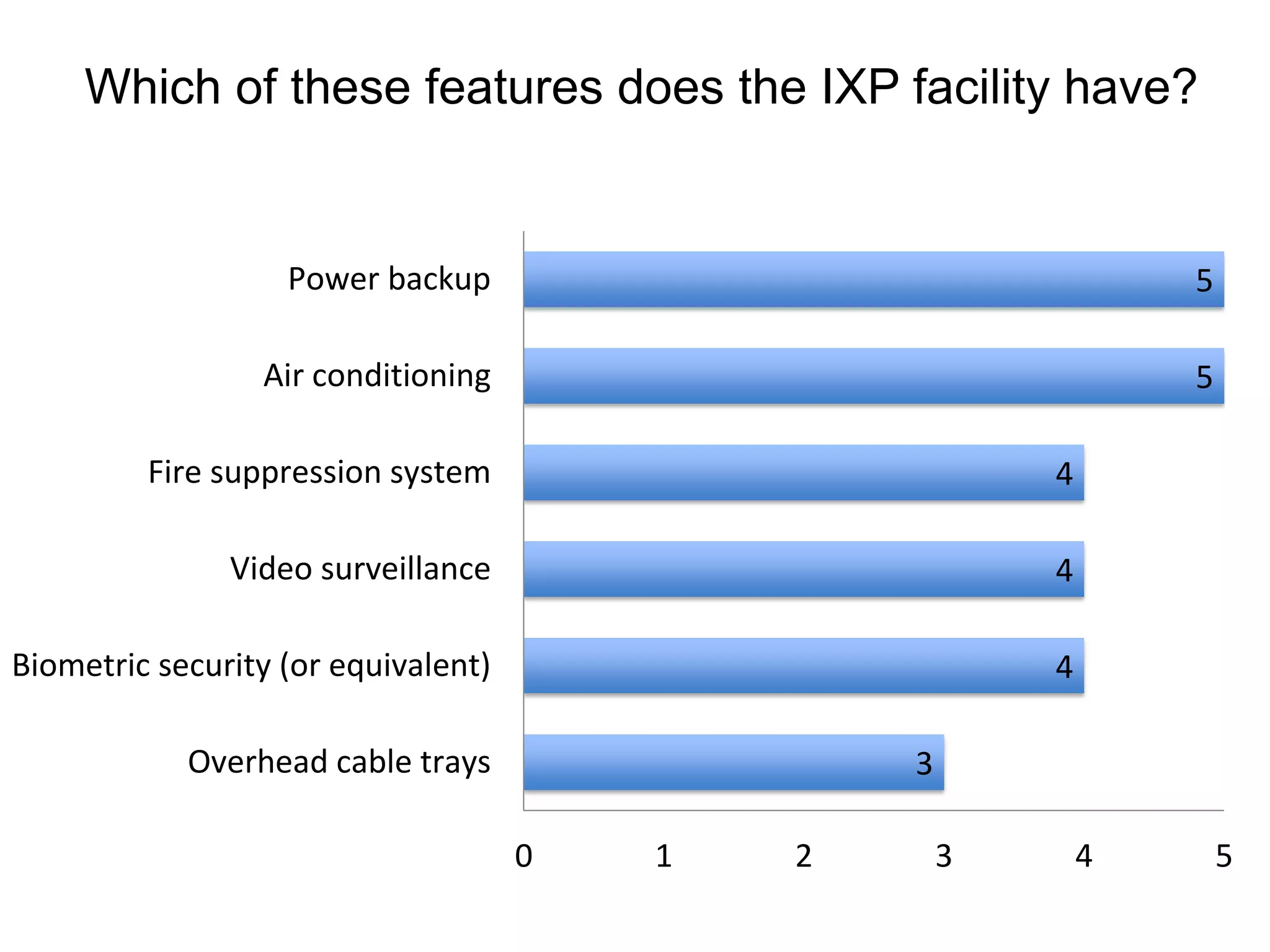
Which of these features does the IXP facility have?
3
4
4
4
5
5
0 1 2 3 4 5
Overhead cable trays
Biometric security (or equivalent)
Video surveillance
Fire suppression system
Air conditioning
Power backup
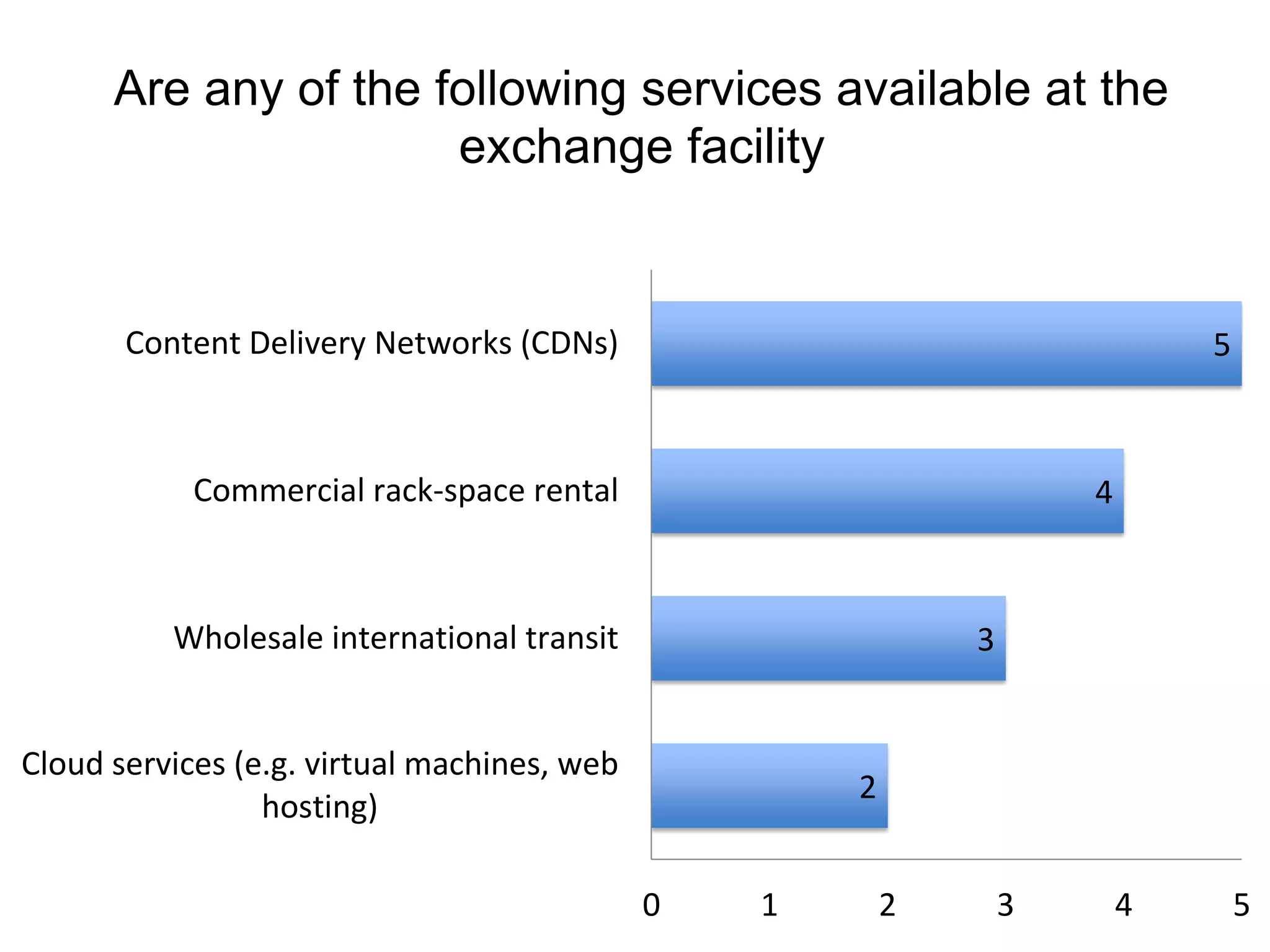
Are any of the following services available at the
exchange facility
2
3
4
5
0 1 2 3 4 5
Cloud services (e.g. virtual machines, web
hosting)
Wholesale international transit
Commercial rack-space rental
Content Delivery Networks (CDNs)
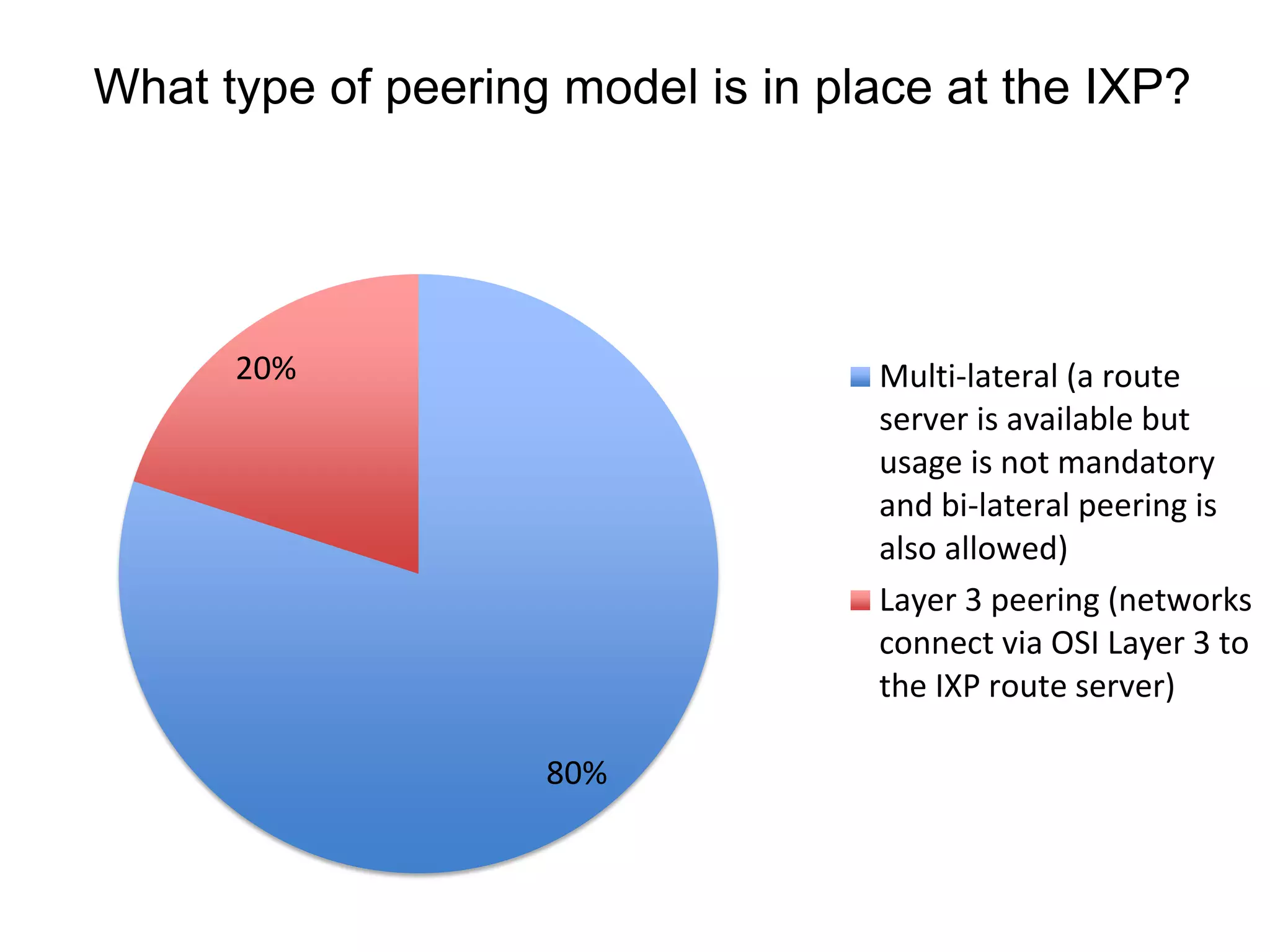
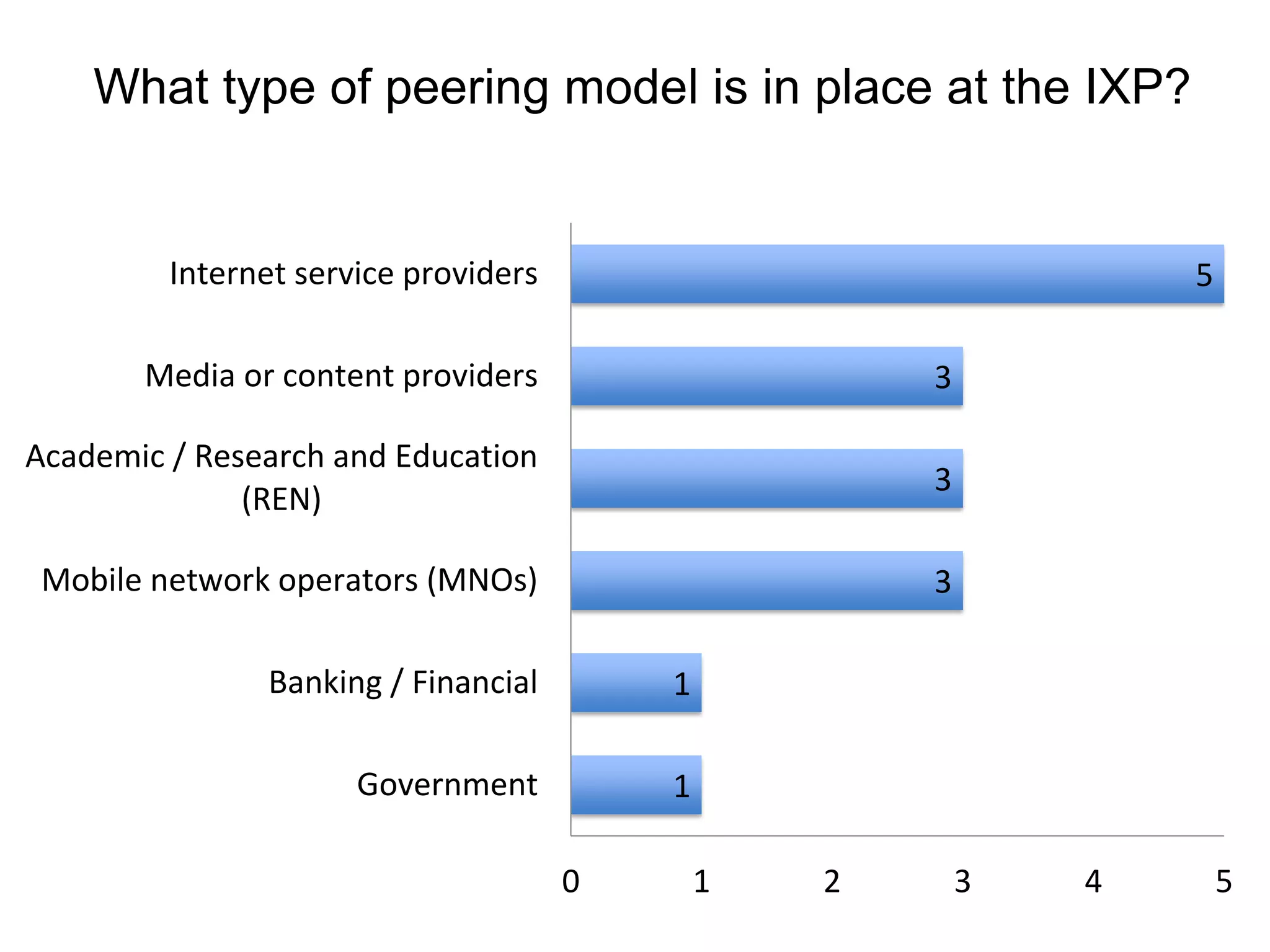
What type of peering model is in place at the IXP?
80%
20% Multi-lateral (a route
server is available but
usage is not mandatory
and bi-lateral peering is
also allowed)
Layer 3 peering (networks
connect via OSI Layer 3 to
the IXP route server)
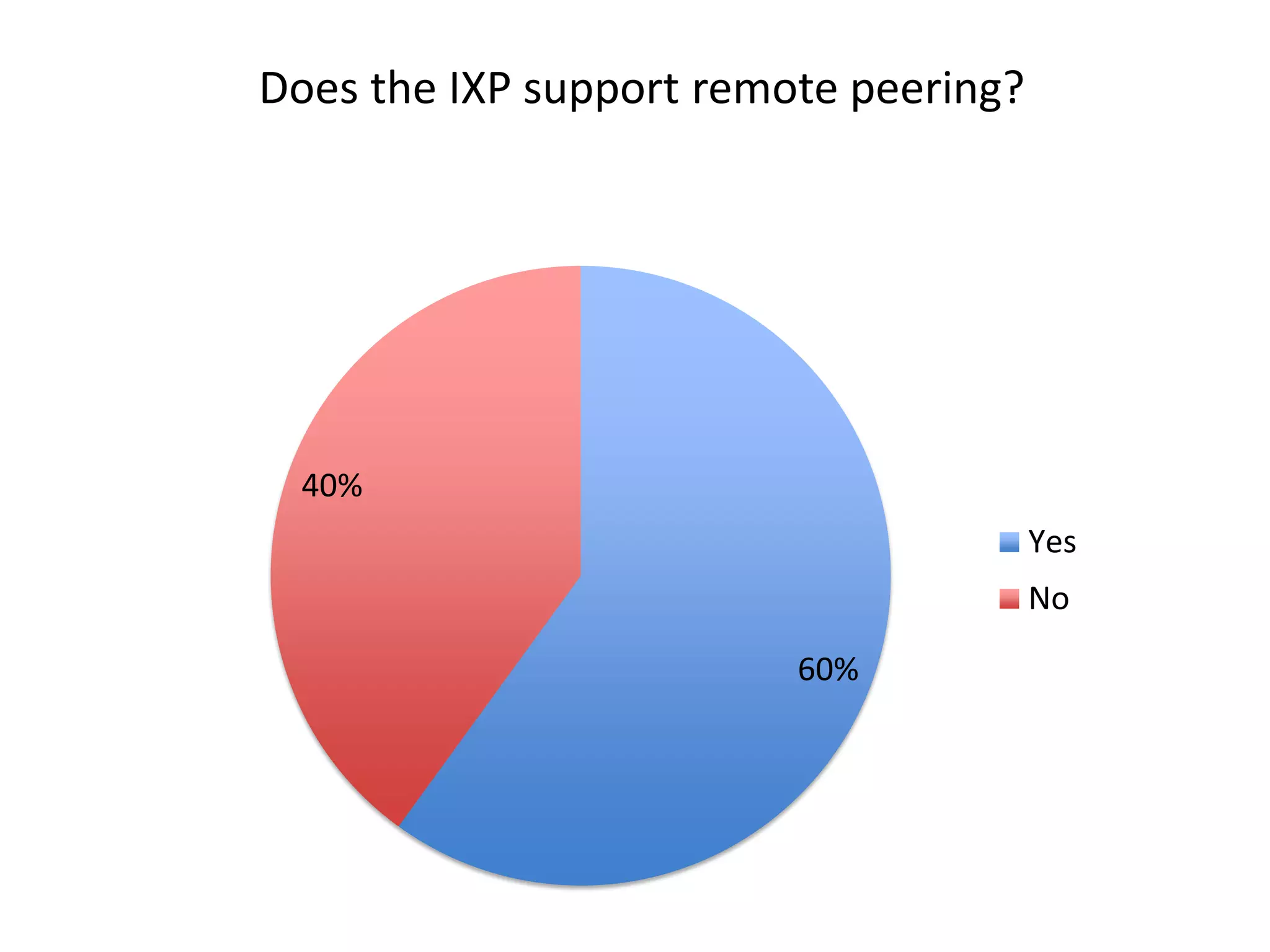
Does the IXP support remote peering?
60%
40%
Yes
No
What type of peering model is in place at the IXP?
1
1
3
3
3
5
0 1 2 3 4 5
Government
Banking / Financial
Mobile network operators (MNOs)
Academic / Research and Education
(REN)
Media or content providers
Internet service providers
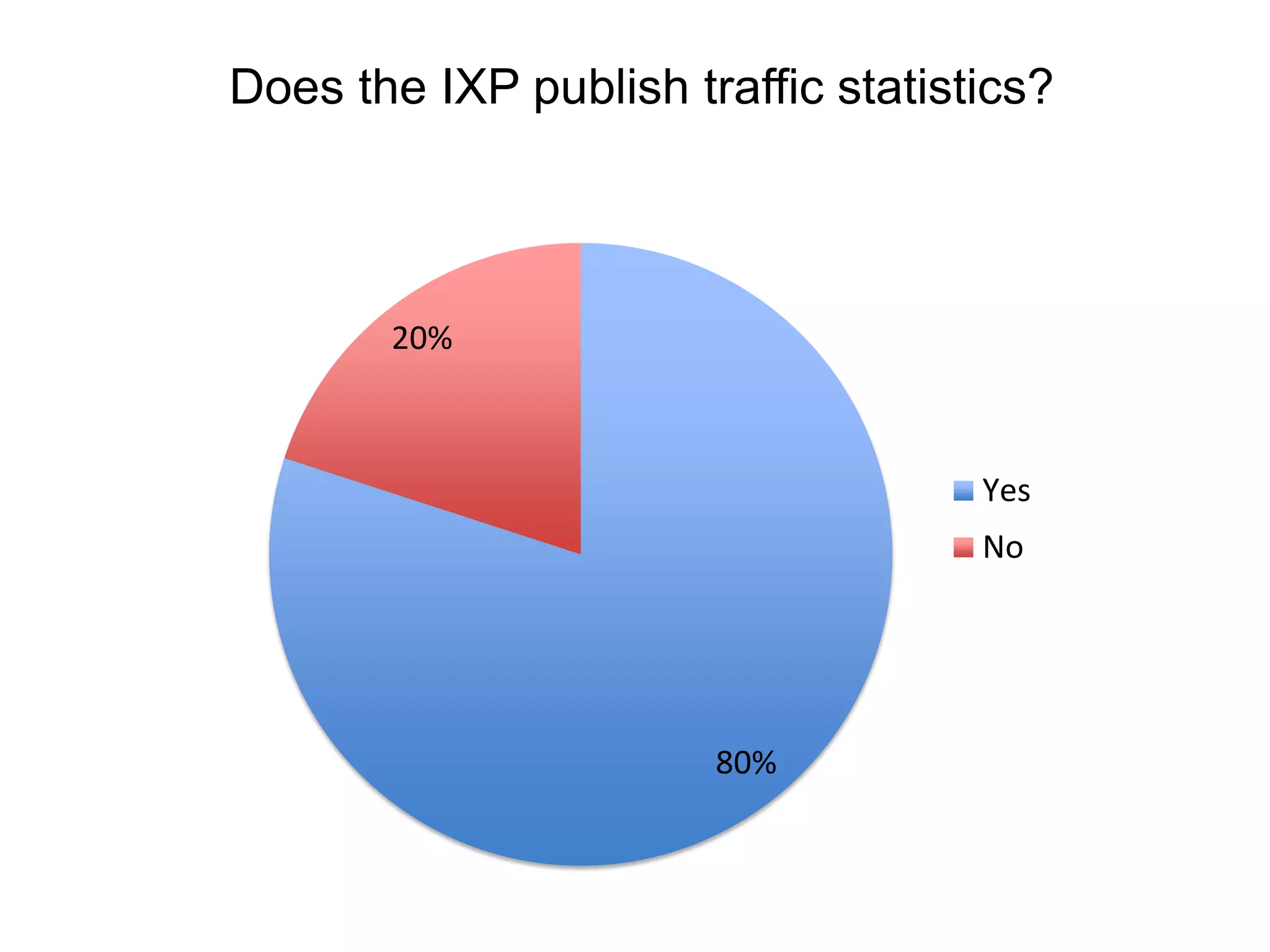
Does the IXP publish traffic statistics?
80%
20%
Yes
No
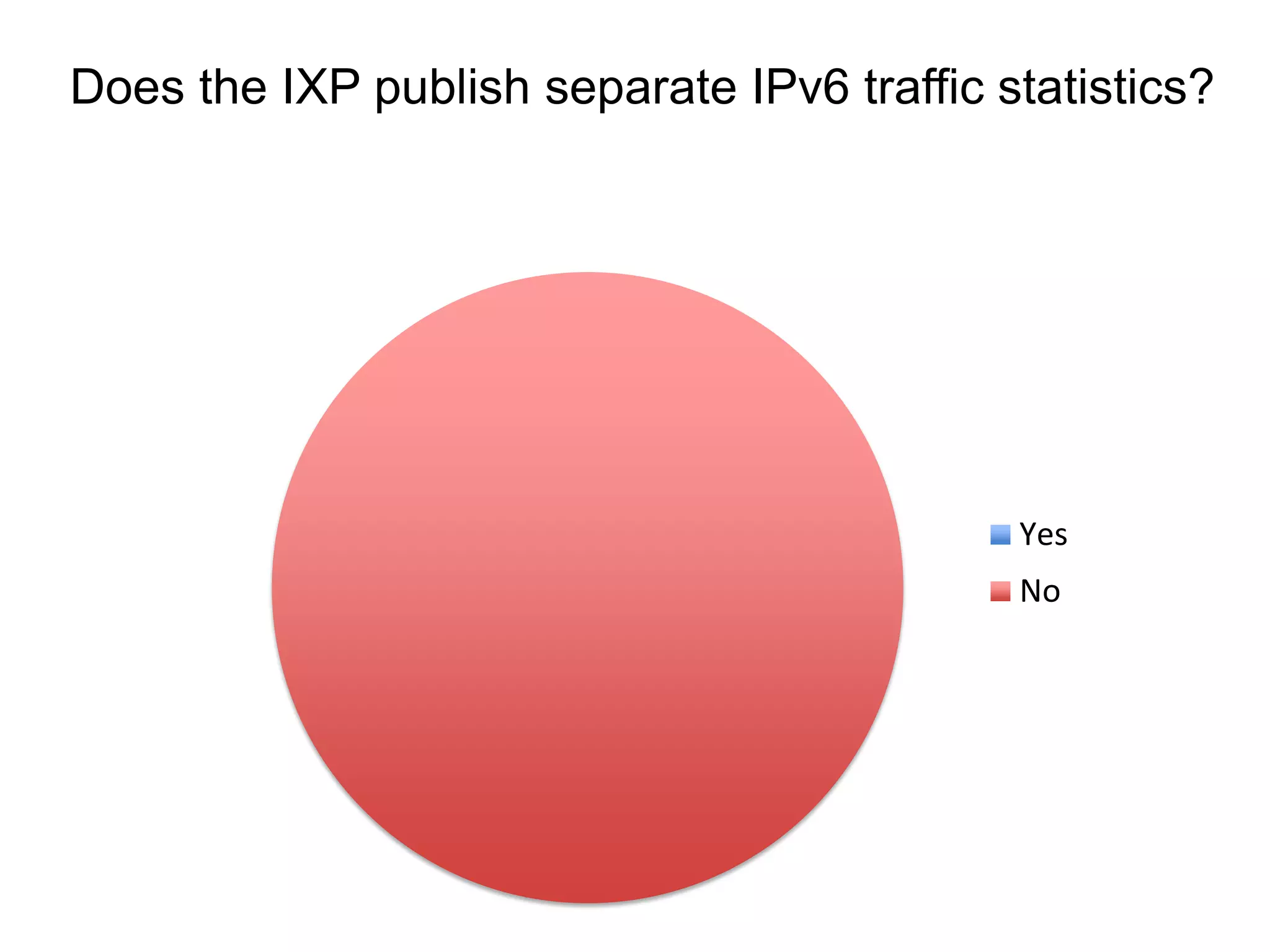
Does the IXP publish separate IPv6 traffic statistics?
Yes
No
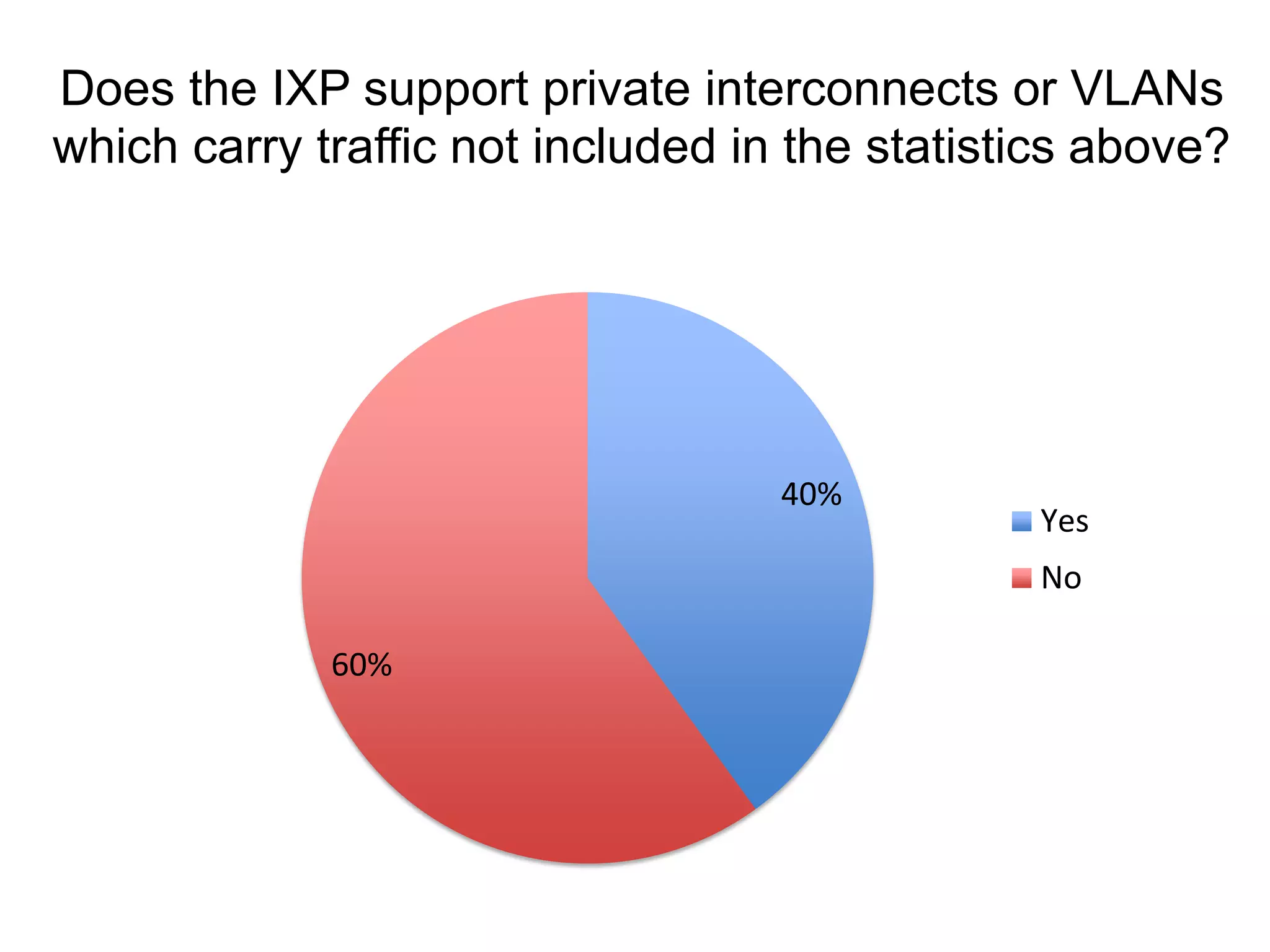
Does the IXP support private interconnects or VLANs
which carry traffic not included in the statistics above?
40%
60%
Yes
No
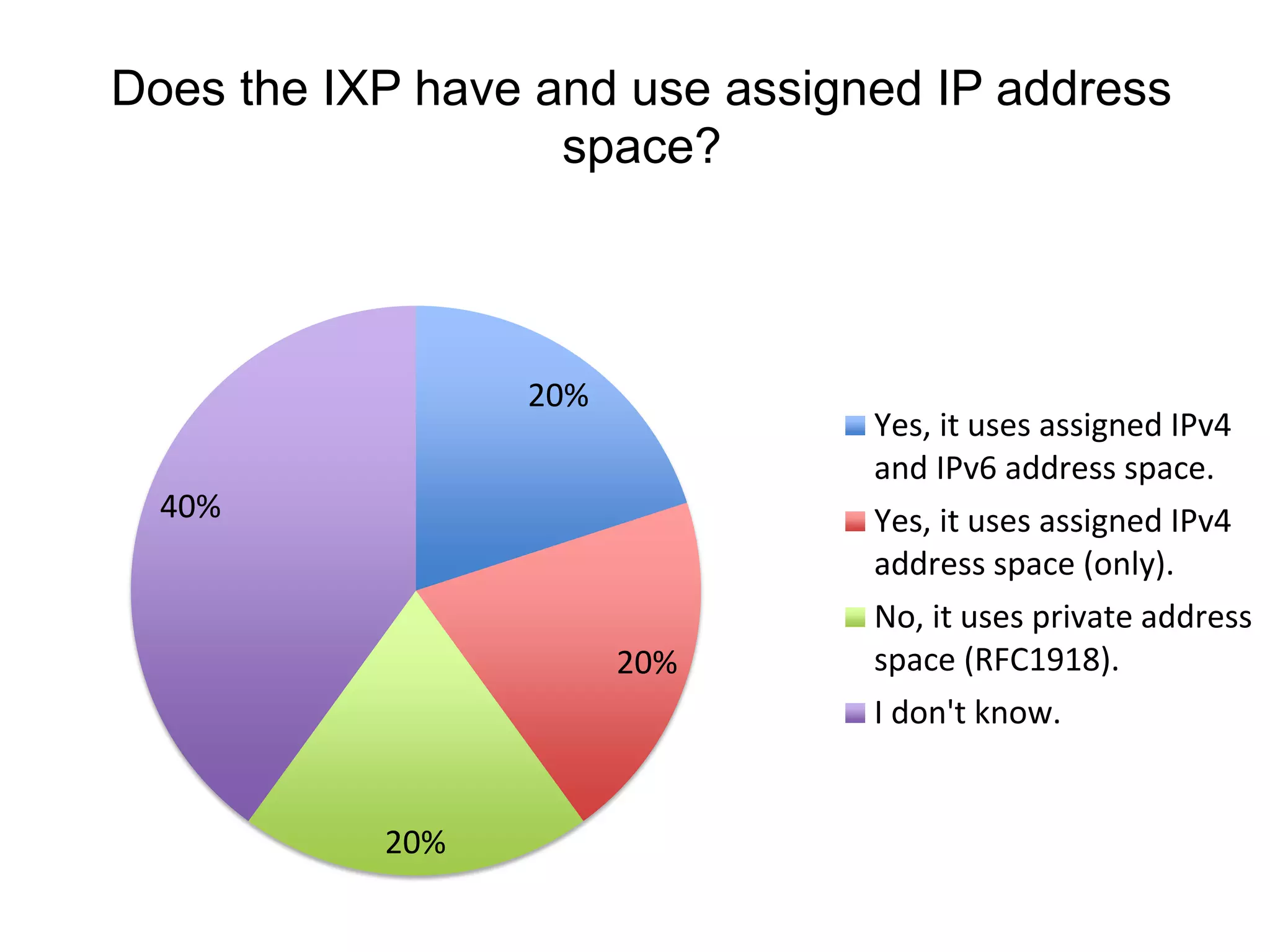
Does the IXP have and use assigned IP address
space?
20%
20%
20%
40%
Yes, it uses assigned IPv4
and IPv6 address space.
Yes, it uses assigned IPv4
address space (only).
No, it uses private address
space (RFC1918).
I don't know.
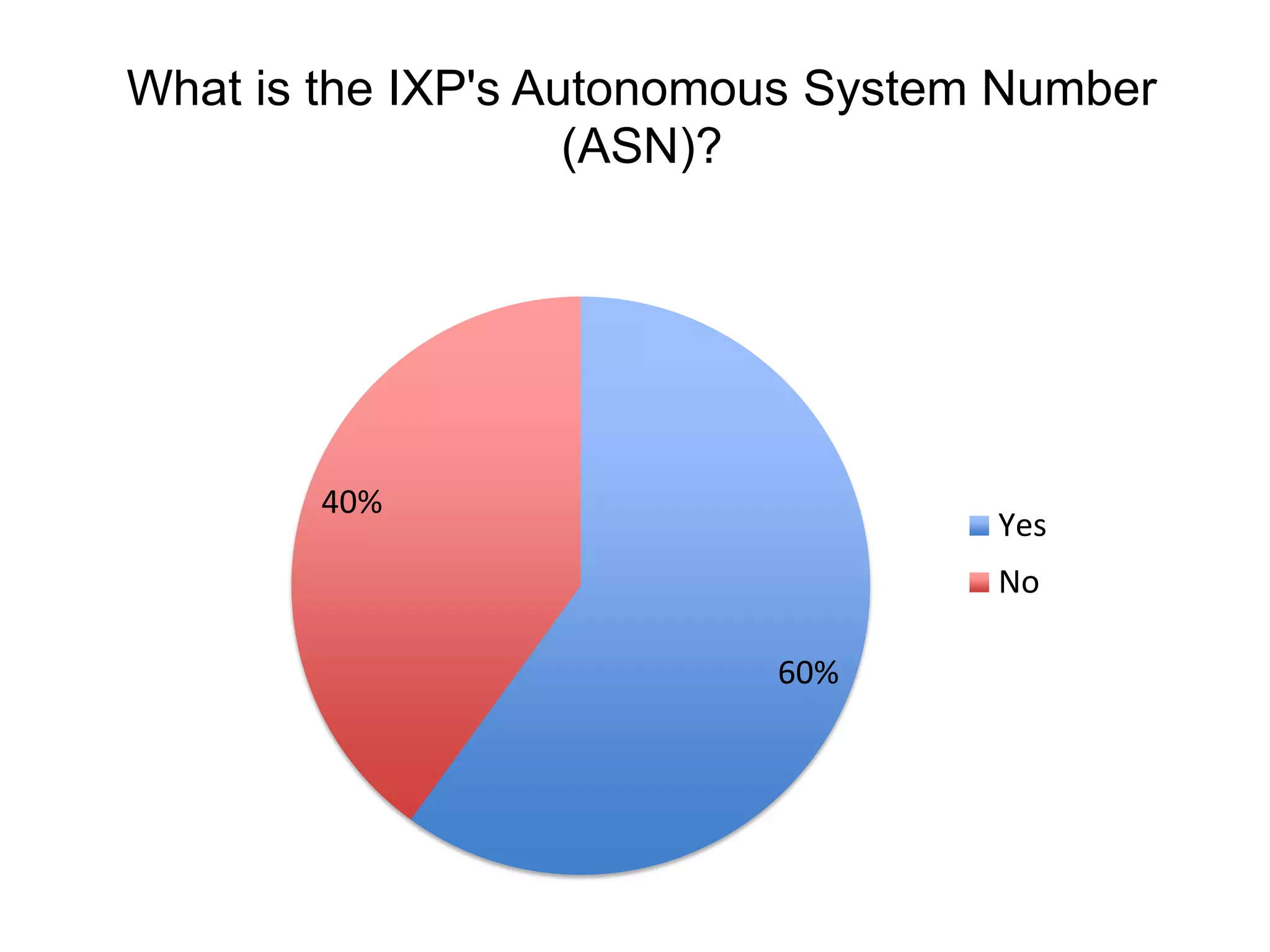
What is the IXP's Autonomous System Number
(ASN)?
60%
40%
Yes
No
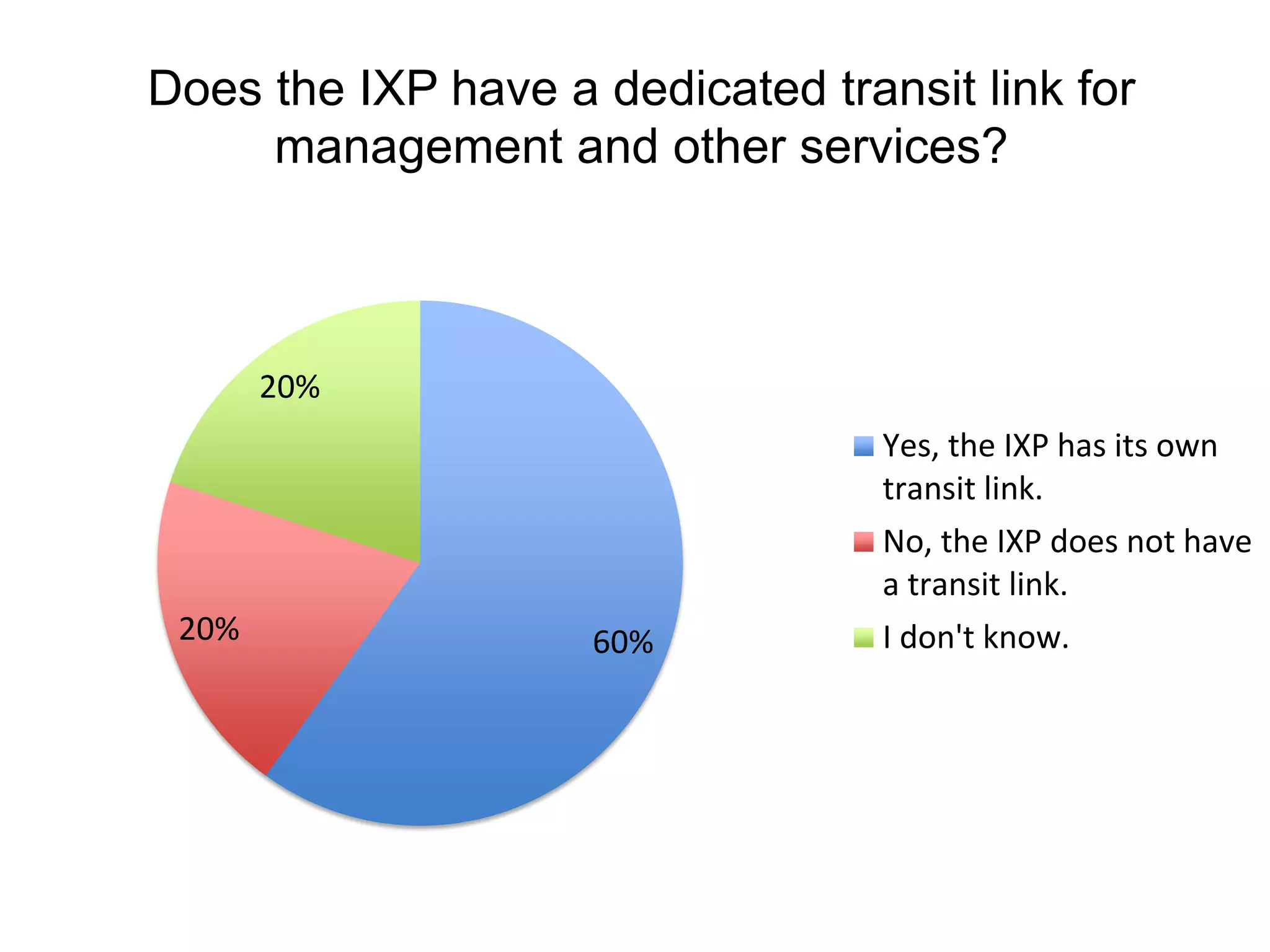
Does the IXP have a dedicated transit link for
management and other services?
60%20%
20%
Yes, the IXP has its own
transit link.
No, the IXP does not have
a transit link.
I don't know.
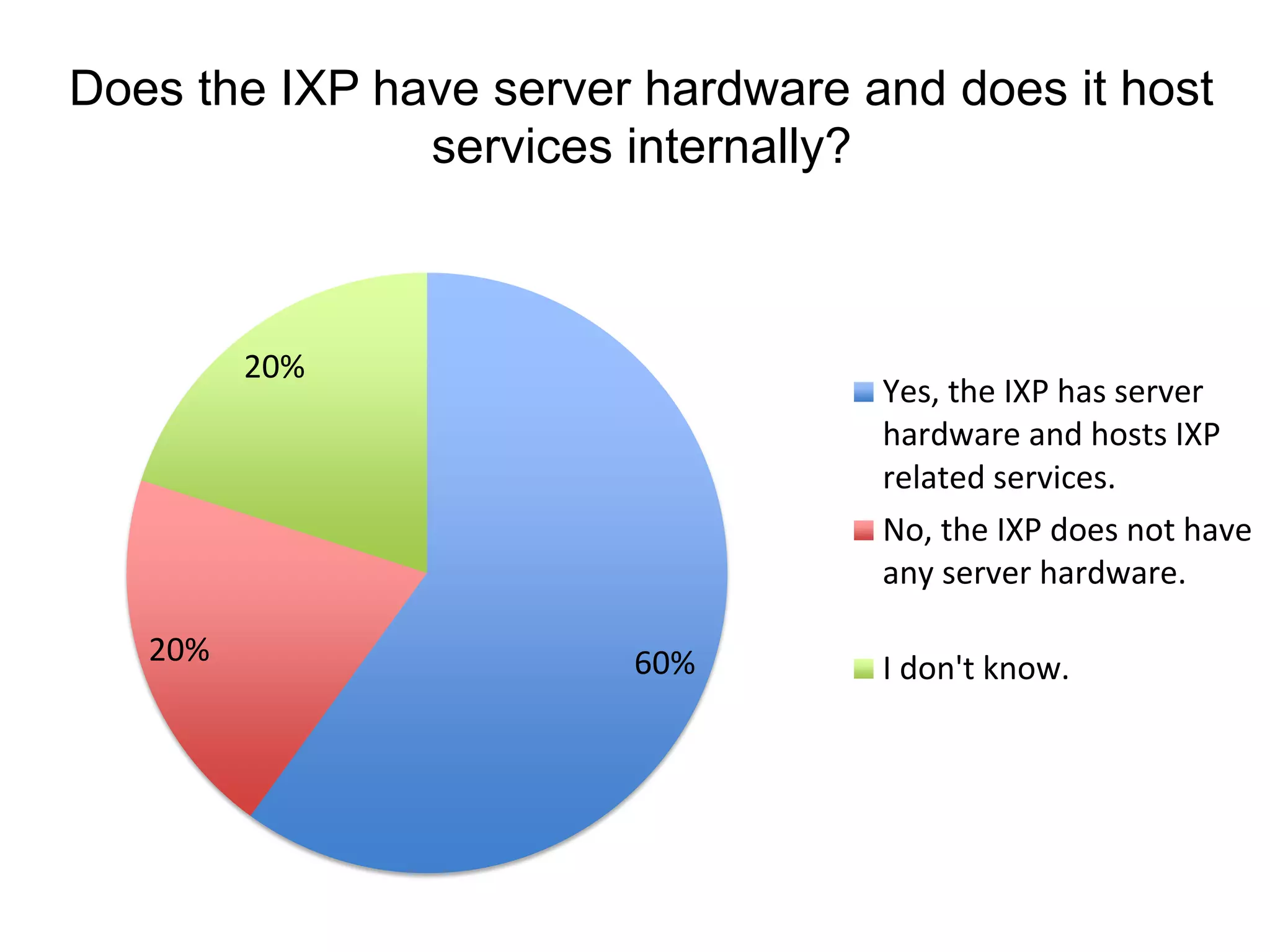
Does the IXP have server hardware and does it host
services internally?
60%20%
20%
Yes, the IXP has server
hardware and hosts IXP
related services.
No, the IXP does not have
any server hardware.
I don't know.
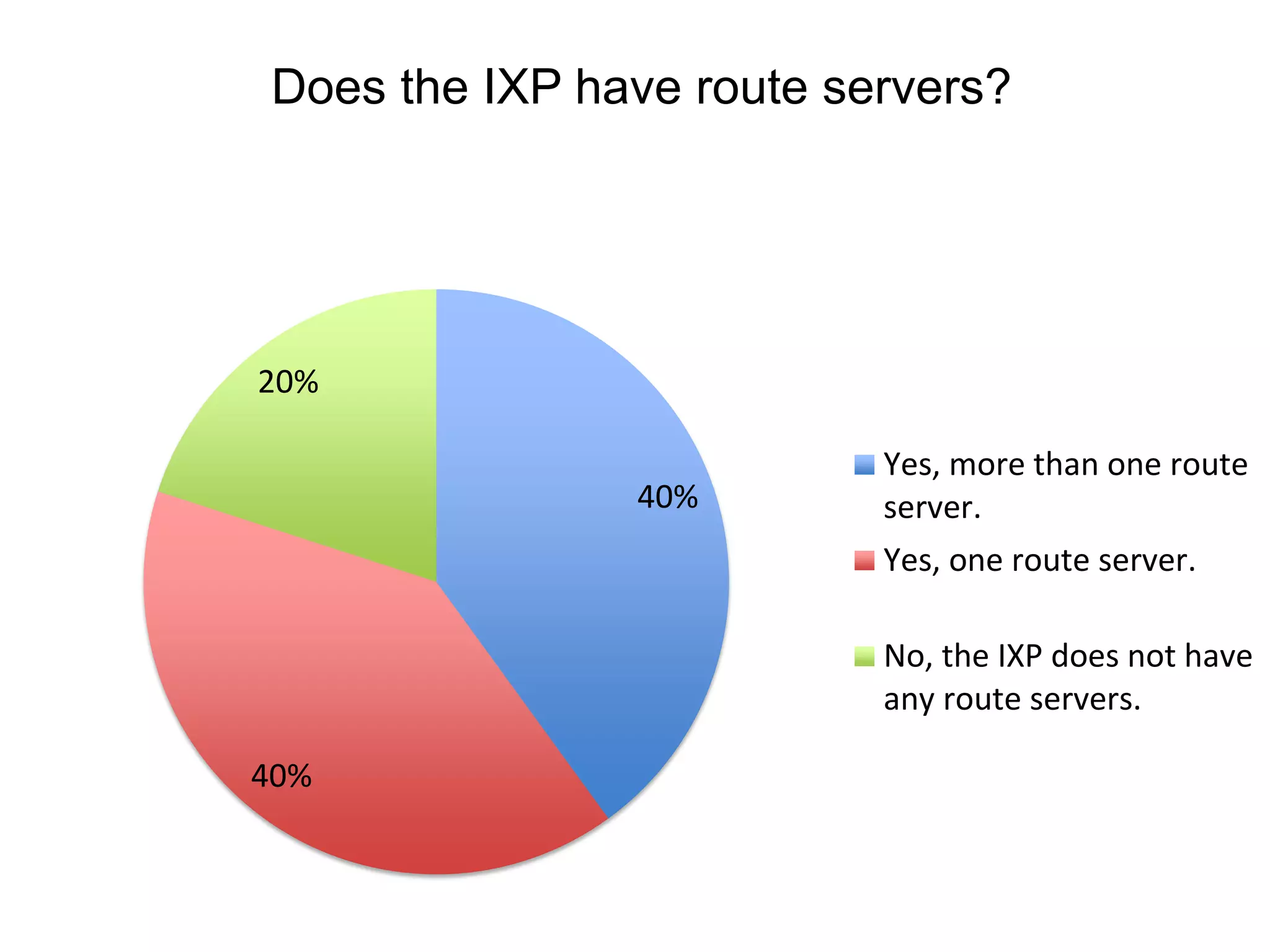
Does the IXP have route servers?
40%
40%
20%
Yes, more than one route
server.
Yes, one route server.
No, the IXP does not have
any route servers.
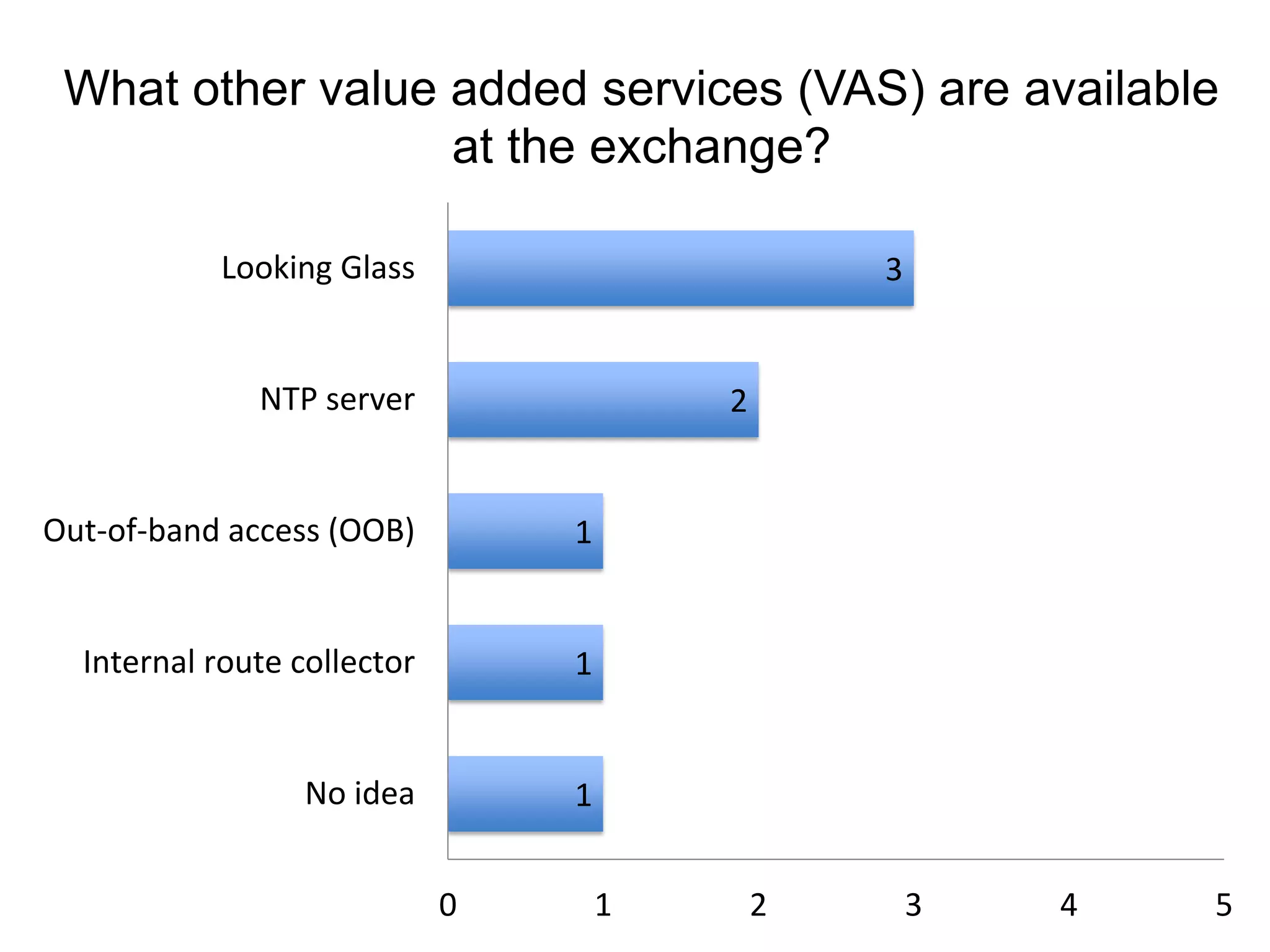
What other value added services (VAS) are available
at the exchange?
1
1
1
2
3
0 1 2 3 4 5
No idea
Internal route collector
Out-of-band access (OOB)
NTP server
Looking Glass
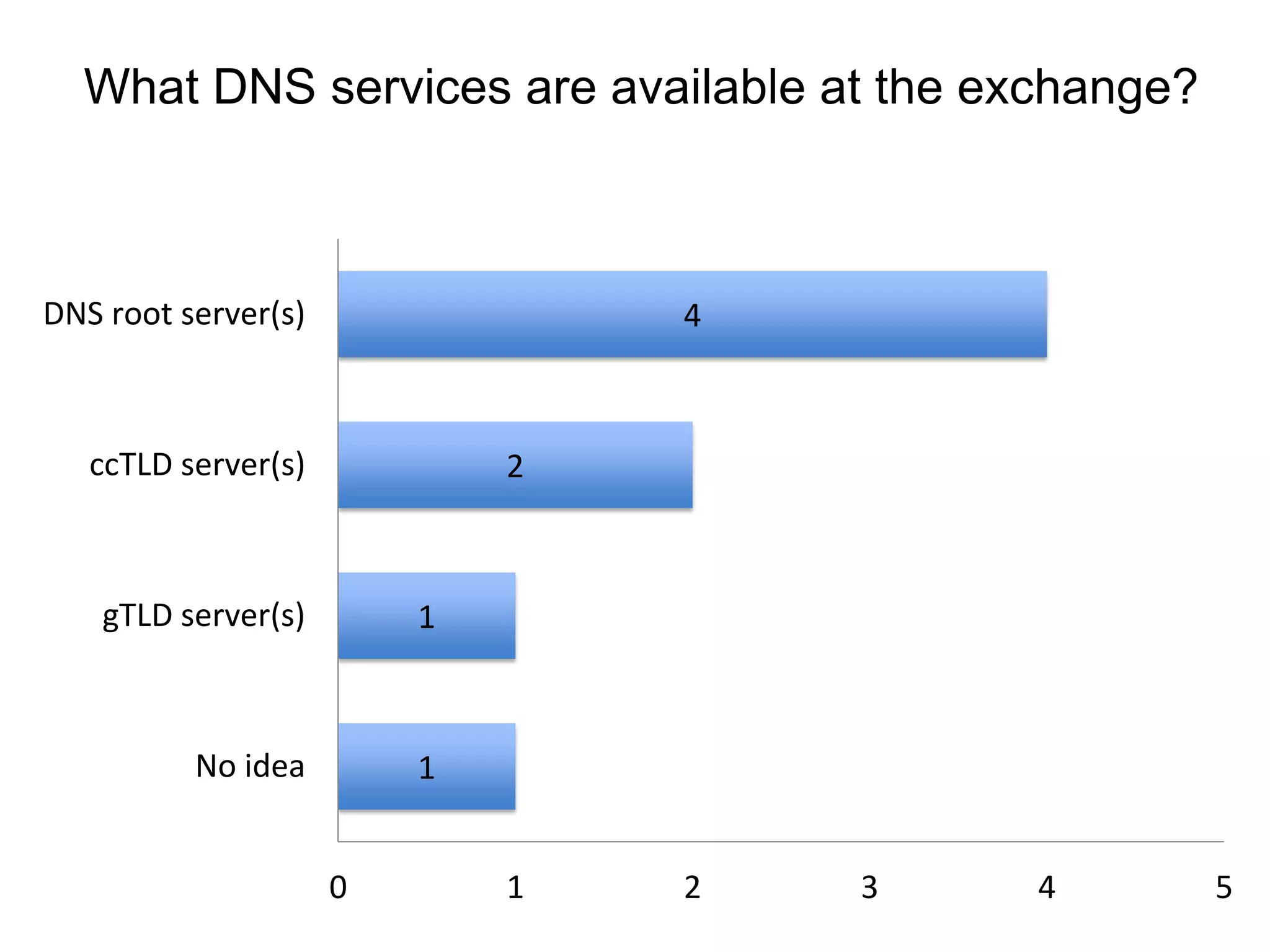
What DNS services are available at the exchange?
1
1
2
4
0 1 2 3 4 5
No idea
gTLD server(s)
ccTLD server(s)
DNS root server(s)

Internet Exchange Points in the Middle East

  • 1.
    Internet Exchange Pointsin the Middle East 14 countries in the Middle East 5 IXPs in 5 countries Oldest IXP: 2007 (Beirut IX) Newest IXP: 2016 (DE-CIX Istanbul) Aggregate IXP Traffic: 115 Gbps
  • 2.
    0 1 2 3 4 5 6 2006 2007 20082009 2010 2011 2012 2013 2014 2015 2016 Growth in the Middle East
  • 3.
    What type oforganization governs the IXP? 40% 20% 20% 20% Industry association Private not-for-profit company Private for-profit company Government
  • 4.
    Does the IXPhave an informal or contractual relationship with the networks that connect to it? 80% 20% Contractual (networks must sign a contract to connect to the IXP) Informal (networks do not need to sign a contract to connect to the IXP)
  • 5.
    Does the IXPoffer a Service Level Agreement (SLA) to the networks that connect? 80% 20% Yes No
  • 6.
    Does the IXPcharge any fees? 80% 20% Monthly port fees Cost Sharing
  • 7.
    Who owns thebuilding the IXP resides in? 40% 20% 20% 20% An academic institution A network operator Government A carrier-neutral data- center operator
  • 8.
    Who controls physicalaccess to the IXP room/facility? 60% 40% The IXP controls access to its own room/facility The building owner
  • 9.
    Which of thesefeatures does the IXP facility have? 3 4 4 4 5 5 0 1 2 3 4 5 Overhead cable trays Biometric security (or equivalent) Video surveillance Fire suppression system Air conditioning Power backup
  • 10.
    Are any ofthe following services available at the exchange facility 2 3 4 5 0 1 2 3 4 5 Cloud services (e.g. virtual machines, web hosting) Wholesale international transit Commercial rack-space rental Content Delivery Networks (CDNs)
  • 11.
    What type ofpeering model is in place at the IXP? 80% 20% Multi-lateral (a route server is available but usage is not mandatory and bi-lateral peering is also allowed) Layer 3 peering (networks connect via OSI Layer 3 to the IXP route server)
  • 12.
    Does the IXPsupport remote peering? 60% 40% Yes No
  • 13.
    What type ofpeering model is in place at the IXP? 1 1 3 3 3 5 0 1 2 3 4 5 Government Banking / Financial Mobile network operators (MNOs) Academic / Research and Education (REN) Media or content providers Internet service providers
  • 14.
    Does the IXPpublish traffic statistics? 80% 20% Yes No
  • 15.
    Does the IXPpublish separate IPv6 traffic statistics? Yes No
  • 16.
    Does the IXPsupport private interconnects or VLANs which carry traffic not included in the statistics above? 40% 60% Yes No
  • 17.
    Does the IXPhave and use assigned IP address space? 20% 20% 20% 40% Yes, it uses assigned IPv4 and IPv6 address space. Yes, it uses assigned IPv4 address space (only). No, it uses private address space (RFC1918). I don't know.
  • 18.
    What is theIXP's Autonomous System Number (ASN)? 60% 40% Yes No
  • 19.
    Does the IXPhave a dedicated transit link for management and other services? 60%20% 20% Yes, the IXP has its own transit link. No, the IXP does not have a transit link. I don't know.
  • 20.
    Does the IXPhave server hardware and does it host services internally? 60%20% 20% Yes, the IXP has server hardware and hosts IXP related services. No, the IXP does not have any server hardware. I don't know.
  • 21.
    Does the IXPhave route servers? 40% 40% 20% Yes, more than one route server. Yes, one route server. No, the IXP does not have any route servers.
  • 22.
    What other valueadded services (VAS) are available at the exchange? 1 1 1 2 3 0 1 2 3 4 5 No idea Internal route collector Out-of-band access (OOB) NTP server Looking Glass
  • 23.
    What DNS servicesare available at the exchange? 1 1 2 4 0 1 2 3 4 5 No idea gTLD server(s) ccTLD server(s) DNS root server(s)