Path to IPv4 Exhaustion
are we Are we Ready to face it?A
Presenter: Madhvi Gokool,
Registration Service Manager
AFRINIC Ltd re we ready to face it
PAre we ready to face it?
• In brief, this presentation will briefly go through
the topics of AFRINIC as RIR, its membership
trends, status of the IPv4 pool , current soft
landing policy ratified, how fast can the last /8 run
out and the dire reality of the state of IPv6 on the
AFRICAN continent. We shall also cover the
implications of not deploying IPv6 and to
highlight some policies that have been proposed
and currently being discussed at AFRINIC
Introduction
• AFRINIC is the Regional Internet Registry
(AFRICAN continent as service region)
• Manages IP Number Resource Pools(IPv4, IPv6
& ASNs
• Membership based organisation
Membership
• Organisations that operate an IP network from
various industries - Internet Service Providers,
Mobile operators, Hosting/Cloud providers,
Research and Education Networks , Banking ,
Government , Critical infrastructure providers etc
ANY ENTITY in service region that originates services
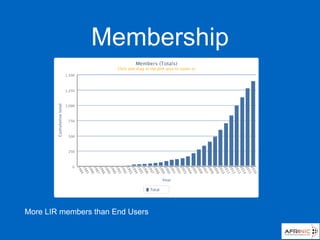
Membership
More LIR members than End Users
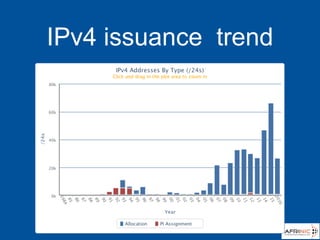
IPv4 issuance trend
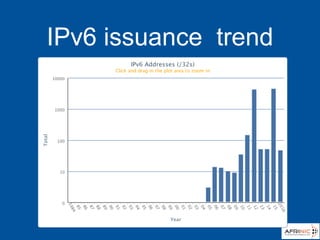
IPv6 issuance trend
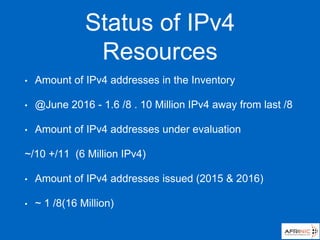
Status of IPv4
Resources
• Amount of IPv4 addresses in the Inventory
• @June 2016 - 1.6 /8 . 10 Million IPv4 away from last /8
• Amount of IPv4 addresses under evaluation
~/10 +/11 (6 Million IPv4)
• Amount of IPv4 addresses issued (2015 & 2016)
• ~ 1 /8(16 Million)
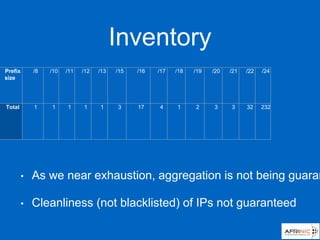
Inventory
Prefix
size
/8 /10 /11 /12 /13 /15 /16 /17 /18 /19 /20 /21 /22 /24
Total 1 1 1 1 1 3 17 4 1 2 3 3 32 232
• As we near exhaustion, aggregation is not being guaran
• Cleanliness (not blacklisted) of IPs not guaranteed
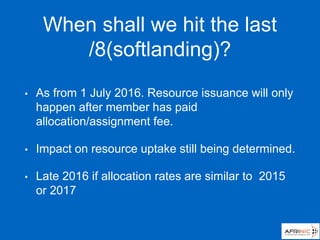
When shall we hit the last
/8(softlanding)?
• As from 1 July 2016. Resource issuance will only
happen after member has paid
allocation/assignment fee.
• Impact on resource uptake still being determined.
• Late 2016 if allocation rates are similar to 2015
or 2017
IPv4 Exhaustion
• When AFRINIC has reached the last /8
• Soft landing policy
• Allocation/Assignment Rules change
Softlanding or Last /8
• A policy AFPUB-2010-v4-005 that has been ratified by
AFRINIC BoD in Nov 2011
• Kicks in when
an otherwise-valid request for IPv4 address space from any LIR
or end user to AfriNIC either
(a) cannot be fulfilled with the IPv4 address space available
in the AFRINIC pool (with the exception of the Final /8), OR
(b) can be fulfilled, but would leave the AFRINIC IPv4
address pool empty (with the exception of the Final /8).
Softlanding or Last /8
• EXHAUSTION PHASE 1
• A /12 IPv4 address block will be in reserved out of the Final /8. This /12 IPv4 address
block shall be preserved by AfriNIC for some future uses, as yet unforeseen.
• Allocations/Assignments (LIR/EU members) will get IP addresses as per current phase
with minimum set to /22 and /24 for LIR & End-user Resource Members respectively
• Maximum Allocation/Assignment shall be a /13 prefix
• No explicit limit on the number of times an organisation may request additional
IPv4 space
• Allocation/Assignment period changes from 12 months to 8 months
• Existing Resource Members eligible to get additional blocks if 90% usage of all
Resources it has (Current & Exhaustion Phase)
Softlanding or Last /8
• EXHAUSTION PHASE 2
• AFRINIC has a /11 on non-RESERVED space available in the Final /8
• Minimum/Maximum Allocation&Assignment shall be a /24 and
/22
• No explicit limit on the number of times an organisation may
request additional IPv4 space
• Allocation/Assignment period changes from 12 months to 8
months
• Existing Resource Members eligible to get additional blocks if
90% usage of all Resources it has (Current & Exhaustion Phase)
How fast can AFRINIC move
from Phase 1 to Phase 2?
• 13,631,488 IPv4 Addresses
• Average rate of consumption /per month in 2016 =
1,398,100
• No. of months = ~10 months
• It could be less - /13 limit per prefix size x no
explicit limit of number of times
Can we agree that Phases 1 & 2 can be short?
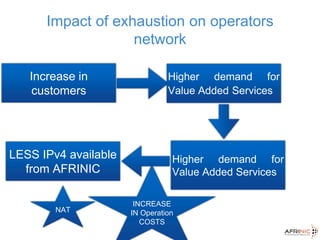
Impact of exhaustion on operators
network
Increase in
customers
Higher demand for
Value Added Services
Higher demand for
Value Added Services
LESS IPv4 available
from AFRINIC
NAT
INCREASE
IN Operation
COSTS
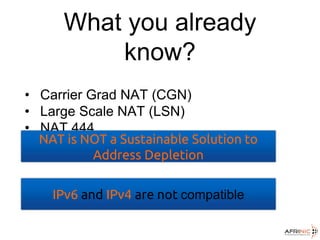
What you already
know?
• Carrier Grad NAT (CGN)
• Large Scale NAT (LSN)
• NAT 444
NAT is NOT a Sustainable Solution to
Address Depletion
IPv6 and IPv4 are not compatible
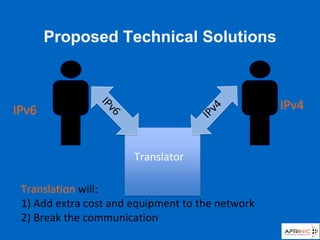
Proposed Technical Solutions
IPv4IPv6
Translator
Translation will:
1) Add extra cost and equipment to the network
2) Break the communication
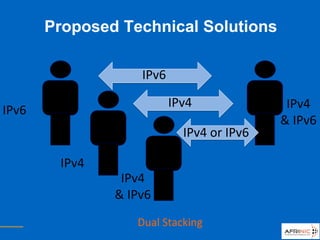
IPv4
IPv6 IPv4
& IPv6
IPv4
& IPv6
IPv6
IPv4
Dual Stacking
Proposed Technical Solutions
IPv4 or IPv6
Networks would grow
Deployment of network infrastructure Interconnection,
infrastructure & rural areas
Cyber security
E – projects
Content and ccTLDs growth
Research and Innovation
Internet governance and critical Internet resources
Internet of Things (IoT)
Shall happen only with IPv6
What shall happen during/after IPv4
Exhaustion
Nationally:
Governments and Regulators
Telecoms, Service Providers, organisations doing business on the
Internet, need to be able to:
• Scale their networks; more clients
• Support a large mobile workforce
• Support large multiple sites
• Ensure that their content and information will be reached by more
viewers
IPv4 Exhaustion - What happens next??
PRIVATE SECTOR
Accurate IPv6 record-keeping does more than help law enforcement.
• Useful for
1. combating abuse.
2. anti-spam measures.
3. figuring out what's going on with distributed denial of service attacks.
Cyber Security & LEAs
IPv4 Exhaustion - What happens next??
Specialized Internet service provider dedicated to supporting
the needs of the research and education communities within
a country.
With thousands of online students and researchers, NRENs
are the ideal places to start implementing and testing new
Internet protocols (IPv6) and architectures (Cloud
Computing).
National Research & Education Networks (NRENs)
IPv6 in AFRICA
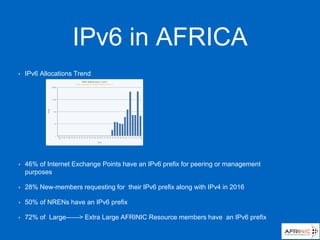
• IPv6 Allocations Trend
• 46% of Internet Exchange Points have an IPv6 prefix for peering or management
purposes
• 28% New-members requesting for their IPv6 prefix along with IPv4 in 2016
• 50% of NRENs have an IPv6 prefix
• 72% of Large——> Extra Large AFRINIC Resource members have an IPv6 prefix
IPv6 in AFRICA
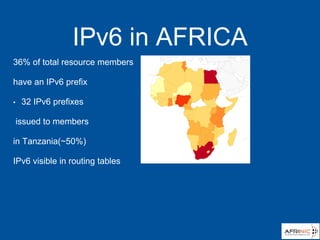
36% of total resource members
have an IPv6 prefix
• 32 IPv6 prefixes
issued to members
in Tanzania(~50%)
IPv6 visible in routing tables
IPv6 trainings in AFRICA
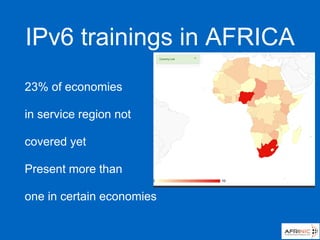
23% of economies
in service region not
covered yet
Present more than
one in certain economies
IPv6 trainings in AFRICA
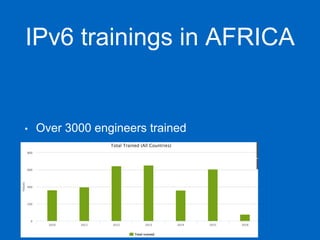
• Over 3000 engineers trained
• since 2010 until June 2016
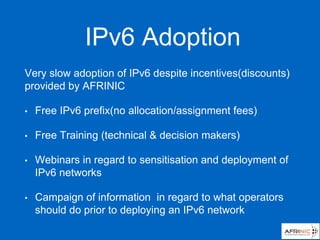
IPv6 Adoption
Very slow adoption of IPv6 despite incentives(discounts)
provided by AFRINIC
• Free IPv6 prefix(no allocation/assignment fees)
• Free Training (technical & decision makers)
• Webinars in regard to sensitisation and deployment of
IPv6 networks
• Campaign of information in regard to what operators
should do prior to deploying an IPv6 network
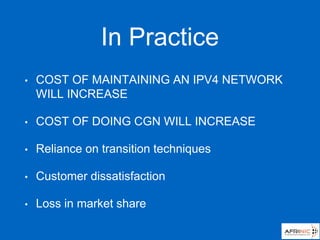
In Practice
• COST OF MAINTAINING AN IPV4 NETWORK
WILL INCREASE
• COST OF DOING CGN WILL INCREASE
• Reliance on transition techniques
• Customer dissatisfaction
• Loss in market share
Innovation
• Shall happen with IPv6
• Internet of Things
• Mobile Internet subscribers
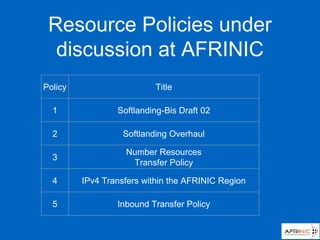
Resource Policies under
discussion at AFRINIC
Policy Title
1 Softlanding-Bis Draft 02
2 Softlanding Overhaul
3
Number Resources
Transfer Policy
4 IPv4 Transfers within the AFRINIC Region
5 Inbound Transfer Policy
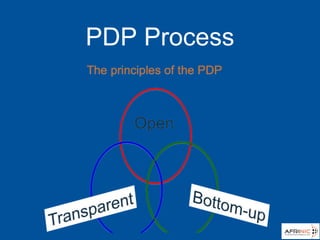
PDP Process
Engage
• Read the policies - they are online
http://www.afrinic.net/en/community/policy-
development/policy-proposals
• Participate in the discussions on the policies on the rpd mailing
list
• How to participate?
Subscribe to the mailing list, read archives of discussions and
contribute
http://www.afrinic.net/en/community/email-a-mailing-lists
Make your voice heard!!!
• Resource policies impact your organisation’s
future
• Now is the time to analyse the policy proposals
and express your concerns as well as your
approvals
• Discussions Not limited to AFRINIC resource
members only
way forward
• Get the IPv4 you need for services & growth for the next 10
months
• Get an IPv6 allocation
• Activate IPv6 deployment
• What are the challenges that some of you are facing while
deploying IPv6? Speak out on our mailing lists if you feel
that AFRINIC can help you address them
• Look forward to seeing your engagement and participation
in the discussions about AFRINIC policies
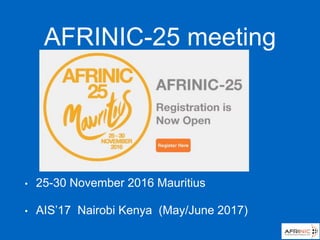
AFRINIC-25 meeting
• 25-30 November 2016 Mauritius
• AIS’17 Nairobi Kenya (May/June 2017)
Please drop by the AFRINIC Booth
Thank You!!
Questions??

Peering and Transit Tutorials: Path to IPv4 Exhaustion

  • 1.
    Path to IPv4Exhaustion are we Are we Ready to face it?A Presenter: Madhvi Gokool, Registration Service Manager AFRINIC Ltd re we ready to face it PAre we ready to face it?
  • 2.
    • In brief,this presentation will briefly go through the topics of AFRINIC as RIR, its membership trends, status of the IPv4 pool , current soft landing policy ratified, how fast can the last /8 run out and the dire reality of the state of IPv6 on the AFRICAN continent. We shall also cover the implications of not deploying IPv6 and to highlight some policies that have been proposed and currently being discussed at AFRINIC
  • 3.
    Introduction • AFRINIC isthe Regional Internet Registry (AFRICAN continent as service region) • Manages IP Number Resource Pools(IPv4, IPv6 & ASNs • Membership based organisation
  • 4.
    Membership • Organisations thatoperate an IP network from various industries - Internet Service Providers, Mobile operators, Hosting/Cloud providers, Research and Education Networks , Banking , Government , Critical infrastructure providers etc ANY ENTITY in service region that originates services
  • 5.
  • 6.
  • 7.
  • 8.
    Status of IPv4 Resources •Amount of IPv4 addresses in the Inventory • @June 2016 - 1.6 /8 . 10 Million IPv4 away from last /8 • Amount of IPv4 addresses under evaluation ~/10 +/11 (6 Million IPv4) • Amount of IPv4 addresses issued (2015 & 2016) • ~ 1 /8(16 Million)
  • 9.
    Inventory Prefix size /8 /10 /11/12 /13 /15 /16 /17 /18 /19 /20 /21 /22 /24 Total 1 1 1 1 1 3 17 4 1 2 3 3 32 232 • As we near exhaustion, aggregation is not being guaran • Cleanliness (not blacklisted) of IPs not guaranteed
  • 10.
    When shall wehit the last /8(softlanding)? • As from 1 July 2016. Resource issuance will only happen after member has paid allocation/assignment fee. • Impact on resource uptake still being determined. • Late 2016 if allocation rates are similar to 2015 or 2017
  • 11.
    IPv4 Exhaustion • WhenAFRINIC has reached the last /8 • Soft landing policy • Allocation/Assignment Rules change
  • 12.
    Softlanding or Last/8 • A policy AFPUB-2010-v4-005 that has been ratified by AFRINIC BoD in Nov 2011 • Kicks in when an otherwise-valid request for IPv4 address space from any LIR or end user to AfriNIC either (a) cannot be fulfilled with the IPv4 address space available in the AFRINIC pool (with the exception of the Final /8), OR (b) can be fulfilled, but would leave the AFRINIC IPv4 address pool empty (with the exception of the Final /8).
  • 13.
    Softlanding or Last/8 • EXHAUSTION PHASE 1 • A /12 IPv4 address block will be in reserved out of the Final /8. This /12 IPv4 address block shall be preserved by AfriNIC for some future uses, as yet unforeseen. • Allocations/Assignments (LIR/EU members) will get IP addresses as per current phase with minimum set to /22 and /24 for LIR & End-user Resource Members respectively • Maximum Allocation/Assignment shall be a /13 prefix • No explicit limit on the number of times an organisation may request additional IPv4 space • Allocation/Assignment period changes from 12 months to 8 months • Existing Resource Members eligible to get additional blocks if 90% usage of all Resources it has (Current & Exhaustion Phase)
  • 14.
    Softlanding or Last/8 • EXHAUSTION PHASE 2 • AFRINIC has a /11 on non-RESERVED space available in the Final /8 • Minimum/Maximum Allocation&Assignment shall be a /24 and /22 • No explicit limit on the number of times an organisation may request additional IPv4 space • Allocation/Assignment period changes from 12 months to 8 months • Existing Resource Members eligible to get additional blocks if 90% usage of all Resources it has (Current & Exhaustion Phase)
  • 15.
    How fast canAFRINIC move from Phase 1 to Phase 2? • 13,631,488 IPv4 Addresses • Average rate of consumption /per month in 2016 = 1,398,100 • No. of months = ~10 months • It could be less - /13 limit per prefix size x no explicit limit of number of times Can we agree that Phases 1 & 2 can be short?
  • 16.
    Impact of exhaustionon operators network Increase in customers Higher demand for Value Added Services Higher demand for Value Added Services LESS IPv4 available from AFRINIC NAT INCREASE IN Operation COSTS
  • 17.
    What you already know? •Carrier Grad NAT (CGN) • Large Scale NAT (LSN) • NAT 444 NAT is NOT a Sustainable Solution to Address Depletion IPv6 and IPv4 are not compatible
  • 18.
    Proposed Technical Solutions IPv4IPv6 Translator Translationwill: 1) Add extra cost and equipment to the network 2) Break the communication
  • 19.
    IPv4 IPv6 IPv4 & IPv6 IPv4 &IPv6 IPv6 IPv4 Dual Stacking Proposed Technical Solutions IPv4 or IPv6
  • 20.
    Networks would grow Deploymentof network infrastructure Interconnection, infrastructure & rural areas Cyber security E – projects Content and ccTLDs growth Research and Innovation Internet governance and critical Internet resources Internet of Things (IoT) Shall happen only with IPv6 What shall happen during/after IPv4 Exhaustion Nationally: Governments and Regulators
  • 21.
    Telecoms, Service Providers,organisations doing business on the Internet, need to be able to: • Scale their networks; more clients • Support a large mobile workforce • Support large multiple sites • Ensure that their content and information will be reached by more viewers IPv4 Exhaustion - What happens next?? PRIVATE SECTOR
  • 22.
    Accurate IPv6 record-keepingdoes more than help law enforcement. • Useful for 1. combating abuse. 2. anti-spam measures. 3. figuring out what's going on with distributed denial of service attacks. Cyber Security & LEAs IPv4 Exhaustion - What happens next??
  • 23.
    Specialized Internet serviceprovider dedicated to supporting the needs of the research and education communities within a country. With thousands of online students and researchers, NRENs are the ideal places to start implementing and testing new Internet protocols (IPv6) and architectures (Cloud Computing). National Research & Education Networks (NRENs)
  • 24.
    IPv6 in AFRICA •IPv6 Allocations Trend • 46% of Internet Exchange Points have an IPv6 prefix for peering or management purposes • 28% New-members requesting for their IPv6 prefix along with IPv4 in 2016 • 50% of NRENs have an IPv6 prefix • 72% of Large——> Extra Large AFRINIC Resource members have an IPv6 prefix
  • 25.
    IPv6 in AFRICA 36%of total resource members have an IPv6 prefix • 32 IPv6 prefixes issued to members in Tanzania(~50%) IPv6 visible in routing tables
  • 26.
    IPv6 trainings inAFRICA 23% of economies in service region not covered yet Present more than one in certain economies
  • 27.
    IPv6 trainings inAFRICA • Over 3000 engineers trained • since 2010 until June 2016
  • 28.
    IPv6 Adoption Very slowadoption of IPv6 despite incentives(discounts) provided by AFRINIC • Free IPv6 prefix(no allocation/assignment fees) • Free Training (technical & decision makers) • Webinars in regard to sensitisation and deployment of IPv6 networks • Campaign of information in regard to what operators should do prior to deploying an IPv6 network
  • 29.
    In Practice • COSTOF MAINTAINING AN IPV4 NETWORK WILL INCREASE • COST OF DOING CGN WILL INCREASE • Reliance on transition techniques • Customer dissatisfaction • Loss in market share
  • 30.
    Innovation • Shall happenwith IPv6 • Internet of Things • Mobile Internet subscribers
  • 31.
    Resource Policies under discussionat AFRINIC Policy Title 1 Softlanding-Bis Draft 02 2 Softlanding Overhaul 3 Number Resources Transfer Policy 4 IPv4 Transfers within the AFRINIC Region 5 Inbound Transfer Policy
  • 32.
  • 33.
    Engage • Read thepolicies - they are online http://www.afrinic.net/en/community/policy- development/policy-proposals • Participate in the discussions on the policies on the rpd mailing list • How to participate? Subscribe to the mailing list, read archives of discussions and contribute http://www.afrinic.net/en/community/email-a-mailing-lists
  • 34.
    Make your voiceheard!!! • Resource policies impact your organisation’s future • Now is the time to analyse the policy proposals and express your concerns as well as your approvals • Discussions Not limited to AFRINIC resource members only
  • 35.
    way forward • Getthe IPv4 you need for services & growth for the next 10 months • Get an IPv6 allocation • Activate IPv6 deployment • What are the challenges that some of you are facing while deploying IPv6? Speak out on our mailing lists if you feel that AFRINIC can help you address them • Look forward to seeing your engagement and participation in the discussions about AFRINIC policies
  • 36.
    AFRINIC-25 meeting • 25-30November 2016 Mauritius • AIS’17 Nairobi Kenya (May/June 2017)
  • 37.
    Please drop bythe AFRINIC Booth Thank You!! Questions??