PUSHING THE FRONTIER:
Exploring the African Web Ecosystem
Rodérick Fanou1, Gareth Tyson2,
Pierre Francois3, and Arjuna Sathiaseelan4
roderick.fanou@imdea.org;
gareth.tyson@qmul.ac.uk
1IMDEA Networks Institute & UC3M;
2Queen Mary University of London;
3CISCO Systems; 4University of Cambridge
The Paper
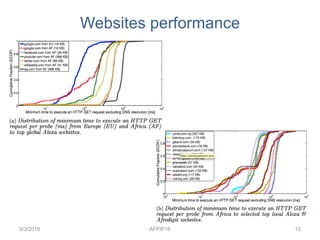
R. Fanou, G. Tyson, P. Francois, and A. Sathiaseelan (2016) Pushing the Frontier: Exploring the
African Web Ecosystem. In: The 25th International World Wide Web Conference (WWW 2016), 11-
15 April 2016, Montreal, Canada.
9/3/2016 AFPIF16 2
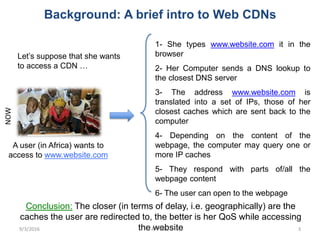
Background: A brief intro to Web CDNs
Conclusion: The closer (in terms of delay, i.e. geographically) are the
caches the user are redirected to, the better is her QoS while accessing
the website
NOW
1- She types www.website.com it in the
browser
2- Her Computer sends a DNS lookup to
the closest DNS server
3- The address www.website.com is
translated into a set of IPs, those of her
closest caches which are sent back to the
computer
4- Depending on the content of the
webpage, the computer may query one or
more IP caches
5- They respond with parts of/all the
webpage content
6- The user can open to the webpage
Let’s suppose that she wants
to access a CDN …
A user (in Africa) wants to
access to www.website.com
9/3/2016 AFPIF16 3
Related Work
• IXPs deployments of particular interest in the African region [1, 2]
• Zaki et al. [3] investigated web performance in Ghana
– Key bottlenecks include slow DNS resolution
– Lack of content caching
• Calder et al. [4] studied Google infrastructure
– Enumerated caches IPs & found their locations
– Studied its growth & matched users to clusters
• Otto et al. [5] examined the role of DNS in the redirection process
• Su et al. [6] found Akamai redirects clients are based on active
networks conditions
9/3/2016 AFPIF16 4
Background: Objective
[7] Mathieu Paonessa (Jaguar Networks), Future
of Content, http://isoc-ny.org/afpif2014/
AfPIF2014_Future_of_Content.pdf, AFPIF2014
[8] M. Kende and K. Rose, Promoting Local Content Hosting to
Develop the Internet Ecosystem. ISOC Report, 2015
Investigate the way users in Africa access the web (African Web
Ecosystem), since the outcome has serious impacts on both mobile and
wireline performance.
9/3/2016 AFPIF16 5
Possible Methodology
Approaches
• Straightforward method: record in a public repository, data from
all (mobile and wireline) users in Africa for websites they access (quite
difficult to achieve as of today)
• Alternative: Ask all local ASes to randomly launched from their
servers, scripts that locally collect this data (quite difficult to achieve as
of today – Some reasons: Networks’ trust, frequent current cuts)
• Another one: Use an existing measurement infrastructure
– Planet Lab (in 2015, 8 monitors)
– Archipelago (in 2015, 5 monitors)
– RIPE Atlas (in 2015, 379 probes in 170 ASes across 45 countries
/58) : the best option
9/3/2016 AFPIF16 6
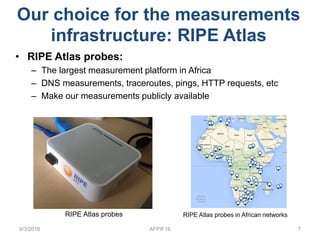
• RIPE Atlas probes:
– The largest measurement platform in Africa
– DNS measurements, traceroutes, pings, HTTP requests, etc
– Make our measurements publicly available
9/3/2016 AFPIF16 7
RIPE Atlas probes RIPE Atlas probes in African networks
Our choice for the measurements
infrastructure: RIPE Atlas
• Task1: Mapping a large Content Provider from
African ASes
• Task2: Compare DNS queries results to EDNS0
results
• Task3: Investigate DNS in African ASes
• Task4: Comparing top Global Providers
Infrastructures serving Africa to those of top
Regional ones
4 Main Tasks
9/3/2016 AFPIF16 8
• Collect all IP prefixes allocated by AFRINIC (African
prefixes)
– 3,082 prefixes of various length allocated by AFRINIC
• Discover all content servers/caches that serve them
– EDNS0 Client-Subnet Probes for a week
– 28,387,226 RIPE Atlas DNS Probes
– Targets: top regional, top global Alexa websites
• Geolocate caches (Improved version of geoloc method in [1])
– Cross-checking 10 data sources: OIM, MM, TC, RDNS, WHOIS &
RP, AR, AF, LAC, AP assignments databases
– 5 sets of pings measurements to tie break between multiple CCs
– Checking Speed of light violation (Extended version - Ongoing):
100 random RIPE Atlas probes worldwide per cache IP
9/3/2016 AFPIF16 9
Methodology Overview: Summary (1)
Methodology Overview: Summary (2)
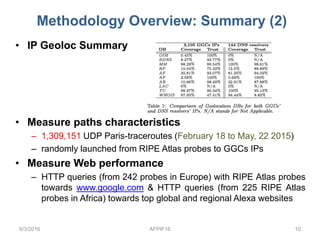
• IP Geoloc Summary
• Measure paths characteristics
– 1,309,151 UDP Paris-traceroutes (February 18 to May, 22 2015)
– randomly launched from RIPE Atlas probes to GGCs IPs
• Measure Web performance
– HTTP queries (from 242 probes in Europe) with RIPE Atlas probes
towards www.google.com & HTTP queries (from 225 RIPE Atlas
probes in Africa) towards top global and regional Alexa websites
9/3/2016 AFPIF16 10
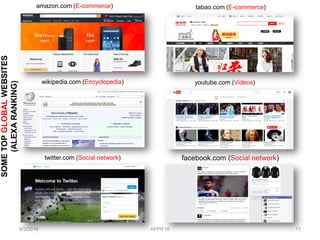
amazon.com (E-commerce)
9/3/2016 AFPIF16 11
tabao.com (E-commerce)
wikipedia.com (Encyclopedia) youtube.com (Videos)
twitter.com (Social network) facebook.com (Social network)
SOMETOPGLOBALWEBSITES
(ALEXARANKING)
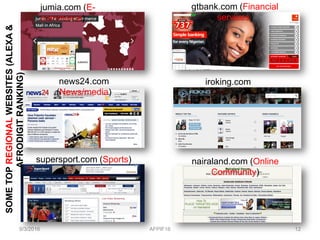
jumia.com (E-
commerce)
9/3/2016 AFPIF16 12
gtbank.com (Financial
services)
news24.com
(News/media)
iroking.com
(Videos)
supersport.com (Sports) nairaland.com (Online
Community)
SOMETOPREGIONALWEBSITES(ALEXA&
AFRODIGITRANKING)
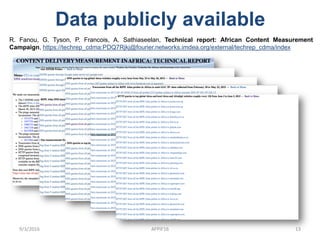
Data publicly available
9/3/2016 AFPIF16 13
R. Fanou, G. Tyson, P. Francois, A. Sathiaseelan, Technical report: African Content Measurement
Campaign, https://techrep_cdma:PDQ7Rjkj@fourier.networks.imdea.org/external/techrep_cdma/index
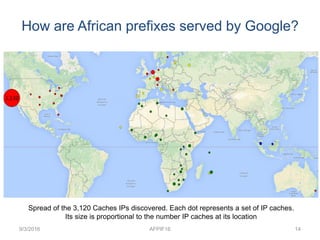
How are African prefixes served by Google?
9/3/2016 AFPIF16 14
Spread of the 3,120 Caches IPs discovered. Each dot represents a set of IP caches.
Its size is proportional to the number IP caches at its location
Websites performance
9/3/2016 AFPIF16 15
Any Feedbacks on the Methodology?
9/3/2016 AFPIF16 16
• Any comments on the methodology?
– Any idea on how we can agree on where were located 3,120 IP caches and the
157 DNS resolvers?
– May be Groundtruth on discovered IPs geoloc from CDNs for comparison?
• Possible Improvements? => frequent assessment of the web African
ecosystem
• Any idea to improve African measurements infrastruc-ture for enabling
deeper studies
• Possible to obtain from local operators similar/related datasets to
better the analysis?
References
[1] R. Fanou, P. Francois, E. Aben, On the Diversity of Interdomain in Africa, In PAM 2015
[2] A. Gupta, M. Calder, N. Feamster, M. Chetty, E. Calandro ,and E. Katz- Bassett.
Peering at the Internet’s Frontier: A First Look at ISP interconnectivity in Africa. In PAM,
2014
[3] C. Matt, F. Xun, H. Zi, E. Katz-Basset, H. John, and G. Ramesh. Mapping the
Expansion of Google’s Serving Infrastructure. In IMC, 2013
[4] J. S. Otto, M. A. Sanchez, J. P. Rula, and F. E. Bustamante. Content Delivery and The
Natural Evolution of DNS: Remote DNS Trends, Performance Issues and Alternative
Solutions. In ACM, 2012
[5] A.-J. Su, D. R. Choffnes, A. Kuzmanovic, and F. E. Bustamante. Draft-ing Behind
Akamai (Travelocity-Based Detouring). In ACM SIGCOMM ’06, 2006.
[6] Y. Zaki, J. Chen, T. Pötsch, and T. A. Lakshminarayanan Subramanian.
Dissecting Web Latency in Ghana. In IMC, 2014.
9/3/2016 AFPIF16 17
Thank you!
Questions or Comments?
9/3/2016 AFPIF16 18
BACKUP SLIDES
9/3/2016 AFPIF16 19
Extended Version: Geolocation
results Rechecks (Ongoing)
• 100 RIPE atlas probes randomly selected
in the world
• Around 18,751 pings measurements
towards 1,870 IPs among
• Computation of the delay
– XXX of IPs whose geoloc are expected to be
wrong
9/3/2016 AFPIF16 20
Striking Results
9/3/2016 AFPIF16 21
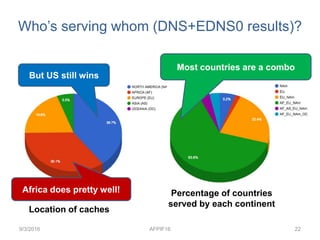
Who’s serving whom (DNS+EDNS0 results)?
9/3/2016 AFPIF16 22
Location of caches
Percentage of countries
served by each continent
Africa does pretty well!
But US still wins
Most countries are a combo
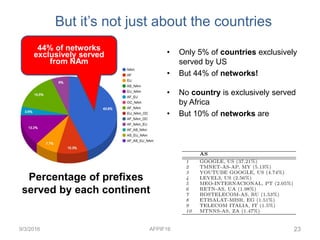
But it’s not just about the countries
9/3/2016 AFPIF16 23
• Only 5% of countries exclusively
served by US
• But 44% of networks!
• No country is exclusively served
by Africa
• But 10% of networks are
Percentage of prefixes
served by each continent
44% of networks
exclusively served
from NAm
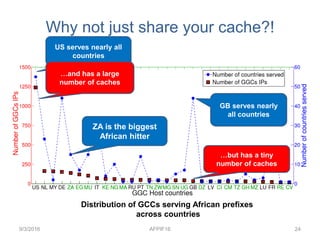
Why not just share your cache?!
9/3/2016 AFPIF16 24
US serves nearly all
countries
…and has a large
number of caches
GB serves nearly
all countries
…but has a tiny
number of caches
ZA is the biggest
African hitter
Distribution of GCCs serving African prefixes
across countries
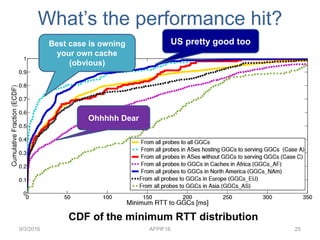
What’s the performance hit?
9/3/2016 AFPIF16 25
US pretty good tooBest case is owning
your own cache
(obvious)
Ohhhhh Dear
CDF of the minimum RTT distribution
Peering is the key to low delays
9/3/2016 AFPIF16 26
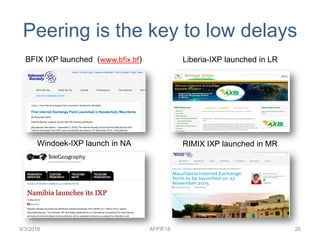
BFIX IXP launched (www.bfix.bf)
Windoek-IXP launch in NA
Liberia-IXP launched in LR
RIMIX IXP launched in MR
Peering is the key to low delays
• Launch of some of them proved [2]
– RTTs among peers decrease
– Financial costs decrease
• But many networks still remain
disconnected from IXPs
– Currently, on average 16 members at an African IXP
9/3/2016 AFPIF16 27
[2] Fanou et al. On the Inderdomain Routing in Africa, in PAM 2015
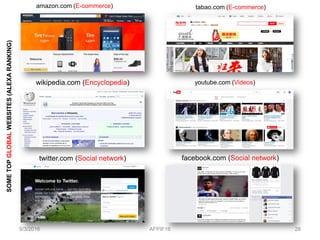
amazon.com (E-commerce)
9/3/2016 AFPIF16 28
tabao.com (E-commerce)
wikipedia.com (Encyclopedia) youtube.com (Videos)
twitter.com (Social network) facebook.com (Social network)
SOMETOPGLOBALWEBSITES(ALEXARANKING)
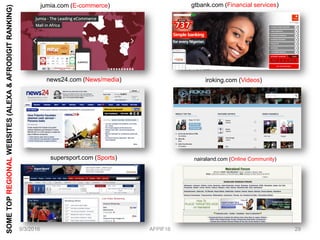
jumia.com (E-commerce)
9/3/2016 AFPIF16 29
gtbank.com (Financial services)
news24.com (News/media) iroking.com (Videos)
supersport.com (Sports) nairaland.com (Online Community)
SOMETOPREGIONALWEBSITES(ALEXA&AFRODIGITRANKING)
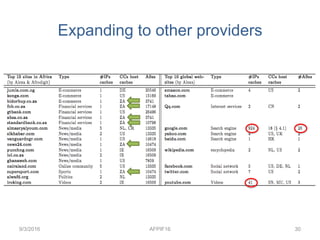
Expanding to other providers
9/3/2016 AFPIF16 30
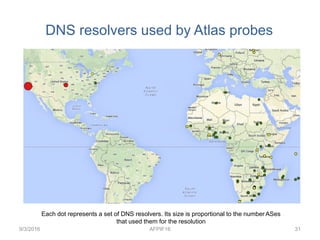
DNS resolvers used by Atlas probes
9/3/2016 AFPIF16 31
Each dot represents a set of DNS resolvers. Its size is proportional to the number ASes
that used them for the resolution
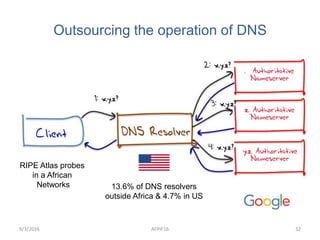
Outsourcing the operation of DNS
9/3/2016 AFPIF16 32
RIPE Atlas probes
in a African
Networks 13.6% of DNS resolvers
outside Africa & 4.7% in US
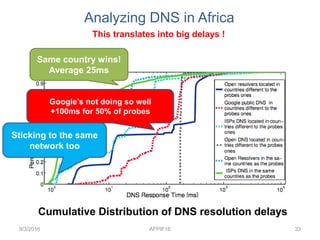
Analyzing DNS in Africa
9/3/2016 AFPIF16 33
Same country wins!
Average 25ms
Google’s not doing so well
+100ms for 50% of probes
Sticking to the same
network too
This translates into big delays !
Cumulative Distribution of DNS resolution delays
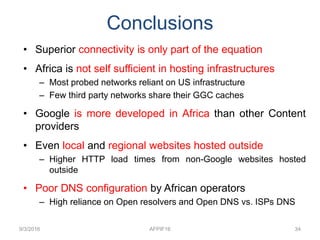
Conclusions
• Superior connectivity is only part of the equation
• Africa is not self sufficient in hosting infrastructures
– Most probed networks reliant on US infrastructure
– Few third party networks share their GGC caches
• Google is more developed in Africa than other Content
providers
• Even local and regional websites hosted outside
– Higher HTTP load times from non-Google websites hosted
outside
• Poor DNS configuration by African operators
– High reliance on Open resolvers and Open DNS vs. ISPs DNS
9/3/2016 AFPIF16 34
• CDNs should begin to improve their presence in Africa
– Popular regional providers as front-runners
• Operators should improve peering
• CDNs must concurrently host caches at existing African IXPs (37 functional/ 39 on PCH
website - https://prefix.pch.net/applications/ixpdir/summary/growth-region/)
• Network operators should correct their DNS settings
• More public DNS resolvers should be placed in Africa
• Technical report available:
R. Fanou, G. Tyson, P. Francois, A. Sathiaseelan, Technical report: African Content Measurement
Campaign, https://techrep_cdma:PDQ7Rjkj@fourier.networks.imdea.org/external/techrep_cdma/index
9/3/2016 AFPIF16 35
Our suggestions
9/3/2016 AFPIF16 36
A few ideas to finish on …
• Deploying CDN caches/replication points is
– Let’s do more of it!
• Network operators should improve peering
– … and stop using third party DNS (or place resolvers in Africa)
• Need better hosting infrastructure in Africa to bring in
smaller players
– E.g. cheaper, more reliable etc.
• Pick the right ISP!
• Users can adopt smarter protocols
– E.g. SPDY/HTTP 2.0
Acknowledgements
9/3/2016 AFPIF16 37
• We are grateful to all RIPE Atlas probes hosts and the
RIPE Atlas team
• Arjuna Sathiaseelan is funded by H2020 RIFE Project
References
[1] A. Gupta
[2] R. Fanou, P. Francois, E. Aben, On the Diversity of Interdomain in
Africa, PAM2015, USA, April 2015
[3]
[4]
[5]
[6]
9/3/2016 AFPIF16 38
Thank you! Any questions?
9/3/2016 AFPIF16 39

Pushing the Frontier: Exploring the African Web Ecosystem

  • 1.
    PUSHING THE FRONTIER: Exploringthe African Web Ecosystem Rodérick Fanou1, Gareth Tyson2, Pierre Francois3, and Arjuna Sathiaseelan4 roderick.fanou@imdea.org; gareth.tyson@qmul.ac.uk 1IMDEA Networks Institute & UC3M; 2Queen Mary University of London; 3CISCO Systems; 4University of Cambridge
  • 2.
    The Paper R. Fanou,G. Tyson, P. Francois, and A. Sathiaseelan (2016) Pushing the Frontier: Exploring the African Web Ecosystem. In: The 25th International World Wide Web Conference (WWW 2016), 11- 15 April 2016, Montreal, Canada. 9/3/2016 AFPIF16 2
  • 3.
    Background: A briefintro to Web CDNs Conclusion: The closer (in terms of delay, i.e. geographically) are the caches the user are redirected to, the better is her QoS while accessing the website NOW 1- She types www.website.com it in the browser 2- Her Computer sends a DNS lookup to the closest DNS server 3- The address www.website.com is translated into a set of IPs, those of her closest caches which are sent back to the computer 4- Depending on the content of the webpage, the computer may query one or more IP caches 5- They respond with parts of/all the webpage content 6- The user can open to the webpage Let’s suppose that she wants to access a CDN … A user (in Africa) wants to access to www.website.com 9/3/2016 AFPIF16 3
  • 4.
    Related Work • IXPsdeployments of particular interest in the African region [1, 2] • Zaki et al. [3] investigated web performance in Ghana – Key bottlenecks include slow DNS resolution – Lack of content caching • Calder et al. [4] studied Google infrastructure – Enumerated caches IPs & found their locations – Studied its growth & matched users to clusters • Otto et al. [5] examined the role of DNS in the redirection process • Su et al. [6] found Akamai redirects clients are based on active networks conditions 9/3/2016 AFPIF16 4
  • 5.
    Background: Objective [7] MathieuPaonessa (Jaguar Networks), Future of Content, http://isoc-ny.org/afpif2014/ AfPIF2014_Future_of_Content.pdf, AFPIF2014 [8] M. Kende and K. Rose, Promoting Local Content Hosting to Develop the Internet Ecosystem. ISOC Report, 2015 Investigate the way users in Africa access the web (African Web Ecosystem), since the outcome has serious impacts on both mobile and wireline performance. 9/3/2016 AFPIF16 5
  • 6.
    Possible Methodology Approaches • Straightforwardmethod: record in a public repository, data from all (mobile and wireline) users in Africa for websites they access (quite difficult to achieve as of today) • Alternative: Ask all local ASes to randomly launched from their servers, scripts that locally collect this data (quite difficult to achieve as of today – Some reasons: Networks’ trust, frequent current cuts) • Another one: Use an existing measurement infrastructure – Planet Lab (in 2015, 8 monitors) – Archipelago (in 2015, 5 monitors) – RIPE Atlas (in 2015, 379 probes in 170 ASes across 45 countries /58) : the best option 9/3/2016 AFPIF16 6
  • 7.
    • RIPE Atlasprobes: – The largest measurement platform in Africa – DNS measurements, traceroutes, pings, HTTP requests, etc – Make our measurements publicly available 9/3/2016 AFPIF16 7 RIPE Atlas probes RIPE Atlas probes in African networks Our choice for the measurements infrastructure: RIPE Atlas
  • 8.
    • Task1: Mappinga large Content Provider from African ASes • Task2: Compare DNS queries results to EDNS0 results • Task3: Investigate DNS in African ASes • Task4: Comparing top Global Providers Infrastructures serving Africa to those of top Regional ones 4 Main Tasks 9/3/2016 AFPIF16 8
  • 9.
    • Collect allIP prefixes allocated by AFRINIC (African prefixes) – 3,082 prefixes of various length allocated by AFRINIC • Discover all content servers/caches that serve them – EDNS0 Client-Subnet Probes for a week – 28,387,226 RIPE Atlas DNS Probes – Targets: top regional, top global Alexa websites • Geolocate caches (Improved version of geoloc method in [1]) – Cross-checking 10 data sources: OIM, MM, TC, RDNS, WHOIS & RP, AR, AF, LAC, AP assignments databases – 5 sets of pings measurements to tie break between multiple CCs – Checking Speed of light violation (Extended version - Ongoing): 100 random RIPE Atlas probes worldwide per cache IP 9/3/2016 AFPIF16 9 Methodology Overview: Summary (1)
  • 10.
    Methodology Overview: Summary(2) • IP Geoloc Summary • Measure paths characteristics – 1,309,151 UDP Paris-traceroutes (February 18 to May, 22 2015) – randomly launched from RIPE Atlas probes to GGCs IPs • Measure Web performance – HTTP queries (from 242 probes in Europe) with RIPE Atlas probes towards www.google.com & HTTP queries (from 225 RIPE Atlas probes in Africa) towards top global and regional Alexa websites 9/3/2016 AFPIF16 10
  • 11.
    amazon.com (E-commerce) 9/3/2016 AFPIF1611 tabao.com (E-commerce) wikipedia.com (Encyclopedia) youtube.com (Videos) twitter.com (Social network) facebook.com (Social network) SOMETOPGLOBALWEBSITES (ALEXARANKING)
  • 12.
    jumia.com (E- commerce) 9/3/2016 AFPIF1612 gtbank.com (Financial services) news24.com (News/media) iroking.com (Videos) supersport.com (Sports) nairaland.com (Online Community) SOMETOPREGIONALWEBSITES(ALEXA& AFRODIGITRANKING)
  • 13.
    Data publicly available 9/3/2016AFPIF16 13 R. Fanou, G. Tyson, P. Francois, A. Sathiaseelan, Technical report: African Content Measurement Campaign, https://techrep_cdma:PDQ7Rjkj@fourier.networks.imdea.org/external/techrep_cdma/index
  • 14.
    How are Africanprefixes served by Google? 9/3/2016 AFPIF16 14 Spread of the 3,120 Caches IPs discovered. Each dot represents a set of IP caches. Its size is proportional to the number IP caches at its location
  • 15.
  • 16.
    Any Feedbacks onthe Methodology? 9/3/2016 AFPIF16 16 • Any comments on the methodology? – Any idea on how we can agree on where were located 3,120 IP caches and the 157 DNS resolvers? – May be Groundtruth on discovered IPs geoloc from CDNs for comparison? • Possible Improvements? => frequent assessment of the web African ecosystem • Any idea to improve African measurements infrastruc-ture for enabling deeper studies • Possible to obtain from local operators similar/related datasets to better the analysis?
  • 17.
    References [1] R. Fanou,P. Francois, E. Aben, On the Diversity of Interdomain in Africa, In PAM 2015 [2] A. Gupta, M. Calder, N. Feamster, M. Chetty, E. Calandro ,and E. Katz- Bassett. Peering at the Internet’s Frontier: A First Look at ISP interconnectivity in Africa. In PAM, 2014 [3] C. Matt, F. Xun, H. Zi, E. Katz-Basset, H. John, and G. Ramesh. Mapping the Expansion of Google’s Serving Infrastructure. In IMC, 2013 [4] J. S. Otto, M. A. Sanchez, J. P. Rula, and F. E. Bustamante. Content Delivery and The Natural Evolution of DNS: Remote DNS Trends, Performance Issues and Alternative Solutions. In ACM, 2012 [5] A.-J. Su, D. R. Choffnes, A. Kuzmanovic, and F. E. Bustamante. Draft-ing Behind Akamai (Travelocity-Based Detouring). In ACM SIGCOMM ’06, 2006. [6] Y. Zaki, J. Chen, T. Pötsch, and T. A. Lakshminarayanan Subramanian. Dissecting Web Latency in Ghana. In IMC, 2014. 9/3/2016 AFPIF16 17
  • 18.
    Thank you! Questions orComments? 9/3/2016 AFPIF16 18
  • 19.
  • 20.
    Extended Version: Geolocation resultsRechecks (Ongoing) • 100 RIPE atlas probes randomly selected in the world • Around 18,751 pings measurements towards 1,870 IPs among • Computation of the delay – XXX of IPs whose geoloc are expected to be wrong 9/3/2016 AFPIF16 20
  • 21.
  • 22.
    Who’s serving whom(DNS+EDNS0 results)? 9/3/2016 AFPIF16 22 Location of caches Percentage of countries served by each continent Africa does pretty well! But US still wins Most countries are a combo
  • 23.
    But it’s notjust about the countries 9/3/2016 AFPIF16 23 • Only 5% of countries exclusively served by US • But 44% of networks! • No country is exclusively served by Africa • But 10% of networks are Percentage of prefixes served by each continent 44% of networks exclusively served from NAm
  • 24.
    Why not justshare your cache?! 9/3/2016 AFPIF16 24 US serves nearly all countries …and has a large number of caches GB serves nearly all countries …but has a tiny number of caches ZA is the biggest African hitter Distribution of GCCs serving African prefixes across countries
  • 25.
    What’s the performancehit? 9/3/2016 AFPIF16 25 US pretty good tooBest case is owning your own cache (obvious) Ohhhhh Dear CDF of the minimum RTT distribution
  • 26.
    Peering is thekey to low delays 9/3/2016 AFPIF16 26 BFIX IXP launched (www.bfix.bf) Windoek-IXP launch in NA Liberia-IXP launched in LR RIMIX IXP launched in MR
  • 27.
    Peering is thekey to low delays • Launch of some of them proved [2] – RTTs among peers decrease – Financial costs decrease • But many networks still remain disconnected from IXPs – Currently, on average 16 members at an African IXP 9/3/2016 AFPIF16 27 [2] Fanou et al. On the Inderdomain Routing in Africa, in PAM 2015
  • 28.
    amazon.com (E-commerce) 9/3/2016 AFPIF1628 tabao.com (E-commerce) wikipedia.com (Encyclopedia) youtube.com (Videos) twitter.com (Social network) facebook.com (Social network) SOMETOPGLOBALWEBSITES(ALEXARANKING)
  • 29.
    jumia.com (E-commerce) 9/3/2016 AFPIF1629 gtbank.com (Financial services) news24.com (News/media) iroking.com (Videos) supersport.com (Sports) nairaland.com (Online Community) SOMETOPREGIONALWEBSITES(ALEXA&AFRODIGITRANKING)
  • 30.
    Expanding to otherproviders 9/3/2016 AFPIF16 30
  • 31.
    DNS resolvers usedby Atlas probes 9/3/2016 AFPIF16 31 Each dot represents a set of DNS resolvers. Its size is proportional to the number ASes that used them for the resolution
  • 32.
    Outsourcing the operationof DNS 9/3/2016 AFPIF16 32 RIPE Atlas probes in a African Networks 13.6% of DNS resolvers outside Africa & 4.7% in US
  • 33.
    Analyzing DNS inAfrica 9/3/2016 AFPIF16 33 Same country wins! Average 25ms Google’s not doing so well +100ms for 50% of probes Sticking to the same network too This translates into big delays ! Cumulative Distribution of DNS resolution delays
  • 34.
    Conclusions • Superior connectivityis only part of the equation • Africa is not self sufficient in hosting infrastructures – Most probed networks reliant on US infrastructure – Few third party networks share their GGC caches • Google is more developed in Africa than other Content providers • Even local and regional websites hosted outside – Higher HTTP load times from non-Google websites hosted outside • Poor DNS configuration by African operators – High reliance on Open resolvers and Open DNS vs. ISPs DNS 9/3/2016 AFPIF16 34
  • 35.
    • CDNs shouldbegin to improve their presence in Africa – Popular regional providers as front-runners • Operators should improve peering • CDNs must concurrently host caches at existing African IXPs (37 functional/ 39 on PCH website - https://prefix.pch.net/applications/ixpdir/summary/growth-region/) • Network operators should correct their DNS settings • More public DNS resolvers should be placed in Africa • Technical report available: R. Fanou, G. Tyson, P. Francois, A. Sathiaseelan, Technical report: African Content Measurement Campaign, https://techrep_cdma:PDQ7Rjkj@fourier.networks.imdea.org/external/techrep_cdma/index 9/3/2016 AFPIF16 35 Our suggestions
  • 36.
    9/3/2016 AFPIF16 36 Afew ideas to finish on … • Deploying CDN caches/replication points is – Let’s do more of it! • Network operators should improve peering – … and stop using third party DNS (or place resolvers in Africa) • Need better hosting infrastructure in Africa to bring in smaller players – E.g. cheaper, more reliable etc. • Pick the right ISP! • Users can adopt smarter protocols – E.g. SPDY/HTTP 2.0
  • 37.
    Acknowledgements 9/3/2016 AFPIF16 37 •We are grateful to all RIPE Atlas probes hosts and the RIPE Atlas team • Arjuna Sathiaseelan is funded by H2020 RIFE Project
  • 38.
    References [1] A. Gupta [2]R. Fanou, P. Francois, E. Aben, On the Diversity of Interdomain in Africa, PAM2015, USA, April 2015 [3] [4] [5] [6] 9/3/2016 AFPIF16 38
  • 39.
    Thank you! Anyquestions? 9/3/2016 AFPIF16 39