1
Keeping Local Traffic Local
by Doing Local Peering
Che-Hoo Cheng
Infrastructure & Development Director, APNIC
PacNOG25@2019-12-02
2 v1.02
How Does Internet Operates?
• Internet is a network of networks, composed of networks of ISPs and users
• User networks connect to ISPs
• Small ISPs connect to large ISPs
• Various networks (large or small) are interconnected with one another to
form Internet
3 v1.03
Autonomous Systems
• A network on Internet is called Autonomous System (AS) which is
represented by AS Number (ASN)
o ASN is unique around the world
▸ APNIC is in charge of ASN assignment for AP region
o Used together with BGP (Border Gateway Protocol) for interconnections with multiple
networks (or multi-homing)
o Networks having ASNs can be more independent, or portable
▸ Together with portable IP addresses
▸ Like what APNIC members are enjoying…
4 v1.04
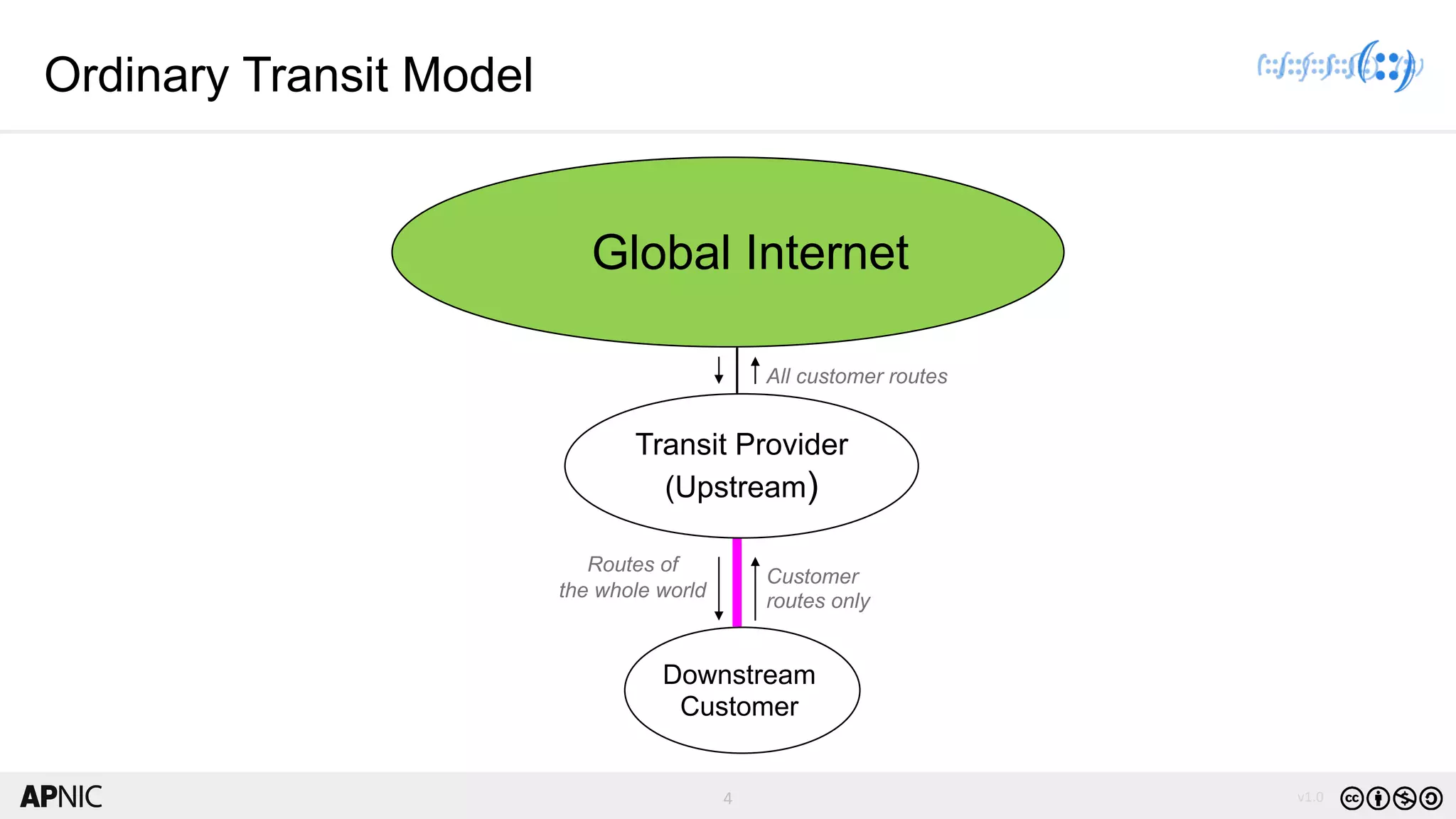
Transit Provider
(Upstream)
Global Internet
Downstream
Customer
Customer
routes only
Routes of
the whole world
All customer routes
Ordinary Transit Model
5 v1.05
Transit in General
• Networks pay transit providers to get to the whole Internet
o Can connect to multiple transit providers for resilience and portability
• A few very large ISPs act as transit providers for the whole world (the so-
called tier-1 networks) which do not need to pay others to get full Internet
connectivity
o Other ISPs must be transit customers of those tier-1 networks directly or indirectly in
order to gain full connectivity
• Networks on Internet are trying to bypass transit providers as much as
possible
o for lower cost and higher performance
6 v1.06
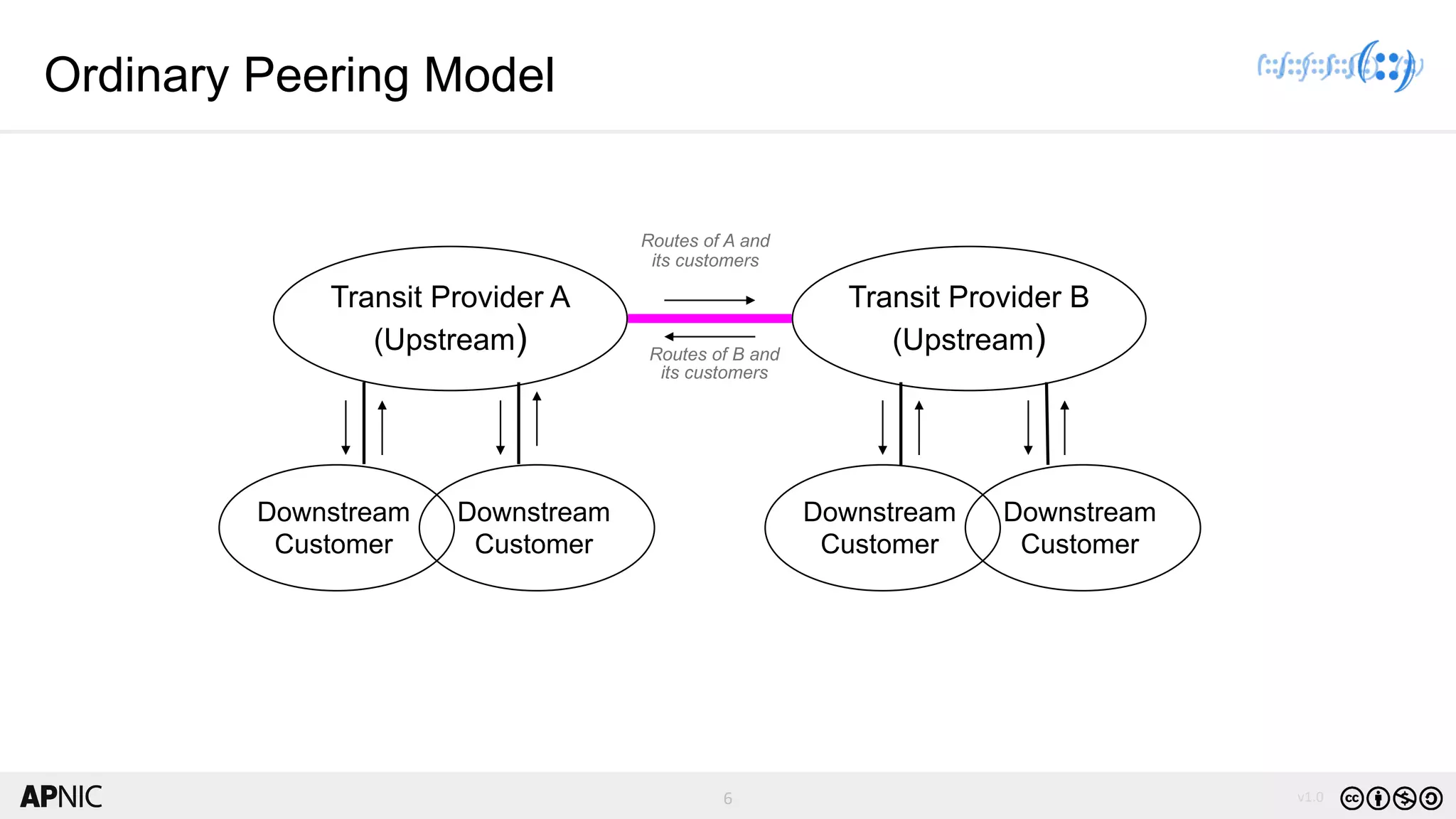
Transit Provider A
(Upstream)
Transit Provider B
(Upstream)
Downstream
Customer
Downstream
Customer
Downstream
Customer
Downstream
Customer
Routes of A and
its customers
Routes of B and
its customers
Ordinary Peering Model
7 v1.07
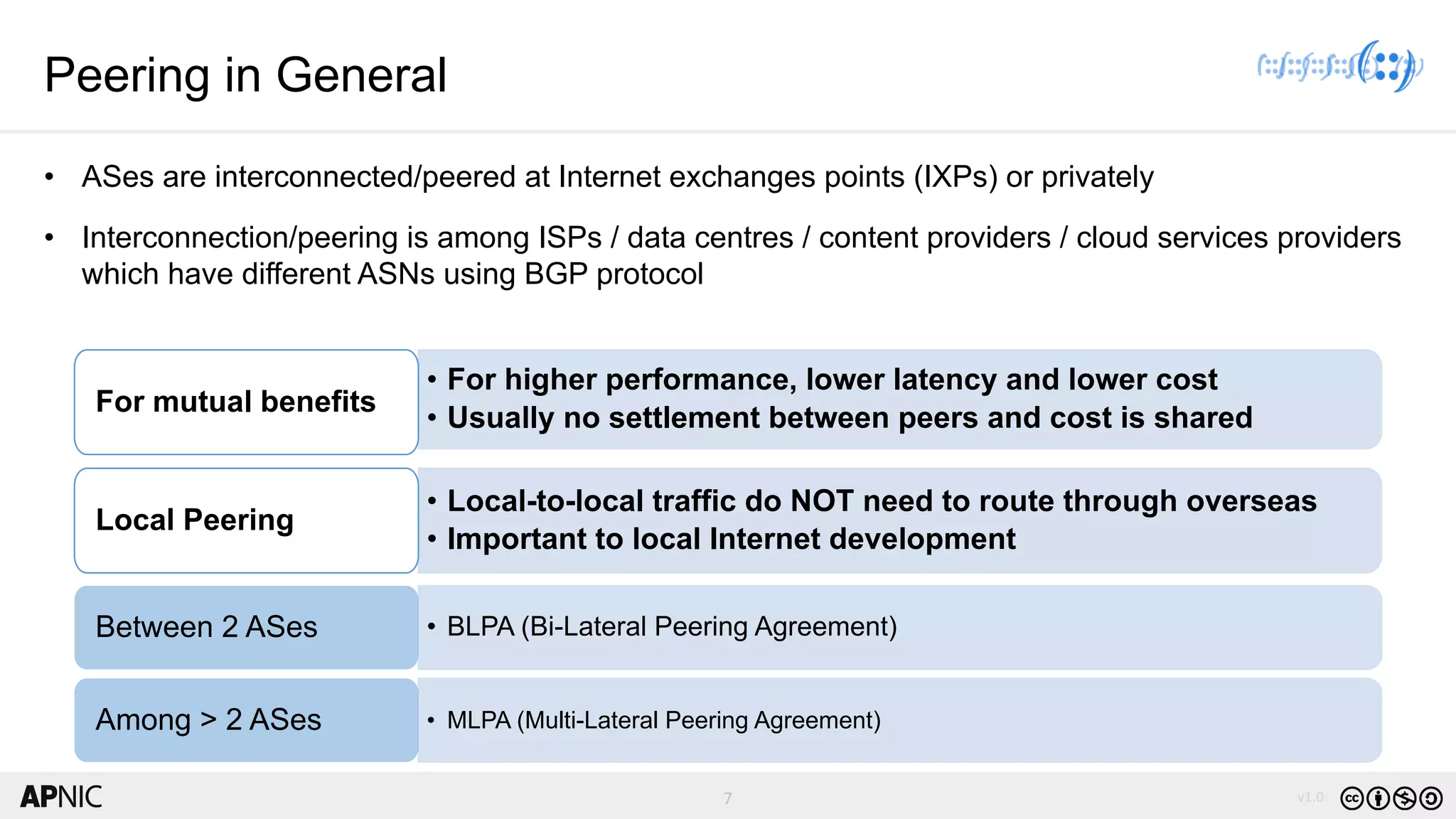
Peering in General
• ASes are interconnected/peered at Internet exchanges points (IXPs) or privately
• Interconnection/peering is among ISPs / data centres / content providers / cloud services providers
which have different ASNs using BGP protocol
• For higher performance, lower latency and lower cost
• Usually no settlement between peers and cost is shared
For mutual benefits
• Local-to-local traffic do NOT need to route through overseas
• Important to local Internet development
Local Peering
• BLPA (Bi-Lateral Peering Agreement)Between 2 ASes
• MLPA (Multi-Lateral Peering Agreement)Among > 2 ASes
8
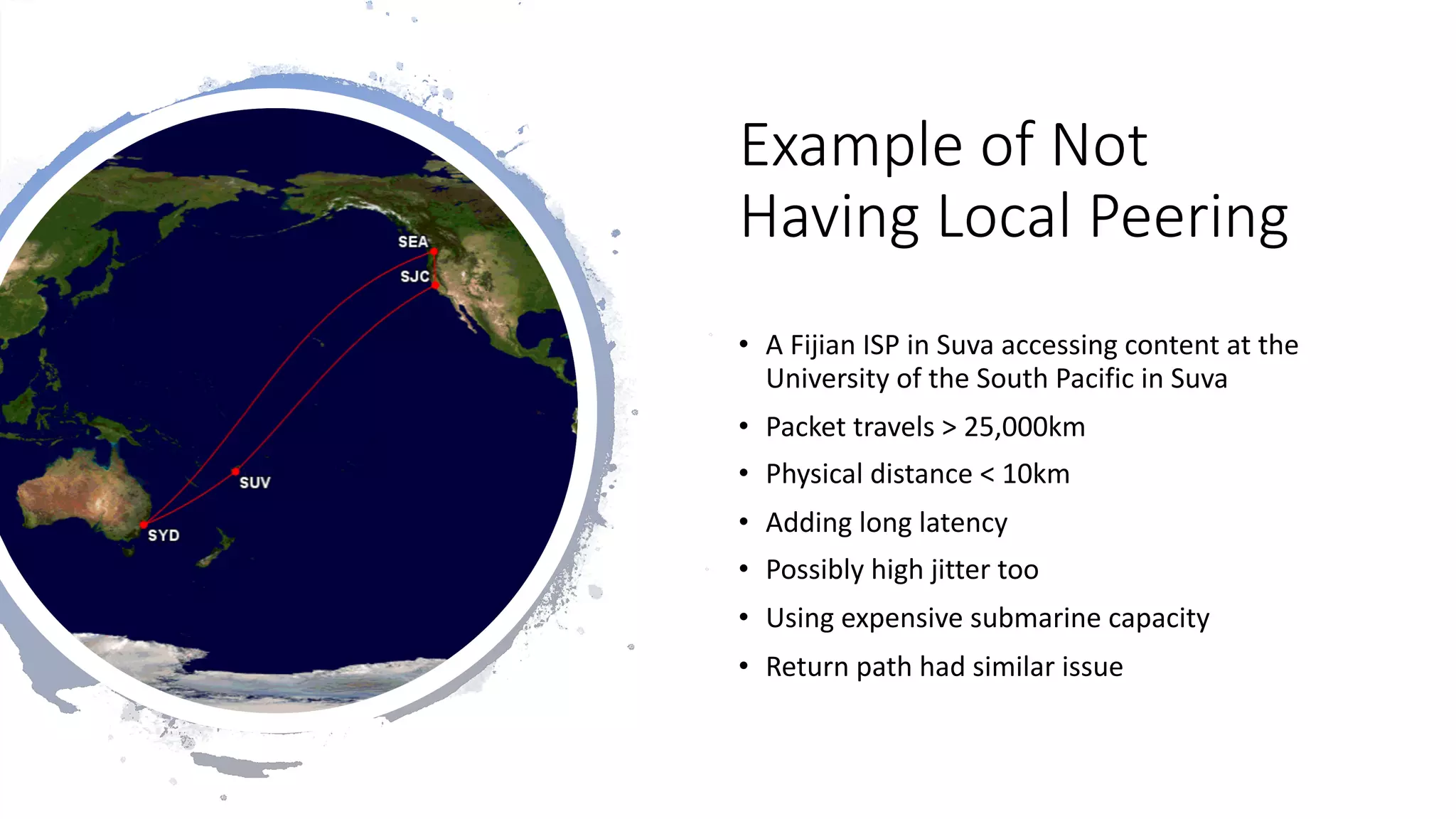
Example of Not
Having Local Peering
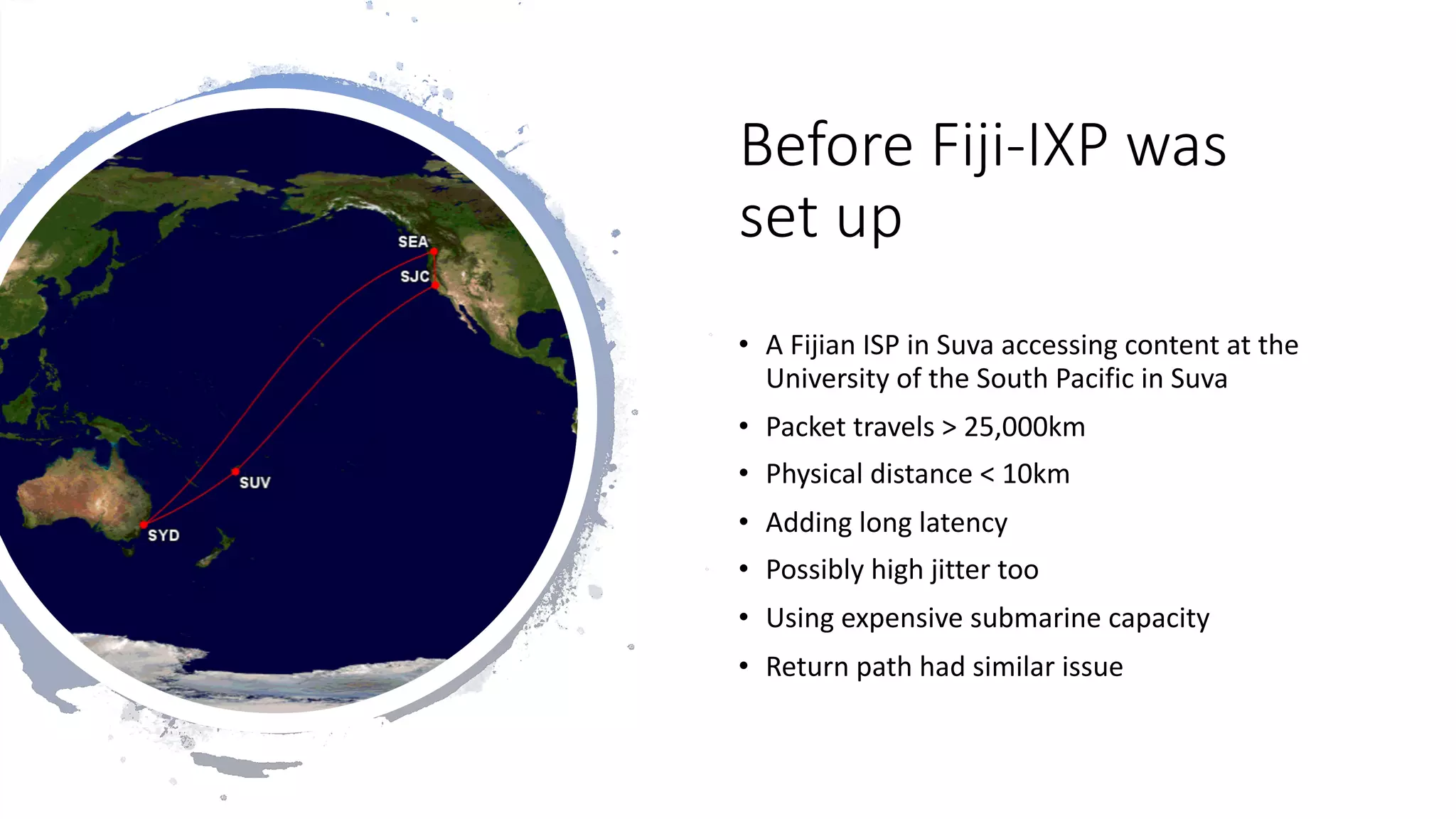
• A Fijian ISP in Suva accessing content at the
University of the South Pacific in Suva
• Packet travels > 25,000km
• Physical distance < 10km
• Adding long latency
• Possibly high jitter too
• Using expensive submarine capacity
• Return path had similar issue
9 v1.09
Private Peering
• A form of BLPA having dedicated point-to-point connection between 2 ASes
• Using cross-connect or local loop or IPL to interconnect
o Cost is usually shared between 2 peers
• May have multiple connections between 2 ASes for resiliency
• Not quite cost-effective
o Spare bandwidth cannot be used for other traffic
• Not very scalable
o nC2 physical connections for n ASes to peer fully with one another
10 v1.010
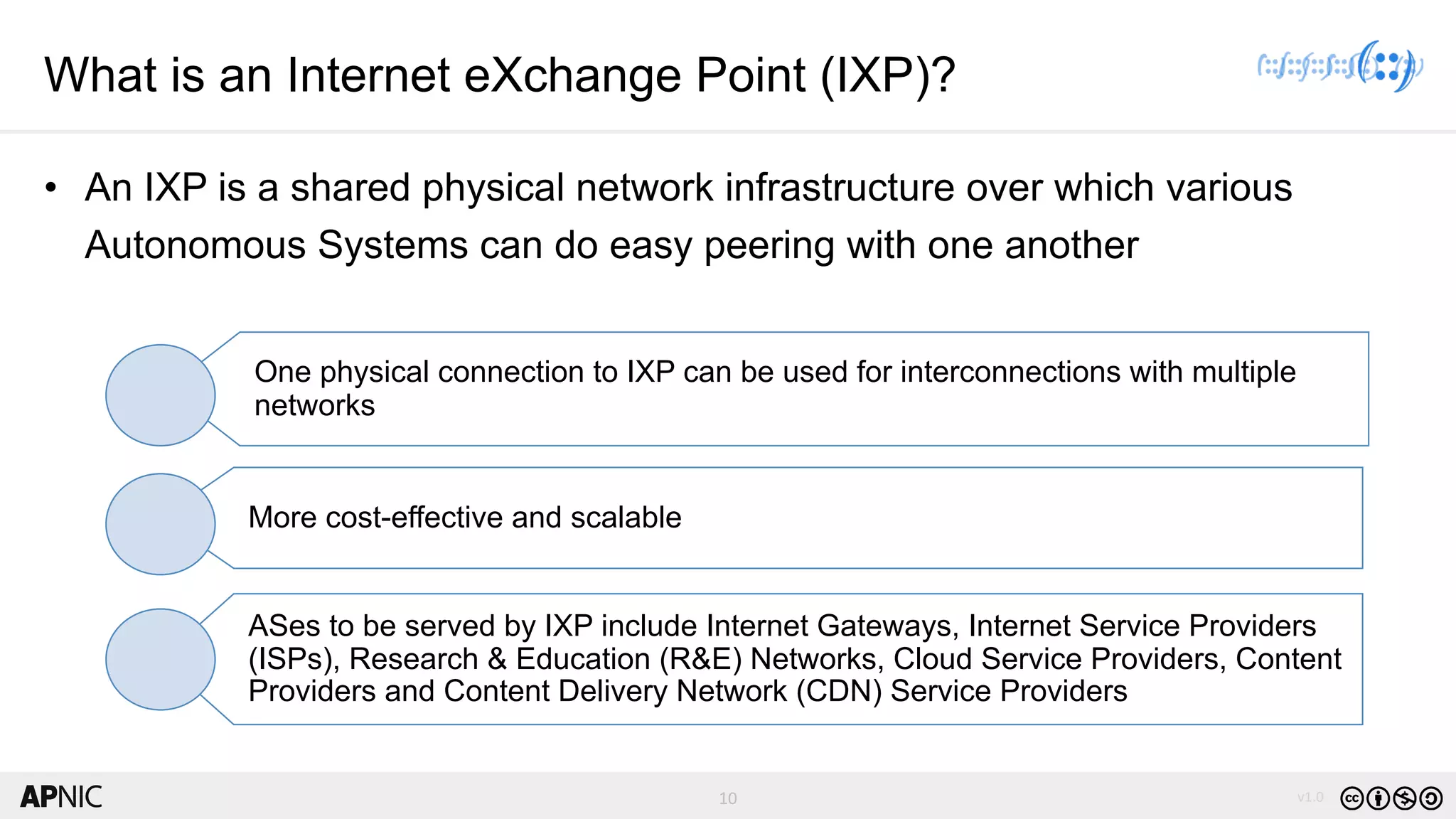
What is an Internet eXchange Point (IXP)?
• An IXP is a shared physical network infrastructure over which various
Autonomous Systems can do easy peering with one another
One physical connection to IXP can be used for interconnections with multiple
networks
More cost-effective and scalable
ASes to be served by IXP include Internet Gateways, Internet Service Providers
(ISPs), Research & Education (R&E) Networks, Cloud Service Providers, Content
Providers and Content Delivery Network (CDN) Service Providers
11 v1.011
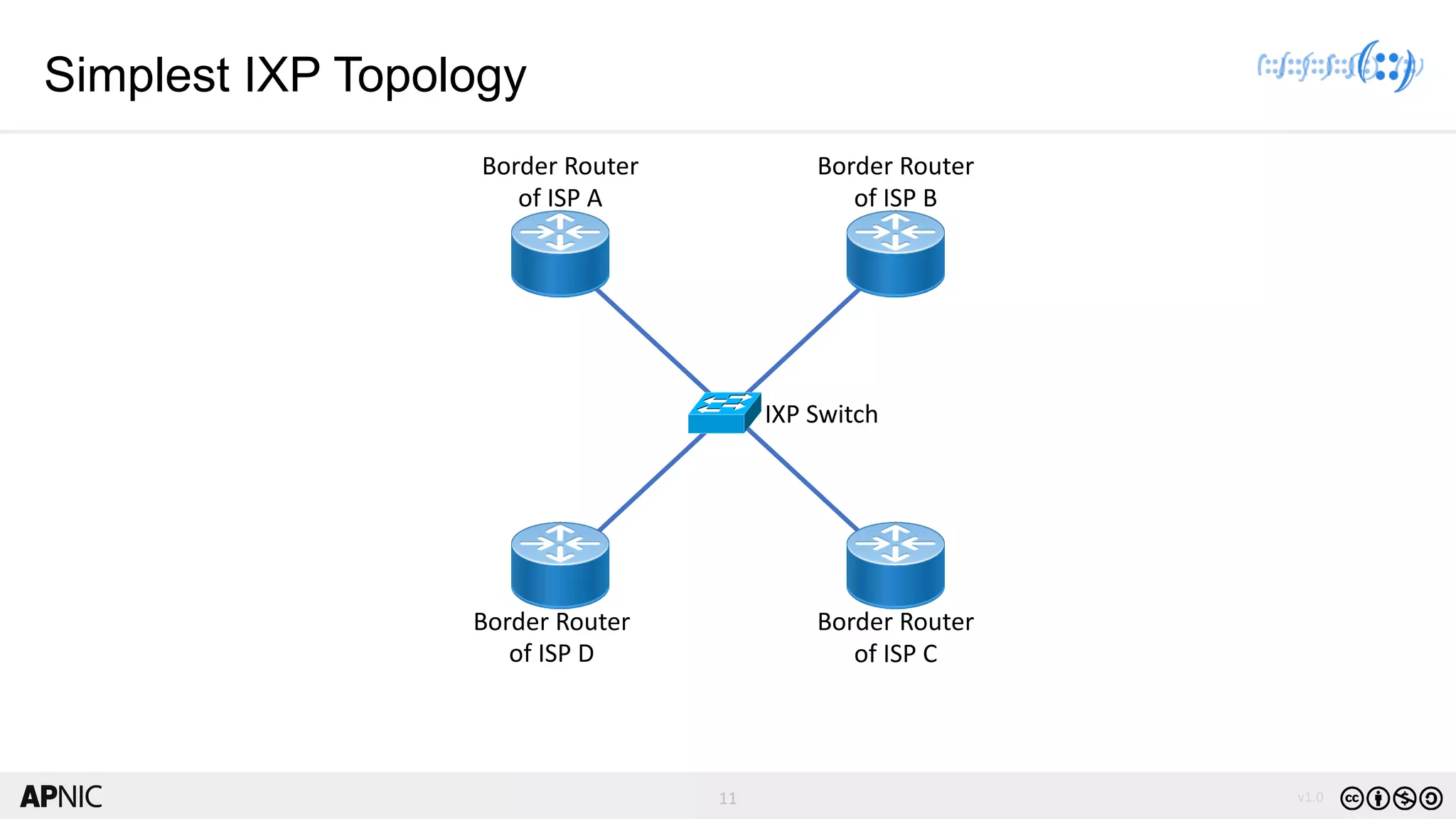
Simplest IXP Topology
IXP Switch
Border Router
of ISP A
Border Router
of ISP B
Border Router
of ISP D
Border Router
of ISP C
12 v1.012
Benefits of IXP
• One main objective of an IXP is to keep local traffic local
o Important to local Internet development
• Helps bypass 3rd-party network infrastructure for easy interconnection and direct traffic exchange
among participating networks
o Reduced cost – cheaper connectivity
o Enhanced network performance – faster speed
o Reduced latency – lower delay
• Helps encourage development of more local content and local applications
o Helps local data centre business and other businesses
• Everybody is benefited
o The gain for each may be different but all will gain
o At the end, it is the most important that end users or consumers are benefited
• Often considered as Critical Internet Infrastructure locally, regionally or globally
13 v1.013
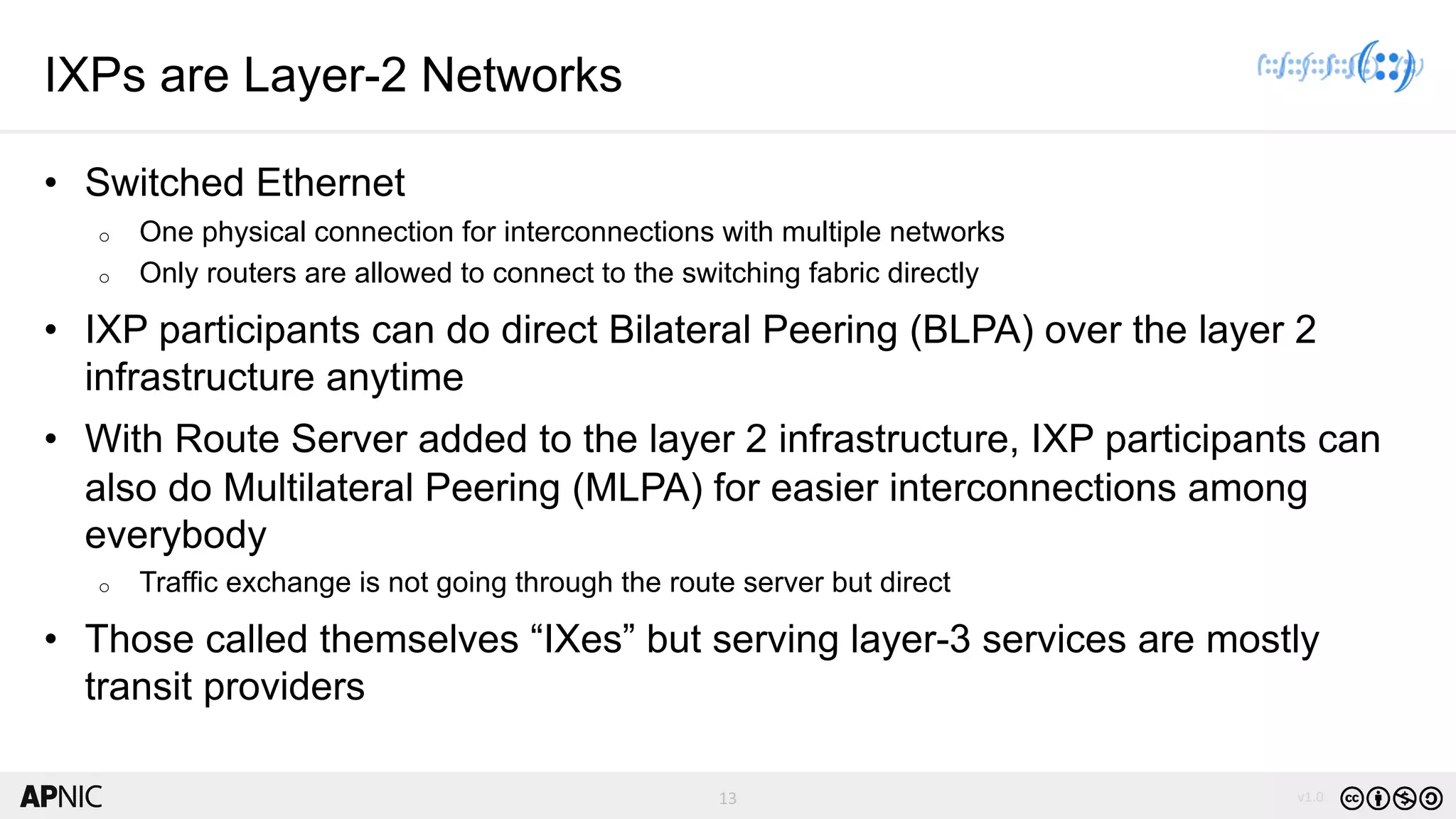
IXPs are Layer-2 Networks
• Switched Ethernet
o One physical connection for interconnections with multiple networks
o Only routers are allowed to connect to the switching fabric directly
• IXP participants can do direct Bilateral Peering (BLPA) over the layer 2
infrastructure anytime
• With Route Server added to the layer 2 infrastructure, IXP participants can
also do Multilateral Peering (MLPA) for easier interconnections among
everybody
o Traffic exchange is not going through the route server but direct
• Those called themselves “IXes” but serving layer-3 services are mostly
transit providers
14 v1.014
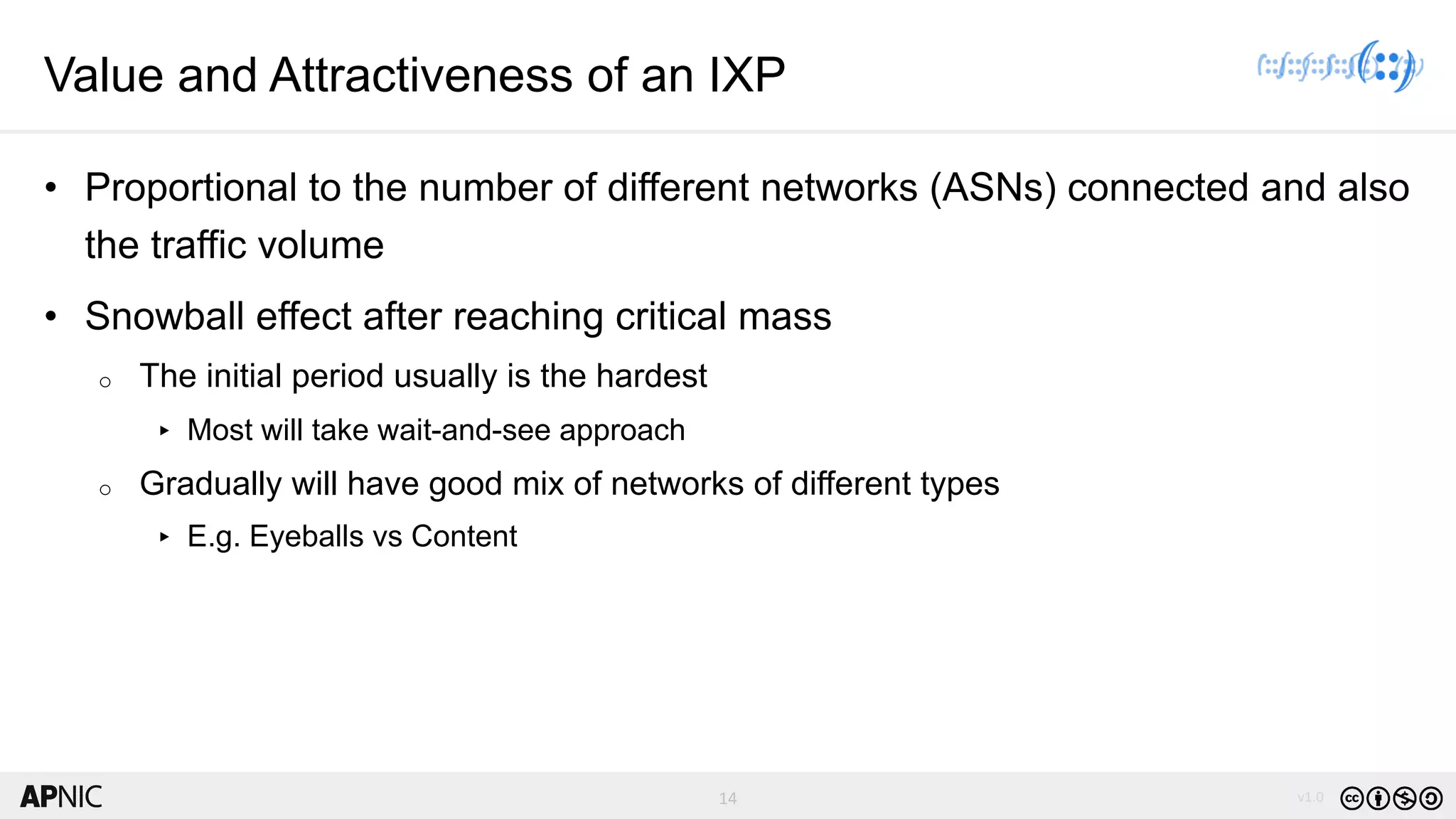
Value and Attractiveness of an IXP
• Proportional to the number of different networks (ASNs) connected and also
the traffic volume
• Snowball effect after reaching critical mass
o The initial period usually is the hardest
▸ Most will take wait-and-see approach
o Gradually will have good mix of networks of different types
▸ E.g. Eyeballs vs Content
15 v1.015
Evolution
• IXP development is an evolutionary process
o Can be done step by step
• It can be improved over time, but picking the right initial neutral organisation
/ governance model and a neutral site at the start is important for future
success
16 v1.016
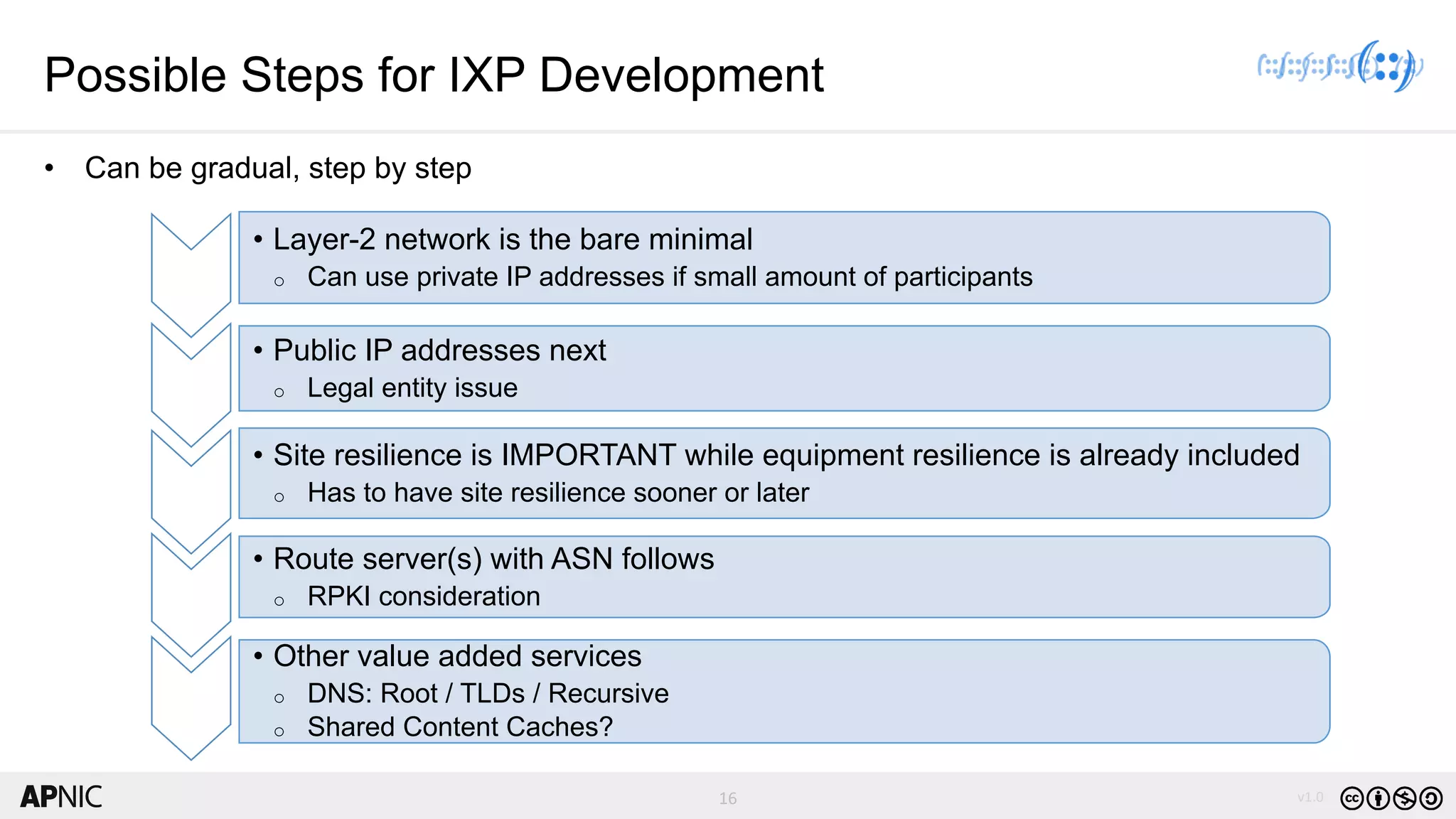
Possible Steps for IXP Development
• Can be gradual, step by step
• Layer-2 network is the bare minimal
o Can use private IP addresses if small amount of participants
• Public IP addresses next
o Legal entity issue
• Site resilience is IMPORTANT while equipment resilience is already included
o Has to have site resilience sooner or later
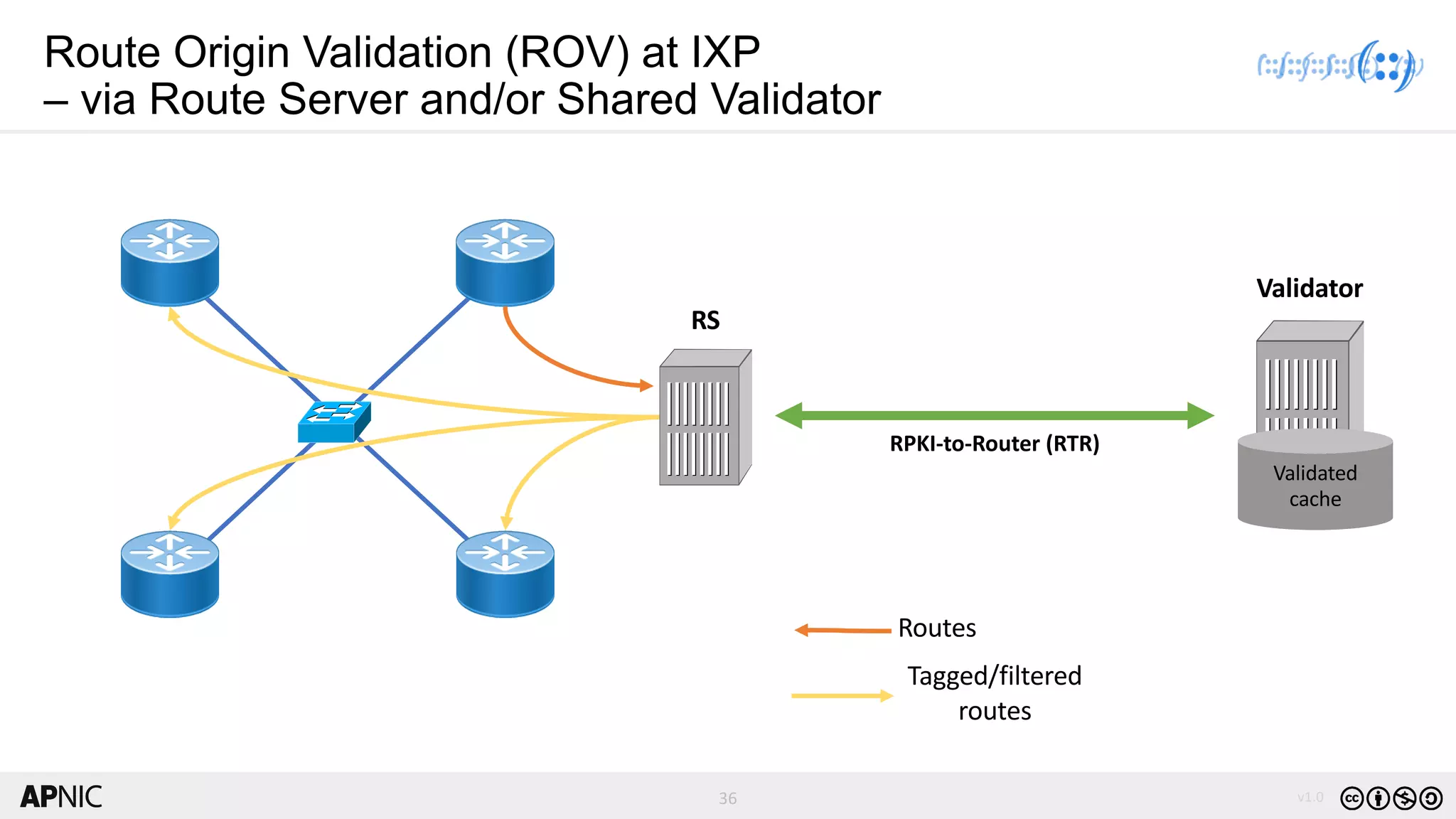
• Route server(s) with ASN follows
o RPKI consideration
• Other value added services
o DNS: Root / TLDs / Recursive
o Shared Content Caches?
17 v1.017
IP/ASN Resources for an IXP
• Considered as Critical Infrastructure under APNIC Policy
o Using public IP addresses and ASN is recommended
o IPv4: /24
o IPv6: /48
o ASN: 1 (for route server)
• But IXP may need another network to provide transit
o Own servers such as network management & monitoring
o DNS anycast servers: Authoritative or Cache/Resolving/Recursive
o Shared Content Caches for Participants
o Usually small
18 v1.018
Neutral Location is Good Starting Point
• May choose one of the followings as starting point:
o University
o Technology Park
o Carrier Neutral Data Center
o Government Data Center
• Having multiple carrier options with easy access is important
• Should maintain neutrality continuously
• Expansion to multiple sites within the same metro area can be done
gradually, coupled with growth
19 v1.019
Governance
• Multi-stakeholder bottom-up approach is the preferred approach for
maximum acceptance of the community
• Government support is also important
• Be as inclusive as possible in order to provide maximum benefits to the
whole community which it serves
• Should be fair and consistent to every participant
• Should be open and transparent as much as possible
20 v1.020
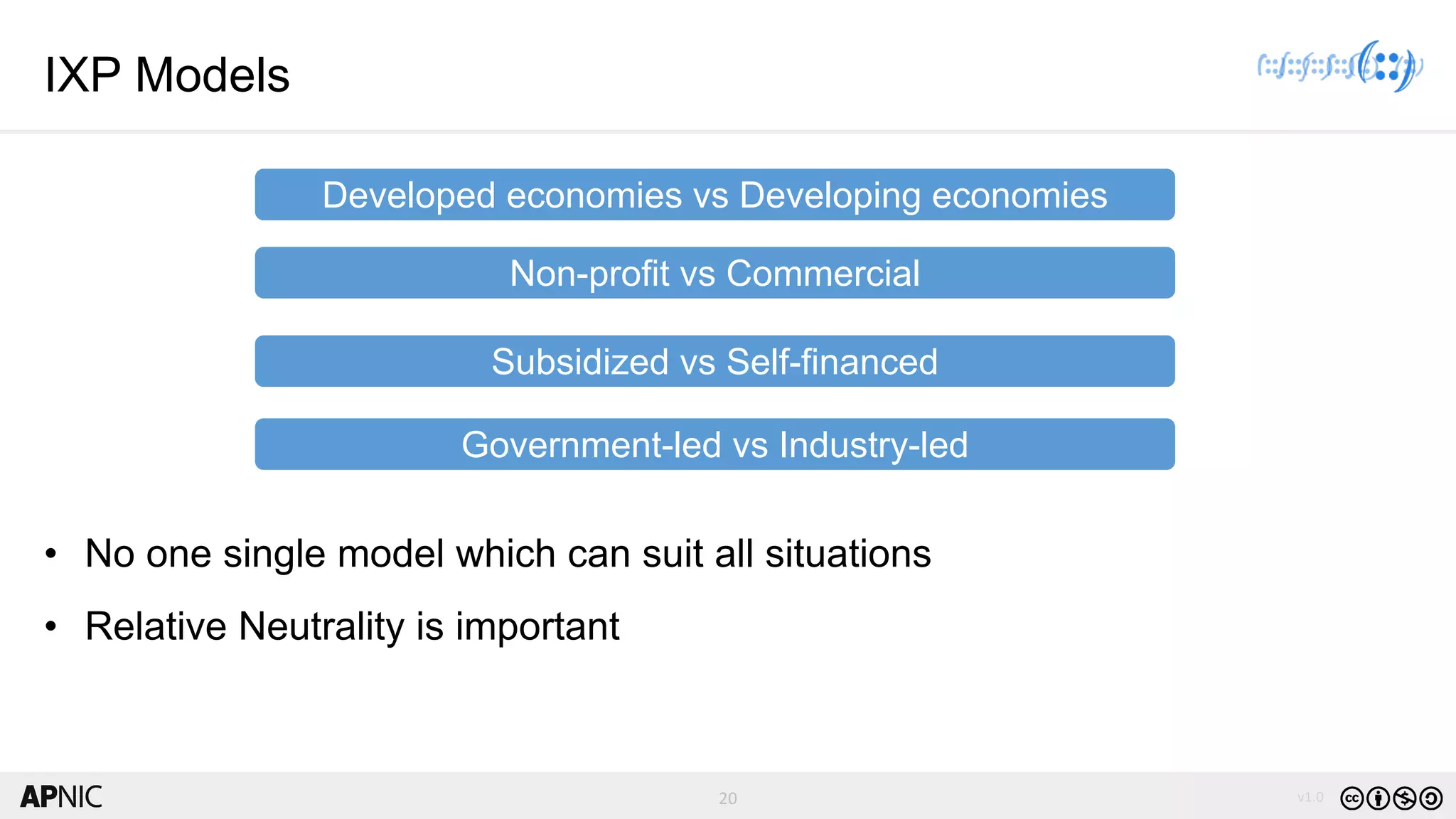
Government-led vs Industry-led
Subsidized vs Self-financed
Non-profit vs Commercial
Developed economies vs Developing economies
IXP Models
• No one single model which can suit all situations
• Relative Neutrality is important
21 v1.021
Commercial vs Non-Profit
• Commercial set-up is free to do anything
o No need to care about neutrality too much
o IXP is mostly a service to help other business
• Non-profit set-up tends to be more cautious
o Neutrality is more important, at least to the target participants
o Tend to be more independent
o Tend to offer fewer services
22 v1.022
Advanced / Developed Economies
• IXPs are business
o Even for not-for-profit set-up
o Less government involvement
• Multiple IXPs
o Keen competition
• But if they cannot keep intra-economy traffic local, someone needs to step
up
o Government? Industry group? Customer pressure?
23 v1.023
Developing Economies
• Some do not have any IXPs yet
• Local traffic does not stay local
o A lose-lose situation for everybody
• IXPs can help Internet development a lot
o Better to be non-for-profit set-up
o May need to start with subsidized model
o May not be a business at all
o Help from government is mostly needed
o Active participation of the biggest players is also very important
24 v1.024
Examples of Pacific Islands
• Far from any other places
• External connectivity is very expensive
o More submarine cables are being built for them
• Small markets because of small population
• Usually just a few ISPs but they may not be interconnected locally
• Local traffic across ISPs usually routed through US or Australia
• Local IXP is very much needed for helping Internet development
• Observed immediate benefits on Day 1 of set-up of Fiji-IXP
o Much improved latency and high volume of traffic
25
Before Fiji-IXP was
set up
• A Fijian ISP in Suva accessing content at the
University of the South Pacific in Suva
• Packet travels > 25,000km
• Physical distance < 10km
• Adding long latency
• Possibly high jitter too
• Using expensive submarine capacity
• Return path had similar issue
26 v1.026
Politics Involved in Early IXP Development
• Usually larger ISPs like IXP less than smaller ISPs because smaller ISPs are mostly target
customers of larger ISPs
• Larger ISPs refuse to connect to IXP making the value of IXP lower
• There are multiple possible mitigation options for that but in any case, larger ISPs need to
collaborate
o E.g. separating access networks from Internet gateway or transit network
• If hurting the goal of “Keeping Local Traffic Local”, then it is lose-lose to everybody
• Government involvement may help or may hurt the case
o It depends on the relationship between the industry and the government
o Forcing large ISPs to do peering may not achieve the expected outcomes
• But having an IXP is NOT a magic wand to solve all the issues
o But collaborative spirit is
27 v1.027
Government Funding for IXPs?
• Is it good or bad?
• More needed during infancy stage of IXP development
• But for long-term, it is probably better to have bottom-up industry-led
governance for IXP
o Align with bottom-up multi-stakeholder approach
o Need to have a long-term sustainable financial model
28 v1.028
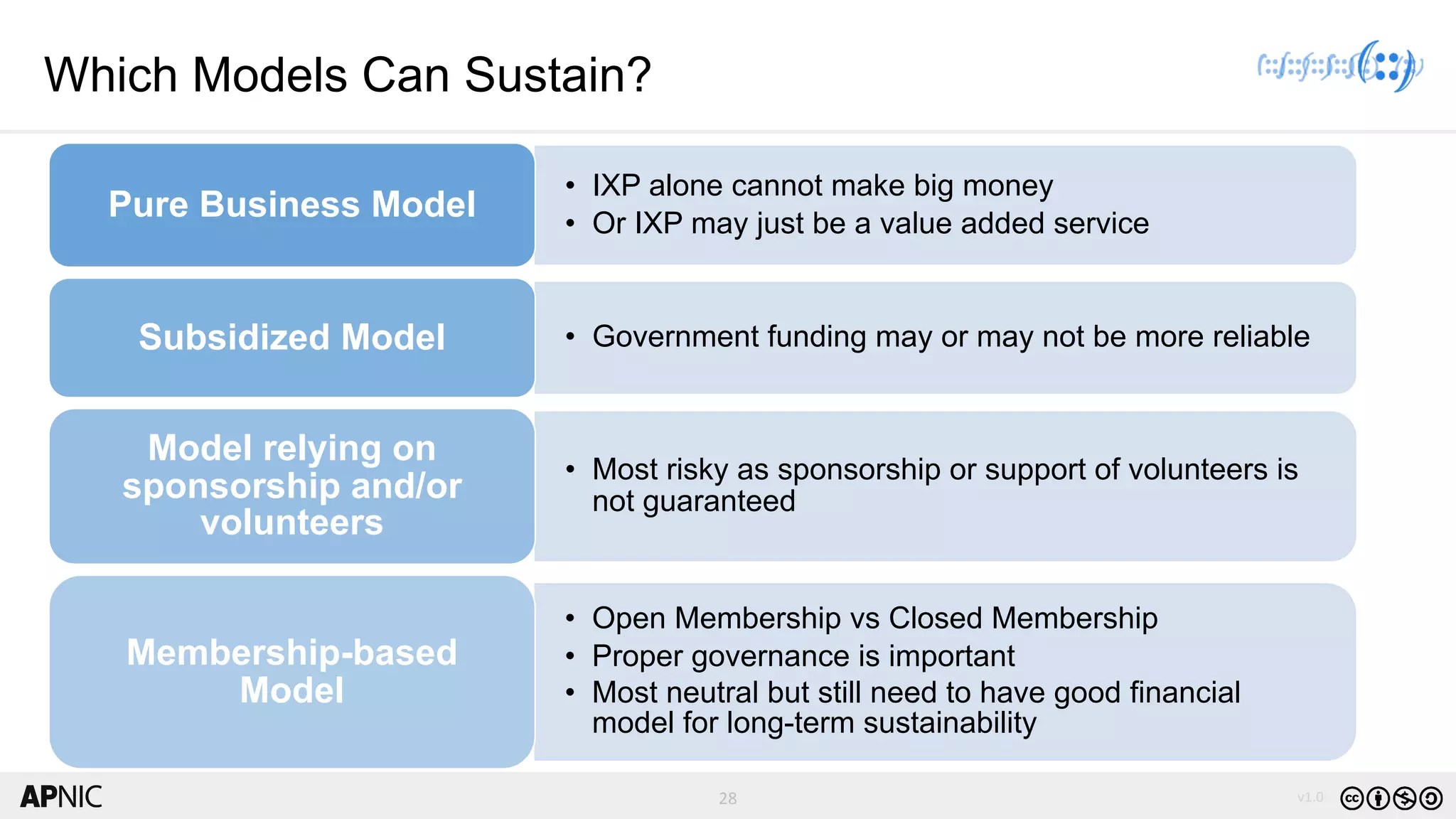
Which Models Can Sustain?
• IXP alone cannot make big money
• Or IXP may just be a value added service
Pure Business Model
• Government funding may or may not be more reliableSubsidized Model
• Most risky as sponsorship or support of volunteers is
not guaranteed
Model relying on
sponsorship and/or
volunteers
• Open Membership vs Closed Membership
• Proper governance is important
• Most neutral but still need to have good financial
model for long-term sustainability
Membership-based
Model
29 v1.029
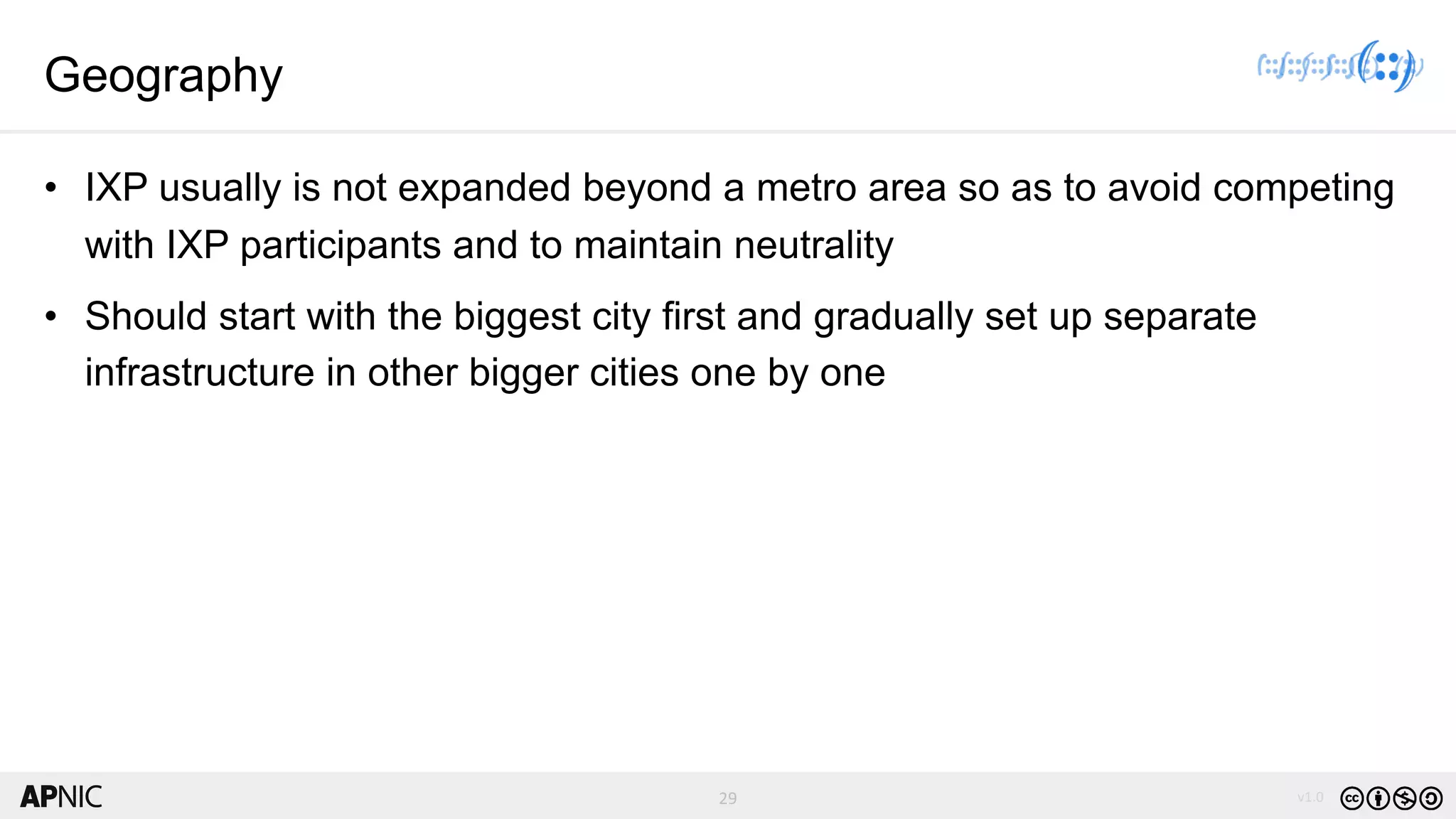
Geography
• IXP usually is not expanded beyond a metro area so as to avoid competing
with IXP participants and to maintain neutrality
• Should start with the biggest city first and gradually set up separate
infrastructure in other bigger cities one by one
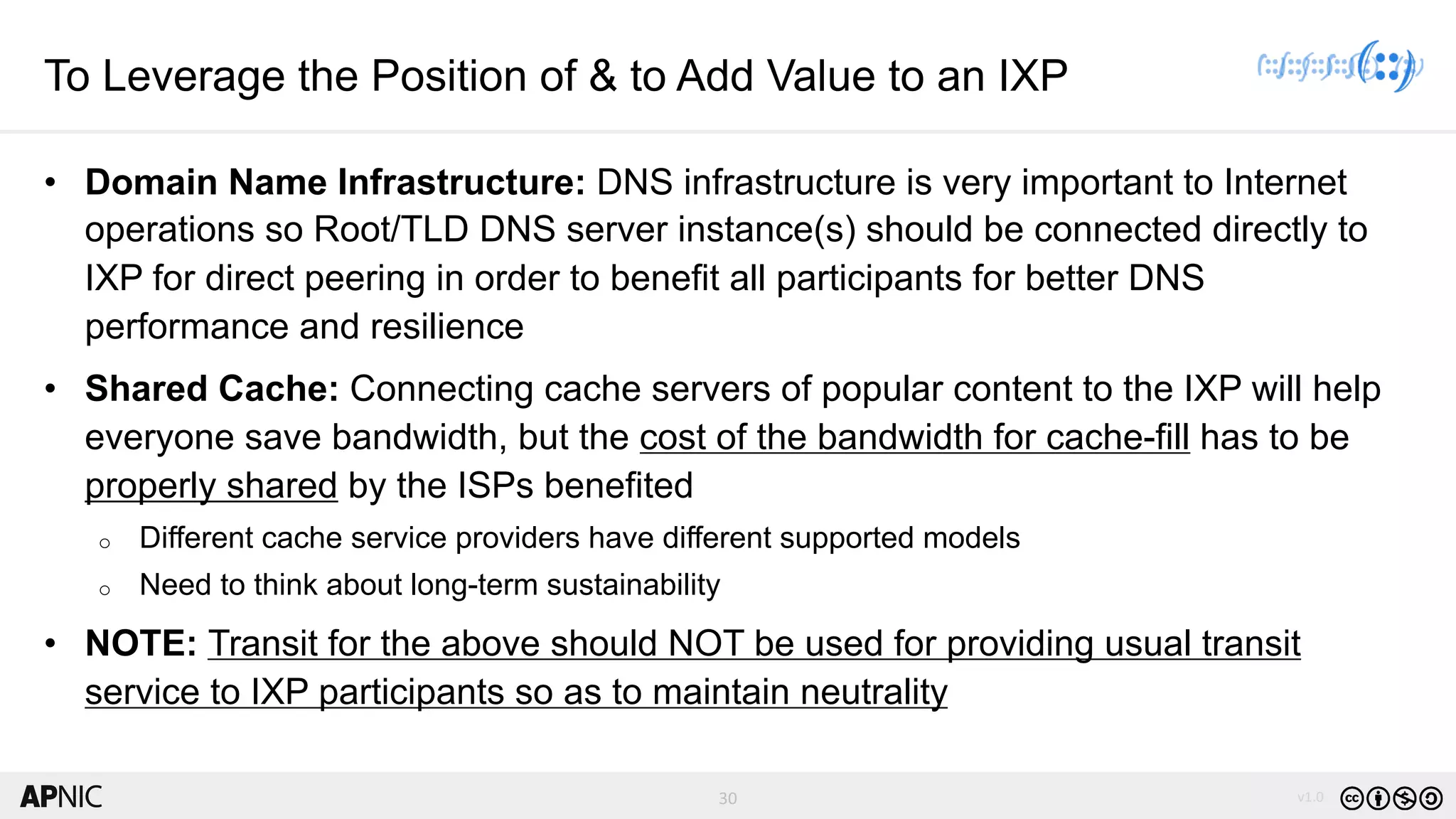
30 v1.030
To Leverage the Position of & to Add Value to an IXP
• Domain Name Infrastructure: DNS infrastructure is very important to Internet
operations so Root/TLD DNS server instance(s) should be connected directly to
IXP for direct peering in order to benefit all participants for better DNS
performance and resilience
• Shared Cache: Connecting cache servers of popular content to the IXP will help
everyone save bandwidth, but the cost of the bandwidth for cache-fill has to be
properly shared by the ISPs benefited
o Different cache service providers have different supported models
o Need to think about long-term sustainability
• NOTE: Transit for the above should NOT be used for providing usual transit
service to IXP participants so as to maintain neutrality
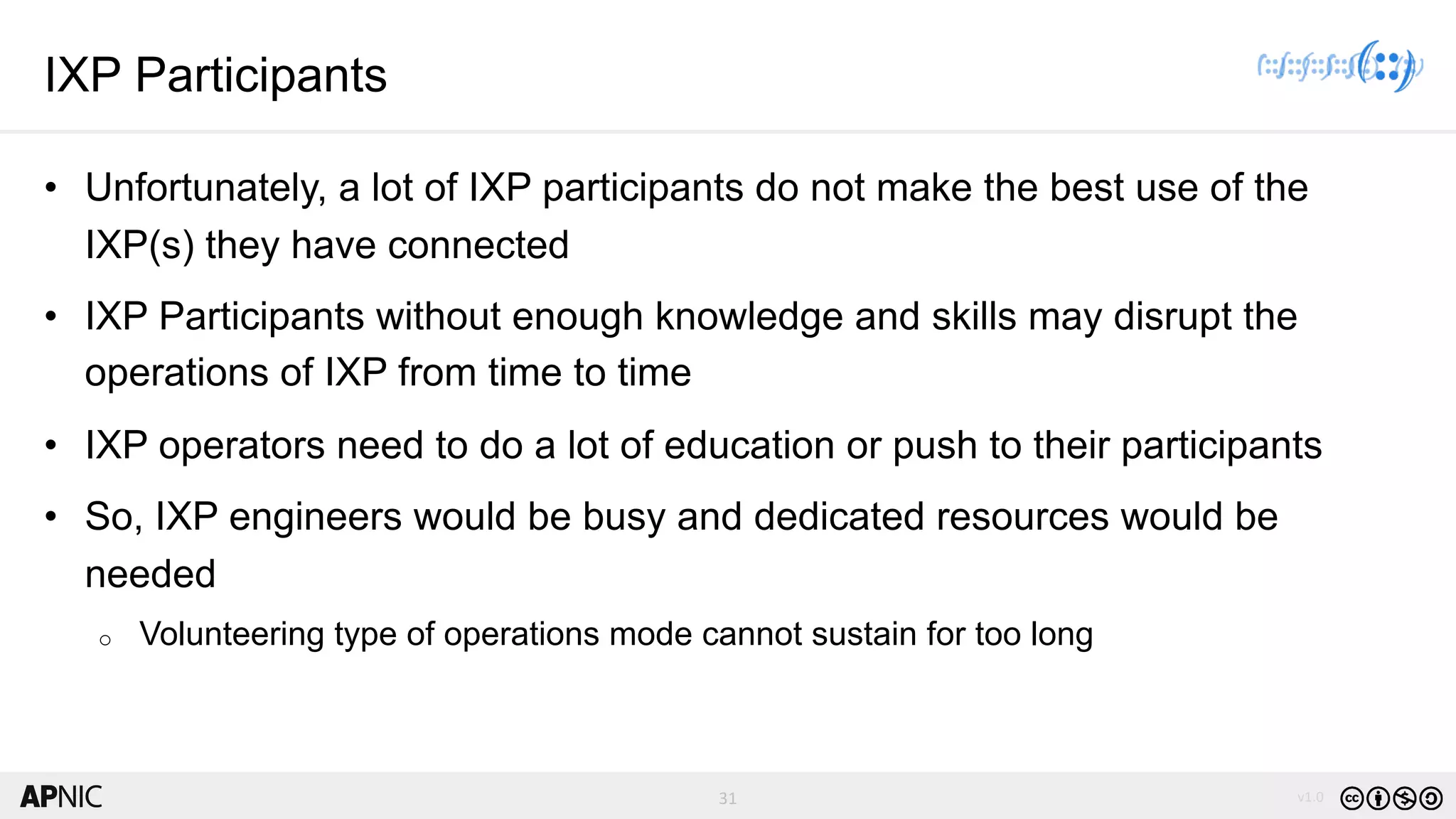
31 v1.031
IXP Participants
• Unfortunately, a lot of IXP participants do not make the best use of the
IXP(s) they have connected
• IXP Participants without enough knowledge and skills may disrupt the
operations of IXP from time to time
• IXP operators need to do a lot of education or push to their participants
• So, IXP engineers would be busy and dedicated resources would be
needed
o Volunteering type of operations mode cannot sustain for too long
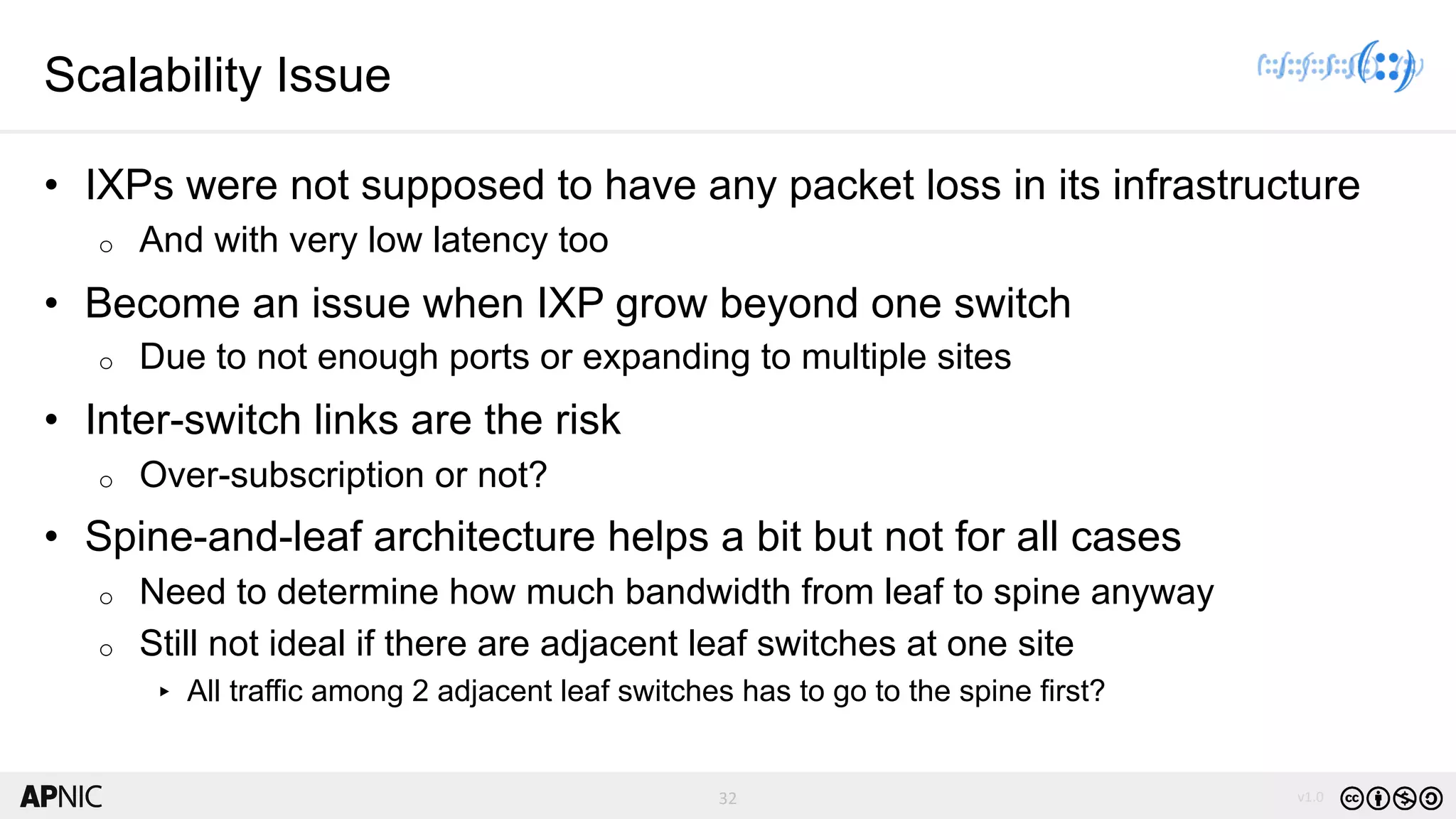
32 v1.032
Scalability Issue
• IXPs were not supposed to have any packet loss in its infrastructure
o And with very low latency too
• Become an issue when IXP grow beyond one switch
o Due to not enough ports or expanding to multiple sites
• Inter-switch links are the risk
o Over-subscription or not?
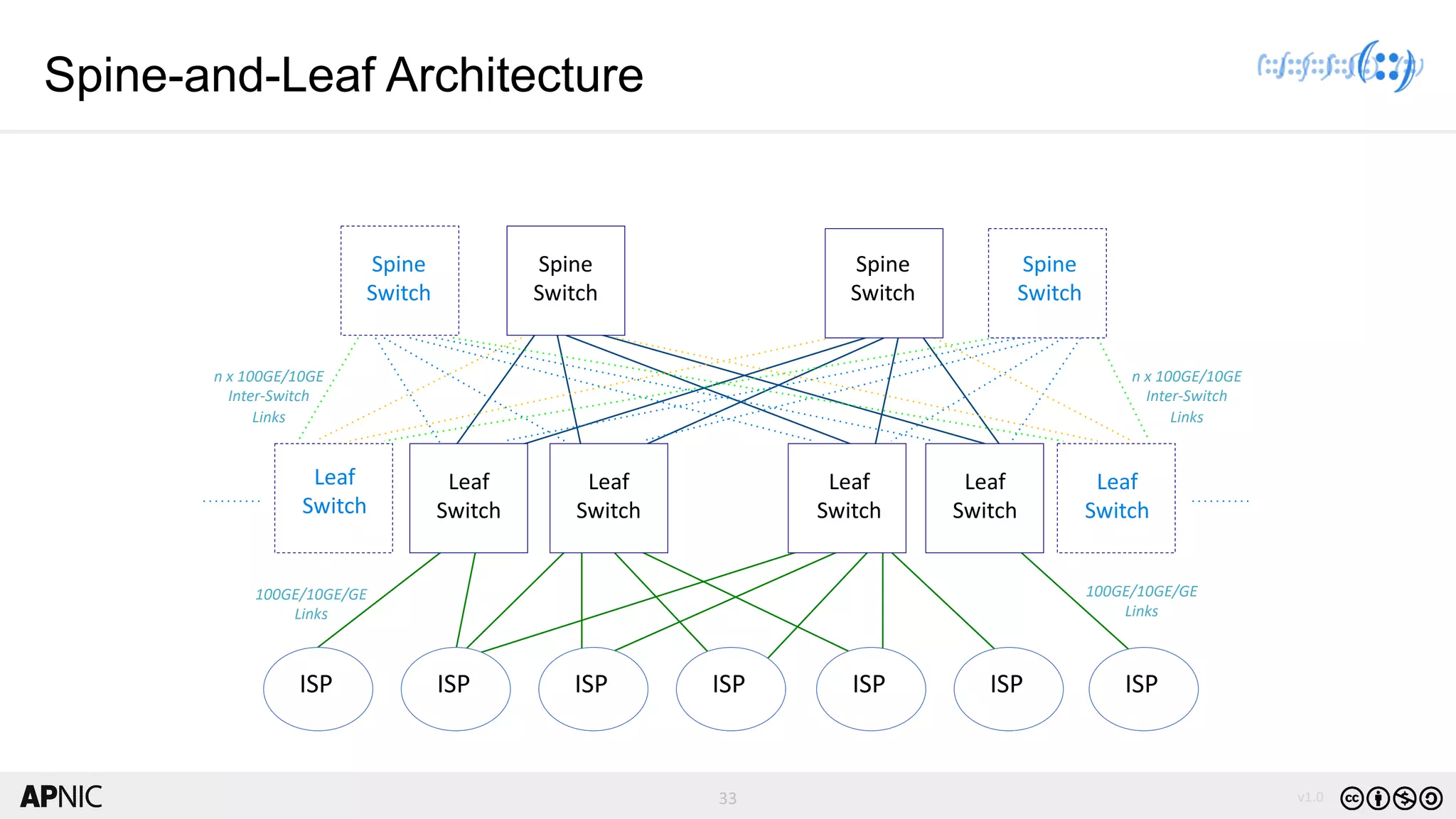
• Spine-and-leaf architecture helps a bit but not for all cases
o Need to determine how much bandwidth from leaf to spine anyway
o Still not ideal if there are adjacent leaf switches at one site
▸ All traffic among 2 adjacent leaf switches has to go to the spine first?
33 v1.033
Spine
Switch
Spine
Switch
Leaf
Switch
Leaf
Switch
Leaf
Switch
n x 100GE/10GE
Inter-Switch
Links
n x 100GE/10GE
Inter-Switch
Links
ISP ISP ISP ISP ISP ISP ISP
Spine
Switch
Spine
Switch
Leaf
Switch
Leaf
Switch
100GE/10GE/GE
Links
100GE/10GE/GE
Links
Leaf
Switch
Spine-and-Leaf Architecture
34 v1.034
IXP Development Work of APNIC
• APNIC strongly believes IXPs help Internet development
o That is why we support APIX and related activities

o After all, IXPs serve and benefit APNIC members
o In fact, IXPs need IP addresses and ASNs and so are APNIC members themselves
• Do more on helping those developing economies
o Especially those which do not have any IXP yet
o Or those which their only IXP is not functioning
• Training and Technical Assistance work primarily
o Not just for IXP operators but also for IXP participants
o Also help talk to major stakeholders to convince them of the benefits of having a local IXP while maintaining neutrality
o May need help of Community Trainers and Consultants from time to time
• Having been supporting IXP development in Fiji, PNG, Vanuatu, Mongolia, Bhutan, Myanmar, some
cities in India and others
35 v1.035
IXP Development Package of APNIC
• Providing Training & Technical Assistance is the minimum
• Will tailor-make support according to individual needs
• Other possible support items (on a case-by-case basis):
o Ethernet switch
o Root Server anycast instance
o Route Server
o ROV & IPv6 deployment support
o IXP Manager
o RIPE Atlas Anchors
o CSIRT Establishment
o Honeypot of Honeynet Project for Analysis
o BGP Route Collection for Analysis
• APIX Membership is recommended to all IXPs
36 v1.036
Route Origin Validation (ROV) at IXP
– via Route Server and/or Shared Validator
Validated
cache
Validator
RPKI-to-Router (RTR)
Routes
Tagged/filtered
routes
RS
37 v1.037
Other Help & Support by APNIC
• APNIC also provides help & support to:
o APIX
o Peering Asia
o Peering Forums hosted by not-for-profit IXPs
o NOGs (which IXPs usually support)
• APNIC also sponsors:
o PeeringDB
o IXP-DB
o IXP Manager
38 v1.038
Final Remarks
• IXPs will continue to play a key role for easier interconnections among
networks for local peering in order to achieve “Keeping Local Traffic
Local”
o Especially for developing economies
o But IXP is NOT a magic wand to solve all the issues
▸ Collaborative spirit is
• Need to find a suitable model for long-term sustainability
• Relative neutrality is important
o So better to maintain it as much as possible
• After all, “Keeping Local Traffic Local” is the most important thing
39 v1.039
Thank You!END OF SESSIONThank You!END OF SESSION

PacNOG 25: Keeping local traffic local by doing local peering

  • 1.
    1 Keeping Local TrafficLocal by Doing Local Peering Che-Hoo Cheng Infrastructure & Development Director, APNIC PacNOG25@2019-12-02
  • 2.
    2 v1.02 How DoesInternet Operates? • Internet is a network of networks, composed of networks of ISPs and users • User networks connect to ISPs • Small ISPs connect to large ISPs • Various networks (large or small) are interconnected with one another to form Internet
  • 3.
    3 v1.03 Autonomous Systems •A network on Internet is called Autonomous System (AS) which is represented by AS Number (ASN) o ASN is unique around the world ▸ APNIC is in charge of ASN assignment for AP region o Used together with BGP (Border Gateway Protocol) for interconnections with multiple networks (or multi-homing) o Networks having ASNs can be more independent, or portable ▸ Together with portable IP addresses ▸ Like what APNIC members are enjoying…
  • 4.
    4 v1.04 Transit Provider (Upstream) GlobalInternet Downstream Customer Customer routes only Routes of the whole world All customer routes Ordinary Transit Model
  • 5.
    5 v1.05 Transit inGeneral • Networks pay transit providers to get to the whole Internet o Can connect to multiple transit providers for resilience and portability • A few very large ISPs act as transit providers for the whole world (the so- called tier-1 networks) which do not need to pay others to get full Internet connectivity o Other ISPs must be transit customers of those tier-1 networks directly or indirectly in order to gain full connectivity • Networks on Internet are trying to bypass transit providers as much as possible o for lower cost and higher performance
  • 6.
    6 v1.06 Transit ProviderA (Upstream) Transit Provider B (Upstream) Downstream Customer Downstream Customer Downstream Customer Downstream Customer Routes of A and its customers Routes of B and its customers Ordinary Peering Model
  • 7.
    7 v1.07 Peering inGeneral • ASes are interconnected/peered at Internet exchanges points (IXPs) or privately • Interconnection/peering is among ISPs / data centres / content providers / cloud services providers which have different ASNs using BGP protocol • For higher performance, lower latency and lower cost • Usually no settlement between peers and cost is shared For mutual benefits • Local-to-local traffic do NOT need to route through overseas • Important to local Internet development Local Peering • BLPA (Bi-Lateral Peering Agreement)Between 2 ASes • MLPA (Multi-Lateral Peering Agreement)Among > 2 ASes
  • 8.
    8 Example of Not HavingLocal Peering • A Fijian ISP in Suva accessing content at the University of the South Pacific in Suva • Packet travels > 25,000km • Physical distance < 10km • Adding long latency • Possibly high jitter too • Using expensive submarine capacity • Return path had similar issue
  • 9.
    9 v1.09 Private Peering •A form of BLPA having dedicated point-to-point connection between 2 ASes • Using cross-connect or local loop or IPL to interconnect o Cost is usually shared between 2 peers • May have multiple connections between 2 ASes for resiliency • Not quite cost-effective o Spare bandwidth cannot be used for other traffic • Not very scalable o nC2 physical connections for n ASes to peer fully with one another
  • 10.
    10 v1.010 What isan Internet eXchange Point (IXP)? • An IXP is a shared physical network infrastructure over which various Autonomous Systems can do easy peering with one another One physical connection to IXP can be used for interconnections with multiple networks More cost-effective and scalable ASes to be served by IXP include Internet Gateways, Internet Service Providers (ISPs), Research & Education (R&E) Networks, Cloud Service Providers, Content Providers and Content Delivery Network (CDN) Service Providers
  • 11.
    11 v1.011 Simplest IXPTopology IXP Switch Border Router of ISP A Border Router of ISP B Border Router of ISP D Border Router of ISP C
  • 12.
    12 v1.012 Benefits ofIXP • One main objective of an IXP is to keep local traffic local o Important to local Internet development • Helps bypass 3rd-party network infrastructure for easy interconnection and direct traffic exchange among participating networks o Reduced cost – cheaper connectivity o Enhanced network performance – faster speed o Reduced latency – lower delay • Helps encourage development of more local content and local applications o Helps local data centre business and other businesses • Everybody is benefited o The gain for each may be different but all will gain o At the end, it is the most important that end users or consumers are benefited • Often considered as Critical Internet Infrastructure locally, regionally or globally
  • 13.
    13 v1.013 IXPs areLayer-2 Networks • Switched Ethernet o One physical connection for interconnections with multiple networks o Only routers are allowed to connect to the switching fabric directly • IXP participants can do direct Bilateral Peering (BLPA) over the layer 2 infrastructure anytime • With Route Server added to the layer 2 infrastructure, IXP participants can also do Multilateral Peering (MLPA) for easier interconnections among everybody o Traffic exchange is not going through the route server but direct • Those called themselves “IXes” but serving layer-3 services are mostly transit providers
  • 14.
    14 v1.014 Value andAttractiveness of an IXP • Proportional to the number of different networks (ASNs) connected and also the traffic volume • Snowball effect after reaching critical mass o The initial period usually is the hardest ▸ Most will take wait-and-see approach o Gradually will have good mix of networks of different types ▸ E.g. Eyeballs vs Content
  • 15.
    15 v1.015 Evolution • IXPdevelopment is an evolutionary process o Can be done step by step • It can be improved over time, but picking the right initial neutral organisation / governance model and a neutral site at the start is important for future success
  • 16.
    16 v1.016 Possible Stepsfor IXP Development • Can be gradual, step by step • Layer-2 network is the bare minimal o Can use private IP addresses if small amount of participants • Public IP addresses next o Legal entity issue • Site resilience is IMPORTANT while equipment resilience is already included o Has to have site resilience sooner or later • Route server(s) with ASN follows o RPKI consideration • Other value added services o DNS: Root / TLDs / Recursive o Shared Content Caches?
  • 17.
    17 v1.017 IP/ASN Resourcesfor an IXP • Considered as Critical Infrastructure under APNIC Policy o Using public IP addresses and ASN is recommended o IPv4: /24 o IPv6: /48 o ASN: 1 (for route server) • But IXP may need another network to provide transit o Own servers such as network management & monitoring o DNS anycast servers: Authoritative or Cache/Resolving/Recursive o Shared Content Caches for Participants o Usually small
  • 18.
    18 v1.018 Neutral Locationis Good Starting Point • May choose one of the followings as starting point: o University o Technology Park o Carrier Neutral Data Center o Government Data Center • Having multiple carrier options with easy access is important • Should maintain neutrality continuously • Expansion to multiple sites within the same metro area can be done gradually, coupled with growth
  • 19.
    19 v1.019 Governance • Multi-stakeholderbottom-up approach is the preferred approach for maximum acceptance of the community • Government support is also important • Be as inclusive as possible in order to provide maximum benefits to the whole community which it serves • Should be fair and consistent to every participant • Should be open and transparent as much as possible
  • 20.
    20 v1.020 Government-led vsIndustry-led Subsidized vs Self-financed Non-profit vs Commercial Developed economies vs Developing economies IXP Models • No one single model which can suit all situations • Relative Neutrality is important
  • 21.
    21 v1.021 Commercial vsNon-Profit • Commercial set-up is free to do anything o No need to care about neutrality too much o IXP is mostly a service to help other business • Non-profit set-up tends to be more cautious o Neutrality is more important, at least to the target participants o Tend to be more independent o Tend to offer fewer services
  • 22.
    22 v1.022 Advanced /Developed Economies • IXPs are business o Even for not-for-profit set-up o Less government involvement • Multiple IXPs o Keen competition • But if they cannot keep intra-economy traffic local, someone needs to step up o Government? Industry group? Customer pressure?
  • 23.
    23 v1.023 Developing Economies •Some do not have any IXPs yet • Local traffic does not stay local o A lose-lose situation for everybody • IXPs can help Internet development a lot o Better to be non-for-profit set-up o May need to start with subsidized model o May not be a business at all o Help from government is mostly needed o Active participation of the biggest players is also very important
  • 24.
    24 v1.024 Examples ofPacific Islands • Far from any other places • External connectivity is very expensive o More submarine cables are being built for them • Small markets because of small population • Usually just a few ISPs but they may not be interconnected locally • Local traffic across ISPs usually routed through US or Australia • Local IXP is very much needed for helping Internet development • Observed immediate benefits on Day 1 of set-up of Fiji-IXP o Much improved latency and high volume of traffic
  • 25.
    25 Before Fiji-IXP was setup • A Fijian ISP in Suva accessing content at the University of the South Pacific in Suva • Packet travels > 25,000km • Physical distance < 10km • Adding long latency • Possibly high jitter too • Using expensive submarine capacity • Return path had similar issue
  • 26.
    26 v1.026 Politics Involvedin Early IXP Development • Usually larger ISPs like IXP less than smaller ISPs because smaller ISPs are mostly target customers of larger ISPs • Larger ISPs refuse to connect to IXP making the value of IXP lower • There are multiple possible mitigation options for that but in any case, larger ISPs need to collaborate o E.g. separating access networks from Internet gateway or transit network • If hurting the goal of “Keeping Local Traffic Local”, then it is lose-lose to everybody • Government involvement may help or may hurt the case o It depends on the relationship between the industry and the government o Forcing large ISPs to do peering may not achieve the expected outcomes • But having an IXP is NOT a magic wand to solve all the issues o But collaborative spirit is
  • 27.
    27 v1.027 Government Fundingfor IXPs? • Is it good or bad? • More needed during infancy stage of IXP development • But for long-term, it is probably better to have bottom-up industry-led governance for IXP o Align with bottom-up multi-stakeholder approach o Need to have a long-term sustainable financial model
  • 28.
    28 v1.028 Which ModelsCan Sustain? • IXP alone cannot make big money • Or IXP may just be a value added service Pure Business Model • Government funding may or may not be more reliableSubsidized Model • Most risky as sponsorship or support of volunteers is not guaranteed Model relying on sponsorship and/or volunteers • Open Membership vs Closed Membership • Proper governance is important • Most neutral but still need to have good financial model for long-term sustainability Membership-based Model
  • 29.
    29 v1.029 Geography • IXPusually is not expanded beyond a metro area so as to avoid competing with IXP participants and to maintain neutrality • Should start with the biggest city first and gradually set up separate infrastructure in other bigger cities one by one
  • 30.
    30 v1.030 To Leveragethe Position of & to Add Value to an IXP • Domain Name Infrastructure: DNS infrastructure is very important to Internet operations so Root/TLD DNS server instance(s) should be connected directly to IXP for direct peering in order to benefit all participants for better DNS performance and resilience • Shared Cache: Connecting cache servers of popular content to the IXP will help everyone save bandwidth, but the cost of the bandwidth for cache-fill has to be properly shared by the ISPs benefited o Different cache service providers have different supported models o Need to think about long-term sustainability • NOTE: Transit for the above should NOT be used for providing usual transit service to IXP participants so as to maintain neutrality
  • 31.
    31 v1.031 IXP Participants •Unfortunately, a lot of IXP participants do not make the best use of the IXP(s) they have connected • IXP Participants without enough knowledge and skills may disrupt the operations of IXP from time to time • IXP operators need to do a lot of education or push to their participants • So, IXP engineers would be busy and dedicated resources would be needed o Volunteering type of operations mode cannot sustain for too long
  • 32.
    32 v1.032 Scalability Issue •IXPs were not supposed to have any packet loss in its infrastructure o And with very low latency too • Become an issue when IXP grow beyond one switch o Due to not enough ports or expanding to multiple sites • Inter-switch links are the risk o Over-subscription or not? • Spine-and-leaf architecture helps a bit but not for all cases o Need to determine how much bandwidth from leaf to spine anyway o Still not ideal if there are adjacent leaf switches at one site ▸ All traffic among 2 adjacent leaf switches has to go to the spine first?
  • 33.
    33 v1.033 Spine Switch Spine Switch Leaf Switch Leaf Switch Leaf Switch n x100GE/10GE Inter-Switch Links n x 100GE/10GE Inter-Switch Links ISP ISP ISP ISP ISP ISP ISP Spine Switch Spine Switch Leaf Switch Leaf Switch 100GE/10GE/GE Links 100GE/10GE/GE Links Leaf Switch Spine-and-Leaf Architecture
  • 34.
    34 v1.034 IXP DevelopmentWork of APNIC • APNIC strongly believes IXPs help Internet development o That is why we support APIX and related activities o After all, IXPs serve and benefit APNIC members o In fact, IXPs need IP addresses and ASNs and so are APNIC members themselves • Do more on helping those developing economies o Especially those which do not have any IXP yet o Or those which their only IXP is not functioning • Training and Technical Assistance work primarily o Not just for IXP operators but also for IXP participants o Also help talk to major stakeholders to convince them of the benefits of having a local IXP while maintaining neutrality o May need help of Community Trainers and Consultants from time to time • Having been supporting IXP development in Fiji, PNG, Vanuatu, Mongolia, Bhutan, Myanmar, some cities in India and others
  • 35.
    35 v1.035 IXP DevelopmentPackage of APNIC • Providing Training & Technical Assistance is the minimum • Will tailor-make support according to individual needs • Other possible support items (on a case-by-case basis): o Ethernet switch o Root Server anycast instance o Route Server o ROV & IPv6 deployment support o IXP Manager o RIPE Atlas Anchors o CSIRT Establishment o Honeypot of Honeynet Project for Analysis o BGP Route Collection for Analysis • APIX Membership is recommended to all IXPs
  • 36.
    36 v1.036 Route OriginValidation (ROV) at IXP – via Route Server and/or Shared Validator Validated cache Validator RPKI-to-Router (RTR) Routes Tagged/filtered routes RS
  • 37.
    37 v1.037 Other Help& Support by APNIC • APNIC also provides help & support to: o APIX o Peering Asia o Peering Forums hosted by not-for-profit IXPs o NOGs (which IXPs usually support) • APNIC also sponsors: o PeeringDB o IXP-DB o IXP Manager
  • 38.
    38 v1.038 Final Remarks •IXPs will continue to play a key role for easier interconnections among networks for local peering in order to achieve “Keeping Local Traffic Local” o Especially for developing economies o But IXP is NOT a magic wand to solve all the issues ▸ Collaborative spirit is • Need to find a suitable model for long-term sustainability • Relative neutrality is important o So better to maintain it as much as possible • After all, “Keeping Local Traffic Local” is the most important thing
  • 39.
    39 v1.039 Thank You!ENDOF SESSIONThank You!END OF SESSION