1
1 v1.0
Technical and Operational Aspects
of Regional Internet Exchange Model
Che-Hoo Cheng
APNIC
2024-11-05
2 v1.0
2
Agenda
• Objectives of Peering, and Benefits of IXPs
• IXP Implementation Steps
• Operation/Business/Governance Models for IXPs
• IXP Development Work of APNIC
• Final Remarks
• Q&A
3 v1.0
3
Disclaimer
• High-level knowledge exchange only
o Not so technical
• No “One Size Fits All”
o Many different “recipes” for running an IXP
• Just to provide hints, not answers
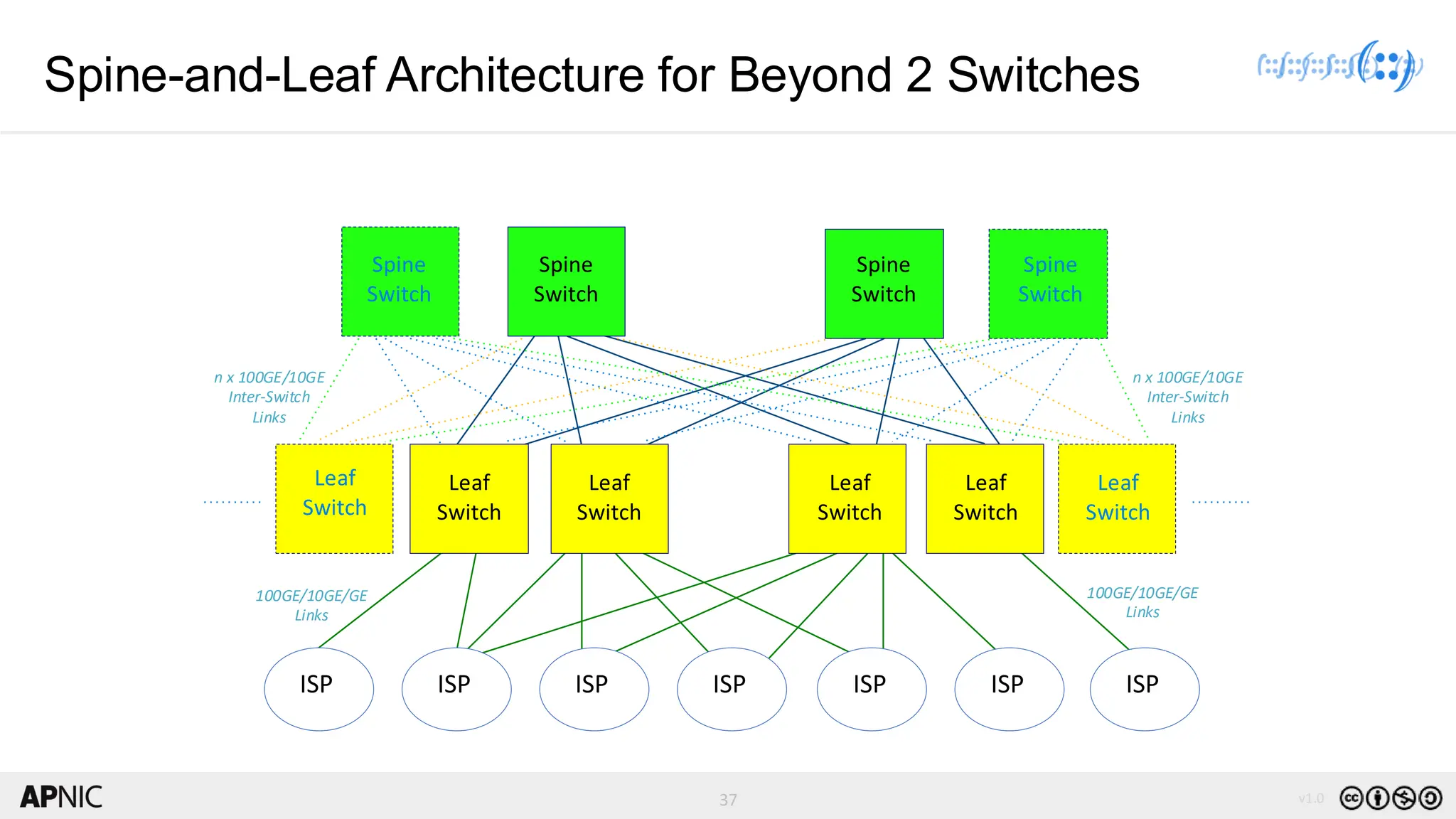
• Cannot cover all scenarios here because of limited time
• Supposed to be interactive
4
4 v1.0
Objectives of Peering
and Benefits of IXPs
5 v1.0
5
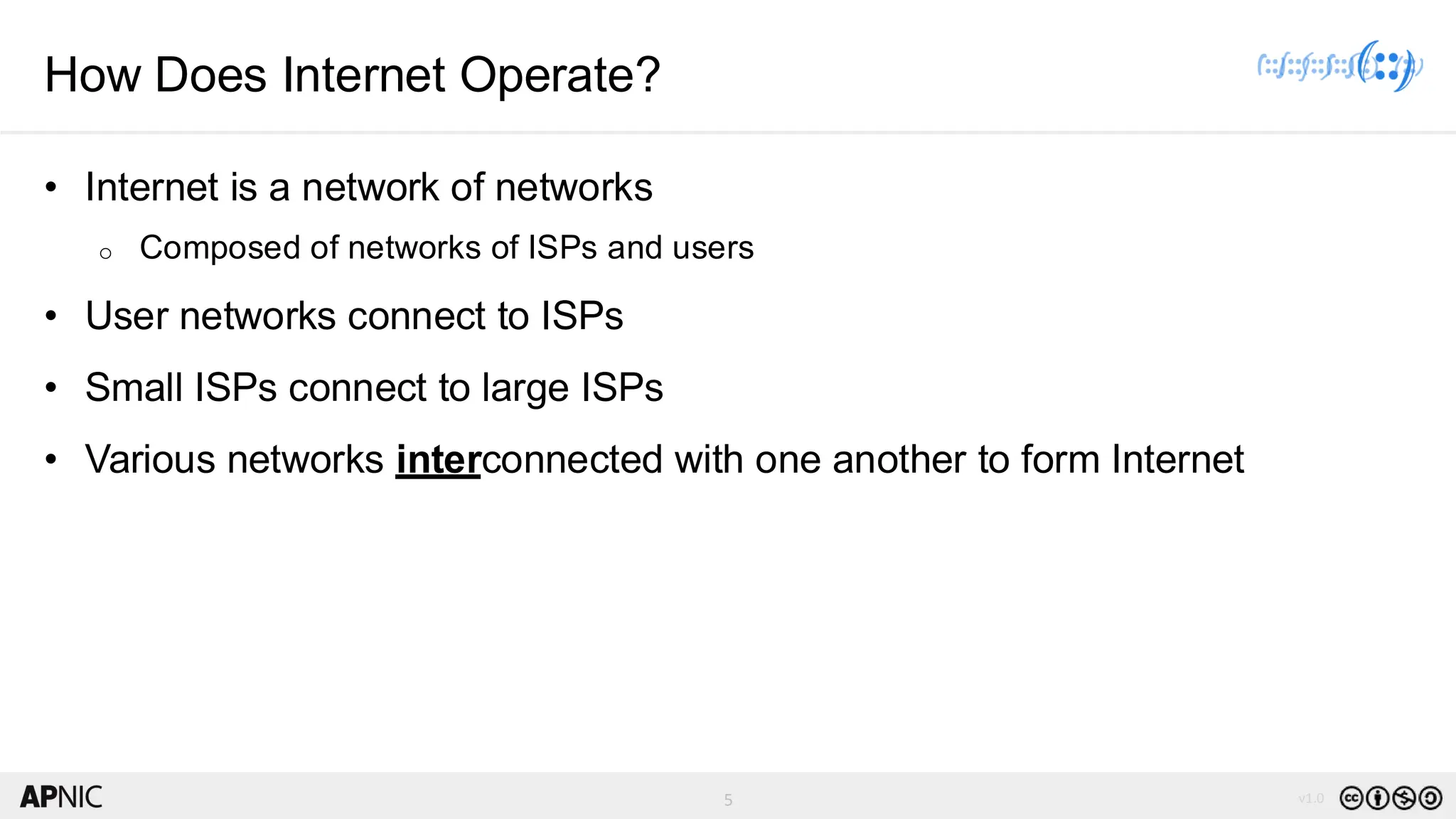
How Does Internet Operate?
• Internet is a network of networks
o Composed of networks of ISPs and users
• User networks connect to ISPs
• Small ISPs connect to large ISPs
• Various networks interconnected with one another to form Internet
8 v1.0
8
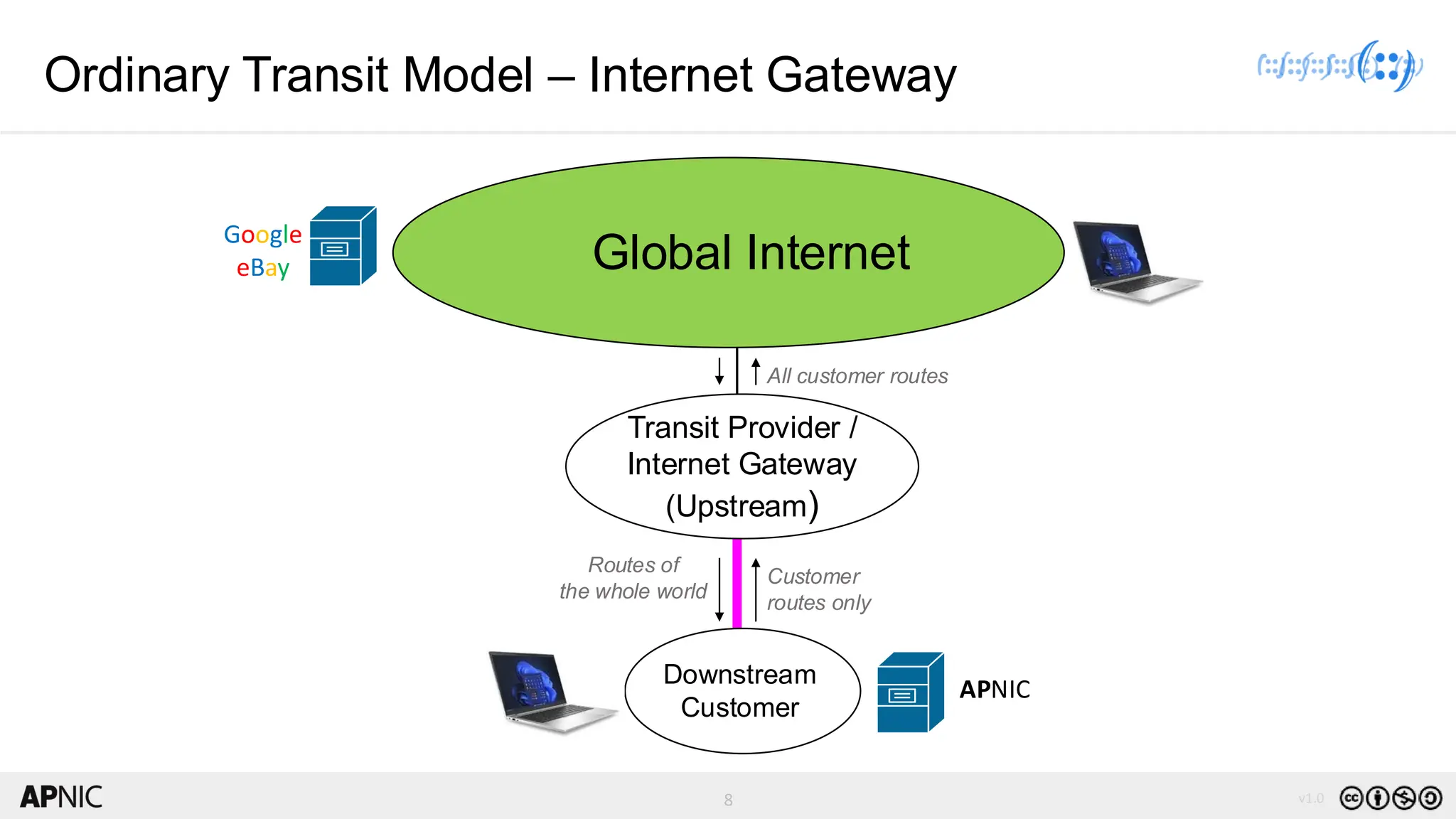
Transit Provider /
Internet Gateway
(Upstream)
Global Internet
Downstream
Customer
Customer
routes only
Routes of
the whole world
All customer routes
Ordinary Transit Model – Internet Gateway
Google
eBay
APNIC
10 v1.0
10
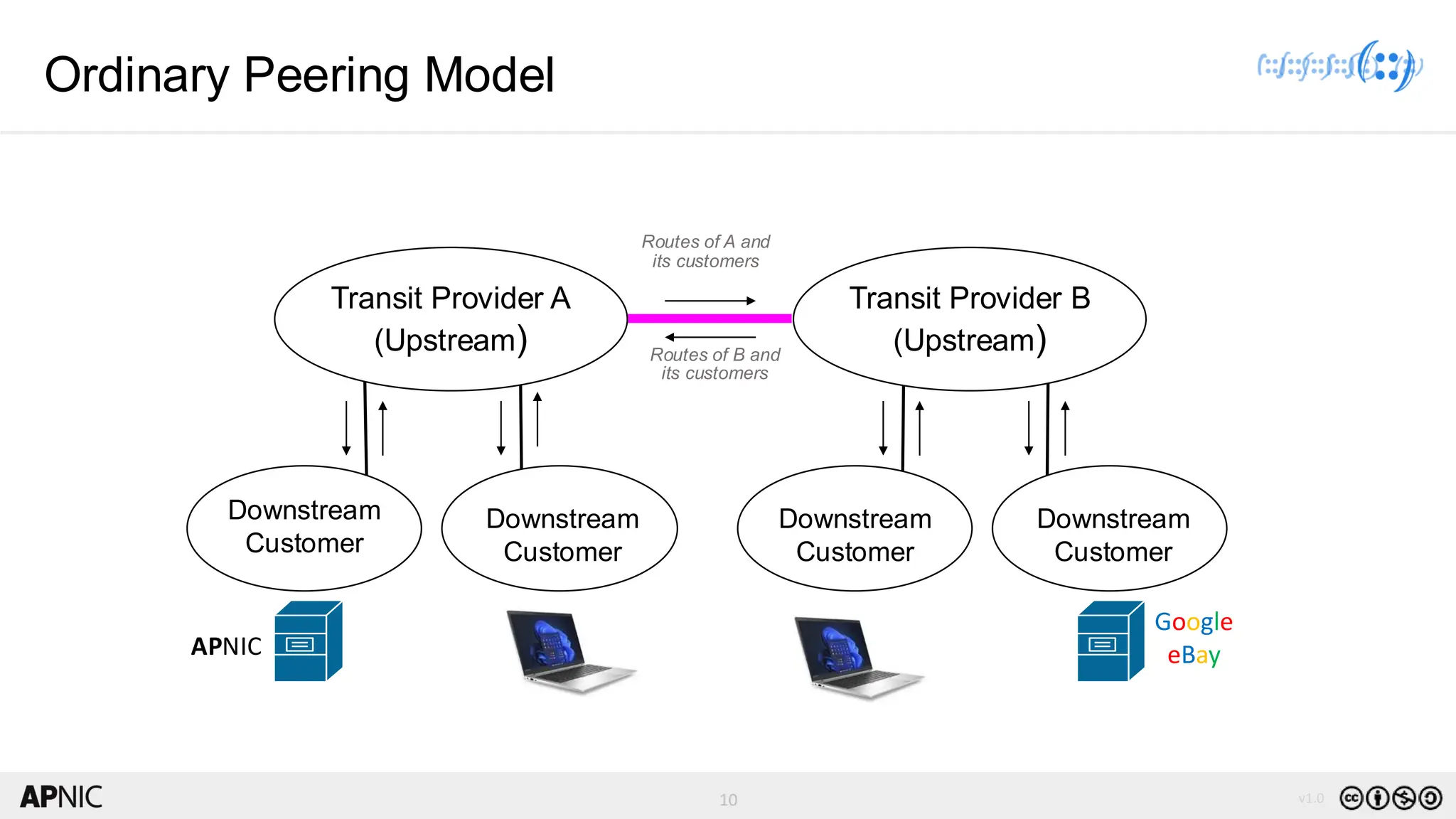
Transit Provider A
(Upstream)
Transit Provider B
(Upstream)
Downstream
Customer
Downstream
Customer
Downstream
Customer
Downstream
Customer
Routes of A and
its customers
Routes of B and
its customers
Ordinary Peering Model
Google
eBay
APNIC
11 v1.0
11
Peering in General
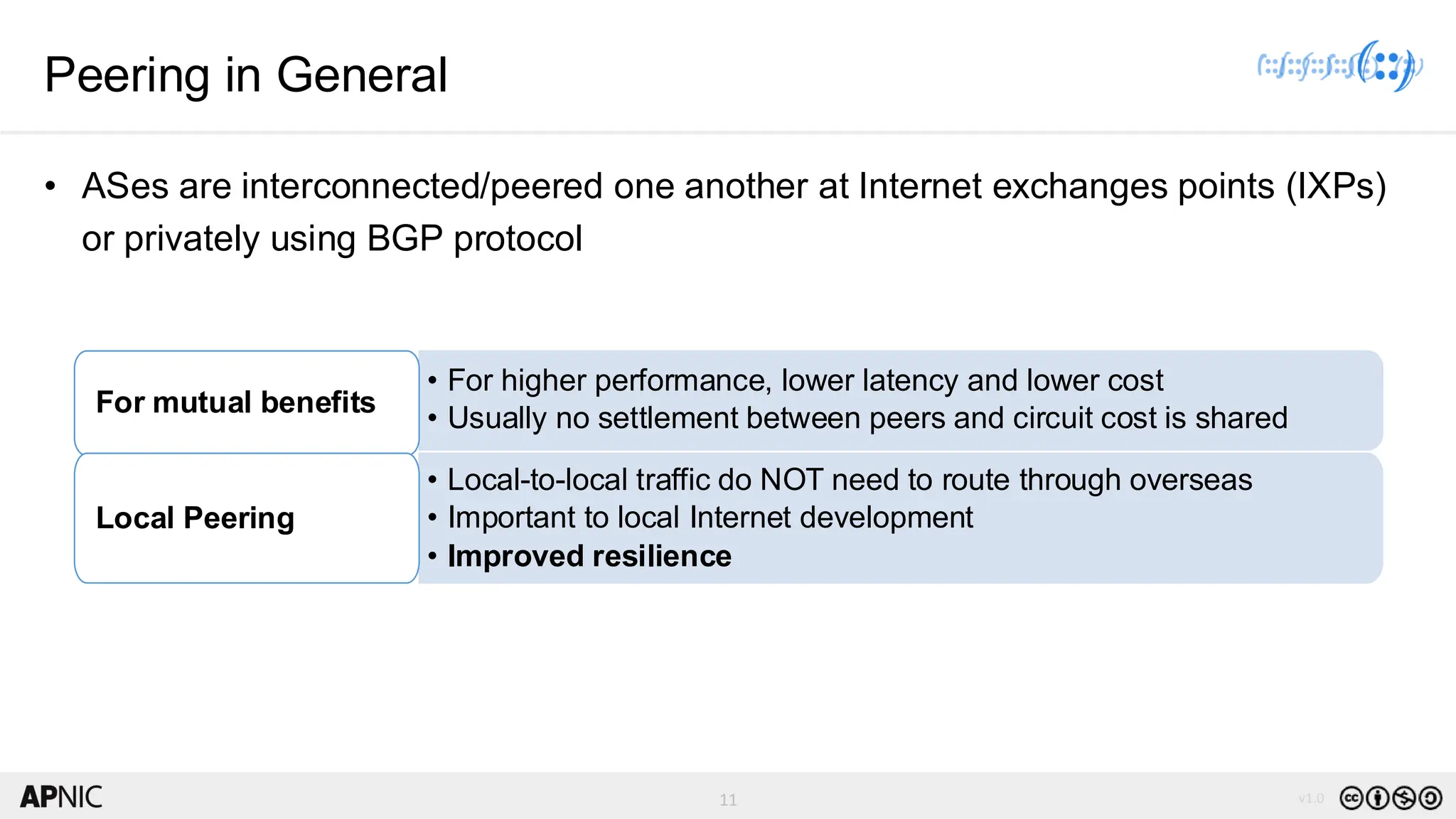
• ASes are interconnected/peered one another at Internet exchanges points (IXPs)
or privately using BGP protocol
• For higher performance, lower latency and lower cost
• Usually no settlement between peers and circuit cost is shared
For mutual benefits
• Local-to-local traffic do NOT need to route through overseas
• Important to local Internet development
• Improved resilience
Local Peering
13 v1.0
13
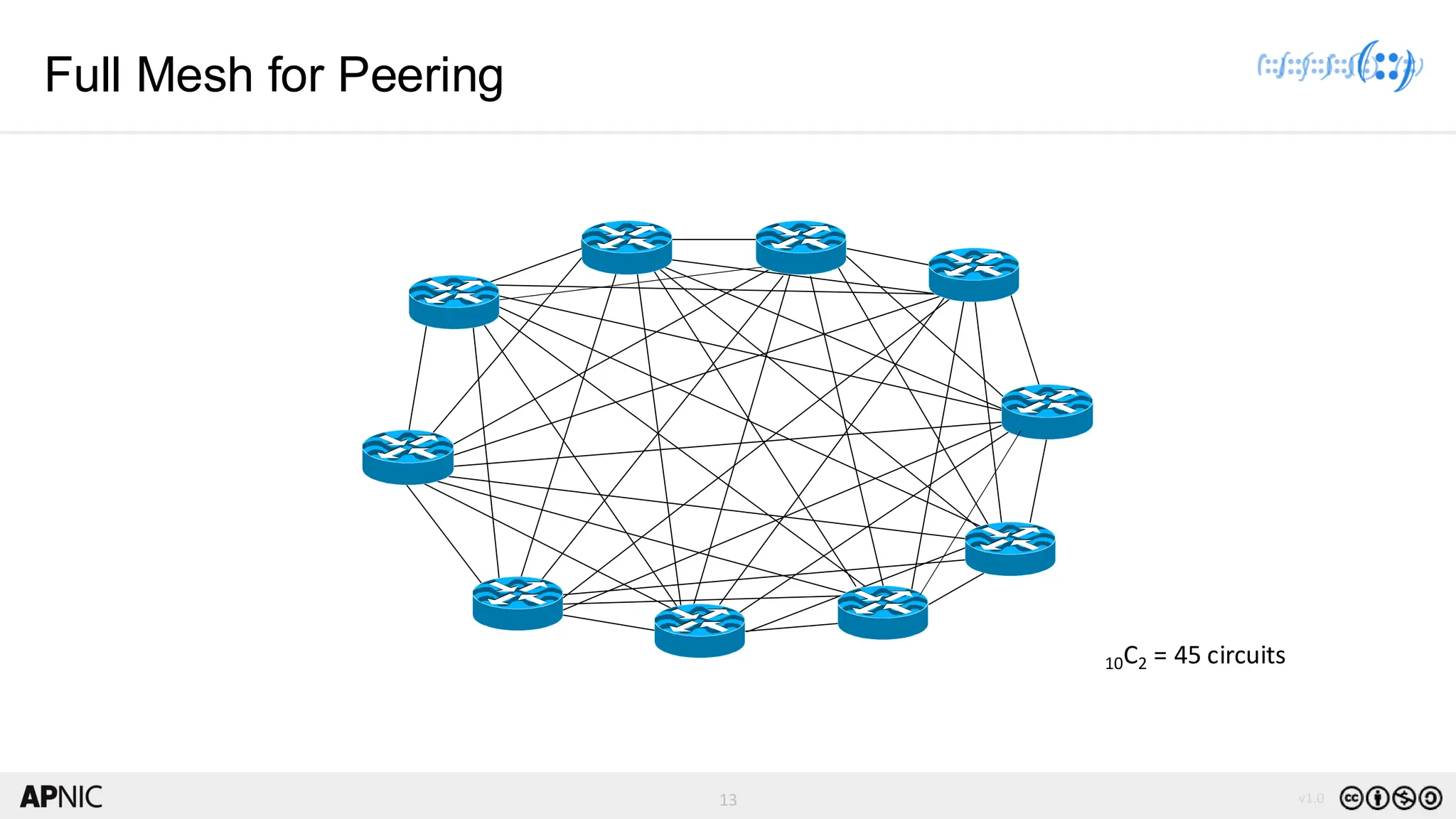
Full Mesh for Peering
10C2 = 45 circuits
15 v1.0
15
What is Internet eXchange Point (IXP)?
• A shared physical network infrastructure over which various ASes can do easy
peering with one another
One physical connection to IXP used for interconnections with multiple networks
More cost-effective and scalable, especially with more participants
IXP serves Internet Service Providers (ISPs), Cloud Service Providers, Content
Providers, Content Delivery Network (CDN) Providers, Research & Education
(R&E) Networks and Government/Enterprise Networks
16 v1.0
16
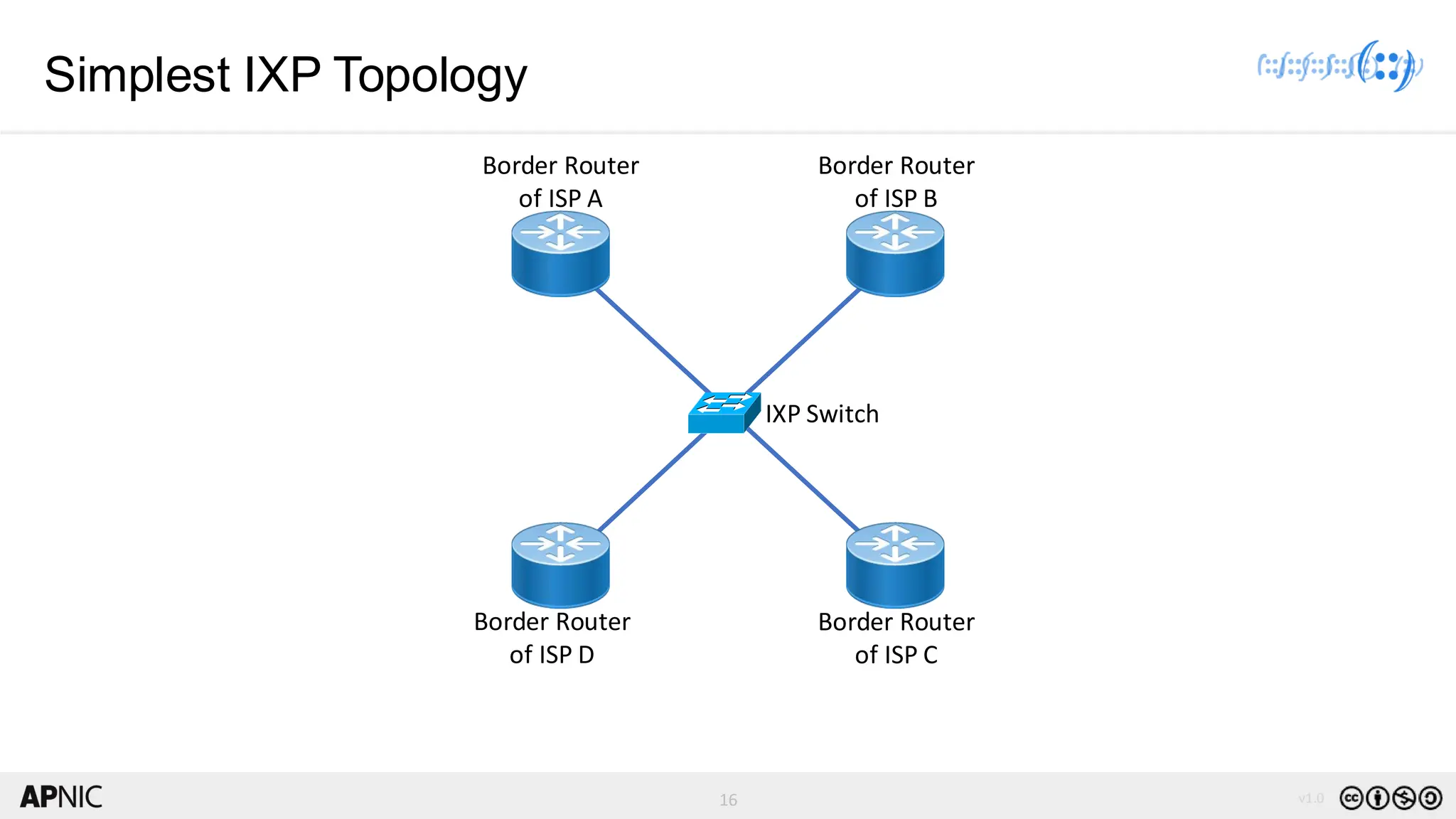
Simplest IXP Topology
IXP Switch
Border Router
of ISP A
Border Router
of ISP B
Border Router
of ISP D
Border Router
of ISP C
19 v1.0
19
Main Benefits of IXP
• Keep local traffic local
o Important to local Internet development
• Easy interconnection and direct traffic exchange among participating networks
o Reduced cost – cheaper connectivity
o Enhanced network performance – faster speed
o Reduced latency – lower delay
o Improved resilience – more backup paths
• Help encourage development of more local content and local applications
o Helps local data centre business and other businesses
• Everybody is benefited
o The gain for each may be different but all will gain
• Often considered as Critical Internet Infrastructure locally, regionally or globally
20 v1.0
20
Examples of Pacific Islands
• Far from any other places
• External connectivity very expensive
• Small markets because of small population
• Usually just a few ISPs but not usually interconnected locally
• Local traffic across ISPs usually routed through US or Australia
• Local IXP very much needed for helping Internet development
• Observed immediate benefits on Day 1 of set-up of Fiji-IXP
o Much improved latency and high volume of traffic
o And improved resilience
• Small land-locked economies have more or less similar issues
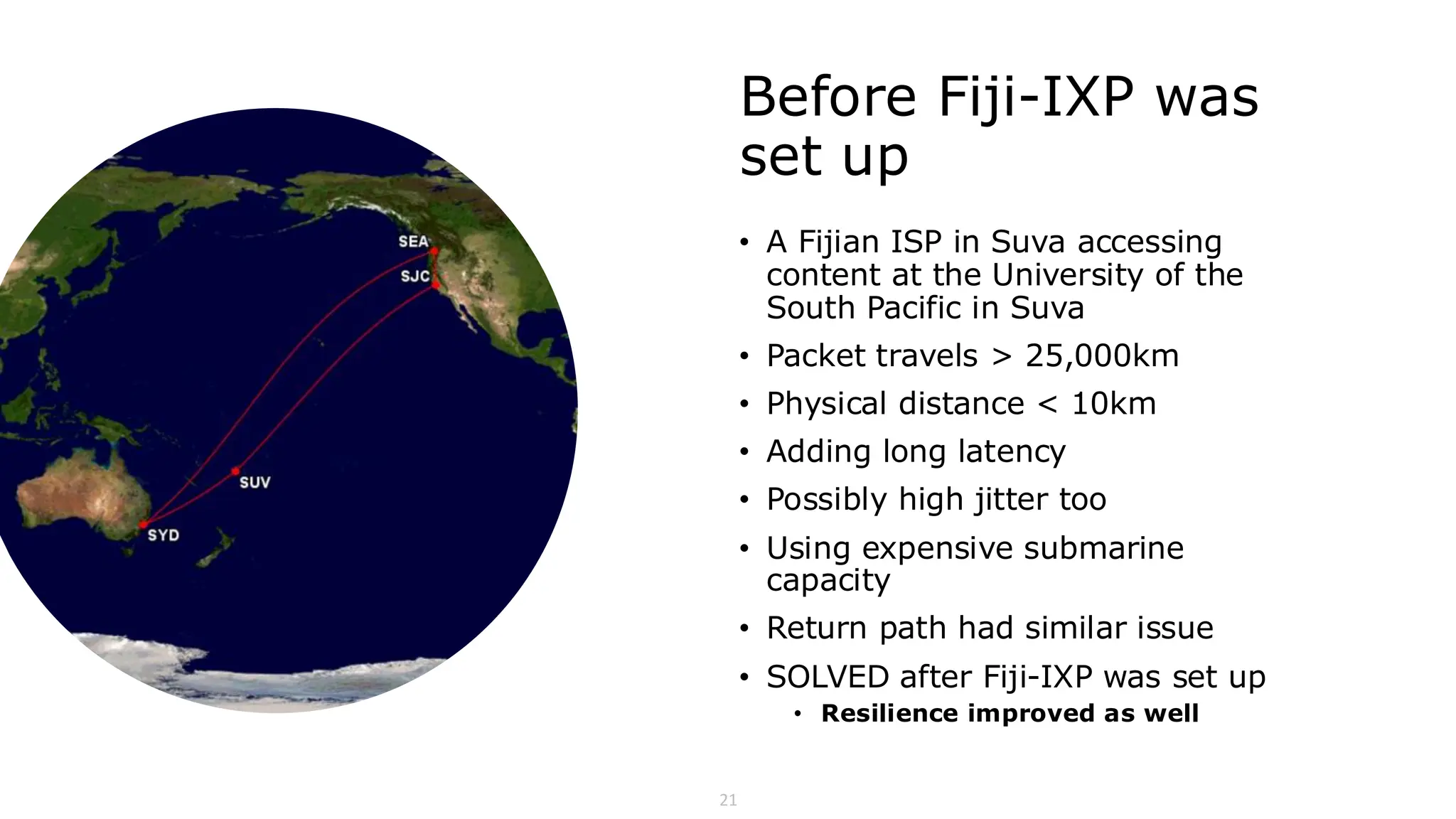
21
Before Fiji-IXP was
set up
• A Fijian ISP in Suva accessing
content at the University of the
South Pacific in Suva
• Packet travels > 25,000km
• Physical distance < 10km
• Adding long latency
• Possibly high jitter too
• Using expensive submarine
capacity
• Return path had similar issue
• SOLVED after Fiji-IXP was set up
• Resilience improved as well
22 v1.0
22
Value and Attractiveness of an IXP
• Proportional to number of different networks (ASNs) connected and amount
of traffic exchanged
• Snowball effect after reaching critical mass
o Initial period usually the hardest
▸ Most take wait-and-see approach
▸ Market needs determine growth
o Gradually have good mix of networks of different types
▸ E.g. Eyeballs vs Content
• Good quality service useful and important
23
23 v1.0
IXP Implementation Steps
24 v1.0
24
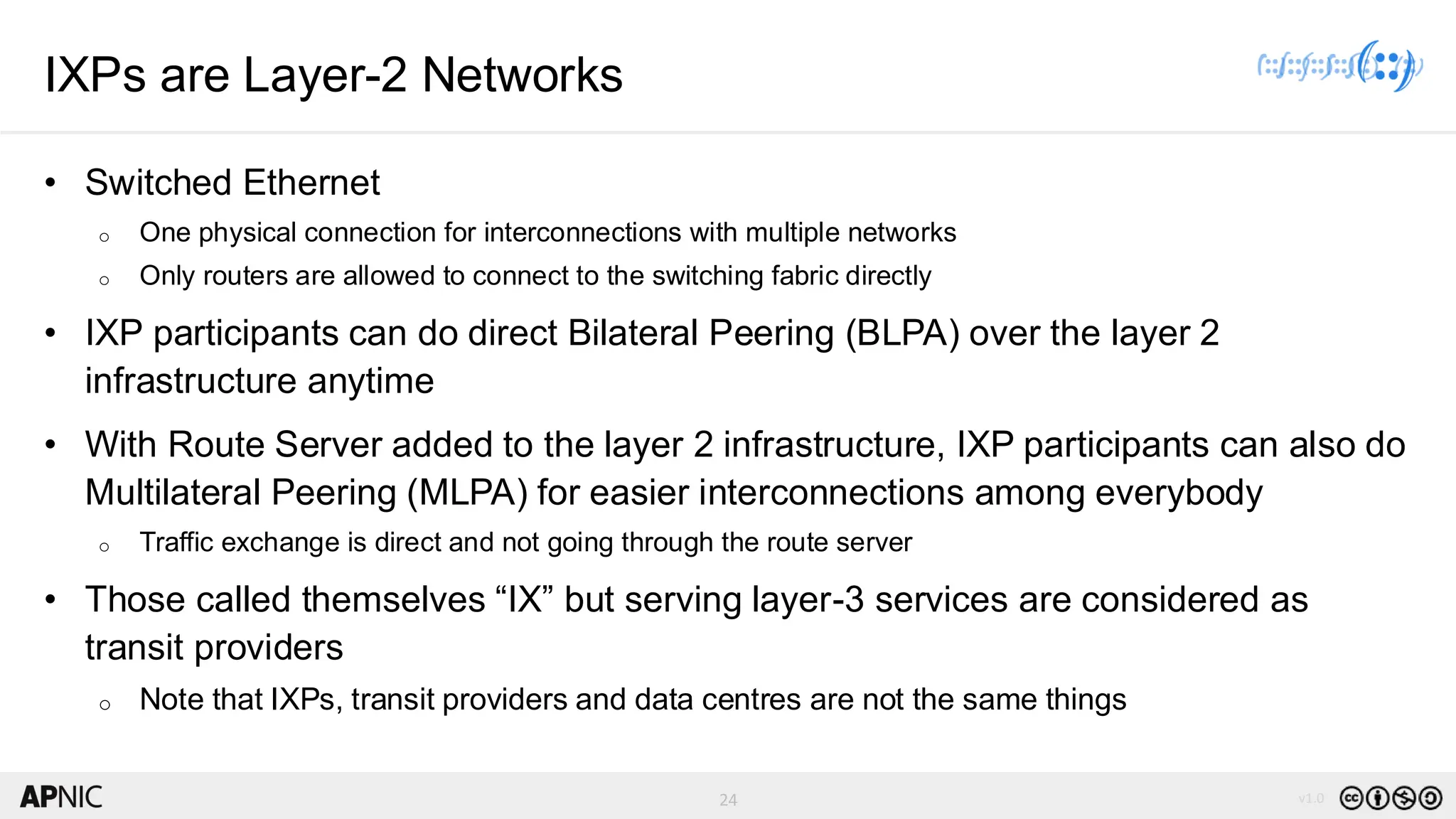
IXPs are Layer-2 Networks
• Switched Ethernet
o One physical connection for interconnections with multiple networks
o Only routers are allowed to connect to the switching fabric directly
• IXP participants can do direct Bilateral Peering (BLPA) over the layer 2
infrastructure anytime
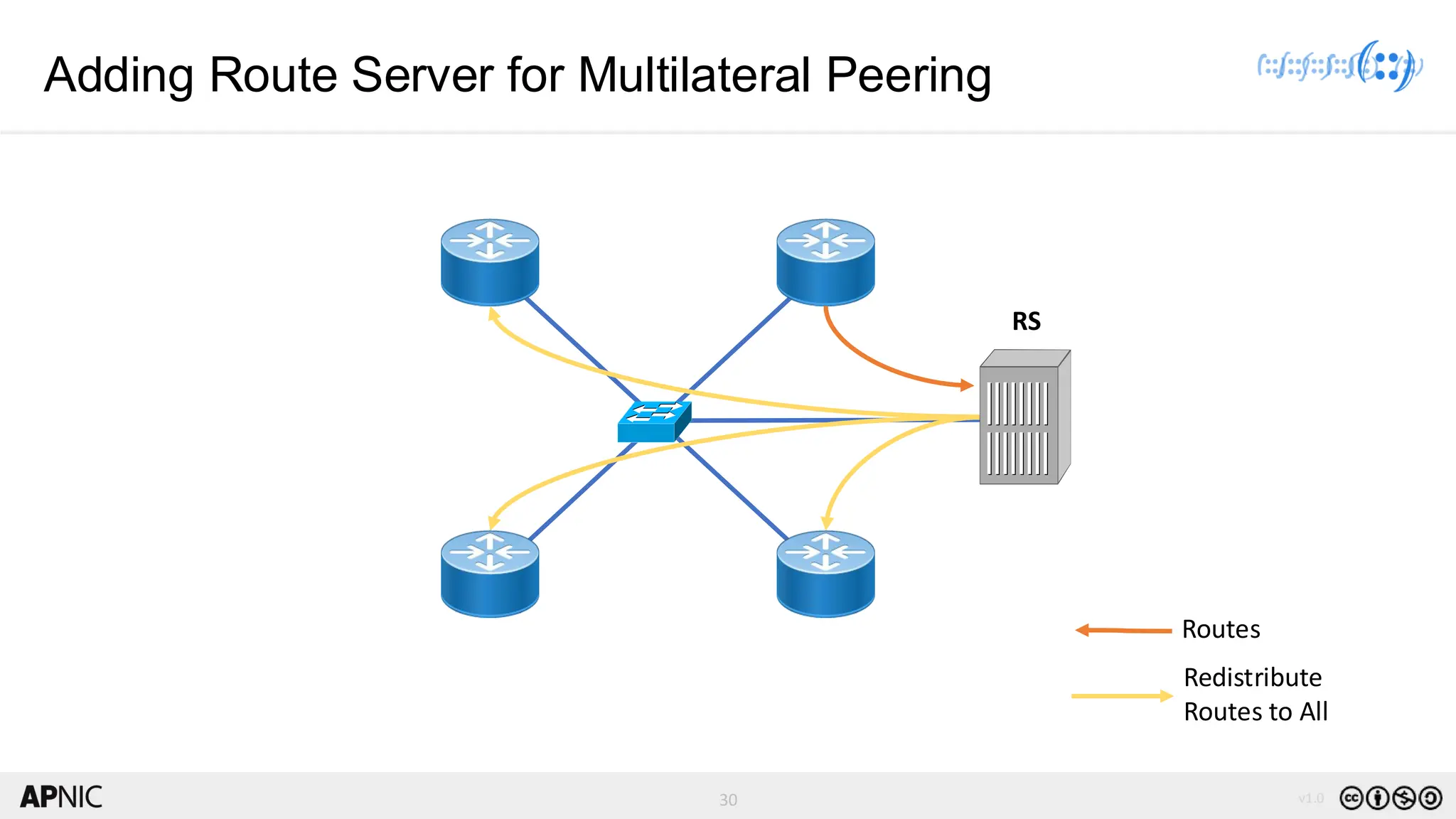
• With Route Server added to the layer 2 infrastructure, IXP participants can also do
Multilateral Peering (MLPA) for easier interconnections among everybody
o Traffic exchange is direct and not going through the route server
• Those called themselves “IX” but serving layer-3 services are considered as
transit providers
o Note that IXPs, transit providers and data centres are not the same things
25 v1.0
25
Evolution
• IXP development is an evolutionary process done step by step
• It can be improved over time, but picking the right initial neutral organisation
& governance model and a neutral site at the start is important for future
success
• Some Local IXPs can evolve into Regional IXPs
26 v1.0
26
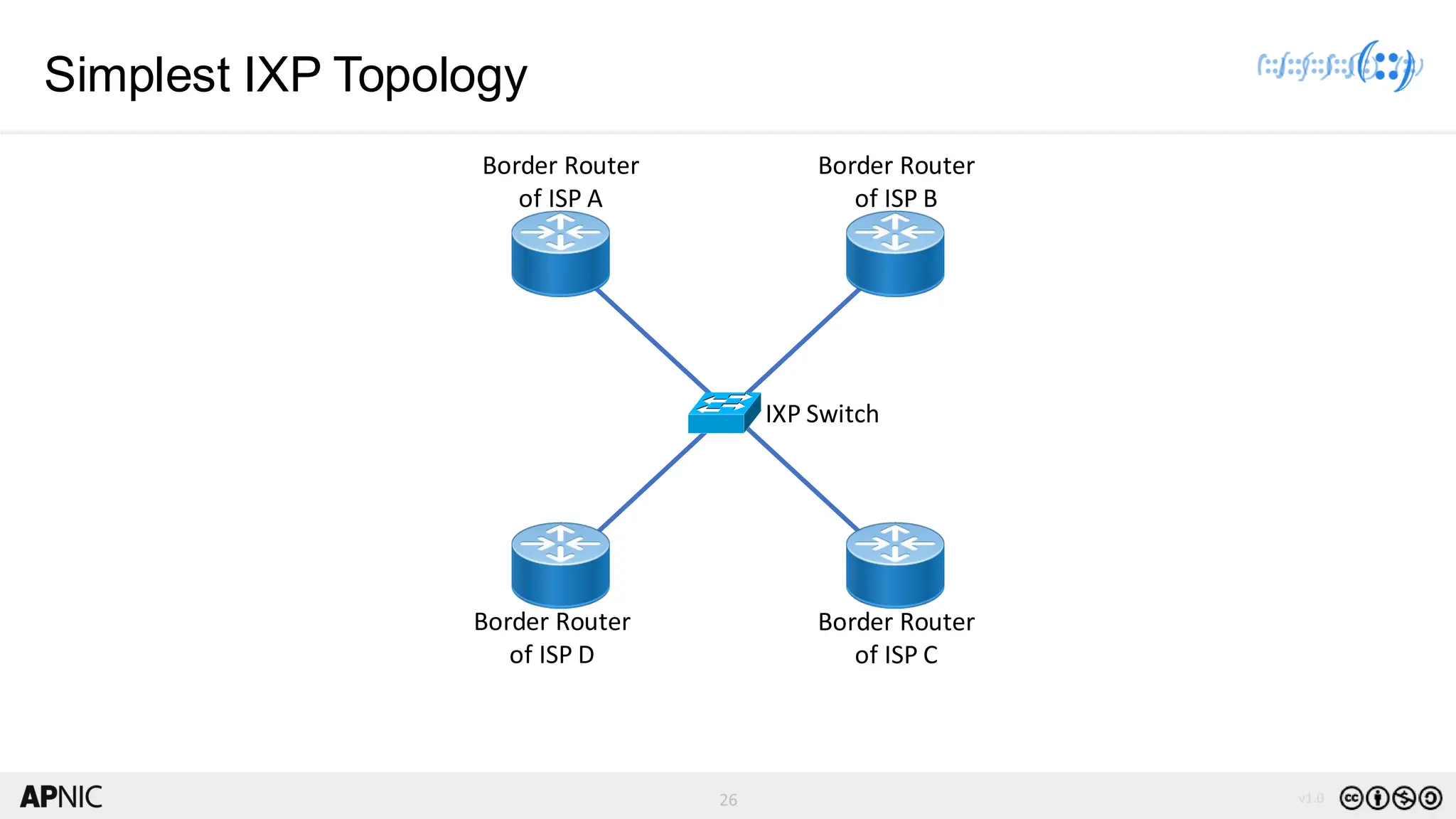
Simplest IXP Topology
IXP Switch
Border Router
of ISP A
Border Router
of ISP B
Border Router
of ISP D
Border Router
of ISP C
27 v1.0
27
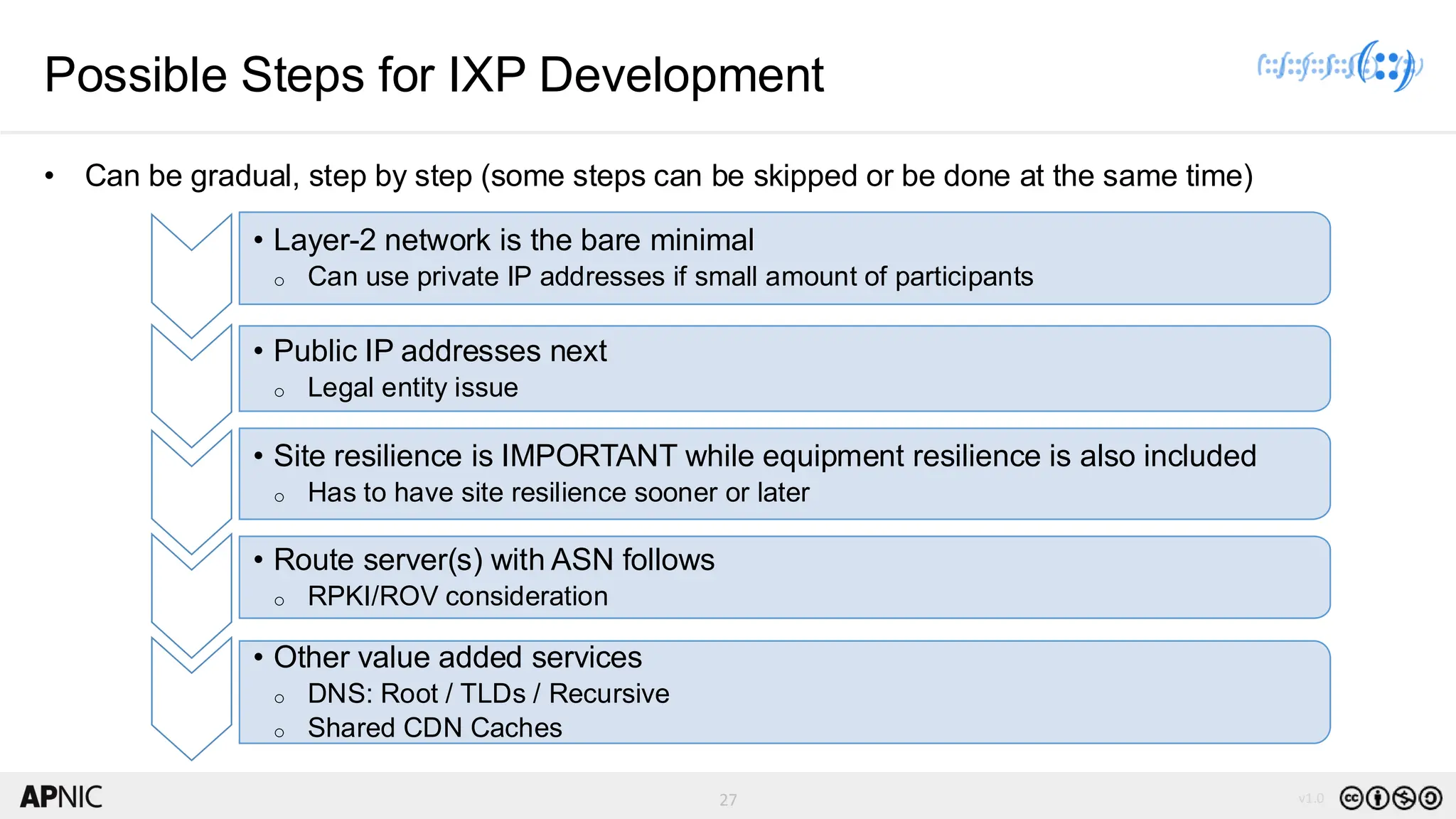
Possible Steps for IXP Development
• Can be gradual, step by step (some steps can be skipped or be done at the same time)
• Layer-2 network is the bare minimal
o Can use private IP addresses if small amount of participants
• Public IP addresses next
o Legal entity issue
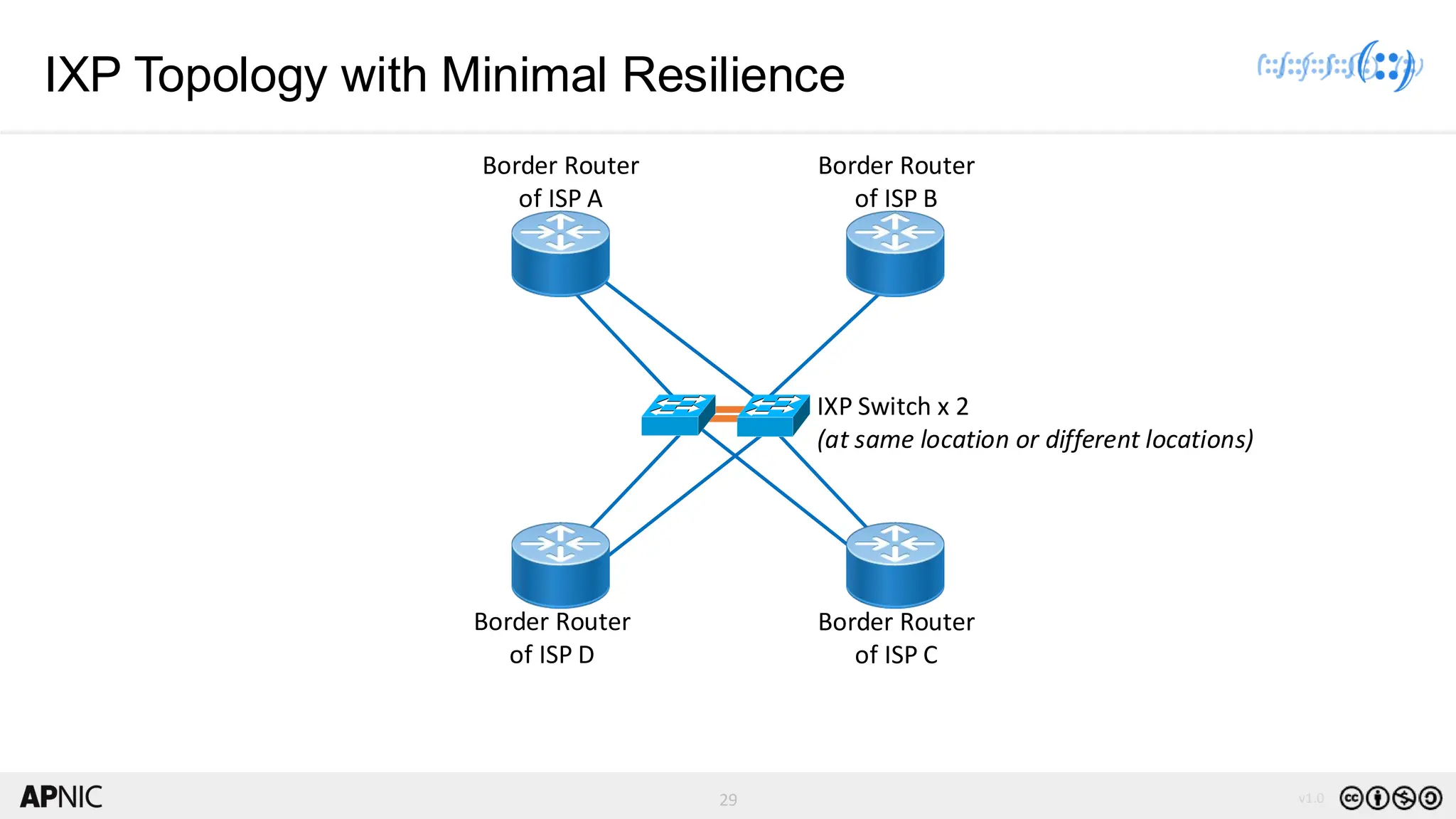
• Site resilience is IMPORTANT while equipment resilience is also included
o Has to have site resilience sooner or later
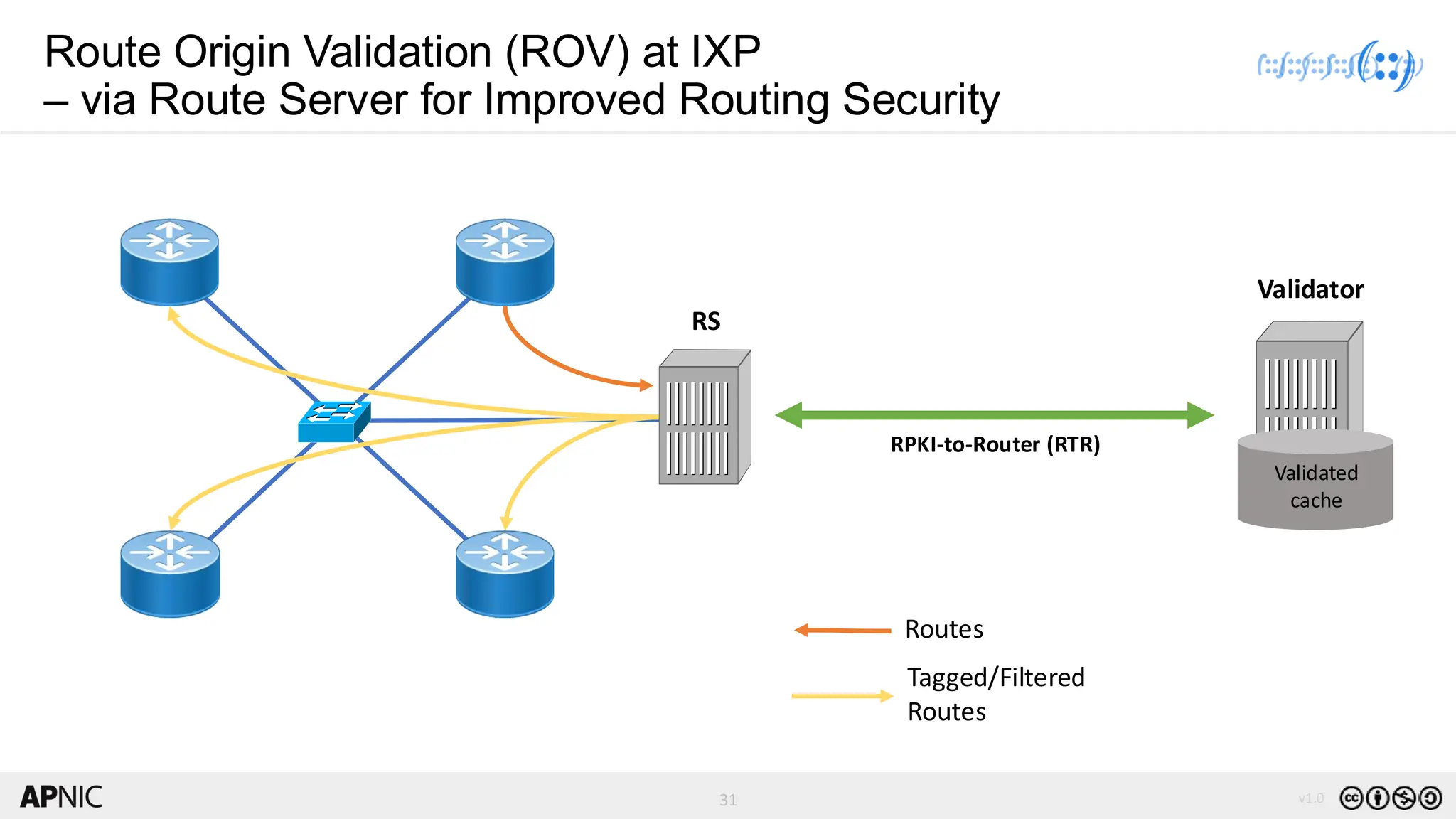
• Route server(s) with ASN follows
o RPKI/ROV consideration
• Other value added services
o DNS: Root / TLDs / Recursive
o Shared CDN Caches
29 v1.0
29
IXP Topology with Minimal Resilience
IXP Switch x 2
(at same location or different locations)
Border Router
of ISP A
Border Router
of ISP B
Border Router
of ISP D
Border Router
of ISP C
30 v1.0
30
Adding Route Server for Multilateral Peering
Routes
Redistribute
Routes to All
RS
31 v1.0
31
Route Origin Validation (ROV) at IXP
– via Route Server for Improved Routing Security
Validated
cache
Validator
RPKI-to-Router (RTR)
Routes
Tagged/Filtered
Routes
RS
35 v1.0
35
Scalability and Resilience Issues
• IXPs were supposed to have no packet loss in its infrastructure
o And with very low latency and very good resilience too
• Become an issue when IXP grow beyond one switch
o Due to not enough ports or expanding to multiple sites
• Inter-switch links are the risk
o Over-subscription has to be minimised
• Also need to minimise single point of failure
o For improved resilience
36 v1.0
36
IXP Topology with Minimal Resilience
IXP Switch x 2
(at same location or different locations)
Border Router
of ISP A
Border Router
of ISP B
Border Router
of ISP D
Border Router
of ISP C
37 v1.0
37
Spine
Switch
Spine
Switch
Leaf
Switch
Leaf
Switch
Leaf
Switch
n x 100GE/10GE
Inter-Switch
Links
n x 100GE/10GE
Inter-Switch
Links
ISP ISP ISP ISP ISP ISP ISP
Spine
Switch
Spine
Switch
Leaf
Switch
Leaf
Switch
100GE/10GE/GE
Links
100GE/10GE/GE
Links
Leaf
Switch
Spine-and-Leaf Architecture for Beyond 2 Switches
40 v1.0
40
IXP Manager Helps Manage “Everything”
• Open-source software
• Highly recommended to use it to manage your IXP
• Helps manage:
o Provisioning
o Monitoring
o Switches
o Route Servers
o PeeringDB / IXP-DB / IRRDB
o RPKI / MANRS
o And many more (Refer to https://docs.ixpmanager.org under “Features”)
45
45 v1.0
Operation/Business/Governance
Models for IXPs
46 v1.0
46
Government-led vs Industry-led
Subsidized vs Self-financed
Commercial vs Non-profit
IXP Models
• No one single model which can suit all situations
• Relative Neutrality is important
Developed economies vs Developing economies
47 v1.0
47
Commercial vs Non-Profit
• Commercial set-up is free to do anything
o No need to care about neutrality too much
o IXP may be a service to help other business
• Non-profit set-up tends to be more cautious
o Neutrality is more important, at least to the target participants
o Tend to be more independent from individual participants
o Tend to offer fewer services
48 v1.0
48
Developed Economies
• IXPs are business
o Even for not-for-profit set-up
o Less government involvement
• Multiple IXPs
o Keen competition
• But if they cannot keep intra-economy traffic local, someone needs to step
up
o Government? Industry group? Customer pressure?
49 v1.0
49
IXPs and Data Centres in Developed Economies
• They are natural partners
• Common situation in advanced metro cities
o Multiple IXPs in one Data Centre
▸ A lot of data centres have their IXPs
o One IXP in multiple Data Centres
▸ The same layer-2 broadcast domain
▸ Circuit cost is a burden to the IXP
▸ A lot of telco’s have their IXPs
o Healthy competition would be good
▸ Customers have choices
▸ Also for better resilience
50 v1.0
50
Developing Economies
• Some do not have any IXPs yet
• Local traffic does not stay local
o A lose-lose situation for everybody
• IXPs can help Internet development a lot
o Better to be non-for-profit set-up
o May need to start with subsidized model
o May not be a business at all
o Help from government is mostly needed
o Active participation of the biggest players is also very important
• For smaller developing economies, there should not be too many IXPs
51 v1.0
51
Governance for Non-Profit IXPs
• Multi-stakeholder bottom-up approach is an approach with good
acceptance by the community
o E.g. membership-based model
• Government support is also important
o At the very least, should get the proper license
• Be as inclusive as possible in order to provide maximum benefits to the
whole community which it serves
• Should be fair and consistent to every participant or member
• Should be open and transparent as much as possible
52 v1.0
52
Membership-Based Model for Non-Profit IXPs
• Networks connected can join as members
o Open membership vs closed membership
o Mandatory membership vs optional membership
• Full Members with voting rights vs Associate Members without voting rights
o Licensed ISPs vs others
o Local legal entities vs overseas legal entities
• Governance by the Board elected
o Policy decisions
o Financial responsibilities
• Government’s role
o A facilitator at the very least
53 v1.0
53
Neutral Locations
• May choose one of the followings as starting point:
o University
o Landing Station
o Technology Park
o Carrier Neutral Commercial Data Center
o Government Data Center
• Having multiple carrier options with easy access is important
• Should maintain neutrality continuously
• Expansion to multiple sites within the same metro area can be done on Day 1 or
be done gradually coupled with growth
o This also helps improve neutrality as more options are provided
54 v1.0
54
Anchor Participants
• It is important to have a few Anchor Participants to start with to help attract
other participants to join
• IXP has no value to attract anyone if no participants
o The more participants, the higher the value for the IXP to attract other participants
55 v1.0
55
Geography
• IXP usually is NOT expanded beyond a metro area so as to avoid
competing with IXP participants and to maintain neutrality
o And simple port charging model can be used
• Usually start with the biggest city first and gradually set up separate
infrastructure in other bigger cities one by one
56 v1.0
56
To Add Value
• Domain Name Infrastructure: DNS infrastructure is very important to Internet
operations so Root/TLD DNS server instance(s) should be connected directly to
IXP for direct peering in order to benefit all participants for better DNS
performance and resilience
• Shared CDN Caches: Connecting cache servers of popular content to the IXP will
help everyone save bandwidth, but the cost of the transit bandwidth needed for
cache-fill has to be properly shared by the ISPs benefited
o Different CDN providers have different supported models
o Need to think about long-term sustainability
• NOTE: Transit for the above should NOT be used for providing usual transit
service to IXP participants so as to maintain neutrality
57 v1.0
57
Financial Model for Non-Profit IXPs
• Seed money?
o Perhaps from subsidies and/or sponsorship/donation
• IXPs need money to operate continuously
o Need to have a long-term sustainable finance model for full cost recovery of CapEx and OpEx
▸ All cost should be covered
o Should not forget about the limited lifetime of the equipment used so must save money for
future major equipment upgrade say once every 5 years
▸ By setting up a reserve fund
• Subsidies, sponsorship or volunteers support may not be stable
• Those networks which are benefited should all contribute in a fair way
o A charging model should be devised to help achieve that
• A good financial model will help sustain the IXP operations in long term
65 v1.0
65
Government Funding for Non-Profit IXPs?
• More needed during infancy stage of IXP development
o Government usually can only provide one-off funding support
• For long-term, IXPs need to have a long-term sustainable financial model
o Better be together with bottom-up industry-led governance for IXP
o Align with bottom-up multi-stakeholder approach
67 v1.0
67
Regional IXP?
• It can be an evolution from a successful local IXP facilitating good local peering
o Will attract more overseas ISPs to connect
• It is more for overseas participants to come to the IXP instead of having the IXP to
expand out to them
• It is usually coupled with a number of positive driving factors
o Competitive environment/pricing for international circuits
o Competitive environment/pricing for local circuits
o Competitive environment/pricing for data centres
o Open and competitive environment -> Submarine cable hub + Data centre hub + Popular IXPs
-> Regional Internet hub
• Good quality services with good resilience are also critical
o There can be multiple regional IXPs/hubs in a region
70 v1.0
70
IXP across Multiple Cities / Economies?
• Affect neutrality?
o Generally considered as competing with participants which provide services across
the same set of locations
• Bad for non-profit IXPs targeting all kinds of networks or providers?
o Those that see competition may not join and then it may affect the goal of “keeping
local traffic local”
o Commercial IXPs can take this business risk especially if this may help their other
business
71 v1.0
71
IXP across Multiple Cities / Economies??
• If more than 2 locations, what is the topology?
o Star or Ring?
• May not be good at Layer-2
o Backup circuit(s) at Layer-2?
o Not easy to manage such a large layer-2 network across long-distance
▸ Riskier to operate
o Or have to use more expensive technologies such as EVPN over VxLAN
• How to cover the cost of the long-distance bandwidth?
72 v1.0
72
Charging for Long-Distance Bandwidth?
• Local IXPs usually charge fixed charge by port speed
o Simple and of low risk
• How to cover the cost of the long-distance / international bandwidth if it is
involved?
o How to be fair? Charge by usage?
o How to make sure it covers the cost fully?
o Somewhat similar to providing shared CDN caches to IXP participants but even more
complicated
▸ Multi-way traffic on possibly multiple circuits of different cost
74 v1.0
74
Remote Layer-2 Connections to IXP?
• More and more common nowadays
o Some even from >1,000km away
• Using fibre-only connection is much easier, with much fewer issues
o But up to 70-80km only
• Some IXPs even help you to connect to oversea IXPs with one physical port
o One physical Ethernet connection to multiple networks/IXPs
• IXPs cannot afford to not support remote connections
o As they want to have more business, sometimes through resellers
o May even partner with overseas IXPs for providing remote connection service to them
• It is still for participants to come to the IXP instead of having the IXP to expand out
75 v1.0
75
Some Lessons Learnt from Some Economies
• Government led IXP has outsourced the operations to one of the ISPs
o Other ISPs complain that they have hard time connecting to the IXP
o The IXP has became not neutral enough
• Government led IXP having CDN caches installed cannot get the ISPs to
use the CDN caches because of disagreement on the cost sharing
arrangement
o Lose-lose for everybody
• Industry led IXP installed at government data centre had power outages
multiple times
o Need better resilience including site resilience
77
77 v1.0
IXP Development Work of APNIC
78 v1.0
78
IXP Development Work of APNIC
• APNIC strongly believes IXPs help Internet development
o After all, IXPs serve and benefit APNIC members
o In fact, IXPs need IP addresses and ASNs and so are APNIC members themselves
• Do more on helping those developing economies
o Especially those which do not have any IXP yet
o Or those which their only IXP is not functioning well
• Training and Technical Assistance work primarily
o Not just for IXP operators but also for IXP participants
o Also help talk to major stakeholders to convince them of the benefits of having a local IXP while
maintaining neutrality
o May need help of Community Trainers and Consultants from time to time
• Having been supporting IXP development in Fiji, PNG, Vanuatu, Mongolia, Bhutan,
Myanmar, Thailand, Pakistan, Maldives, India and others
79 v1.0
79
IXP Development Package of APNIC
• Training & Technical Assistance primarily
o Technical & non-technical
• Other possible support items (on case-by-case basis according to individual
needs):
o Equipment support along with APNIC Foundation
o Route Server
o ROV & IPv6 deployment support
o IXP Manager
o Root Server anycast instance
o RIPE Atlas Anchor
• APIX & MANRS Memberships are recommended to all IXPs
o Up-to-date and accurate records on PeeringDB and IXP-DB are recommended as well
80 v1.0
80
Other Help & Support by APNIC
• APNIC also provides help & support to:
o APIX
o Peering Asia
o Peering Forums hosted by not-for-profit IXPs
o NOGs (which IXPs usually support)
• And, APNIC Foundation sponsors:
o PeeringDB
o IXP-DB
o IXP Manager
81
81 v1.0
Final Remarks
82 v1.0
82
Final Remarks
• IXPs will continue to play a key role for easier interconnections among
networks
o Especially for developing economies
o But IXP is NOT a magic wand to solve all the issues
▸ Collaborative spirit is
• Need to find a suitable model for long-term sustainability
• Relative neutrality is important
o So have to maintain it as much as possible
• After all, “Keeping Local Traffic Local” is the most important thing for the
whole country/economy
83
83 v1.0
Q&A
84 v1.0
84

Technical and Operational Aspects of Regional Internet Exchange Model

  • 1.
    1 1 v1.0 Technical andOperational Aspects of Regional Internet Exchange Model Che-Hoo Cheng APNIC 2024-11-05
  • 2.
    2 v1.0 2 Agenda • Objectivesof Peering, and Benefits of IXPs • IXP Implementation Steps • Operation/Business/Governance Models for IXPs • IXP Development Work of APNIC • Final Remarks • Q&A
  • 3.
    3 v1.0 3 Disclaimer • High-levelknowledge exchange only o Not so technical • No “One Size Fits All” o Many different “recipes” for running an IXP • Just to provide hints, not answers • Cannot cover all scenarios here because of limited time • Supposed to be interactive
  • 4.
    4 4 v1.0 Objectives ofPeering and Benefits of IXPs
  • 5.
    5 v1.0 5 How DoesInternet Operate? • Internet is a network of networks o Composed of networks of ISPs and users • User networks connect to ISPs • Small ISPs connect to large ISPs • Various networks interconnected with one another to form Internet
  • 6.
    8 v1.0 8 Transit Provider/ Internet Gateway (Upstream) Global Internet Downstream Customer Customer routes only Routes of the whole world All customer routes Ordinary Transit Model – Internet Gateway Google eBay APNIC
  • 7.
    10 v1.0 10 Transit ProviderA (Upstream) Transit Provider B (Upstream) Downstream Customer Downstream Customer Downstream Customer Downstream Customer Routes of A and its customers Routes of B and its customers Ordinary Peering Model Google eBay APNIC
  • 8.
    11 v1.0 11 Peering inGeneral • ASes are interconnected/peered one another at Internet exchanges points (IXPs) or privately using BGP protocol • For higher performance, lower latency and lower cost • Usually no settlement between peers and circuit cost is shared For mutual benefits • Local-to-local traffic do NOT need to route through overseas • Important to local Internet development • Improved resilience Local Peering
  • 9.
    13 v1.0 13 Full Meshfor Peering 10C2 = 45 circuits
  • 10.
    15 v1.0 15 What isInternet eXchange Point (IXP)? • A shared physical network infrastructure over which various ASes can do easy peering with one another One physical connection to IXP used for interconnections with multiple networks More cost-effective and scalable, especially with more participants IXP serves Internet Service Providers (ISPs), Cloud Service Providers, Content Providers, Content Delivery Network (CDN) Providers, Research & Education (R&E) Networks and Government/Enterprise Networks
  • 11.
    16 v1.0 16 Simplest IXPTopology IXP Switch Border Router of ISP A Border Router of ISP B Border Router of ISP D Border Router of ISP C
  • 12.
    19 v1.0 19 Main Benefitsof IXP • Keep local traffic local o Important to local Internet development • Easy interconnection and direct traffic exchange among participating networks o Reduced cost – cheaper connectivity o Enhanced network performance – faster speed o Reduced latency – lower delay o Improved resilience – more backup paths • Help encourage development of more local content and local applications o Helps local data centre business and other businesses • Everybody is benefited o The gain for each may be different but all will gain • Often considered as Critical Internet Infrastructure locally, regionally or globally
  • 13.
    20 v1.0 20 Examples ofPacific Islands • Far from any other places • External connectivity very expensive • Small markets because of small population • Usually just a few ISPs but not usually interconnected locally • Local traffic across ISPs usually routed through US or Australia • Local IXP very much needed for helping Internet development • Observed immediate benefits on Day 1 of set-up of Fiji-IXP o Much improved latency and high volume of traffic o And improved resilience • Small land-locked economies have more or less similar issues
  • 14.
    21 Before Fiji-IXP was setup • A Fijian ISP in Suva accessing content at the University of the South Pacific in Suva • Packet travels > 25,000km • Physical distance < 10km • Adding long latency • Possibly high jitter too • Using expensive submarine capacity • Return path had similar issue • SOLVED after Fiji-IXP was set up • Resilience improved as well
  • 15.
    22 v1.0 22 Value andAttractiveness of an IXP • Proportional to number of different networks (ASNs) connected and amount of traffic exchanged • Snowball effect after reaching critical mass o Initial period usually the hardest ▸ Most take wait-and-see approach ▸ Market needs determine growth o Gradually have good mix of networks of different types ▸ E.g. Eyeballs vs Content • Good quality service useful and important
  • 16.
  • 17.
    24 v1.0 24 IXPs areLayer-2 Networks • Switched Ethernet o One physical connection for interconnections with multiple networks o Only routers are allowed to connect to the switching fabric directly • IXP participants can do direct Bilateral Peering (BLPA) over the layer 2 infrastructure anytime • With Route Server added to the layer 2 infrastructure, IXP participants can also do Multilateral Peering (MLPA) for easier interconnections among everybody o Traffic exchange is direct and not going through the route server • Those called themselves “IX” but serving layer-3 services are considered as transit providers o Note that IXPs, transit providers and data centres are not the same things
  • 18.
    25 v1.0 25 Evolution • IXPdevelopment is an evolutionary process done step by step • It can be improved over time, but picking the right initial neutral organisation & governance model and a neutral site at the start is important for future success • Some Local IXPs can evolve into Regional IXPs
  • 19.
    26 v1.0 26 Simplest IXPTopology IXP Switch Border Router of ISP A Border Router of ISP B Border Router of ISP D Border Router of ISP C
  • 20.
    27 v1.0 27 Possible Stepsfor IXP Development • Can be gradual, step by step (some steps can be skipped or be done at the same time) • Layer-2 network is the bare minimal o Can use private IP addresses if small amount of participants • Public IP addresses next o Legal entity issue • Site resilience is IMPORTANT while equipment resilience is also included o Has to have site resilience sooner or later • Route server(s) with ASN follows o RPKI/ROV consideration • Other value added services o DNS: Root / TLDs / Recursive o Shared CDN Caches
  • 21.
    29 v1.0 29 IXP Topologywith Minimal Resilience IXP Switch x 2 (at same location or different locations) Border Router of ISP A Border Router of ISP B Border Router of ISP D Border Router of ISP C
  • 22.
    30 v1.0 30 Adding RouteServer for Multilateral Peering Routes Redistribute Routes to All RS
  • 23.
    31 v1.0 31 Route OriginValidation (ROV) at IXP – via Route Server for Improved Routing Security Validated cache Validator RPKI-to-Router (RTR) Routes Tagged/Filtered Routes RS
  • 24.
    35 v1.0 35 Scalability andResilience Issues • IXPs were supposed to have no packet loss in its infrastructure o And with very low latency and very good resilience too • Become an issue when IXP grow beyond one switch o Due to not enough ports or expanding to multiple sites • Inter-switch links are the risk o Over-subscription has to be minimised • Also need to minimise single point of failure o For improved resilience
  • 25.
    36 v1.0 36 IXP Topologywith Minimal Resilience IXP Switch x 2 (at same location or different locations) Border Router of ISP A Border Router of ISP B Border Router of ISP D Border Router of ISP C
  • 26.
    37 v1.0 37 Spine Switch Spine Switch Leaf Switch Leaf Switch Leaf Switch n x100GE/10GE Inter-Switch Links n x 100GE/10GE Inter-Switch Links ISP ISP ISP ISP ISP ISP ISP Spine Switch Spine Switch Leaf Switch Leaf Switch 100GE/10GE/GE Links 100GE/10GE/GE Links Leaf Switch Spine-and-Leaf Architecture for Beyond 2 Switches
  • 27.
    40 v1.0 40 IXP ManagerHelps Manage “Everything” • Open-source software • Highly recommended to use it to manage your IXP • Helps manage: o Provisioning o Monitoring o Switches o Route Servers o PeeringDB / IXP-DB / IRRDB o RPKI / MANRS o And many more (Refer to https://docs.ixpmanager.org under “Features”)
  • 28.
  • 29.
    46 v1.0 46 Government-led vsIndustry-led Subsidized vs Self-financed Commercial vs Non-profit IXP Models • No one single model which can suit all situations • Relative Neutrality is important Developed economies vs Developing economies
  • 30.
    47 v1.0 47 Commercial vsNon-Profit • Commercial set-up is free to do anything o No need to care about neutrality too much o IXP may be a service to help other business • Non-profit set-up tends to be more cautious o Neutrality is more important, at least to the target participants o Tend to be more independent from individual participants o Tend to offer fewer services
  • 31.
    48 v1.0 48 Developed Economies •IXPs are business o Even for not-for-profit set-up o Less government involvement • Multiple IXPs o Keen competition • But if they cannot keep intra-economy traffic local, someone needs to step up o Government? Industry group? Customer pressure?
  • 32.
    49 v1.0 49 IXPs andData Centres in Developed Economies • They are natural partners • Common situation in advanced metro cities o Multiple IXPs in one Data Centre ▸ A lot of data centres have their IXPs o One IXP in multiple Data Centres ▸ The same layer-2 broadcast domain ▸ Circuit cost is a burden to the IXP ▸ A lot of telco’s have their IXPs o Healthy competition would be good ▸ Customers have choices ▸ Also for better resilience
  • 33.
    50 v1.0 50 Developing Economies •Some do not have any IXPs yet • Local traffic does not stay local o A lose-lose situation for everybody • IXPs can help Internet development a lot o Better to be non-for-profit set-up o May need to start with subsidized model o May not be a business at all o Help from government is mostly needed o Active participation of the biggest players is also very important • For smaller developing economies, there should not be too many IXPs
  • 34.
    51 v1.0 51 Governance forNon-Profit IXPs • Multi-stakeholder bottom-up approach is an approach with good acceptance by the community o E.g. membership-based model • Government support is also important o At the very least, should get the proper license • Be as inclusive as possible in order to provide maximum benefits to the whole community which it serves • Should be fair and consistent to every participant or member • Should be open and transparent as much as possible
  • 35.
    52 v1.0 52 Membership-Based Modelfor Non-Profit IXPs • Networks connected can join as members o Open membership vs closed membership o Mandatory membership vs optional membership • Full Members with voting rights vs Associate Members without voting rights o Licensed ISPs vs others o Local legal entities vs overseas legal entities • Governance by the Board elected o Policy decisions o Financial responsibilities • Government’s role o A facilitator at the very least
  • 36.
    53 v1.0 53 Neutral Locations •May choose one of the followings as starting point: o University o Landing Station o Technology Park o Carrier Neutral Commercial Data Center o Government Data Center • Having multiple carrier options with easy access is important • Should maintain neutrality continuously • Expansion to multiple sites within the same metro area can be done on Day 1 or be done gradually coupled with growth o This also helps improve neutrality as more options are provided
  • 37.
    54 v1.0 54 Anchor Participants •It is important to have a few Anchor Participants to start with to help attract other participants to join • IXP has no value to attract anyone if no participants o The more participants, the higher the value for the IXP to attract other participants
  • 38.
    55 v1.0 55 Geography • IXPusually is NOT expanded beyond a metro area so as to avoid competing with IXP participants and to maintain neutrality o And simple port charging model can be used • Usually start with the biggest city first and gradually set up separate infrastructure in other bigger cities one by one
  • 39.
    56 v1.0 56 To AddValue • Domain Name Infrastructure: DNS infrastructure is very important to Internet operations so Root/TLD DNS server instance(s) should be connected directly to IXP for direct peering in order to benefit all participants for better DNS performance and resilience • Shared CDN Caches: Connecting cache servers of popular content to the IXP will help everyone save bandwidth, but the cost of the transit bandwidth needed for cache-fill has to be properly shared by the ISPs benefited o Different CDN providers have different supported models o Need to think about long-term sustainability • NOTE: Transit for the above should NOT be used for providing usual transit service to IXP participants so as to maintain neutrality
  • 40.
    57 v1.0 57 Financial Modelfor Non-Profit IXPs • Seed money? o Perhaps from subsidies and/or sponsorship/donation • IXPs need money to operate continuously o Need to have a long-term sustainable finance model for full cost recovery of CapEx and OpEx ▸ All cost should be covered o Should not forget about the limited lifetime of the equipment used so must save money for future major equipment upgrade say once every 5 years ▸ By setting up a reserve fund • Subsidies, sponsorship or volunteers support may not be stable • Those networks which are benefited should all contribute in a fair way o A charging model should be devised to help achieve that • A good financial model will help sustain the IXP operations in long term
  • 41.
    65 v1.0 65 Government Fundingfor Non-Profit IXPs? • More needed during infancy stage of IXP development o Government usually can only provide one-off funding support • For long-term, IXPs need to have a long-term sustainable financial model o Better be together with bottom-up industry-led governance for IXP o Align with bottom-up multi-stakeholder approach
  • 42.
    67 v1.0 67 Regional IXP? •It can be an evolution from a successful local IXP facilitating good local peering o Will attract more overseas ISPs to connect • It is more for overseas participants to come to the IXP instead of having the IXP to expand out to them • It is usually coupled with a number of positive driving factors o Competitive environment/pricing for international circuits o Competitive environment/pricing for local circuits o Competitive environment/pricing for data centres o Open and competitive environment -> Submarine cable hub + Data centre hub + Popular IXPs -> Regional Internet hub • Good quality services with good resilience are also critical o There can be multiple regional IXPs/hubs in a region
  • 43.
    70 v1.0 70 IXP acrossMultiple Cities / Economies? • Affect neutrality? o Generally considered as competing with participants which provide services across the same set of locations • Bad for non-profit IXPs targeting all kinds of networks or providers? o Those that see competition may not join and then it may affect the goal of “keeping local traffic local” o Commercial IXPs can take this business risk especially if this may help their other business
  • 44.
    71 v1.0 71 IXP acrossMultiple Cities / Economies?? • If more than 2 locations, what is the topology? o Star or Ring? • May not be good at Layer-2 o Backup circuit(s) at Layer-2? o Not easy to manage such a large layer-2 network across long-distance ▸ Riskier to operate o Or have to use more expensive technologies such as EVPN over VxLAN • How to cover the cost of the long-distance bandwidth?
  • 45.
    72 v1.0 72 Charging forLong-Distance Bandwidth? • Local IXPs usually charge fixed charge by port speed o Simple and of low risk • How to cover the cost of the long-distance / international bandwidth if it is involved? o How to be fair? Charge by usage? o How to make sure it covers the cost fully? o Somewhat similar to providing shared CDN caches to IXP participants but even more complicated ▸ Multi-way traffic on possibly multiple circuits of different cost
  • 46.
    74 v1.0 74 Remote Layer-2Connections to IXP? • More and more common nowadays o Some even from >1,000km away • Using fibre-only connection is much easier, with much fewer issues o But up to 70-80km only • Some IXPs even help you to connect to oversea IXPs with one physical port o One physical Ethernet connection to multiple networks/IXPs • IXPs cannot afford to not support remote connections o As they want to have more business, sometimes through resellers o May even partner with overseas IXPs for providing remote connection service to them • It is still for participants to come to the IXP instead of having the IXP to expand out
  • 47.
    75 v1.0 75 Some LessonsLearnt from Some Economies • Government led IXP has outsourced the operations to one of the ISPs o Other ISPs complain that they have hard time connecting to the IXP o The IXP has became not neutral enough • Government led IXP having CDN caches installed cannot get the ISPs to use the CDN caches because of disagreement on the cost sharing arrangement o Lose-lose for everybody • Industry led IXP installed at government data centre had power outages multiple times o Need better resilience including site resilience
  • 48.
  • 49.
    78 v1.0 78 IXP DevelopmentWork of APNIC • APNIC strongly believes IXPs help Internet development o After all, IXPs serve and benefit APNIC members o In fact, IXPs need IP addresses and ASNs and so are APNIC members themselves • Do more on helping those developing economies o Especially those which do not have any IXP yet o Or those which their only IXP is not functioning well • Training and Technical Assistance work primarily o Not just for IXP operators but also for IXP participants o Also help talk to major stakeholders to convince them of the benefits of having a local IXP while maintaining neutrality o May need help of Community Trainers and Consultants from time to time • Having been supporting IXP development in Fiji, PNG, Vanuatu, Mongolia, Bhutan, Myanmar, Thailand, Pakistan, Maldives, India and others
  • 50.
    79 v1.0 79 IXP DevelopmentPackage of APNIC • Training & Technical Assistance primarily o Technical & non-technical • Other possible support items (on case-by-case basis according to individual needs): o Equipment support along with APNIC Foundation o Route Server o ROV & IPv6 deployment support o IXP Manager o Root Server anycast instance o RIPE Atlas Anchor • APIX & MANRS Memberships are recommended to all IXPs o Up-to-date and accurate records on PeeringDB and IXP-DB are recommended as well
  • 51.
    80 v1.0 80 Other Help& Support by APNIC • APNIC also provides help & support to: o APIX o Peering Asia o Peering Forums hosted by not-for-profit IXPs o NOGs (which IXPs usually support) • And, APNIC Foundation sponsors: o PeeringDB o IXP-DB o IXP Manager
  • 52.
  • 53.
    82 v1.0 82 Final Remarks •IXPs will continue to play a key role for easier interconnections among networks o Especially for developing economies o But IXP is NOT a magic wand to solve all the issues ▸ Collaborative spirit is • Need to find a suitable model for long-term sustainability • Relative neutrality is important o So have to maintain it as much as possible • After all, “Keeping Local Traffic Local” is the most important thing for the whole country/economy
  • 54.
  • 55.