
ISOC CONFERENCE
DYNAMIC SPECTRUM AND OTHER INFRASTRUCTURE APPROACHES
BEYOND WI-FI
BY JOB NDEGE
CTO ,MAWINGU NETWORKS LIMITED
TV White Space Description
 ‘TV White Spaces’ are portions of the UHF radio spectrum which
not assigned to licensed operators (often termed the primary
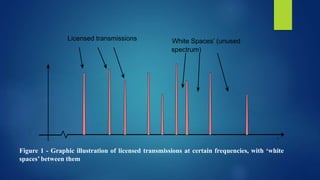
or are otherwise unused at all times or in all locations. Figure 1
illustrates the concept, showing unused ‘white spaces’ between
licensed transmissions.
 With demand for wireless connectivity increasing, the exploitation
of white space is an attractive way of making more efficient use of
radio spectrum simply by sharing the spectrum such that if not
in one location of a country by
TV White Space Description
 the primary user, then in that geography it can be redeployed and
used by secondary users and will not interfere with the primary
user.
f
Licensed transmissions ‘White Spaces’ (unused
spectrum)
Figure 1 - Graphic illustration of licensed transmissions at certain frequencies, with ‘white
spaces’ between them
TV White Space Description
 In many countries, analogue television broadcasts have been switched off and
replaced by more spectrally efficient digital television transmissions. Two
potential benefits of this transition are: freeing up or clearing spectrum for
reallocation to other licensed uses and to enable additional further
opportunistic access to interleaved spectrum between licensed users, such as
broadcasters.
 These UHF frequencies have good propagation and building penetration
characteristics, and of course this is the reason they were first chosen for TV
broadcasting.
TV White Space Description
 These characteristics make TV white space eminently suitable for use in rural
broadband applications, where transmission links may be several kilometers in
length and may involve challenging terrain such as hills, foliage, and water.
challenging terrain such as hills, foliage, and water.
TV White Space Description
 The US regulator (FCC) has made certain parts of the TV band available for
on a license-exempt basis. The UK regulator (Ofcom), the Singaporean
(IDA), and the Canadian regulator (Industry Canada) are in the final stages of
rule-making.
 This represents a ground breaking development in the management of
spectrum, as it involves unlicensed transmissions being interleaved with those
of licensed users such as TV broadcasters and wireless microphone (PMSE)
users. Several other regulators around the world are actively considering
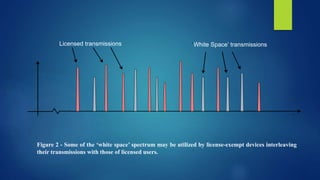
approaches. Figures 1 and 2 illustrate how white space transmissions can exist
alongside licensed transmissions.
TV White Space Description
 Allowing license-exempt devices to interleave their
transmissions with those of licensed users does, however,
presents challenges in ensuring that such unlicensed
transmissions will not adversely interfere with the licensed
transmissions.
 The approaches being pursued by the FCC, Ofcom, IDA, and
Industry Canada differ slightly, but all involve the use of a
regulator-approved database which White Space Devices
(WSDs) will need to consult before being allowed to access
spectrum.
Licensed transmissions ‘White Space’ transmissions
f
Figure 2 - Some of the ‘white space’ spectrum may be utilized by license-exempt devices interleaving
their transmissions with those of licensed users.
TV White Space Description
As of 2011, nobody had demonstrated, let alone deployed, TV white
technology on the African continent. All of that changed when the
Communications Commission of Kenya (now the CAK) provided
with authorization to conduct a TV white space demonstration at the
Internet Governance Forum conference held at the UN Compound in
Gigiri. At that event, Microsoft and Adaptrum, a pioneer in TV white
radio technologies, successfully established a broadband connection on
unassigned UHF frequencies streaming HD video and showcasing other
applications. The Gigiri demo was the first time TV white space
was demonstrated on the African continent.
 On 19 August 2013, the Communications Authority of Kenya (‘CAK’ or the
‘Authority’) issued Microsoft East Africa Limited (‘Microsoft’ or ‘we’) with a
trial authorization to conduct a trial utilizing television white spaces (‘TV
white spaces’) technologies in the vicinity of Nanyuki and Kalema (the ‘2013
Trial Authorization’).
 Consequently, a series of pilots and projects were undertaken in defined
rural parts of Kenya. These projects relied on a combination of wireless
technologies designed to operate on a license-exempt or unlicensed basis,
including Wi-Fi and TV White Space base stations and end user devices.
Mawingu TVWS – Background
 The TV white space technology was used for point-to-multipoint
“last mile” broadband connectivity.
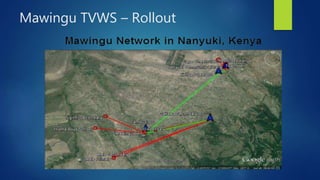
 The diagram below is the test network that was deployed in the
vicinity of Nanyuki in rural Laikipia and Nyeri Counties, Kenya and
connected to a long-haul fibre network for internet breakout.
Mawingu TVWS – Rollout
 To reduce operating expenditures and to address the huge challenge of
delivering broadband access to citizens who lack access to electricity
where they live, the trial project leveraged solar energy, which powers
base stations and also enables consumers to charge devices.
 The project utilized TV white space spectrum to deliver connectivity to
solar powered Internet kiosks, or ‘solar cybers’, in rural communities.
Mawingu TVWS – Rollout
 The Mawingu Project provided at absolutely no charge
connectivity to the following locations in the Nanyuki
area:
1. Kenya National Library Services Nanyuki Branch – 10
computers with dozens of users daily;
2. Male Primary School – 315 students;
3. Nanyuki Red Cross Office – 7 staff members;
4. Tambuzi Farm – 35 employees;
Mawingu TVWS – Rollout
5. Tithigi Boys Secondary School – 280 students;
6. Thome Boys Secondary School – 260 students;
7. Male Secondary School – 220 students;
8. Gakawa Secondary -310 students
9. Laikipia County Government Office – the Executive, Assembly and all
staff members as well as visitors on the premises;
Mawingu TVWS – Rollout
10. Solar Cyber run by Mawingu Networks Limited providing electrical
charging services for phones and torches and high speed Internet
access to the community for free – 20 to 25 persons per day; and
11. Cape Chestnut, a restaurant and business centre – all guests and
customers within the premises.
Mawingu TVWS – Rollout
In our view, the Mawingu TV White Space Trial Project has been extremely
successful:
Technical Results:
o The Mawingu project has successfully demonstrated the technical
viability of this model of delivery, with interference free point to
multi-point coverage of up to 14 kilometres from TVWS base
stations operating at only 2.5 Watts power (EIRP measurement);
Learnings From Mawingu TVWS
In total this provides approximately 235 km2 of TVWS coverage
using multiple 90 degree base station sector antennas;
o To date, we have achieved speeds of up to 16 Mbps on a single 8
MHz TV channel at distances of up to 14 kilometres;
o There have been no reports of interference from any concerned
parties;
o There has been no interference with the equipment or network
during the test period which helps the project achieve a 99.8%
availability;
Learnings From Mawingu TVWS
o We have demonstrated that the technology can support various
media protocols such as streaming videos, emails, FTP, Skype
voice and video conferencing, and high speed VPN services;
o We have delivered this technology in areas with no source of
electricity. In fact, the majority of the endpoints are running on
standalone solar power systems – a clean and renewable source of
energy.
Learnings From Mawingu TVWS
• No interference caused to any Television Service reported to date;
• No increase detected in the UHF band’s noise floor;
• Co-channel operation is achievable at low power levels;
• Solar Power can meet the supply of a typical of TVWS Base
Station’s 24 hour ‘base load’ along with their associated Back-Haul
radio links;
• Cloud Based (and hence remote) management of all network
components is possible;
Learnings From Mawingu TVWS
• Operations below 4 Watts EIRP have proven to be most successful
to date thus allowing for maximum spectrum reuse in small areas;
• That local Kenyan systems integrators are very capable of deploying
and maintaining the software and hardware with minimal training;
• Hardware and radio costs are falling - notably developments of
new white space 802.11af chips, along with other technical
developments in channel bonding and MIMO techniques, will bring
lower costs but also higher connection speeds and efficiencies;
Learnings From Mawingu TVWS
•Using available software and terrain data, white space radio frequency (RF)
coverage predictions are reliable and straightforward to generate for various
local areas of the country;
• TVWS is capable of reaching into relatively low population densities in
dispersed areas without existing ‘grid power’;
• The WS radio technology and supporting hardware is highly reliable, and as
a qualitative data point, there were zero equipment failures over 12 months
across all radios used, and in all the ICT Lab’s hardware and solar equipment.
•
Learnings From Mawingu TVWS
•The use of a ‘Hybrid’ MHz/GHz approach (blending TVWS frequencies
alongside Wi-Fi and other available frequencies) allows efficient use of the right
radios and spectrum meaning that we can demonstrate just 3 base stations
covering areas of almost 235 km2.
Learnings From Mawingu TVWS
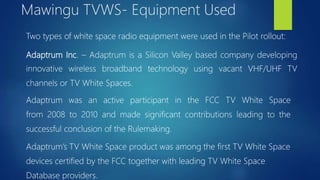
Two types of white space radio equipment were used in the Pilot rollout:
Adaptrum Inc. – Adaptrum is a Silicon Valley based company developing
innovative wireless broadband technology using vacant VHF/UHF TV
channels or TV White Spaces.
Adaptrum was an active participant in the FCC TV White Space
from 2008 to 2010 and made significant contributions leading to the
successful conclusion of the Rulemaking.
Adaptrum’s TV White Space product was among the first TV White Space
devices certified by the FCC together with leading TV White Space
Database providers.
Mawingu TVWS- Equipment Used
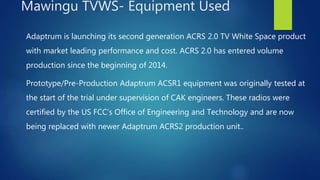
Adaptrum is launching its second generation ACRS 2.0 TV White Space product
with market leading performance and cost. ACRS 2.0 has entered volume
production since the beginning of 2014.
Prototype/Pre-Production Adaptrum ACSR1 equipment was originally tested at
the start of the trial under supervision of CAK engineers. These radios were
certified by the US FCC’s Office of Engineering and Technology and are now
being replaced with newer Adaptrum ACRS2 production unit..
Mawingu TVWS- Equipment Used
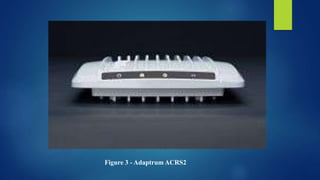
Figure 3 - Adaptrum ACRS2
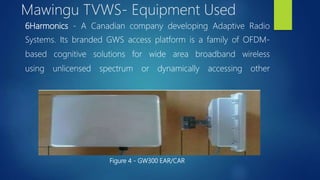
6Harmonics - A Canadian company developing Adaptive Radio
Systems. Its branded GWS access platform is a family of OFDM-
based cognitive solutions for wide area broadband wireless
using unlicensed spectrum or dynamically accessing other
Figure 4 - GW300 EAR/CAR
Mawingu TVWS- Equipment Used
The 6Harmonics GW 300 core adaptive radio (CAR, which is the
basestation radios)/edge adaptive radio (EAR, which is the CPE unit)
hardware based on Wi-Fi 802.11 was configured to operate within a single
8 MHz-wide TV channel.
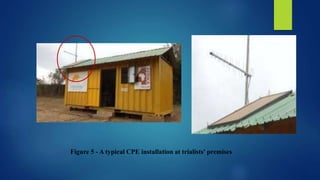
CPE units comprising a white space transceiver and aerial were insatlled at
customer premises, as shown in Figure 5. The white space transceivers are
mounted externally and connected to an Ethernet cable which is fed into
the premises.
Mawingu TVWS- Implementation
Inside the premises, a small Ethernet/Wi-Fi router is supplied to connect
end user devices. Our rural implemntation will typically use Solar power.
The Ethernet cable was also used to deliver electrical power to the
externally-mounted white space transceivers, using Power-Over-Ethernet
(POE).
Mawingu TVWS- Implementation
Figure 5 - A typical CPE installation at trialists' premises
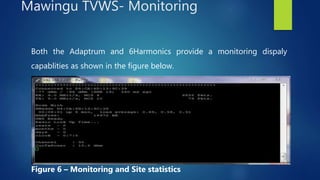
Both the Adaptrum and 6Harmonics provide a monitoring dispaly
capablities as shown in the figure below.
Figure 6 – Monitoring and Site statistics
Mawingu TVWS- Monitoring
The current efficiencies of the equipment is 2Mbps /MHZ on forward and 1.5Mbps /MHZ on the
return at the moment on 64QAM effectivley 16/12Mbps download/upload on an 8MHz channel.
Factors Affecting End-to-End Throughput:
The achievable end-to-end throughput is a function of several factors:
• Path loss and multi-path effects associated with the radio channel;
• Physical Layer capabilities of the radios, e.g. modulation scheme, PA and LNA
performances etc.
• Efficiency of the MAC layer in its ability to share the radio channel among different users;
 The Internet transport protocol in use, e.g. TCP or UDP
Mawingu TVWS- Data Throughput
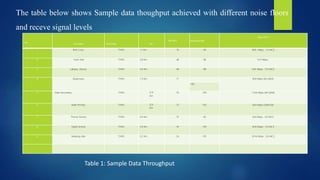
The table below shows Sample data thoughput achieved with different noise floors
and receve signal levels
No
Site Name Technology Km
SNR dBm Noise floor dBm
Mbps RX/TX
1 Red Cross TVWS 1.7 Km -74 -101 16/6 Mbps : 7/3 MCS
2 Town Hall TVWS 0.8 Km -48 -96 11/4 Mbps :
3 Laikipia Library TVWS 0.6 Km -46 -98 13/6 Mbps : 11/3 MCS
4 Dispensary TVWS 7.4 Km -71 8/8 Mbps (64 QAM)
-102
5 Male Secondary TVWS 12.8
Km
-74 -103 7.3/6 Mbps (64 QAM)
6 Male Primary TVWS 12.6
Km
-73 -102 8/6 Mbps (QAM 64)
7 Thome School TVWS 6.0 Km -75 -92 6/6 Mbps : 3/3 MCS
8 Tigithi School TVWS 5.6 Km -74 -101 16/6 Mbps : 7/3 MCS
9 Mawingu Ben TVWS 0.2 Km -24 -101 13/14 Mbps : 5/6 MCS
Table 1: Sample Data Throughput
Using TVWS in Kenya requires that a servcie provider have a Broadcasting Signal Distribution
License from the Communicatiosn Authority (CA) to access the Spectrum. In effect then a
provider needs to have both the BSD, Infrastructure Building Licenses (NFS) and the Internet
Service provision licenses (ASP). BSDs are free to engage with any NFP to rollout a network in
partnership.
Kenya Regulatory TVWS Regulatory
Environment
In recognition of our pioneer work on TVWS Mawingu was recently at the Dynamic Specturm
Alliance Global summit 2017 awarded for Increasing Digital Inclusion.
Mawingu TVWS- AWARDS
THANK YOU

TVWS use case in Kenya

  • 1.
    ISOC CONFERENCE DYNAMIC SPECTRUMAND OTHER INFRASTRUCTURE APPROACHES BEYOND WI-FI BY JOB NDEGE CTO ,MAWINGU NETWORKS LIMITED
  • 2.
    TV White SpaceDescription  ‘TV White Spaces’ are portions of the UHF radio spectrum which not assigned to licensed operators (often termed the primary or are otherwise unused at all times or in all locations. Figure 1 illustrates the concept, showing unused ‘white spaces’ between licensed transmissions.  With demand for wireless connectivity increasing, the exploitation of white space is an attractive way of making more efficient use of radio spectrum simply by sharing the spectrum such that if not in one location of a country by
  • 3.
    TV White SpaceDescription  the primary user, then in that geography it can be redeployed and used by secondary users and will not interfere with the primary user.
  • 4.
    f Licensed transmissions ‘WhiteSpaces’ (unused spectrum) Figure 1 - Graphic illustration of licensed transmissions at certain frequencies, with ‘white spaces’ between them
  • 5.
    TV White SpaceDescription  In many countries, analogue television broadcasts have been switched off and replaced by more spectrally efficient digital television transmissions. Two potential benefits of this transition are: freeing up or clearing spectrum for reallocation to other licensed uses and to enable additional further opportunistic access to interleaved spectrum between licensed users, such as broadcasters.  These UHF frequencies have good propagation and building penetration characteristics, and of course this is the reason they were first chosen for TV broadcasting.
  • 6.
    TV White SpaceDescription  These characteristics make TV white space eminently suitable for use in rural broadband applications, where transmission links may be several kilometers in length and may involve challenging terrain such as hills, foliage, and water. challenging terrain such as hills, foliage, and water.
  • 7.
    TV White SpaceDescription  The US regulator (FCC) has made certain parts of the TV band available for on a license-exempt basis. The UK regulator (Ofcom), the Singaporean (IDA), and the Canadian regulator (Industry Canada) are in the final stages of rule-making.  This represents a ground breaking development in the management of spectrum, as it involves unlicensed transmissions being interleaved with those of licensed users such as TV broadcasters and wireless microphone (PMSE) users. Several other regulators around the world are actively considering approaches. Figures 1 and 2 illustrate how white space transmissions can exist alongside licensed transmissions.
  • 8.
    TV White SpaceDescription  Allowing license-exempt devices to interleave their transmissions with those of licensed users does, however, presents challenges in ensuring that such unlicensed transmissions will not adversely interfere with the licensed transmissions.  The approaches being pursued by the FCC, Ofcom, IDA, and Industry Canada differ slightly, but all involve the use of a regulator-approved database which White Space Devices (WSDs) will need to consult before being allowed to access spectrum.
  • 9.
    Licensed transmissions ‘WhiteSpace’ transmissions f Figure 2 - Some of the ‘white space’ spectrum may be utilized by license-exempt devices interleaving their transmissions with those of licensed users.
  • 10.
    TV White SpaceDescription As of 2011, nobody had demonstrated, let alone deployed, TV white technology on the African continent. All of that changed when the Communications Commission of Kenya (now the CAK) provided with authorization to conduct a TV white space demonstration at the Internet Governance Forum conference held at the UN Compound in Gigiri. At that event, Microsoft and Adaptrum, a pioneer in TV white radio technologies, successfully established a broadband connection on unassigned UHF frequencies streaming HD video and showcasing other applications. The Gigiri demo was the first time TV white space was demonstrated on the African continent.
  • 11.
     On 19August 2013, the Communications Authority of Kenya (‘CAK’ or the ‘Authority’) issued Microsoft East Africa Limited (‘Microsoft’ or ‘we’) with a trial authorization to conduct a trial utilizing television white spaces (‘TV white spaces’) technologies in the vicinity of Nanyuki and Kalema (the ‘2013 Trial Authorization’).  Consequently, a series of pilots and projects were undertaken in defined rural parts of Kenya. These projects relied on a combination of wireless technologies designed to operate on a license-exempt or unlicensed basis, including Wi-Fi and TV White Space base stations and end user devices. Mawingu TVWS – Background
  • 12.
     The TVwhite space technology was used for point-to-multipoint “last mile” broadband connectivity.  The diagram below is the test network that was deployed in the vicinity of Nanyuki in rural Laikipia and Nyeri Counties, Kenya and connected to a long-haul fibre network for internet breakout. Mawingu TVWS – Rollout
  • 13.
  • 14.
     To reduceoperating expenditures and to address the huge challenge of delivering broadband access to citizens who lack access to electricity where they live, the trial project leveraged solar energy, which powers base stations and also enables consumers to charge devices.  The project utilized TV white space spectrum to deliver connectivity to solar powered Internet kiosks, or ‘solar cybers’, in rural communities. Mawingu TVWS – Rollout
  • 15.
     The MawinguProject provided at absolutely no charge connectivity to the following locations in the Nanyuki area: 1. Kenya National Library Services Nanyuki Branch – 10 computers with dozens of users daily; 2. Male Primary School – 315 students; 3. Nanyuki Red Cross Office – 7 staff members; 4. Tambuzi Farm – 35 employees; Mawingu TVWS – Rollout
  • 16.
    5. Tithigi BoysSecondary School – 280 students; 6. Thome Boys Secondary School – 260 students; 7. Male Secondary School – 220 students; 8. Gakawa Secondary -310 students 9. Laikipia County Government Office – the Executive, Assembly and all staff members as well as visitors on the premises; Mawingu TVWS – Rollout
  • 17.
    10. Solar Cyberrun by Mawingu Networks Limited providing electrical charging services for phones and torches and high speed Internet access to the community for free – 20 to 25 persons per day; and 11. Cape Chestnut, a restaurant and business centre – all guests and customers within the premises. Mawingu TVWS – Rollout
  • 18.
    In our view,the Mawingu TV White Space Trial Project has been extremely successful: Technical Results: o The Mawingu project has successfully demonstrated the technical viability of this model of delivery, with interference free point to multi-point coverage of up to 14 kilometres from TVWS base stations operating at only 2.5 Watts power (EIRP measurement); Learnings From Mawingu TVWS
  • 19.
    In total thisprovides approximately 235 km2 of TVWS coverage using multiple 90 degree base station sector antennas; o To date, we have achieved speeds of up to 16 Mbps on a single 8 MHz TV channel at distances of up to 14 kilometres; o There have been no reports of interference from any concerned parties; o There has been no interference with the equipment or network during the test period which helps the project achieve a 99.8% availability; Learnings From Mawingu TVWS
  • 20.
    o We havedemonstrated that the technology can support various media protocols such as streaming videos, emails, FTP, Skype voice and video conferencing, and high speed VPN services; o We have delivered this technology in areas with no source of electricity. In fact, the majority of the endpoints are running on standalone solar power systems – a clean and renewable source of energy. Learnings From Mawingu TVWS
  • 21.
    • No interferencecaused to any Television Service reported to date; • No increase detected in the UHF band’s noise floor; • Co-channel operation is achievable at low power levels; • Solar Power can meet the supply of a typical of TVWS Base Station’s 24 hour ‘base load’ along with their associated Back-Haul radio links; • Cloud Based (and hence remote) management of all network components is possible; Learnings From Mawingu TVWS
  • 22.
    • Operations below4 Watts EIRP have proven to be most successful to date thus allowing for maximum spectrum reuse in small areas; • That local Kenyan systems integrators are very capable of deploying and maintaining the software and hardware with minimal training; • Hardware and radio costs are falling - notably developments of new white space 802.11af chips, along with other technical developments in channel bonding and MIMO techniques, will bring lower costs but also higher connection speeds and efficiencies; Learnings From Mawingu TVWS
  • 23.
    •Using available softwareand terrain data, white space radio frequency (RF) coverage predictions are reliable and straightforward to generate for various local areas of the country; • TVWS is capable of reaching into relatively low population densities in dispersed areas without existing ‘grid power’; • The WS radio technology and supporting hardware is highly reliable, and as a qualitative data point, there were zero equipment failures over 12 months across all radios used, and in all the ICT Lab’s hardware and solar equipment. • Learnings From Mawingu TVWS
  • 24.
    •The use ofa ‘Hybrid’ MHz/GHz approach (blending TVWS frequencies alongside Wi-Fi and other available frequencies) allows efficient use of the right radios and spectrum meaning that we can demonstrate just 3 base stations covering areas of almost 235 km2. Learnings From Mawingu TVWS
  • 25.
    Two types ofwhite space radio equipment were used in the Pilot rollout: Adaptrum Inc. – Adaptrum is a Silicon Valley based company developing innovative wireless broadband technology using vacant VHF/UHF TV channels or TV White Spaces. Adaptrum was an active participant in the FCC TV White Space from 2008 to 2010 and made significant contributions leading to the successful conclusion of the Rulemaking. Adaptrum’s TV White Space product was among the first TV White Space devices certified by the FCC together with leading TV White Space Database providers. Mawingu TVWS- Equipment Used
  • 26.
    Adaptrum is launchingits second generation ACRS 2.0 TV White Space product with market leading performance and cost. ACRS 2.0 has entered volume production since the beginning of 2014. Prototype/Pre-Production Adaptrum ACSR1 equipment was originally tested at the start of the trial under supervision of CAK engineers. These radios were certified by the US FCC’s Office of Engineering and Technology and are now being replaced with newer Adaptrum ACRS2 production unit.. Mawingu TVWS- Equipment Used
  • 27.
    Figure 3 -Adaptrum ACRS2
  • 28.
    6Harmonics - ACanadian company developing Adaptive Radio Systems. Its branded GWS access platform is a family of OFDM- based cognitive solutions for wide area broadband wireless using unlicensed spectrum or dynamically accessing other Figure 4 - GW300 EAR/CAR Mawingu TVWS- Equipment Used
  • 29.
    The 6Harmonics GW300 core adaptive radio (CAR, which is the basestation radios)/edge adaptive radio (EAR, which is the CPE unit) hardware based on Wi-Fi 802.11 was configured to operate within a single 8 MHz-wide TV channel. CPE units comprising a white space transceiver and aerial were insatlled at customer premises, as shown in Figure 5. The white space transceivers are mounted externally and connected to an Ethernet cable which is fed into the premises. Mawingu TVWS- Implementation
  • 30.
    Inside the premises,a small Ethernet/Wi-Fi router is supplied to connect end user devices. Our rural implemntation will typically use Solar power. The Ethernet cable was also used to deliver electrical power to the externally-mounted white space transceivers, using Power-Over-Ethernet (POE). Mawingu TVWS- Implementation
  • 31.
    Figure 5 -A typical CPE installation at trialists' premises
  • 32.
    Both the Adaptrumand 6Harmonics provide a monitoring dispaly capablities as shown in the figure below. Figure 6 – Monitoring and Site statistics Mawingu TVWS- Monitoring
  • 33.
    The current efficienciesof the equipment is 2Mbps /MHZ on forward and 1.5Mbps /MHZ on the return at the moment on 64QAM effectivley 16/12Mbps download/upload on an 8MHz channel. Factors Affecting End-to-End Throughput: The achievable end-to-end throughput is a function of several factors: • Path loss and multi-path effects associated with the radio channel; • Physical Layer capabilities of the radios, e.g. modulation scheme, PA and LNA performances etc. • Efficiency of the MAC layer in its ability to share the radio channel among different users;  The Internet transport protocol in use, e.g. TCP or UDP Mawingu TVWS- Data Throughput
  • 34.
    The table belowshows Sample data thoughput achieved with different noise floors and receve signal levels No Site Name Technology Km SNR dBm Noise floor dBm Mbps RX/TX 1 Red Cross TVWS 1.7 Km -74 -101 16/6 Mbps : 7/3 MCS 2 Town Hall TVWS 0.8 Km -48 -96 11/4 Mbps : 3 Laikipia Library TVWS 0.6 Km -46 -98 13/6 Mbps : 11/3 MCS 4 Dispensary TVWS 7.4 Km -71 8/8 Mbps (64 QAM) -102 5 Male Secondary TVWS 12.8 Km -74 -103 7.3/6 Mbps (64 QAM) 6 Male Primary TVWS 12.6 Km -73 -102 8/6 Mbps (QAM 64) 7 Thome School TVWS 6.0 Km -75 -92 6/6 Mbps : 3/3 MCS 8 Tigithi School TVWS 5.6 Km -74 -101 16/6 Mbps : 7/3 MCS 9 Mawingu Ben TVWS 0.2 Km -24 -101 13/14 Mbps : 5/6 MCS Table 1: Sample Data Throughput
  • 35.
    Using TVWS inKenya requires that a servcie provider have a Broadcasting Signal Distribution License from the Communicatiosn Authority (CA) to access the Spectrum. In effect then a provider needs to have both the BSD, Infrastructure Building Licenses (NFS) and the Internet Service provision licenses (ASP). BSDs are free to engage with any NFP to rollout a network in partnership. Kenya Regulatory TVWS Regulatory Environment
  • 36.
    In recognition ofour pioneer work on TVWS Mawingu was recently at the Dynamic Specturm Alliance Global summit 2017 awarded for Increasing Digital Inclusion. Mawingu TVWS- AWARDS
  • 37.