CONNECTIVITY FOR THE REST TO US – CASE FOR TVWS
C3 Limited
Postal Address: P.O. Box 31000, Blantyre 3, Malawi
Physical Address: MPC Business Park, Chichiri
E-Mail: info@c3.mw
TABLEOFCONTENTS
Introduction
Overview
Television White Spaces
Topologies and Configurations
3
4
5
6
7
8
10
11
12
13
14
16
Channel Planning 15
Table of Contents
17
Communication Technologies Used by ISP’s in Malawi
Unique Benefits of Wi-FAR
Coverage of Wi-FAR Radios
Point to MultiPoint – Three Sector
Point to MultiPoint – Two Sector (Dual BTS)
Wi-Fi Hotspot Use Case
Network Relay (Layer 2)
Channel Re-Use
Network Channel Planning
Internet Society 2nd Summit on Community Networks - Africa
1 – INTRODUCTION
PHASE1–4C3NETWORKINFRASTRUCTUREBUILD
Overview
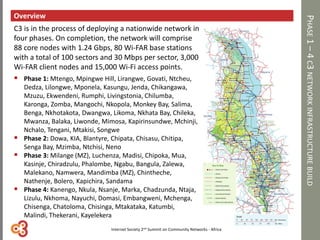
C3 is in the process of deploying a nationwide network in
four phases. On completion, the network will comprise
88 core nodes with 1.24 Gbps, 80 Wi-FAR base stations
with a total of 100 sectors and 30 Mbps per sector, 3,000
Wi-FAR client nodes and 15,000 Wi-Fi access points.
 Phase 1: Mtengo, Mpingwe Hill, Lirangwe, Govati, Ntcheu,
Dedza, Lilongwe, Mponela, Kasungu, Jenda, Chikangawa,
Mzuzu, Ekwendeni, Rumphi, Livingstonia, Chilumba,
Karonga, Zomba, Mangochi, Nkopola, Monkey Bay, Salima,
Benga, Nkhotakota, Dwangwa, Likoma, Nkhata Bay, Chileka,
Mwanza, Balaka, Liwonde, Mimosa, Kapirinsundwe, Mchinji,
Nchalo, Tengani, Mtakisi, Songwe
 Phase 2: Dowa, KIA, Blantyre, Chipata, Chisasu, Chitipa,
Senga Bay, Mzimba, Ntchisi, Neno
 Phase 3: Milange (MZ), Luchenza, Madisi, Chipoka, Mua,
Kasinje, Chiradzulu, Phalombe, Ngabu, Bangula, Zalewa,
Malekano, Namwera, Mandimba (MZ), Chintheche,
Nathenje, Bolero, Kapichira, Sandama
 Phase 4: Kanengo, Nkula, Nsanje, Marka, Chadzunda, Ntaja,
Lizulu, Nkhoma, Nayuchi, Domasi, Embangweni, Mchenga,
Chisenga, Chatoloma, Chisinga, Mtakataka, Katumbi,
Malindi, Thekerani, Kayelekera
Internet Society 2nd Summit on Community Networks - Africa
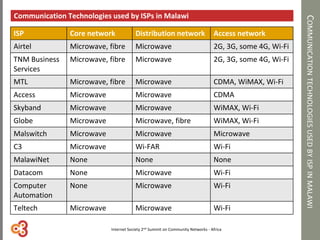
COMMUNICATIONTECHNOLOGIESUSEDBYISPINMALAWI
Communication Technologies used by ISPs in Malawi
ISP Core network Distribution network Access network
Airtel Microwave, fibre Microwave 2G, 3G, some 4G, Wi-Fi
TNM Business
Services
Microwave, fibre Microwave 2G, 3G, some 4G, Wi-Fi
MTL Microwave, fibre Microwave CDMA, WiMAX, Wi-Fi
Access Microwave Microwave CDMA
Skyband Microwave Microwave WiMAX, Wi-Fi
Globe Microwave Microwave, fibre WiMAX, Wi-Fi
Malswitch Microwave Microwave Microwave
C3 Microwave Wi-FAR Wi-Fi
MalawiNet None None None
Datacom None Microwave Wi-Fi
Computer
Automation
None Microwave Wi-Fi
Teltech Microwave Microwave Wi-Fi
Internet Society 2nd Summit on Community Networks - Africa
TELEVISION WHITE SPACES (TVWS)
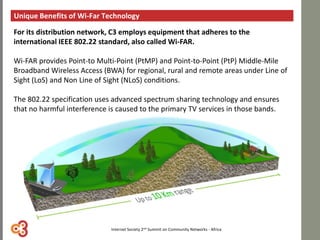
Unique Benefits of Wi-Far Technology
For its distribution network, C3 employs equipment that adheres to the
international IEEE 802.22 standard, also called Wi-FAR.
Wi-FAR provides Point-to Multi-Point (PtMP) and Point-to-Point (PtP) Middle-Mile
Broadband Wireless Access (BWA) for regional, rural and remote areas under Line of
Sight (LoS) and Non Line of Sight (NLoS) conditions.
The 802.22 specification uses advanced spectrum sharing technology and ensures
that no harmful interference is caused to the primary TV services in those bands.
Internet Society 2nd Summit on Community Networks - Africa
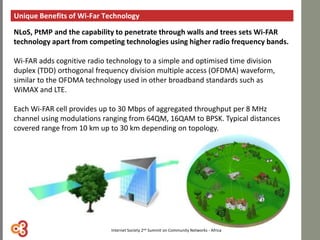
Unique Benefits of Wi-Far Technology
NLoS, PtMP and the capability to penetrate through walls and trees sets Wi-FAR
technology apart from competing technologies using higher radio frequency bands.
Wi-FAR adds cognitive radio technology to a simple and optimised time division
duplex (TDD) orthogonal frequency division multiple access (OFDMA) waveform,
similar to the OFDMA technology used in other broadband standards such as
WiMAX and LTE.
Each Wi-FAR cell provides up to 30 Mbps of aggregated throughput per 8 MHz
channel using modulations ranging from 64QM, 16QAM to BPSK. Typical distances
covered range from 10 km up to 30 km depending on topology.
Internet Society 2nd Summit on Community Networks - Africa
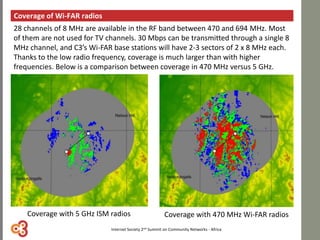
Coverage of Wi-FAR radios
Coverage with 5 GHz ISM radios Coverage with 470 MHz Wi-FAR radios
28 channels of 8 MHz are available in the RF band between 470 and 694 MHz. Most
of them are not used for TV channels. 30 Mbps can be transmitted through a single 8
MHz channel, and C3’s Wi-FAR base stations will have 2-3 sectors of 2 x 8 MHz each.
Thanks to the low radio frequency, coverage is much larger than with higher
frequencies. Below is a comparison between coverage in 470 MHz versus 5 GHz.
Internet Society 2nd Summit on Community Networks - Africa
TOPOLOGIES AND CONFIGURATIONS
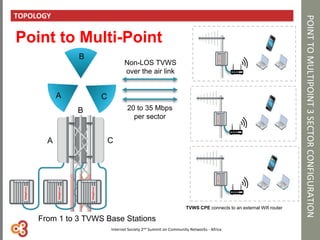
POINTTOMULTIPOINT3SECTORCONFIGURATION
TOPOLOGY
TVWS CPE connects to an external Wifi router
A
B
C
A
B
C
Point to Multi-Point
Non-LOS TVWS
over the air link
20 to 35 Mbps
per sector
From 1 to 3 TVWS Base Stations
Internet Society 2nd Summit on Community Networks - Africa
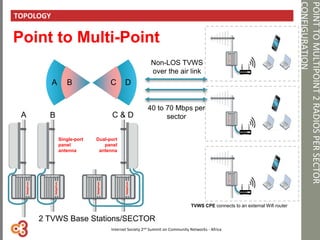
POINTTOMULTIPOINT2RADIOSPERSECTOR
CONFIGURATION
TOPOLOGY
Point to Multi-Point
Non-LOS TVWS
over the air link
TVWS CPE connects to an external Wifi router
40 to 70 Mbps per
sector
A
A B C & D
B C D
Single-port
panel
antenna
Dual-port
panel
antenna
2 TVWS Base Stations/SECTOR
Internet Society 2nd Summit on Community Networks - Africa
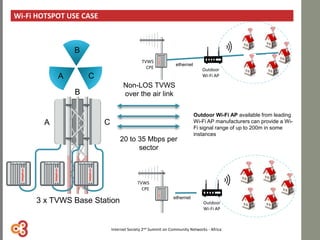
Wi-Fi HOTSPOT USE CASE
Non-LOS TVWS
over the air link
Outdoor Wi-Fi AP available from leading
Wi-Fi AP manufacturers can provide a Wi-
Fi signal range of up to 200m in some
instances
20 to 35 Mbps per
sector
Outdoor
Wi-Fi AP
ethernet
TVWS
CPE
Outdoor
Wi-Fi AP
ethernet
A
B
C
TVWS
CPE
A
B
C
3 x TVWS Base Station
Internet Society 2nd Summit on Community Networks - Africa
LAYER2DISTRIBUTIONANDBASICCONFIGURATION
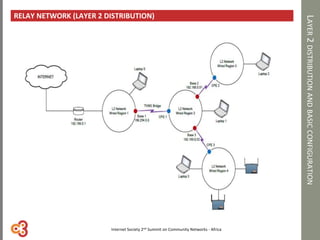
RELAY NETWORK (LAYER 2 DISTRIBUTION)
Internet Society 2nd Summit on Community Networks - Africa
CHANNEL PLANNING
UHFCHANNELRE-USETYPICAL9-15UNIQUECHANNEL
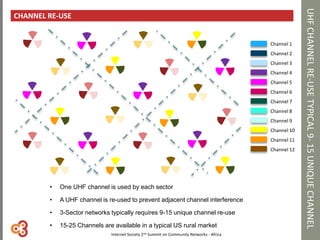
CHANNEL RE-USE
Channel 1
Channel 2
Channel 3
Channel 4
Channel 5
Channel 6
Channel 7
Channel 8
Channel 9
Channel 10
Channel 11
Channel 12
• One UHF channel is used by each sector
• A UHF channel is re-used to prevent adjacent channel interference
• 3-Sector networks typically requires 9-15 unique channel re-use
• 15-25 Channels are available in a typical US rural market
Internet Society 2nd Summit on Community Networks - Africa
UHFCHANNELRE-USEEXAMPLE3CLUSTER
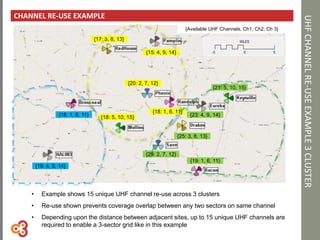
CHANNEL RE-USE EXAMPLE
{15: 4, 9, 14}
{17: 3, 8, 13}
{18: 1, 6, 11}
{18: 5, 10, 15}
{20: 2, 7, 12}
{23: 4, 9, 14}
{21: 5, 10, 15}
{25: 3, 8, 13}
{29: 2, 7, 12}
{19: 1, 6, 11}
{18: 1, 6, 11}
{19: 4, 9, 14}
{Available UHF Channels, Ch1, Ch2, Ch 3}
• Example shows 15 unique UHF channel re-use across 3 clusters
• Re-use shown prevents coverage overlap between any two sectors on same channel
• Depending upon the distance between adjacent sites, up to 15 unique UHF channels are
required to enable a 3-sector grid like in this example
CENTRALANDPARTIALNORTHERNREGIONCOVERAGE
C3 TVWS COVERAGE PLAN (SNAP VIEW)
Internet Society 2nd Summit on Community Networks - Africa
THANK YOU
C3 Limited
Postal Address: P.O. Box 31000, Blantyre 3, Malawi
Physical Address: MPC Business Park, Chichiri
E-Mail: info@c3.mw

TVWS use case in Malawi

  • 1.
    CONNECTIVITY FOR THEREST TO US – CASE FOR TVWS C3 Limited Postal Address: P.O. Box 31000, Blantyre 3, Malawi Physical Address: MPC Business Park, Chichiri E-Mail: info@c3.mw
  • 2.
    TABLEOFCONTENTS Introduction Overview Television White Spaces Topologiesand Configurations 3 4 5 6 7 8 10 11 12 13 14 16 Channel Planning 15 Table of Contents 17 Communication Technologies Used by ISP’s in Malawi Unique Benefits of Wi-FAR Coverage of Wi-FAR Radios Point to MultiPoint – Three Sector Point to MultiPoint – Two Sector (Dual BTS) Wi-Fi Hotspot Use Case Network Relay (Layer 2) Channel Re-Use Network Channel Planning Internet Society 2nd Summit on Community Networks - Africa
  • 3.
  • 4.
    PHASE1–4C3NETWORKINFRASTRUCTUREBUILD Overview C3 is inthe process of deploying a nationwide network in four phases. On completion, the network will comprise 88 core nodes with 1.24 Gbps, 80 Wi-FAR base stations with a total of 100 sectors and 30 Mbps per sector, 3,000 Wi-FAR client nodes and 15,000 Wi-Fi access points.  Phase 1: Mtengo, Mpingwe Hill, Lirangwe, Govati, Ntcheu, Dedza, Lilongwe, Mponela, Kasungu, Jenda, Chikangawa, Mzuzu, Ekwendeni, Rumphi, Livingstonia, Chilumba, Karonga, Zomba, Mangochi, Nkopola, Monkey Bay, Salima, Benga, Nkhotakota, Dwangwa, Likoma, Nkhata Bay, Chileka, Mwanza, Balaka, Liwonde, Mimosa, Kapirinsundwe, Mchinji, Nchalo, Tengani, Mtakisi, Songwe  Phase 2: Dowa, KIA, Blantyre, Chipata, Chisasu, Chitipa, Senga Bay, Mzimba, Ntchisi, Neno  Phase 3: Milange (MZ), Luchenza, Madisi, Chipoka, Mua, Kasinje, Chiradzulu, Phalombe, Ngabu, Bangula, Zalewa, Malekano, Namwera, Mandimba (MZ), Chintheche, Nathenje, Bolero, Kapichira, Sandama  Phase 4: Kanengo, Nkula, Nsanje, Marka, Chadzunda, Ntaja, Lizulu, Nkhoma, Nayuchi, Domasi, Embangweni, Mchenga, Chisenga, Chatoloma, Chisinga, Mtakataka, Katumbi, Malindi, Thekerani, Kayelekera Internet Society 2nd Summit on Community Networks - Africa
  • 5.
    COMMUNICATIONTECHNOLOGIESUSEDBYISPINMALAWI Communication Technologies usedby ISPs in Malawi ISP Core network Distribution network Access network Airtel Microwave, fibre Microwave 2G, 3G, some 4G, Wi-Fi TNM Business Services Microwave, fibre Microwave 2G, 3G, some 4G, Wi-Fi MTL Microwave, fibre Microwave CDMA, WiMAX, Wi-Fi Access Microwave Microwave CDMA Skyband Microwave Microwave WiMAX, Wi-Fi Globe Microwave Microwave, fibre WiMAX, Wi-Fi Malswitch Microwave Microwave Microwave C3 Microwave Wi-FAR Wi-Fi MalawiNet None None None Datacom None Microwave Wi-Fi Computer Automation None Microwave Wi-Fi Teltech Microwave Microwave Wi-Fi Internet Society 2nd Summit on Community Networks - Africa
  • 6.
  • 7.
    Unique Benefits ofWi-Far Technology For its distribution network, C3 employs equipment that adheres to the international IEEE 802.22 standard, also called Wi-FAR. Wi-FAR provides Point-to Multi-Point (PtMP) and Point-to-Point (PtP) Middle-Mile Broadband Wireless Access (BWA) for regional, rural and remote areas under Line of Sight (LoS) and Non Line of Sight (NLoS) conditions. The 802.22 specification uses advanced spectrum sharing technology and ensures that no harmful interference is caused to the primary TV services in those bands. Internet Society 2nd Summit on Community Networks - Africa
  • 8.
    Unique Benefits ofWi-Far Technology NLoS, PtMP and the capability to penetrate through walls and trees sets Wi-FAR technology apart from competing technologies using higher radio frequency bands. Wi-FAR adds cognitive radio technology to a simple and optimised time division duplex (TDD) orthogonal frequency division multiple access (OFDMA) waveform, similar to the OFDMA technology used in other broadband standards such as WiMAX and LTE. Each Wi-FAR cell provides up to 30 Mbps of aggregated throughput per 8 MHz channel using modulations ranging from 64QM, 16QAM to BPSK. Typical distances covered range from 10 km up to 30 km depending on topology. Internet Society 2nd Summit on Community Networks - Africa
  • 9.
    Coverage of Wi-FARradios Coverage with 5 GHz ISM radios Coverage with 470 MHz Wi-FAR radios 28 channels of 8 MHz are available in the RF band between 470 and 694 MHz. Most of them are not used for TV channels. 30 Mbps can be transmitted through a single 8 MHz channel, and C3’s Wi-FAR base stations will have 2-3 sectors of 2 x 8 MHz each. Thanks to the low radio frequency, coverage is much larger than with higher frequencies. Below is a comparison between coverage in 470 MHz versus 5 GHz. Internet Society 2nd Summit on Community Networks - Africa
  • 10.
  • 11.
    POINTTOMULTIPOINT3SECTORCONFIGURATION TOPOLOGY TVWS CPE connectsto an external Wifi router A B C A B C Point to Multi-Point Non-LOS TVWS over the air link 20 to 35 Mbps per sector From 1 to 3 TVWS Base Stations Internet Society 2nd Summit on Community Networks - Africa
  • 12.
    POINTTOMULTIPOINT2RADIOSPERSECTOR CONFIGURATION TOPOLOGY Point to Multi-Point Non-LOSTVWS over the air link TVWS CPE connects to an external Wifi router 40 to 70 Mbps per sector A A B C & D B C D Single-port panel antenna Dual-port panel antenna 2 TVWS Base Stations/SECTOR Internet Society 2nd Summit on Community Networks - Africa
  • 13.
    Wi-Fi HOTSPOT USECASE Non-LOS TVWS over the air link Outdoor Wi-Fi AP available from leading Wi-Fi AP manufacturers can provide a Wi- Fi signal range of up to 200m in some instances 20 to 35 Mbps per sector Outdoor Wi-Fi AP ethernet TVWS CPE Outdoor Wi-Fi AP ethernet A B C TVWS CPE A B C 3 x TVWS Base Station Internet Society 2nd Summit on Community Networks - Africa
  • 14.
    LAYER2DISTRIBUTIONANDBASICCONFIGURATION RELAY NETWORK (LAYER2 DISTRIBUTION) Internet Society 2nd Summit on Community Networks - Africa
  • 15.
  • 16.
    UHFCHANNELRE-USETYPICAL9-15UNIQUECHANNEL CHANNEL RE-USE Channel 1 Channel2 Channel 3 Channel 4 Channel 5 Channel 6 Channel 7 Channel 8 Channel 9 Channel 10 Channel 11 Channel 12 • One UHF channel is used by each sector • A UHF channel is re-used to prevent adjacent channel interference • 3-Sector networks typically requires 9-15 unique channel re-use • 15-25 Channels are available in a typical US rural market Internet Society 2nd Summit on Community Networks - Africa
  • 17.
    UHFCHANNELRE-USEEXAMPLE3CLUSTER CHANNEL RE-USE EXAMPLE {15:4, 9, 14} {17: 3, 8, 13} {18: 1, 6, 11} {18: 5, 10, 15} {20: 2, 7, 12} {23: 4, 9, 14} {21: 5, 10, 15} {25: 3, 8, 13} {29: 2, 7, 12} {19: 1, 6, 11} {18: 1, 6, 11} {19: 4, 9, 14} {Available UHF Channels, Ch1, Ch2, Ch 3} • Example shows 15 unique UHF channel re-use across 3 clusters • Re-use shown prevents coverage overlap between any two sectors on same channel • Depending upon the distance between adjacent sites, up to 15 unique UHF channels are required to enable a 3-sector grid like in this example
  • 18.
    CENTRALANDPARTIALNORTHERNREGIONCOVERAGE C3 TVWS COVERAGEPLAN (SNAP VIEW) Internet Society 2nd Summit on Community Networks - Africa
  • 19.
    THANK YOU C3 Limited PostalAddress: P.O. Box 31000, Blantyre 3, Malawi Physical Address: MPC Business Park, Chichiri E-Mail: info@c3.mw