ROLE OF TRADE IN DEVELOPMENT
Assess India’s Trade and It’s Contribution
Nishant Kumar
(I120412)
III year Int. M.Sc.Economics
Dept. Of Economics
INTRODUCTION
 Trade, also called goods exchange economy ,is to transfer the
ownership of goods from one person or entity to another by
getting a product or service in exchange from the buyer.
 Trade is the basic component of economic activity and is
undertaken for mutual advantage.
 Trade is believed to have first begun in South West of Asia.
Nishant Kumar
WHY TRADE HAPPENED?
Nishant Kumar
 All countries are different from each other.
 To achieve the economics of scale in production.
TRADE THEORY
Nishant Kumar
MERCANTILISTS’ VIEWS ON TRADE
 Mercantilists measured the wealth of a nation by the stock
of precious metals it possessed.
 Mercantilists advocated strict government control of all
economic activity and preached economic nationalism
because they believed that a nation could gain in trade only
at the expense of other nations(trade was a zero-sum
game).
Nishant Kumar
TRADE BASED ON ABSOLUTE
ADVANTAGE: ADAM SMITH
When one nation is more efficient than another in the production
of one commodity but is less efficient than other nation in
producing a second commodity, then both nations can gain by
each specializing in the production of the commodity of its
absolute advantage and exchanging part of its output with the
other nation for the commodity of its absolute disadvantage.
 Adam believed that all nations would gain from free trade and
strongly advocated a policy of laissez-faire .
 Adam’s theory served the interest of factory owners (who were
able to pay lower wages because of cheaper food imports) and
harmed landowners (because food became less scarce due to
cheaper imports).
Nishant Kumar
TRADE BASED ON COMPARATIVE
ADVANTAGE :DAVID RICARDO
When one nation is less efficient than(has an absolute
disadvantage with respect to) the other nation in the
production of both commodities, there is still a basis for
mutually beneficial trade.
 Under the labour theory of value, the value or price of a
commodity depends exclusively on the amount of labour
going into the production of the commodity.
Nishant Kumar
HECKSCHER -OHLIN MODEL
A nation will export the commodity whose production
requires the intensive use of the nation’s relatively
abundant and cheap factor and import the commodity
whose production requires the intensive use of the
nation’s relatively scarce and expensive factor.
Nishant Kumar
ROLE OF TRADE IN DEVELOPMENT
Nishant Kumar
Nishant Kumar
1. Trade can help boost development and reduce poverty by
generating growth through increased commercial
opportunities and investment, as well as broadening the
productive base through private development.
 Between 2000 and 2008, GDP per capita increased
from $325 to over $625 in Least-Developed Countries.
 Much of this can be attributed to an increase in trade and
foreign investment.
Nishant Kumar
2. Trade enhances competitiveness by helping developing
countries reduce the cost of inputs, acquire finance
through investments, increase the value added of their
products and move up the global value chain .
 Emerging economies like China, Brazil, India and South
Africa are steadily catching up with developed countries,
thanks to increased trade.
 The GDP per capita increase of G20 developing countries
stands at 115% for the decade 2000-2010.
Nishant Kumar
3. Trade facilitates export diversification by allowing
developing countries to access new markets and new
materials which open up new production possibilities.
 India cut import duties from an average of 90% in
1991 to 30% in 1997. This gave Indian manufacturers
access to a variety of intermediate and capital goods.
Imports of intermediate goods increased by 227% over
the period.
 Two thirds of the intermediate goods imported were
products Indian producers could not buy before 1991.
As a result, industrial output grew by 50% with new
products accounting for 25% of the total.
Nishant Kumar
4. Trade encourages innovation by facilitating exchange of
know-how, technology and investment in research and
development, including through foreign direct
investment.
 Investment and trade have facilitated the deployment of
information and communication technology, with mobile
cellular coverage reaching 86% of the world’s population
in 2008.
Nishant Kumar
5. Trade openness expands business opportunities for
domestic companies by opening up new markets,
removing unnecessary barriers and making it easier for
them to export.
6. Trade expands choice and lowers prices for consumers by
broadening supply sources of goods and services and
strengthening competition.
Nishant Kumar
7. Trade plays a role in the improvement of quality, labour
and environmental standards through increased
competition and the exchange of best practices between
trade partners, building capacity in industry and product
standards.
8. Trade contributes to cutting government spending by
expanding supply sources of goods and services and
strengthening competition for government procurement.
Nishant Kumar
9. Trade strengthens ties between nations by bringing
people together in peaceful and mutual beneficial
exchanges and as such contributes to peace and
stability.
 A study undertaken by the Centre for Economic Policy
Research on empirical data showed that the probability
disputes escalating to conflict is lower for countries that
trade more because of the opportunity cost associated
with the loss of trade gains.
Nishant Kumar
10. Trade creates employment opportunities by boosting
economic sectors that create jobs and usually higher
incomes, thus improving livelihoods.
 Manufacturing workers in open economies received
pay rates 3 to 9 times greater than those in closed
economies, depending on the region.
ASSESS INDIA’S TRADE AND IT’S
CONTRIBUTION
Nishant Kumar
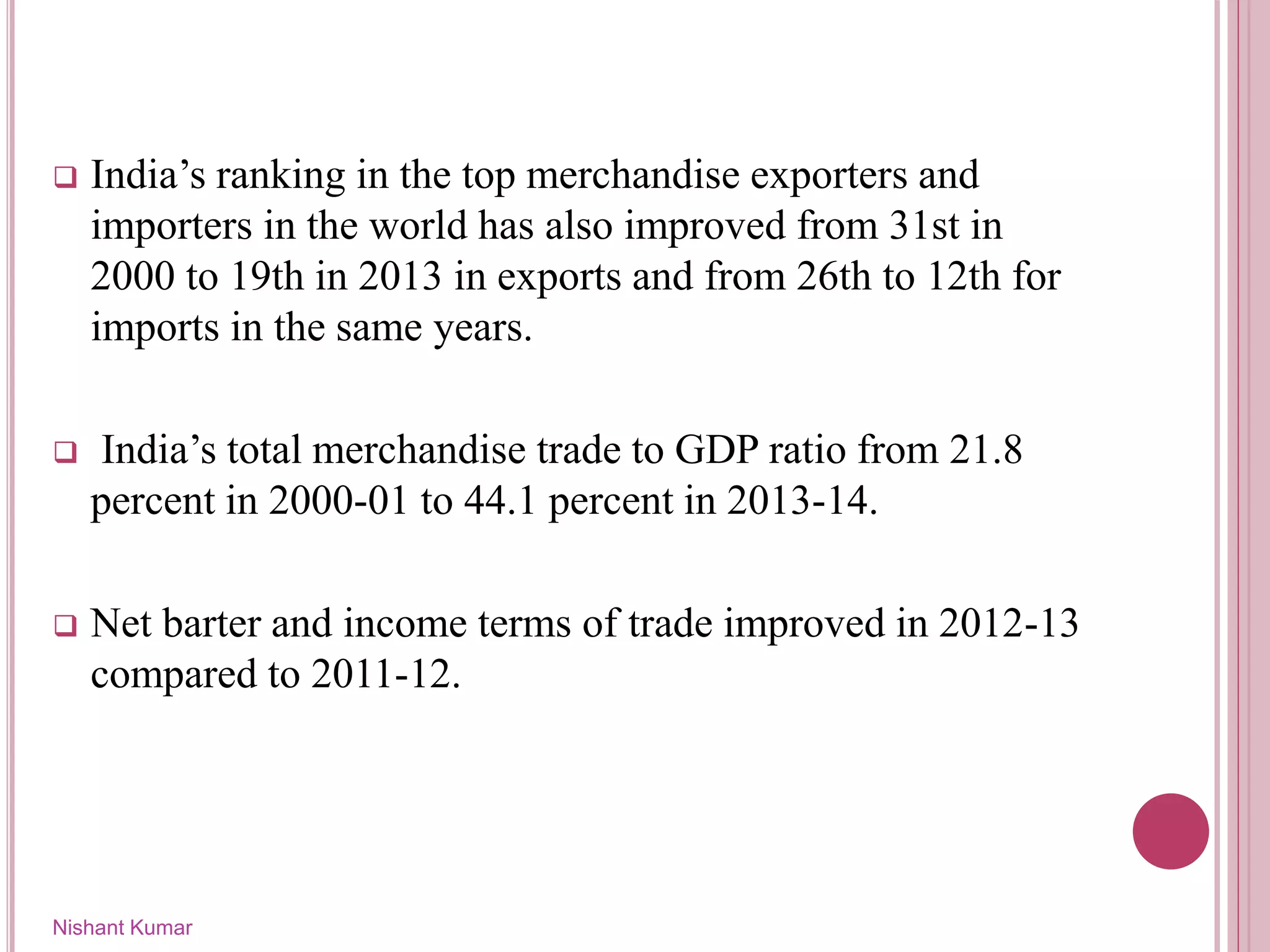
 India’s ranking in the top merchandise exporters and
importers in the world has also improved from 31st in
2000 to 19th in 2013 in exports and from 26th to 12th for
imports in the same years.
 India’s total merchandise trade to GDP ratio from 21.8
percent in 2000-01 to 44.1 percent in 2013-14.
 Net barter and income terms of trade improved in 2012-13
compared to 2011-12.
Nishant Kumar
Nishant Kumar
-200000
-100000
0
100000
200000
300000
400000
500000
600000
700000
800000
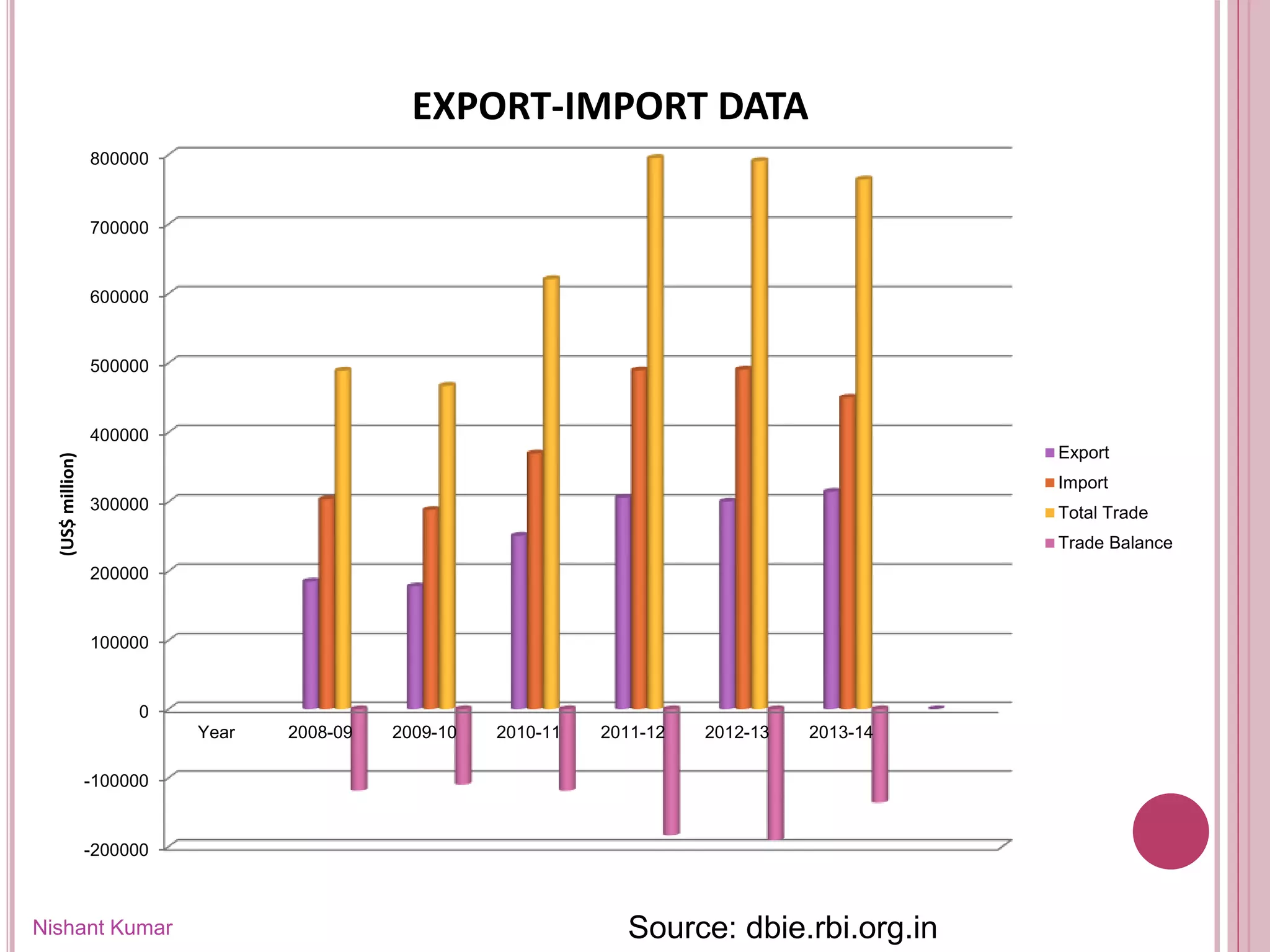
Year 2008-09 2009-10 2010-11 2011-12 2012-13 2013-14
(US$million)
EXPORT-IMPORT DATA
Export
Import
Total Trade
Trade Balance
Source: dbie.rbi.org.in
Nishant Kumar
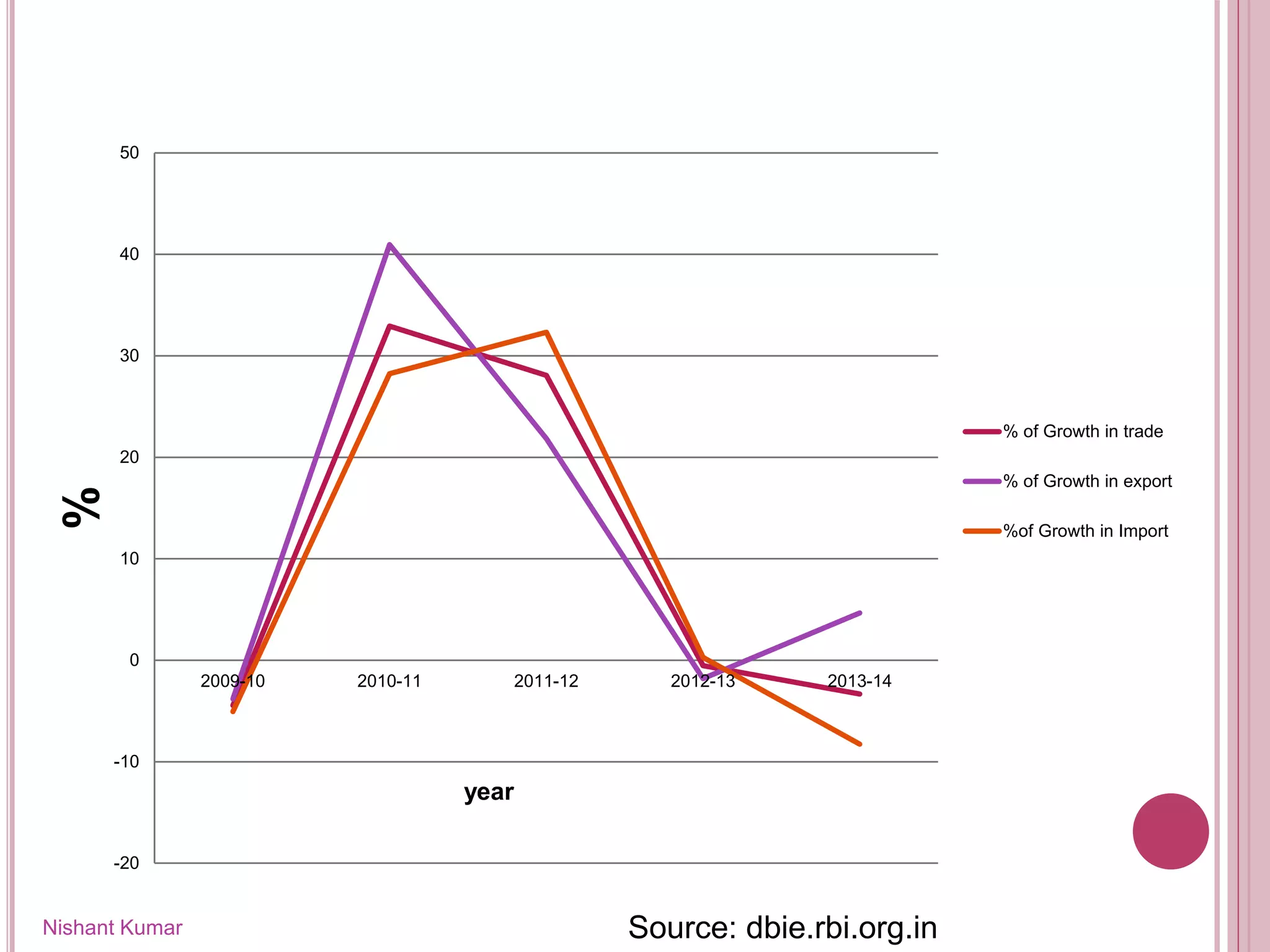
-20
-10
0
10
20
30
40
50
2009-10 2010-11 2011-12 2012-13 2013-14
%
year
% of Growth in trade
% of Growth in export
%of Growth in Import
Source: dbie.rbi.org.in
NishantKumar
Nishant Kumar
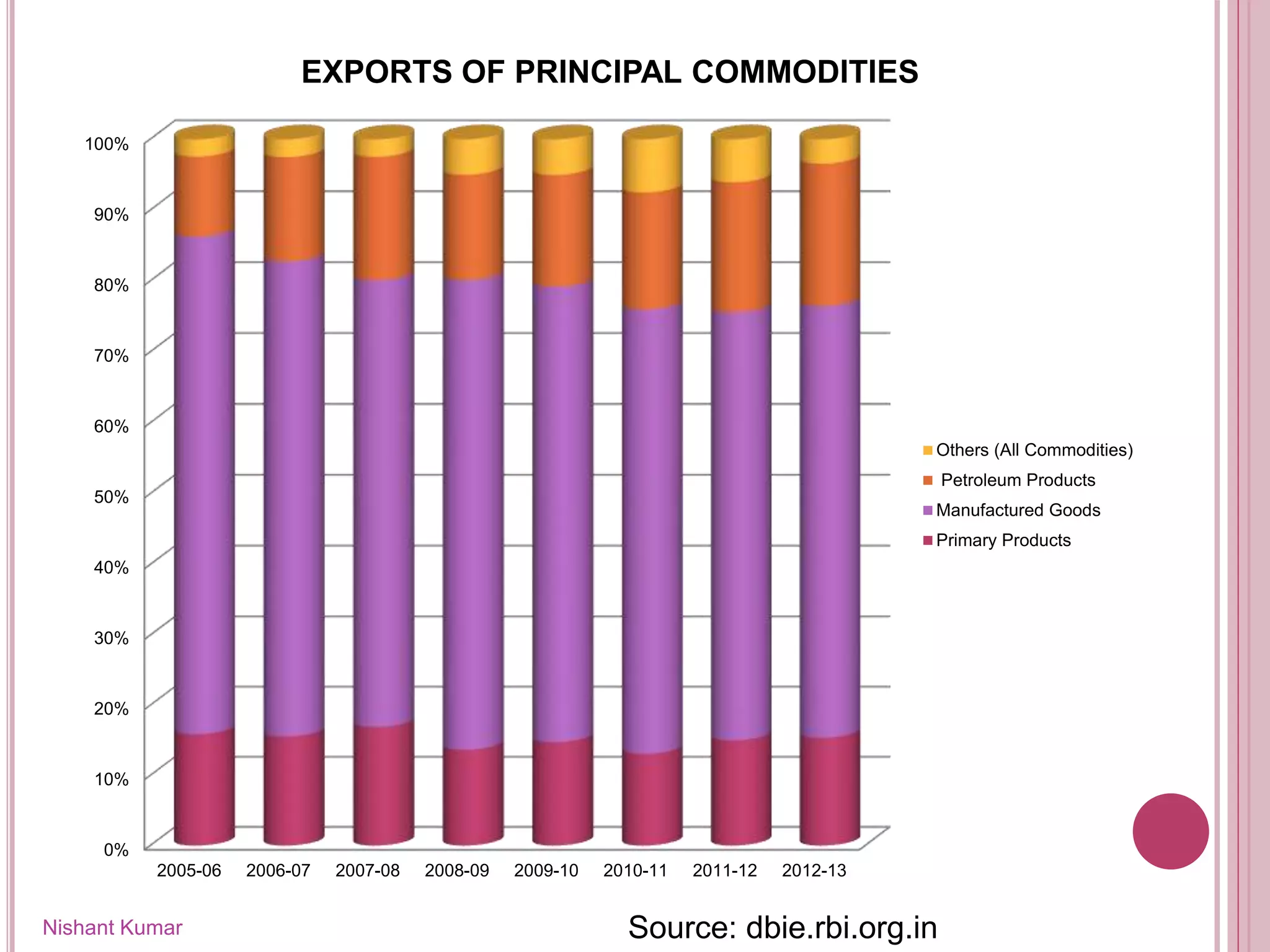
0%
10%
20%
30%
40%
50%
60%
70%
80%
90%
100%
2005-06 2006-07 2007-08 2008-09 2009-10 2010-11 2011-12 2012-13
EXPORTS OF PRINCIPAL COMMODITIES
Others (All Commodities)
Petroleum Products
Manufactured Goods
Primary Products
Source: dbie.rbi.org.in
NishantKumar
Nishant Kumar
0%
10%
20%
30%
40%
50%
60%
70%
80%
90%
100%
2005-06 2006-07 2007-08 2008-09 2009-10 2010-11 2011-12 2012-13
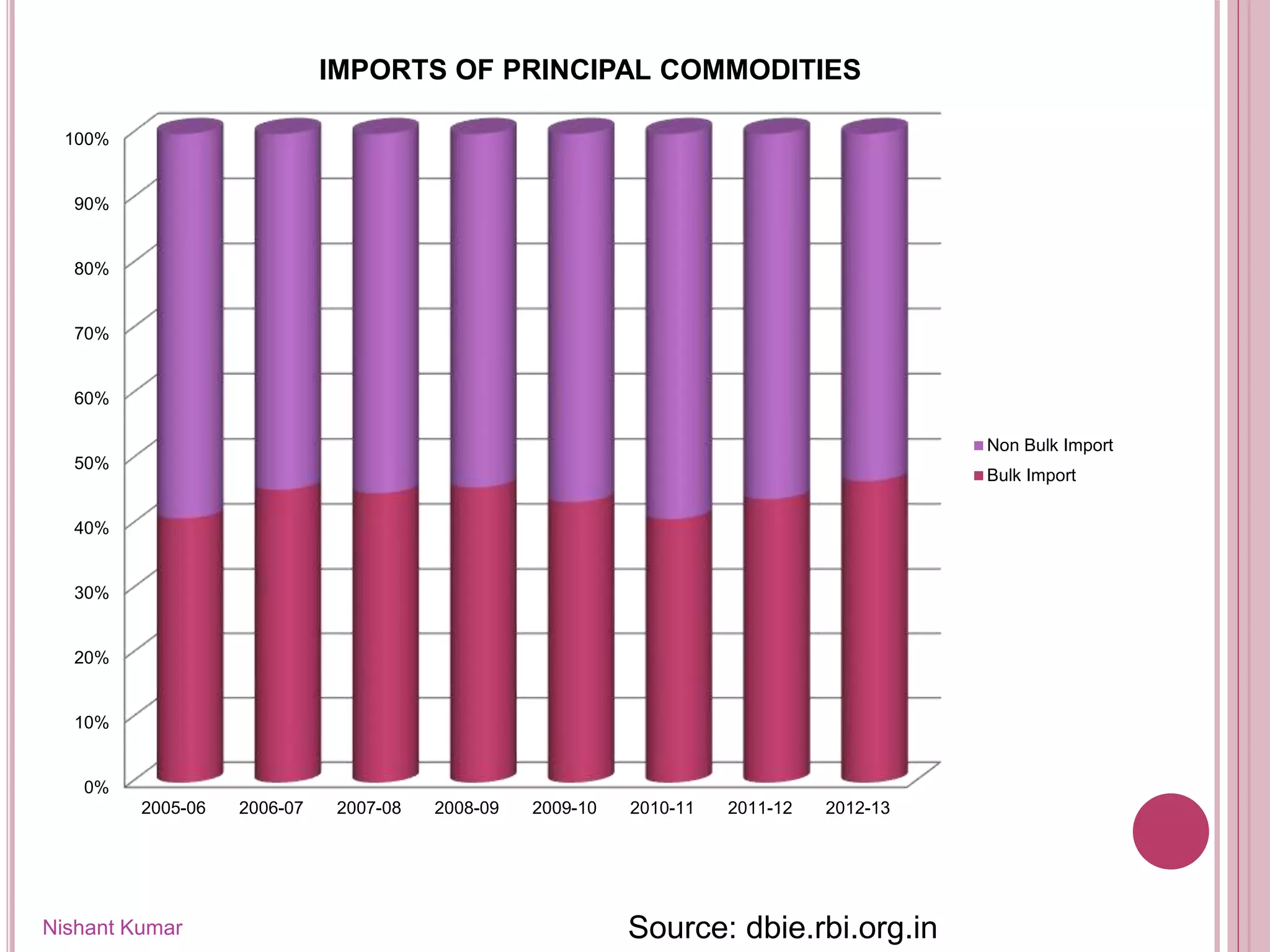
IMPORTS OF PRINCIPAL COMMODITIES
Non Bulk Import
Bulk Import
Source: dbie.rbi.org.in
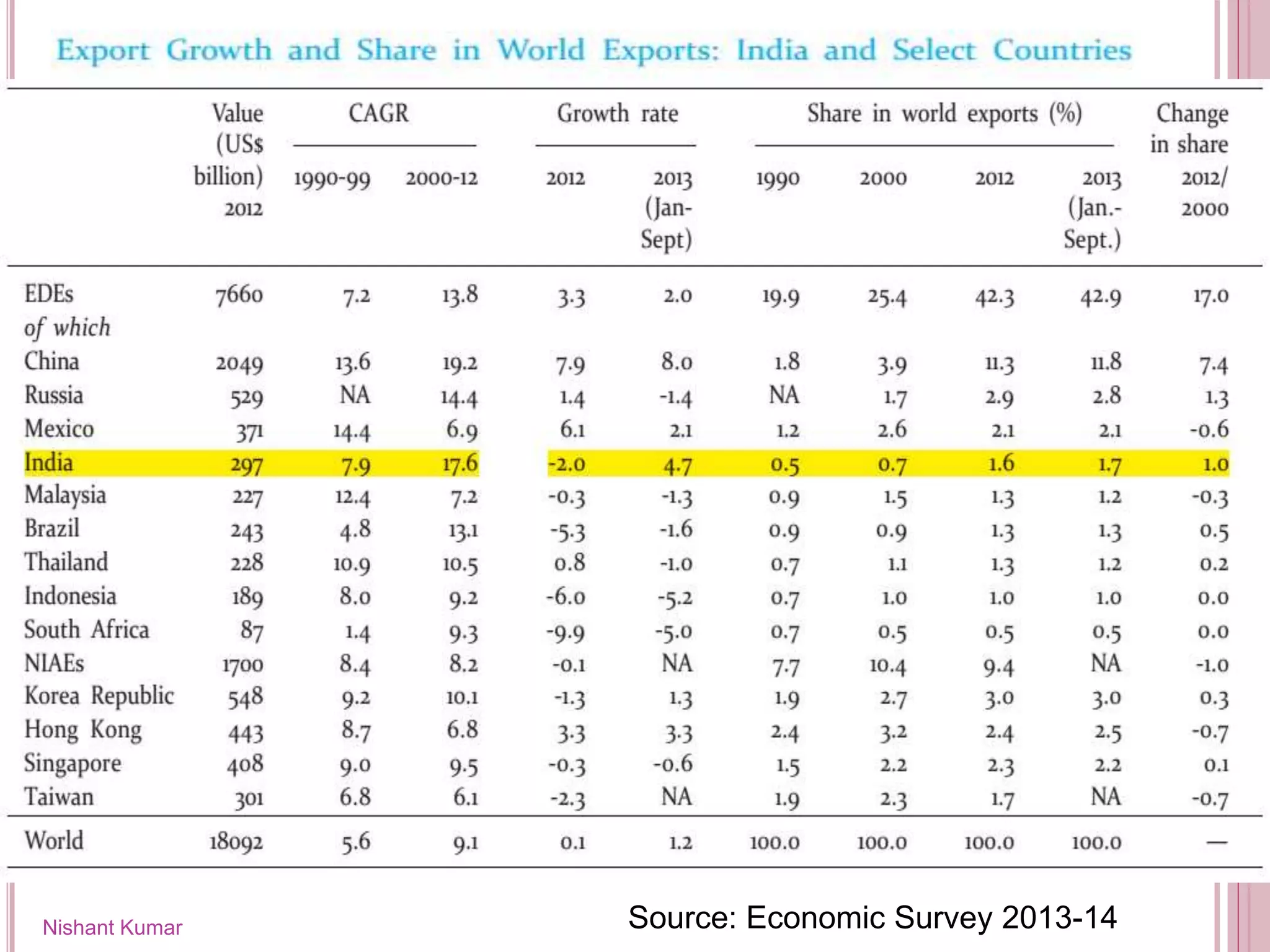
Nishant Kumar Source: Economic Survey 2013-14
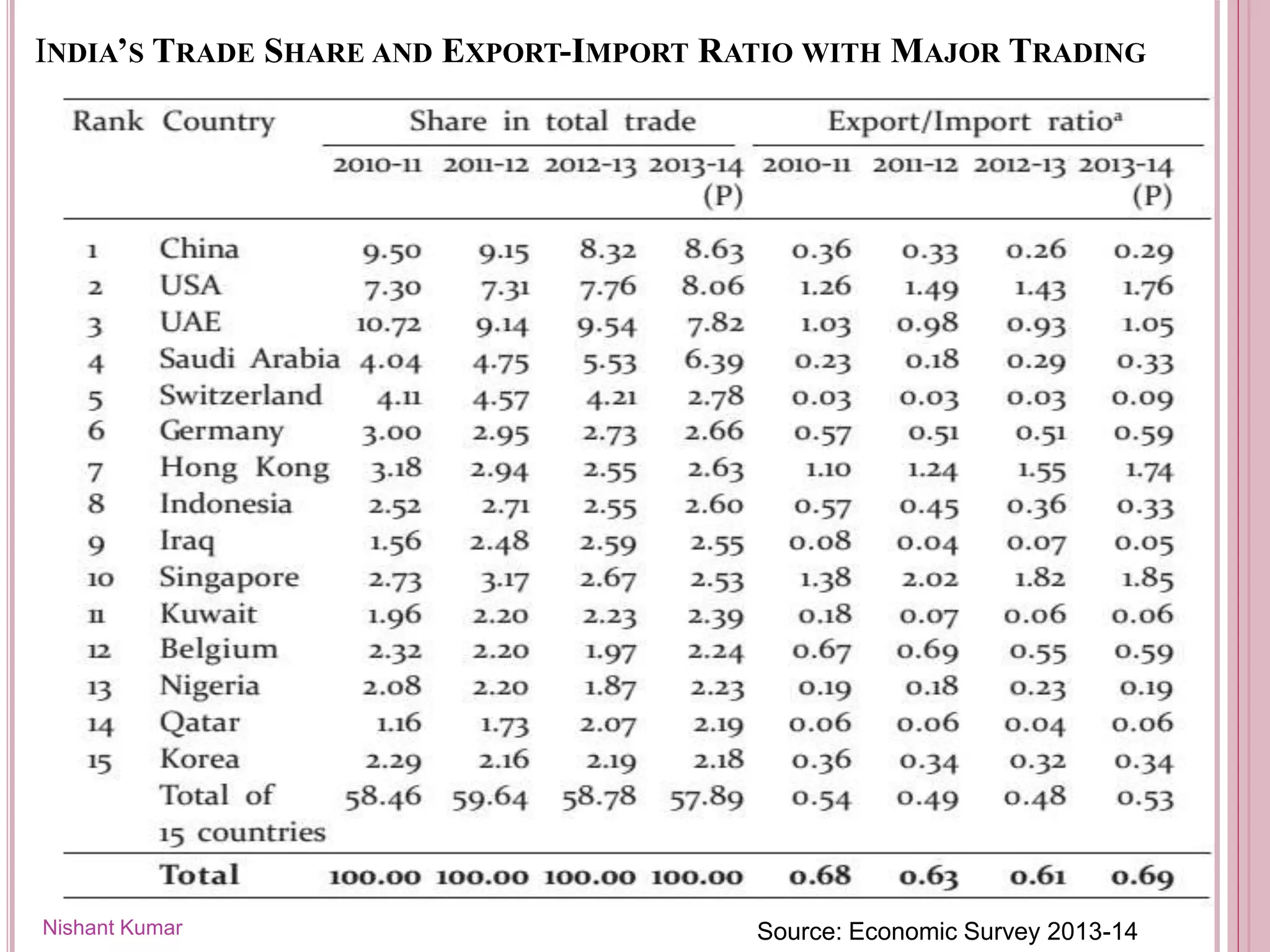
INDIA’S TRADE SHARE AND EXPORT-IMPORT RATIO WITH MAJOR TRADING
PARTNERS
Nishant Kumar Source: Economic Survey 2013-14
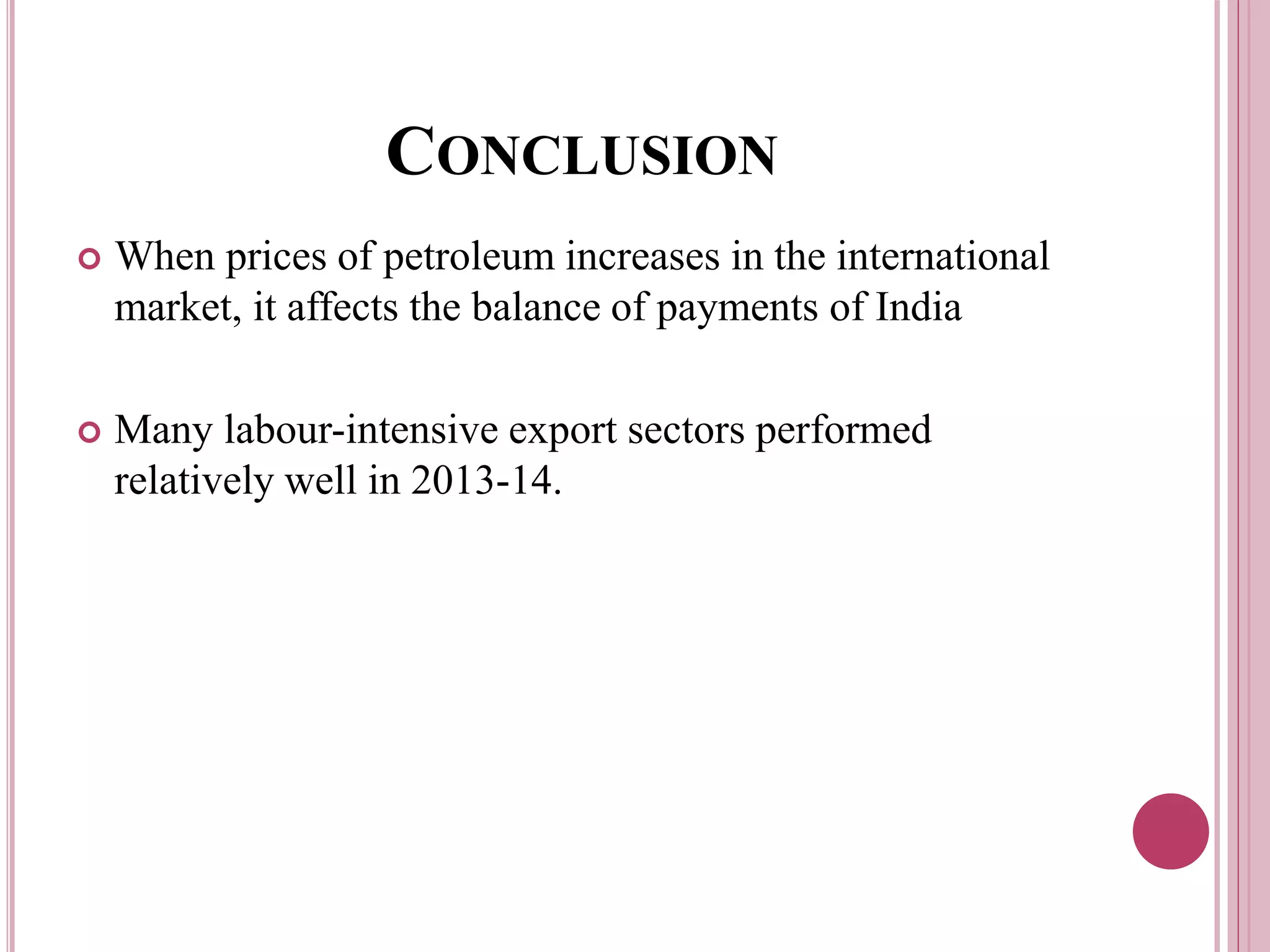
CONCLUSION
 When prices of petroleum increases in the international
market, it affects the balance of payments of India
 Many labour-intensive export sectors performed
relatively well in 2013-14.
REFERENCES
 Datt & Sundharam, Indian Economy, S Chand
Publishing.
 Economic Survey, 2013-14
 Handbook of Statistics on the Indian Economy, RBI
 Paul R .Krugman & Maurice Obstfeld International
Economics Theory and Policy.

Role of trade in development

  • 1.
    ROLE OF TRADEIN DEVELOPMENT Assess India’s Trade and It’s Contribution Nishant Kumar (I120412) III year Int. M.Sc.Economics Dept. Of Economics
  • 2.
    INTRODUCTION  Trade, alsocalled goods exchange economy ,is to transfer the ownership of goods from one person or entity to another by getting a product or service in exchange from the buyer.  Trade is the basic component of economic activity and is undertaken for mutual advantage.  Trade is believed to have first begun in South West of Asia. Nishant Kumar
  • 3.
    WHY TRADE HAPPENED? NishantKumar  All countries are different from each other.  To achieve the economics of scale in production.
  • 4.
  • 5.
    MERCANTILISTS’ VIEWS ONTRADE  Mercantilists measured the wealth of a nation by the stock of precious metals it possessed.  Mercantilists advocated strict government control of all economic activity and preached economic nationalism because they believed that a nation could gain in trade only at the expense of other nations(trade was a zero-sum game). Nishant Kumar
  • 6.
    TRADE BASED ONABSOLUTE ADVANTAGE: ADAM SMITH When one nation is more efficient than another in the production of one commodity but is less efficient than other nation in producing a second commodity, then both nations can gain by each specializing in the production of the commodity of its absolute advantage and exchanging part of its output with the other nation for the commodity of its absolute disadvantage.  Adam believed that all nations would gain from free trade and strongly advocated a policy of laissez-faire .  Adam’s theory served the interest of factory owners (who were able to pay lower wages because of cheaper food imports) and harmed landowners (because food became less scarce due to cheaper imports). Nishant Kumar
  • 7.
    TRADE BASED ONCOMPARATIVE ADVANTAGE :DAVID RICARDO When one nation is less efficient than(has an absolute disadvantage with respect to) the other nation in the production of both commodities, there is still a basis for mutually beneficial trade.  Under the labour theory of value, the value or price of a commodity depends exclusively on the amount of labour going into the production of the commodity. Nishant Kumar
  • 8.
    HECKSCHER -OHLIN MODEL Anation will export the commodity whose production requires the intensive use of the nation’s relatively abundant and cheap factor and import the commodity whose production requires the intensive use of the nation’s relatively scarce and expensive factor. Nishant Kumar
  • 9.
    ROLE OF TRADEIN DEVELOPMENT Nishant Kumar
  • 10.
    Nishant Kumar 1. Tradecan help boost development and reduce poverty by generating growth through increased commercial opportunities and investment, as well as broadening the productive base through private development.  Between 2000 and 2008, GDP per capita increased from $325 to over $625 in Least-Developed Countries.  Much of this can be attributed to an increase in trade and foreign investment.
  • 11.
    Nishant Kumar 2. Tradeenhances competitiveness by helping developing countries reduce the cost of inputs, acquire finance through investments, increase the value added of their products and move up the global value chain .  Emerging economies like China, Brazil, India and South Africa are steadily catching up with developed countries, thanks to increased trade.  The GDP per capita increase of G20 developing countries stands at 115% for the decade 2000-2010.
  • 12.
    Nishant Kumar 3. Tradefacilitates export diversification by allowing developing countries to access new markets and new materials which open up new production possibilities.  India cut import duties from an average of 90% in 1991 to 30% in 1997. This gave Indian manufacturers access to a variety of intermediate and capital goods. Imports of intermediate goods increased by 227% over the period.  Two thirds of the intermediate goods imported were products Indian producers could not buy before 1991. As a result, industrial output grew by 50% with new products accounting for 25% of the total.
  • 13.
    Nishant Kumar 4. Tradeencourages innovation by facilitating exchange of know-how, technology and investment in research and development, including through foreign direct investment.  Investment and trade have facilitated the deployment of information and communication technology, with mobile cellular coverage reaching 86% of the world’s population in 2008.
  • 14.
    Nishant Kumar 5. Tradeopenness expands business opportunities for domestic companies by opening up new markets, removing unnecessary barriers and making it easier for them to export. 6. Trade expands choice and lowers prices for consumers by broadening supply sources of goods and services and strengthening competition.
  • 15.
    Nishant Kumar 7. Tradeplays a role in the improvement of quality, labour and environmental standards through increased competition and the exchange of best practices between trade partners, building capacity in industry and product standards. 8. Trade contributes to cutting government spending by expanding supply sources of goods and services and strengthening competition for government procurement.
  • 16.
    Nishant Kumar 9. Tradestrengthens ties between nations by bringing people together in peaceful and mutual beneficial exchanges and as such contributes to peace and stability.  A study undertaken by the Centre for Economic Policy Research on empirical data showed that the probability disputes escalating to conflict is lower for countries that trade more because of the opportunity cost associated with the loss of trade gains.
  • 17.
    Nishant Kumar 10. Tradecreates employment opportunities by boosting economic sectors that create jobs and usually higher incomes, thus improving livelihoods.  Manufacturing workers in open economies received pay rates 3 to 9 times greater than those in closed economies, depending on the region.
  • 18.
    ASSESS INDIA’S TRADEAND IT’S CONTRIBUTION Nishant Kumar
  • 19.
     India’s rankingin the top merchandise exporters and importers in the world has also improved from 31st in 2000 to 19th in 2013 in exports and from 26th to 12th for imports in the same years.  India’s total merchandise trade to GDP ratio from 21.8 percent in 2000-01 to 44.1 percent in 2013-14.  Net barter and income terms of trade improved in 2012-13 compared to 2011-12. Nishant Kumar
  • 20.
    Nishant Kumar -200000 -100000 0 100000 200000 300000 400000 500000 600000 700000 800000 Year 2008-092009-10 2010-11 2011-12 2012-13 2013-14 (US$million) EXPORT-IMPORT DATA Export Import Total Trade Trade Balance Source: dbie.rbi.org.in
  • 21.
    Nishant Kumar -20 -10 0 10 20 30 40 50 2009-10 2010-112011-12 2012-13 2013-14 % year % of Growth in trade % of Growth in export %of Growth in Import Source: dbie.rbi.org.in
  • 22.
  • 23.
    Nishant Kumar 0% 10% 20% 30% 40% 50% 60% 70% 80% 90% 100% 2005-06 2006-072007-08 2008-09 2009-10 2010-11 2011-12 2012-13 EXPORTS OF PRINCIPAL COMMODITIES Others (All Commodities) Petroleum Products Manufactured Goods Primary Products Source: dbie.rbi.org.in
  • 24.
  • 25.
    Nishant Kumar 0% 10% 20% 30% 40% 50% 60% 70% 80% 90% 100% 2005-06 2006-072007-08 2008-09 2009-10 2010-11 2011-12 2012-13 IMPORTS OF PRINCIPAL COMMODITIES Non Bulk Import Bulk Import Source: dbie.rbi.org.in
  • 26.
    Nishant Kumar Source:Economic Survey 2013-14
  • 27.
    INDIA’S TRADE SHAREAND EXPORT-IMPORT RATIO WITH MAJOR TRADING PARTNERS Nishant Kumar Source: Economic Survey 2013-14
  • 28.
    CONCLUSION  When pricesof petroleum increases in the international market, it affects the balance of payments of India  Many labour-intensive export sectors performed relatively well in 2013-14.
  • 29.
    REFERENCES  Datt &Sundharam, Indian Economy, S Chand Publishing.  Economic Survey, 2013-14  Handbook of Statistics on the Indian Economy, RBI  Paul R .Krugman & Maurice Obstfeld International Economics Theory and Policy.