
Branch - MBA
International Business Management
DR. APJ ABDUL KALAM TECHNICAL UNIVERSITY
By
Dr. B. B.Tiwari
Professor
Department of Management
Shri Ramswaroop Memorial Group of Professional Colleges, Lucknow
Lecture – 2
International Trade Theories:
Absolute Cost Advantage Theory
Origin of the theory:
Introduction
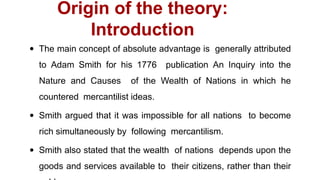
 The main concept of absolute advantage is generally attributed
to Adam Smith for his 1776 publication An Inquiry into the
Nature and Causes of the Wealth of Nations in which he
countered mercantilist ideas.
 Smith argued that it was impossible for all nations to become
rich simultaneously by following mercantilism.
 Smith also stated that the wealth of nations depends upon the
goods and services available to their citizens, rather than their
ABSOLUTE ADVANTAGE
THEORY : SIMPLE TERMS
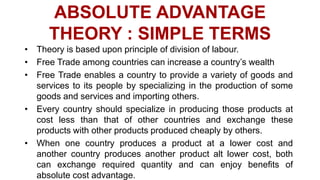
• Theory is based upon principle of division of labour.
• Free Trade among countries can increase a country’s wealth
• Free Trade enables a country to provide a variety of goods and
services to its people by specializing in the production of some
goods and services and importing others.
• Every country should specialize in producing those products at
cost less than that of other countries and exchange these
products with other products produced cheaply by others.
• When one country produces a product at a lower cost and
another country produces another product alt lower cost, both
can exchange required quantity and can enjoy benefits of
absolute cost advantage.
Absolute Advantage
 Export those goods and services for which a country is more
productive than other countries.
 Import those goods and services for which other
countries are more productive than it is.
 Country should concentrate on production of goods in which it
holds an absolute advantage.
 Measures nations wealth by the standard of living of its
people
 Two Commodities and two countries
 Assumes total world production and emphasis on
efficiency.
 No transportation cost between and within the country.
 Factors are easily mobile within a country and
immobile between the countries
 Full employment.
Assumptions
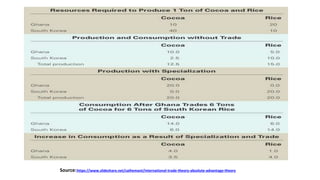
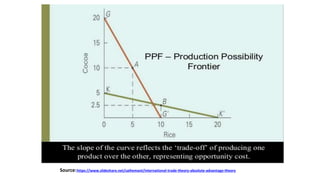
Source:https://www.slideshare.net/saihemant/international-trade-theory-absolute-advantage-theory
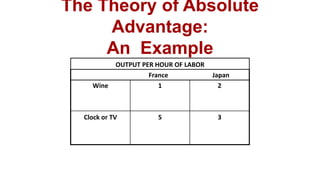
The Theory of Absolute
Advantage:
An Example
OUTPUT PER HOUR OF LABOR
France Japan
Wine 1 2
Clock or TV 5 3
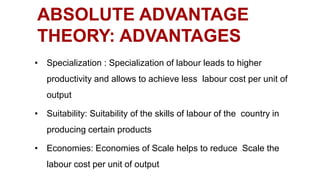
ABSOLUTE ADVANTAGE
THEORY: ADVANTAGES
• Specialization : Specialization of labour leads to higher
productivity and allows to achieve less labour cost per unit of
output
• Suitability: Suitability of the skills of labour of the country in
producing certain products
• Economies: Economies of Scale helps to reduce Scale the
labour cost per unit of output
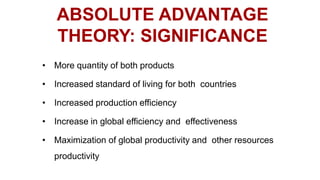
ABSOLUTE ADVANTAGE
THEORY: SIGNIFICANCE
• More quantity of both products
• Increased standard of living for both countries
• Increased production efficiency
• Increase in global efficiency and effectiveness
• Maximization of global productivity and other resources
productivity
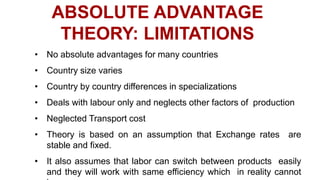
ABSOLUTE ADVANTAGE
THEORY: LIMITATIONS
• No absolute advantages for many countries
• Country size varies
• Country by country differences in specializations
• Deals with labour only and neglects other factors of production
• Neglected Transport cost
• Theory is based on an assumption that Exchange rates are
stable and fixed.
• It also assumes that labor can switch between products easily
and they will work with same efficiency which in reality cannot
THANK YOU

Unit -2 : lecture-2 (absolute advantage theory)

  • 1.
    Branch - MBA InternationalBusiness Management DR. APJ ABDUL KALAM TECHNICAL UNIVERSITY By Dr. B. B.Tiwari Professor Department of Management Shri Ramswaroop Memorial Group of Professional Colleges, Lucknow Lecture – 2 International Trade Theories: Absolute Cost Advantage Theory
  • 2.
    Origin of thetheory: Introduction  The main concept of absolute advantage is generally attributed to Adam Smith for his 1776 publication An Inquiry into the Nature and Causes of the Wealth of Nations in which he countered mercantilist ideas.  Smith argued that it was impossible for all nations to become rich simultaneously by following mercantilism.  Smith also stated that the wealth of nations depends upon the goods and services available to their citizens, rather than their
  • 3.
    ABSOLUTE ADVANTAGE THEORY :SIMPLE TERMS • Theory is based upon principle of division of labour. • Free Trade among countries can increase a country’s wealth • Free Trade enables a country to provide a variety of goods and services to its people by specializing in the production of some goods and services and importing others. • Every country should specialize in producing those products at cost less than that of other countries and exchange these products with other products produced cheaply by others. • When one country produces a product at a lower cost and another country produces another product alt lower cost, both can exchange required quantity and can enjoy benefits of absolute cost advantage.
  • 4.
    Absolute Advantage  Exportthose goods and services for which a country is more productive than other countries.  Import those goods and services for which other countries are more productive than it is.  Country should concentrate on production of goods in which it holds an absolute advantage.  Measures nations wealth by the standard of living of its people
  • 5.
     Two Commoditiesand two countries  Assumes total world production and emphasis on efficiency.  No transportation cost between and within the country.  Factors are easily mobile within a country and immobile between the countries  Full employment. Assumptions
  • 6.
  • 7.
  • 8.
    The Theory ofAbsolute Advantage: An Example OUTPUT PER HOUR OF LABOR France Japan Wine 1 2 Clock or TV 5 3
  • 9.
    ABSOLUTE ADVANTAGE THEORY: ADVANTAGES •Specialization : Specialization of labour leads to higher productivity and allows to achieve less labour cost per unit of output • Suitability: Suitability of the skills of labour of the country in producing certain products • Economies: Economies of Scale helps to reduce Scale the labour cost per unit of output
  • 10.
    ABSOLUTE ADVANTAGE THEORY: SIGNIFICANCE •More quantity of both products • Increased standard of living for both countries • Increased production efficiency • Increase in global efficiency and effectiveness • Maximization of global productivity and other resources productivity
  • 11.
    ABSOLUTE ADVANTAGE THEORY: LIMITATIONS •No absolute advantages for many countries • Country size varies • Country by country differences in specializations • Deals with labour only and neglects other factors of production • Neglected Transport cost • Theory is based on an assumption that Exchange rates are stable and fixed. • It also assumes that labor can switch between products easily and they will work with same efficiency which in reality cannot
  • 12.