ISO
Presentation Outline
• Why standards?
• What is ISO?
• Who develops ISO standards??
• ISO Standards
• ISO 9001
• Case Study
• ISO 25010
• Case study
• Advantages
• Certifications
• Limitations
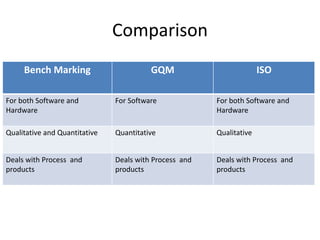
• Comparison
Why Standards?
• Quality orientated process approaches and
standards are maturing and gaining
acceptance in many companies
• Standards can help areas to make the business
more profitable because less time is spent on
non-productive work
• Standards emphasize communication and
shared understanding
Benefits
• The use of standards has many potential
benefits for any organization
• Improved management of software
• Visible certification can attract new customers or be
required by existing ones
• Partnerships and co-development, particularly in a global
environment, are enhanced
Importance
• Ensure best practice
• avoids repetition of past mistakes
• Framework for quality assurance process
• it involves checking standard compliance
• Provide continuity
• new staff can understand the organisation by the
standards applied
What is ISO?
• ISO is the world's largest developer of
International Standards.
• ISO is derived from the Greek isos , meaning
equal.
• ISO is an independent, non-governmental
international organization with a membership
of 162 Countries, one member per country.
Who develops ISO standards?
• ISO standards are developed by technical
committees, (or subcommittees) comprising
experts from the industrial, technical and
business sectors
• Publication as an International Standard
requires approval by at least 75 % of the
national bodies casting a vote.
ISO Standards
• There are almost 42 standards
• ISO 31000 (Risk Management)
• ISO 14000 (Environmental Management)
• ISO 9000 (Quality Management)
• ISO 25010 (System And Software Management)
• Etc.
ISO 9001
• ISO 9001 is generic standard.
• It is PROCESS standard.
• ISO 9001 is for quality management.
• Quality refers to all those features of a
product (or service) which are required by the
customer.
Process , not Products (cont.)
• Processes affect final products or services.
• ISO 9001 gives the requirements for what the
organization must do to manage processes
affecting quality of its products and services.
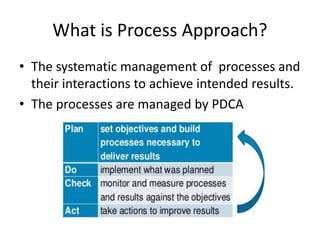
What is Process Approach?
• The systematic management of processes and
their interactions to achieve intended results.
• The processes are managed by PDCA
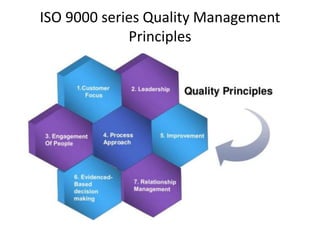
ISO 9000 series Quality Management
Principles
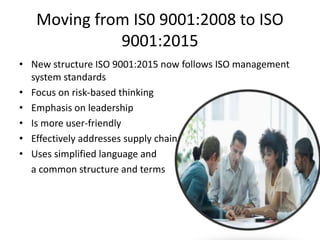
Moving from IS0 9001:2008 to ISO
9001:2015
• New structure ISO 9001:2015 now follows ISO management
system standards
• Focus on risk-based thinking
• Emphasis on leadership
• Is more user-friendly
• Effectively addresses supply chain
• Uses simplified language and
a common structure and terms
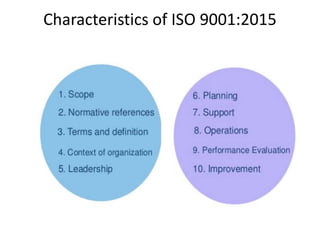
Characteristics of ISO 9001:2015
Case Study
Fraser and Fraser are a team of international researchers. They have solved over
20,000 cases and are committed to delivering professional and cost effective
results.
Mr Anthony John contacted with a requirement for ISO 9001 Certification of their
current systems with some assistance required to meet the requirements of the
Standards.
Fraser and Fraser embraced the Certification process and used it as a positive
means by which they could improve the system.
ISO 25010
• This International Standard is derived
from ISO/IEC 9126:1991, Software
engineering — Product quality which was
developed to support these needs.
• It defined quality characteristics and described
a software product evaluation process model.
Terms and Definitions
• Quality in Use Model
• Product Quality Model
• General
• Terms from ISO:25000
Quality in Use Model
• Quality in use is the degree to which a product
or system can be used by specific users to
meet their needs to achieve specific goals
with effectiveness, efficiency, freedom from
risk and satisfaction in specific contexts of use.
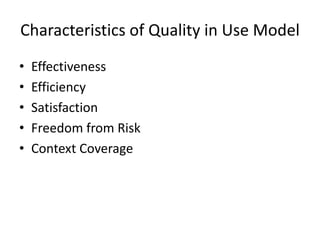
Characteristics of Quality in Use Model
• Effectiveness
• Efficiency
• Satisfaction
• Freedom from Risk
• Context Coverage
Product Quality Model
• Product Quality model has eight main
characteristic. It deals with both software
product and computer system.
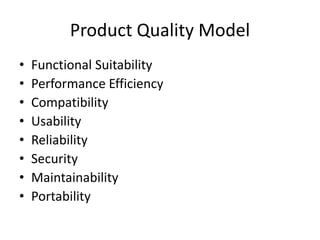
Product Quality Model
• Functional Suitability
• Performance Efficiency
• Compatibility
• Usability
• Reliability
• Security
• Maintainability
• Portability
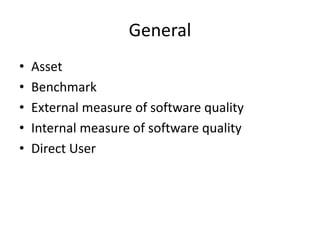
General
• Asset
• Benchmark
• External measure of software quality
• Internal measure of software quality
• Direct User
Terms and definitions from ISO:25000
• Attributes
• inherent property or characteristic of an entity
• Context of use
• environments in which a product is used
• Implied needs
• needs that may not have been stated but are
actual needs
Case study
Applying ISO standards to solve and prioritize Quality issues of automatic ETL
processes by Tiago L.Alves.
ETL processes were requiring a growing amount of effort to guarantee its successful
execution. There were a multitude of reasons causing the ETL processes to fail, e.g.
unavailability of the extracted files at the batch job execution, temporary connectivity
problems, and processed files attempted to be downloaded before being produced. .
The main challenge was to define which issues are causing more impact and
consequently had to be solved first. To accomplish this we used the ISO/IEC 25010
Standard as a framework to categorize all the issues found, use these categorizations
to create a broader overview of all problems and identify the priority issues that had
to be solved first.
By grouping and categorizing the issues in the standard’s characteristics and sub-
characteristics it was easy to communicate to management that there was a problem
that needed a solution.
We successfully applied this methodology to evolve a set of ETL processes at Microsoft
for which neither documentation existed nor original team was available.
Advantages
• Enhances Marketing.
• Promotes International trade
• Increase profit and productivity.
• Increase customer Satisfaction
• Improves employee motivation, awareness,
and morale
Certification
• (ISO) does not certify organizations itself.
• Auditing : external/internal
If there are no major list of problems,
the certification body will issue
a certificate.
• An ISO certificate is not a once-
for-and-all award.
Limitations
• Money, time, and paperwork required for
registration.
• Risks of not knowing if there are direct
relationships to improved quality.
• Uncertainty of fact that what kind and how
many resources will be needed.
Comparison
Bench Marking GQM ISO
For both Software and
Hardware
For Software For both Software and
Hardware
Qualitative and Quantitative Quantitative Qualitative
Deals with Process and
products
Deals with Process and
products
Deals with Process and
products
Referrences
• https://www.iso.org/files/live/sites/isoorg/files/archive/pdf/en/iso_9001_-
_moving_from_2008_to_2015.pdf
• https://www.iso.org/about-us.html
• https://en.wikipedia.org/wiki/ISO_9000
• http://www.cqsltd.com/iso-9001-certification/iso-9001-case-study.aspx
• � 2015 CQS (Certified Quality Systems) Ltd.
• Britannia House, Britannia Business Centre, Enigma Park, Malvern, Worcestershire, WR14 1GZ
• http://asq.org/quality-progress/2015/09/standards/keep-calm-and-prepare-for-iso-9001-
2015.html
• https://nl.wikipedia.org/wiki/Categorie:ISO-standaard
• https://www.researchgate.net/publication/264558012_Applying_ISOIEC_25010_Standard_to_prior
itize_and_solve_quality_issues_of_automatic_ETL_processes
• https://www.google.com.pk/url?sa=t&rct=j&q=&esrc=s&source=web&cd=5&ved=0ahUKEwjN9Zrb
1dTSAhUGOY8KHa6EBAsQFgguMAQ&url=http%3A%2F%2Fprofs.etsmtl.ca%2Fclaporte%2FEnglish%
2FVSE%2FEducation%2FIntro%2520to%2520ISO-
IEC%2520SE%2520standards%252002RO.ppt&usg=AFQjCNF00f6lf76NQNKvyl11KKDrZiHbvQ&sig2=
Za-glVhrKsoByEb94oSvcg&bvm=bv.149397726,d.c2I&cad=rja
• Towards an Integrated Mode1 for Specifying and Measuring Quality in Use by Mohammad
K.Donayee on 2001.
• https://www.iso.org/files/live/sites/isoorg/files/archive/pdf/en/iso_9001_-
_moving_from_2008_to_2015.pdf

International Organization for Standardization

  • 1.
  • 2.
    Presentation Outline • Whystandards? • What is ISO? • Who develops ISO standards?? • ISO Standards • ISO 9001 • Case Study • ISO 25010 • Case study • Advantages • Certifications • Limitations • Comparison
  • 3.
    Why Standards? • Qualityorientated process approaches and standards are maturing and gaining acceptance in many companies • Standards can help areas to make the business more profitable because less time is spent on non-productive work • Standards emphasize communication and shared understanding
  • 4.
    Benefits • The useof standards has many potential benefits for any organization • Improved management of software • Visible certification can attract new customers or be required by existing ones • Partnerships and co-development, particularly in a global environment, are enhanced
  • 5.
    Importance • Ensure bestpractice • avoids repetition of past mistakes • Framework for quality assurance process • it involves checking standard compliance • Provide continuity • new staff can understand the organisation by the standards applied
  • 6.
    What is ISO? •ISO is the world's largest developer of International Standards. • ISO is derived from the Greek isos , meaning equal. • ISO is an independent, non-governmental international organization with a membership of 162 Countries, one member per country.
  • 7.
    Who develops ISOstandards? • ISO standards are developed by technical committees, (or subcommittees) comprising experts from the industrial, technical and business sectors • Publication as an International Standard requires approval by at least 75 % of the national bodies casting a vote.
  • 8.
    ISO Standards • Thereare almost 42 standards • ISO 31000 (Risk Management) • ISO 14000 (Environmental Management) • ISO 9000 (Quality Management) • ISO 25010 (System And Software Management) • Etc.
  • 9.
    ISO 9001 • ISO9001 is generic standard. • It is PROCESS standard. • ISO 9001 is for quality management. • Quality refers to all those features of a product (or service) which are required by the customer.
  • 10.
    Process , notProducts (cont.) • Processes affect final products or services. • ISO 9001 gives the requirements for what the organization must do to manage processes affecting quality of its products and services.
  • 11.
    What is ProcessApproach? • The systematic management of processes and their interactions to achieve intended results. • The processes are managed by PDCA
  • 12.
    ISO 9000 seriesQuality Management Principles
  • 13.
    Moving from IS09001:2008 to ISO 9001:2015 • New structure ISO 9001:2015 now follows ISO management system standards • Focus on risk-based thinking • Emphasis on leadership • Is more user-friendly • Effectively addresses supply chain • Uses simplified language and a common structure and terms
  • 14.
  • 15.
    Case Study Fraser andFraser are a team of international researchers. They have solved over 20,000 cases and are committed to delivering professional and cost effective results. Mr Anthony John contacted with a requirement for ISO 9001 Certification of their current systems with some assistance required to meet the requirements of the Standards. Fraser and Fraser embraced the Certification process and used it as a positive means by which they could improve the system.
  • 16.
    ISO 25010 • ThisInternational Standard is derived from ISO/IEC 9126:1991, Software engineering — Product quality which was developed to support these needs. • It defined quality characteristics and described a software product evaluation process model.
  • 17.
    Terms and Definitions •Quality in Use Model • Product Quality Model • General • Terms from ISO:25000
  • 18.
    Quality in UseModel • Quality in use is the degree to which a product or system can be used by specific users to meet their needs to achieve specific goals with effectiveness, efficiency, freedom from risk and satisfaction in specific contexts of use.
  • 19.
    Characteristics of Qualityin Use Model • Effectiveness • Efficiency • Satisfaction • Freedom from Risk • Context Coverage
  • 20.
    Product Quality Model •Product Quality model has eight main characteristic. It deals with both software product and computer system.
  • 21.
    Product Quality Model •Functional Suitability • Performance Efficiency • Compatibility • Usability • Reliability • Security • Maintainability • Portability
  • 22.
    General • Asset • Benchmark •External measure of software quality • Internal measure of software quality • Direct User
  • 23.
    Terms and definitionsfrom ISO:25000 • Attributes • inherent property or characteristic of an entity • Context of use • environments in which a product is used • Implied needs • needs that may not have been stated but are actual needs
  • 24.
    Case study Applying ISOstandards to solve and prioritize Quality issues of automatic ETL processes by Tiago L.Alves. ETL processes were requiring a growing amount of effort to guarantee its successful execution. There were a multitude of reasons causing the ETL processes to fail, e.g. unavailability of the extracted files at the batch job execution, temporary connectivity problems, and processed files attempted to be downloaded before being produced. . The main challenge was to define which issues are causing more impact and consequently had to be solved first. To accomplish this we used the ISO/IEC 25010 Standard as a framework to categorize all the issues found, use these categorizations to create a broader overview of all problems and identify the priority issues that had to be solved first. By grouping and categorizing the issues in the standard’s characteristics and sub- characteristics it was easy to communicate to management that there was a problem that needed a solution. We successfully applied this methodology to evolve a set of ETL processes at Microsoft for which neither documentation existed nor original team was available.
  • 25.
    Advantages • Enhances Marketing. •Promotes International trade • Increase profit and productivity. • Increase customer Satisfaction • Improves employee motivation, awareness, and morale
  • 26.
    Certification • (ISO) doesnot certify organizations itself. • Auditing : external/internal If there are no major list of problems, the certification body will issue a certificate. • An ISO certificate is not a once- for-and-all award.
  • 27.
    Limitations • Money, time,and paperwork required for registration. • Risks of not knowing if there are direct relationships to improved quality. • Uncertainty of fact that what kind and how many resources will be needed.
  • 28.
    Comparison Bench Marking GQMISO For both Software and Hardware For Software For both Software and Hardware Qualitative and Quantitative Quantitative Qualitative Deals with Process and products Deals with Process and products Deals with Process and products
  • 29.
    Referrences • https://www.iso.org/files/live/sites/isoorg/files/archive/pdf/en/iso_9001_- _moving_from_2008_to_2015.pdf • https://www.iso.org/about-us.html •https://en.wikipedia.org/wiki/ISO_9000 • http://www.cqsltd.com/iso-9001-certification/iso-9001-case-study.aspx • � 2015 CQS (Certified Quality Systems) Ltd. • Britannia House, Britannia Business Centre, Enigma Park, Malvern, Worcestershire, WR14 1GZ • http://asq.org/quality-progress/2015/09/standards/keep-calm-and-prepare-for-iso-9001- 2015.html • https://nl.wikipedia.org/wiki/Categorie:ISO-standaard • https://www.researchgate.net/publication/264558012_Applying_ISOIEC_25010_Standard_to_prior itize_and_solve_quality_issues_of_automatic_ETL_processes • https://www.google.com.pk/url?sa=t&rct=j&q=&esrc=s&source=web&cd=5&ved=0ahUKEwjN9Zrb 1dTSAhUGOY8KHa6EBAsQFgguMAQ&url=http%3A%2F%2Fprofs.etsmtl.ca%2Fclaporte%2FEnglish% 2FVSE%2FEducation%2FIntro%2520to%2520ISO- IEC%2520SE%2520standards%252002RO.ppt&usg=AFQjCNF00f6lf76NQNKvyl11KKDrZiHbvQ&sig2= Za-glVhrKsoByEb94oSvcg&bvm=bv.149397726,d.c2I&cad=rja • Towards an Integrated Mode1 for Specifying and Measuring Quality in Use by Mohammad K.Donayee on 2001. • https://www.iso.org/files/live/sites/isoorg/files/archive/pdf/en/iso_9001_- _moving_from_2008_to_2015.pdf