Engineering Standards andRegulations
Submitted To: Dr. Rakesh Goyal
Presented by
Daksh (2210994037)
Department of Mechanical Engineering
2.
What does ISOmean?
• ISO is an abbreviation of the
International Standards Organization.
• An ISO standard is essentially an internationally
recognized way of doing something.
• It means that everyone follows the same set of
guidelines no matter where they are based, resulting in
a safer, more consistent end result.
• This benefits both the organization and the customer
or end user.
3.
Objectives of ISO-:
• Facilitate International Trade: By standardizing products and services, ISO helps
eliminate barriers to international trade.
• Ensure Quality and Safety: ISO standards ensure that products and services are safe,
reliable, and of good quality.
• Promote Innovation: By setting benchmarks, ISO encourages organizations to innovate
while adhering to standardized practices.
• Sustainability: Many ISO standards focus on environmental management and
sustainability, guiding organizations towards responsible practices.
4.
What are thebenefits of ISO
standards?
• Giving you tried and tested methods for best practice in every aspect of business
operations
• Having a universally recognized type of certification, making it easier to both attract and
enable third parties to work with you
• Simplifying your wider regulatory requirements
• Being able to demonstrate that you’re a brand that customers can trust.
5.
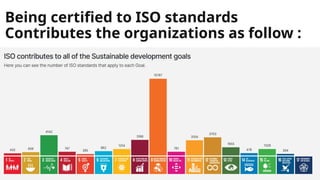
Being certified toISO standards
Contributes the organizations as follow :
6.
Key Components ofISO Certification
1.Compliance with Standards: Organizations must align their processes and systems with
the specific requirements of the ISO standard they seek certification for.
2.Documentation: Detailed documentation of processes, procedures, and policies is
essential to demonstrate compliance.
3.Implementation: Effective implementation of the standardized processes across the
organization.
4.Continuous Improvement: ISO emphasizes the importance of continual enhancement
of processes and systems.
5.Auditing: Regular internal and external audits are conducted to ensure ongoing
compliance and identify areas for improvement.
7.
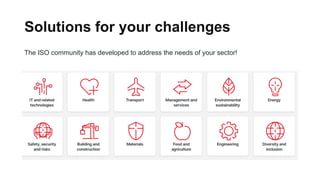
Solutions for yourchallenges
The ISO community has developed to address the needs of your sector!
Who Approves ISOInternational
Standards?
• It brings global experts together to agree on
the best way of doing things – for anything
from making a product to managing a
process.
• As one of the oldest non-governmental
international organizations, ISO has enabled
trade and cooperation between people and
companies the world over since 1946.
• The International Standards published by
ISO serve to make lives easier, safer and
better.
10.
What are theMost Popular ISO
Standards?
Out of the 22,782 international standards, here are 9 of the
most popular ISO standards and how they are commonly used.
1. Quality Management System - ISO 9001
2. Environmental Management - ISO 14001
3. Information Security Management - ISO/IEC 27001
4. Food Safety Management - ISO 22000
5. Energy Management - ISO 50001
6. Medical Devices - ISO 13485
7. Testing and Calibration - ISO/IEC 17025
8. Occupational Health and Safety - ISO 45001
9. Risk Management - ISO 31000
11.
Quality Management System
ISO9001
• ISO 9001 is a globally recognized standard for
quality management. It helps organizations of
all sizes and sectors to improve their
performance, meet customer expectations and
demonstrate their commitment to quality. Its
requirements define how to establish,
implement, maintain, and continually improve a
quality management system (QMS).
• Implementing ISO 9001 means your
organization has put in place effective
processes and trained staff to deliver flawless
products or services time after time.
12.
Why is ISO9001 important?
Business benefits include:
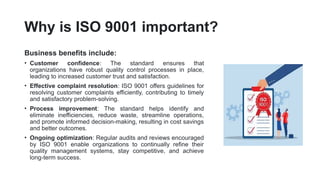
• Customer confidence: The standard ensures that
organizations have robust quality control processes in place,
leading to increased customer trust and satisfaction.
• Effective complaint resolution: ISO 9001 offers guidelines for
resolving customer complaints efficiently, contributing to timely
and satisfactory problem-solving.
• Process improvement: The standard helps identify and
eliminate inefficiencies, reduce waste, streamline operations,
and promote informed decision-making, resulting in cost savings
and better outcomes.
• Ongoing optimization: Regular audits and reviews encouraged
by ISO 9001 enable organizations to continually refine their
quality management systems, stay competitive, and achieve
long-term success.
13.
Who should usethe ISO 9001
standard?
• Any organization that wants to improve its quality
management system, meet customer and applicable
statutory and regulatory requirements, and enhance
customer satisfaction can use the ISO 9001 standard.
• It is suitable for organizations of any size, and applies to all
sectors, including manufacturing, services, healthcare,
education, government, and non-profit organizations.
ISO 9001 can also be used by certification bodies or other
third parties to assess an organization’s conformity with this
International Standard.
14.
Is there astandard adapting the
requirements of ISO 9001 to my sector?
• ISO has a range of standards for quality management systems that are based on ISO
9001 and adapted to specific sectors and industries. These include:
• ISO 13485 on medical devices
• ISO/TS 54001 on elections at all levels of government
• ISO 18091 on local government sector applications
• ISO 22163 on railway sector applications
• ISO 29001 on petroleum, petrochemical and natural gas-related products and services
• ISO/IEC/IEEE 90003 on computer software
15.
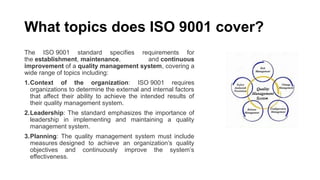
What topics doesISO 9001 cover?
The ISO 9001 standard specifies requirements for
the establishment, maintenance, and continuous
improvement of a quality management system, covering a
wide range of topics including:
1.Context of the organization: ISO 9001 requires
organizations to determine the external and internal factors
that affect their ability to achieve the intended results of
their quality management system.
2.Leadership: The standard emphasizes the importance of
leadership in implementing and maintaining a quality
management system.
3.Planning: The quality management system must include
measures designed to achieve an organization’s quality
objectives and continuously improve the system’s
effectiveness.
16.
4. Support: ISO9001 addresses issues such as resources, competence,
awareness, communication and documented information.
5. Operation: The processes necessary to meet customer requirements and
increase customer satisfaction must be planned, implemented and controlled.
6. Performance evaluation: The standard requires organizations to monitor,
measure, analyze and evaluate the performance and effectiveness of their quality
management system.
7. Improvement: ISO 9001 emphasizes the importance of continuously increasing
the effectiveness of the quality management system based on the results of
performance evaluation and other data sources.
Overall, ISO 9001 helps organizations address all aspects of managing the quality
of their products and services, with an emphasis on customer satisfaction and
constant enhancement of the quality management system.
17.
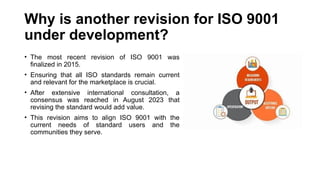
Why is anotherrevision for ISO 9001
under development?
• The most recent revision of ISO 9001 was
finalized in 2015.
• Ensuring that all ISO standards remain current
and relevant for the marketplace is crucial.
• After extensive international consultation, a
consensus was reached in August 2023 that
revising the standard would add value.
• This revision aims to align ISO 9001 with the
current needs of standard users and the
communities they serve.
18.
I am certifiedto ISO 9001:2015. What
does this revision mean for me?
• The publication of the revised standard will present
an excellent opportunity for you to review and
update your quality management system. Take
this chance to ensure that your system effectively
addresses any changes and aligns well with your
needs, as well as those of your customers and
other stakeholders. At the time of publication, ample
information will be provided about the updates
made and how they may impact organizations.
• In terms of validity of their certificates, organizations
certified to ISO 9001:2015 will be granted
a transition period to migrate their quality
management system to the new edition of the
standard.
19.
Where can Ifind help with auditing
ISO 9001?
• Support on auditing quality management systems can be
found on the website of the
ISO 9001 Auditing Practices Group. This is an informal group
of quality management system experts, auditors and
practitioners from ISO/TC 176 and the International
Accreditation Forum.
20.
What is theISO definition of quality?
• A definition of quality is part of the core
vocabulary for quality management which
can be found in ISO 9000:2015 and applies
to all ISO quality management standards,
including ISO 9001. It says that quality is the
“degree to which a set of inherent
characteristics [or distinguishing features] of
an object”, which in turn is defined as
anything perceivable or conceivable, such
as a product, service, process, person,
organization, system or resource, “fulfils
requirements.

![What is the ISO definition of quality?
• A definition of quality is part of the core
vocabulary for quality management which
can be found in ISO 9000:2015 and applies
to all ISO quality management standards,
including ISO 9001. It says that quality is the
“degree to which a set of inherent
characteristics [or distinguishing features] of
an object”, which in turn is defined as
anything perceivable or conceivable, such
as a product, service, process, person,
organization, system or resource, “fulfils
requirements.](https://image.slidesharecdn.com/esr-250510170214-0d0defe7/85/esr-for-fluid-machinery-in-mechanical-enginnering-20-320.jpg)


