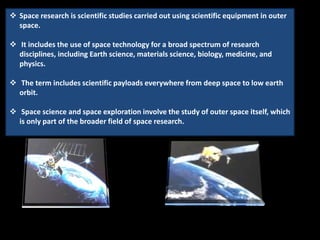
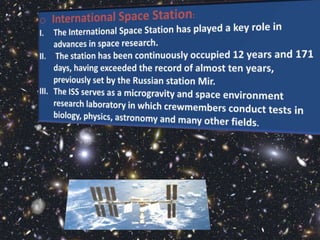
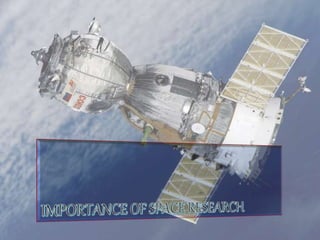
 Space research is scientific studies carried out using scientific equipment in outer
space.
 It includes the use of space technology for a broad spectrum of research
disciplines, including Earth science, materials science, biology, medicine, and
physics.
 The term includes scientific payloads everywhere from deep space to low earth
orbit.
 Space science and space exploration involve the study of outer space itself, which
is only part of the broader field of space research.
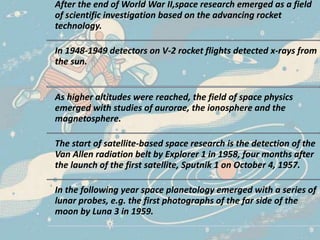
After the end of World War II,space research emerged as a field
of scientific investigation based on the advancing rocket
technology.
In 1948-1949 detectors on V-2 rocket flights detected x-rays from
the sun.
As higher altitudes were reached, the field of space physics
emerged with studies of aurorae, the ionosphere and the
magnetosphere.
The start of satellite-based space research is the detection of the
Van Allen radiation belt by Explorer 1 in 1958, four months after
the launch of the first satellite, Sputnik 1 on October 4, 1957.
In the following year space planetology emerged with a series of
lunar probes, e.g. the first photographs of the far side of the
moon by Luna 3 in 1959.
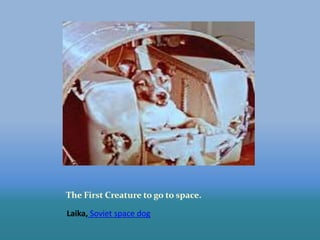
The First Creature to go to space.
Laika, Soviet space dog
Space research includes the following fields of science:
• Earth observations, using remote sensing techniques to interpret
optical and radar data from Earth observation satellites
• Geodesy, using gravitational perturbations of satellite orbits.
• Space physics, the in situ study of space plasmas, e.g. aurorae, the
ionosphere, the magnetosphere and space weather.
• Planetology, using space probes to study objects in the planetary
system
• Astronomy, using space telescopes and detectors that are not limited
by looking through the atmosphere
• Materials sciences, taking advantage of the micro-g environment on
orbital platforms
• Life sciences, including physiology, using the space radiation
environment and weightlessness
• Physics, using space as a laboratory for studies in fundamental physics.
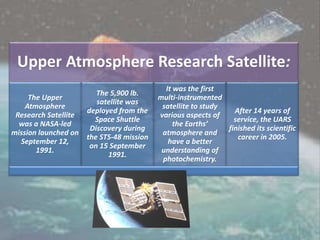
Upper Atmosphere Research Satellite:
The Upper
Atmosphere
Research Satellite
was a NASA-led
mission launched on
September 12,
1991.
The 5,900 lb.
satellite was
deployed from the
Space Shuttle
Discovery during
the STS-48 mission
on 15 September
1991.
It was the first
multi-instrumented
satellite to study
various aspects of
the Earths’
atmosphere and
have a better
understanding of
photochemistry.
After 14 years of
service, the UARS
finished its scientific
career in 2005.
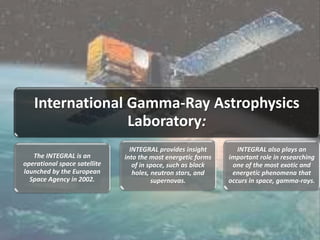
International Gamma-Ray Astrophysics
Laboratory:
The INTEGRAL is an
operational space satellite
launched by the European
Space Agency in 2002.
INTEGRAL provides insight
into the most energetic forms
of in space, such as black
holes, neutron stars, and
supernovas.
INTEGRAL also plays an
important role in researching
one of the most exotic and
energetic phenomena that
occurs in space, gamma-rays.
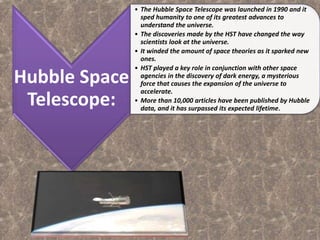
Hubble Space
Telescope:
• The Hubble Space Telescope was launched in 1990 and it
sped humanity to one of its greatest advances to
understand the universe.
• The discoveries made by the HST have changed the way
scientists look at the universe.
• It winded the amount of space theories as it sparked new
ones.
• HST played a key role in conjunction with other space
agencies in the discovery of dark energy, a mysterious
force that causes the expansion of the universe to
accelerate.
• More than 10,000 articles have been published by Hubble
data, and it has surpassed its expected lifetime.
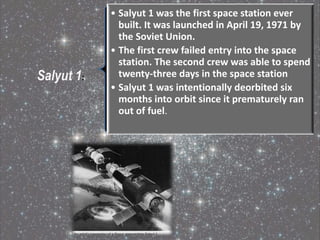
Salyut 1:
• Salyut 1 was the first space station ever
built. It was launched in April 19, 1971 by
the Soviet Union.
• The first crew failed entry into the space
station. The second crew was able to spend
twenty-three days in the space station
• Salyut 1 was intentionally deorbited six
months into orbit since it prematurely ran
out of fuel.
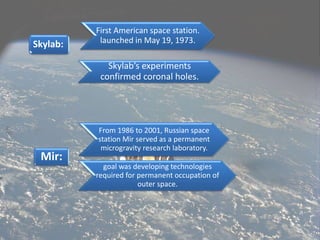
Skylab:
First American space station.
launched in May 19, 1973.
Mir:
From 1986 to 2001, Russian space
station Mir served as a permanent
microgravity research laboratory.
goal was developing technologies
required for permanent occupation of
outer space.
Skylab’s experiments
confirmed coronal holes.
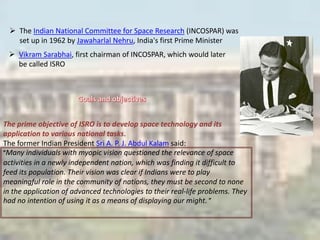
 The Indian National Committee for Space Research (INCOSPAR) was
set up in 1962 by Jawaharlal Nehru, India's first Prime Minister
 Vikram Sarabhai, first chairman of INCOSPAR, which would later
be called ISRO
The prime objective of ISRO is to develop space technology and its
application to various national tasks.
The former Indian President Sri A. P. J. Abdul Kalam said:
“Many individuals with myopic vision questioned the relevance of space
activities in a newly independent nation, which was finding it difficult to
feed its population. Their vision was clear if Indians were to play
meaningful role in the community of nations, they must be second to none
in the application of advanced technologies to their real-life problems. They
had no intention of using it as a means of displaying our might.”
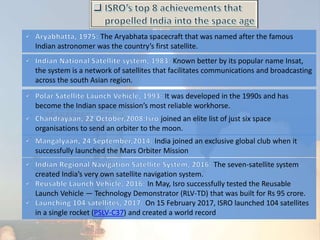
India joined an exclusive global club when it
successfully launched the Mars Orbiter Mission
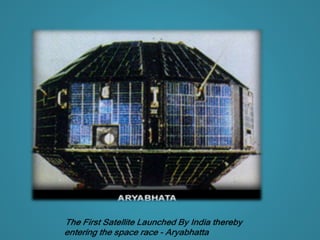
The Aryabhata spacecraft that was named after the famous
Indian astronomer was the country’s first satellite.
Known better by its popular name Insat,
the system is a network of satellites that facilitates communications and broadcasting
across the south Asian region.
It was developed in the 1990s and has
become the Indian space mission’s most reliable workhorse.
joined an elite list of just six space
organisations to send an orbiter to the moon.
The seven-satellite system
created India’s very own satellite navigation system.
In May, Isro successfully tested the Reusable
Launch Vehicle — Technology Demonstrator (RLV-TD) that was built for Rs 95 crore.
On 15 February 2017, ISRO launched 104 satellites
in a single rocket (PSLV-C37) and created a world record
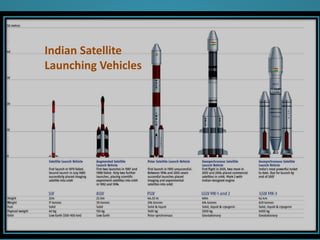
Indian Satellite
Launching Vehicles
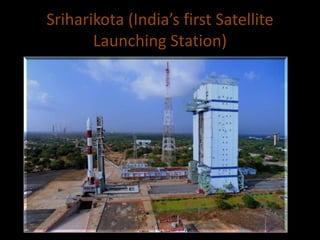
Sriharikota (India’s first Satellite
Launching Station)
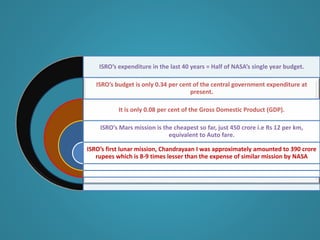
ISRO’s expenditure in the last 40 years = Half of NASA’s single year budget.
ISRO’s budget is only 0.34 per cent of the central government expenditure at
present.
It is only 0.08 per cent of the Gross Domestic Product (GDP).
ISRO’s Mars mission is the cheapest so far, just 450 crore i.e Rs 12 per km,
equivalent to Auto fare.
ISRO’s first lunar mission, Chandrayaan I was approximately amounted to 390 crore
rupees which is 8-9 times lesser than the expense of similar mission by NASA
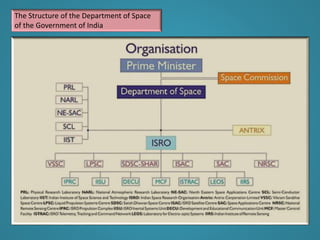
The Structure of the Department of Space
of the Government of India
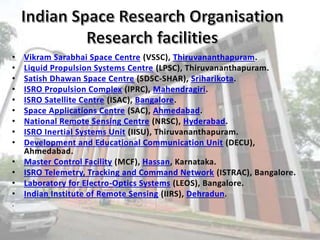
• Vikram Sarabhai Space Centre (VSSC), Thiruvananthapuram.
• Liquid Propulsion Systems Centre (LPSC), Thiruvananthapuram.
• Satish Dhawan Space Centre (SDSC-SHAR), Sriharikota.
• ISRO Propulsion Complex (IPRC), Mahendragiri.
• ISRO Satellite Centre (ISAC), Bangalore.
• Space Applications Centre (SAC), Ahmedabad.
• National Remote Sensing Centre (NRSC), Hyderabad.
• ISRO Inertial Systems Unit (IISU), Thiruvananthapuram.
• Development and Educational Communication Unit (DECU),
Ahmedabad.
• Master Control Facility (MCF), Hassan, Karnataka.
• ISRO Telemetry, Tracking and Command Network (ISTRAC), Bangalore.
• Laboratory for Electro-Optics Systems (LEOS), Bangalore.
• Indian Institute of Remote Sensing (IIRS), Dehradun.
.
Meet ANTRIX, the corporate arm of ISRO.
o Antrix deals with the commercialization of
space products, consultancy and technology
transfer developed by the ISRO.
o It has clientele worldwide – Europe, Middle
East and SE Asia.
o Apart from bigwigs from ISRO and other
related space bodies, two of India’s biggest
industrialists – Ratan Tata and Jamshyd Godrej
– are on the board.
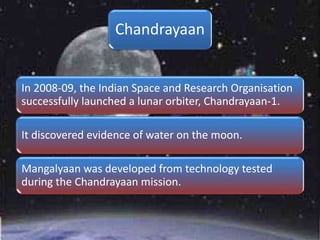
Chandrayaan
In 2008-09, the Indian Space and Research Organisation
successfully launched a lunar orbiter, Chandrayaan-1.
It discovered evidence of water on the moon.
Mangalyaan was developed from technology tested
during the Chandrayaan mission.
INDIA (ISRO) is the only one country who has
reached to the MARS in his FIRST attempt!
 They are developing an orbital vehicle as well as setting
up a training center in Bangalore to train astronauts.
 ISRO also developed Bhuvan, a web-based 3D satellite
imagery tool which is the Indian incarnation of Google
Earth.
 Human spaceflight programme: ISRO has proposed a
budget of ₹124 billion for its human spaceflight
programme.India will become the fourth nation, after the
USSR, USA and China to successfully carry out manned
missions indigenously.
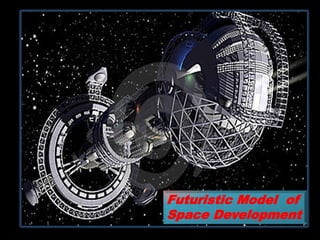
Futuristic Model of
Space Development
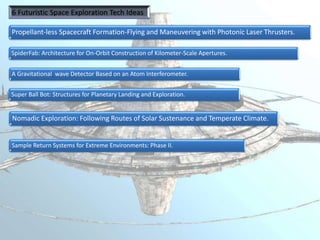
Propellant-less Spacecraft Formation-Flying and Maneuvering with Photonic Laser Thrusters.
SpiderFab: Architecture for On-Orbit Construction of Kilometer-Scale Apertures.
A Gravitational wave Detector Based on an Atom Interferometer.
Super Ball Bot: Structures for Planetary Landing and Exploration.
Nomadic Exploration: Following Routes of Solar Sustenance and Temperate Climate.
Sample Return Systems for Extreme Environments: Phase II.
Space research:OUTLINE,HISTORY AND PROGRESS

Space research:OUTLINE,HISTORY AND PROGRESS

  • 2.
     Space researchis scientific studies carried out using scientific equipment in outer space.  It includes the use of space technology for a broad spectrum of research disciplines, including Earth science, materials science, biology, medicine, and physics.  The term includes scientific payloads everywhere from deep space to low earth orbit.  Space science and space exploration involve the study of outer space itself, which is only part of the broader field of space research.
  • 3.
    After the endof World War II,space research emerged as a field of scientific investigation based on the advancing rocket technology. In 1948-1949 detectors on V-2 rocket flights detected x-rays from the sun. As higher altitudes were reached, the field of space physics emerged with studies of aurorae, the ionosphere and the magnetosphere. The start of satellite-based space research is the detection of the Van Allen radiation belt by Explorer 1 in 1958, four months after the launch of the first satellite, Sputnik 1 on October 4, 1957. In the following year space planetology emerged with a series of lunar probes, e.g. the first photographs of the far side of the moon by Luna 3 in 1959.
  • 5.
    The First Creatureto go to space. Laika, Soviet space dog
  • 6.
    Space research includesthe following fields of science: • Earth observations, using remote sensing techniques to interpret optical and radar data from Earth observation satellites • Geodesy, using gravitational perturbations of satellite orbits. • Space physics, the in situ study of space plasmas, e.g. aurorae, the ionosphere, the magnetosphere and space weather. • Planetology, using space probes to study objects in the planetary system • Astronomy, using space telescopes and detectors that are not limited by looking through the atmosphere • Materials sciences, taking advantage of the micro-g environment on orbital platforms • Life sciences, including physiology, using the space radiation environment and weightlessness • Physics, using space as a laboratory for studies in fundamental physics.
  • 8.
    Upper Atmosphere ResearchSatellite: The Upper Atmosphere Research Satellite was a NASA-led mission launched on September 12, 1991. The 5,900 lb. satellite was deployed from the Space Shuttle Discovery during the STS-48 mission on 15 September 1991. It was the first multi-instrumented satellite to study various aspects of the Earths’ atmosphere and have a better understanding of photochemistry. After 14 years of service, the UARS finished its scientific career in 2005.
  • 9.
    International Gamma-Ray Astrophysics Laboratory: TheINTEGRAL is an operational space satellite launched by the European Space Agency in 2002. INTEGRAL provides insight into the most energetic forms of in space, such as black holes, neutron stars, and supernovas. INTEGRAL also plays an important role in researching one of the most exotic and energetic phenomena that occurs in space, gamma-rays.
  • 10.
    Hubble Space Telescope: • TheHubble Space Telescope was launched in 1990 and it sped humanity to one of its greatest advances to understand the universe. • The discoveries made by the HST have changed the way scientists look at the universe. • It winded the amount of space theories as it sparked new ones. • HST played a key role in conjunction with other space agencies in the discovery of dark energy, a mysterious force that causes the expansion of the universe to accelerate. • More than 10,000 articles have been published by Hubble data, and it has surpassed its expected lifetime.
  • 13.
    Salyut 1: • Salyut1 was the first space station ever built. It was launched in April 19, 1971 by the Soviet Union. • The first crew failed entry into the space station. The second crew was able to spend twenty-three days in the space station • Salyut 1 was intentionally deorbited six months into orbit since it prematurely ran out of fuel.
  • 15.
    Skylab: First American spacestation. launched in May 19, 1973. Mir: From 1986 to 2001, Russian space station Mir served as a permanent microgravity research laboratory. goal was developing technologies required for permanent occupation of outer space. Skylab’s experiments confirmed coronal holes.
  • 16.
     The IndianNational Committee for Space Research (INCOSPAR) was set up in 1962 by Jawaharlal Nehru, India's first Prime Minister  Vikram Sarabhai, first chairman of INCOSPAR, which would later be called ISRO The prime objective of ISRO is to develop space technology and its application to various national tasks. The former Indian President Sri A. P. J. Abdul Kalam said: “Many individuals with myopic vision questioned the relevance of space activities in a newly independent nation, which was finding it difficult to feed its population. Their vision was clear if Indians were to play meaningful role in the community of nations, they must be second to none in the application of advanced technologies to their real-life problems. They had no intention of using it as a means of displaying our might.”
  • 17.
    India joined anexclusive global club when it successfully launched the Mars Orbiter Mission The Aryabhata spacecraft that was named after the famous Indian astronomer was the country’s first satellite. Known better by its popular name Insat, the system is a network of satellites that facilitates communications and broadcasting across the south Asian region. It was developed in the 1990s and has become the Indian space mission’s most reliable workhorse. joined an elite list of just six space organisations to send an orbiter to the moon. The seven-satellite system created India’s very own satellite navigation system. In May, Isro successfully tested the Reusable Launch Vehicle — Technology Demonstrator (RLV-TD) that was built for Rs 95 crore. On 15 February 2017, ISRO launched 104 satellites in a single rocket (PSLV-C37) and created a world record
  • 19.
  • 20.
    Sriharikota (India’s firstSatellite Launching Station)
  • 21.
    ISRO’s expenditure inthe last 40 years = Half of NASA’s single year budget. ISRO’s budget is only 0.34 per cent of the central government expenditure at present. It is only 0.08 per cent of the Gross Domestic Product (GDP). ISRO’s Mars mission is the cheapest so far, just 450 crore i.e Rs 12 per km, equivalent to Auto fare. ISRO’s first lunar mission, Chandrayaan I was approximately amounted to 390 crore rupees which is 8-9 times lesser than the expense of similar mission by NASA
  • 22.
    The Structure ofthe Department of Space of the Government of India
  • 23.
    • Vikram SarabhaiSpace Centre (VSSC), Thiruvananthapuram. • Liquid Propulsion Systems Centre (LPSC), Thiruvananthapuram. • Satish Dhawan Space Centre (SDSC-SHAR), Sriharikota. • ISRO Propulsion Complex (IPRC), Mahendragiri. • ISRO Satellite Centre (ISAC), Bangalore. • Space Applications Centre (SAC), Ahmedabad. • National Remote Sensing Centre (NRSC), Hyderabad. • ISRO Inertial Systems Unit (IISU), Thiruvananthapuram. • Development and Educational Communication Unit (DECU), Ahmedabad. • Master Control Facility (MCF), Hassan, Karnataka. • ISRO Telemetry, Tracking and Command Network (ISTRAC), Bangalore. • Laboratory for Electro-Optics Systems (LEOS), Bangalore. • Indian Institute of Remote Sensing (IIRS), Dehradun. .
  • 24.
    Meet ANTRIX, thecorporate arm of ISRO. o Antrix deals with the commercialization of space products, consultancy and technology transfer developed by the ISRO. o It has clientele worldwide – Europe, Middle East and SE Asia. o Apart from bigwigs from ISRO and other related space bodies, two of India’s biggest industrialists – Ratan Tata and Jamshyd Godrej – are on the board.
  • 25.
    Chandrayaan In 2008-09, theIndian Space and Research Organisation successfully launched a lunar orbiter, Chandrayaan-1. It discovered evidence of water on the moon. Mangalyaan was developed from technology tested during the Chandrayaan mission.
  • 26.
    INDIA (ISRO) isthe only one country who has reached to the MARS in his FIRST attempt!
  • 27.
     They aredeveloping an orbital vehicle as well as setting up a training center in Bangalore to train astronauts.  ISRO also developed Bhuvan, a web-based 3D satellite imagery tool which is the Indian incarnation of Google Earth.  Human spaceflight programme: ISRO has proposed a budget of ₹124 billion for its human spaceflight programme.India will become the fourth nation, after the USSR, USA and China to successfully carry out manned missions indigenously.
  • 30.
  • 31.
    Propellant-less Spacecraft Formation-Flyingand Maneuvering with Photonic Laser Thrusters. SpiderFab: Architecture for On-Orbit Construction of Kilometer-Scale Apertures. A Gravitational wave Detector Based on an Atom Interferometer. Super Ball Bot: Structures for Planetary Landing and Exploration. Nomadic Exploration: Following Routes of Solar Sustenance and Temperate Climate. Sample Return Systems for Extreme Environments: Phase II.