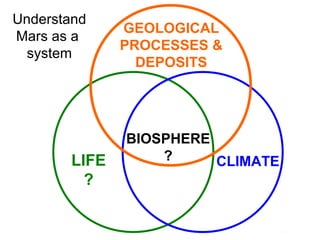
LIFE
?
CLIMATE
BIOSPHERE
?
GEOLOGICAL
PROCESSES &
DEPOSITS
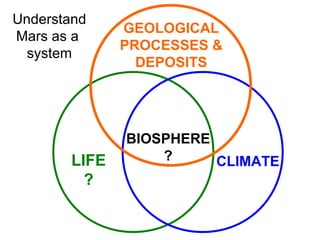
Understand
Mars as a
system
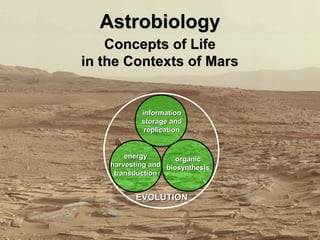
AstrobiologyAstrobiology
Concepts of LifeConcepts of Life
in the Contexts of Marsin the Contexts of Mars
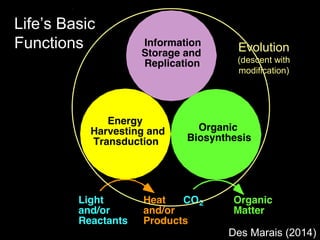
informationinformation
storage andstorage and
replicationreplication
energyenergy
harvesting andharvesting and
transductiontransduction
organicorganic
biosynthesisbiosynthesis
EVOLUTIONEVOLUTION
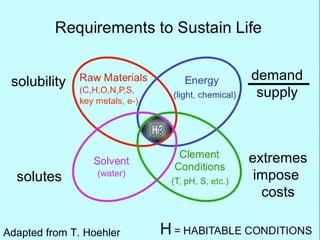
solutes
demand
supply
extremes
impose
costs
solubility
Adapted from T. Hoehler
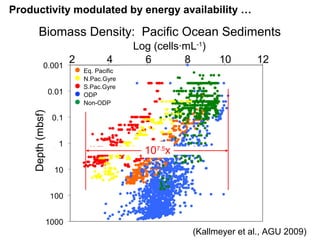
Depth(mbsf)
12108642
Log (cells·mL-1
)
● Eq. Pacific
● N.Pac.Gyre
● S.Pac.Gyre
● ODP
● Non-ODP
Biomass Density: Pacific Ocean Sediments
(Kallmeyer et al., AGU 2009)
107.5
x
Productivity modulated by energy availability …
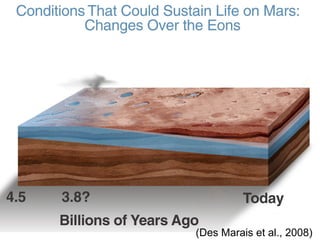
(Des Marais et al., 2008)
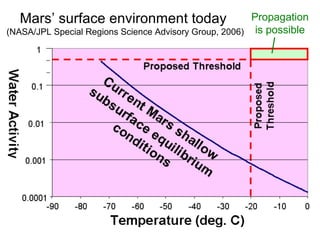
Propagation
is possible
Mars’ surface environment today
(NASA/JPL Special Regions Science Advisory Group, 2006)
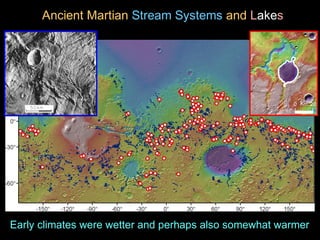
Open Basin Lakes
N=>210 (~65% newly
recognized)
Fassett and Head, 2008a,b
Noachian Valley Networks and Open Basin LakesAncient Martian Stream Systems and Lakes
Early climates were wetter and perhaps also somewhat warmer
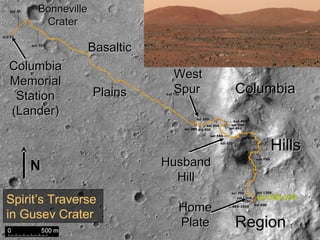
NN
BonnevilleBonneville
CraterCrater
ColumbiaColumbia
HillsHills
RegionRegion
BasalticBasaltic
PlainsPlains
ColumbiaColumbia
MemorialMemorial
StationStation
(Lander)(Lander)
HomeHome
PlatePlate
WestWest
SpurSpur
HusbandHusband
HillHill
Spirit’s Traverse
in Gusev Crater
Rocks and soils (regolith fines)
within reach
Which ones to focus on?
Targeted Remote Sensing
observations
Which ones to touch?
Contact
observations
Which ones to sample?
samples
Deciphering Geological Processes and History
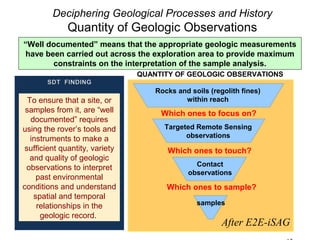
Quantity of Geologic Observations
After E2E-iSAG
QUANTITY OF GEOLOGIC OBSERVATIONS
“Well documented” means that the appropriate geologic measurements
have been carried out across the exploration area to provide maximum
constraints on the interpretation of the sample analysis.
To ensure that a site, or
samples from it, are “well
documented” requires
using the rover’s tools and
instruments to make a
sufficient quantity, variety
and quality of geologic
observations to interpret
past environmental
conditions and understand
spatial and temporal
relationships in the
geologic record.
06/03/15 132020 Mars Rover Science Definition Team
Scientific Process for Detecting Past Martian Life
POTENTIAL FOR
BIOSIGNATURE
PRESERVATIO
N
EXISTENCE OF
POTENTIAL
BIOSIGNATURE
PRE-CONDITIONS THAT
MUST HAVE BEEN MET
Past conditions
suitable for the
existence of life
at the site.
Past conditions
suitable for the
preservation of
past life in the
geologic record.
An observable
feature that
might be
evidence of past life.
RECOGNITION OF
DEFINITIVE
BIOSIGNATURE
An observable
feature that is
confirmed to be
evidence of past life.
POSSIBLE EVIDENCE
OF ANY PAST LIFE
PAST LIFE
DETECTED
Proposed Mars 2020 Rover
Labs on Earth
MSR
PAST
HABITABLE
ENVIRONMENT
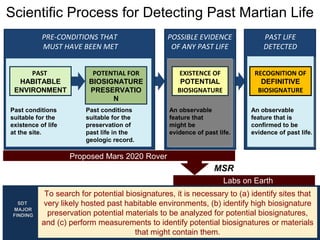
To search for potential biosignatures, it is necessary to (a) identify sites that
very likely hosted past habitable environments, (b) identify high biosignature
preservation potential materials to be analyzed for potential biosignatures,
and (c) perform measurements to identify potential biosignatures or materials
that might contain them.
Summary
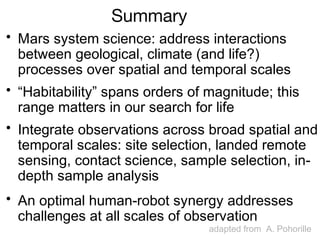
• Mars system science: address interactions
between geological, climate (and life?)
processes over spatial and temporal scales
• “Habitability” spans orders of magnitude; this
range matters in our search for life
• Integrate observations across broad spatial and
temporal scales: site selection, landed remote
sensing, contact science, sample selection, in-
depth sample analysis
• An optimal human-robot synergy addresses
challenges at all scales of observation
adapted from A. Pohorille
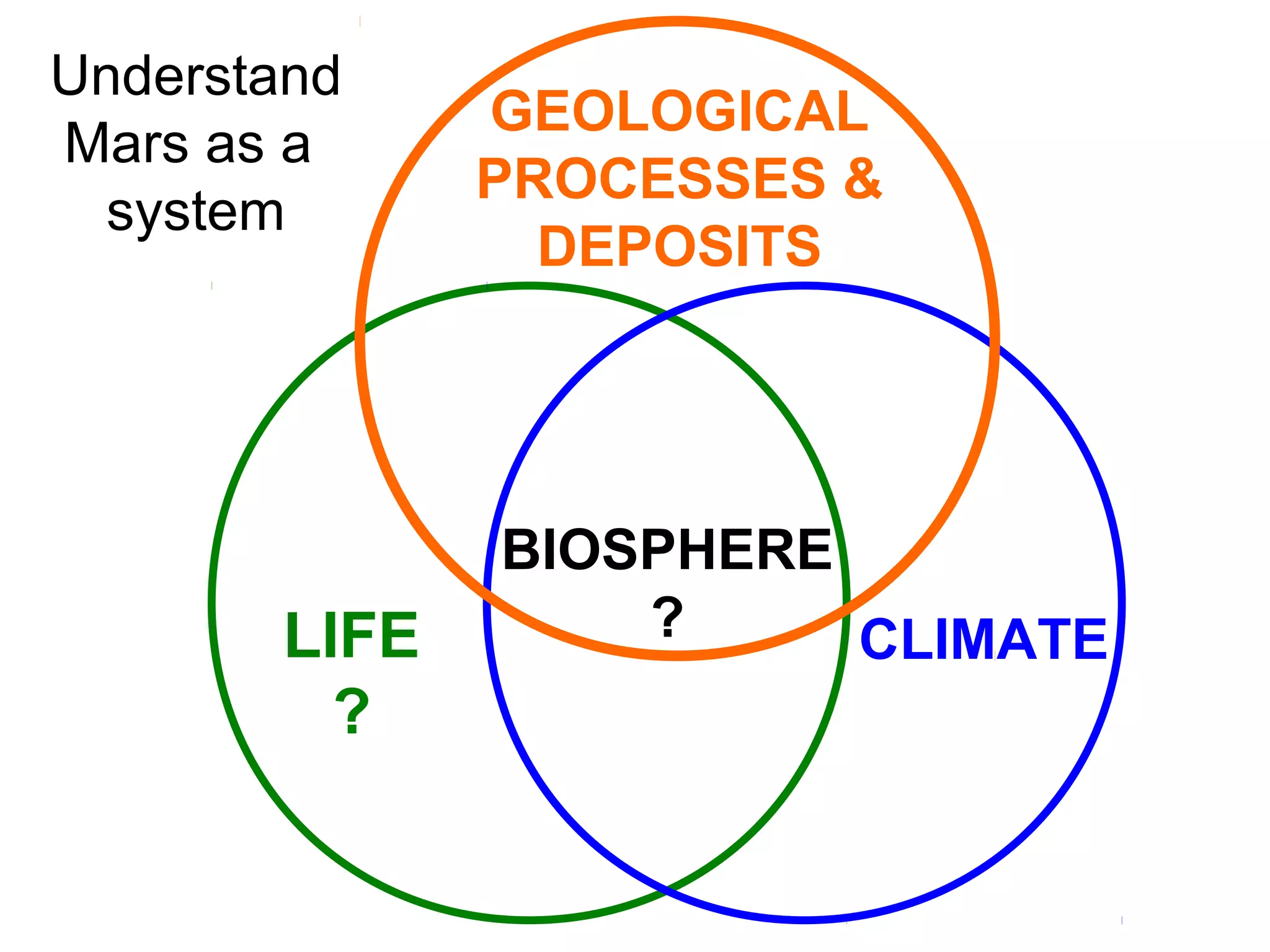
LIFE
?
CLIMATE
BIOSPHERE
?
GEOLOGICAL
PROCESSES &
DEPOSITS
Understand
Mars as a
system
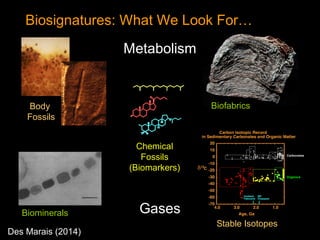
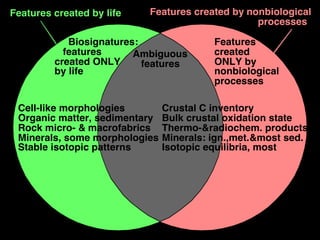
Biosignatures: What We Look For…
Body
Fossils
Biominerals
Biofabrics
Chemical
Fossils
(Biomarkers)
Stable Isotopes
Des Marais (2014)
Gases
Metabolism
End
Evolution
(descent with
modification)
Life’s Basic
Functions
Des Marais (2014)
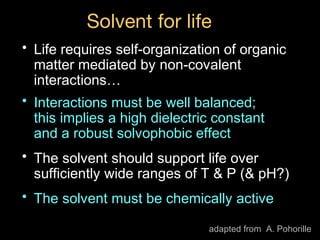
Solvent for life
• Life requires self-organization of organic
matter mediated by non-covalent
interactions…
• Interactions must be well balanced;
this implies a high dielectric constant
and a robust solvophobic effect
• The solvent should support life over
sufficiently wide ranges of T & P (& pH?)
• The solvent must be chemically active
adapted from A. Pohorille
Mineralogical Traces of Early Habitable
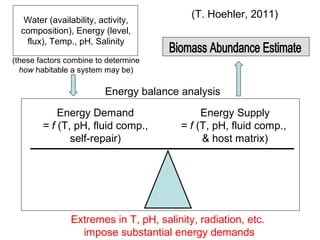
EnvironmentsWater (availability, activity,
composition), Energy (level,
flux), Temp., pH, Salinity
Energy balance analysis
Energy Demand
= f (T, pH, fluid comp.,
self-repair)
Energy Supply
= f (T, pH, fluid comp.,
& host matrix)
(these factors combine to determine
how habitable a system may be)
Extremes in T, pH, salinity, radiation, etc.
impose substantial energy demands
(T. Hoehler, 2011)
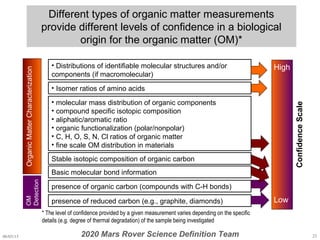
presence of reduced carbon (e.g., graphite, diamonds)
• Distributions of identifiable molecular structures and/or
components (if macromolecular)
Low
High
presence of organic carbon (compounds with C-H bonds)
• Isomer ratios of amino acids
OM
Detection
ConfidenceScale
• molecular mass distribution of organic components
• compound specific isotopic composition
• aliphatic/aromatic ratio
• organic functionalization (polar/nonpolar)
• C, H, O, S, N, Cl ratios of organic matter
• fine scale OM distribution in materials
Basic molecular bond information
OrganicMatterCharacterization
Different types of organic matter measurements
provide different levels of confidence in a biological
origin for the organic matter (OM)*
Stable isotopic composition of organic carbon
* The level of confidence provided by a given measurement varies depending on the specific
details (e.g. degree of thermal degradation) of the sample being investigated
06/03/15 232020 Mars Rover Science Definition Team
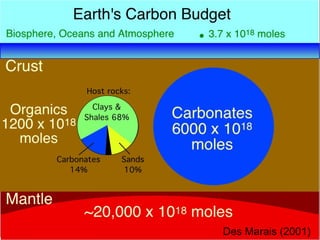
Des Marais (2001)
Astronauts and Robots 2015: David Des Marais, NASA

Astronauts and Robots 2015: David Des Marais, NASA

  • 1.
  • 2.
    AstrobiologyAstrobiology Concepts of LifeConceptsof Life in the Contexts of Marsin the Contexts of Mars informationinformation storage andstorage and replicationreplication energyenergy harvesting andharvesting and transductiontransduction organicorganic biosynthesisbiosynthesis EVOLUTIONEVOLUTION
  • 3.
  • 4.
    Depth(mbsf) 12108642 Log (cells·mL-1 ) ● Eq.Pacific ● N.Pac.Gyre ● S.Pac.Gyre ● ODP ● Non-ODP Biomass Density: Pacific Ocean Sediments (Kallmeyer et al., AGU 2009) 107.5 x Productivity modulated by energy availability …
  • 5.
    (Des Marais etal., 2008)
  • 6.
    Propagation is possible Mars’ surfaceenvironment today (NASA/JPL Special Regions Science Advisory Group, 2006)
  • 10.
    Open Basin Lakes N=>210(~65% newly recognized) Fassett and Head, 2008a,b Noachian Valley Networks and Open Basin LakesAncient Martian Stream Systems and Lakes Early climates were wetter and perhaps also somewhat warmer
  • 11.
  • 12.
    Rocks and soils(regolith fines) within reach Which ones to focus on? Targeted Remote Sensing observations Which ones to touch? Contact observations Which ones to sample? samples Deciphering Geological Processes and History Quantity of Geologic Observations After E2E-iSAG QUANTITY OF GEOLOGIC OBSERVATIONS “Well documented” means that the appropriate geologic measurements have been carried out across the exploration area to provide maximum constraints on the interpretation of the sample analysis. To ensure that a site, or samples from it, are “well documented” requires using the rover’s tools and instruments to make a sufficient quantity, variety and quality of geologic observations to interpret past environmental conditions and understand spatial and temporal relationships in the geologic record.
  • 13.
    06/03/15 132020 MarsRover Science Definition Team Scientific Process for Detecting Past Martian Life POTENTIAL FOR BIOSIGNATURE PRESERVATIO N EXISTENCE OF POTENTIAL BIOSIGNATURE PRE-CONDITIONS THAT MUST HAVE BEEN MET Past conditions suitable for the existence of life at the site. Past conditions suitable for the preservation of past life in the geologic record. An observable feature that might be evidence of past life. RECOGNITION OF DEFINITIVE BIOSIGNATURE An observable feature that is confirmed to be evidence of past life. POSSIBLE EVIDENCE OF ANY PAST LIFE PAST LIFE DETECTED Proposed Mars 2020 Rover Labs on Earth MSR PAST HABITABLE ENVIRONMENT To search for potential biosignatures, it is necessary to (a) identify sites that very likely hosted past habitable environments, (b) identify high biosignature preservation potential materials to be analyzed for potential biosignatures, and (c) perform measurements to identify potential biosignatures or materials that might contain them.
  • 14.
    Summary • Mars systemscience: address interactions between geological, climate (and life?) processes over spatial and temporal scales • “Habitability” spans orders of magnitude; this range matters in our search for life • Integrate observations across broad spatial and temporal scales: site selection, landed remote sensing, contact science, sample selection, in- depth sample analysis • An optimal human-robot synergy addresses challenges at all scales of observation adapted from A. Pohorille
  • 15.
  • 16.
    Biosignatures: What WeLook For… Body Fossils Biominerals Biofabrics Chemical Fossils (Biomarkers) Stable Isotopes Des Marais (2014) Gases Metabolism
  • 17.
  • 18.
  • 19.
    Solvent for life •Life requires self-organization of organic matter mediated by non-covalent interactions… • Interactions must be well balanced; this implies a high dielectric constant and a robust solvophobic effect • The solvent should support life over sufficiently wide ranges of T & P (& pH?) • The solvent must be chemically active adapted from A. Pohorille
  • 21.
    Mineralogical Traces ofEarly Habitable EnvironmentsWater (availability, activity, composition), Energy (level, flux), Temp., pH, Salinity Energy balance analysis Energy Demand = f (T, pH, fluid comp., self-repair) Energy Supply = f (T, pH, fluid comp., & host matrix) (these factors combine to determine how habitable a system may be) Extremes in T, pH, salinity, radiation, etc. impose substantial energy demands (T. Hoehler, 2011)
  • 23.
    presence of reducedcarbon (e.g., graphite, diamonds) • Distributions of identifiable molecular structures and/or components (if macromolecular) Low High presence of organic carbon (compounds with C-H bonds) • Isomer ratios of amino acids OM Detection ConfidenceScale • molecular mass distribution of organic components • compound specific isotopic composition • aliphatic/aromatic ratio • organic functionalization (polar/nonpolar) • C, H, O, S, N, Cl ratios of organic matter • fine scale OM distribution in materials Basic molecular bond information OrganicMatterCharacterization Different types of organic matter measurements provide different levels of confidence in a biological origin for the organic matter (OM)* Stable isotopic composition of organic carbon * The level of confidence provided by a given measurement varies depending on the specific details (e.g. degree of thermal degradation) of the sample being investigated 06/03/15 232020 Mars Rover Science Definition Team
  • 24.

Editor's Notes

  • #13 Many more rocks would need to be imaged than interrogated closely, and more rocks would be examined in detail than are actually cached (adapted from E2E-ISAG, 2011).