Chapter 5Chapter 5
The Standard Trade ModelThe Standard Trade Model
Prepared by Iordanis Petsas
To Accompany
International Economics: Theory and PolicyInternational Economics: Theory and Policy, Sixth Edition
by Paul R. Krugman and Maurice Obstfeld
Chapter Organization
 Introduction
 A Standard Model of a Trading Economy
 International Transfers of Income: Shifting the RD
Curve
 Tariffs and Export Subsidies: Simultaneous Shifts in
RS and RD
 Summary
 Appendix: Representing International Equilibrium
with Offer Curves
Introduction
 Previous trade theories have emphasized specific
sources of comparative advantage which give rise to
international trade:
• Differences in labor productivity (Ricardian model)
• Differences in resources (specific factors model and
Heckscher-Ohlin model)
 The standard trade model is a general model of trade
that admits these models as special cases.
A Standard Model of a
Trading Economy
 The standard trade model is built on four key
relationships:
• Production possibility frontier and the relative supply
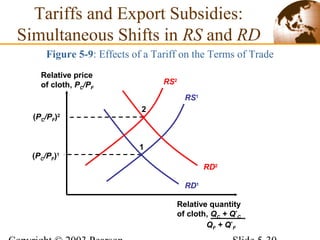
curve
• Relative prices and relative demand
• World relative supply and world relative demand
• Terms of trade and national welfare
A Standard Model of a
Trading Economy
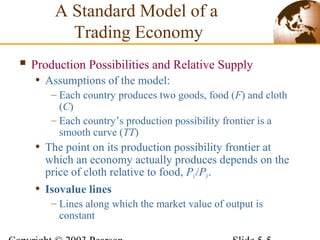
 Production Possibilities and Relative Supply
• Assumptions of the model:
– Each country produces two goods, food (F) and cloth
(C)
– Each country’s production possibility frontier is a
smooth curve (TT)
• The point on its production possibility frontier at
which an economy actually produces depends on the
price of cloth relative to food, PC/PF.
• Isovalue lines
– Lines along which the market value of output is
constant
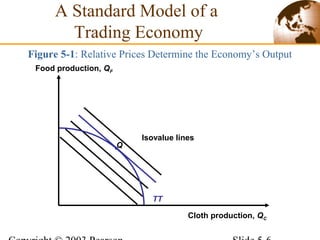
Figure 5-1: Relative Prices Determine the Economy’s Output
Q
Isovalue lines
TT
A Standard Model of a
Trading Economy
Cloth production, QC
Food production, QF
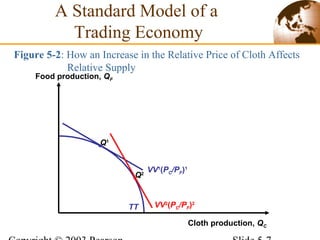
Figure 5-2: How an Increase in the Relative Price of Cloth Affects
Relative Supply
Q1
VV1
(PC/PF)1
Q2
VV2
(PC/PF)2
A Standard Model of a
Trading Economy
TT
Cloth production, QC
Food production, QF
 Relative Prices and Demand
• The value of an economy's consumption equals the
value of its production:
PCQC+ PFQF= PCDC + PFDF = V
• The economy’s choice of a point on the isovalue line
depends on the tastes of its consumers, which can be
represented graphically by a series of indifference
curves.
A Standard Model of a
Trading Economy
• Indifference curves
– Each traces a set of combinations of cloth (C) and food
(F) consumption that leave the individual equally well
off
– They have three properties:
– Downward sloping
– The farther up and to the right each lies, the higher the level of
welfare to which it corresponds
– Each gets flatter as we move to the right
A Standard Model of a
Trading Economy
TT
Figure 5-3: Production, Consumption, and Trade in the Standard Model
Cloth production, QC
Food production, QF
Q
D
Indifference curves
Food
imports
Cloth exports
A Standard Model of a
Trading Economy
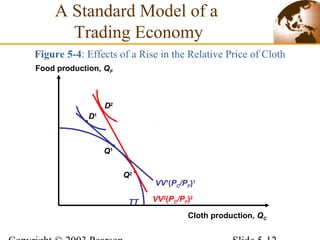
• If the relative price of cloth, PC/PF , increases, the
economy’s consumption choice shifts from D1
to D2
.
– The move from D1
to D2
reflects two effects:
– Income effect
– Substitution effect
– It is possible that the income effect will be so strong
that when PC/PF rises, consumption of both goods
actually rises, while the ratio of cloth consumption to
food consumption falls.
A Standard Model of a
Trading Economy
TT
Figure 5-4: Effects of a Rise in the Relative Price of Cloth
Q1
VV1
(PC/PF)1
Q2
VV2
(PC/PF)2
D2
D1
A Standard Model of a
Trading Economy
Cloth production, QC
Food production, QF
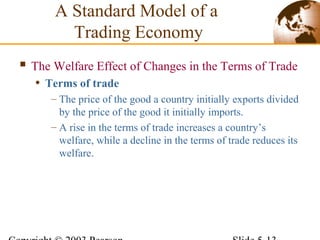
 The Welfare Effect of Changes in the Terms of Trade
• Terms of trade
– The price of the good a country initially exports divided
by the price of the good it initially imports.
– A rise in the terms of trade increases a country’s
welfare, while a decline in the terms of trade reduces its
welfare.
A Standard Model of a
Trading Economy
 Determining Relative Prices
• Suppose that the world economy consists of two
countries:
– Home (which exports cloth)
– Its terms of trade are measured by PC/PF
– Its quantities of cloth and food producedare QC and QF
– Foreign (which exports food)
– Its terms of trade are measured by PF/PC
– Its quantities of cloth and food producedare Q*
C and Q*
F
A Standard Model of a
Trading Economy
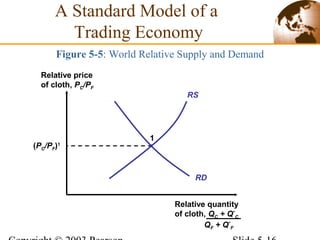
• To determine PC/PF, one must find the intersection of
world relative supply of cloth and world relative
demand.
– The world relative supply curve (RS) is upward sloping
because an increase in PC/PF leads both countries to
produce more cloth and less food.
– The world relative demand curve (RD) is downward
sloping because an increase in PC/PF leads both countries
to shift their consumption mix away from cloth toward
food.
A Standard Model of a
Trading Economy
Figure 5-5: World Relative Supply and Demand
RS
RD
Relative price
of cloth, PC/PF
Relative quantity
of cloth, QC + Q*
C
QF + Q*
F
A Standard Model of a
Trading Economy
(PC/PF)1
1
 Economic Growth: A Shift of the RS Curve
• Is economic growth in other countries good or bad for
our nation?
– It may be good for our nation because it means larger
markets for our exports.
– It may mean increased competition for our exporters.
• Is growth in a country more or less valuable when that
nation is part of a closely integrated world economy?
– It should be more valuable when a country can sell
some of its increased production to the world market.
– It is less valuable when the benefits of growth are
passed on to foreigners rather than retained at home.
A Standard Model of a
Trading Economy
 Growth and the Production Possibility Frontier
• Economic growth implies an outward shift of a
country’s production possibility frontier (TT).
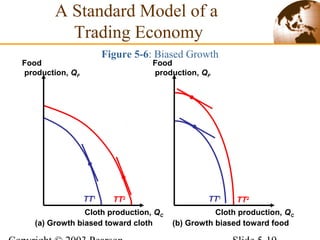
• Biased growth
– Takes place when TT shifts out more in one direction
than in the other
– Can occur for two reasons:
– Technological progress in one sector of the economy
– Increase in a country’s supply of a factor of production
A Standard Model of a
Trading Economy
Figure 5-6: Biased Growth
TT1
TT1
TT2
TT2
A Standard Model of a
Trading Economy
Cloth production, QC
Food
production, QF
(a) Growth biased toward cloth
Cloth production, QC
Food
production, QF
(b) Growth biased toward food
 Relative Supply and the Terms of Trade
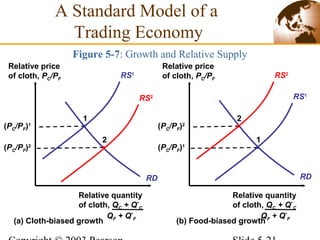
• Export-biased growth
– Disproportionately expands a country’s production
possibilities in the direction of the good it exports
– Worsens a growing country’s terms of trade, to the
benefit of the rest of the world
• Import-biased growth
– Disproportionately expands a country’s production
possibilities in the direction of the good it imports
– Improves a growing country’s terms of trade at the rest
of the word’s expense
A Standard Model of a
Trading Economy
Figure 5-7: Growth and Relative Supply
Relative price
of cloth, PC/PF
Relative quantity
of cloth, QC + Q*
C
QF + Q*
F
RS1
RD
1
(PC/PF)1
RS2
(PC/PF)2
2
Relative price
of cloth, PC/PF
Relative quantity
of cloth, QC + Q*
C
QF + Q*
F
RS2
RD
2
(PC/PF)2
RS1
(PC/PF)1
1
(a) Cloth-biased growth (b) Food-biased growth
A Standard Model of a
Trading Economy
 International Effects of Growth
• Export-biased growth in the rest of the world improves
our terms of trade, while import-biased growth abroad
worsens our terms of trade.
• Export-biased growth in our country worsens our
terms of trade, reducing the direct benefits of growth,
while import-biased growth leads to an improvement
of our terms of trade.
A Standard Model of a
Trading Economy
• Immiserizing growth
– A situation where export-biased growth by poor nations
can worsen their terms of trade so much that they would
be worse off than if they had not grown at all
– It can occur under extreme conditions: Strongly export-
biased growth must be combined with very steep RS and
RD curves.
– It is regarded by most economists as more a theoretical
point than a real-world issue.
A Standard Model of a
Trading Economy
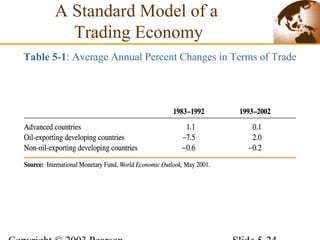
Table 5-1: Average Annual Percent Changes in Terms of Trade
A Standard Model of a
Trading Economy
International Transfers of Income:
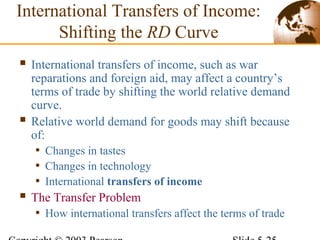
Shifting the RD Curve
 International transfers of income, such as war
reparations and foreign aid, may affect a country’s
terms of trade by shifting the world relative demand
curve.
 Relative world demand for goods may shift because
of:
• Changes in tastes
• Changes in technology
• International transfers of income
 The Transfer Problem
• How international transfers affect the terms of trade
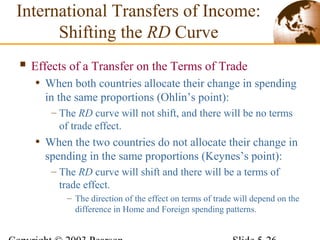
 Effects of a Transfer on the Terms of Trade
• When both countries allocate their change in spending
in the same proportions (Ohlin’s point):
– The RD curve will not shift, and there will be no terms
of trade effect.
• When the two countries do not allocate their change in
spending in the same proportions (Keynes’s point):
– The RD curve will shift and there will be a terms of
trade effect.
– The direction of the effect on terms of trade will depend on the
difference in Home and Foreign spending patterns.
International Transfers of Income:
Shifting the RD Curve
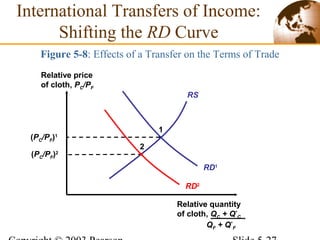
Figure 5-8: Effects of a Transfer on the Terms of Trade
Relative price
of cloth, PC/PF
Relative quantity
of cloth, QC + Q*
C
QF + Q*
F
RS
RD2
RD1
(PC/PF)2
2
1
(PC/PF)1
International Transfers of Income:
Shifting the RD Curve
 Presumptions about the Terms of Trade Effects of
Transfers
• A transfer will worsen the donor’s terms of trade if the
donor has a higher marginal propensity to spend on its
export good than the recipient.
• In practice, most countries spend a much higher share
of their income on domestically produced goods than
foreigners do.
– This is not necessarily due to differences in taste but
rather to barriers to trade, natural and artificial.
International Transfers of Income:
Shifting the RD Curve
 Import tariffs and export subsidies affect both
relative supply and relative demand.
 Relative Demand and Supply Effects of a Tariff
• Tariffs drive a wedge between the prices at which
goods are traded internationally (external prices) and
the prices at which they are traded within a country
(internal prices).
• The terms of trade correspond to external, not internal,
prices.
Tariffs and Export Subsidies:
Simultaneous Shifts in RS and RD
Tariffs and Export Subsidies:
Simultaneous Shifts in RS and RD
Figure 5-9: Effects of a Tariff on the Terms of Trade
Relative price
of cloth, PC/PF
Relative quantity
of cloth, QC + Q*
C
QF + Q*
F
RS1
RD1
RD2
RS2
(PC/PF)1
1
(PC/PF)2
2
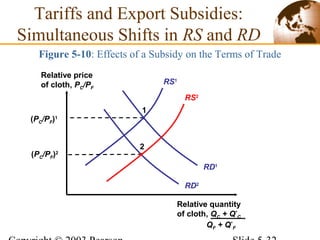
 Effects of an Export Subsidy
• Tariffs and export subsidies are often treated as similar
policies but they have opposite effects on the terms of
trade.
– Example: Suppose that Home offers 20% subsidy on the
value of cloth exported:
– This will raise Home’s internal price of cloth relative to food by
20%.
– This will lead Home producers to produce more cloth and less
food.
– A Home export subsidy worsens Home’s terms of trade
and improves Foreign’s.
Tariffs and Export Subsidies:
Simultaneous Shifts in RS and RD
Tariffs and Export Subsidies:
Simultaneous Shifts in RS and RD
Figure 5-10: Effects of a Subsidy on the Terms of Trade
Relative price
of cloth, PC/PF
Relative quantity
of cloth, QC + Q*
C
QF + Q*
F
RS1
RD1
RD2
RS2
(PC/PF)1
1
(PC/PF)2
2
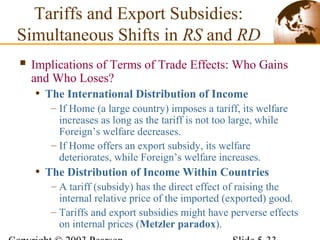
 Implications of Terms of Trade Effects: Who Gains
and Who Loses?
• The International Distribution of Income
– If Home (a large country) imposes a tariff, its welfare
increases as long as the tariff is not too large, while
Foreign’s welfare decreases.
– If Home offers an export subsidy, its welfare
deteriorates, while Foreign’s welfare increases.
• The Distribution of Income Within Countries
– A tariff (subsidy) has the direct effect of raising the
internal relative price of the imported (exported) good.
– Tariffs and export subsidies might have perverse effects
on internal prices (Metzler paradox).
Tariffs and Export Subsidies:
Simultaneous Shifts in RS and RD
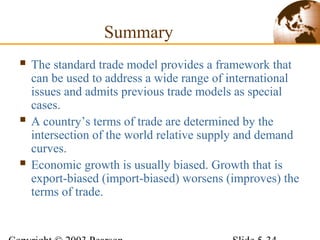
Summary
 The standard trade model provides a framework that
can be used to address a wide range of international
issues and admits previous trade models as special
cases.
 A country’s terms of trade are determined by the
intersection of the world relative supply and demand
curves.
 Economic growth is usually biased. Growth that is
export-biased (import-biased) worsens (improves) the
terms of trade.
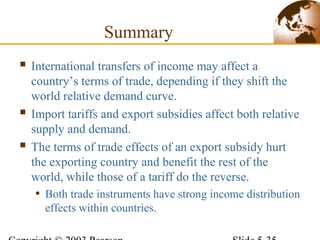
 International transfers of income may affect a
country’s terms of trade, depending if they shift the
world relative demand curve.
 Import tariffs and export subsidies affect both relative
supply and demand.
 The terms of trade effects of an export subsidy hurt
the exporting country and benefit the rest of the
world, while those of a tariff do the reverse.
• Both trade instruments have strong income distribution
effects within countries.
Summary
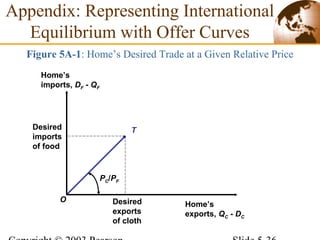
Figure 5A-1: Home’s Desired Trade at a Given Relative Price
TDesired
imports
of food
Desired
exports
of cloth
Home’s
imports, DF - QF
Home’s
exports, QC - DC
O
PC/PF
Appendix: Representing International
Equilibrium with Offer Curves
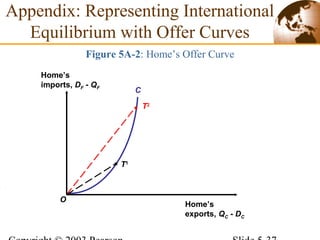
Figure 5A-2: Home’s Offer Curve
C
T2
T1
Appendix: Representing International
Equilibrium with Offer Curves
Home’s
imports, DF - QF
Home’s
exports, QC - DC
O
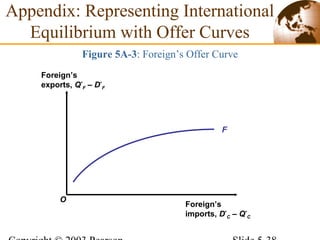
Figure 5A-3: Foreign’s Offer Curve
F
Appendix: Representing International
Equilibrium with Offer Curves
Foreign’s
exports, Q*
F – D*
F
Foreign’s
imports, D*
C – Q*
C
O
Appendix: Representing International
Equilibrium with Offer Curves
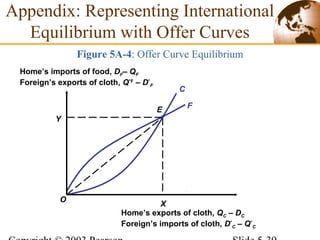
Figure 5A-4: Offer Curve Equilibrium
C
F
X
Y
E
Home’s exports of cloth, QC – DC
Foreign’s imports of cloth, D*
C – Q*
C
O
Home’s imports of food, DF– QF
Foreign’s exports of cloth, Q*F
– D*
F

International economic ch05

  • 1.
    Chapter 5Chapter 5 TheStandard Trade ModelThe Standard Trade Model Prepared by Iordanis Petsas To Accompany International Economics: Theory and PolicyInternational Economics: Theory and Policy, Sixth Edition by Paul R. Krugman and Maurice Obstfeld
  • 2.
    Chapter Organization  Introduction A Standard Model of a Trading Economy  International Transfers of Income: Shifting the RD Curve  Tariffs and Export Subsidies: Simultaneous Shifts in RS and RD  Summary  Appendix: Representing International Equilibrium with Offer Curves
  • 3.
    Introduction  Previous tradetheories have emphasized specific sources of comparative advantage which give rise to international trade: • Differences in labor productivity (Ricardian model) • Differences in resources (specific factors model and Heckscher-Ohlin model)  The standard trade model is a general model of trade that admits these models as special cases.
  • 4.
    A Standard Modelof a Trading Economy  The standard trade model is built on four key relationships: • Production possibility frontier and the relative supply curve • Relative prices and relative demand • World relative supply and world relative demand • Terms of trade and national welfare
  • 5.
    A Standard Modelof a Trading Economy  Production Possibilities and Relative Supply • Assumptions of the model: – Each country produces two goods, food (F) and cloth (C) – Each country’s production possibility frontier is a smooth curve (TT) • The point on its production possibility frontier at which an economy actually produces depends on the price of cloth relative to food, PC/PF. • Isovalue lines – Lines along which the market value of output is constant
  • 6.
    Figure 5-1: RelativePrices Determine the Economy’s Output Q Isovalue lines TT A Standard Model of a Trading Economy Cloth production, QC Food production, QF
  • 7.
    Figure 5-2: Howan Increase in the Relative Price of Cloth Affects Relative Supply Q1 VV1 (PC/PF)1 Q2 VV2 (PC/PF)2 A Standard Model of a Trading Economy TT Cloth production, QC Food production, QF
  • 8.
     Relative Pricesand Demand • The value of an economy's consumption equals the value of its production: PCQC+ PFQF= PCDC + PFDF = V • The economy’s choice of a point on the isovalue line depends on the tastes of its consumers, which can be represented graphically by a series of indifference curves. A Standard Model of a Trading Economy
  • 9.
    • Indifference curves –Each traces a set of combinations of cloth (C) and food (F) consumption that leave the individual equally well off – They have three properties: – Downward sloping – The farther up and to the right each lies, the higher the level of welfare to which it corresponds – Each gets flatter as we move to the right A Standard Model of a Trading Economy
  • 10.
    TT Figure 5-3: Production,Consumption, and Trade in the Standard Model Cloth production, QC Food production, QF Q D Indifference curves Food imports Cloth exports A Standard Model of a Trading Economy
  • 11.
    • If therelative price of cloth, PC/PF , increases, the economy’s consumption choice shifts from D1 to D2 . – The move from D1 to D2 reflects two effects: – Income effect – Substitution effect – It is possible that the income effect will be so strong that when PC/PF rises, consumption of both goods actually rises, while the ratio of cloth consumption to food consumption falls. A Standard Model of a Trading Economy
  • 12.
    TT Figure 5-4: Effectsof a Rise in the Relative Price of Cloth Q1 VV1 (PC/PF)1 Q2 VV2 (PC/PF)2 D2 D1 A Standard Model of a Trading Economy Cloth production, QC Food production, QF
  • 13.
     The WelfareEffect of Changes in the Terms of Trade • Terms of trade – The price of the good a country initially exports divided by the price of the good it initially imports. – A rise in the terms of trade increases a country’s welfare, while a decline in the terms of trade reduces its welfare. A Standard Model of a Trading Economy
  • 14.
     Determining RelativePrices • Suppose that the world economy consists of two countries: – Home (which exports cloth) – Its terms of trade are measured by PC/PF – Its quantities of cloth and food producedare QC and QF – Foreign (which exports food) – Its terms of trade are measured by PF/PC – Its quantities of cloth and food producedare Q* C and Q* F A Standard Model of a Trading Economy
  • 15.
    • To determinePC/PF, one must find the intersection of world relative supply of cloth and world relative demand. – The world relative supply curve (RS) is upward sloping because an increase in PC/PF leads both countries to produce more cloth and less food. – The world relative demand curve (RD) is downward sloping because an increase in PC/PF leads both countries to shift their consumption mix away from cloth toward food. A Standard Model of a Trading Economy
  • 16.
    Figure 5-5: WorldRelative Supply and Demand RS RD Relative price of cloth, PC/PF Relative quantity of cloth, QC + Q* C QF + Q* F A Standard Model of a Trading Economy (PC/PF)1 1
  • 17.
     Economic Growth:A Shift of the RS Curve • Is economic growth in other countries good or bad for our nation? – It may be good for our nation because it means larger markets for our exports. – It may mean increased competition for our exporters. • Is growth in a country more or less valuable when that nation is part of a closely integrated world economy? – It should be more valuable when a country can sell some of its increased production to the world market. – It is less valuable when the benefits of growth are passed on to foreigners rather than retained at home. A Standard Model of a Trading Economy
  • 18.
     Growth andthe Production Possibility Frontier • Economic growth implies an outward shift of a country’s production possibility frontier (TT). • Biased growth – Takes place when TT shifts out more in one direction than in the other – Can occur for two reasons: – Technological progress in one sector of the economy – Increase in a country’s supply of a factor of production A Standard Model of a Trading Economy
  • 19.
    Figure 5-6: BiasedGrowth TT1 TT1 TT2 TT2 A Standard Model of a Trading Economy Cloth production, QC Food production, QF (a) Growth biased toward cloth Cloth production, QC Food production, QF (b) Growth biased toward food
  • 20.
     Relative Supplyand the Terms of Trade • Export-biased growth – Disproportionately expands a country’s production possibilities in the direction of the good it exports – Worsens a growing country’s terms of trade, to the benefit of the rest of the world • Import-biased growth – Disproportionately expands a country’s production possibilities in the direction of the good it imports – Improves a growing country’s terms of trade at the rest of the word’s expense A Standard Model of a Trading Economy
  • 21.
    Figure 5-7: Growthand Relative Supply Relative price of cloth, PC/PF Relative quantity of cloth, QC + Q* C QF + Q* F RS1 RD 1 (PC/PF)1 RS2 (PC/PF)2 2 Relative price of cloth, PC/PF Relative quantity of cloth, QC + Q* C QF + Q* F RS2 RD 2 (PC/PF)2 RS1 (PC/PF)1 1 (a) Cloth-biased growth (b) Food-biased growth A Standard Model of a Trading Economy
  • 22.
     International Effectsof Growth • Export-biased growth in the rest of the world improves our terms of trade, while import-biased growth abroad worsens our terms of trade. • Export-biased growth in our country worsens our terms of trade, reducing the direct benefits of growth, while import-biased growth leads to an improvement of our terms of trade. A Standard Model of a Trading Economy
  • 23.
    • Immiserizing growth –A situation where export-biased growth by poor nations can worsen their terms of trade so much that they would be worse off than if they had not grown at all – It can occur under extreme conditions: Strongly export- biased growth must be combined with very steep RS and RD curves. – It is regarded by most economists as more a theoretical point than a real-world issue. A Standard Model of a Trading Economy
  • 24.
    Table 5-1: AverageAnnual Percent Changes in Terms of Trade A Standard Model of a Trading Economy
  • 25.
    International Transfers ofIncome: Shifting the RD Curve  International transfers of income, such as war reparations and foreign aid, may affect a country’s terms of trade by shifting the world relative demand curve.  Relative world demand for goods may shift because of: • Changes in tastes • Changes in technology • International transfers of income  The Transfer Problem • How international transfers affect the terms of trade
  • 26.
     Effects ofa Transfer on the Terms of Trade • When both countries allocate their change in spending in the same proportions (Ohlin’s point): – The RD curve will not shift, and there will be no terms of trade effect. • When the two countries do not allocate their change in spending in the same proportions (Keynes’s point): – The RD curve will shift and there will be a terms of trade effect. – The direction of the effect on terms of trade will depend on the difference in Home and Foreign spending patterns. International Transfers of Income: Shifting the RD Curve
  • 27.
    Figure 5-8: Effectsof a Transfer on the Terms of Trade Relative price of cloth, PC/PF Relative quantity of cloth, QC + Q* C QF + Q* F RS RD2 RD1 (PC/PF)2 2 1 (PC/PF)1 International Transfers of Income: Shifting the RD Curve
  • 28.
     Presumptions aboutthe Terms of Trade Effects of Transfers • A transfer will worsen the donor’s terms of trade if the donor has a higher marginal propensity to spend on its export good than the recipient. • In practice, most countries spend a much higher share of their income on domestically produced goods than foreigners do. – This is not necessarily due to differences in taste but rather to barriers to trade, natural and artificial. International Transfers of Income: Shifting the RD Curve
  • 29.
     Import tariffsand export subsidies affect both relative supply and relative demand.  Relative Demand and Supply Effects of a Tariff • Tariffs drive a wedge between the prices at which goods are traded internationally (external prices) and the prices at which they are traded within a country (internal prices). • The terms of trade correspond to external, not internal, prices. Tariffs and Export Subsidies: Simultaneous Shifts in RS and RD
  • 30.
    Tariffs and ExportSubsidies: Simultaneous Shifts in RS and RD Figure 5-9: Effects of a Tariff on the Terms of Trade Relative price of cloth, PC/PF Relative quantity of cloth, QC + Q* C QF + Q* F RS1 RD1 RD2 RS2 (PC/PF)1 1 (PC/PF)2 2
  • 31.
     Effects ofan Export Subsidy • Tariffs and export subsidies are often treated as similar policies but they have opposite effects on the terms of trade. – Example: Suppose that Home offers 20% subsidy on the value of cloth exported: – This will raise Home’s internal price of cloth relative to food by 20%. – This will lead Home producers to produce more cloth and less food. – A Home export subsidy worsens Home’s terms of trade and improves Foreign’s. Tariffs and Export Subsidies: Simultaneous Shifts in RS and RD
  • 32.
    Tariffs and ExportSubsidies: Simultaneous Shifts in RS and RD Figure 5-10: Effects of a Subsidy on the Terms of Trade Relative price of cloth, PC/PF Relative quantity of cloth, QC + Q* C QF + Q* F RS1 RD1 RD2 RS2 (PC/PF)1 1 (PC/PF)2 2
  • 33.
     Implications ofTerms of Trade Effects: Who Gains and Who Loses? • The International Distribution of Income – If Home (a large country) imposes a tariff, its welfare increases as long as the tariff is not too large, while Foreign’s welfare decreases. – If Home offers an export subsidy, its welfare deteriorates, while Foreign’s welfare increases. • The Distribution of Income Within Countries – A tariff (subsidy) has the direct effect of raising the internal relative price of the imported (exported) good. – Tariffs and export subsidies might have perverse effects on internal prices (Metzler paradox). Tariffs and Export Subsidies: Simultaneous Shifts in RS and RD
  • 34.
    Summary  The standardtrade model provides a framework that can be used to address a wide range of international issues and admits previous trade models as special cases.  A country’s terms of trade are determined by the intersection of the world relative supply and demand curves.  Economic growth is usually biased. Growth that is export-biased (import-biased) worsens (improves) the terms of trade.
  • 35.
     International transfersof income may affect a country’s terms of trade, depending if they shift the world relative demand curve.  Import tariffs and export subsidies affect both relative supply and demand.  The terms of trade effects of an export subsidy hurt the exporting country and benefit the rest of the world, while those of a tariff do the reverse. • Both trade instruments have strong income distribution effects within countries. Summary
  • 36.
    Figure 5A-1: Home’sDesired Trade at a Given Relative Price TDesired imports of food Desired exports of cloth Home’s imports, DF - QF Home’s exports, QC - DC O PC/PF Appendix: Representing International Equilibrium with Offer Curves
  • 37.
    Figure 5A-2: Home’sOffer Curve C T2 T1 Appendix: Representing International Equilibrium with Offer Curves Home’s imports, DF - QF Home’s exports, QC - DC O
  • 38.
    Figure 5A-3: Foreign’sOffer Curve F Appendix: Representing International Equilibrium with Offer Curves Foreign’s exports, Q* F – D* F Foreign’s imports, D* C – Q* C O
  • 39.
    Appendix: Representing International Equilibriumwith Offer Curves Figure 5A-4: Offer Curve Equilibrium C F X Y E Home’s exports of cloth, QC – DC Foreign’s imports of cloth, D* C – Q* C O Home’s imports of food, DF– QF Foreign’s exports of cloth, Q*F – D* F