INTERMOLECULAR FORCES OF ATTRACTION 
Bautista, LaureenKate 
Capistrano, Amiel 
Espiel, Kyle 
Nicolas, Ezber
TERMINOLOGIES 
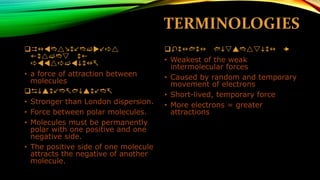
Intermolecular forces of attraction- 
•a force of attraction between molecules 
Dipole-dipole- 
•Stronger than London dispersion. 
•Force between polar molecules. 
•Molecules must be permanently polar with one positive and one negative side. 
•The positive side of one molecule attracts the negative of another molecule. 
London dispersion  
•Weakest of the weak intermolecular forces 
•Caused by random and temporary movement of electrons 
•Short-lived, temporary force 
•More electrons = greater attractions
TERMINOLOGIES 
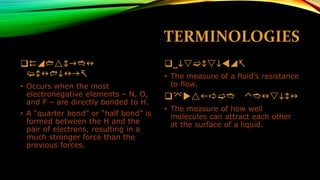
Hydrogen bonding- 
•Occurs when the most electronegative elements –N, O, and F –are directly bonded to H. 
•A “quarter bond” or “half bond” is formed between the H and the pair of electrons, resulting in a much stronger force than the previous forces. 
Viscosity- 
•The measure of a fluid’s resistance to flow. 
Surface Tension 
•The measure of how well molecules can attract each other at the surface of a liquid.
RESULTS AND INTERPRETATIONS 
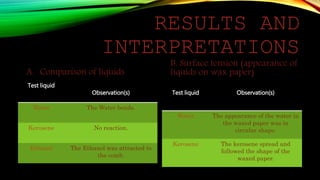
A.Comparison of liquids 
Testliquid 
Observation(s) 
Water 
The Water bends. 
Kerosene 
No reaction. 
Ethanol 
The Ethanol was attracted to the comb. 
B. Surface tension (appearance of liquids on wax paper) 
Testliquid 
Observation(s) 
Water 
The appearance of the water in the waxed paper was in circular shape. 
Kerosene 
The kerosene spread and followed the shape of the waxed paper.
RESULTS AND INTERPRETATIONS 
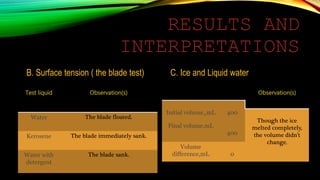
B. Surface tension ( the blade test) 
Testliquid 
Observation(s) 
Water 
The blade floated. 
Kerosene 
The blade immediatelysank. 
Water with detergent 
The blade sank. 
C. Ice and Liquid water 
Observation(s) 
Initial volume,,mL 
400 
Though the ice melted completely, the volume didn’t change. 
Final volume,mL 
400 
Volume difference,mL 
0
QUESTIONS 
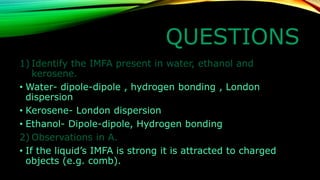
1)Identify the IMFA present in water, ethanol and kerosene. 
•Waterdipoledipole , hydrogen bonding , London dispersion 
•KeroseneLondon dispersion 
•EthanolDipoledipole, Hydrogen bonding 
2)Observations in A. 
•If the liquid’s IMFA is strong it is attracted to charged objects (e.g. comb).
QUESTIONS 
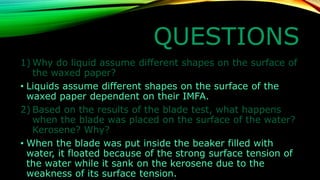
1)Why do liquid assume different shapes on the surface of the waxed paper? 
•Liquids assume different shapes on the surface of the waxed paper dependent on their IMFA. 
2)Based on the results of the blade test, what happens when the blade was placed on the surface of the water? Kerosene? Why? 
•When the blade was put inside the beaker filled with water, it floated because of the strong surface tension of the water while it sank on the kerosene due to the weakness of its surface tension.
QUESTIONS 
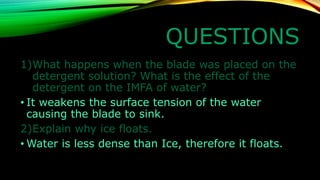
1)What happens when the blade was placed on the detergent solution? What is the effect of the detergent on the IMFA of water? 
•It weakens the surface tension of the water causing the blade to sink. 
2)Explain why ice floats. 
•Water is less dense than Ice, therefore it floats.
QUESTIONS 
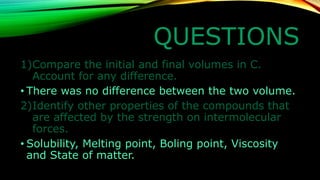
1)Compare the initial and final volumes in C. Account for any difference. 
•There was no difference between the two volume. 
2)Identify other properties of the compounds that are affected by the strength on intermolecular forces. 
•Solubility, Melting point, Boling point, Viscosity and State of matter.
FACTORS AFFECTING IMFA 
Generalization: 
•Higher intermolecular forces cause greater viscosity, greater surface tension, and higher melting and boiling points. 
•IMFA of liquids can be determine on their physical properties. 
Viscosity 
Melting Point 
Boiling point 
State of matter 
Surface tension 
Miscibility

Intermolecular forces of attraction (lab report)

  • 1.
    INTERMOLECULAR FORCES OFATTRACTION Bautista, LaureenKate Capistrano, Amiel Espiel, Kyle Nicolas, Ezber
  • 2.
    TERMINOLOGIES Intermolecular forcesof attraction- •a force of attraction between molecules Dipole-dipole- •Stronger than London dispersion. •Force between polar molecules. •Molecules must be permanently polar with one positive and one negative side. •The positive side of one molecule attracts the negative of another molecule. London dispersion  •Weakest of the weak intermolecular forces •Caused by random and temporary movement of electrons •Short-lived, temporary force •More electrons = greater attractions
  • 3.
    TERMINOLOGIES Hydrogen bonding- •Occurs when the most electronegative elements –N, O, and F –are directly bonded to H. •A “quarter bond” or “half bond” is formed between the H and the pair of electrons, resulting in a much stronger force than the previous forces. Viscosity- •The measure of a fluid’s resistance to flow. Surface Tension •The measure of how well molecules can attract each other at the surface of a liquid.
  • 4.
    RESULTS AND INTERPRETATIONS A.Comparison of liquids Testliquid Observation(s) Water The Water bends. Kerosene No reaction. Ethanol The Ethanol was attracted to the comb. B. Surface tension (appearance of liquids on wax paper) Testliquid Observation(s) Water The appearance of the water in the waxed paper was in circular shape. Kerosene The kerosene spread and followed the shape of the waxed paper.
  • 5.
    RESULTS AND INTERPRETATIONS B. Surface tension ( the blade test) Testliquid Observation(s) Water The blade floated. Kerosene The blade immediatelysank. Water with detergent The blade sank. C. Ice and Liquid water Observation(s) Initial volume,,mL 400 Though the ice melted completely, the volume didn’t change. Final volume,mL 400 Volume difference,mL 0
  • 6.
    QUESTIONS 1)Identify theIMFA present in water, ethanol and kerosene. •Waterdipoledipole , hydrogen bonding , London dispersion •KeroseneLondon dispersion •EthanolDipoledipole, Hydrogen bonding 2)Observations in A. •If the liquid’s IMFA is strong it is attracted to charged objects (e.g. comb).
  • 7.
    QUESTIONS 1)Why doliquid assume different shapes on the surface of the waxed paper? •Liquids assume different shapes on the surface of the waxed paper dependent on their IMFA. 2)Based on the results of the blade test, what happens when the blade was placed on the surface of the water? Kerosene? Why? •When the blade was put inside the beaker filled with water, it floated because of the strong surface tension of the water while it sank on the kerosene due to the weakness of its surface tension.
  • 8.
    QUESTIONS 1)What happenswhen the blade was placed on the detergent solution? What is the effect of the detergent on the IMFA of water? •It weakens the surface tension of the water causing the blade to sink. 2)Explain why ice floats. •Water is less dense than Ice, therefore it floats.
  • 9.
    QUESTIONS 1)Compare theinitial and final volumes in C. Account for any difference. •There was no difference between the two volume. 2)Identify other properties of the compounds that are affected by the strength on intermolecular forces. •Solubility, Melting point, Boling point, Viscosity and State of matter.
  • 10.
    FACTORS AFFECTING IMFA Generalization: •Higher intermolecular forces cause greater viscosity, greater surface tension, and higher melting and boiling points. •IMFA of liquids can be determine on their physical properties. Viscosity Melting Point Boiling point State of matter Surface tension Miscibility