KINETIC
MOLECULAR
MODEL
Prepared by: JAY JAY C. MILO
GENERAL CHEMISTRY II (2nd
Semester
MOST ESSENTIAL LEARNING
COMPETENCIES
 Use the kinetic molecular model to
explain properties of liquids and solid
STEM_GC11IMFIIIa-c-99)
 Describe and differentiate the types of
intermolecular forces (STEM_GC11IMFIIIa-c-100)
Learning Objectives:
01 describe kinetic
molecular theory
02
03
Identify the four
intermolecular forces
Differentiate the properties of liquids such as
surface tension, capillary action, viscosity,
boiling point and molar heat of vaporization.
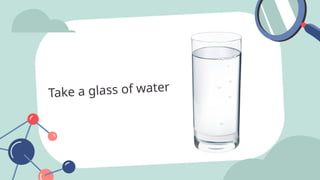
Take a glass of water
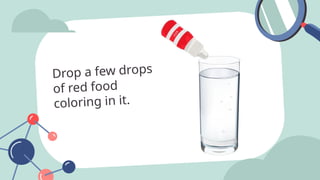
Drop a few drops
of red food
coloring in it.
• What happens?
• Why does this happen?
KINETIC
MOLECULAR
THEORY
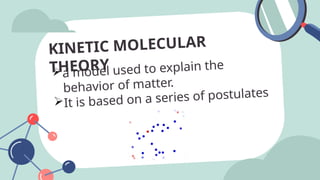
a model used to explain the
behavior of matter.
It is based on a series of postulates
KINETIC MOLECULAR
THEORY
 Matter is made of particles that are
constantly in motion. This energy
in motion is called kinetic energy.
 The amount of kinetic energy in a
substance is related to its
temperature.
Some of the postulates of KMT are as follows:
 There is space between particles.
The amount of space in between
particles is related to the
substance's state of matter.
 Phase changes happen when the
temperature of the substance
changes sufficiently.
Some of the postulates of KMT are as follows:
 There are attractive forces in
between particles called
intermolecular forces. The
strength of these forces increase
as particles get closer together.
Some of the postulates of KMT are as follows:
TWO KINDS OF FORCES OR ATTRACTIONS
THAT OPERATE IN A MOLECULE
INTRAMOLECULAR INTERMOLECULAR
forces that hold atoms
together within a
molecule
forces that exist
between molecules.
What is an
Intermolecular
Force? (IMF)
the attractive and repulsive forces
that arise between the molecules of
a substance.
forces that hold atoms together
within a molecule.
INTERMOLECULAR FORCES
(IMF)
Molecules compose two or more
atoms connected by a chemical bonds
are relatively weaker than the forces
within the molecules forming bonds
(intramolecular forces)
INTERMOLECULAR FORCES
(IMF)
Intermolecular forces are
accountable for the properties
of substances.
It explains why substance exist
as solid, liquid or gasses at
room temperature.
INTERMOLECULAR FORCES
(IMF)
4 Types of
Intermolecular
forcesLondon-
Dispersion
Interaction
Dipole-dipole
Interaction
Ion-dipole
Interaction Hydrogen Bonding
Van Der Waals Forces
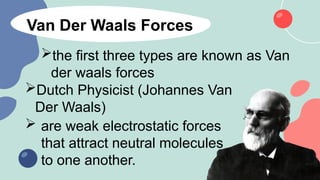
the first three types are known as Van
der waals forces
Dutch Physicist (Johannes Van
Der Waals)
 are weak electrostatic forces
that attract neutral molecules
to one another.
GENERAL TYPES
OF
INTERMOLECULA
R FORCES
1) DIPOLE-DIPOLE INTERACTION
 Are attracting forces existing between polar
molecules.
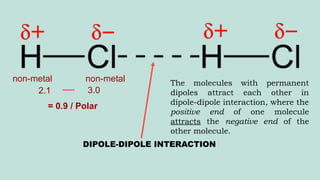
 In polar molecules like HCl, the dipole-dipole
interaction is the force of attraction.
 DIPOLE refers to the unequal sharing of
electrons between Hydrogen and Chlorine
atoms in HCl, which results in a partially
positive pole in H and a partially negative
pole in Cl.
DIPOLE-DIPOLE INTERACTION
non-metal non-metal
2.1 3.0
= 0.9 / Polar
The molecules with permanent
dipoles attract each other in
dipole-dipole interaction, where the
positive end of one molecule
attracts the negative end of the
other molecule.
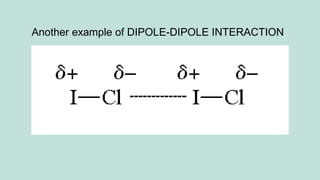
Another example of DIPOLE-DIPOLE INTERACTION
BIG
IDEA
Dipole-dipole interaction
results between two polar
molecules. Since a polar
molecule has a partial
positive and partial negative
side, these are attracted to
each other.
2) ION-DIPOLE INTERACTION
The intermolecular force attraction
between a charge ion (cation or
anion) and a polar molecule.
2) ION DIPOLE INTERACTION
 When NaCl dissolves in water, it splits into two
ions: Na+ and Cl-. Water has a partial positive
and partial negative end because it is a polar
molecule. Thus, the partially negative end of the
water molecule will be attracted to the Na+ ion,
while the partially positive end of the water
molecule will be attracted by the Cl- ion from the
NaCl molecule.
BIG
IDEA
Ion dipole interaction exist
between ions (charged
atoms) with polar molecules.
The partial positive charge of
a polar molecule is attracted
to an ion and its partial
negative can be attracted to a
cation
3) LONDON-DISPERSION INTERACTION
This intermolecular force of attraction
can be found in all molecules.
It is the weakest intermolecular force
created by a non-polar molecule's
transient dipoles.
As the molecular weight of the
substance increases, so does the
strength of the dispersion forces.
3) LONDON-DISPERSION INTERACTION
The more electrons a molecule has, the stronger the
London dispersion forces are. For example, bromine
has more electrons than chlorine, so bromine will
have stronger London dispersion forces than chlorine,
resulting in a higher boiling point for bromine,
compared to chlorine.
BIG
IDEA
Not all the weakest are entirely useless.
Although not considered to be strong
intermolecular force. London
Dispersion force allows nonpolar
substances to condense into liquids and
to freeze into solids when temperature
is sufficiently lowered.
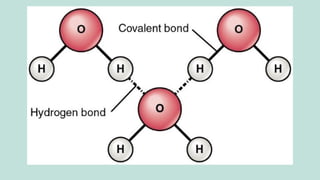
4) HYDROGEN BOND
Hydrogen bond is the link that exists between
water molecules.
It is a type of dipole-dipole interaction
between the polar molecule Hydrogen and
the highly electronegative elements Fluorine,
Oxygen, and Nitrogen. The extremely
electronegative elements F, O, and N cause
hydrogen to become strongly positive in a
hydrogen bond.
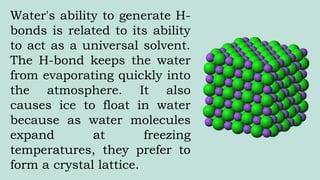
Water's ability to generate H-
bonds is related to its ability
to act as a universal solvent.
The H-bond keeps the water
from evaporating quickly into
the atmosphere. It also
causes ice to float in water
because as water molecules
expand at freezing
temperatures, they prefer to
form a crystal lattice.
Rank each
intermolecular force in
the order from the
strongest to the
weakest.
_____Dipole-Dipole force
_____Hydrogen bond
_____London Dispersion Force
The types of intermolecular forces
in a liquid depend on the chemical
make up of the liquid itself.
Strength of intermolecular force is
related to the type of intermolecular
force, but it is also affected by the
amount of kinetic energy in the
substance. The more kinetic
energy, the weaker the
intermolecular forces.
Liquids have more kinetic
energy than solids, so the
intermolecular forces between
liquid particles tend to be
weaker. Liquids do not have a
simple or regular structure,
but many of their properties
can be explained qualitatively
by viewing them at the
particulate level.
ACTIVITY: INTERMOLECULAR
FORCES
Direction: Identify the possible intermolecular force
attraction in the following pairs of molecule:
1) NaCl ------ H2O
2) NH3 ------ NH3
3) H2S ------- H2S
4) O2 ------- O2
5) HCl ------ HCl
6) CH3OH ------ CH3OH
7) H2 ---------- H2
8) Na2S ------ HCl
9) Br2 ------- Br2
10) H2O ----- H2O
ESSAY
1) Why can salt (NaCl) be dissolved in water?
What intermolecular force attraction (IMF)
is present between salt and water?
2) Why is a hydrogen bond considered as the
strongest among the intermolecular force?
PROPERTIES OF
LIQUIDS AND THEIR
INTERMOLECULAR
FORCES
EFFECTS OF
INTERMOLECULAR
FORCES ON THE
PROPERTIES OF
SUSBTANCES
WHAT I
AM
I am a state of matter. I have my
own volume, but I take the shape
of the container I am in. Oil is an
example.
What am I?
I happen to some substances,
such as salt, when they are mixed
with a liquid. I happen faster in
warm liquids.
What am I?
I am the small particles of
matter in all solids, liquids and
gases.
What am I?
PROPERTIES OF LIQUIDS AND THEIR INTERMOLECULAR FORCES
SURFACE TENSION
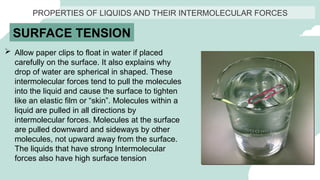
 Allow paper clips to float in water if placed
carefully on the surface. It also explains why
drop of water are spherical in shaped. These
intermolecular forces tend to pull the molecules
into the liquid and cause the surface to tighten
like an elastic film or “skin”. Molecules within a
liquid are pulled in all directions by
intermolecular forces. Molecules at the surface
are pulled downward and sideways by other
molecules, not upward away from the surface.
The liquids that have strong Intermolecular
forces also have high surface tension
PROPERTIES OF LIQUIDS AND THEIR INTERMOLECULAR FORCES
SURFACE TENSION
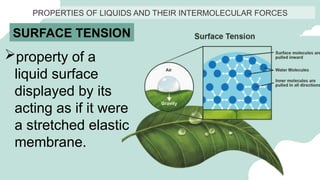
property of a
liquid surface
displayed by its
acting as if it were
a stretched elastic
membrane.
PROPERTIES OF LIQUIDS AND THEIR INTERMOLECULAR FORCES
CAPILLARY ACTION
CAPILLARY ACTION is an example of a
surface tension.
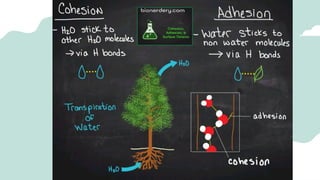
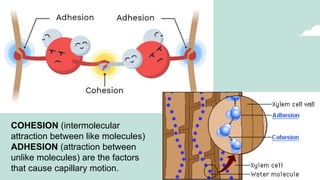
COHESION (intermolecular
attraction between like molecules)
ADHESION (attraction between
unlike molecules) are the factors
that cause capillary motion.
The higher the
surface tension of a
substance, the
stronger the
intermolecular
forces between
molecules.
●List five (5) examples
of surface tension and
explain briefly.
SEATWORK:
PROPERTIES OF LIQUIDS AND THEIR INTERMOLECULAR FORCES
VISCOSITY
a measurement of a liquid's flow resistance.
The viscosity of a liquid determines how slowly it
flows.
Because the viscosity of substances diminishes at
high temperatures like syrup flows more quickly
when it's heated.
PROPERTIES OF LIQUIDS AND THEIR INTERMOLECULAR FORCES
VISCOSITY
The viscosity of liquid depends on their
intermolecular attraction. The stronger
the intermolecular force, the higher is
the liquid’s viscosity.
PROPERTIES OF LIQUIDS AND THEIR INTERMOLECULAR FORCES
BOILING POINT
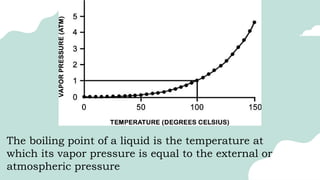
The equilibrium vapor pressure exerted by
the liquid or solid above it determines the
boiling point.
A measure of the tendency of a
material to change into the
gaseous or vapor state
The boiling point of a liquid is the temperature at
which its vapor pressure is equal to the external or
atmospheric pressure
PROPERTIES OF LIQUIDS AND THEIR INTERMOLECULAR FORCES
BOILING POINT
Increasing the temperature of a liquid raises the
kinetic energy of its molecules, until such point
where the energy of the particle movement
exceeds the intermolecular forces that hold them
together. The greater intermolecular force, the
higher the energy needed to increase the kinetic
energy of the molecules to break these forces.
PROPERTIES OF
SOLIDS AND
THEIR
INTERMOLECUL
AR FORCES
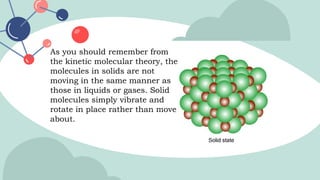
As you should remember from
the kinetic molecular theory, the
molecules in solids are not
moving in the same manner as
those in liquids or gases. Solid
molecules simply vibrate and
rotate in place rather than move
about.
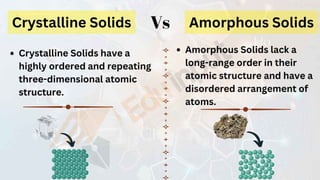
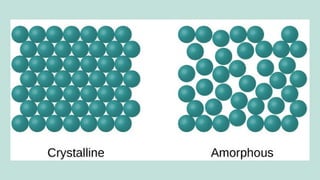
Two main categories of
solids
A) CRYSTALLINE SOLID
B) AMORPHOUS SOLID
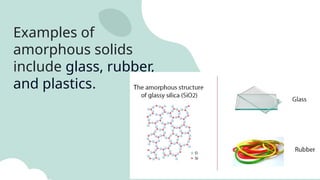
Examples of
amorphous solids
include glass, rubber,
and plastics.
1. IONIC SOLID
FOUR TYPES OF CRYSTALLINE
SOLIDS
Made up of positive and negative ions
and held together by electrostatic
attractions. They’re characterized by
very high melting points and
brittleness and are poor conductors in
the solid state. An example of an ionic
solid is table salt, NaCl.
2. MOLECULAR SOLID
FOUR TYPES OF CRYSTALLINE
SOLIDS
Made up of atoms or molecules held
together by London dispersion forces,
dipole-dipole forces, or hydrogen
bonds. Characterized by low melting
points and flexibility and are poor
conductors. An example of a
molecular solid is sucrose.
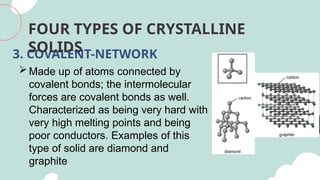
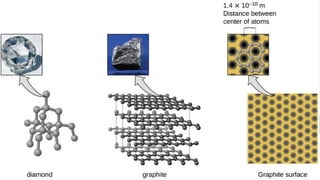
3. COVALENT-NETWORK
FOUR TYPES OF CRYSTALLINE
SOLIDS
Made up of atoms connected by
covalent bonds; the intermolecular
forces are covalent bonds as well.
Characterized as being very hard with
very high melting points and being
poor conductors. Examples of this
type of solid are diamond and
graphite
4. METALLIC SOLID
FOUR TYPES OF CRYSTALLINE
SOLIDS
Metallic solids are a type of crystalline
solid, so their structure is arranged in
a crystal lattice. In metallic solids, the
crystal lattice consists of positive ions
and free-flowing electrons that are
also known as a "sea" of delocalized
electrons. Copper as metallic solid
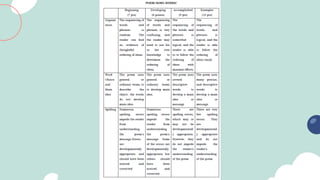
“The Scientist Got Talent”
PERFORMANCE TASK 1
Compose a poem or a song (indicate the tune), at
least 2 stanzas having four lines, showing or
applying the concepts about Kinetic Molecular
Theory or intermolecular force and bonding.
1. Kinetic Molecular Model and Intermolecular forces

1. Kinetic Molecular Model and Intermolecular forces

  • 1.
    KINETIC MOLECULAR MODEL Prepared by: JAYJAY C. MILO GENERAL CHEMISTRY II (2nd Semester
  • 2.
    MOST ESSENTIAL LEARNING COMPETENCIES Use the kinetic molecular model to explain properties of liquids and solid STEM_GC11IMFIIIa-c-99)  Describe and differentiate the types of intermolecular forces (STEM_GC11IMFIIIa-c-100)
  • 3.
    Learning Objectives: 01 describekinetic molecular theory 02 03 Identify the four intermolecular forces Differentiate the properties of liquids such as surface tension, capillary action, viscosity, boiling point and molar heat of vaporization.
  • 4.
    Take a glassof water
  • 5.
    Drop a fewdrops of red food coloring in it.
  • 6.
    • What happens? •Why does this happen?
  • 7.
  • 8.
    a model usedto explain the behavior of matter. It is based on a series of postulates KINETIC MOLECULAR THEORY
  • 9.
     Matter ismade of particles that are constantly in motion. This energy in motion is called kinetic energy.  The amount of kinetic energy in a substance is related to its temperature. Some of the postulates of KMT are as follows:
  • 10.
     There isspace between particles. The amount of space in between particles is related to the substance's state of matter.  Phase changes happen when the temperature of the substance changes sufficiently. Some of the postulates of KMT are as follows:
  • 11.
     There areattractive forces in between particles called intermolecular forces. The strength of these forces increase as particles get closer together. Some of the postulates of KMT are as follows:
  • 12.
    TWO KINDS OFFORCES OR ATTRACTIONS THAT OPERATE IN A MOLECULE INTRAMOLECULAR INTERMOLECULAR forces that hold atoms together within a molecule forces that exist between molecules.
  • 13.
  • 14.
    the attractive andrepulsive forces that arise between the molecules of a substance. forces that hold atoms together within a molecule. INTERMOLECULAR FORCES (IMF) Molecules compose two or more atoms connected by a chemical bonds
  • 16.
    are relatively weakerthan the forces within the molecules forming bonds (intramolecular forces) INTERMOLECULAR FORCES (IMF)
  • 17.
    Intermolecular forces are accountablefor the properties of substances. It explains why substance exist as solid, liquid or gasses at room temperature. INTERMOLECULAR FORCES (IMF)
  • 18.
  • 19.
    Van Der WaalsForces the first three types are known as Van der waals forces Dutch Physicist (Johannes Van Der Waals)  are weak electrostatic forces that attract neutral molecules to one another.
  • 20.
  • 21.
    1) DIPOLE-DIPOLE INTERACTION Are attracting forces existing between polar molecules.  In polar molecules like HCl, the dipole-dipole interaction is the force of attraction.  DIPOLE refers to the unequal sharing of electrons between Hydrogen and Chlorine atoms in HCl, which results in a partially positive pole in H and a partially negative pole in Cl.
  • 22.
    DIPOLE-DIPOLE INTERACTION non-metal non-metal 2.13.0 = 0.9 / Polar The molecules with permanent dipoles attract each other in dipole-dipole interaction, where the positive end of one molecule attracts the negative end of the other molecule.
  • 23.
    Another example ofDIPOLE-DIPOLE INTERACTION
  • 24.
    BIG IDEA Dipole-dipole interaction results betweentwo polar molecules. Since a polar molecule has a partial positive and partial negative side, these are attracted to each other.
  • 25.
    2) ION-DIPOLE INTERACTION Theintermolecular force attraction between a charge ion (cation or anion) and a polar molecule.
  • 28.
    2) ION DIPOLEINTERACTION  When NaCl dissolves in water, it splits into two ions: Na+ and Cl-. Water has a partial positive and partial negative end because it is a polar molecule. Thus, the partially negative end of the water molecule will be attracted to the Na+ ion, while the partially positive end of the water molecule will be attracted by the Cl- ion from the NaCl molecule.
  • 29.
    BIG IDEA Ion dipole interactionexist between ions (charged atoms) with polar molecules. The partial positive charge of a polar molecule is attracted to an ion and its partial negative can be attracted to a cation
  • 30.
    3) LONDON-DISPERSION INTERACTION Thisintermolecular force of attraction can be found in all molecules. It is the weakest intermolecular force created by a non-polar molecule's transient dipoles. As the molecular weight of the substance increases, so does the strength of the dispersion forces.
  • 32.
    3) LONDON-DISPERSION INTERACTION Themore electrons a molecule has, the stronger the London dispersion forces are. For example, bromine has more electrons than chlorine, so bromine will have stronger London dispersion forces than chlorine, resulting in a higher boiling point for bromine, compared to chlorine.
  • 33.
    BIG IDEA Not all theweakest are entirely useless. Although not considered to be strong intermolecular force. London Dispersion force allows nonpolar substances to condense into liquids and to freeze into solids when temperature is sufficiently lowered.
  • 34.
    4) HYDROGEN BOND Hydrogenbond is the link that exists between water molecules. It is a type of dipole-dipole interaction between the polar molecule Hydrogen and the highly electronegative elements Fluorine, Oxygen, and Nitrogen. The extremely electronegative elements F, O, and N cause hydrogen to become strongly positive in a hydrogen bond.
  • 36.
    Water's ability togenerate H- bonds is related to its ability to act as a universal solvent. The H-bond keeps the water from evaporating quickly into the atmosphere. It also causes ice to float in water because as water molecules expand at freezing temperatures, they prefer to form a crystal lattice.
  • 37.
    Rank each intermolecular forcein the order from the strongest to the weakest. _____Dipole-Dipole force _____Hydrogen bond _____London Dispersion Force
  • 38.
    The types ofintermolecular forces in a liquid depend on the chemical make up of the liquid itself. Strength of intermolecular force is related to the type of intermolecular force, but it is also affected by the amount of kinetic energy in the substance. The more kinetic energy, the weaker the intermolecular forces.
  • 39.
    Liquids have morekinetic energy than solids, so the intermolecular forces between liquid particles tend to be weaker. Liquids do not have a simple or regular structure, but many of their properties can be explained qualitatively by viewing them at the particulate level.
  • 40.
    ACTIVITY: INTERMOLECULAR FORCES Direction: Identifythe possible intermolecular force attraction in the following pairs of molecule: 1) NaCl ------ H2O 2) NH3 ------ NH3 3) H2S ------- H2S 4) O2 ------- O2 5) HCl ------ HCl 6) CH3OH ------ CH3OH 7) H2 ---------- H2 8) Na2S ------ HCl 9) Br2 ------- Br2 10) H2O ----- H2O
  • 41.
    ESSAY 1) Why cansalt (NaCl) be dissolved in water? What intermolecular force attraction (IMF) is present between salt and water? 2) Why is a hydrogen bond considered as the strongest among the intermolecular force?
  • 42.
    PROPERTIES OF LIQUIDS ANDTHEIR INTERMOLECULAR FORCES
  • 43.
    EFFECTS OF INTERMOLECULAR FORCES ONTHE PROPERTIES OF SUSBTANCES
  • 44.
  • 45.
    I am astate of matter. I have my own volume, but I take the shape of the container I am in. Oil is an example. What am I?
  • 46.
    I happen tosome substances, such as salt, when they are mixed with a liquid. I happen faster in warm liquids. What am I?
  • 47.
    I am thesmall particles of matter in all solids, liquids and gases. What am I?
  • 48.
    PROPERTIES OF LIQUIDSAND THEIR INTERMOLECULAR FORCES SURFACE TENSION  Allow paper clips to float in water if placed carefully on the surface. It also explains why drop of water are spherical in shaped. These intermolecular forces tend to pull the molecules into the liquid and cause the surface to tighten like an elastic film or “skin”. Molecules within a liquid are pulled in all directions by intermolecular forces. Molecules at the surface are pulled downward and sideways by other molecules, not upward away from the surface. The liquids that have strong Intermolecular forces also have high surface tension
  • 49.
    PROPERTIES OF LIQUIDSAND THEIR INTERMOLECULAR FORCES SURFACE TENSION property of a liquid surface displayed by its acting as if it were a stretched elastic membrane.
  • 52.
    PROPERTIES OF LIQUIDSAND THEIR INTERMOLECULAR FORCES CAPILLARY ACTION CAPILLARY ACTION is an example of a surface tension.
  • 54.
    COHESION (intermolecular attraction betweenlike molecules) ADHESION (attraction between unlike molecules) are the factors that cause capillary motion.
  • 56.
    The higher the surfacetension of a substance, the stronger the intermolecular forces between molecules.
  • 57.
    ●List five (5)examples of surface tension and explain briefly. SEATWORK:
  • 58.
    PROPERTIES OF LIQUIDSAND THEIR INTERMOLECULAR FORCES VISCOSITY a measurement of a liquid's flow resistance. The viscosity of a liquid determines how slowly it flows. Because the viscosity of substances diminishes at high temperatures like syrup flows more quickly when it's heated.
  • 59.
    PROPERTIES OF LIQUIDSAND THEIR INTERMOLECULAR FORCES VISCOSITY The viscosity of liquid depends on their intermolecular attraction. The stronger the intermolecular force, the higher is the liquid’s viscosity.
  • 60.
    PROPERTIES OF LIQUIDSAND THEIR INTERMOLECULAR FORCES BOILING POINT The equilibrium vapor pressure exerted by the liquid or solid above it determines the boiling point. A measure of the tendency of a material to change into the gaseous or vapor state
  • 61.
    The boiling pointof a liquid is the temperature at which its vapor pressure is equal to the external or atmospheric pressure
  • 62.
    PROPERTIES OF LIQUIDSAND THEIR INTERMOLECULAR FORCES BOILING POINT Increasing the temperature of a liquid raises the kinetic energy of its molecules, until such point where the energy of the particle movement exceeds the intermolecular forces that hold them together. The greater intermolecular force, the higher the energy needed to increase the kinetic energy of the molecules to break these forces.
  • 63.
  • 64.
    As you shouldremember from the kinetic molecular theory, the molecules in solids are not moving in the same manner as those in liquids or gases. Solid molecules simply vibrate and rotate in place rather than move about.
  • 65.
    Two main categoriesof solids A) CRYSTALLINE SOLID B) AMORPHOUS SOLID
  • 68.
    Examples of amorphous solids includeglass, rubber, and plastics.
  • 69.
    1. IONIC SOLID FOURTYPES OF CRYSTALLINE SOLIDS Made up of positive and negative ions and held together by electrostatic attractions. They’re characterized by very high melting points and brittleness and are poor conductors in the solid state. An example of an ionic solid is table salt, NaCl.
  • 70.
    2. MOLECULAR SOLID FOURTYPES OF CRYSTALLINE SOLIDS Made up of atoms or molecules held together by London dispersion forces, dipole-dipole forces, or hydrogen bonds. Characterized by low melting points and flexibility and are poor conductors. An example of a molecular solid is sucrose.
  • 71.
    3. COVALENT-NETWORK FOUR TYPESOF CRYSTALLINE SOLIDS Made up of atoms connected by covalent bonds; the intermolecular forces are covalent bonds as well. Characterized as being very hard with very high melting points and being poor conductors. Examples of this type of solid are diamond and graphite
  • 73.
    4. METALLIC SOLID FOURTYPES OF CRYSTALLINE SOLIDS Metallic solids are a type of crystalline solid, so their structure is arranged in a crystal lattice. In metallic solids, the crystal lattice consists of positive ions and free-flowing electrons that are also known as a "sea" of delocalized electrons. Copper as metallic solid
  • 75.
    “The Scientist GotTalent” PERFORMANCE TASK 1 Compose a poem or a song (indicate the tune), at least 2 stanzas having four lines, showing or applying the concepts about Kinetic Molecular Theory or intermolecular force and bonding.

Editor's Notes