Presentation on-
Intermediate Accounting
Presentation on Intermediate
Accounting
Prepared by,
“Creative Crew”
Rahat
131-116-051
BBA 29th
Metropolitan University, Sylhet
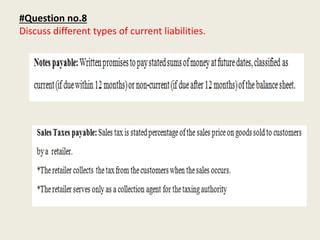
#Question no.8
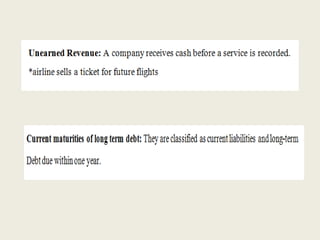
Discuss different types of current liabilities.
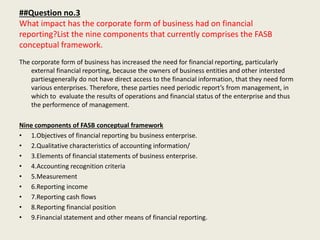
##Question no.3
What impact has the corporate form of business had on financial
reporting?List the nine components that currently comprises the FASB
conceptual framework.
The corporate form of business has increased the need for financial reporting, particularly
external financial reporting, because the owners of business entities and other intersted
partiesgenerally do not have direct access to the financial information, that they need form
various enterprises. Therefore, these parties need periodic report’s from management, in
which to evaluate the results of operations and financial status of the enterprise and thus
the performence of management.
Nine components of FASB conceptual framework
• 1.Objectives of financial reporting bu business enterprise.
• 2.Qualitative characteristics of accounting information/
• 3.Elements of financial statements of business enterprise.
• 4.Accounting recognition criteria
• 5.Measurement
• 6.Reporting income
• 7.Reporting cash flows
• 8.Reporting financial position
• 9.Financial statement and other means of financial reporting.
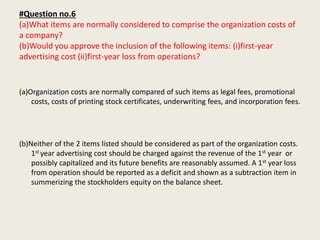
#Question no.6
(a)What items are normally considered to comprise the organization costs of
a company?
(b)Would you approve the inclusion of the following items: (i)first-year
advertising cost (ii)first-year loss from operations?
(a)Organization costs are normally compared of such items as legal fees, promotional
costs, costs of printing stock certificates, underwriting fees, and incorporation fees.
(b)Neither of the 2 items listed should be considered as part of the organization costs.
1st year advertising cost should be charged against the revenue of the 1st year or
possibly capitalized and its future benefits are reasonably assumed. A 1st year loss
from operation should be reported as a deficit and shown as a subtraction item in
summerizing the stockholders equity on the balance sheet.
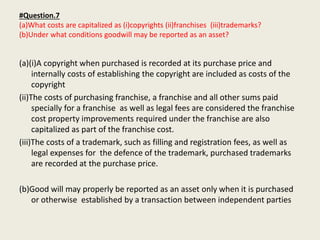
#Question.7
(a)What costs are capitalized as (i)copyrights (ii)franchises (iii)trademarks?
(b)Under what conditions goodwill may be reported as an asset?
(a)(i)A copyright when purchased is recorded at its purchase price and
internally costs of establishing the copyright are included as costs of the
copyright
(ii)The costs of purchasing franchise, a franchise and all other sums paid
specially for a franchise as well as legal fees are considered the franchise
cost property improvements required under the franchise are also
capitalized as part of the franchise cost.
(iii)The costs of a trademark, such as filling and registration fees, as well as
legal expenses for the defence of the trademark, purchased trademarks
are recorded at the purchase price.
(b)Good will may properly be reported as an asset only when it is purchased
or otherwise established by a transaction between independent parties
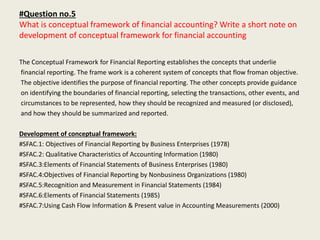
#Question no.5
What is conceptual framework of financial accounting? Write a short note on
development of conceptual framework for financial accounting
The Conceptual Framework for Financial Reporting establishes the concepts that underlie
financial reporting. The frame work is a coherent system of concepts that flow froman objective.
The objective identifies the purpose of financial reporting. The other concepts provide guidance
on identifying the boundaries of financial reporting, selecting the transactions, other events, and
circumstances to be represented, how they should be recognized and measured (or disclosed),
and how they should be summarized and reported.
Development of conceptual framework:
#SFAC.1: Objectives of Financial Reporting by Business Enterprises (1978)
#SFAC.2: Qualitative Characteristics of Accounting Information (1980)
#SFAC.3:Elements of Financial Statements of Business Enterprises (1980)
#SFAC.4:Objectives of Financial Reporting by Nonbusiness Organizations (1980)
#SFAC.5:Recognition and Measurement in Financial Statements (1984)
#SFAC.6:Elements of Financial Statements (1985)
#SFAC.7:Using Cash Flow Information & Present value in Accounting Measurements (2000)
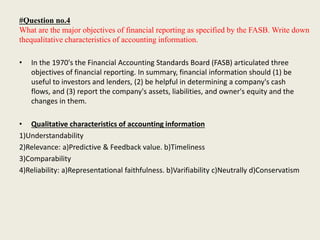
• In the 1970's the Financial Accounting Standards Board (FASB) articulated three
objectives of financial reporting. In summary, financial information should (1) be
useful to investors and lenders, (2) be helpful in determining a company's cash
flows, and (3) report the company's assets, liabilities, and owner's equity and the
changes in them.
• Qualitative characteristics of accounting information
1)Understandability
2)Relevance: a)Predictive & Feedback value. b)Timeliness
3)Comparability
4)Reliability: a)Representational faithfulness. b)Varifiability c)Neutrally d)Conservatism
#Question no.4
What are the major objectives of financial reporting as specified by the FASB. Write down
thequalitative characteristics of accounting information.

Intermediate accounting

  • 1.
  • 2.
    Presentation on Intermediate Accounting Preparedby, “Creative Crew” Rahat 131-116-051 BBA 29th Metropolitan University, Sylhet
  • 3.
    #Question no.8 Discuss differenttypes of current liabilities.
  • 5.
    ##Question no.3 What impacthas the corporate form of business had on financial reporting?List the nine components that currently comprises the FASB conceptual framework. The corporate form of business has increased the need for financial reporting, particularly external financial reporting, because the owners of business entities and other intersted partiesgenerally do not have direct access to the financial information, that they need form various enterprises. Therefore, these parties need periodic report’s from management, in which to evaluate the results of operations and financial status of the enterprise and thus the performence of management. Nine components of FASB conceptual framework • 1.Objectives of financial reporting bu business enterprise. • 2.Qualitative characteristics of accounting information/ • 3.Elements of financial statements of business enterprise. • 4.Accounting recognition criteria • 5.Measurement • 6.Reporting income • 7.Reporting cash flows • 8.Reporting financial position • 9.Financial statement and other means of financial reporting.
  • 6.
    #Question no.6 (a)What itemsare normally considered to comprise the organization costs of a company? (b)Would you approve the inclusion of the following items: (i)first-year advertising cost (ii)first-year loss from operations? (a)Organization costs are normally compared of such items as legal fees, promotional costs, costs of printing stock certificates, underwriting fees, and incorporation fees. (b)Neither of the 2 items listed should be considered as part of the organization costs. 1st year advertising cost should be charged against the revenue of the 1st year or possibly capitalized and its future benefits are reasonably assumed. A 1st year loss from operation should be reported as a deficit and shown as a subtraction item in summerizing the stockholders equity on the balance sheet.
  • 7.
    #Question.7 (a)What costs arecapitalized as (i)copyrights (ii)franchises (iii)trademarks? (b)Under what conditions goodwill may be reported as an asset? (a)(i)A copyright when purchased is recorded at its purchase price and internally costs of establishing the copyright are included as costs of the copyright (ii)The costs of purchasing franchise, a franchise and all other sums paid specially for a franchise as well as legal fees are considered the franchise cost property improvements required under the franchise are also capitalized as part of the franchise cost. (iii)The costs of a trademark, such as filling and registration fees, as well as legal expenses for the defence of the trademark, purchased trademarks are recorded at the purchase price. (b)Good will may properly be reported as an asset only when it is purchased or otherwise established by a transaction between independent parties
  • 8.
    #Question no.5 What isconceptual framework of financial accounting? Write a short note on development of conceptual framework for financial accounting The Conceptual Framework for Financial Reporting establishes the concepts that underlie financial reporting. The frame work is a coherent system of concepts that flow froman objective. The objective identifies the purpose of financial reporting. The other concepts provide guidance on identifying the boundaries of financial reporting, selecting the transactions, other events, and circumstances to be represented, how they should be recognized and measured (or disclosed), and how they should be summarized and reported. Development of conceptual framework: #SFAC.1: Objectives of Financial Reporting by Business Enterprises (1978) #SFAC.2: Qualitative Characteristics of Accounting Information (1980) #SFAC.3:Elements of Financial Statements of Business Enterprises (1980) #SFAC.4:Objectives of Financial Reporting by Nonbusiness Organizations (1980) #SFAC.5:Recognition and Measurement in Financial Statements (1984) #SFAC.6:Elements of Financial Statements (1985) #SFAC.7:Using Cash Flow Information & Present value in Accounting Measurements (2000)
  • 9.
    • In the1970's the Financial Accounting Standards Board (FASB) articulated three objectives of financial reporting. In summary, financial information should (1) be useful to investors and lenders, (2) be helpful in determining a company's cash flows, and (3) report the company's assets, liabilities, and owner's equity and the changes in them. • Qualitative characteristics of accounting information 1)Understandability 2)Relevance: a)Predictive & Feedback value. b)Timeliness 3)Comparability 4)Reliability: a)Representational faithfulness. b)Varifiability c)Neutrally d)Conservatism #Question no.4 What are the major objectives of financial reporting as specified by the FASB. Write down thequalitative characteristics of accounting information.