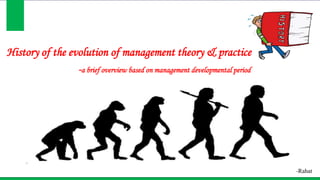





History of the evolution of management theory & practice
-a brief overview based on management developmental period
-Rahat
Acknowledgment
Preparing this assignment appeared to be a great experience to me. It gave me very
important knowledge about management and its development history. I would like to
give a lot of thanks to our honorable course teacher, Md. Jamal Uddin for giving me
a wonderful opportunity to make such an interesting and valuable assignment and
giving all of us a clear concept about the assignment.
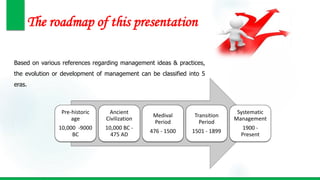
The roadmap of this presentation
Pre-historic
age
10,000 -9000
BC
Ancient
Civilization
10,000 BC -
475 AD
Medival
Period
476 - 1500
Transition
Period
1501 - 1899
Systematic
Management
1900 -
Present
Based on various references regarding management ideas & practices,
the evolution or development of management can be classified into 5
eras.
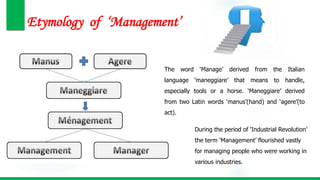
Etymology of ‘Management’
The word ‘Manage’ derived from the Italian
language ‘maneggiare’ that means to handle,
especially tools or a horse. ‘Maneggiare’ derived
from two Latin words ‘manus’(hand) and ‘agere’(to
act).
During the period of ‘Industrial Revolution’
the term ‘Management’ flourished vastly
for managing people who were working in
various industries.
Concept about ‘Management’
Management is actually ‘managing the situation’
Management in all business and organizations is the act of getting people
together to accomplish goals and objectives by using available resources
efficiently and effectively.
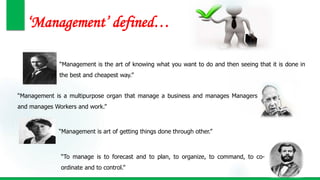
‘Management’ defined…
“Management is the art of knowing what you want to do and then seeing that it is done in
the best and cheapest way.”
“Management is a multipurpose organ that manage a business and manages Managers
and manages Workers and work.”
“To manage is to forecast and to plan, to organize, to command, to co-
ordinate and to control.”
“Management is art of getting things done through other.”
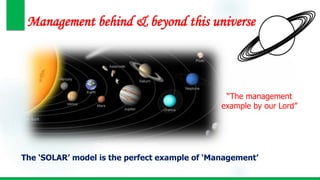
Management behind & beyond this universe
The ‘SOLAR’ model is the perfect example of ‘Management’
“The management
example by our Lord”
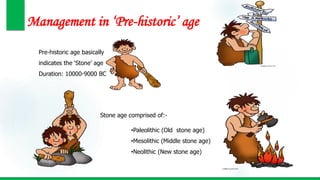
Management in ‘Pre-historic’ age
Pre-historic age basically
indicates the ‘Stone’ age
Duration: 10000-9000 BC
Stone age comprised of:-
•Paleolithic (Old stone age)
•Mesolithic (Middle stone age)
•Neolithic (New stone age)
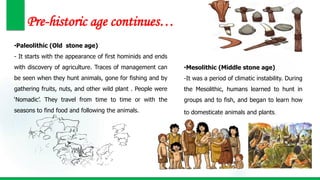
Pre-historic age continues…
•Paleolithic (Old stone age)
- It starts with the appearance of first hominids and ends
with discovery of agriculture. Traces of management can
be seen when they hunt animals, gone for fishing and by
gathering fruits, nuts, and other wild plant . People were
‘Nomadic’. They travel from time to time or with the
seasons to find food and following the animals.
•Mesolithic (Middle stone age)
-It was a period of climatic instability. During
the Mesolithic, humans learned to hunt in
groups and to fish, and began to learn how
to domesticate animals and plants.
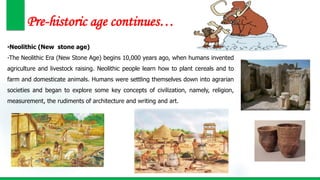
Pre-historic age continues…
•Neolithic (New stone age)
-The Neolithic Era (New Stone Age) begins 10,000 years ago, when humans invented
agriculture and livestock raising. Neolithic people learn how to plant cereals and to
farm and domesticate animals. Humans were settling themselves down into agrarian
societies and began to explore some key concepts of civilization, namely, religion,
measurement, the rudiments of architecture and writing and art.
Management in ancient civilization
Management also has been practiced during ancient civilization.
This period existed between 10,000-4,75 AD. Some of the most
interesting examples are-
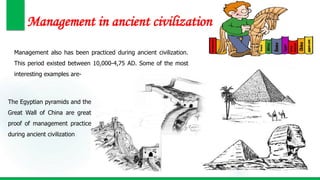
The Egyptian pyramids and the
Great Wall of China are great
proof of management practice
during ancient civilization
Continues…
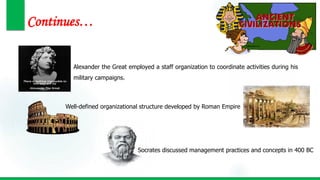
Alexander the Great employed a staff organization to coordinate activities during his
military campaigns.
Well-defined organizational structure developed by Roman Empire
Socrates discussed management practices and concepts in 400 BC
Continues…
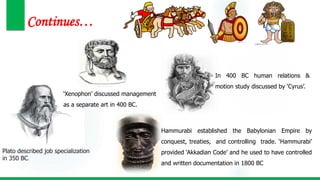
Plato described job specialization
in 350 BC.
‘Xenophon’ discussed management
as a separate art in 400 BC.
In 400 BC human relations &
motion study discussed by ‘Cyrus’.
Hammurabi established the Babylonian Empire by
conquest, treaties, and controlling trade. ‘Hammurabi’
provided ‘Akkadian Code’ and he used to have controlled
and written documentation in 1800 BC
Continues…
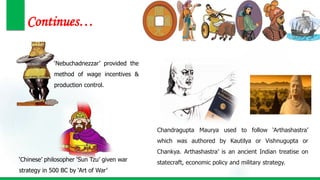
‘Nebuchadnezzar’ provided the
method of wage incentives &
production control.
‘Chinese’ philosopher ‘Sun Tzu’ given war
strategy in 500 BC by ‘Art of War’
Chandragupta Maurya used to follow ‘Arthashastra’
which was authored by Kautilya or Vishnugupta or
Chankya. Arthashastra’ is an ancient Indian treatise on
statecraft, economic policy and military strategy.
Continues…
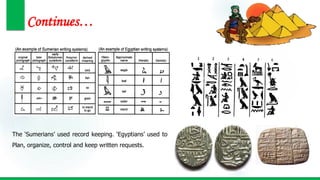
The ‘Sumerians’ used record keeping. ‘Egyptians’ used to
Plan, organize, control and keep written requests.
Management during medieval period
Medieval period is regarded as ‘Era of darkness’. This time frame for this
era is 476-1500. Practice and traces of management also can be seen is
this period. Some of the examples are:
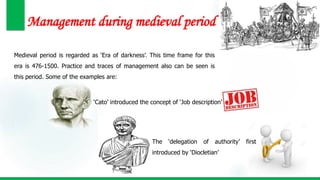
‘Cato’ introduced the concept of ‘Job description’
The ‘delegation of authority’ first
introduced by ‘Diocletian’
Medieval period continues…
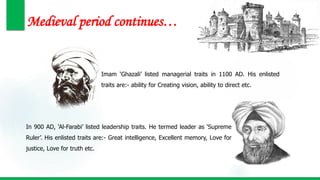
In 900 AD, ‘Al-Farabi’ listed leadership traits. He termed leader as ‘Supreme
Ruler’. His enlisted traits are:- Great intelligence, Excellent memory, Love for
justice, Love for truth etc.
Imam ‘Ghazali’ listed managerial traits in 1100 AD. His enlisted
traits are:- ability for Creating vision, ability to direct etc.
Medieval period continues…
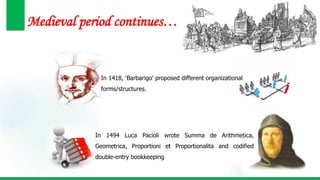
In 1418, ‘Barbarigo’ proposed different organizational
forms/structures.
In 1494 Luca Pacioli wrote Summa de Arithmetica,
Geometrica, Proportioni et Proportionalita and codified
double-entry bookkeeping
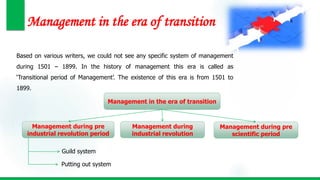
Management in the era of transition
Based on various writers, we could not see any specific system of management
during 1501 – 1899. In the history of management this era is called as
‘Transitional period of Management’. The existence of this era is from 1501 to
1899.
Management in the era of transition
Management during pre
industrial revolution period
Management during
industrial revolution
Management during pre
scientific period
Guild system
Putting out system
Management during pre-industrial
revolution
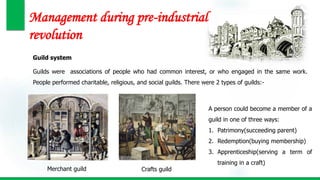
Guild system
Guilds were associations of people who had common interest, or who engaged in the same work.
People performed charitable, religious, and social guilds. There were 2 types of guilds:-
Merchant guild Crafts guild
A person could become a member of a
guild in one of three ways:
1. Patrimony(succeeding parent)
2. Redemption(buying membership)
3. Apprenticeship(serving a term of
training in a craft)
Continues…
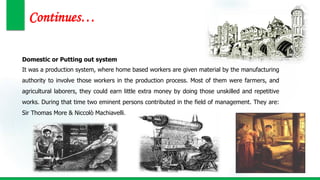
Domestic or Putting out system
It was a production system, where home based workers are given material by the manufacturing
authority to involve those workers in the production process. Most of them were farmers, and
agricultural laborers, they could earn little extra money by doing those unskilled and repetitive
works. During that time two eminent persons contributed in the field of management. They are:
Sir Thomas More & Niccolò Machiavelli.
Continues…
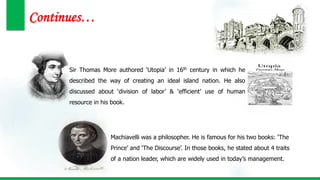
Sir Thomas More authored ‘Utopia’ in 16th century in which he
described the way of creating an ideal island nation. He also
discussed about ‘division of labor’ & ‘efficient’ use of human
resource in his book.
Machiavelli was a philosopher. He is famous for his two books: ‘The
Prince’ and ‘The Discourse’. In those books, he stated about 4 traits
of a nation leader, which are widely used in today’s management.
Management during industrial
revolution period
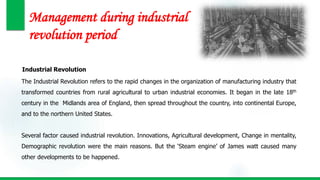
Industrial Revolution
The Industrial Revolution refers to the rapid changes in the organization of manufacturing industry that
transformed countries from rural agricultural to urban industrial economies. It began in the late 18th
century in the Midlands area of England, then spread throughout the country, into continental Europe,
and to the northern United States.
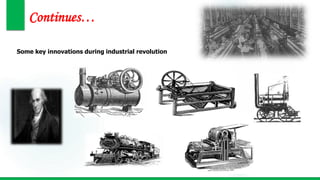
Several factor caused industrial revolution. Innovations, Agricultural development, Change in mentality,
Demographic revolution were the main reasons. But the ‘Steam engine’ of James watt caused many
other developments to be happened.
Continues…
Some key innovations during industrial revolution
Continues…
Practices of management
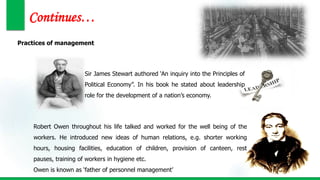
Sir James Stewart authored ‘An inquiry into the Principles of
Political Economy”. In his book he stated about leadership
role for the development of a nation’s economy.
Robert Owen throughout his life talked and worked for the well being of the
workers. He introduced new ideas of human relations, e.g. shorter working
hours, housing facilities, education of children, provision of canteen, rest
pauses, training of workers in hygiene etc.
Owen is known as ‘father of personnel management’
Continues…
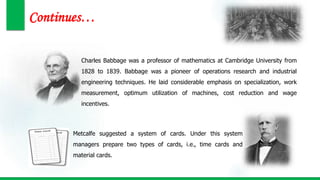
Charles Babbage was a professor of mathematics at Cambridge University from
1828 to 1839. Babbage was a pioneer of operations research and industrial
engineering techniques. He laid considerable emphasis on specialization, work
measurement, optimum utilization of machines, cost reduction and wage
incentives.
Metcalfe suggested a system of cards. Under this system
managers prepare two types of cards, i.e., time cards and
material cards.
Continues…
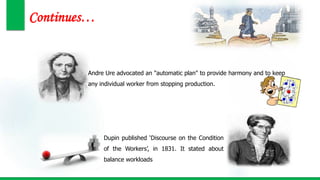
Andre Ure advocated an "automatic plan" to provide harmony and to keep
any individual worker from stopping production.
Dupin published ‘Discourse on the Condition
of the Workers’, in 1831. It stated about
balance workloads
Continues…
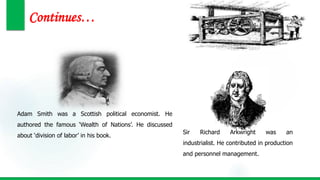
Sir Richard Arkwright was an
industrialist. He contributed in production
and personnel management.
Adam Smith was a Scottish political economist. He
authored the famous ‘Wealth of Nations’. He discussed
about ‘division of labor’ in his book.
Management during pre scientific
period
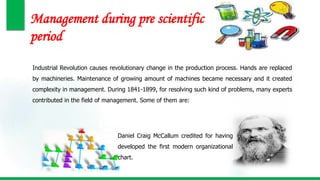
Industrial Revolution causes revolutionary change in the production process. Hands are replaced
by machineries. Maintenance of growing amount of machines became necessary and it created
complexity in management. During 1841-1899, for resolving such kind of problems, many experts
contributed in the field of management. Some of them are:
Daniel Craig McCallum credited for having
developed the first modern organizational
chart.
Continues…
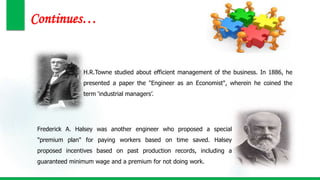
H.R.Towne studied about efficient management of the business. In 1886, he
presented a paper the "Engineer as an Economist", wherein he coined the
term ‘industrial managers’.
Frederick A. Halsey was another engineer who proposed a special
"premium plan" for paying workers based on time saved. Halsey
proposed incentives based on past production records, including a
guaranteed minimum wage and a premium for not doing work.
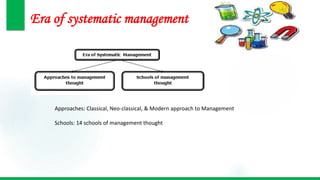
Era of systematic management
Approaches: Classical, Neo-classical, & Modern approach to Management
Schools: 14 schools of management thought
References
কর্মকার শ্যার্ সুন্দর, সাাংগঠনিক আচরণঃ প্রথর্ সাংস্করণ (সাাংগঠনিক ত্ত্ব)
Claude S. George, The History of Management Thought (Englewood Cliffs,
N.J.: Prentice-Hall, 1968)
Ricky W. Griffin, Fundamentals of Management(Cengage Learning)
Robbins, Stephen P & Mary Coulter, Management. — 11th ed.(Pearson:
Prentice-Hall)
www.slideshare.net
Thank You!!!
If You have any question

Evolution of Management Thought

  • 1.
    History of theevolution of management theory & practice -a brief overview based on management developmental period -Rahat
  • 2.
    Acknowledgment Preparing this assignmentappeared to be a great experience to me. It gave me very important knowledge about management and its development history. I would like to give a lot of thanks to our honorable course teacher, Md. Jamal Uddin for giving me a wonderful opportunity to make such an interesting and valuable assignment and giving all of us a clear concept about the assignment.
  • 3.
    The roadmap ofthis presentation Pre-historic age 10,000 -9000 BC Ancient Civilization 10,000 BC - 475 AD Medival Period 476 - 1500 Transition Period 1501 - 1899 Systematic Management 1900 - Present Based on various references regarding management ideas & practices, the evolution or development of management can be classified into 5 eras.
  • 4.
    Etymology of ‘Management’ Theword ‘Manage’ derived from the Italian language ‘maneggiare’ that means to handle, especially tools or a horse. ‘Maneggiare’ derived from two Latin words ‘manus’(hand) and ‘agere’(to act). During the period of ‘Industrial Revolution’ the term ‘Management’ flourished vastly for managing people who were working in various industries.
  • 5.
    Concept about ‘Management’ Managementis actually ‘managing the situation’ Management in all business and organizations is the act of getting people together to accomplish goals and objectives by using available resources efficiently and effectively.
  • 6.
    ‘Management’ defined… “Management isthe art of knowing what you want to do and then seeing that it is done in the best and cheapest way.” “Management is a multipurpose organ that manage a business and manages Managers and manages Workers and work.” “To manage is to forecast and to plan, to organize, to command, to co- ordinate and to control.” “Management is art of getting things done through other.”
  • 7.
    Management behind &beyond this universe The ‘SOLAR’ model is the perfect example of ‘Management’ “The management example by our Lord”
  • 8.
    Management in ‘Pre-historic’age Pre-historic age basically indicates the ‘Stone’ age Duration: 10000-9000 BC Stone age comprised of:- •Paleolithic (Old stone age) •Mesolithic (Middle stone age) •Neolithic (New stone age)
  • 9.
    Pre-historic age continues… •Paleolithic(Old stone age) - It starts with the appearance of first hominids and ends with discovery of agriculture. Traces of management can be seen when they hunt animals, gone for fishing and by gathering fruits, nuts, and other wild plant . People were ‘Nomadic’. They travel from time to time or with the seasons to find food and following the animals. •Mesolithic (Middle stone age) -It was a period of climatic instability. During the Mesolithic, humans learned to hunt in groups and to fish, and began to learn how to domesticate animals and plants.
  • 10.
    Pre-historic age continues… •Neolithic(New stone age) -The Neolithic Era (New Stone Age) begins 10,000 years ago, when humans invented agriculture and livestock raising. Neolithic people learn how to plant cereals and to farm and domesticate animals. Humans were settling themselves down into agrarian societies and began to explore some key concepts of civilization, namely, religion, measurement, the rudiments of architecture and writing and art.
  • 11.
    Management in ancientcivilization Management also has been practiced during ancient civilization. This period existed between 10,000-4,75 AD. Some of the most interesting examples are- The Egyptian pyramids and the Great Wall of China are great proof of management practice during ancient civilization
  • 12.
    Continues… Alexander the Greatemployed a staff organization to coordinate activities during his military campaigns. Well-defined organizational structure developed by Roman Empire Socrates discussed management practices and concepts in 400 BC
  • 13.
    Continues… Plato described jobspecialization in 350 BC. ‘Xenophon’ discussed management as a separate art in 400 BC. In 400 BC human relations & motion study discussed by ‘Cyrus’. Hammurabi established the Babylonian Empire by conquest, treaties, and controlling trade. ‘Hammurabi’ provided ‘Akkadian Code’ and he used to have controlled and written documentation in 1800 BC
  • 14.
    Continues… ‘Nebuchadnezzar’ provided the methodof wage incentives & production control. ‘Chinese’ philosopher ‘Sun Tzu’ given war strategy in 500 BC by ‘Art of War’ Chandragupta Maurya used to follow ‘Arthashastra’ which was authored by Kautilya or Vishnugupta or Chankya. Arthashastra’ is an ancient Indian treatise on statecraft, economic policy and military strategy.
  • 15.
    Continues… The ‘Sumerians’ usedrecord keeping. ‘Egyptians’ used to Plan, organize, control and keep written requests.
  • 16.
    Management during medievalperiod Medieval period is regarded as ‘Era of darkness’. This time frame for this era is 476-1500. Practice and traces of management also can be seen is this period. Some of the examples are: ‘Cato’ introduced the concept of ‘Job description’ The ‘delegation of authority’ first introduced by ‘Diocletian’
  • 17.
    Medieval period continues… In900 AD, ‘Al-Farabi’ listed leadership traits. He termed leader as ‘Supreme Ruler’. His enlisted traits are:- Great intelligence, Excellent memory, Love for justice, Love for truth etc. Imam ‘Ghazali’ listed managerial traits in 1100 AD. His enlisted traits are:- ability for Creating vision, ability to direct etc.
  • 18.
    Medieval period continues… In1418, ‘Barbarigo’ proposed different organizational forms/structures. In 1494 Luca Pacioli wrote Summa de Arithmetica, Geometrica, Proportioni et Proportionalita and codified double-entry bookkeeping
  • 19.
    Management in theera of transition Based on various writers, we could not see any specific system of management during 1501 – 1899. In the history of management this era is called as ‘Transitional period of Management’. The existence of this era is from 1501 to 1899. Management in the era of transition Management during pre industrial revolution period Management during industrial revolution Management during pre scientific period Guild system Putting out system
  • 20.
    Management during pre-industrial revolution Guildsystem Guilds were associations of people who had common interest, or who engaged in the same work. People performed charitable, religious, and social guilds. There were 2 types of guilds:- Merchant guild Crafts guild A person could become a member of a guild in one of three ways: 1. Patrimony(succeeding parent) 2. Redemption(buying membership) 3. Apprenticeship(serving a term of training in a craft)
  • 21.
    Continues… Domestic or Puttingout system It was a production system, where home based workers are given material by the manufacturing authority to involve those workers in the production process. Most of them were farmers, and agricultural laborers, they could earn little extra money by doing those unskilled and repetitive works. During that time two eminent persons contributed in the field of management. They are: Sir Thomas More & Niccolò Machiavelli.
  • 22.
    Continues… Sir Thomas Moreauthored ‘Utopia’ in 16th century in which he described the way of creating an ideal island nation. He also discussed about ‘division of labor’ & ‘efficient’ use of human resource in his book. Machiavelli was a philosopher. He is famous for his two books: ‘The Prince’ and ‘The Discourse’. In those books, he stated about 4 traits of a nation leader, which are widely used in today’s management.
  • 23.
    Management during industrial revolutionperiod Industrial Revolution The Industrial Revolution refers to the rapid changes in the organization of manufacturing industry that transformed countries from rural agricultural to urban industrial economies. It began in the late 18th century in the Midlands area of England, then spread throughout the country, into continental Europe, and to the northern United States. Several factor caused industrial revolution. Innovations, Agricultural development, Change in mentality, Demographic revolution were the main reasons. But the ‘Steam engine’ of James watt caused many other developments to be happened.
  • 24.
    Continues… Some key innovationsduring industrial revolution
  • 25.
    Continues… Practices of management SirJames Stewart authored ‘An inquiry into the Principles of Political Economy”. In his book he stated about leadership role for the development of a nation’s economy. Robert Owen throughout his life talked and worked for the well being of the workers. He introduced new ideas of human relations, e.g. shorter working hours, housing facilities, education of children, provision of canteen, rest pauses, training of workers in hygiene etc. Owen is known as ‘father of personnel management’
  • 26.
    Continues… Charles Babbage wasa professor of mathematics at Cambridge University from 1828 to 1839. Babbage was a pioneer of operations research and industrial engineering techniques. He laid considerable emphasis on specialization, work measurement, optimum utilization of machines, cost reduction and wage incentives. Metcalfe suggested a system of cards. Under this system managers prepare two types of cards, i.e., time cards and material cards.
  • 27.
    Continues… Andre Ure advocatedan "automatic plan" to provide harmony and to keep any individual worker from stopping production. Dupin published ‘Discourse on the Condition of the Workers’, in 1831. It stated about balance workloads
  • 28.
    Continues… Sir Richard Arkwrightwas an industrialist. He contributed in production and personnel management. Adam Smith was a Scottish political economist. He authored the famous ‘Wealth of Nations’. He discussed about ‘division of labor’ in his book.
  • 29.
    Management during prescientific period Industrial Revolution causes revolutionary change in the production process. Hands are replaced by machineries. Maintenance of growing amount of machines became necessary and it created complexity in management. During 1841-1899, for resolving such kind of problems, many experts contributed in the field of management. Some of them are: Daniel Craig McCallum credited for having developed the first modern organizational chart.
  • 30.
    Continues… H.R.Towne studied aboutefficient management of the business. In 1886, he presented a paper the "Engineer as an Economist", wherein he coined the term ‘industrial managers’. Frederick A. Halsey was another engineer who proposed a special "premium plan" for paying workers based on time saved. Halsey proposed incentives based on past production records, including a guaranteed minimum wage and a premium for not doing work.
  • 31.
    Era of systematicmanagement Approaches: Classical, Neo-classical, & Modern approach to Management Schools: 14 schools of management thought
  • 32.
    References কর্মকার শ্যার্ সুন্দর,সাাংগঠনিক আচরণঃ প্রথর্ সাংস্করণ (সাাংগঠনিক ত্ত্ব) Claude S. George, The History of Management Thought (Englewood Cliffs, N.J.: Prentice-Hall, 1968) Ricky W. Griffin, Fundamentals of Management(Cengage Learning) Robbins, Stephen P & Mary Coulter, Management. — 11th ed.(Pearson: Prentice-Hall) www.slideshare.net
  • 33.
  • 34.
    If You haveany question