Accounting for
Managers 1
INTRODUCTION TO
FINANCIAL ACCOUNTING
CHAPTER - 1
Accounting for
Managers 2
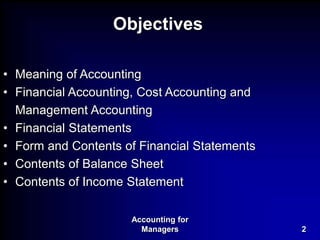
Objectives
• Meaning of Accounting
• Financial Accounting, Cost Accounting and
Management Accounting
• Financial Statements
• Form and Contents of Financial Statements
• Contents of Balance Sheet
• Contents of Income Statement
Accounting for
Managers 3
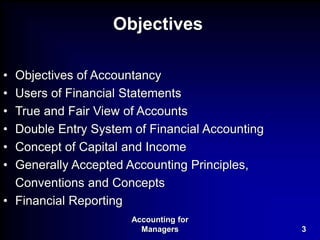
Objectives
• Objectives of Accountancy
• Users of Financial Statements
• True and Fair View of Accounts
• Double Entry System of Financial Accounting
• Concept of Capital and Income
• Generally Accepted Accounting Principles,
Conventions and Concepts
• Financial Reporting
Accounting for
Managers 4
Meaning of Accounting
 All of us do some accounting, often without realizing it.
It is a part of our life, and in business, it is a more
serious matter.
 In simple words, ‘accounting’ merely means,
‘reckoning’ or ‘recounting’.
Accounting for
Managers 5
Meaning of Accounting
The American Institute of Certified Public Accountants
defines accounting as “the art of recording, classifying
and summarizing in a significant manner and in terms of
money transactions and events which are, in part at
least, of a financial character, and interpreting the results
thereof”.
6
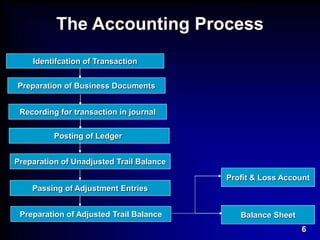
Preparation of Business Documents
Identifcation of Transaction
Recording for transaction in journal
Posting of Ledger
Balance Sheet
Profit & Loss Account
Preparation of Unadjusted Trail Balance
Passing of Adjustment Entries
Preparation of Adjusted Trail Balance
The Accounting Process
Accounting for
Managers 7
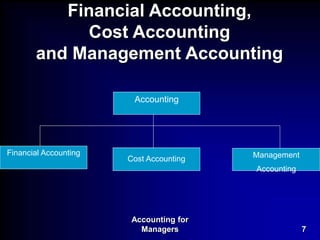
Financial Accounting,
Cost Accounting
and Management Accounting
Accounting
Cost Accounting Management
Accounting
Financial Accounting
Accounting for
Managers 8
Financial Statements
Typically, the major financial statements which result
from the process of accounting are:
 Profit and Loss Account
 Balance Sheet
 Cash Flow Statement.
Accounting for
Managers 9
Form and Contents of
Financial Statements
 Financial statements consist of Balance Sheet and
Income Statement (Profit and Loss Account).
 As per the Indian Companies Act, 1956, the Balance
Sheet of a company shall be in either horizontal form
or vertical form while the vertical form is the most
commonly used by companies in practice.
Accounting for
Managers 10
Contents of the Balance Sheet
Assets:
 Fixed assets
 Investments
 Current assets, loans and advances
 Miscellaneous expenditure
 Profit and loss account.
Accounting for
Managers 11
Contents of the Balance Sheet
Liabilities:
 Share capital
 Reserves and surplus
 Secured loans
 Unsecured loans
 Current liabilities and provisions.
Accounting for
Managers 12
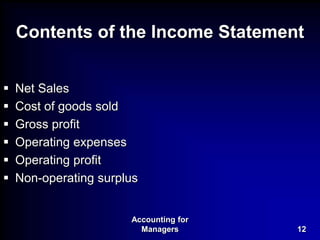
Contents of the Income Statement
 Net Sales
 Cost of goods sold
 Gross profit
 Operating expenses
 Operating profit
 Non-operating surplus
Accounting for
Managers 13
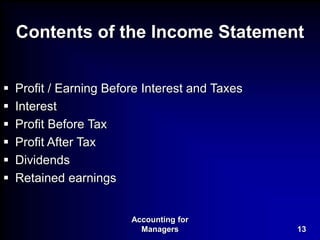
Contents of the Income Statement
 Profit / Earning Before Interest and Taxes
 Interest
 Profit Before Tax
 Profit After Tax
 Dividends
 Retained earnings
Accounting for
Managers 14
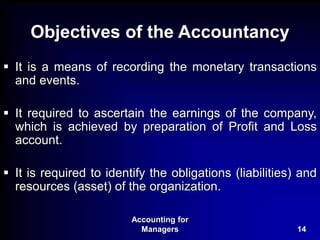
Objectives of the Accountancy
 It is a means of recording the monetary transactions
and events.
 It required to ascertain the earnings of the company,
which is achieved by preparation of Profit and Loss
account.
 It is required to identify the obligations (liabilities) and
resources (asset) of the organization.
Accounting for
Managers 15
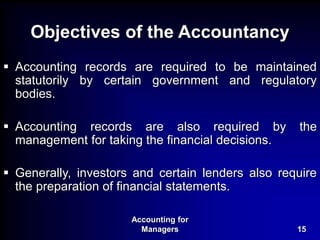
Objectives of the Accountancy
 Accounting records are required to be maintained
statutorily by certain government and regulatory
bodies.
 Accounting records are also required by the
management for taking the financial decisions.
 Generally, investors and certain lenders also require
the preparation of financial statements.
Accounting for
Managers 16
Users of Financial Statements
• Management
• Shareholders, Security Analysts and Investors
• Lenders
• Suppliers/Creditors
• Customers
• Legal
• Employees
• Government and Regulatory Agencies
• Research
Accounting for
Managers 17
True and Fair View of Accounts
 Since each user of accounts may have a different
focus in viewing the financial statements, it is
necessary that the accounting statements are not
biased in favor of any one interested group. It is,
therefore, necessary for an accountant to ensure that
the accounts represent a “true and fair” picture of the
affairs of business.
Accounting for
Managers 18
Double Entry System
 Earlier, organizations used to maintain accounts in the
single entry system which recognizes only cash
transactions.
 But now, accounts are invariably maintained in the
double entry system which recognizes both cash and
credit transactions. Accounts are maintained on
accrual basis under this system.
 All transactions are supposed to have dual aspect – a
debit aspect and a credit aspect.
Accounting for
Managers 19
Concept of Capital and Income
The Accountant’s Concept of Capital and Income
 Capital is the contribution made by the owner(s) in the
business and is regarded as a liability to the business
in the nature of owners’ equity. The underlying feature
for this treatment is the distinction between the
owner(s) and that of the business owned by them as a
result of which the business is vested with an implied
obligation to repay such sum to the owner(s).
Accounting for
Managers 20
Concept of Capital and Income
The Accountant’s Concept of Capital and Income
• The income of the business is arrived at by matching
the revenues of a defined period with the expenses of
the same period, and it accrues to the owner(s). This
matching of revenues and expenses can either be on
an Accrual basis or Cash basis or the Hybrid (mixture
of both accrual and cash bases).
Accounting for
Managers 21
Concept of Capital and Income
The Economist’s Concept of Capital and Income
 According to economist J R Hicks “the purpose of
income calculation is to give people an indication of
the amount which they can consume without
impoverishing themselves. Income is the amount
which a person can consume during a period and still
remain well off at the end of the period as he was at
the beginning”.
Accounting for
Managers 22
Concept of Capital and Income
The Economist’s Concept of Capital and Income
 Capital for an economist refers to assets which are
used to produce goods and services. This concept has
an asset orientation and is applicable to a certain point
of time. If the inventory of wealth at a point of time is
called the Capital, the benefits derived from such
wealth during a certain defined period is called
income.
Accounting for
Managers 23
GAAP, Conventions and Concepts
• “Generally accepted accounting principles incorporate
the consensus at a particular time as to which
economic resources and obligations should be
recorded as assets and liabilities by financial
accounting, which changes in assets and liabilities
should be recorded.
Accounting for
Managers 24
GAAP, Conventions and Concepts
The generally accepted accounting principles which are
followed in several countries are as follows:
• Materiality Concept
• Money Measurement Concept
• Cost Concept
• Time Period Concept
• Conservatism Concept
• Consistency Concept
Accounting for
Managers 25
GAAP, Conventions and Concepts
The generally accepted accounting principles which are
followed in several countries are as follows:
 Business Entity Concept
 Going Concern Concept
 Duality or Accounting Equivalence Concept
 Accounting Period Concept
 Realization Concept
 Matching Concept
Accounting for
Managers 26
Financial Reporting
• The end-users of financial statements need not
necessarily be those with finance background. They
might not be in a position to understand the complex
technicalities of financial statements.
• One outcome of this dissatisfaction on the part of the
end-users of the annual report has been the
highlighted summarized versions of the Balance Sheet
and Profit and Loss Account in non-technical
language.
Accounting for
Managers 27
Financial Reporting
According to FASB, there are two main objectives of
financial reporting:
• Information about enterprise earnings and its
components measured by accrual accounting provides
a better indication of enterprise performance than
information about current cash receipts and payments.
Accounting for
Managers 28
Financial Reporting
According to FASB, there are two main objectives of
financial reporting:
 Financial reporting should also provide information
about an enterprise’s economic resources, obligations
and owners’ equity, liquidity or solvency and
management’s stewardship as well as management’s
explanations and interpretations of information
provided.
Accounting for
Managers 29
Summary
• Financial Accounting consists of creation of financial
information and the subsequent use of such
information. Creation entails three steps namely
Recording
Classifying
Summarizing
Accounting for
Managers 30
Summary
 Typically, the major financial statements which result
from the process of accounting are: Profit and Loss
Account, Balance Sheet and Cash Flow Statement.
• The double entry system of accounting is based on a
set of principles which are called Generally Accepted
Accounting Principles (GAAP).

Introduction to Financial Accounting.ppt

  • 1.
    Accounting for Managers 1 INTRODUCTIONTO FINANCIAL ACCOUNTING CHAPTER - 1
  • 2.
    Accounting for Managers 2 Objectives •Meaning of Accounting • Financial Accounting, Cost Accounting and Management Accounting • Financial Statements • Form and Contents of Financial Statements • Contents of Balance Sheet • Contents of Income Statement
  • 3.
    Accounting for Managers 3 Objectives •Objectives of Accountancy • Users of Financial Statements • True and Fair View of Accounts • Double Entry System of Financial Accounting • Concept of Capital and Income • Generally Accepted Accounting Principles, Conventions and Concepts • Financial Reporting
  • 4.
    Accounting for Managers 4 Meaningof Accounting  All of us do some accounting, often without realizing it. It is a part of our life, and in business, it is a more serious matter.  In simple words, ‘accounting’ merely means, ‘reckoning’ or ‘recounting’.
  • 5.
    Accounting for Managers 5 Meaningof Accounting The American Institute of Certified Public Accountants defines accounting as “the art of recording, classifying and summarizing in a significant manner and in terms of money transactions and events which are, in part at least, of a financial character, and interpreting the results thereof”.
  • 6.
    6 Preparation of BusinessDocuments Identifcation of Transaction Recording for transaction in journal Posting of Ledger Balance Sheet Profit & Loss Account Preparation of Unadjusted Trail Balance Passing of Adjustment Entries Preparation of Adjusted Trail Balance The Accounting Process
  • 7.
    Accounting for Managers 7 FinancialAccounting, Cost Accounting and Management Accounting Accounting Cost Accounting Management Accounting Financial Accounting
  • 8.
    Accounting for Managers 8 FinancialStatements Typically, the major financial statements which result from the process of accounting are:  Profit and Loss Account  Balance Sheet  Cash Flow Statement.
  • 9.
    Accounting for Managers 9 Formand Contents of Financial Statements  Financial statements consist of Balance Sheet and Income Statement (Profit and Loss Account).  As per the Indian Companies Act, 1956, the Balance Sheet of a company shall be in either horizontal form or vertical form while the vertical form is the most commonly used by companies in practice.
  • 10.
    Accounting for Managers 10 Contentsof the Balance Sheet Assets:  Fixed assets  Investments  Current assets, loans and advances  Miscellaneous expenditure  Profit and loss account.
  • 11.
    Accounting for Managers 11 Contentsof the Balance Sheet Liabilities:  Share capital  Reserves and surplus  Secured loans  Unsecured loans  Current liabilities and provisions.
  • 12.
    Accounting for Managers 12 Contentsof the Income Statement  Net Sales  Cost of goods sold  Gross profit  Operating expenses  Operating profit  Non-operating surplus
  • 13.
    Accounting for Managers 13 Contentsof the Income Statement  Profit / Earning Before Interest and Taxes  Interest  Profit Before Tax  Profit After Tax  Dividends  Retained earnings
  • 14.
    Accounting for Managers 14 Objectivesof the Accountancy  It is a means of recording the monetary transactions and events.  It required to ascertain the earnings of the company, which is achieved by preparation of Profit and Loss account.  It is required to identify the obligations (liabilities) and resources (asset) of the organization.
  • 15.
    Accounting for Managers 15 Objectivesof the Accountancy  Accounting records are required to be maintained statutorily by certain government and regulatory bodies.  Accounting records are also required by the management for taking the financial decisions.  Generally, investors and certain lenders also require the preparation of financial statements.
  • 16.
    Accounting for Managers 16 Usersof Financial Statements • Management • Shareholders, Security Analysts and Investors • Lenders • Suppliers/Creditors • Customers • Legal • Employees • Government and Regulatory Agencies • Research
  • 17.
    Accounting for Managers 17 Trueand Fair View of Accounts  Since each user of accounts may have a different focus in viewing the financial statements, it is necessary that the accounting statements are not biased in favor of any one interested group. It is, therefore, necessary for an accountant to ensure that the accounts represent a “true and fair” picture of the affairs of business.
  • 18.
    Accounting for Managers 18 DoubleEntry System  Earlier, organizations used to maintain accounts in the single entry system which recognizes only cash transactions.  But now, accounts are invariably maintained in the double entry system which recognizes both cash and credit transactions. Accounts are maintained on accrual basis under this system.  All transactions are supposed to have dual aspect – a debit aspect and a credit aspect.
  • 19.
    Accounting for Managers 19 Conceptof Capital and Income The Accountant’s Concept of Capital and Income  Capital is the contribution made by the owner(s) in the business and is regarded as a liability to the business in the nature of owners’ equity. The underlying feature for this treatment is the distinction between the owner(s) and that of the business owned by them as a result of which the business is vested with an implied obligation to repay such sum to the owner(s).
  • 20.
    Accounting for Managers 20 Conceptof Capital and Income The Accountant’s Concept of Capital and Income • The income of the business is arrived at by matching the revenues of a defined period with the expenses of the same period, and it accrues to the owner(s). This matching of revenues and expenses can either be on an Accrual basis or Cash basis or the Hybrid (mixture of both accrual and cash bases).
  • 21.
    Accounting for Managers 21 Conceptof Capital and Income The Economist’s Concept of Capital and Income  According to economist J R Hicks “the purpose of income calculation is to give people an indication of the amount which they can consume without impoverishing themselves. Income is the amount which a person can consume during a period and still remain well off at the end of the period as he was at the beginning”.
  • 22.
    Accounting for Managers 22 Conceptof Capital and Income The Economist’s Concept of Capital and Income  Capital for an economist refers to assets which are used to produce goods and services. This concept has an asset orientation and is applicable to a certain point of time. If the inventory of wealth at a point of time is called the Capital, the benefits derived from such wealth during a certain defined period is called income.
  • 23.
    Accounting for Managers 23 GAAP,Conventions and Concepts • “Generally accepted accounting principles incorporate the consensus at a particular time as to which economic resources and obligations should be recorded as assets and liabilities by financial accounting, which changes in assets and liabilities should be recorded.
  • 24.
    Accounting for Managers 24 GAAP,Conventions and Concepts The generally accepted accounting principles which are followed in several countries are as follows: • Materiality Concept • Money Measurement Concept • Cost Concept • Time Period Concept • Conservatism Concept • Consistency Concept
  • 25.
    Accounting for Managers 25 GAAP,Conventions and Concepts The generally accepted accounting principles which are followed in several countries are as follows:  Business Entity Concept  Going Concern Concept  Duality or Accounting Equivalence Concept  Accounting Period Concept  Realization Concept  Matching Concept
  • 26.
    Accounting for Managers 26 FinancialReporting • The end-users of financial statements need not necessarily be those with finance background. They might not be in a position to understand the complex technicalities of financial statements. • One outcome of this dissatisfaction on the part of the end-users of the annual report has been the highlighted summarized versions of the Balance Sheet and Profit and Loss Account in non-technical language.
  • 27.
    Accounting for Managers 27 FinancialReporting According to FASB, there are two main objectives of financial reporting: • Information about enterprise earnings and its components measured by accrual accounting provides a better indication of enterprise performance than information about current cash receipts and payments.
  • 28.
    Accounting for Managers 28 FinancialReporting According to FASB, there are two main objectives of financial reporting:  Financial reporting should also provide information about an enterprise’s economic resources, obligations and owners’ equity, liquidity or solvency and management’s stewardship as well as management’s explanations and interpretations of information provided.
  • 29.
    Accounting for Managers 29 Summary •Financial Accounting consists of creation of financial information and the subsequent use of such information. Creation entails three steps namely Recording Classifying Summarizing
  • 30.
    Accounting for Managers 30 Summary Typically, the major financial statements which result from the process of accounting are: Profit and Loss Account, Balance Sheet and Cash Flow Statement. • The double entry system of accounting is based on a set of principles which are called Generally Accepted Accounting Principles (GAAP).