


Modes of International market
entry or expansion
Do not put all eggs in
one basket.
― Warren Buffet
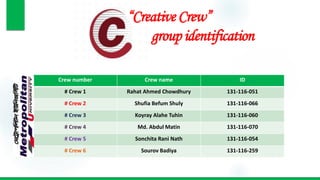
“Creative Crew”
group identification
Crew number Crew name ID
# Crew 1 Rahat Ahmed Chowdhury 131-116-051
# Crew 2 Shufia Befum Shuly 131-116-066
# Crew 3 Koyray Alahe Tuhin 131-116-060
# Crew 4 Md. Abdul Matin 131-116-070
# Crew 5 Sonchita Rani Nath 131-116-054
# Crew 6 Sourov Badiya 131-116-259
Acknowledgment
Preparing this assignment appeared to be a great experience to us. It added a lot to
our knowledge. This assignment is one of our memorable experiences in student life.
We also would like to give a lot of thanks to our honorable course teacher, Md.
Saidur Rahman a.k.a Polash sir for giving us a wonderful opportunity to make
such an interesting and valuable assignment and giving us a clear concept about the
assignment.
International market entry
 Once a firm has decided to establish itself in
global market—it becomes necessary that
the company studies and analyzes the
various options available to enter the
international markets and select the most
suitable one.
 In order to succeed in international markets,
the decision to select an appropriate entry
mode is a crucial and integral part of a firm’s
international marketing strategy.
Why firms goes international???
Major reasons for firms going international are:
 Profitability
 Growth
 Economies of scale
 Access to resources
 Marketing opportunities
 USP of product & services
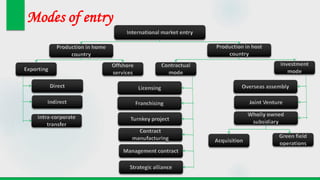
Modes of entry
Exporting
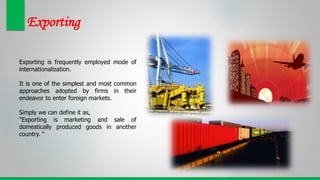
Exporting is frequently employed mode of
internationalization.
It is one of the simplest and most common
approaches adopted by firms in their
endeavor to enter foreign markets.
Simply we can define it as,
“Exporting is marketing and sale of
domestically produced goods in another
country. “
Exporting classified
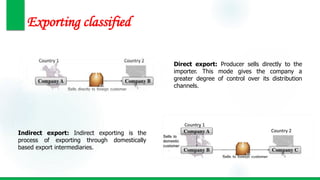
Direct export: Producer sells directly to the
importer. This mode gives the company a
greater degree of control over its distribution
channels.
Indirect export: Indirect exporting is the
process of exporting through domestically
based export intermediaries.
Classification of export continues…..
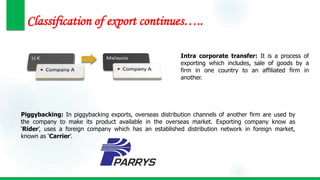
Intra corporate transfer: It is a process of
exporting which includes, sale of goods by a
firm in one country to an affiliated firm in
another.
Piggybacking: In piggybacking exports, overseas distribution channels of another firm are used by
the company to make its product available in the overseas market. Exporting company know as
‘Rider’, uses a foreign company which has an established distribution network in foreign market,
known as ‘Carrier’.
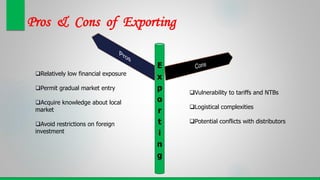
Pros & Cons of Exporting
E
x
p
o
r
t
i
n
g
Relatively low financial exposure
Permit gradual market entry
Acquire knowledge about local
market
Avoid restrictions on foreign
investment
Vulnerability to tariffs and NTBs
Logistical complexities
Potential conflicts with distributors
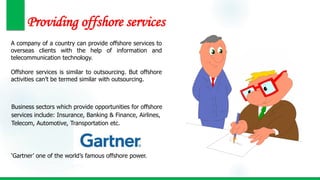
Providing offshore services
A company of a country can provide offshore services to
overseas clients with the help of information and
telecommunication technology.
Offshore services is similar to outsourcing. But offshore
activities can’t be termed similar with outsourcing.
Business sectors which provide opportunities for offshore
services include: Insurance, Banking & Finance, Airlines,
Telecom, Automotive, Transportation etc.
‘Gartner’ one of the world’s famous offshore power.
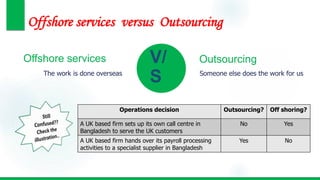
Offshore services
The work is done overseas
Outsourcing
Someone else does the work for us
V/
S
Offshore services versus Outsourcing
Operations decision Outsourcing? Off shoring?
A UK based firm sets up its own call centre in
Bangladesh to serve the UK customers
No Yes
A UK based firm hands over its payroll processing
activities to a specialist supplier in Bangladesh
Yes No
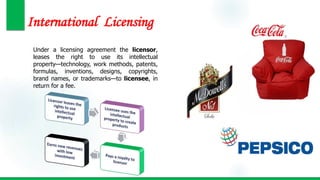
International Licensing
Under a licensing agreement the licensor,
leases the right to use its intellectual
property—technology, work methods, patents,
formulas, inventions, designs, copyrights,
brand names, or trademarks—to licensee, in
return for a fee.
Pros & Cons of International Licensing
• Low financial risks
• Low-cost way to assess
market potential
• Avoid tariffs, NTBs,
restrictions on foreign
investment
• Licensee provides
knowledge of local
markets
• Limited market
opportunities/profits
• Dependence on licensee
• Potential conflicts with
licensee
• Possibility of creating
future competitor
International Franchising
Under franchising, an independent organization
called the franchisee operates the business
under the name of another company called the
franchisor.
Franchising is a form of Licensing but the
Franchisor can exercise more control over the
Franchisee as compared to that in Licensing
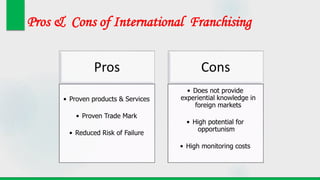
Pros & Cons of International Franchising
Pros
• Proven products & Services
• Proven Trade Mark
• Reduced Risk of Failure
Cons
• Does not provide
experiential knowledge in
foreign markets
• High potential for
opportunism
• High monitoring costs
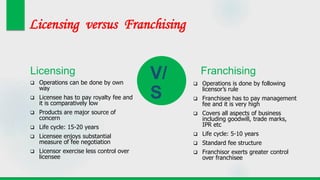
Licensing
 Operations can be done by own
way
 Licensee has to pay royalty fee and
it is comparatively low
 Products are major source of
concern
 Life cycle: 15-20 years
 Licensee enjoys substantial
measure of fee negotiation
 Licensor exercise less control over
licensee
FranchisingV/
S
Licensing versus Franchising
 Operations is done by following
licensor’s rule
 Franchisee has to pay management
fee and it is very high
 Covers all aspects of business
including goodwill, trade marks,
IPR etc
 Life cycle: 5-10 years
 Standard fee structure
 Franchisor exerts greater control
over franchisee
Turnkey project(B.O.T)
A turnkey project is a contract under which a
firm agrees to fully design, construct and
equip a manufacturing/business/service facility
and turn the project over to the purchaser
when it is ready for operation, for
remuneration
The company hires a contractor in the desired
country that they want to create an operation.
At the completion of the contract, the foreign
company gives the “key” to the project and it
is ready for operation.
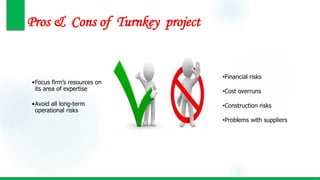
Pros & Cons of Turnkey project
•Focus firm’s resources on
its area of expertise
•Avoid all long-term
operational risks
•Financial risks
•Cost overruns
•Construction risks
•Problems with suppliers
Contract manufacturing
Contract manufacturing is a process that
establishes a working agreement between two
companies. As part of the agreement, one
company produces parts or other materials on
behalf of their client. Simply it can be defined
as the process of outsourcing entire or part of
a company’s manufacturing operations.
A number of global companies outsource their
manufacturing activities to low-cost locations.
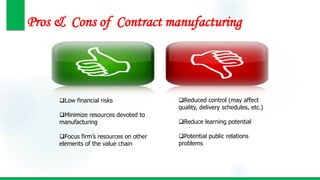
Pros & Cons of Contract manufacturing
Low financial risks
Minimize resources devoted to
manufacturing
Focus firm’s resources on other
elements of the value chain
Reduced control (may affect
quality, delivery schedules, etc.)
Reduce learning potential
Potential public relations
problems
Management contract
A management contract is an agreement
between two companies whereby one company
provides managerial assistance, technical
expertise and specialized services to the second
company for a certain period of time in return for
monetary compensation.
Most management contracts provide for
training of local personnel who will eventually
take over the management responsibilities.
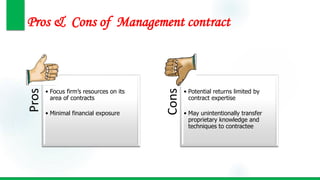
Pros & Cons of Management contract
Pros
• Focus firm’s resources on its
area of contracts
• Minimal financial exposure
Cons
• Potential returns limited by
contract expertise
• May unintentionally transfer
proprietary knowledge and
techniques to contractee
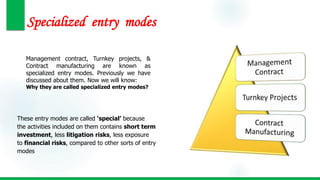
Specialized entry modes
Management contract, Turnkey projects, &
Contract manufacturing are known as
specialized entry modes. Previously we have
discussed about them. Now we will know:
Why they are called specialized entry modes?
These entry modes are called ‘special’ because
the activities included on them contains short term
investment, less litigation risks, less exposure
to financial risks, compared to other sorts of entry
modes
Thank You!!!
If You have any question

International market entry modes

  • 1.
    Modes of Internationalmarket entry or expansion Do not put all eggs in one basket. ― Warren Buffet
  • 2.
    “Creative Crew” group identification Crewnumber Crew name ID # Crew 1 Rahat Ahmed Chowdhury 131-116-051 # Crew 2 Shufia Befum Shuly 131-116-066 # Crew 3 Koyray Alahe Tuhin 131-116-060 # Crew 4 Md. Abdul Matin 131-116-070 # Crew 5 Sonchita Rani Nath 131-116-054 # Crew 6 Sourov Badiya 131-116-259
  • 3.
    Acknowledgment Preparing this assignmentappeared to be a great experience to us. It added a lot to our knowledge. This assignment is one of our memorable experiences in student life. We also would like to give a lot of thanks to our honorable course teacher, Md. Saidur Rahman a.k.a Polash sir for giving us a wonderful opportunity to make such an interesting and valuable assignment and giving us a clear concept about the assignment.
  • 4.
    International market entry Once a firm has decided to establish itself in global market—it becomes necessary that the company studies and analyzes the various options available to enter the international markets and select the most suitable one.  In order to succeed in international markets, the decision to select an appropriate entry mode is a crucial and integral part of a firm’s international marketing strategy.
  • 5.
    Why firms goesinternational??? Major reasons for firms going international are:  Profitability  Growth  Economies of scale  Access to resources  Marketing opportunities  USP of product & services
  • 6.
  • 7.
    Exporting Exporting is frequentlyemployed mode of internationalization. It is one of the simplest and most common approaches adopted by firms in their endeavor to enter foreign markets. Simply we can define it as, “Exporting is marketing and sale of domestically produced goods in another country. “
  • 8.
    Exporting classified Direct export:Producer sells directly to the importer. This mode gives the company a greater degree of control over its distribution channels. Indirect export: Indirect exporting is the process of exporting through domestically based export intermediaries.
  • 9.
    Classification of exportcontinues….. Intra corporate transfer: It is a process of exporting which includes, sale of goods by a firm in one country to an affiliated firm in another. Piggybacking: In piggybacking exports, overseas distribution channels of another firm are used by the company to make its product available in the overseas market. Exporting company know as ‘Rider’, uses a foreign company which has an established distribution network in foreign market, known as ‘Carrier’.
  • 10.
    Pros & Consof Exporting E x p o r t i n g Relatively low financial exposure Permit gradual market entry Acquire knowledge about local market Avoid restrictions on foreign investment Vulnerability to tariffs and NTBs Logistical complexities Potential conflicts with distributors
  • 11.
    Providing offshore services Acompany of a country can provide offshore services to overseas clients with the help of information and telecommunication technology. Offshore services is similar to outsourcing. But offshore activities can’t be termed similar with outsourcing. Business sectors which provide opportunities for offshore services include: Insurance, Banking & Finance, Airlines, Telecom, Automotive, Transportation etc. ‘Gartner’ one of the world’s famous offshore power.
  • 12.
    Offshore services The workis done overseas Outsourcing Someone else does the work for us V/ S Offshore services versus Outsourcing Operations decision Outsourcing? Off shoring? A UK based firm sets up its own call centre in Bangladesh to serve the UK customers No Yes A UK based firm hands over its payroll processing activities to a specialist supplier in Bangladesh Yes No
  • 13.
    International Licensing Under alicensing agreement the licensor, leases the right to use its intellectual property—technology, work methods, patents, formulas, inventions, designs, copyrights, brand names, or trademarks—to licensee, in return for a fee.
  • 14.
    Pros & Consof International Licensing • Low financial risks • Low-cost way to assess market potential • Avoid tariffs, NTBs, restrictions on foreign investment • Licensee provides knowledge of local markets • Limited market opportunities/profits • Dependence on licensee • Potential conflicts with licensee • Possibility of creating future competitor
  • 15.
    International Franchising Under franchising,an independent organization called the franchisee operates the business under the name of another company called the franchisor. Franchising is a form of Licensing but the Franchisor can exercise more control over the Franchisee as compared to that in Licensing
  • 16.
    Pros & Consof International Franchising Pros • Proven products & Services • Proven Trade Mark • Reduced Risk of Failure Cons • Does not provide experiential knowledge in foreign markets • High potential for opportunism • High monitoring costs
  • 17.
    Licensing  Operations canbe done by own way  Licensee has to pay royalty fee and it is comparatively low  Products are major source of concern  Life cycle: 15-20 years  Licensee enjoys substantial measure of fee negotiation  Licensor exercise less control over licensee FranchisingV/ S Licensing versus Franchising  Operations is done by following licensor’s rule  Franchisee has to pay management fee and it is very high  Covers all aspects of business including goodwill, trade marks, IPR etc  Life cycle: 5-10 years  Standard fee structure  Franchisor exerts greater control over franchisee
  • 18.
    Turnkey project(B.O.T) A turnkeyproject is a contract under which a firm agrees to fully design, construct and equip a manufacturing/business/service facility and turn the project over to the purchaser when it is ready for operation, for remuneration The company hires a contractor in the desired country that they want to create an operation. At the completion of the contract, the foreign company gives the “key” to the project and it is ready for operation.
  • 19.
    Pros & Consof Turnkey project •Focus firm’s resources on its area of expertise •Avoid all long-term operational risks •Financial risks •Cost overruns •Construction risks •Problems with suppliers
  • 20.
    Contract manufacturing Contract manufacturingis a process that establishes a working agreement between two companies. As part of the agreement, one company produces parts or other materials on behalf of their client. Simply it can be defined as the process of outsourcing entire or part of a company’s manufacturing operations. A number of global companies outsource their manufacturing activities to low-cost locations.
  • 21.
    Pros & Consof Contract manufacturing Low financial risks Minimize resources devoted to manufacturing Focus firm’s resources on other elements of the value chain Reduced control (may affect quality, delivery schedules, etc.) Reduce learning potential Potential public relations problems
  • 22.
    Management contract A managementcontract is an agreement between two companies whereby one company provides managerial assistance, technical expertise and specialized services to the second company for a certain period of time in return for monetary compensation. Most management contracts provide for training of local personnel who will eventually take over the management responsibilities.
  • 23.
    Pros & Consof Management contract Pros • Focus firm’s resources on its area of contracts • Minimal financial exposure Cons • Potential returns limited by contract expertise • May unintentionally transfer proprietary knowledge and techniques to contractee
  • 24.
    Specialized entry modes Managementcontract, Turnkey projects, & Contract manufacturing are known as specialized entry modes. Previously we have discussed about them. Now we will know: Why they are called specialized entry modes? These entry modes are called ‘special’ because the activities included on them contains short term investment, less litigation risks, less exposure to financial risks, compared to other sorts of entry modes
  • 25.
  • 26.
    If You haveany question