CONCEPTUAL FRAMEWORK FOR FINANCIAL ACCOUNTING
By the end of this lesson, you shall be able to
understand:
 Objectives of financial reporting
Qualitative characteristics of financial reporting
Underlying principles, concepts and assumption of financial reporting
Definition, recognition and measurement of the elements in financial
statements
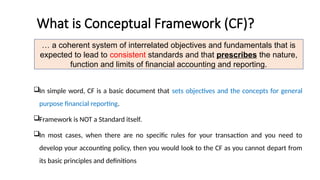
What is Conceptual Framework (CF)?
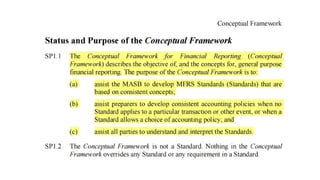
In simple word, CF is a basic document that sets objectives and the concepts for general
purpose financial reporting.
Framework is NOT a Standard itself.
In most cases, when there are no specific rules for your transaction and you need to
develop your accounting policy, then you would look to the CF as you cannot depart from
its basic principles and definitions
… a coherent system of interrelated objectives and fundamentals that is
expected to lead to consistent standards and that prescribes the nature,
function and limits of financial accounting and reporting.
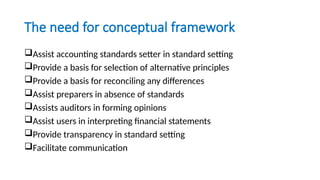
The need for conceptual framework
Assist accounting standards setter in standard setting
Provide a basis for selection of alternative principles
Provide a basis for reconciling any differences
Assist preparers in absence of standards
Assists auditors in forming opinions
Assist users in interpreting financial statements
Provide transparency in standard setting
Facilitate communication
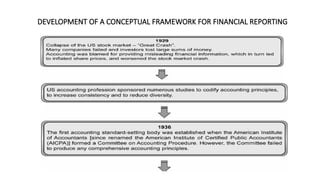
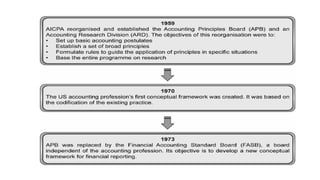
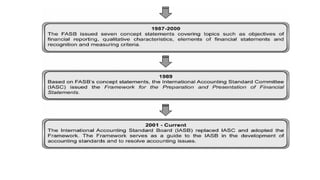
DEVELOPMENT OF A CONCEPTUAL FRAMEWORK FOR FINANCIAL REPORTING
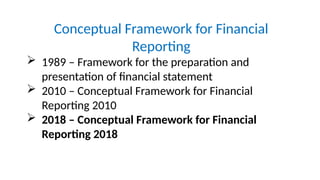
Conceptual Framework for Financial
Reporting
 1989 – Framework for the preparation and
presentation of financial statement
 2010 – Conceptual Framework for Financial
Reporting 2010
 2018 – Conceptual Framework for Financial
Reporting 2018
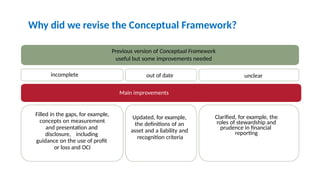
Why did we revise the Conceptual Framework?
Previous version of Conceptual Framework
useful but some improvements needed
incomplete out of date unclear
Main improvements
Filled in the gaps, for example,
concepts on measurement
and presentation and
disclosure, including
guidance on the use of profit
or loss and OCI
Clarified, for example, the
roles of stewardship and
prudence in financial
reporting
Updated, for example,
the definitions of an
asset and a liability and
recognition criteria
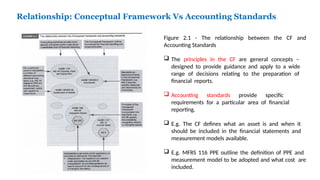
Relationship: Conceptual Framework Vs Accounting Standards
Figure 2.1 - The relationship between the CF and
Accounting Standards
 The principles in the CF are general concepts –
designed to provide guidance and apply to a wide
range of decisions relating to the preparation of
financial reports.
 Accounting standards provide specific
requirements for a particular area of financial
reporting.
 E.g. The CF defines what an asset is and when it
should be included in the financial statements and
measurement models available.
 E.g. MFRS 116 PPE outline the definition of PPE and
measurement model to be adopted and what cost are
included.
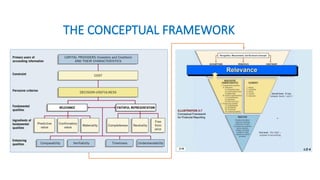
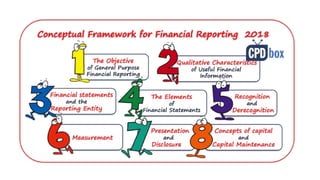
THE CONCEPTUAL FRAMEWORK
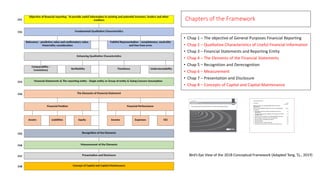
Bird’s Eye View of the 2018 Conceptual Framework (Adapted Tong, T.L., 2019)
Ch1
Ch2
Ch3
Ch4
Ch5
Ch6
Ch7
Ch8
Objective of financial reporting - To provide useful information to existing and potential investors, lenders and other
creditors
Fundamental Qualitative Characteristics
Relevance - predictive value and confirmatory value.
Materiality consideration
Faithful Representation - completeness, neutrality
and free from error
Enhancing Qualitative Characteristics
Comparability -
Consistency Verifiability Timeliness Understandability
Financial Statements & The reporting entity - Single entity or Group of entity & Going Concern Assumption
The Elements of Financial Statement
Financial Position Financial Performance
Assets Liabilities Equity Income Expenses OCI
Recognition of the Elements
Measurement of the Elements
Presentation and Disclosure
Concept of Capital and Capital Maintenance
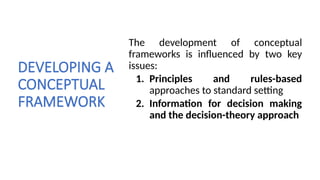
DEVELOPING A
CONCEPTUAL
FRAMEWORK
The development of conceptual
frameworks is influenced by two key
issues:
1. Principles and rules-based
approaches to standard setting
2. Information for decision making
and the decision-theory approach
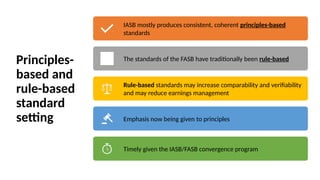
Principles-
based and
rule-based
standard
setting
IASB mostly produces consistent, coherent principles-based
standards
The standards of the FASB have traditionally been rule-based
Rule-based standards may increase comparability and verifiability
and may reduce earnings management
Emphasis now being given to principles
Timely given the IASB/FASB convergence program
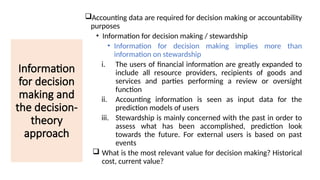
Information
for decision
making and
the decision-
theory
approach
Accounting data are required for decision making or accountability
purposes
• Information for decision making / stewardship
• Information for decision making implies more than
information on stewardship
i. The users of financial information are greatly expanded to
include all resource providers, recipients of goods and
services and parties performing a review or oversight
function
ii. Accounting information is seen as input data for the
prediction models of users
iii. Stewardship is mainly concerned with the past in order to
assess what has been accomplished, prediction look
towards the future. For external users is based on past
events
 What is the most relevant value for decision making? Historical
cost, current value?
SAM/UITM/PA
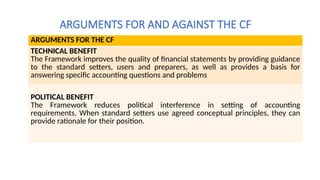
ARGUMENTS FOR AND AGAINST THE CF
ARGUMENTS FOR THE CF
TECHNICAL BENEFIT
The Framework improves the quality of financial statements by providing guidance
to the standard setters, users and preparers, as well as provides a basis for
answering specific accounting questions and problems
POLITICAL BENEFIT
The Framework reduces political interference in setting of accounting
requirements. When standard setters use agreed conceptual principles, they can
provide rationale for their position.
ARGUMENTS FOR AND AGAINST THE CF
ARGUMENTS AGAINST THE CF
THE FRAMEWORK DOES NOT WORK IN PRACTICE
The Framework’s principles and definitions are abstract and unclear. For example, the definition of assets and liabilities
are rather vague, and the recognition criteria are based on the subjective concept of “probability”.
In addition, the qualitative characteristics of the financial information do not provide a clear guideline due to
inconsistency and opportunistic reporting.
Also, the measurement is based on unspecified rules. The current Framework simply acknowledges that a variety of
measurement bases (such as historical cost, current cost, net realisable value, etc.) is used in financial reports, but does
not include principles for selecting the measurement
THE FRAMEWORK IS TOO DESCRIPTIVE
The current Framework simply describes existing practice. This indicates that political process prevails in the
development of the Framework.
In other words, it is likely that political persuasion, pressure and conflict will affect the development of the Framework.
Some critics also view the Framework as policy documents based on professional values and self-interest. The accounting
profession is perceived as seeking to maintain its positions in social acceptance and economic power
Chapter 1
The Objective of General Purpose
Financial Reporting
 The objective is to provide financial information about the reporting entity that is
useful to existing and potential investors, lenders, and other creditors in making
decisions relating to provide resources to the entity.
 In more detail: The objective of financial statements is to provide financial information
about the reporting entity’s assets, liabilities, equity, income and expenses that is
useful to users of financials statements in assessing the prospects for future net cash
flows to the reporting entity and is assessing management’s stewardship of the
entity’s economic resources.
 Primary users - existing and potential investors, lenders, and other creditors that
provide resources to the entity.
 General purpose reports are NOT designed to show the value of the reporting
entity but to provide information to help primary users in estimating the value of
the reporting entity.
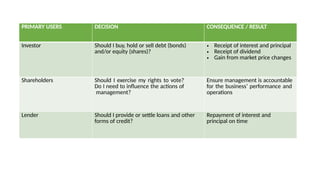
PRIMARY USERS DECISION CONSEQUENCE / RESULT
Investor Should I buy, hold or sell debt (bonds)
and/or equity (shares)?
• Receipt of interest and principal
• Receipt of dividend
• Gain from market price changes
Shareholders Should I exercise my rights to vote?
Do I need to influence the actions of
management?
Ensure management is accountable
for the business’ performance and
operations
Lender Should I provide or settle loans and other
forms of credit?
Repayment of interest and
principal on time
Information from Financial Reporting
Economic resources and claims
Changes in economic resources and claims (result from the entity’s financial
performance)
Financial performance reflected by accruals accounting (Accrual accounting depicts
the effects of transactions and other events and circumstances on a reporting entity’s economic
resources and claims in the periods in which those effects occur, even if the resulting cash receipts
and payments occur in a different period)
Financial performance reflected by past cash flows
Changes in economic resources and claim not resulting from financial
performance (such as issuing debt or equity instruments)
Chapter 2
Qualitative Characteristics of Useful
Financial Information
Two main types of Qualitative Characteristics of Useful Financial
Information:
 Fundamental – It is necessary in order for the financial information to
be useful. Without this, the financial information can be considered
not useful.
 Enhancing – To improve the usefulness of the financial
information. Without this, the financial information is still useful.
To be useful, financial statement must relevance and faithful
representation.
Enhancing qualitative characteristics should be maximised to the
extent possible
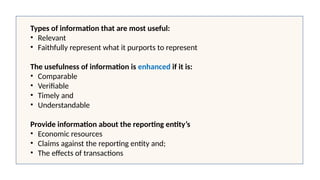
Types of information that are most useful:
• Relevant
• Faithfully represent what it purports to represent
The usefulness of information is enhanced if it is:
• Comparable
• Verifiable
• Timely and
• Understandable
Provide information about the reporting entity’s
• Economic resources
• Claims against the reporting entity and;
• The effects of transactions
Materiality
Information is material if omitting it or misstating it could influence decisions that the primary
users of general purpose financial reports make on the basis of those reports, which provide
financial information about a specific reporting entity.
Materiality is an entity-specific aspect of relevance based on the nature or magnitude, or both,
of the items to which the information relates in the context of an individual entity’s financial
report.
Consequently, the Board cannot specify a uniform quantitative threshold for materiality or
predetermine what could be material in a particular situation.
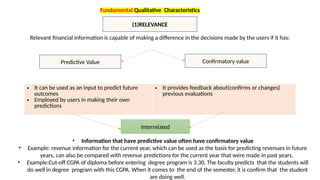
(1)RELEVANCE
Relevant financial information is capable of making a difference in the decisions made by the users if it has:
Predictive Value Confirmatory value
• It can be used as an input to predict future
outcomes
• Employed by users in making their own
predictions
• It provides feedback about(confirms or changes)
previous evaluations
Interrelated
• Information that have predictive value often have confirmatory value
• Example: revenue information for the current year, which can be used as the basis for predicting revenues in future
years, can also be compared with revenue predictions for the current year that were made in past years.
• Example:Cut-off CGPA of diploma before entering degree program is 3.30. The faculty predicts that the students will
do well in degree program with this CGPA. When it comes to the end of the semester, it is confirm that the student
are doing well.
Fundamental Qualitative Characteristics
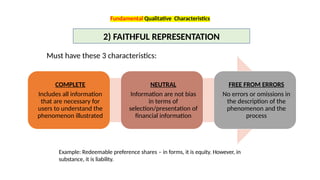
2) FAITHFUL REPRESENTATION
Must have these 3 characteristics:
COMPLETE
Includes all information
that are necessary for
users to understand the
phenomenon illustrated
NEUTRAL
Information are not bias
in terms of
selection/presentation of
financial information
FREE FROM ERRORS
No errors or omissions in
the description of the
phenomenon and the
process
Example: Redeemable preference shares – in forms, it is equity. However, in
substance, it is liability.
Fundamental Qualitative Characteristics
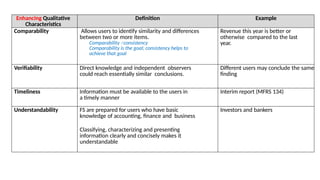
Enhancing Qualitative
Characteristics
Definition Example
Comparability Allows users to identify similarity and differences
between two or more items.
Comparability ≠consistency
Comparability is the goal; consistency helps to
achieve that goal
Revenue this year is better or
otherwise compared to the last
year.
Verifiability Direct knowledge and independent observers
could reach essentially similar conclusions.
Different users may conclude the same
finding
Timeliness Information must be available to the users in
a timely manner
Interim report (MFRS 134)
Understandability FS are prepared for users who have basic
knowledge of accounting, finance and business
Classifying, characterizing and presenting
information clearly and concisely makes it
understandable
Investors and bankers
Chapter 3
Financial Statements and the
Reporting Entity
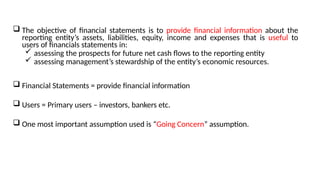
 The objective of financial statements is to provide financial information about the
reporting entity’s assets, liabilities, equity, income and expenses that is useful to
users of financials statements in:
 assessing the prospects for future net cash flows to the reporting entity
 assessing management’s stewardship of the entity’s economic resources.
 Financial Statements = provide financial information
 Users = Primary users – investors, bankers etc.
 One most important assumption used is “Going Concern” assumption.
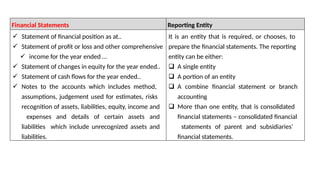
Financial Statements Reporting Entity
 Statement of financial position as at..
 Statement of profit or loss and other comprehensive
 income for the year ended …
 Statement of changes in equity for the year ended..
 Statement of cash flows for the year ended..
 Notes to the accounts which includes method,
assumptions, judgement used for estimates, risks
recognition of assets, liabilities, equity, income and
expenses and details of certain assets and
liabilities which include unrecognized assets and
liabilities.
It is an entity that is required, or chooses, to
prepare the financial statements. The reporting
entity can be either:
 A single entity
 A portion of an entity
 A combine financial statement or branch
accounting
 More than one entity, that is consolidated
financial statements – consolidated financial
statements of parent and subsidiaries’
financial statements.
Chapter 4
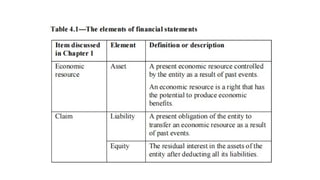
The Elements of Financial
Statements
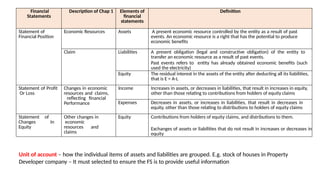
Financial
Statements
Description of Chap 1 Elements of
financial
statements
Definition
Statement of
Financial Position
Economic Resources Assets A present economic resource controlled by the entity as a result of past
events. An economic resource is a right that has the potential to produce
economic benefits
Claim Liabilities A present obligation (legal and constructive obligation) of the entity to
transfer an economic resource as a result of past events.
Past events refers to entity has already obtained economic benefits (such
used the electricity)
Equity The residual interest in the assets of the entity after deducting all its liabilities,
that is E = A-L
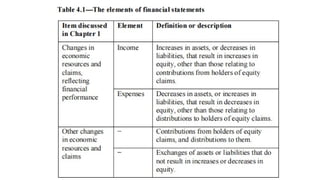
Statement of Profit
Or Loss
Changes in economic
resources and claims,
reflecting financial
Performance
Income Increases in assets, or decreases in liabilities, that result in increases in equity,
other than those relating to contributions from holders of equity claims
Expenses Decreases in assets, or increases in liabilities, that result in decreases in
equity, other than those relating to distributions to holders of equity claims
Statement of
Changes In
Equity
Other changes in
economic
resources and
claims
Equity Contributions from holders of equity claims, and distributions to them.
Exchanges of assets or liabilities that do not result in increases or decreases in
equity
Unit of account – how the individual items of assets and liabilities are grouped. E.g. stock of houses in Property
Developer company – It must selected to ensure the FS is to provide useful information
Chapter 5
Recognition and Derecognition
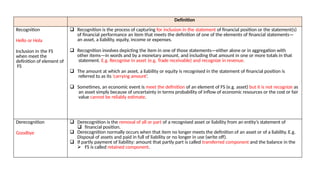
Definition
Recognition
Hello or Hola
Inclusion in the FS
when meet the
definition of element of
FS
 Recognition is the process of capturing for inclusion in the statement of financial position or the statement(s)
of financial performance an item that meets the definition of one of the elements of financial statements—
an asset, a liability, equity, income or expenses.
 Recognition involves depicting the item in one of those statements—either alone or in aggregation with
other items—in words and by a monetary amount, and including that amount in one or more totals in that
statement. E.g. Recognise in asset (e.g. Trade receivable) and recognize in revenue.
 The amount at which an asset, a liability or equity is recognised in the statement of financial position is
referred to as its ‘carrying amount’.
 Sometimes, an economic event is meet the definition of an element of FS (e.g. asset) but it is not recognize as
an asset simply because of uncertainty in terms probability of inflow of economic resources or the cost or fair
value cannot be reliably estimate.
Derecognition
Goodbye
 Derecognition is the removal of all or part of a recognised asset or liability from an entity’s statement of
 financial position.
 Derecognition normally occurs when that item no longer meets the definition of an asset or of a liability. E.g.
Disposal of assets and paid in full of liability or no longer in use (write off).
 If partly payment of liability: amount that partly part is called transferred component and the balance in the
 FS is called retained component.
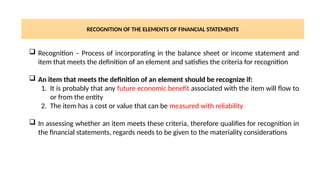
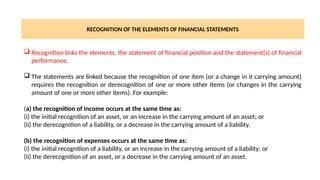
RECOGNITION OF THE ELEMENTS OF FINANCIAL STATEMENTS
 Recognition – Process of incorporating in the balance sheet or income statement and
item that meets the definition of an element and satisfies the criteria for recognition
 An item that meets the definition of an element should be recognize if:
1. It is probably that any future economic benefit associated with the item will flow to
or from the entity
2. The item has a cost or value that can be measured with reliability
 In assessing whether an item meets these criteria, therefore qualifies for recognition in
the financial statements, regards needs to be given to the materiality considerations
RECOGNITION OF THE ELEMENTS OF FINANCIAL STATEMENTS
 Recognition links the elements, the statement of financial position and the statement(s) of financial
performance.
 The statements are linked because the recognition of one item (or a change in it carrying amount)
requires the recognition or derecognition of one or more other items (or changes in the carrying
amount of one or more other items). For example:
(a) the recognition of income occurs at the same time as:
(i) the initial recognition of an asset, or an increase in the carrying amount of an asset; or
(ii) the derecognition of a liability, or a decrease in the carrying amount of a liability.
(b) the recognition of expenses occurs at the same time as:
(i) the initial recognition of a liability, or an increase in the carrying amount of a liability; or
(ii) the derecognition of an asset, or a decrease in the carrying amount of an asset.
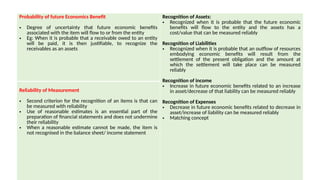
Probability of future Economics Benefit
• Degree of uncertainty that future economic benefits
associated with the item will flow to or from the entity
• Eg: When it is probable that a receivable owed to an entity
will be paid, it is then justifiable, to recognize the
receivables as an assets
Recognition of Assets:
• Recognized when it is probable that the future economic
benefits will flow to the entity and the assets has a
cost/value that can be measured reliably
Recognition of Liabilities
• Recognized when it is probable that an outflow of resources
embodying economic benefits will result from the
settlement of the present obligation and the amount at
which the settlement will take place can be measured
reliably
Recognition of income
• Increase in future economic benefits related to an increase
in asset/decrease of that liability can be measured reliably
Recognition of Expenses
• Decrease in future economic benefits related to decrease in
asset/increase of liability can be measured reliably
• Matching concept
Reliability of Measurement
• Second criterion for the recognition of an items is that can
be measured with reliability
• Use of reasonable estimates is an essential part of the
preparation of financial statements and does not undermine
their reliability
• When a reasonable estimate cannot be made, the item is
not recognised in the balance sheet/ income statement
Chapter 6
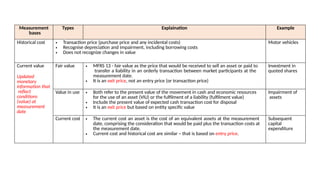
Measurement
Measurement
bases
Types Explaination Example
Historical cost • Transaction price (purchase price and any incidental costs)
• Recognise depreciation and impairment, including borrowing costs
• Does not recognize changes in value
Motor vehicles
Current value
Updated
monetary
information that
reflect
conditions
(value) at
measurement
date
Fair value • MFRS 13 - fair value as the price that would be received to sell an asset or paid to
transfer a liability in an orderly transaction between market participants at the
measurement date.
• It is an exit price, not an entry price (or transaction price)
Investment in
quoted shares
Value in use • Both refer to the present value of the movement in cash and economic resources
for the use of an asset (VIU) or the fulfilment of a liability (fulfilment value)
• Include the present value of expected cash transaction cost for disposal
• It is an exit price but based on entity specific value
Impairment of
assets
Current cost • The current cost an asset is the cost of an equivalent assets at the measurement
date, comprising the consideration that would be paid plus the transaction costs at
the measurement date.
• Current cost and historical cost are similar – that is based on entry price.
Subsequent
capital
expenditure
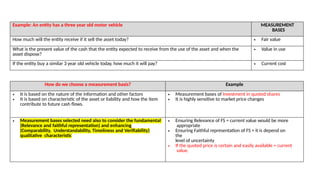
Example: An entity has a three year old motor vehicle MEASUREMENT
BASES
How much will the entity receive if it sell the asset today? • Fair value
What is the present value of the cash that the entity expected to receive from the use of the asset and when the
asset dispose?
• Value in use
If the entity buy a similar 3 year old vehicle today, how much it will pay? • Current cost
How do we choose a measurement basis? Example
• It is based on the nature of the information and other factors
• It is based on characteristic of the asset or liability and how the item
contribute to future cash flows.
• Measurement bases of Investment in quoted shares
• It is highly sensitive to market price changes
• Measurement bases selected need also to consider the fundamental
(Relevance and faithful representation) and enhancing
(Comparability, Understandability, Timeliness and Verifiability)
qualitative characteristic
• Ensuring Relevance of FS = current value would be more
appropriate
• Ensuring Faithful representation of FS = it is depend on
the
level of uncertainty
• If the quoted price is certain and easily available = current
value.
Chapter 7
Presentation and Disclosure
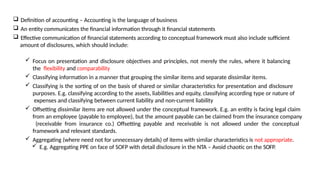
 Definition of accounting – Accounting is the language of business
 An entity communicates the financial information through it financial statements
 Effective communication of financial statements according to conceptual framework must also include sufficient
amount of disclosures, which should include:
 Focus on presentation and disclosure objectives and principles, not merely the rules, where it balancing
the flexibility and comparability
 Classifying information in a manner that grouping the similar items and separate dissimilar items.
 Classifying is the sorting of on the basis of shared or similar characteristics for presentation and disclosure
purposes. E.g. classifying according to the assets, liabilities and equity, classifying according type or nature of
expenses and classifying between current liability and non-current liability
 Offsetting dissimilar items are not allowed under the conceptual framework. E.g. an entity is facing legal claim
from an employee (payable to employee), but the amount payable can be claimed from the insurance company
(receivable from insurance co.) Offsetting payable and receivable is not allowed under the conceptual
framework and relevant standards.
 Aggregating (where need not for unnecessary details) of items with similar characteristics is not appropriate.
 E.g. Aggregating PPE on face of SOFP with detail disclosure in the NTA – Avoid chaotic on the SOFP.
Chapter 8
Concept of Capital and Capital
Maintenance
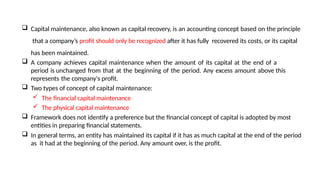
 Capital maintenance, also known as capital recovery, is an accounting concept based on the principle
that a company’s profit should only be recognized after it has fully recovered its costs, or its capital
has been maintained.
 A company achieves capital maintenance when the amount of its capital at the end of a
period is unchanged from that at the beginning of the period. Any excess amount above this
represents the company's profit.
 Two types of concept of capital maintenance:
 The financial capital maintenance
 The physical capital maintenance
 Framework does not identify a preference but the financial concept of capital is adopted by most
entities in preparing financial statements.
 In general terms, an entity has maintained its capital if it has as much capital at the end of the period
as it had at the beginning of the period. Any amount over, is the profit.
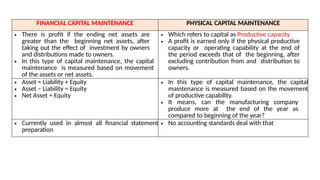
FINANCIAL CAPITAL MAINTENANCE PHYSICAL CAPITAL MAINTENANCE
• There is profit if the ending net assets are
greater than the beginning net assets, after
taking out the effect of investment by owners
and distributions made to owners.
• In this type of capital maintenance, the capital
maintenance is measured based on movement
of the assets or net assets.
• Which refers to capital as Productive capacity
• A profit is earned only if the physical productive
capacity or operating capability at the end of
the period exceeds that of the beginning, after
excluding contribution from and distribution to
owners.
• Asset = Liability + Equity
• Asset – Liability = Equity
• Net Asset = Equity
• In this type of capital maintenance, the capital
maintenance is measured based on the movement
of productive capability.
• It means, can the manufacturing company
produce more at the end of the year as
compared to beginning of the year?
• Currently used in almost all financial statement
preparation
• No accounting standards deal with that
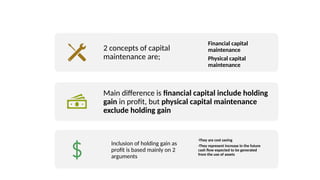
CONCEPT OF CAPITAL MAINTENANCE
2 concepts of capital
maintenance are;
Financial capital
maintenance
Physical capital
maintenance
Main difference is financial capital include holding
gain in profit, but physical capital maintenance
exclude holding gain
Inclusion of holding gain as
profit is based mainly on 2
arguments
-They are cost saving
-They represent increase in the future
cash flow expected to be generated
from the use of assets
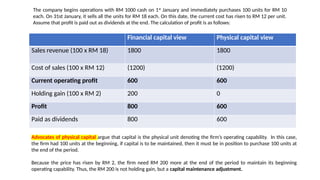
Financial capital view Physical capital view
Sales revenue (100 x RM 18) 1800 1800
Cost of sales (100 x RM 12) (1200) (1200)
Current operating profit 600 600
Holding gain (100 x RM 2) 200 0
Profit 800 600
Paid as dividends 800 600
The company begins operations with RM 1000 cash on 1st
January and immediately purchases 100 units for RM 10
each. On 31st January, it sells all the units for RM 18 each. On this date, the current cost has risen to RM 12 per unit.
Assume that profit is paid out as dividends at the end. The calculation of profit is as follows:
Advocates of physical capital argue that capital is the physical unit denoting the firm’s operating capability. In this case,
the firm had 100 units at the beginning, if capital is to be maintained, then it must be in position to purchase 100 units at
the end of the period.
Because the price has risen by RM 2, the firm need RM 200 more at the end of the period to maintain its beginning
operating capability. Thus, the RM 200 is not holding gain, but a capital maintenance adjustment.
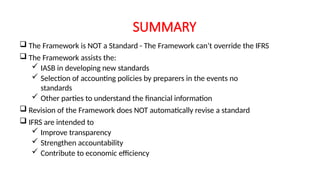
SUMMARY
 The Framework is NOT a Standard - The Framework can’t override the IFRS
 The Framework assists the:
 IASB in developing new standards
 Selection of accounting policies by preparers in the events no
standards
 Other parties to understand the financial information
 Revision of the Framework does NOT automatically revise a standard
 IFRS are intended to
 Improve transparency
 Strengthen accountability
 Contribute to economic efficiency
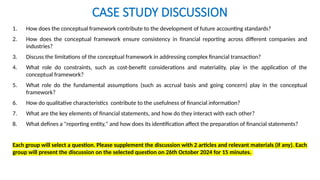
CASE STUDY DISCUSSION
1. How does the conceptual framework contribute to the development of future accounting standards?
2. How does the conceptual framework ensure consistency in financial reporting across different companies and
industries?
3. Discuss the limitations of the conceptual framework in addressing complex financial transaction?
4. What role do constraints, such as cost-benefit considerations and materiality, play in the application of the
conceptual framework?
5. What role do the fundamental assumptions (such as accrual basis and going concern) play in the conceptual
framework?
6. How do qualitative characteristics contribute to the usefulness of financial information?
7. What are the key elements of financial statements, and how do they interact with each other?
8. What defines a "reporting entity," and how does its identification affect the preparation of financial statements?
Each group will select a question. Please supplement the discussion with 2 articles and relevant materials (if any). Each
group will present the discussion on the selected question on 26th October 2024 for 15 minutes.

NOTE-CONCEPTUAL FRAMEWORK.pptx FOR EDUCATION

  • 1.
    CONCEPTUAL FRAMEWORK FORFINANCIAL ACCOUNTING
  • 2.
    By the endof this lesson, you shall be able to understand:  Objectives of financial reporting Qualitative characteristics of financial reporting Underlying principles, concepts and assumption of financial reporting Definition, recognition and measurement of the elements in financial statements
  • 3.
    What is ConceptualFramework (CF)? In simple word, CF is a basic document that sets objectives and the concepts for general purpose financial reporting. Framework is NOT a Standard itself. In most cases, when there are no specific rules for your transaction and you need to develop your accounting policy, then you would look to the CF as you cannot depart from its basic principles and definitions … a coherent system of interrelated objectives and fundamentals that is expected to lead to consistent standards and that prescribes the nature, function and limits of financial accounting and reporting.
  • 5.
    The need forconceptual framework Assist accounting standards setter in standard setting Provide a basis for selection of alternative principles Provide a basis for reconciling any differences Assist preparers in absence of standards Assists auditors in forming opinions Assist users in interpreting financial statements Provide transparency in standard setting Facilitate communication
  • 6.
    DEVELOPMENT OF ACONCEPTUAL FRAMEWORK FOR FINANCIAL REPORTING
  • 9.
    Conceptual Framework forFinancial Reporting  1989 – Framework for the preparation and presentation of financial statement  2010 – Conceptual Framework for Financial Reporting 2010  2018 – Conceptual Framework for Financial Reporting 2018
  • 10.
    Why did werevise the Conceptual Framework? Previous version of Conceptual Framework useful but some improvements needed incomplete out of date unclear Main improvements Filled in the gaps, for example, concepts on measurement and presentation and disclosure, including guidance on the use of profit or loss and OCI Clarified, for example, the roles of stewardship and prudence in financial reporting Updated, for example, the definitions of an asset and a liability and recognition criteria
  • 11.
    Relationship: Conceptual FrameworkVs Accounting Standards Figure 2.1 - The relationship between the CF and Accounting Standards  The principles in the CF are general concepts – designed to provide guidance and apply to a wide range of decisions relating to the preparation of financial reports.  Accounting standards provide specific requirements for a particular area of financial reporting.  E.g. The CF defines what an asset is and when it should be included in the financial statements and measurement models available.  E.g. MFRS 116 PPE outline the definition of PPE and measurement model to be adopted and what cost are included.
  • 12.
  • 13.
    Bird’s Eye Viewof the 2018 Conceptual Framework (Adapted Tong, T.L., 2019) Ch1 Ch2 Ch3 Ch4 Ch5 Ch6 Ch7 Ch8 Objective of financial reporting - To provide useful information to existing and potential investors, lenders and other creditors Fundamental Qualitative Characteristics Relevance - predictive value and confirmatory value. Materiality consideration Faithful Representation - completeness, neutrality and free from error Enhancing Qualitative Characteristics Comparability - Consistency Verifiability Timeliness Understandability Financial Statements & The reporting entity - Single entity or Group of entity & Going Concern Assumption The Elements of Financial Statement Financial Position Financial Performance Assets Liabilities Equity Income Expenses OCI Recognition of the Elements Measurement of the Elements Presentation and Disclosure Concept of Capital and Capital Maintenance
  • 14.
    DEVELOPING A CONCEPTUAL FRAMEWORK The developmentof conceptual frameworks is influenced by two key issues: 1. Principles and rules-based approaches to standard setting 2. Information for decision making and the decision-theory approach
  • 15.
    Principles- based and rule-based standard setting IASB mostlyproduces consistent, coherent principles-based standards The standards of the FASB have traditionally been rule-based Rule-based standards may increase comparability and verifiability and may reduce earnings management Emphasis now being given to principles Timely given the IASB/FASB convergence program
  • 16.
    Information for decision making and thedecision- theory approach Accounting data are required for decision making or accountability purposes • Information for decision making / stewardship • Information for decision making implies more than information on stewardship i. The users of financial information are greatly expanded to include all resource providers, recipients of goods and services and parties performing a review or oversight function ii. Accounting information is seen as input data for the prediction models of users iii. Stewardship is mainly concerned with the past in order to assess what has been accomplished, prediction look towards the future. For external users is based on past events  What is the most relevant value for decision making? Historical cost, current value? SAM/UITM/PA
  • 17.
    ARGUMENTS FOR ANDAGAINST THE CF ARGUMENTS FOR THE CF TECHNICAL BENEFIT The Framework improves the quality of financial statements by providing guidance to the standard setters, users and preparers, as well as provides a basis for answering specific accounting questions and problems POLITICAL BENEFIT The Framework reduces political interference in setting of accounting requirements. When standard setters use agreed conceptual principles, they can provide rationale for their position.
  • 18.
    ARGUMENTS FOR ANDAGAINST THE CF ARGUMENTS AGAINST THE CF THE FRAMEWORK DOES NOT WORK IN PRACTICE The Framework’s principles and definitions are abstract and unclear. For example, the definition of assets and liabilities are rather vague, and the recognition criteria are based on the subjective concept of “probability”. In addition, the qualitative characteristics of the financial information do not provide a clear guideline due to inconsistency and opportunistic reporting. Also, the measurement is based on unspecified rules. The current Framework simply acknowledges that a variety of measurement bases (such as historical cost, current cost, net realisable value, etc.) is used in financial reports, but does not include principles for selecting the measurement THE FRAMEWORK IS TOO DESCRIPTIVE The current Framework simply describes existing practice. This indicates that political process prevails in the development of the Framework. In other words, it is likely that political persuasion, pressure and conflict will affect the development of the Framework. Some critics also view the Framework as policy documents based on professional values and self-interest. The accounting profession is perceived as seeking to maintain its positions in social acceptance and economic power
  • 20.
    Chapter 1 The Objectiveof General Purpose Financial Reporting
  • 21.
     The objectiveis to provide financial information about the reporting entity that is useful to existing and potential investors, lenders, and other creditors in making decisions relating to provide resources to the entity.  In more detail: The objective of financial statements is to provide financial information about the reporting entity’s assets, liabilities, equity, income and expenses that is useful to users of financials statements in assessing the prospects for future net cash flows to the reporting entity and is assessing management’s stewardship of the entity’s economic resources.  Primary users - existing and potential investors, lenders, and other creditors that provide resources to the entity.  General purpose reports are NOT designed to show the value of the reporting entity but to provide information to help primary users in estimating the value of the reporting entity.
  • 22.
    PRIMARY USERS DECISIONCONSEQUENCE / RESULT Investor Should I buy, hold or sell debt (bonds) and/or equity (shares)? • Receipt of interest and principal • Receipt of dividend • Gain from market price changes Shareholders Should I exercise my rights to vote? Do I need to influence the actions of management? Ensure management is accountable for the business’ performance and operations Lender Should I provide or settle loans and other forms of credit? Repayment of interest and principal on time
  • 23.
    Information from FinancialReporting Economic resources and claims Changes in economic resources and claims (result from the entity’s financial performance) Financial performance reflected by accruals accounting (Accrual accounting depicts the effects of transactions and other events and circumstances on a reporting entity’s economic resources and claims in the periods in which those effects occur, even if the resulting cash receipts and payments occur in a different period) Financial performance reflected by past cash flows Changes in economic resources and claim not resulting from financial performance (such as issuing debt or equity instruments)
  • 24.
    Chapter 2 Qualitative Characteristicsof Useful Financial Information
  • 25.
    Two main typesof Qualitative Characteristics of Useful Financial Information:  Fundamental – It is necessary in order for the financial information to be useful. Without this, the financial information can be considered not useful.  Enhancing – To improve the usefulness of the financial information. Without this, the financial information is still useful. To be useful, financial statement must relevance and faithful representation. Enhancing qualitative characteristics should be maximised to the extent possible
  • 26.
    Types of informationthat are most useful: • Relevant • Faithfully represent what it purports to represent The usefulness of information is enhanced if it is: • Comparable • Verifiable • Timely and • Understandable Provide information about the reporting entity’s • Economic resources • Claims against the reporting entity and; • The effects of transactions
  • 27.
    Materiality Information is materialif omitting it or misstating it could influence decisions that the primary users of general purpose financial reports make on the basis of those reports, which provide financial information about a specific reporting entity. Materiality is an entity-specific aspect of relevance based on the nature or magnitude, or both, of the items to which the information relates in the context of an individual entity’s financial report. Consequently, the Board cannot specify a uniform quantitative threshold for materiality or predetermine what could be material in a particular situation.
  • 28.
    (1)RELEVANCE Relevant financial informationis capable of making a difference in the decisions made by the users if it has: Predictive Value Confirmatory value • It can be used as an input to predict future outcomes • Employed by users in making their own predictions • It provides feedback about(confirms or changes) previous evaluations Interrelated • Information that have predictive value often have confirmatory value • Example: revenue information for the current year, which can be used as the basis for predicting revenues in future years, can also be compared with revenue predictions for the current year that were made in past years. • Example:Cut-off CGPA of diploma before entering degree program is 3.30. The faculty predicts that the students will do well in degree program with this CGPA. When it comes to the end of the semester, it is confirm that the student are doing well. Fundamental Qualitative Characteristics
  • 29.
    2) FAITHFUL REPRESENTATION Musthave these 3 characteristics: COMPLETE Includes all information that are necessary for users to understand the phenomenon illustrated NEUTRAL Information are not bias in terms of selection/presentation of financial information FREE FROM ERRORS No errors or omissions in the description of the phenomenon and the process Example: Redeemable preference shares – in forms, it is equity. However, in substance, it is liability. Fundamental Qualitative Characteristics
  • 30.
    Enhancing Qualitative Characteristics Definition Example ComparabilityAllows users to identify similarity and differences between two or more items. Comparability ≠consistency Comparability is the goal; consistency helps to achieve that goal Revenue this year is better or otherwise compared to the last year. Verifiability Direct knowledge and independent observers could reach essentially similar conclusions. Different users may conclude the same finding Timeliness Information must be available to the users in a timely manner Interim report (MFRS 134) Understandability FS are prepared for users who have basic knowledge of accounting, finance and business Classifying, characterizing and presenting information clearly and concisely makes it understandable Investors and bankers
  • 31.
    Chapter 3 Financial Statementsand the Reporting Entity
  • 32.
     The objectiveof financial statements is to provide financial information about the reporting entity’s assets, liabilities, equity, income and expenses that is useful to users of financials statements in:  assessing the prospects for future net cash flows to the reporting entity  assessing management’s stewardship of the entity’s economic resources.  Financial Statements = provide financial information  Users = Primary users – investors, bankers etc.  One most important assumption used is “Going Concern” assumption.
  • 33.
    Financial Statements ReportingEntity  Statement of financial position as at..  Statement of profit or loss and other comprehensive  income for the year ended …  Statement of changes in equity for the year ended..  Statement of cash flows for the year ended..  Notes to the accounts which includes method, assumptions, judgement used for estimates, risks recognition of assets, liabilities, equity, income and expenses and details of certain assets and liabilities which include unrecognized assets and liabilities. It is an entity that is required, or chooses, to prepare the financial statements. The reporting entity can be either:  A single entity  A portion of an entity  A combine financial statement or branch accounting  More than one entity, that is consolidated financial statements – consolidated financial statements of parent and subsidiaries’ financial statements.
  • 34.
    Chapter 4 The Elementsof Financial Statements
  • 35.
    Financial Statements Description of Chap1 Elements of financial statements Definition Statement of Financial Position Economic Resources Assets A present economic resource controlled by the entity as a result of past events. An economic resource is a right that has the potential to produce economic benefits Claim Liabilities A present obligation (legal and constructive obligation) of the entity to transfer an economic resource as a result of past events. Past events refers to entity has already obtained economic benefits (such used the electricity) Equity The residual interest in the assets of the entity after deducting all its liabilities, that is E = A-L Statement of Profit Or Loss Changes in economic resources and claims, reflecting financial Performance Income Increases in assets, or decreases in liabilities, that result in increases in equity, other than those relating to contributions from holders of equity claims Expenses Decreases in assets, or increases in liabilities, that result in decreases in equity, other than those relating to distributions to holders of equity claims Statement of Changes In Equity Other changes in economic resources and claims Equity Contributions from holders of equity claims, and distributions to them. Exchanges of assets or liabilities that do not result in increases or decreases in equity Unit of account – how the individual items of assets and liabilities are grouped. E.g. stock of houses in Property Developer company – It must selected to ensure the FS is to provide useful information
  • 38.
  • 39.
    Definition Recognition Hello or Hola Inclusionin the FS when meet the definition of element of FS  Recognition is the process of capturing for inclusion in the statement of financial position or the statement(s) of financial performance an item that meets the definition of one of the elements of financial statements— an asset, a liability, equity, income or expenses.  Recognition involves depicting the item in one of those statements—either alone or in aggregation with other items—in words and by a monetary amount, and including that amount in one or more totals in that statement. E.g. Recognise in asset (e.g. Trade receivable) and recognize in revenue.  The amount at which an asset, a liability or equity is recognised in the statement of financial position is referred to as its ‘carrying amount’.  Sometimes, an economic event is meet the definition of an element of FS (e.g. asset) but it is not recognize as an asset simply because of uncertainty in terms probability of inflow of economic resources or the cost or fair value cannot be reliably estimate. Derecognition Goodbye  Derecognition is the removal of all or part of a recognised asset or liability from an entity’s statement of  financial position.  Derecognition normally occurs when that item no longer meets the definition of an asset or of a liability. E.g. Disposal of assets and paid in full of liability or no longer in use (write off).  If partly payment of liability: amount that partly part is called transferred component and the balance in the  FS is called retained component.
  • 40.
    RECOGNITION OF THEELEMENTS OF FINANCIAL STATEMENTS  Recognition – Process of incorporating in the balance sheet or income statement and item that meets the definition of an element and satisfies the criteria for recognition  An item that meets the definition of an element should be recognize if: 1. It is probably that any future economic benefit associated with the item will flow to or from the entity 2. The item has a cost or value that can be measured with reliability  In assessing whether an item meets these criteria, therefore qualifies for recognition in the financial statements, regards needs to be given to the materiality considerations
  • 41.
    RECOGNITION OF THEELEMENTS OF FINANCIAL STATEMENTS  Recognition links the elements, the statement of financial position and the statement(s) of financial performance.  The statements are linked because the recognition of one item (or a change in it carrying amount) requires the recognition or derecognition of one or more other items (or changes in the carrying amount of one or more other items). For example: (a) the recognition of income occurs at the same time as: (i) the initial recognition of an asset, or an increase in the carrying amount of an asset; or (ii) the derecognition of a liability, or a decrease in the carrying amount of a liability. (b) the recognition of expenses occurs at the same time as: (i) the initial recognition of a liability, or an increase in the carrying amount of a liability; or (ii) the derecognition of an asset, or a decrease in the carrying amount of an asset.
  • 42.
    Probability of futureEconomics Benefit • Degree of uncertainty that future economic benefits associated with the item will flow to or from the entity • Eg: When it is probable that a receivable owed to an entity will be paid, it is then justifiable, to recognize the receivables as an assets Recognition of Assets: • Recognized when it is probable that the future economic benefits will flow to the entity and the assets has a cost/value that can be measured reliably Recognition of Liabilities • Recognized when it is probable that an outflow of resources embodying economic benefits will result from the settlement of the present obligation and the amount at which the settlement will take place can be measured reliably Recognition of income • Increase in future economic benefits related to an increase in asset/decrease of that liability can be measured reliably Recognition of Expenses • Decrease in future economic benefits related to decrease in asset/increase of liability can be measured reliably • Matching concept Reliability of Measurement • Second criterion for the recognition of an items is that can be measured with reliability • Use of reasonable estimates is an essential part of the preparation of financial statements and does not undermine their reliability • When a reasonable estimate cannot be made, the item is not recognised in the balance sheet/ income statement
  • 43.
  • 44.
    Measurement bases Types Explaination Example Historicalcost • Transaction price (purchase price and any incidental costs) • Recognise depreciation and impairment, including borrowing costs • Does not recognize changes in value Motor vehicles Current value Updated monetary information that reflect conditions (value) at measurement date Fair value • MFRS 13 - fair value as the price that would be received to sell an asset or paid to transfer a liability in an orderly transaction between market participants at the measurement date. • It is an exit price, not an entry price (or transaction price) Investment in quoted shares Value in use • Both refer to the present value of the movement in cash and economic resources for the use of an asset (VIU) or the fulfilment of a liability (fulfilment value) • Include the present value of expected cash transaction cost for disposal • It is an exit price but based on entity specific value Impairment of assets Current cost • The current cost an asset is the cost of an equivalent assets at the measurement date, comprising the consideration that would be paid plus the transaction costs at the measurement date. • Current cost and historical cost are similar – that is based on entry price. Subsequent capital expenditure
  • 45.
    Example: An entityhas a three year old motor vehicle MEASUREMENT BASES How much will the entity receive if it sell the asset today? • Fair value What is the present value of the cash that the entity expected to receive from the use of the asset and when the asset dispose? • Value in use If the entity buy a similar 3 year old vehicle today, how much it will pay? • Current cost How do we choose a measurement basis? Example • It is based on the nature of the information and other factors • It is based on characteristic of the asset or liability and how the item contribute to future cash flows. • Measurement bases of Investment in quoted shares • It is highly sensitive to market price changes • Measurement bases selected need also to consider the fundamental (Relevance and faithful representation) and enhancing (Comparability, Understandability, Timeliness and Verifiability) qualitative characteristic • Ensuring Relevance of FS = current value would be more appropriate • Ensuring Faithful representation of FS = it is depend on the level of uncertainty • If the quoted price is certain and easily available = current value.
  • 46.
  • 47.
     Definition ofaccounting – Accounting is the language of business  An entity communicates the financial information through it financial statements  Effective communication of financial statements according to conceptual framework must also include sufficient amount of disclosures, which should include:  Focus on presentation and disclosure objectives and principles, not merely the rules, where it balancing the flexibility and comparability  Classifying information in a manner that grouping the similar items and separate dissimilar items.  Classifying is the sorting of on the basis of shared or similar characteristics for presentation and disclosure purposes. E.g. classifying according to the assets, liabilities and equity, classifying according type or nature of expenses and classifying between current liability and non-current liability  Offsetting dissimilar items are not allowed under the conceptual framework. E.g. an entity is facing legal claim from an employee (payable to employee), but the amount payable can be claimed from the insurance company (receivable from insurance co.) Offsetting payable and receivable is not allowed under the conceptual framework and relevant standards.  Aggregating (where need not for unnecessary details) of items with similar characteristics is not appropriate.  E.g. Aggregating PPE on face of SOFP with detail disclosure in the NTA – Avoid chaotic on the SOFP.
  • 48.
    Chapter 8 Concept ofCapital and Capital Maintenance
  • 49.
     Capital maintenance,also known as capital recovery, is an accounting concept based on the principle that a company’s profit should only be recognized after it has fully recovered its costs, or its capital has been maintained.  A company achieves capital maintenance when the amount of its capital at the end of a period is unchanged from that at the beginning of the period. Any excess amount above this represents the company's profit.  Two types of concept of capital maintenance:  The financial capital maintenance  The physical capital maintenance  Framework does not identify a preference but the financial concept of capital is adopted by most entities in preparing financial statements.  In general terms, an entity has maintained its capital if it has as much capital at the end of the period as it had at the beginning of the period. Any amount over, is the profit.
  • 50.
    FINANCIAL CAPITAL MAINTENANCEPHYSICAL CAPITAL MAINTENANCE • There is profit if the ending net assets are greater than the beginning net assets, after taking out the effect of investment by owners and distributions made to owners. • In this type of capital maintenance, the capital maintenance is measured based on movement of the assets or net assets. • Which refers to capital as Productive capacity • A profit is earned only if the physical productive capacity or operating capability at the end of the period exceeds that of the beginning, after excluding contribution from and distribution to owners. • Asset = Liability + Equity • Asset – Liability = Equity • Net Asset = Equity • In this type of capital maintenance, the capital maintenance is measured based on the movement of productive capability. • It means, can the manufacturing company produce more at the end of the year as compared to beginning of the year? • Currently used in almost all financial statement preparation • No accounting standards deal with that
  • 51.
    CONCEPT OF CAPITALMAINTENANCE 2 concepts of capital maintenance are; Financial capital maintenance Physical capital maintenance Main difference is financial capital include holding gain in profit, but physical capital maintenance exclude holding gain Inclusion of holding gain as profit is based mainly on 2 arguments -They are cost saving -They represent increase in the future cash flow expected to be generated from the use of assets
  • 52.
    Financial capital viewPhysical capital view Sales revenue (100 x RM 18) 1800 1800 Cost of sales (100 x RM 12) (1200) (1200) Current operating profit 600 600 Holding gain (100 x RM 2) 200 0 Profit 800 600 Paid as dividends 800 600 The company begins operations with RM 1000 cash on 1st January and immediately purchases 100 units for RM 10 each. On 31st January, it sells all the units for RM 18 each. On this date, the current cost has risen to RM 12 per unit. Assume that profit is paid out as dividends at the end. The calculation of profit is as follows: Advocates of physical capital argue that capital is the physical unit denoting the firm’s operating capability. In this case, the firm had 100 units at the beginning, if capital is to be maintained, then it must be in position to purchase 100 units at the end of the period. Because the price has risen by RM 2, the firm need RM 200 more at the end of the period to maintain its beginning operating capability. Thus, the RM 200 is not holding gain, but a capital maintenance adjustment.
  • 53.
    SUMMARY  The Frameworkis NOT a Standard - The Framework can’t override the IFRS  The Framework assists the:  IASB in developing new standards  Selection of accounting policies by preparers in the events no standards  Other parties to understand the financial information  Revision of the Framework does NOT automatically revise a standard  IFRS are intended to  Improve transparency  Strengthen accountability  Contribute to economic efficiency
  • 54.
    CASE STUDY DISCUSSION 1.How does the conceptual framework contribute to the development of future accounting standards? 2. How does the conceptual framework ensure consistency in financial reporting across different companies and industries? 3. Discuss the limitations of the conceptual framework in addressing complex financial transaction? 4. What role do constraints, such as cost-benefit considerations and materiality, play in the application of the conceptual framework? 5. What role do the fundamental assumptions (such as accrual basis and going concern) play in the conceptual framework? 6. How do qualitative characteristics contribute to the usefulness of financial information? 7. What are the key elements of financial statements, and how do they interact with each other? 8. What defines a "reporting entity," and how does its identification affect the preparation of financial statements? Each group will select a question. Please supplement the discussion with 2 articles and relevant materials (if any). Each group will present the discussion on the selected question on 26th October 2024 for 15 minutes.