GOOD MORNING
REMINERALIZATION
AGENTS IN DENTISTRY
Dr. J. Aurlene
II year Post Graduate
Dept. Of Public Health Dentistry
SRM Dental College, Ramapuram
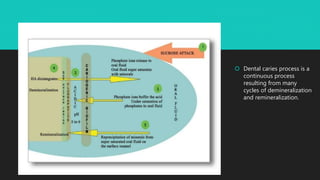
 Dental caries process is a
continuous process
resulting from many
cycles of demineralization
and remineralization.
 Fermentable carbohydrates provide plaque bacteria with substrate for acid production.
 This causes a rapid drop in plaque pH and when pH becomes less than 5.5, hydroxyapatite in
enamel breaks down and calcium and phosphate ions diffuse out from the enamel.
 5.5 is the “critical pH”, the point where equilibrium exists. There is no mineral dissolution and no
mineral precipitation.
 The plaque remains acidic for about 30-60 minutes after which normal pH is restored gradually.
The calcium and phosphate ions re-enter enamel when normal pH is restored and thus
remineralization occurs.
REMINERALIZATION
 Remineralization is defined as the process whereby calcium and phosphate ions are supplied
from an external source to the tooth thereby, causing ion deposition into crystal voids in
demineralized enamel, thus producing net mineral gain.
 Remineralization Agents - Biomimetic approaches to stabilization of bioavailable calcium,
phosphate, and fluoride ions and the localization of these ions to non-cavitated caries lesions for
controlled remineralization.
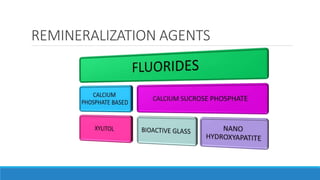
REMINERALIZATION AGENTS
Requirements of Remineralization Agents
 Should deliver calcium and phosphate into the subsurface
 Should not deliver any excess of calcium
 Should not favor calculus formation
 Should work at an acidic pH so as to stop demineralization during a carious attack
 Should work in xerostomic patients also, as saliva cannot effectively stop the carious
process
 Should be able to boost the remineralizing properties of saliva
 The novel materials should be able to show some benefits over fluoride.
INDICATIONS FOR USE
 An adjunct to preventive therapy for reducing caries in high-risk patients.
 Reduce dental erosion in patients with gastric reflux or other disorders.
 To reduce decalcification in orthodontic patients.
 To repair enamel in cases involving whitespot lesions.
 Before and after teeth whitening and to desensitize sensitive teeth.
Enamel
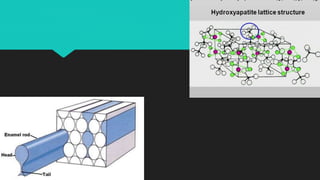
 Dental enamel is comprised chemically of approximately 96 wt% of mineral hydroxyapatite
CalO(P04)6(OH)2.
 In dental mineral, replacement of calcium ions occurs by ions such as sodium, zinc, and
strontium.
 Carbonate can occupy the phosphate positions in the lattice, and both carbonate and
fluoride may be substituted for hydroxyl ions.
 Histologically, enamel is composed of so called prisms or rods.
 The spaces between the prisms and the crystallites are filled with water and organic material.
 The spaces form the diffusion pathways for acids, mineral components, and fluoride ions.
FLUORIDES
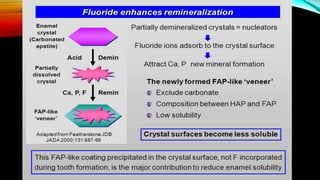
 Fluoride reduces the decay of tooth enamel by the formation of fluorapatite and its
incorporation into the dental enamel. The fluoride ions reduce the rate of tooth enamel
demineralization and increase the rate of remineralization of teeth at the early stages of cavities.
Mechanism of Action of Fluorides
 The critical pH of fluorapatite is 4.5 which is lesser than hydroxyapatite.
 Fluoride being electronegative adsorbs onto the tooth surface and attracts positively charged Ca++
ions to the tooth surface.
 In an acidic environment, fluoride ions react with hydrogen to form hydrofluoric acid. HF diffuses
into bacterial cell and interferes with the enzyme enolase. Fluoride binds to Mg++ which inhibits
conversion of 2-phosphoglycerate to PEP – phosphoenolpyruvate.
 Fluoride decreases the surface free energy of enamel and reduces bacterial adhesion to enamel
surfaces.
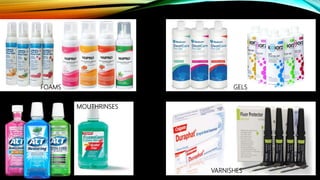
GELS
VARNISHES
FOAMS
MOUTHRINSES
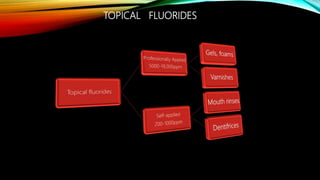
TOPICAL FLUORIDES
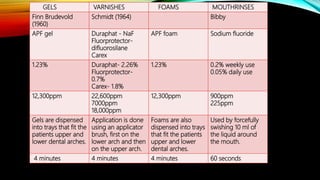
GELS VARNISHES FOAMS MOUTHRINSES
Finn Brudevold
(1960)
Schmidt (1964) Bibby
APF gel Duraphat - NaF
Fluorprotector-
difluorosilane
Carex
APF foam Sodium fluoride
1.23% Duraphat- 2.26%
Fluorprotector-
0.7%
Carex- 1.8%
1.23% 0.2% weekly use
0.05% daily use
12,300ppm 22,600ppm
7000ppm
18,000ppm
12,300ppm 900ppm
225ppm
Gels are dispensed
into trays that fit the
patients upper and
lower dental arches.
Application is done
using an applicator
brush, first on the
lower arch and then
on the upper arch.
Foams are also
dispensed into trays
that fit the patients
upper and lower
dental arches.
Used by forcefully
swishing 10 ml of
the liquid around
the mouth.
4 minutes 4 minutes 4 minutes 60 seconds
Fluoride Dentifrices
 A dentifrice is a substance used with a tooth brush for the purpose of cleaning the accessible
surfaces of the teeth.
 The first clinical trial with fluoride toothpaste was done by Bibby et al in 1942.
 Fluoride compounds present in fluoride dentifrices are sodium fluoride, amine fluoride,
monofluorophosphate and stannous fluoride.
 Most toothpastes contains between 0.22% (1,000 ppm) and 0.312% (1,450 ppm) fluoride.
 High-fluoride content toothpaste generally contains 1.1% (5,000 ppm) sodium fluoride.
 A 200g tube of Colgate contains 1000ppm of fluoride with the fluoride compound as
Monofluorophosphate.
 A single brushing with a full ribbon of paste on a brush head provides about one gram of
toothpaste and will expose the individual to approximately 1mgF.
 For young children non fluoridated and non abrasive toothpaste is recommended till the child is 4
years of age, after 6 years of age fluoridated toothpaste should be used.
Calcium Phosphate Based
Stabilised – RECALDENT (CPP ACP)
Unstabilised- ENAMELON (ACP)
Stabilised calcium phosphate system
 RECALDENT is the commercial name of the stabilised casein phosphopeptide amorphous
calcium phosphate system. (CPP-ACP)
 Prof. Eric Reynolds at the School of Dental Science at the University of Melbourne in Australia
discovered casein, a bovine milk phosphoprotein.
 This protein nanotechnology combines specific phosphoproteins from bovine milk with
nanoparticles of amorphous calcium phosphate (ACP). The precise ratio is 144 calcium ions plus
96 phosphate ions and 6 peptides of CPP.
 CPP has the ability to bind and stabilize calcium and phosphate in solution, as well as to bind to
dental plaque and tooth enamel.
 Calcium phosphate is normally insoluble, i.e. forms a crystalline structure at neutral pH. However,
the CPP maintains calcium and phosphate in an amorphous, noncrystalline state. In this
amorphous state, calcium and phosphate ions can enter the tooth enamel.
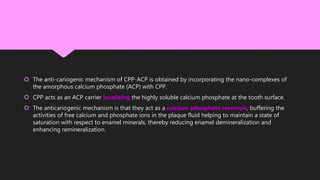
 The anti-cariogenic mechanism of CPP-ACP is obtained by incorporating the nano-complexes of
the amorphous calcium phosphate (ACP) with CPP.
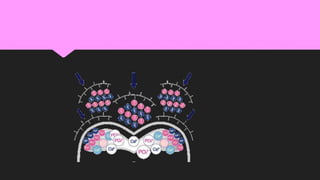
 CPP acts as an ACP carrier localizing the highly soluble calcium phosphate at the tooth surface.
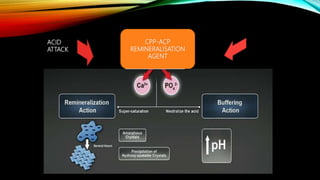
 The anticariogenic mechanism is that they act as a calcium-phosphate reservoir, buffering the
activities of free calcium and phosphate ions in the plaque fluid helping to maintain a state of
saturation with respect to enamel minerals, thereby reducing enamel demineralization and
enhancing remineralization.
CPP-ACP
REMINERALISATION
AGENT
ACID
ATTACK
Indications for Use
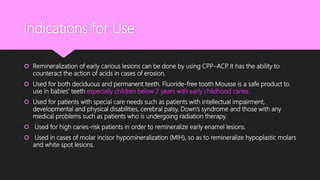
 Remineralization of early carious lesions can be done by using CPP–ACP. It has the ability to
counteract the action of acids in cases of erosion.
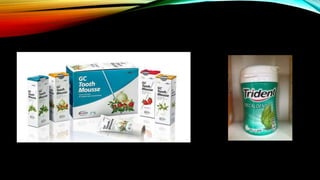
 Used for both deciduous and permanent teeth. Fluoride-free tooth Mousse is a safe product to
use in babies’ teeth especially children below 2 years with early childhood caries.
 Used for patients with special care needs such as patients with intellectual impairment,
developmental and physical disabilities, cerebral palsy, Down’s syndrome and those with any
medical problems such as patients who is undergoing radiation therapy.
 Used for high caries-risk patients in order to remineralize early enamel lesions.
 Used in cases of molar incisor hypomineralization (MIH), so as to remineralize hypoplastic molars
and white spot lesions.
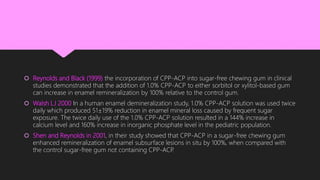
 Reynolds and Black (1999) the incorporation of CPP-ACP into sugar-free chewing gum in clinical
studies demonstrated that the addition of 1.0% CPP-ACP to either sorbitol or xylitol-based gum
can increase in enamel remineralization by 100% relative to the control gum.
 Walsh LJ 2000 In a human enamel demineralization study, 1.0% CPP-ACP solution was used twice
daily which produced 51±19% reduction in enamel mineral loss caused by frequent sugar
exposure. The twice daily use of the 1.0% CPP-ACP solution resulted in a 144% increase in
calcium level and 160% increase in inorganic phosphate level in the pediatric population.
 Shen and Reynolds in 2001, in their study showed that CPP-ACP in a sugar-free chewing gum
enhanced remineralization of enamel subsurface lesions in situ by 100%, when compared with
the control sugar-free gum not containing CPP-ACP.
Unstabilised Calcium Phosphate System
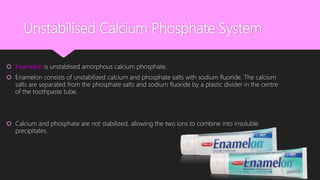
 Enamelon is unstablised amorphous calcium phosphate.
 Enamelon consists of unstabilized calcium and phosphate salts with sodium fluoride. The calcium
salts are separated from the phosphate salts and sodium fluoride by a plastic divider in the centre
of the toothpaste tube.
 Calcium and phosphate are not stabilized, allowing the two ions to combine into insoluble
precipitates.
CALCIUM SUCROSE PHOSPHATE
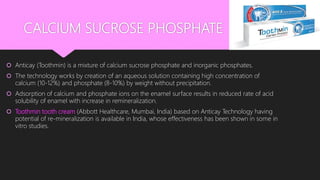
 Anticay (Toothmin) is a mixture of calcium sucrose phosphate and inorganic phosphates.
 The technology works by creation of an aqueous solution containing high concentration of
calcium (10-12%) and phosphate (8-10%) by weight without precipitation.
 Adsorption of calcium and phosphate ions on the enamel surface results in reduced rate of acid
solubility of enamel with increase in remineralization.
 Toothmin tooth cream (Abbott Healthcare, Mumbai, India) based on Anticay Technology having
potential of re-mineralization is available in India, whose effectiveness has been shown in some in
vitro studies.
BIOACTIVE GLASS
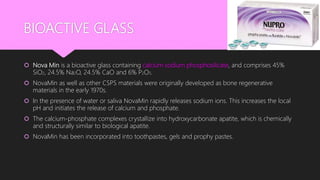
 Nova Min is a bioactive glass containing calcium sodium phosphosilicate, and comprises 45%
SiO2, 24.5% Na2O, 24.5% CaO and 6% P2O5.
 NovaMin as well as other CSPS materials were originally developed as bone regenerative
materials in the early 1970s.
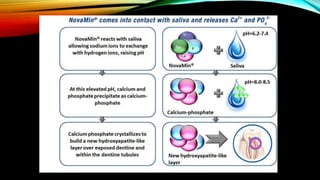
 In the presence of water or saliva NovaMin rapidly releases sodium ions. This increases the local
pH and initiates the release of calcium and phosphate.
 The calcium-phosphate complexes crystallize into hydroxycarbonate apatite, which is chemically
and structurally similar to biological apatite.
 NovaMin has been incorporated into toothpastes, gels and prophy pastes.
XYLITOL
 Xylitol is one of a number of non-sugar sweeteners permitted for use in foods throughout the
world.
 Habitual use of xylitol is associated with a significant reduction in caries incidence and increased
tooth remineralization.
 Cariogenic bacteria process xylitol very poorly, producing little acid. This decreases caries
incidence and promotes colonization of less virulent strains of bacteria that can ferment xylitol.
 A minimum of 5-6 grams and three exposures per day (from chewing gum and/or candies) is
required for clinical effect.
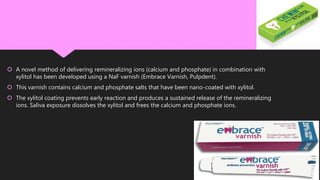
 A novel method of delivering remineralizing ions (calcium and phosphate) in combination with
xylitol has been developed using a NaF varnish (Embrace Varnish, Pulpdent).
 This varnish contains calcium and phosphate salts that have been nano-coated with xylitol.
 The xylitol coating prevents early reaction and produces a sustained release of the remineralizing
ions. Saliva exposure dissolves the xylitol and frees the calcium and phosphate ions.
NANOHYDROXYAPATITE
 The main constituents of dental hard tissue is is hydroxyapatite which is 95wt% and 75wt% for
enamel and dentin, respectively.
 The nanohydroxyapatite powder has a crystal dimension of 50-100 nm in length and 20-40 nm in
width.
 HA nanocrystals adhere to the pores created by demineralization. These adherent nanocrystals
aggregate and grow into microclusters and form a uniform apatite layer on the demineralized
surface.
Enamel surface remineralization: Using
synthetic nanohydroxyapatite
Thirty sound human premolars were divided into nanohydroxyapatite group (n = 15) and the
sodium fluoride group (n = 15). The specimens were subjected to demineralization before
being coated with 10% aqueous slurry of 20 nm nanohydroxyapatite or 2% sodium fluoride.
The remineralizing efficacy of the materials was evaluated using surface microhardness (SMH)
measurements, scanning microscopic analysis.
10% biomimetic nanohydroxyapatite of the particle size 20 nm has the potential to
remineralize initial enamel caries under in vitro conditions when compared with 2% sodium
fluoride.
Swarup JS. Enamel surface remineralization: Using synthetic nanohydroxyapatite.
Contemp Clin Dent. 2012 Oct;3(4):433-6.
References
Gupta K, Taneja V, Kumar S, Bhat S. Remineralizing Agents– An Insight into the Current and Future
Trends. Int J Oral Health Med Res 2016;3(2):55-58
Naveena P, Nagarathana C, Sakunthala BK (2014) Remineralizing Agent -Then and Now -An Update.
Dentistry 4:256.
Kandelman D, Gagnon G, Clinical results after 12 months from a study of the incidence and
progression of dental caries in relation to consumption of chewing gum containing xylitol in school
preventive programs, J Dent Res, 1987:66:1407-1411.
Reynolds EC, Remineralization of enamel subsurface lesions by casein phosphopeptide-stabilization
calcium phosphate solutions, J Dent Res, 1997;79(9):1587-95.
Cross KJ, Huq NL, Reynolds EC, Casein Phosphopeptides in oral health-chemistry and clinical
applications, Curr Pharm Des, 2007, 13 (8):793-800.
Zero DT, Dentifrices, mouthwashes and remineralization/caries arrestment strategies, BMC Oral Health,
2006:6 (Suppl 1):S9-S22.
Featherstone JD, Dental Caries: a dynamic disease process, Aust Dent J, 2008;53(3):286-91.
Van Louveren C, the antimicrobial action of fluoride and its role in caries inhibition, J Dent
Res1990:69:676-81.
Suni S, Panchmal GS, Shenoy RP, Jodalli P, Sonde L. Caries Prevention through Casein Phosphopeptide–
Amorphous Calcium Phosphate (CPP–ACP). Int J Oral Health Med Res 2015;2(4):70-73.
Laurence J. Walsh. Contemporary technologies for remineralization therapies: A review. international
dentistry SA VOL. 11, NO. 6.
Damen JJ, ten Cate JM, Silica-induced precipitation of calcium phosphate in the presence of inhibitors
of of hydroxyapatite formation, J Dent Res, 1992: 71:453-457.
http://www.oralhealthgroup.com/features/dental-remineralization-simplified/
THANK YOU

Remineralization agents in dentistry

  • 1.
  • 2.
    REMINERALIZATION AGENTS IN DENTISTRY Dr.J. Aurlene II year Post Graduate Dept. Of Public Health Dentistry SRM Dental College, Ramapuram
  • 3.
     Dental cariesprocess is a continuous process resulting from many cycles of demineralization and remineralization.
  • 4.
     Fermentable carbohydratesprovide plaque bacteria with substrate for acid production.  This causes a rapid drop in plaque pH and when pH becomes less than 5.5, hydroxyapatite in enamel breaks down and calcium and phosphate ions diffuse out from the enamel.  5.5 is the “critical pH”, the point where equilibrium exists. There is no mineral dissolution and no mineral precipitation.  The plaque remains acidic for about 30-60 minutes after which normal pH is restored gradually. The calcium and phosphate ions re-enter enamel when normal pH is restored and thus remineralization occurs.
  • 5.
    REMINERALIZATION  Remineralization isdefined as the process whereby calcium and phosphate ions are supplied from an external source to the tooth thereby, causing ion deposition into crystal voids in demineralized enamel, thus producing net mineral gain.  Remineralization Agents - Biomimetic approaches to stabilization of bioavailable calcium, phosphate, and fluoride ions and the localization of these ions to non-cavitated caries lesions for controlled remineralization.
  • 6.
  • 7.
    Requirements of RemineralizationAgents  Should deliver calcium and phosphate into the subsurface  Should not deliver any excess of calcium  Should not favor calculus formation  Should work at an acidic pH so as to stop demineralization during a carious attack  Should work in xerostomic patients also, as saliva cannot effectively stop the carious process  Should be able to boost the remineralizing properties of saliva  The novel materials should be able to show some benefits over fluoride.
  • 8.
    INDICATIONS FOR USE An adjunct to preventive therapy for reducing caries in high-risk patients.  Reduce dental erosion in patients with gastric reflux or other disorders.  To reduce decalcification in orthodontic patients.  To repair enamel in cases involving whitespot lesions.  Before and after teeth whitening and to desensitize sensitive teeth.
  • 9.
    Enamel  Dental enamelis comprised chemically of approximately 96 wt% of mineral hydroxyapatite CalO(P04)6(OH)2.  In dental mineral, replacement of calcium ions occurs by ions such as sodium, zinc, and strontium.  Carbonate can occupy the phosphate positions in the lattice, and both carbonate and fluoride may be substituted for hydroxyl ions.  Histologically, enamel is composed of so called prisms or rods.  The spaces between the prisms and the crystallites are filled with water and organic material.  The spaces form the diffusion pathways for acids, mineral components, and fluoride ions.
  • 11.
    FLUORIDES  Fluoride reducesthe decay of tooth enamel by the formation of fluorapatite and its incorporation into the dental enamel. The fluoride ions reduce the rate of tooth enamel demineralization and increase the rate of remineralization of teeth at the early stages of cavities.
  • 12.
    Mechanism of Actionof Fluorides  The critical pH of fluorapatite is 4.5 which is lesser than hydroxyapatite.  Fluoride being electronegative adsorbs onto the tooth surface and attracts positively charged Ca++ ions to the tooth surface.  In an acidic environment, fluoride ions react with hydrogen to form hydrofluoric acid. HF diffuses into bacterial cell and interferes with the enzyme enolase. Fluoride binds to Mg++ which inhibits conversion of 2-phosphoglycerate to PEP – phosphoenolpyruvate.  Fluoride decreases the surface free energy of enamel and reduces bacterial adhesion to enamel surfaces.
  • 14.
  • 15.
  • 16.
    GELS VARNISHES FOAMSMOUTHRINSES Finn Brudevold (1960) Schmidt (1964) Bibby APF gel Duraphat - NaF Fluorprotector- difluorosilane Carex APF foam Sodium fluoride 1.23% Duraphat- 2.26% Fluorprotector- 0.7% Carex- 1.8% 1.23% 0.2% weekly use 0.05% daily use 12,300ppm 22,600ppm 7000ppm 18,000ppm 12,300ppm 900ppm 225ppm Gels are dispensed into trays that fit the patients upper and lower dental arches. Application is done using an applicator brush, first on the lower arch and then on the upper arch. Foams are also dispensed into trays that fit the patients upper and lower dental arches. Used by forcefully swishing 10 ml of the liquid around the mouth. 4 minutes 4 minutes 4 minutes 60 seconds
  • 17.
    Fluoride Dentifrices  Adentifrice is a substance used with a tooth brush for the purpose of cleaning the accessible surfaces of the teeth.  The first clinical trial with fluoride toothpaste was done by Bibby et al in 1942.  Fluoride compounds present in fluoride dentifrices are sodium fluoride, amine fluoride, monofluorophosphate and stannous fluoride.  Most toothpastes contains between 0.22% (1,000 ppm) and 0.312% (1,450 ppm) fluoride.
  • 18.
     High-fluoride contenttoothpaste generally contains 1.1% (5,000 ppm) sodium fluoride.  A 200g tube of Colgate contains 1000ppm of fluoride with the fluoride compound as Monofluorophosphate.  A single brushing with a full ribbon of paste on a brush head provides about one gram of toothpaste and will expose the individual to approximately 1mgF.  For young children non fluoridated and non abrasive toothpaste is recommended till the child is 4 years of age, after 6 years of age fluoridated toothpaste should be used.
  • 19.
    Calcium Phosphate Based Stabilised– RECALDENT (CPP ACP) Unstabilised- ENAMELON (ACP)
  • 20.
    Stabilised calcium phosphatesystem  RECALDENT is the commercial name of the stabilised casein phosphopeptide amorphous calcium phosphate system. (CPP-ACP)  Prof. Eric Reynolds at the School of Dental Science at the University of Melbourne in Australia discovered casein, a bovine milk phosphoprotein.  This protein nanotechnology combines specific phosphoproteins from bovine milk with nanoparticles of amorphous calcium phosphate (ACP). The precise ratio is 144 calcium ions plus 96 phosphate ions and 6 peptides of CPP.  CPP has the ability to bind and stabilize calcium and phosphate in solution, as well as to bind to dental plaque and tooth enamel.  Calcium phosphate is normally insoluble, i.e. forms a crystalline structure at neutral pH. However, the CPP maintains calcium and phosphate in an amorphous, noncrystalline state. In this amorphous state, calcium and phosphate ions can enter the tooth enamel.
  • 22.
     The anti-cariogenicmechanism of CPP-ACP is obtained by incorporating the nano-complexes of the amorphous calcium phosphate (ACP) with CPP.  CPP acts as an ACP carrier localizing the highly soluble calcium phosphate at the tooth surface.  The anticariogenic mechanism is that they act as a calcium-phosphate reservoir, buffering the activities of free calcium and phosphate ions in the plaque fluid helping to maintain a state of saturation with respect to enamel minerals, thereby reducing enamel demineralization and enhancing remineralization.
  • 23.
  • 25.
    Indications for Use Remineralization of early carious lesions can be done by using CPP–ACP. It has the ability to counteract the action of acids in cases of erosion.  Used for both deciduous and permanent teeth. Fluoride-free tooth Mousse is a safe product to use in babies’ teeth especially children below 2 years with early childhood caries.  Used for patients with special care needs such as patients with intellectual impairment, developmental and physical disabilities, cerebral palsy, Down’s syndrome and those with any medical problems such as patients who is undergoing radiation therapy.  Used for high caries-risk patients in order to remineralize early enamel lesions.  Used in cases of molar incisor hypomineralization (MIH), so as to remineralize hypoplastic molars and white spot lesions.
  • 26.
     Reynolds andBlack (1999) the incorporation of CPP-ACP into sugar-free chewing gum in clinical studies demonstrated that the addition of 1.0% CPP-ACP to either sorbitol or xylitol-based gum can increase in enamel remineralization by 100% relative to the control gum.  Walsh LJ 2000 In a human enamel demineralization study, 1.0% CPP-ACP solution was used twice daily which produced 51±19% reduction in enamel mineral loss caused by frequent sugar exposure. The twice daily use of the 1.0% CPP-ACP solution resulted in a 144% increase in calcium level and 160% increase in inorganic phosphate level in the pediatric population.  Shen and Reynolds in 2001, in their study showed that CPP-ACP in a sugar-free chewing gum enhanced remineralization of enamel subsurface lesions in situ by 100%, when compared with the control sugar-free gum not containing CPP-ACP.
  • 27.
    Unstabilised Calcium PhosphateSystem  Enamelon is unstablised amorphous calcium phosphate.  Enamelon consists of unstabilized calcium and phosphate salts with sodium fluoride. The calcium salts are separated from the phosphate salts and sodium fluoride by a plastic divider in the centre of the toothpaste tube.  Calcium and phosphate are not stabilized, allowing the two ions to combine into insoluble precipitates.
  • 29.
    CALCIUM SUCROSE PHOSPHATE Anticay (Toothmin) is a mixture of calcium sucrose phosphate and inorganic phosphates.  The technology works by creation of an aqueous solution containing high concentration of calcium (10-12%) and phosphate (8-10%) by weight without precipitation.  Adsorption of calcium and phosphate ions on the enamel surface results in reduced rate of acid solubility of enamel with increase in remineralization.  Toothmin tooth cream (Abbott Healthcare, Mumbai, India) based on Anticay Technology having potential of re-mineralization is available in India, whose effectiveness has been shown in some in vitro studies.
  • 31.
    BIOACTIVE GLASS  NovaMin is a bioactive glass containing calcium sodium phosphosilicate, and comprises 45% SiO2, 24.5% Na2O, 24.5% CaO and 6% P2O5.  NovaMin as well as other CSPS materials were originally developed as bone regenerative materials in the early 1970s.  In the presence of water or saliva NovaMin rapidly releases sodium ions. This increases the local pH and initiates the release of calcium and phosphate.  The calcium-phosphate complexes crystallize into hydroxycarbonate apatite, which is chemically and structurally similar to biological apatite.  NovaMin has been incorporated into toothpastes, gels and prophy pastes.
  • 33.
    XYLITOL  Xylitol isone of a number of non-sugar sweeteners permitted for use in foods throughout the world.  Habitual use of xylitol is associated with a significant reduction in caries incidence and increased tooth remineralization.  Cariogenic bacteria process xylitol very poorly, producing little acid. This decreases caries incidence and promotes colonization of less virulent strains of bacteria that can ferment xylitol.  A minimum of 5-6 grams and three exposures per day (from chewing gum and/or candies) is required for clinical effect.
  • 34.
     A novelmethod of delivering remineralizing ions (calcium and phosphate) in combination with xylitol has been developed using a NaF varnish (Embrace Varnish, Pulpdent).  This varnish contains calcium and phosphate salts that have been nano-coated with xylitol.  The xylitol coating prevents early reaction and produces a sustained release of the remineralizing ions. Saliva exposure dissolves the xylitol and frees the calcium and phosphate ions.
  • 35.
    NANOHYDROXYAPATITE  The mainconstituents of dental hard tissue is is hydroxyapatite which is 95wt% and 75wt% for enamel and dentin, respectively.  The nanohydroxyapatite powder has a crystal dimension of 50-100 nm in length and 20-40 nm in width.  HA nanocrystals adhere to the pores created by demineralization. These adherent nanocrystals aggregate and grow into microclusters and form a uniform apatite layer on the demineralized surface.
  • 36.
    Enamel surface remineralization:Using synthetic nanohydroxyapatite Thirty sound human premolars were divided into nanohydroxyapatite group (n = 15) and the sodium fluoride group (n = 15). The specimens were subjected to demineralization before being coated with 10% aqueous slurry of 20 nm nanohydroxyapatite or 2% sodium fluoride. The remineralizing efficacy of the materials was evaluated using surface microhardness (SMH) measurements, scanning microscopic analysis. 10% biomimetic nanohydroxyapatite of the particle size 20 nm has the potential to remineralize initial enamel caries under in vitro conditions when compared with 2% sodium fluoride. Swarup JS. Enamel surface remineralization: Using synthetic nanohydroxyapatite. Contemp Clin Dent. 2012 Oct;3(4):433-6.
  • 37.
    References Gupta K, TanejaV, Kumar S, Bhat S. Remineralizing Agents– An Insight into the Current and Future Trends. Int J Oral Health Med Res 2016;3(2):55-58 Naveena P, Nagarathana C, Sakunthala BK (2014) Remineralizing Agent -Then and Now -An Update. Dentistry 4:256. Kandelman D, Gagnon G, Clinical results after 12 months from a study of the incidence and progression of dental caries in relation to consumption of chewing gum containing xylitol in school preventive programs, J Dent Res, 1987:66:1407-1411. Reynolds EC, Remineralization of enamel subsurface lesions by casein phosphopeptide-stabilization calcium phosphate solutions, J Dent Res, 1997;79(9):1587-95.
  • 38.
    Cross KJ, HuqNL, Reynolds EC, Casein Phosphopeptides in oral health-chemistry and clinical applications, Curr Pharm Des, 2007, 13 (8):793-800. Zero DT, Dentifrices, mouthwashes and remineralization/caries arrestment strategies, BMC Oral Health, 2006:6 (Suppl 1):S9-S22. Featherstone JD, Dental Caries: a dynamic disease process, Aust Dent J, 2008;53(3):286-91. Van Louveren C, the antimicrobial action of fluoride and its role in caries inhibition, J Dent Res1990:69:676-81. Suni S, Panchmal GS, Shenoy RP, Jodalli P, Sonde L. Caries Prevention through Casein Phosphopeptide– Amorphous Calcium Phosphate (CPP–ACP). Int J Oral Health Med Res 2015;2(4):70-73.
  • 39.
    Laurence J. Walsh.Contemporary technologies for remineralization therapies: A review. international dentistry SA VOL. 11, NO. 6. Damen JJ, ten Cate JM, Silica-induced precipitation of calcium phosphate in the presence of inhibitors of of hydroxyapatite formation, J Dent Res, 1992: 71:453-457. http://www.oralhealthgroup.com/features/dental-remineralization-simplified/
  • 40.